

Startup Introduction Email Samples That Get Replies in 2026
Most startup introduction emails don't book meetings. Founders on r/startups routinely report sending 50+ emails and getting two or three replies back. Cold email benchmarks hover around 30% opens and 5% replies - numbers that feel even worse when you're burning through your network and your runway at the same time.
You can beat those numbers with the right structure, whether you're reaching an investor, a first customer, or a connector who can open doors. We've broken down the templates, the data, and the mistakes that kill response rates so you can copy what works and skip what doesn't.
Quick-Start Guide
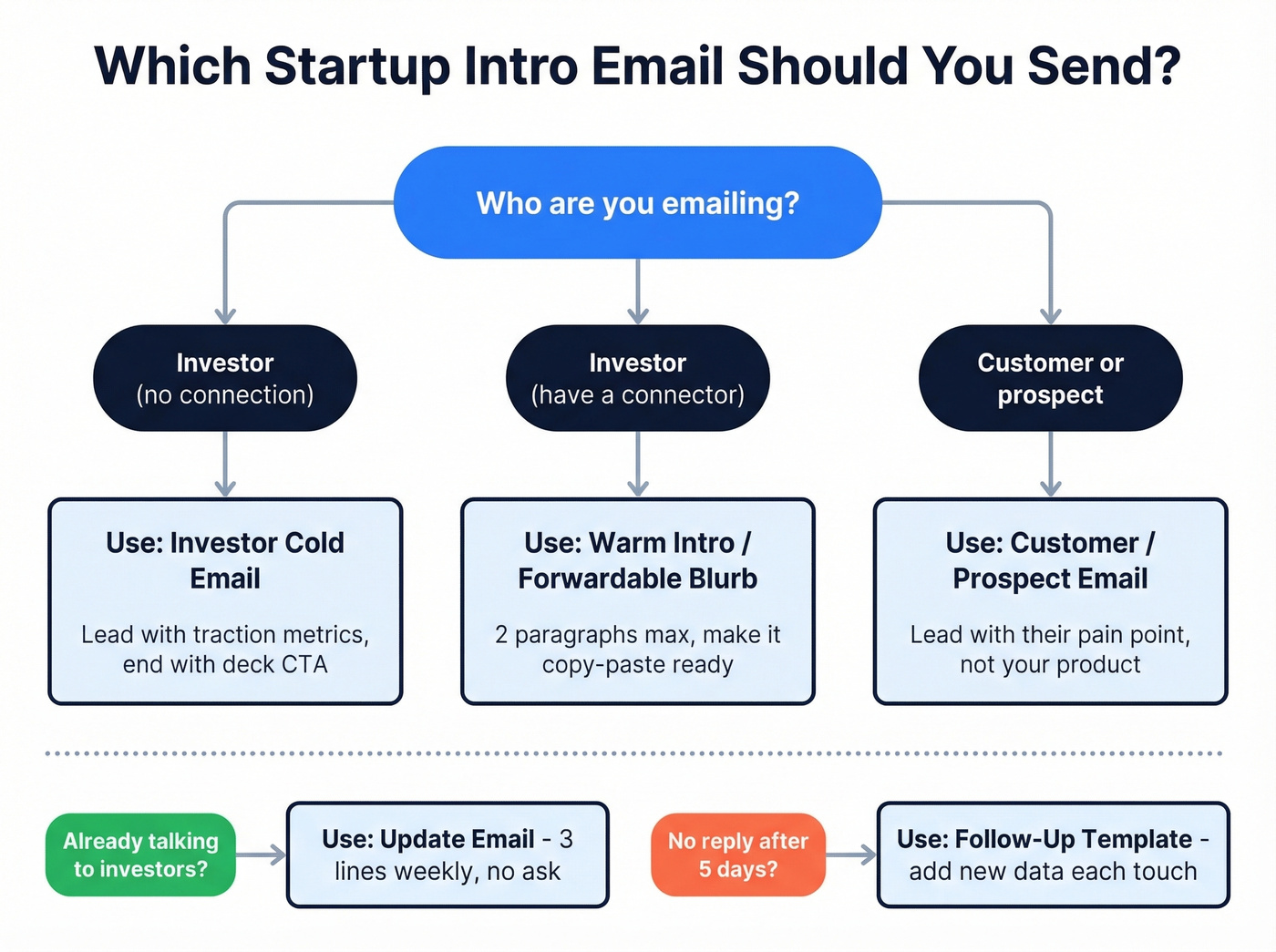
Emails between 75-125 words hit a 52% booking rate - that's your sweet spot within the broader 50-200 word range Visible.vc recommends. Here's the fast path:
- Investor cold email: Personalized opener, pitch, proof, deck CTA. Jump to templates below.
- Warm intro / forwardable blurb: The two-paragraph format connectors expect, using the "Intro TO/FROM" subject line.
- Update email: Skip the cold pitch entirely - send traction updates until investors come to you.
Pick the template that matches your audience, customize it in five minutes, verify your contacts, and send.
Five Rules for Every Template
We've reviewed hundreds of founder outreach emails over the years. These five rules separate the ones that book meetings from the ones that get archived.
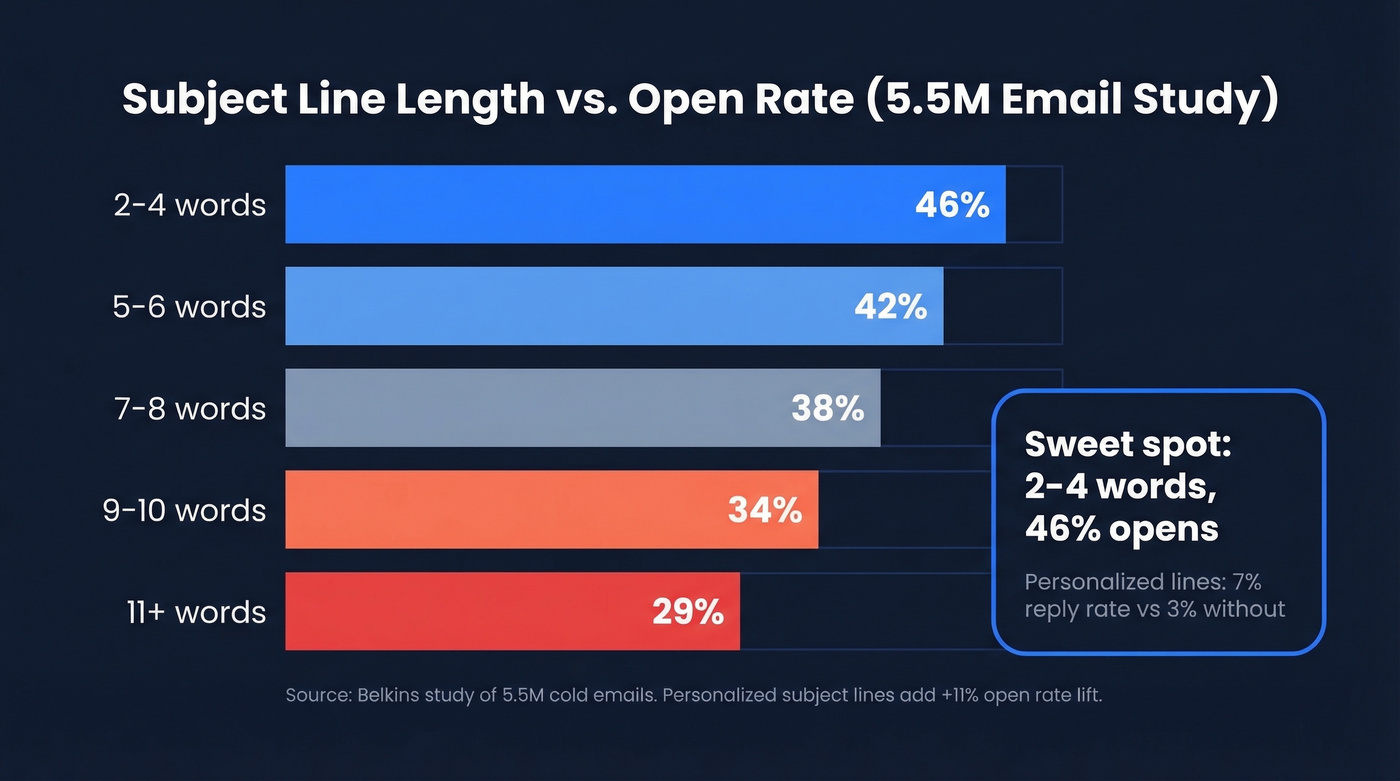
- 2-4 word subject lines. A Belkins study of 5.5 million emails found that 2-4 word subject lines hit roughly 46% open rates. Longer lines drop fast - 9-10 words fall to around 34%. (If you want more ideas, swipe from these email subject lines.)
- Personalize the subject line. Personalized subject lines pull 46% opens vs. 35% without, and replies jump from 3% to 7%. Including the recipient's name alone lifts open rates by 26%. For a deeper playbook, use personalized outreach.
- Stay under 125 words. The email's job is to get a reply, not close a deal. If you're rewriting a lot, keep a simple email copywriting checklist.
- One CTA, one action. "Can I send my deck?" beats "Let me know your thoughts" every time. (More examples: email call to action.)
- Use "Intro TO/FROM" for warm intros. It's the format connectors expect, and it makes the email searchable later. If you're sending a similar note to a buyer, see this introduction email to a buyer.

You just nailed the copy. Now make sure it reaches the inbox. Bounce rates above 5% wreck your domain reputation - and your fundraise. Prospeo verifies emails at 98% accuracy across 300M+ profiles, so every intro email you send actually lands.
Don't let a perfect pitch bounce. Verify every address before you hit send.
Startup Introduction Email Samples for Every Scenario
Investor Cold Email
This four-part structure is the most common format founders use to book meetings. The concrete subject line example comes from Evalyze's analysis of successful fundraising outreach. If you're building a sequence, pair this with a B2B cold email sequence.
Subject: $50K MRR | 40% MoM Growth | Raising Seed
Hi [FIRST NAME],
I noticed [FUND] led [PORTFOLIO COMPANY]'s seed round - we're solving a similar problem in [ADJACENT SPACE] and thought there might be a fit.
[COMPANY] helps [TARGET CUSTOMER] do [SPECIFIC OUTCOME]. In the past [TIME PERIOD], we've:
- Hit $[MRR] MRR, growing [X]% MoM
- [TRACTION PROOF: e.g., "6,400 waitlist sign-ups in <2 weeks"]
- [SOCIAL PROOF: e.g., "Backed by [ANGEL/ACCELERATOR]"]
We're raising a $[AMOUNT] [ROUND]. Can I share my deck link?
[YOUR NAME]
Real traction bullets from successful cold emails on OpenVC include "6,400 waitlist sign-ups in <2 weeks" and "GMV growing 31% MoM." The more specific your numbers, the better - vague claims about market size don't move the needle, but concrete growth metrics do. (If you need a tighter one-liner, borrow from these sample elevator pitches.)
Warm Intro / Forwardable Blurb
The Jewelbots example uses this exact format - two clean paragraphs with "190K in pre-sales" as the hook - and it works because the connector can forward it with zero editing. That's the whole game. Make their life easy and they'll actually send it.
Subject: Intro [INVESTOR NAME] / [YOUR NAME], [COMPANY]
Hi [CONNECTOR],
Thanks for offering to connect me with [INVESTOR NAME]. Here's a quick blurb they can scan:
I'm [YOUR NAME], founder of [COMPANY] ([URL]). We're building [ONE-SENTENCE DESCRIPTION]. So far we've [TRACTION: e.g., "done 190K in pre-sales" or "onboarded 400 beta users in 3 weeks"].
I'd love 15 minutes with [INVESTOR NAME] to get their take on [SPECIFIC TOPIC]. Happy to work around their schedule.
[YOUR NAME]
Customer / Prospect Email
For early-stage startups, the sell isn't features - it's the problem you understand better than anyone else. Lead with an observation that proves you did your homework, not a product description. If you're prospecting at scale, use these sales prospecting techniques.
Subject: [SPECIFIC PAIN POINT] at [THEIR COMPANY]?
Hi [FIRST NAME],
[THEIR COMPANY] is [OBSERVATION - e.g., "scaling your SDR team based on your recent job posts"]. Most teams at that stage hit [SPECIFIC PROBLEM].
We built [PRODUCT] to fix that. [ONE SENTENCE ON HOW]. We're in early access with [X] companies including [NAME-DROP IF POSSIBLE].
Worth a 15-minute call this week?
[YOUR NAME]
The Update Email
Here's my hot take: if your deal sizes are under $25K, you probably don't need to cold pitch investors at all. One founder shared on r/angelinvestors how they raised from Jason Calacanis by sending short weekly updates to 50-100 angels - no warm intros, no deck, no explicit ask. The psychology is simple: act like they already invested. Eventually, they request a call, and now you're in an inbound conversation instead of begging for 15 minutes.
Subject: [COMPANY] Weekly Update - [DATE]
What we shipped: [FEATURE/MILESTONE] Customer signal: [QUOTE, STAT, OR FEEDBACK] Next week: [FOCUS AREA]
Three lines. That's it.
Follow-Up Template
Most meetings come from the second or third touch. Follow-ups boost replies by up to 28%, so plan for 3-4 over 10-12 days. For more options, see these sales follow-up templates.
Subject: Re: [ORIGINAL SUBJECT]
Hi [FIRST NAME],
Quick follow-up - since my last note, we [NEW DEVELOPMENT: e.g., "closed our first enterprise pilot"].
Still happy to share the deck if there's interest.
[YOUR NAME]
Each follow-up should add a new data point. Don't just bump the thread with "checking in" - that's the fastest way to get ignored permanently.
Mistakes That Kill Your Email
The killer isn't bad copy. It's length.
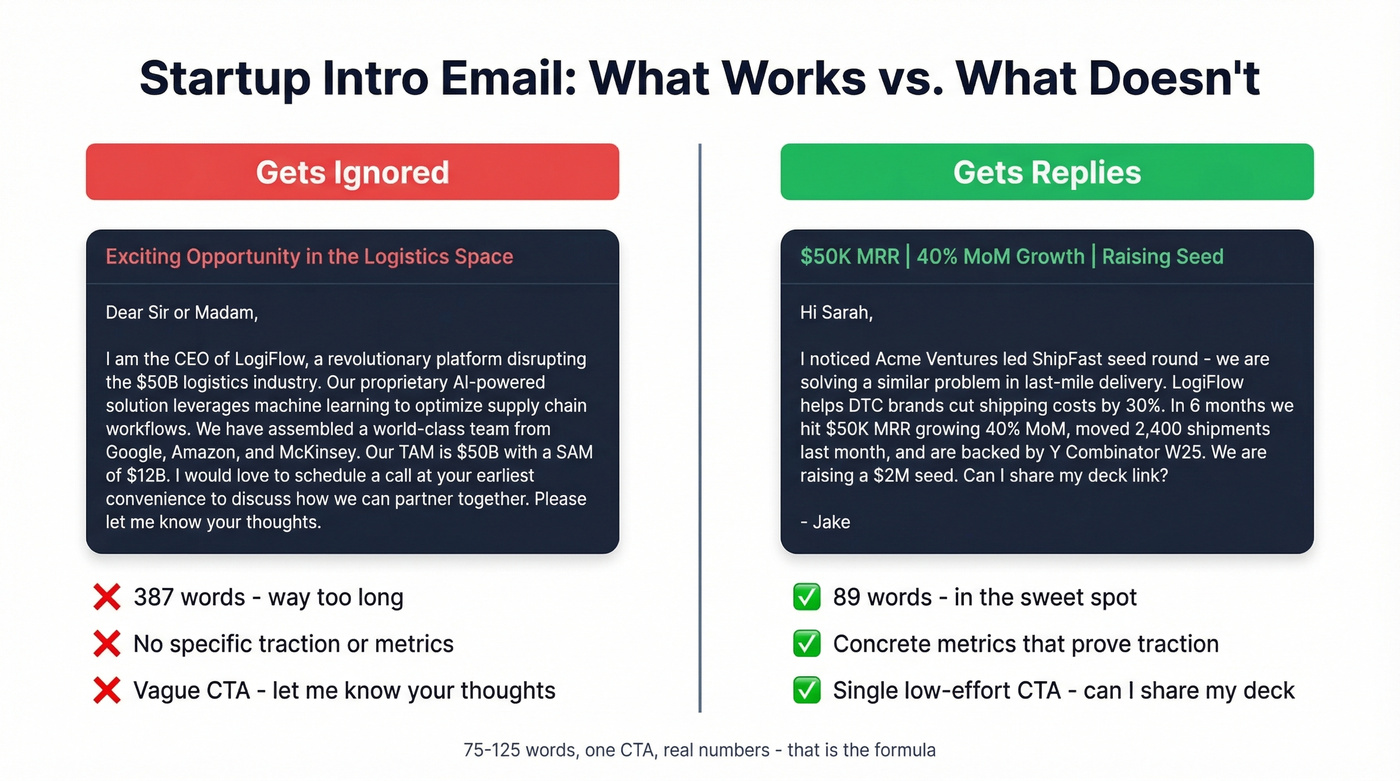
Too long. Over 150 words and you've lost the reader. We've seen founders write 400-word investor emails that read like executive summaries, cramming in market size, competitive landscape, team bios, and a roadmap. The email isn't the pitch - it's the door to the pitch.
No traction proof. "We're disrupting the $50B logistics space" means nothing. "We moved 2,400 shipments last month, up 40% MoM" means everything.
Vague CTA. "Let me know your thoughts" creates decision paralysis. "Can I send my deck?" gives the recipient a single, low-effort action.
Sending to unverified emails. This one's frustrating because it's entirely preventable. The average bounce rate sits around 7%, and anything above 5% damages your domain reputation. Run your list through a verification tool like Prospeo before you send - 98% email accuracy, and the free tier covers 75 verifications per month. A great intro email is worthless if it bounces. (More on benchmarks and fixes: email bounce rate.)

Finding the right investor or prospect email is half the battle. Prospeo's Email Finder pulls verified contacts from 300M+ professional profiles at $0.01 per email - no contracts, no sales calls. The free tier covers 75 verifications per month, enough to launch your first outreach campaign today.
Stop guessing email addresses. Find and verify them in seconds.
FAQ
How long should a startup intro email be?
Aim for 75-125 words - that range hits a 52% booking rate according to outreach benchmarks. If it takes more than 30 seconds to read, it's too long. The email's job is to earn a reply, not close a deal.
Should I attach or link my pitch deck?
Always link it. Attachments trigger spam filters and add friction. Use DocSend or a similar tool so you can track which slides investors actually read and follow up with context. The data on slide engagement is genuinely useful for refining your deck over time.
What's the best day and time to send?
HubSpot's research consistently shows Tuesday through Thursday mornings perform best for B2B email. But for investor outreach specifically, the consensus on r/startups is that timing matters less than personalization - a well-researched email sent on a Friday still beats a generic blast on a Tuesday.
How do I find investor email addresses?
Skip the guessing game. Use a B2B data platform like Prospeo to find and verify professional emails before sending. With 98% accuracy and a free tier of 75 verifications per month, it keeps your bounce rate under 5% so your best intro emails actually reach inboxes.