

State of Sales 2024: What 8 Reports Actually Tell Us
84% of reps missed quota last year. Meanwhile, 88% of organizations report regular AI use. That gap tells you everything about where sales actually stands right now.
We pulled the key published findings from every major state of sales 2024 report - Salesforce, HubSpot, Pipedrive, Orum, Outreach, McKinsey, Bain, and Gartner - so you don't have to reconcile contradictory stats across six gated PDFs. Here's what they actually agree on.
Sales Performance at a Glance
- Quota attainment is falling. Only 57% of reps hit quota, down 7% since 2021. In the US, it's worse - 45%.
- Pipeline ownership is shifting. AMs now generate 53% of revenue pipeline. The phone drives most of it. Execs and reps can't agree on who's responsible for building pipe.
- The fix isn't more AI. It's cleaner data, redesigned workflows, and honest alignment on metrics. Every report hints at this. Most won't say it outright because they're selling you AI.
2024 Sales Performance Scorecard
Different methodologies, different sample sizes, different incentives. But line up all eight reports and a few patterns emerge clearly.
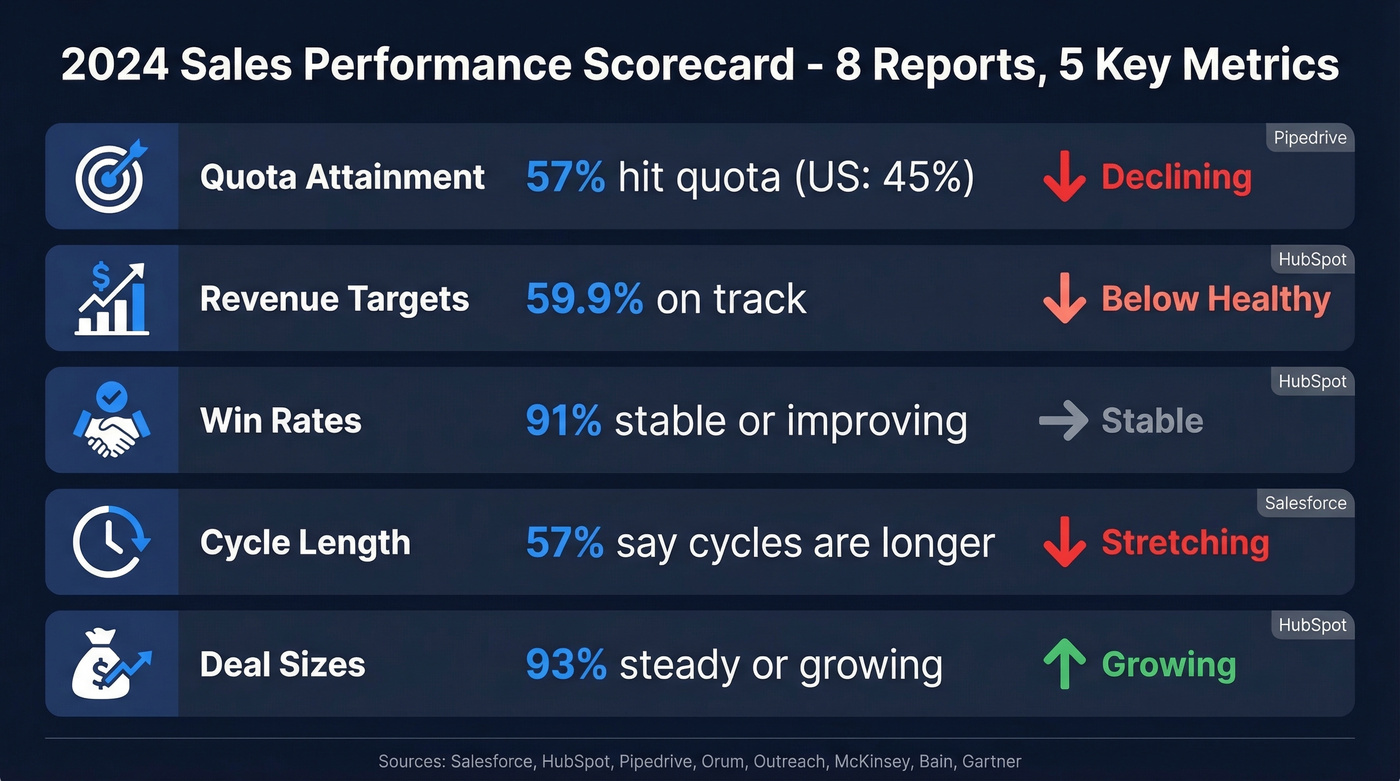
| Metric | Finding | Source | Signal |
|---|---|---|---|
| Quota attainment | 57% hit (US: 45%) | Pipedrive | ↓ Declining fast |
| Revenue targets | 59.9% on track | HubSpot | ↓ Below healthy |
| Win rates | 91% stable/improving | HubSpot | → Stable |
| Cycle length | 57% say longer | Salesforce | ↓ Stretching |
| Deal sizes | 93% steady/growing | HubSpot | ↑ Growing |
Win rates and deal sizes look healthy, but fewer reps hit quota and cycles are stretching. Teams are winning deals at roughly the same rate - they're just not generating enough pipeline to feed the machine. The bottleneck has moved upstream. If you're trying to diagnose it, start with pipeline health metrics before you change tooling.
Pipeline Is Everyone's Job Now
Orum's survey of 1,000 sales leaders found that Account Management now generates 53% of revenue pipeline - not SDRs, not marketing. And 70% say the majority of their pipeline comes from the phone, a stat that would've sounded anachronistic five years ago. This is also why modern sales prospecting techniques look a lot more like account work than pure volume.
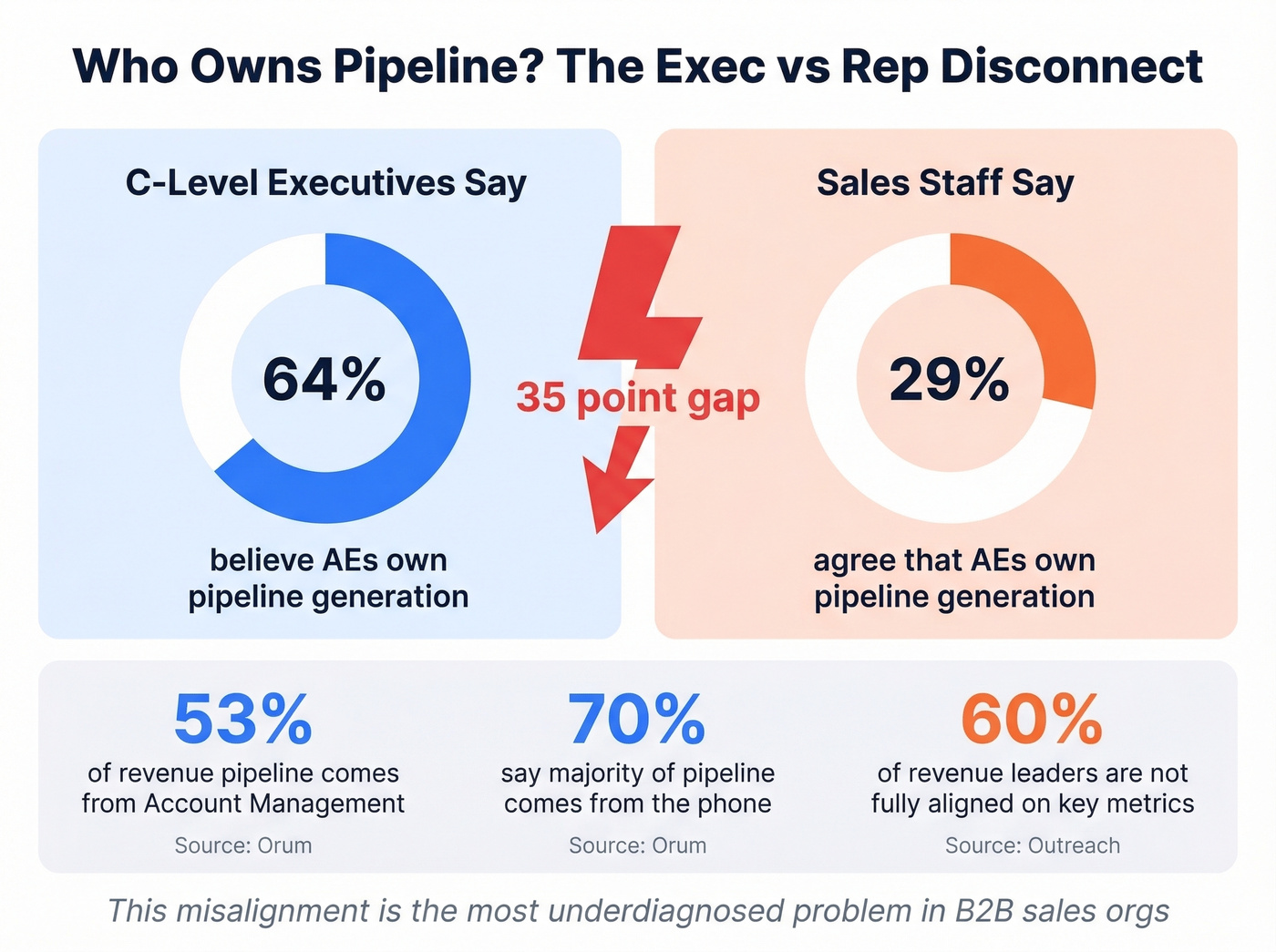
But there's a perception gap that should worry every CRO. Outreach's data shows 64% of C-level execs believe AEs own pipeline generation, while only 29% of sales staff agree. That's a structural misalignment, and it explains why pipeline targets keep getting missed. In our experience, this exec-rep disconnect is the single most underdiagnosed problem in B2B sales orgs - more damaging than bad tooling, worse than high turnover. Only 10% of leaders identified inbound as their primary GTM strategy, and 60% of revenue leaders aren't fully aligned on key metrics.
When leadership can't agree on who builds pipeline or how to measure it, no amount of tooling fixes the problem. This is where sales leadership and sales operations metrics matter more than another sequence tool.

Every report agrees: pipeline is the bottleneck. But pipeline built on bad contact data is just busy work. Prospeo refreshes 300M+ profiles every 7 days - not every 6 weeks - so your reps reach real buyers, not dead inboxes.
Stop feeding your pipeline with stale data. Start with 75 free verified emails.
AI Adoption: Everywhere in Pilot, Nowhere at Scale
Every vendor report leads with AI. Of course they do - they're selling AI. The actual numbers tell a different story.
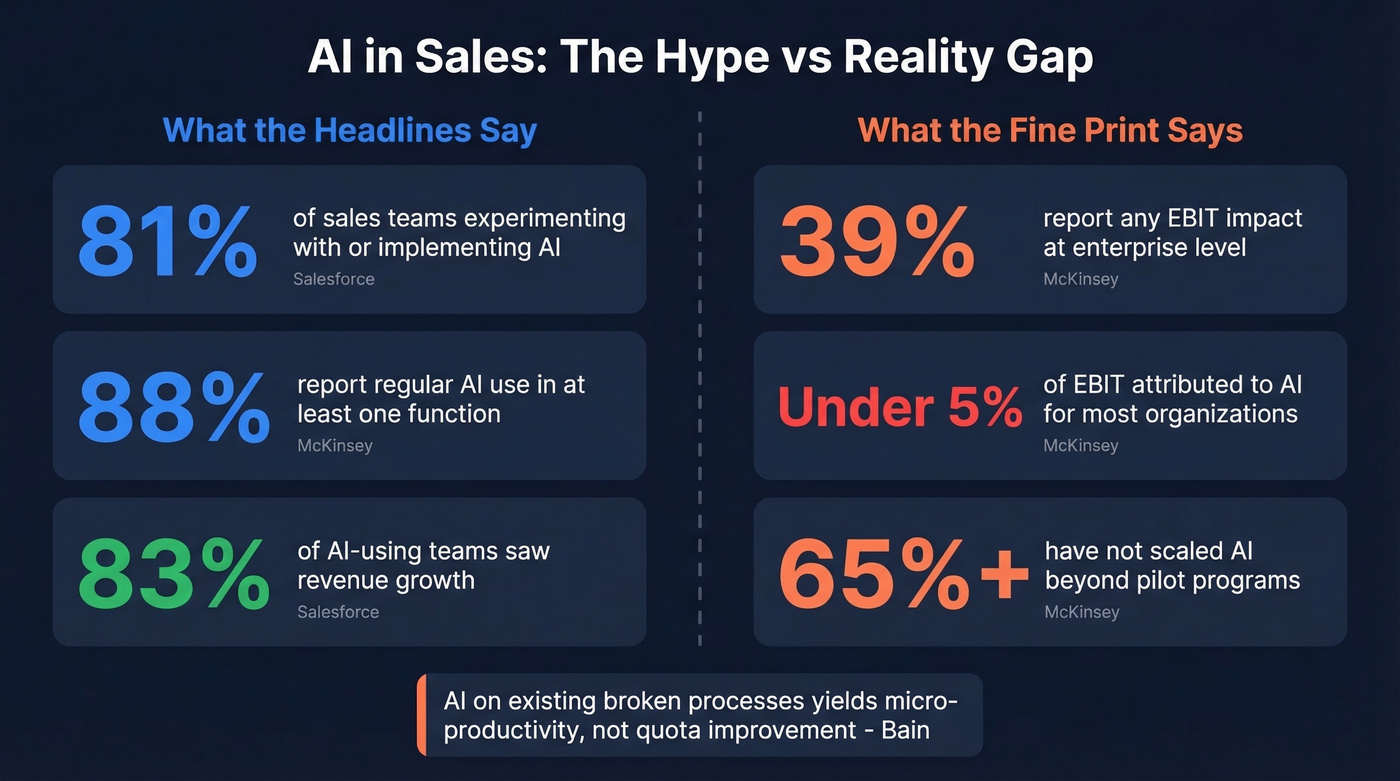
81% of sales teams are experimenting with or implementing AI. 88% report regular use in at least one business function. And 83% of AI-using teams saw revenue growth versus 66% without. Sounds like a slam dunk.
Until you look deeper. McKinsey found only 39% report any EBIT impact at the enterprise level, and most say AI accounts for less than 5% of EBIT. Nearly two-thirds haven't scaled beyond pilots. Bain's framing is the most honest: applying AI to existing broken processes yields "micro-productivity" - marginal time savings that don't move quota numbers. We've watched teams buy AI tools before fixing their CRM data. It never ends well. If you're evaluating tooling anyway, compare it against what actually improves sales execution, not just activity volume.
The Data Crisis Underneath
Here's the thing: this is the section every vendor report buries. Salesforce estimates 19% of company data is inaccessible to the teams that need it, and only 35% of sales pros trust their organization's data accuracy. Meanwhile, 73% of B2B buyers actively avoid sellers who send irrelevant outreach, and 74% of AI-using teams now prioritize data hygiene - which tells you they learned the hard way that AI on dirty data produces confidently wrong outputs.
Every trend in this article - AI adoption, pipeline generation, quota attainment - runs through data quality. Bad data means bounced emails, wasted rep time, and sequences that never reach the right person. This is exactly why we built Prospeo around a 7-day data refresh cycle and 98% email accuracy: Snyk dropped bounce rates from 35-40% to under 5% and grew AE-sourced pipeline 180% after switching to verified contact data. If you're fixing this systematically, start with data enrichment services and a clear lead generation workflow so enrichment actually lands in the right fields.

Only 35% of sales pros trust their org's data accuracy. Snyk fixed that - dropping bounce rates from 35% to under 5% and growing AE-sourced pipeline 180% with Prospeo's 98% accurate, 7-day-refreshed contact data. At $0.01 per email, clean data costs less than one bounced sequence.
Audit your contact list for free before you invest another dollar in AI.
Seller Retention and Productivity
Sales reps spend 60% of their time on non-selling tasks. Bain puts selling time around 25%. Ask any SDR and they'll tell you the same thing - admin work is eating their day alive. Your highest-cost employees spend most of their time not doing the thing you hired them for. This is also why teams keep investing in SDR tools and sequence management to claw back selling time.
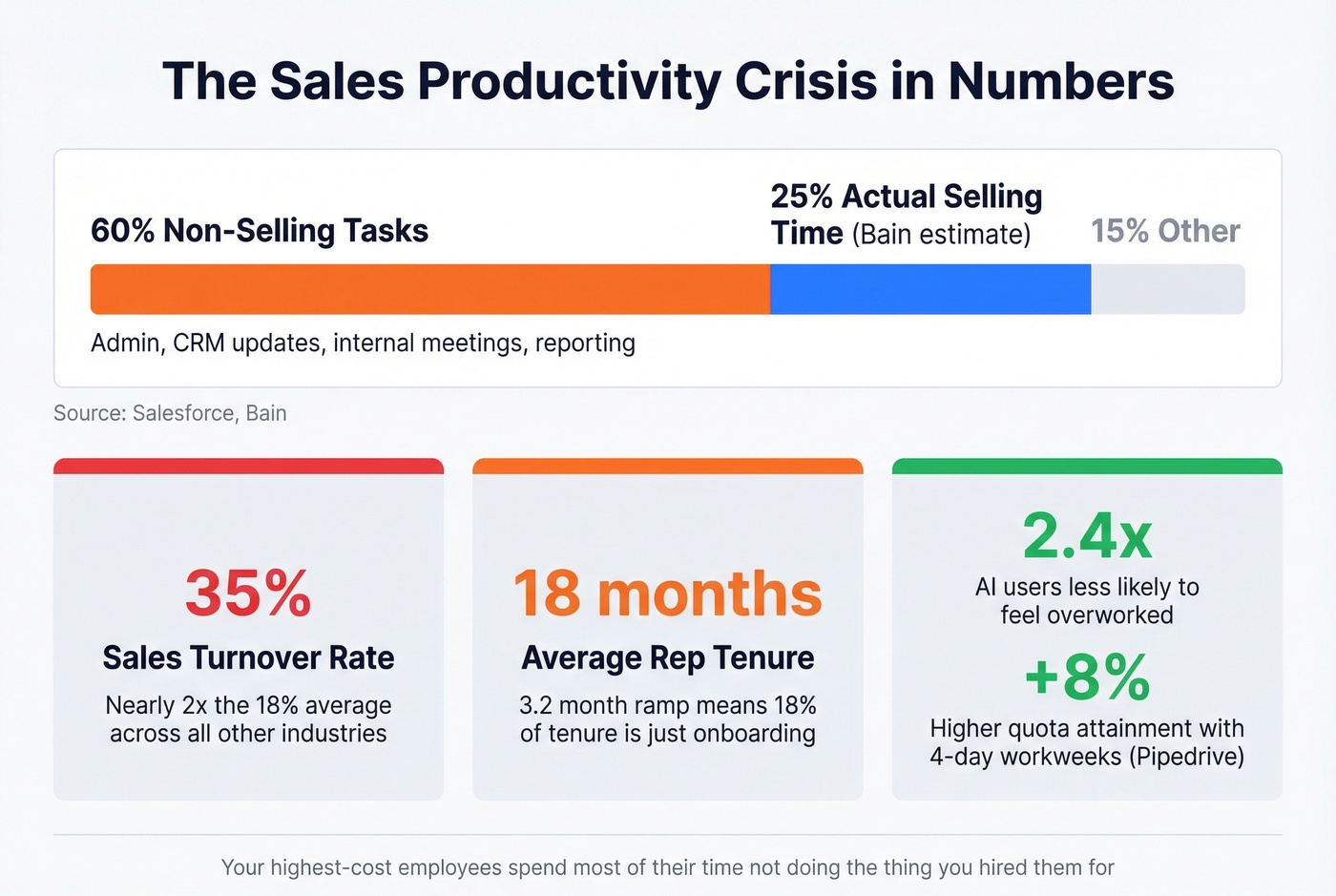
Turnover runs around 35%, nearly double the 18% average across all other industries. Average rep tenure sits at 18 months with a 3.2-month ramp. You're spending a quarter of a rep's tenure just getting them up to speed, which is a brutal math problem that most sales leaders acknowledge but few actually solve. A structured 30-60-90 day plan helps, but only if the inputs (territory, accounts, data) are clean.
There are bright spots, though. AI users are 2.4x less likely to feel overworked. And Pipedrive found that four-day workweeks correlate with 8% higher quota attainment - a stat that should make every sales leader pause before mandating return-to-office five days a week.
What These Findings Mean for 2026
Gartner predicts that by 2027, 95% of seller research workflows will begin with AI. That's probably directionally right. Getting there requires more than buying another tool.
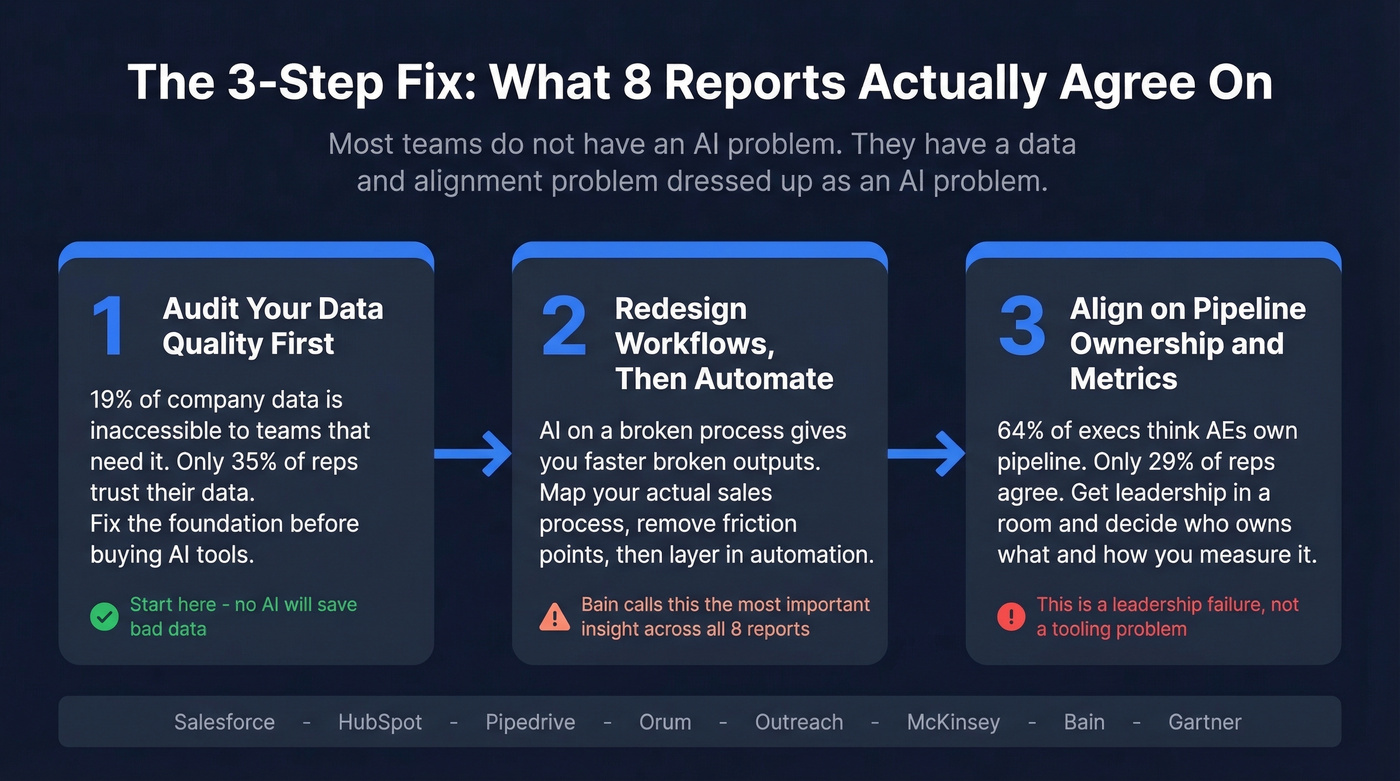
Let's be blunt about what we took away from reading all eight reports: most teams don't have an AI problem. They have a data and alignment problem dressed up as an AI problem. The three-step fix:
- Audit your data quality before investing in AI. If 19% of your data is inaccessible and only 35% of your team trusts it, no AI agent will save you. Fix the foundation first.
- Redesign workflows, don't just automate them. Bain's thesis is the most important insight across all eight reports. AI on a broken process gives you faster broken outputs.
- Align on who owns pipeline and which metrics matter. The exec-vs-rep perception gap is a leadership failure, not a tooling problem. Get in a room and decide.
If you only read one report, start with Salesforce's. Outreach has the best pipeline data. Pipedrive is the most honest about quota. Skip the McKinsey and Bain reports unless you're presenting to a board - they're heavy on frameworks, light on actionable numbers. The rest are worth skimming, but you've already got the key findings right here.