

Networking Email Subject Lines: What 5.5 Million Emails Tell Us About Getting Replies
You've probably read five articles that all say "keep it short and personalize." None of them tell you that question-format subject lines hit 46% open rates, or that Gmail on Android cuts off your subject line at 33 characters. A dataset of 5.5 million B2B emails from Belkins shows which subject line patterns actually work for networking emails - and which ones drag your opens into the gutter.
Most subject line guides dump 50+ examples with zero data. That's a word dump, not a strategy.
You don't need 90 examples. You need three patterns that work and the discipline to personalize each one. We call it the 3-Pattern System, and everything in this article is built around it.
The 3-Pattern System (Quick Version)
If you're short on time, here's the cheat sheet:
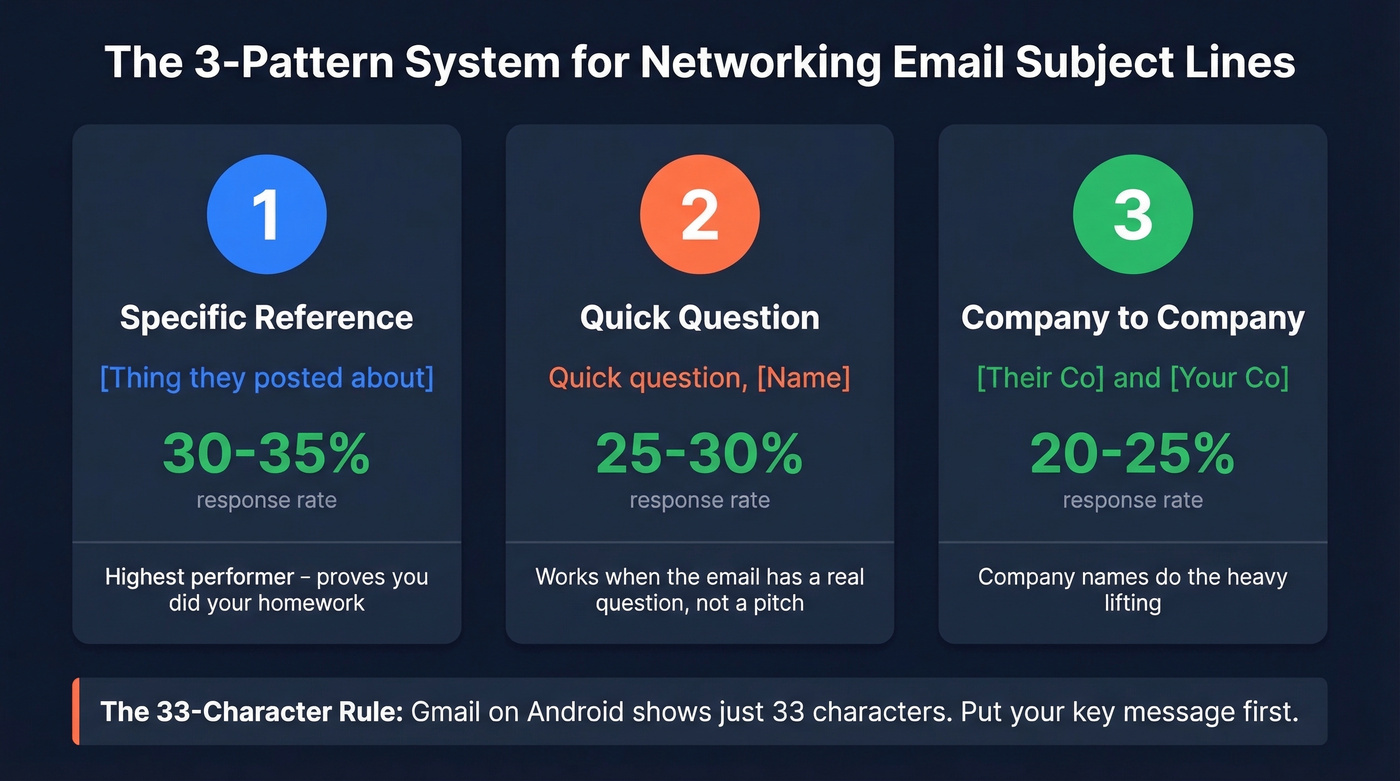
- Pattern 1 - Specific reference ("[Thing they posted about]"): ~30-35% response rate. Highest performer because it proves you did your homework.
- Pattern 2 - Quick question ("Quick question, [Name]"): ~25-30% response rate. Works when the email contains a genuine question, not a disguised pitch.
- Pattern 3 - Company-to-company ("[Their Company] and [Your Company]"): ~20-25% response rate. Signals relevance through company recognition.
The 33-character rule: Gmail on Android shows just 33 characters. If your key message isn't in those first 33 characters, most mobile readers never see it.
That's the whole strategy. Everything below is the evidence and the examples.
What the Data Says About Open Rates
The 5.5M-email dataset covers messages sent from January through December 2025, and the patterns are unambiguous.
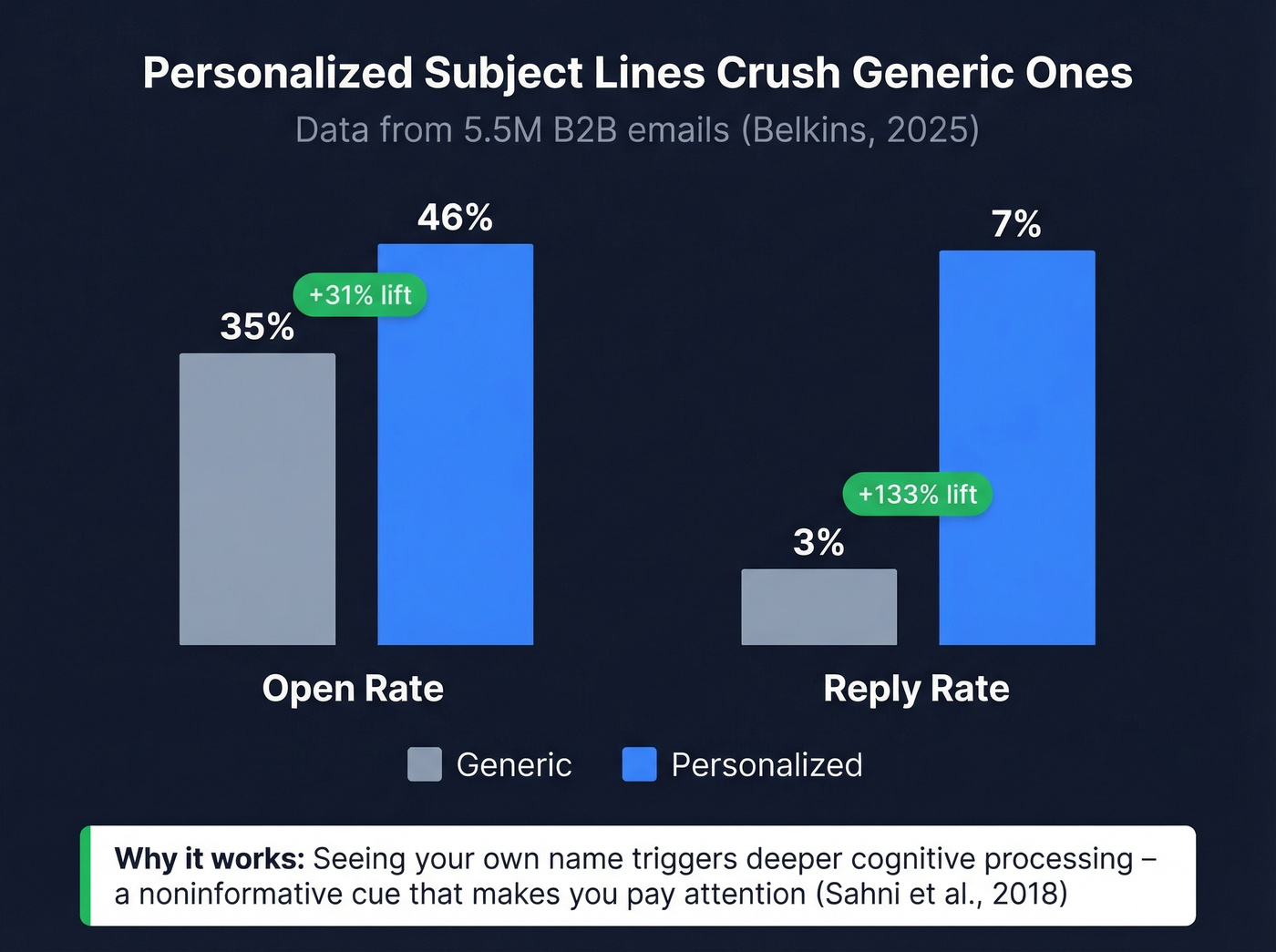
Personalization Lift
Personalized subject lines hit a 46% open rate versus 35% without - a 31% lift. Reply rates more than doubled, from 3% to 7%. That's not marginal. That's the difference between a campaign that works and one that doesn't.
The psychology backs this up. A study published in Marketing Science (Sahni, Wheeler, Chintagunta, 2018) found that adding a recipient's name increased opens by ~20% and reduced unsubscribes by 17%. In the same campaign, sales leads - valued at roughly $100 each - increased 30%. The mechanism is what researchers call a "noninformative cue": seeing your own name triggers deeper cognitive processing, even when the name itself adds no new information. You pay attention because it feels like it's for you.
This is the single most underused insight in networking outreach. Every competitor article says "personalize." None of them explain why it works at a cognitive level or quantify the revenue impact.
Length and Format
Two-to-four-word subject lines performed best at 46% open rate. Performance drops after 7 words. By 9-10 words, you're down to around 35-34%.
Question-format subject lines tied at 46%, matching the best performers in the dataset. Numbers in subject lines actually performed slightly worse (27% vs 28% without). Marketing hype tanks performance - subject lines with urgency language, generic greetings, or promotional phrasing pushed opens below 36%. Practitioners on r/b2bmarketing echo this. Anything that sounds like "Boost your ROI" or "Transform your business" gets ignored or filtered.
How Long Should Your Subject Line Be?
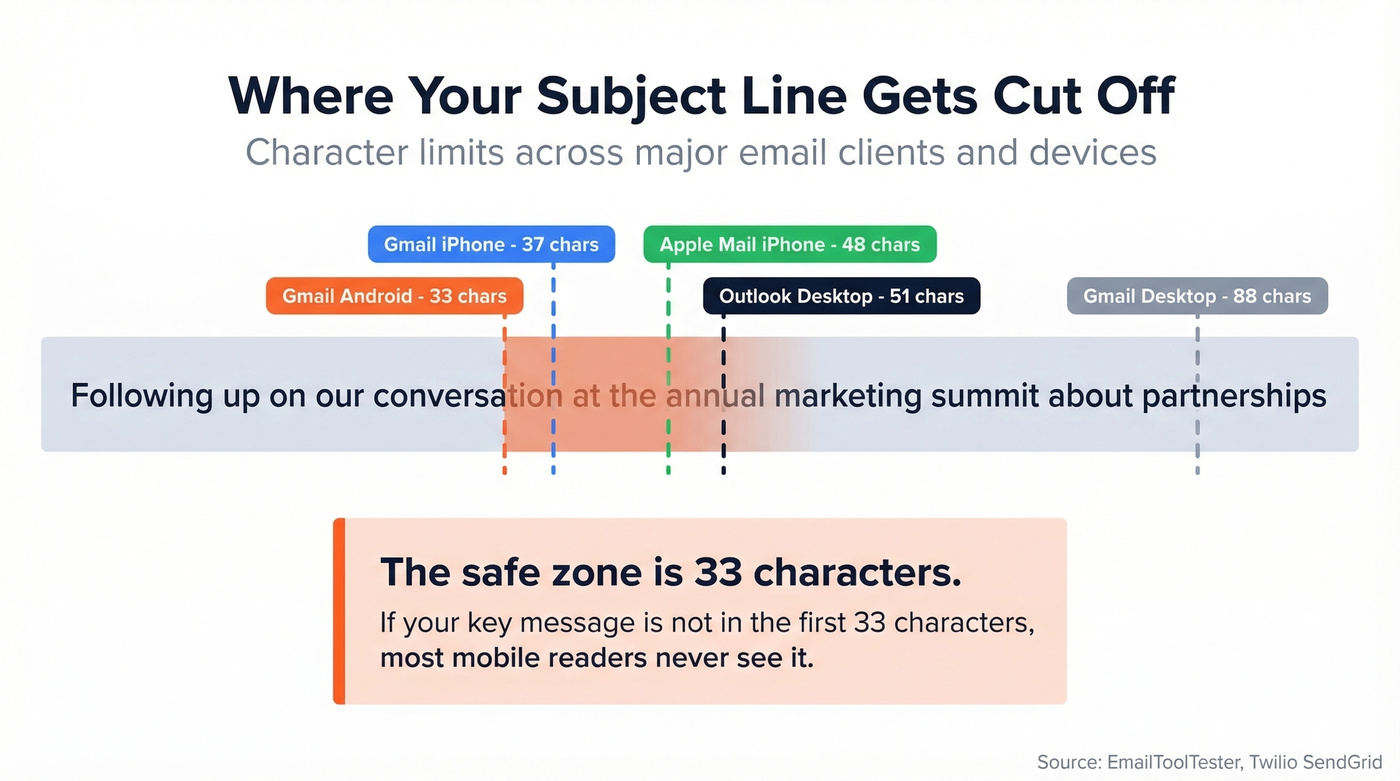
"Keep it short" is useless advice without a number. EmailToolTester ran truncation tests across major devices and clients. Here's what actually shows in the inbox:
| Device / Client | Characters Visible |
|---|---|
| Gmail (Android) | 33 |
| Gmail (iPhone) | 37 |
| Apple Mail (iPhone) | 48 |
| Outlook (desktop) | 51 |
| Gmail (desktop) | 88 |
Twilio SendGrid's data corroborates this - mobile shows roughly 33-50 characters, and the best-performing subject lines were 2-4 words despite the average being 6.
Put your key message in the first 33 characters. Everything after that is bonus text that desktop users might see.
Here's the thing: if your average deal size is under $15k, mobile optimization matters more than desktop. Your prospects are reading email on their phones between meetings, not sitting at a desk with Outlook maximized. Optimize for the 33-character screen first, always.
If you want a deeper library of data-backed examples, see our email subject line examples and the 5.5M-email-tested cold email subject line examples.

Your subject line is optimized for 33 characters. Your email is personalized. But if that address bounces, none of it matters. Prospeo delivers 98% email accuracy with 5-step verification - so your networking emails actually land.
Stop crafting perfect subject lines for emails that bounce.
Templates by Scenario
Cold Introduction
- [Specific thing they posted about] - 30-35% response rate. Requires real homework, but nothing else comes close.
- Quick question, [Name] - 25-30% response rate. Only works when the email contains an actual question.
- Saw your [talk/article/post] on [topic]
- [Mutual interest] - thought you'd have a take
- [Name], [one-line observation about their work]
- Fellow [industry/role] - quick intro
- Your [specific project] caught my attention
- [Name], [their company]'s approach to [topic]
If you’re building a repeatable outreach motion, pair these with proven sales prospecting techniques so your subject line and targeting work together.
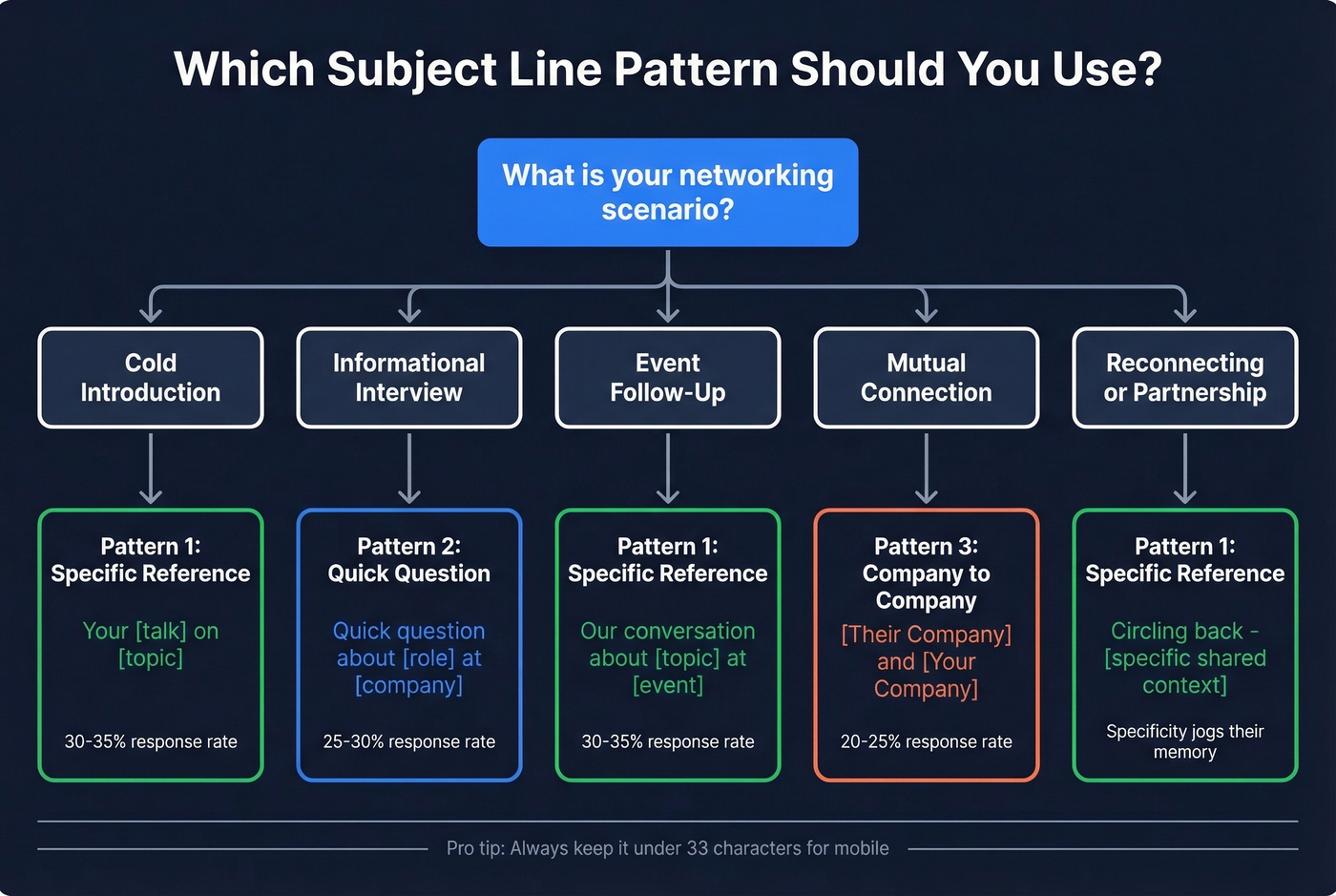
In our experience, the specific-reference pattern outperforms everything else because it's the hardest to fake. Anyone can write "Quick question" - but referencing someone's actual conference talk or blog post proves you spent five minutes on them. That five minutes is your competitive advantage over the other 47 emails in their inbox that morning.
Informational Interview
- Interested in learning from your success in [industry]
- Quick question about [role] at [company]
- [Name], your path to [their current role]
- Aspiring [role] - would value 15 minutes
- Your [specific career move] inspired a question
- [Mutual connection] suggested I reach out
Subject lines shift by industry context. Finance professionals expect formality; tech startup founders respond better to casual directness. "Quick question about PE exits" reads differently than "Quick question about your Series A." Match the tone to the recipient's world.
Event Follow-Up
You just attended an industry conference, collected 15 business cards, and now you're staring at a blank email draft. These work:
- Great meeting you at [event name]
- [Name], following up from [event]
- Our conversation about [topic] at [event]
- [Event] - the [specific topic] you mentioned
- Continuing our [event] conversation
If you need a follow-up cadence that doesn’t feel spammy, use these sales follow-up templates as a starting point.
Mutual Connection / Referral
[Their Company] and [Your Company] - 20-25% response rate. The company names do the heavy lifting.
Name the connection, name the context, keep it under 33 characters:
- [Mutual connection] suggested we connect
- [Name] from [company] pointed me your way
- [Referrer] thought we should talk
- Fellow [group/community] member
Reconnecting / Partnership
For dormant contacts, specificity matters even more - you need to jog their memory in the subject line itself:
- [Name], it's been a while
- Thinking about our [topic] conversation
- Circling back - [specific shared context]
For partnership outreach, lead with the collaboration angle:
- [Their company] + [your company] on [topic]
- Idea for [their company]'s [initiative]
- [Name], a [topic] partnership idea
Full Email Templates
A great subject line gets the open. The body determines whether you get a reply. The same principles apply to both: short, specific, and genuinely useful to the recipient. Every template below follows the 3-Pattern System - the subject line hooks attention, and the body delivers on the promise.
If you want to go deeper on writing the actual message (not just the subject line), this connection email guide pairs well with the templates below.
Template 1: Cold Intro to a Peer or Leader
Subject: Your [specific project/article] on [topic]
Hi [Name],
I came across your [specific work] and it resonated - especially [specific detail]. I'm working on [related project/challenge] and your perspective would be incredibly valuable.
Would you be open to a 15-minute call this week or next? Happy to work around your schedule.
Best, [Your name]
Template 2: Informational Interview Request
Subject: Quick question about [role] at [company]
Hi [Name],
I'm exploring a move into [industry/function] and your career path - particularly [specific transition or achievement] - is exactly the kind of trajectory I'm studying.
Would you have 15 minutes for a quick call? I have two specific questions and I promise to respect your time. If you're not the right person, happy to be pointed elsewhere.
Thanks, [Your name]
Template 3: Event Follow-Up
Subject: Great meeting you at [event]
Hi [Name],
Really enjoyed our conversation about [specific topic] at [event]. Your point about [specific detail] stuck with me - I've been thinking about how it applies to [your context].
Would love to continue the conversation. Coffee or a quick call next week?
Best, [Your name]
None of these templates matter if you're sending to the wrong address. We've watched teams craft perfect subject lines and then bounce 30% of their sends because the email data was stale. Prospeo's Email Finder pulls verified addresses from professional profiles and company websites with 98% accuracy on a 7-day refresh cycle, so you're not sending to addresses that went dead months ago. The free tier gives you 75 lookups a month - plenty for networking outreach.
If you’re troubleshooting bounces and list quality, start with our email bounce rate benchmarks and fixes.
The specific-reference pattern works because you did your homework. Prospeo's Chrome extension pulls verified emails and 40+ data points from any professional profile - so you spend 30 seconds finding contacts, not 30 minutes.
Research the person, not the email address. Prospeo handles that part.
Mistakes That Kill Your Open Rate
A perfect subject line means nothing if it never reaches the inbox. Your subject line doesn't just affect opens; it affects whether you reach the inbox at all. Email providers track engagement signals - opens, deletes-without-reading, spam complaints - to decide future placement. Here are the six mistakes we see most often:
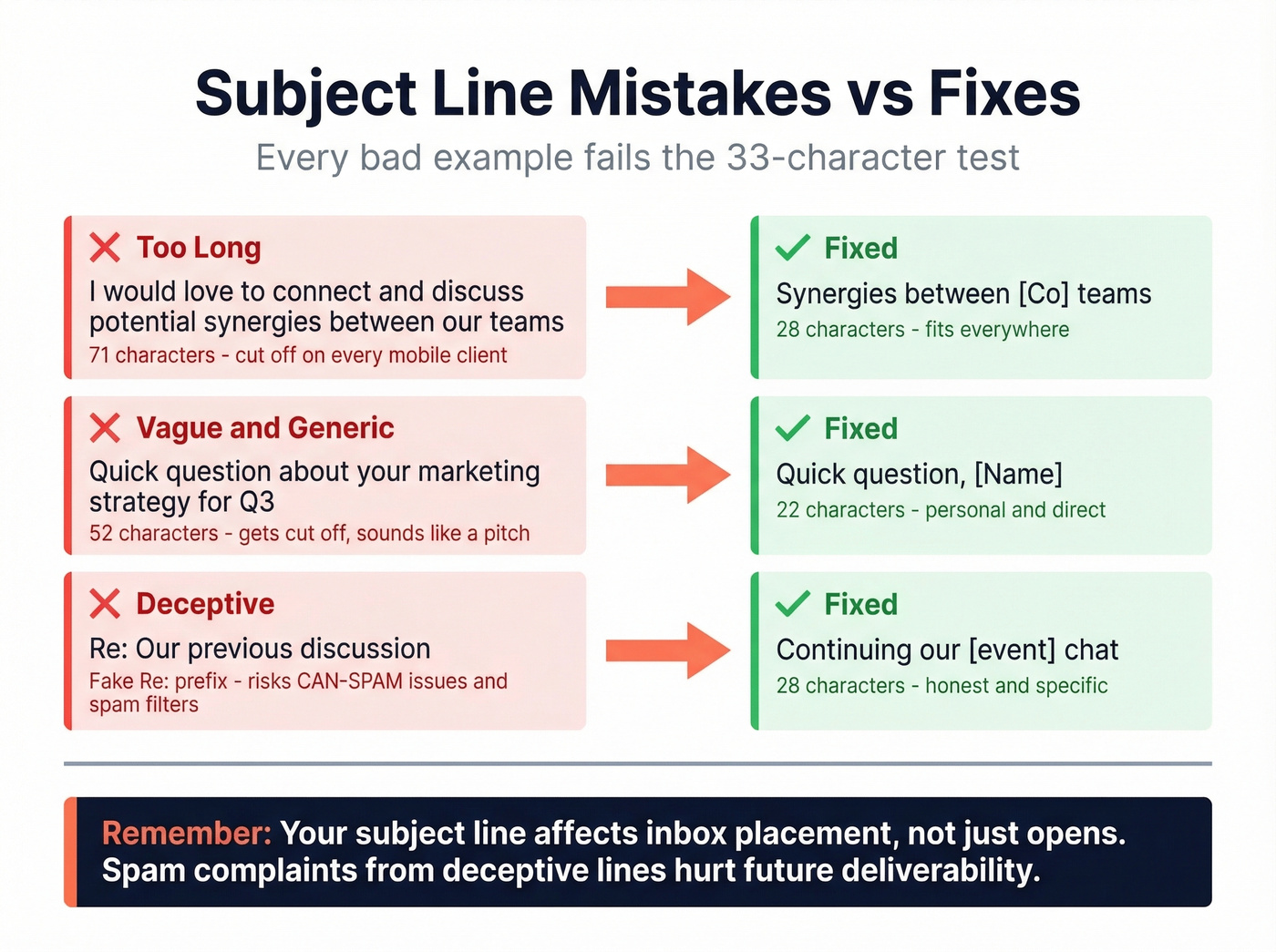
Fake Re: or Fwd: prefixes. This isn't a clever hack. It's a spam tactic that can put you at risk under CAN-SPAM's misleading header rules. Recipients feel deceived, and email providers are increasingly filtering these.
Too long for mobile. If your subject line runs past 33 characters, Gmail on Android cuts it off. "Following up on our conversation at the annual marketing summit" becomes "Following up on our conversation a..." - useless.
- Bad: "I'd love to connect and discuss potential synergies between our teams" - Good: "Synergies between [Company] teams"
- Bad: "Quick question about your marketing strategy for Q3" - Good: "Quick question, [Name]"
- Bad: "Re: Our previous discussion" - Good: "Continuing our [event] chat"
Vague openers. "Touching base," "Hope you're well," "Just checking in" - these signal mass email. They contain zero information and give the recipient zero reason to open. (If you need alternatives, see how to say just checking in professionally.)
Seller-centric framing. If your subject line is about you - your product, your company, your offer - it's already dead. "Let me show you how we can help" is about you. "[Their company]'s approach to [topic]" is about them. The same dataset showing 46% opens for personalized lines also shows that promotional phrasing pushes opens below 36%.
Aggressive punctuation and caps. ALL CAPS and excessive exclamation marks trigger spam filters and make you look desperate. One exclamation mark is fine. Three is a red flag. If you’re worried about filtering, run a quick check with an email spam checker.
Missing personalization. Generic subject lines signal mass email. Even adding a first name lifts opens by ~20%. There's no excuse for skipping it when the lift is this well-documented.
How to A/B Test Subject Lines
Don't guess. Test. A Mailshake case study showed a reply rate jump from 9.8% to 18% after A/B testing - on a campaign of just 206 prospects. Nearly double the replies from the same list.
Start by picking your two strongest patterns and splitting your list evenly. Run each variation until you've got roughly 100 replies per version - that's the threshold where the data becomes reliable. Below that, you're reading noise.
If you’re also testing what shows next to the subject line, use this guide to email preview text A/B testing.
Timing matters too. Practitioners consistently report that Tuesday through Thursday, 9-11am in the recipient's timezone, outperforms Monday mornings and Friday afternoons. It's not a dramatic difference, but when you're optimizing every variable, send time costs you nothing to get right. If you want a tighter schedule by region and persona, see the best time to send cold emails playbook. According to HubSpot, 47% of marketers A/B test their subject lines. The other 53% are guessing. Don't be in the second group.
FAQ
How long should networking email subject lines be?
Two to four words - or under 33 characters - to display fully across all devices. The 5.5M-email dataset found 2-4 word subject lines hit a 46% open rate, and EmailToolTester's truncation testing confirms Gmail on Android cuts off at 33 characters. Front-load your key message.
Should I personalize every networking subject line?
Yes. Personalized subject lines get 46% opens versus 35% without. Even adding a first name increases opens ~20% according to research published in Marketing Science (2018). Skip personalization and you're leaving replies on the table.
What's the best subject line for someone you've never met?
Lead with a specific reference to their work - a recent talk, article, or project. This pattern drives 30-35% response rates, the highest of any approach tested. If you can't find something specific, fall back to "Quick question, [Name]" with a genuine question in the body.