

How to Build a Target Customer Profile That Doesn't Collect Dust
You've built a target customer profile before. It probably lives in a Google Doc nobody's opened since the offsite. Marketing spent two days crafting "Marketing Mary" - a 34-year-old VP who loves podcasts and yoga - and sales ignored it before the slide deck hit their inbox. Folks on r/b2bmarketing call these "fairytale personas," and they're everywhere.
Here's what's wild: 61% of consumers now expect businesses to personalize their experience using AI, and 74% say hyper-personalization actually improves it. Your buyers want you to know them. But you can't know them if your profile is fiction built from gut feelings in a conference room.
What a Useful Profile Actually Needs
A profile that drives pipeline needs three things most guides skip: a scoring rubric that tiers accounts A/B/C, a "no-go" profile that tells your team who to avoid, and a way to turn the profile into a prospect list - not just another document. Below: all three, plus a JTBD framework, filled-out examples, and the five mistakes that kill profiles before they're useful.
What Is a Target Customer Profile?
A target customer profile is a data-backed description of the customer most likely to buy from you, stay, and generate profit. It's not a mood board. It's a set of measurable attributes your team can use to find, qualify, and prioritize prospects.
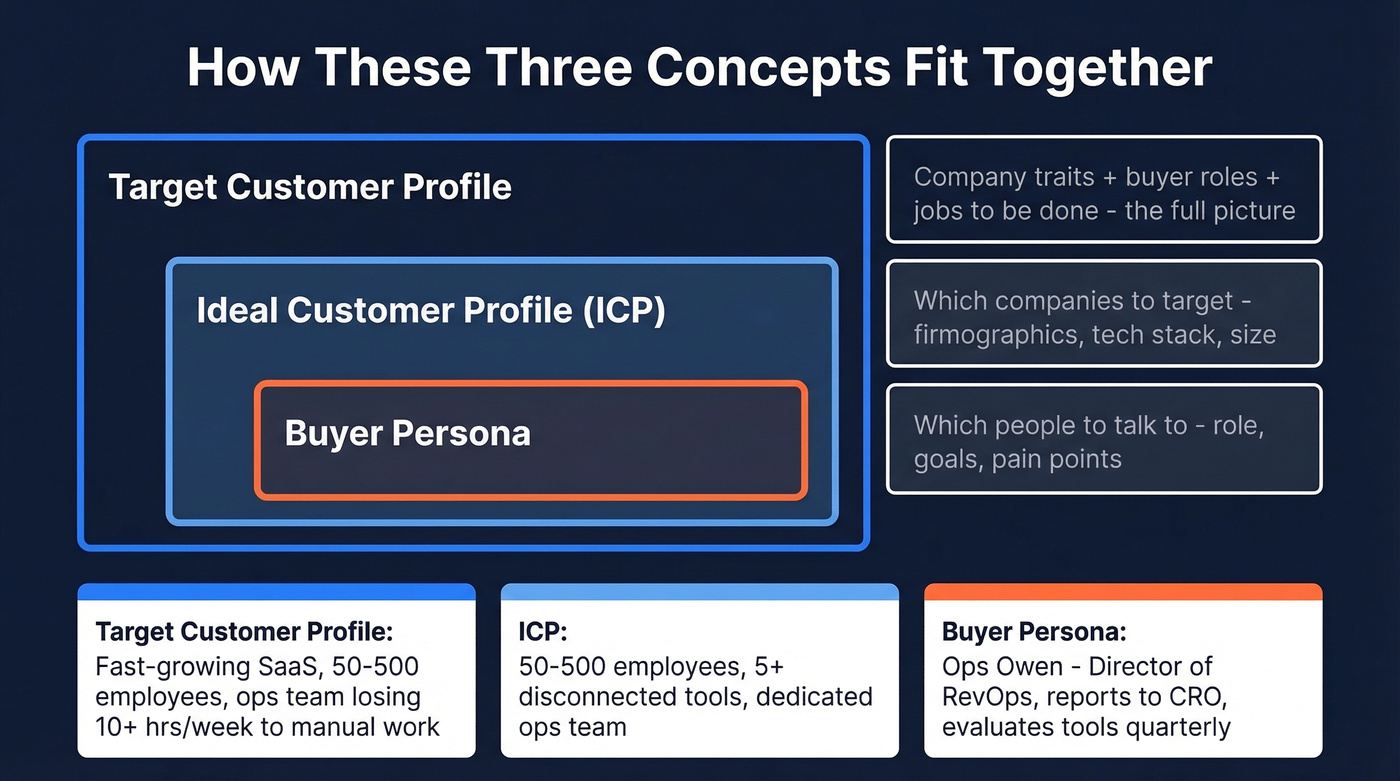
The confusion usually starts with terminology. "ICP," "buyer persona," and "target customer profile" get used interchangeably, but they describe different layers. Here's the cleanest way to think about it, using HubSpot's framework and Zapier as an example:
| Concept | Describes | Example (Zapier) |
|---|---|---|
| Target Customer Profile | Company traits + buyer roles + JTBD | Fast-growing SaaS, 50-500 employees, ops team losing 10+ hrs/week to manual work |
| Ideal Customer Profile | Which companies to target | 50-500 employees, 5+ disconnected tools, dedicated ops team |
| Buyer Persona | Which people to talk to | "Ops Owen" - Director of RevOps, reports to CRO, evaluates tools quarterly |
ICPs define which companies. Personas define which people. A target customer profile can encompass both - and in practice, the terms are nearly interchangeable in B2B contexts. Don't get hung up on labels. Get hung up on whether your team can actually use the thing.
B2B vs B2C Profiles
The fields you track depend entirely on whether you're selling to businesses or consumers. A B2B profile centers on the organization and its buying committee; B2C profiles center on the individual.
| Dimension | B2B Profile | B2C Profile |
|---|---|---|
| Core data | Firmographics (industry, size, revenue) | Demographics (age, income, location) |
| Behavioral | Tech stack, buying committee, sales cycle | Purchase frequency, brand loyalty |
| Psychographic | Business goals, pain points, risk tolerance | Lifestyle, values, interests |
| Decision-making | 3-7 stakeholders, formal evaluation | Individual or household, emotional triggers |
| Budget signal | Annual revenue, funding stage, department budget | Disposable income, price sensitivity |
The critical difference: B2B profiles must account for multiple decision-makers. The person who uses your product, the person who pays for it, and the person who approves the purchase are rarely the same human - and your profile needs to reflect all of them.
How to Create a Profile That Drives Revenue
Stop brainstorming in workshops. Start in your CRM.
Start With Closed-Won Deals
Pull your last 50-100 closed-won deals and look for patterns. When you analyze enough wins, 70-80% will share 3-5 common traits - industry, company size, tech stack, trigger event, or buying committee structure. Those shared traits are your profile. In our experience, the pattern usually emerges after analyzing 30-40 deals; you don't always need 100.
Don't just look at who bought. Look at who bought and stayed profitable. The 80/20 rule applies here: 20% of your customers likely generate 80% of your profits. Your profile should describe that 20%, not the full customer base. A customer who churns in 90 days or requires 3x the support hours isn't ideal - even if they closed fast. (If churn is skewing your "best customer" list, run a quick churn analysis before you lock the profile.)
Define Your Profile Fields
Keep it tight. You need roughly seven core traits per profile, and you should stick to 2-3 profiles. More than that and you've built something nobody will reference.
For B2B, your field checklist should cover:
- Firmographics - industry, employee count, annual revenue, funding stage
- Technographics - current tech stack, technical maturity, tools they're replacing
- Business context - primary challenges, strategic goals, growth trajectory
- Channels - where they consume content: podcasts, newsletters, conferences, Reddit communities
That last one matters more than most teams realize. If your best customers all hang out on r/SaaS and attend SaaStr, that's an outbound targeting signal, not trivia.
Don't try to capture everything. Capture what differentiates a great customer from a mediocre one. If "industry" doesn't predict win rates for you, drop it. If "tech stack" does, weight it heavily. (Need a tighter definition of what counts as a usable field? Start with firmographic and technographic data.)
Add Jobs To Be Done
Demographics tell you who. Jobs To Be Done tells you why they buy. Contributors on r/ProductMarketing consistently recommend including JTBD as a core profiling field - and they're right. It's the single most underused dimension in customer segmentation.
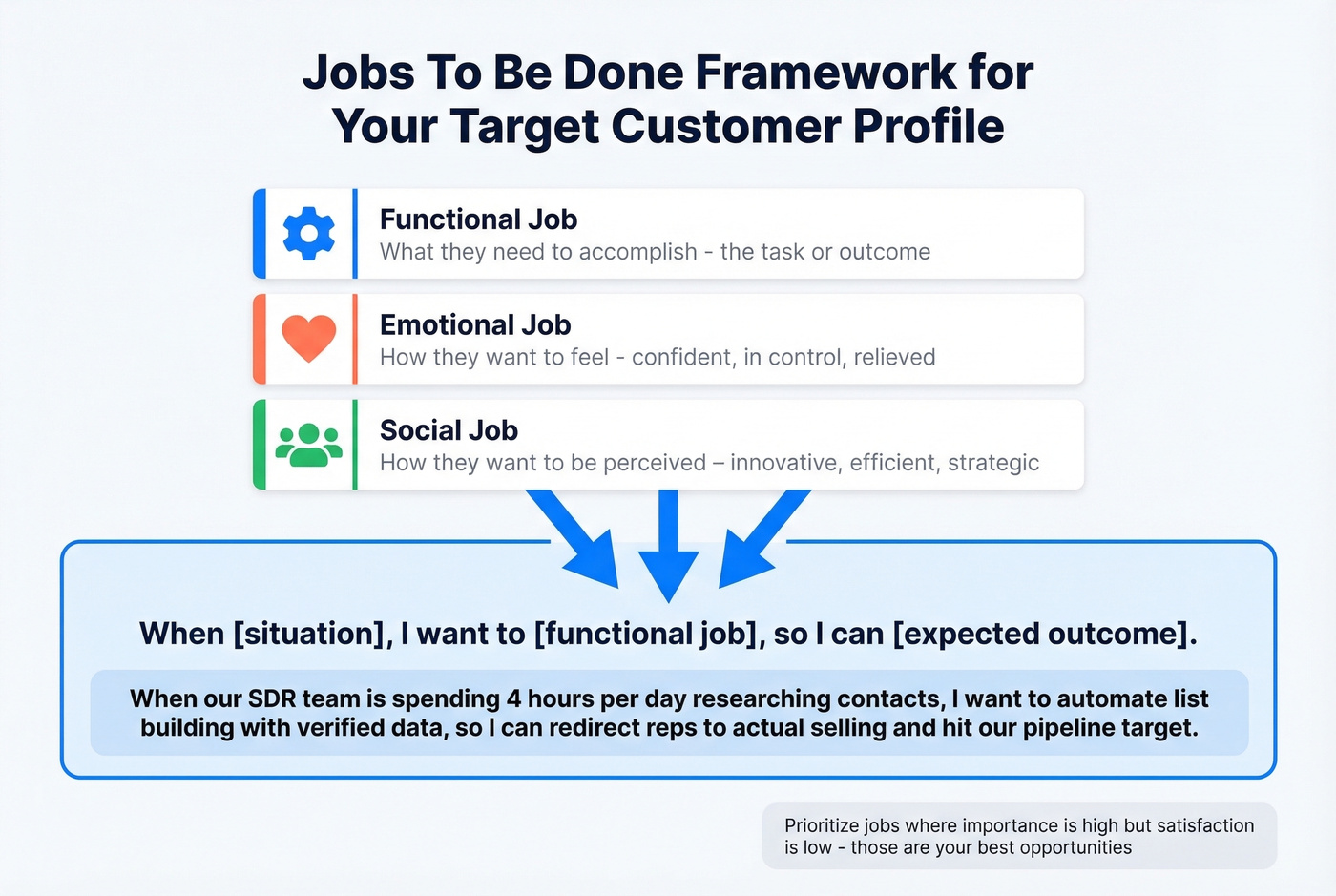
JTBD has three dimensions: functional (what they need to accomplish), emotional (how they want to feel), and social (how they want to be perceived). A complete job statement looks like this:
"When [situation], I want to [functional job], so I can [expected outcome]."
For example: "When our SDR team is spending 4 hours per day researching contacts, I want to automate list building with verified data, so I can redirect reps to actual selling and hit our pipeline target."
That statement is infinitely more useful than "Marketing Mary likes podcasts." It tells you the trigger, the need, and the outcome - which maps directly to your messaging, positioning, and qualification criteria. Prioritize jobs by importance vs. satisfaction: the biggest gaps between "this matters a lot" and "I'm not happy with my current solution" are your best opportunities.
Map the Buying Committee
Every B2B deal involves at least three roles: the decider (chooses the solution), the payer (writes the check), and the user (lives with it daily). It's increasingly rare one person fills all three.
Your profile should name these roles explicitly. For a mid-market SaaS sale, that might be VP of Sales as decider, CFO as payer, SDR team lead as user, and IT security as blocker. Knowing who joins the evaluation - and at what stage - prevents your reps from pitching the wrong person the wrong message. (If you want a more formal qualification lens here, map roles to MEDDIC sales qualification.)
Run Mandatory Checks
Before you finalize any profile, run it through five checks that separate interesting profiles from profiles that actually convert:
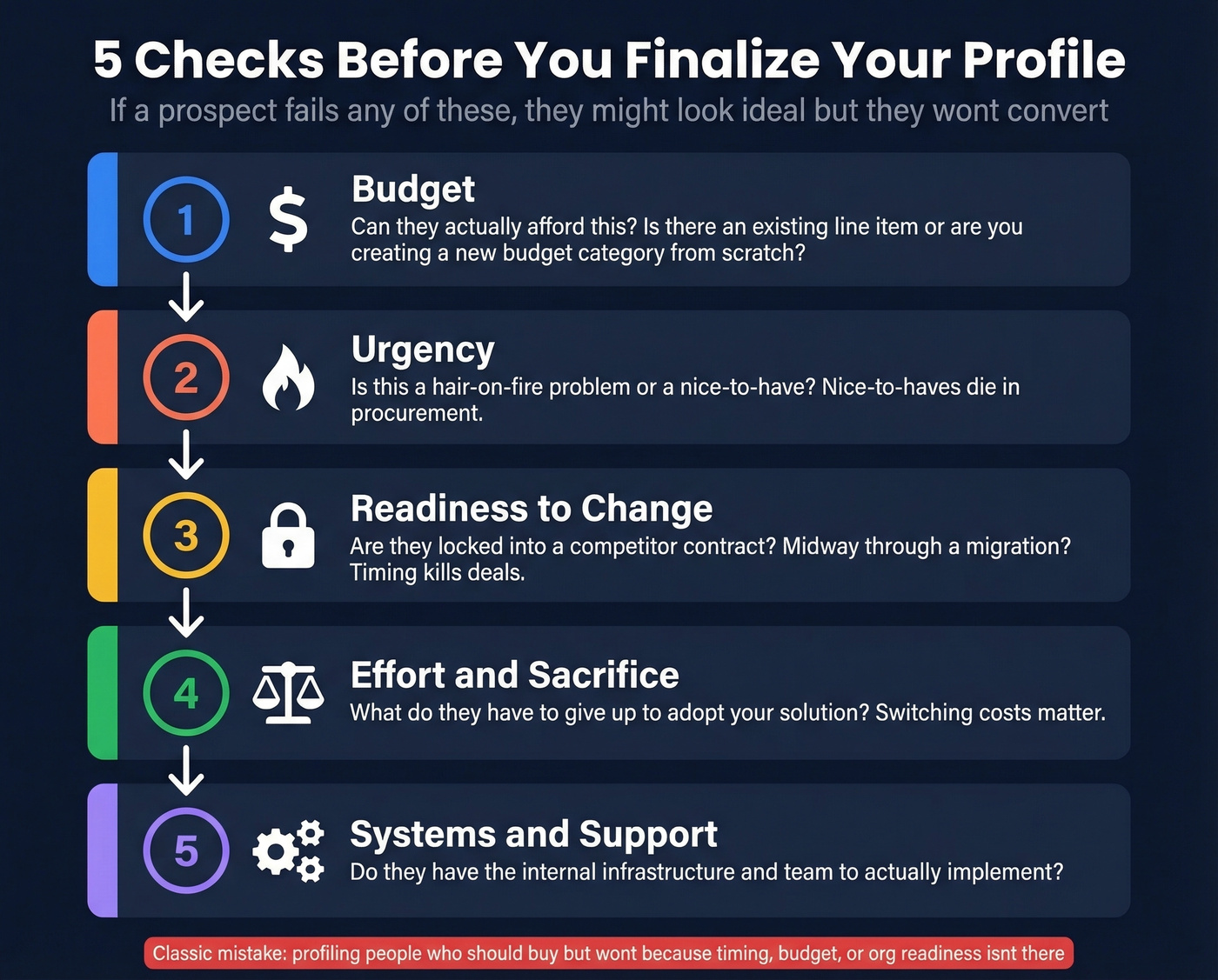
- Budget - Can they afford this? Is there a line item, or are you creating one?
- Urgency - Is this a "nice to have" or a "hair on fire" problem?
- Readiness to change - Are they locked into a competitor contract? Midway through a migration?
- Effort and sacrifice - What do they have to give up to adopt your solution?
- Systems and support - Do they have the internal infrastructure to implement?
These checks prevent the classic mistake: building a profile of people who should buy but won't - because the timing, budget, or organizational readiness isn't there.
Score and Tier Your Accounts
A profile without a scoring rubric is just a description. A profile with a scoring rubric is a prioritization engine. (If you want a plug-and-play version, use an ideal customer profile template and adapt the weights.)
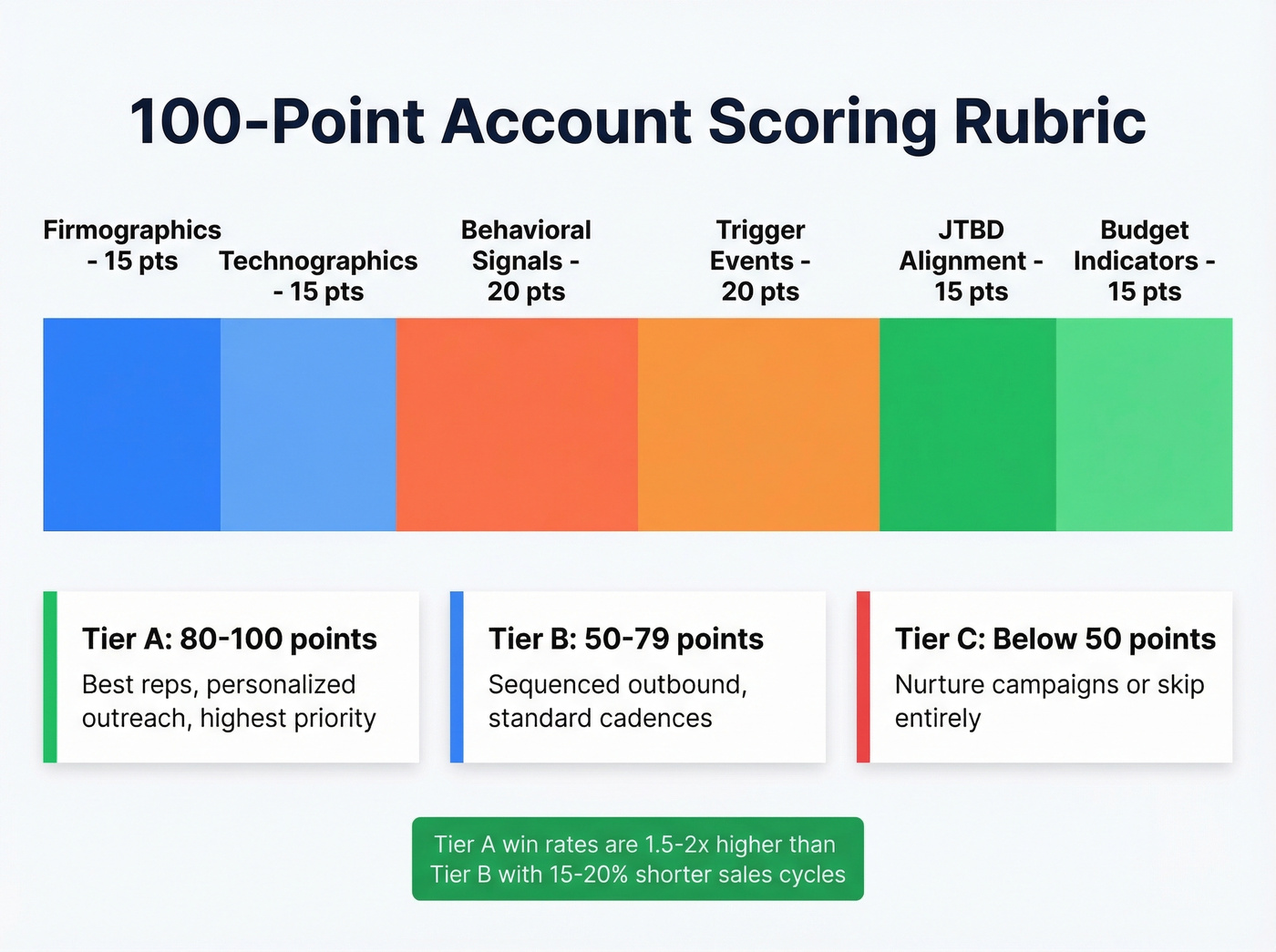
This is the single most operationally useful framework in this guide - and we haven't seen any of the top-ranking articles on this topic include one with concrete point allocations. Build a 100-point scale across your key dimensions:
| Category | Points | What You're Scoring |
|---|---|---|
| Firmographics | 15 | Industry, size, revenue match |
| Technographics | 15 | Tech stack compatibility |
| Behavioral signals | 20 | Content engagement, site visits |
| Trigger events | 20 | Funding, hiring, leadership change |
| JTBD alignment | 15 | Problem-solution fit |
| Budget indicators | 15 | Revenue, funding stage, dept size |
Tier your accounts: Tier A (80-100) gets your best reps and most personalized outreach. Tier B (50-79) gets sequenced outbound. Tier C (below 50) gets nurture campaigns or nothing at all.
The payoff is real. Top teams see Tier A win rates 1.5-2x higher than Tier B, with 15-20% shorter sales cycles. That's the difference between a profile that "informs strategy" and one that actually moves revenue. (To operationalize the "signals" part, see identifying buying signals.)
Build Your No-Go Profile
Let's be honest: for every target customer profile, you need one for who you will not pursue. We've seen SDR teams reclaim 5-10 hours per week just by documenting who NOT to call - this saves more pipeline time than any positive targeting exercise.
Your no-go profile might include companies under 10 employees (too small to justify your price point), industries with regulatory blockers (healthcare if you're not HIPAA compliant), or companies mid-contract with a competitor with 12+ months remaining. Write it down. Share it with the team. An SDR who knows who to skip is worth two who don't.

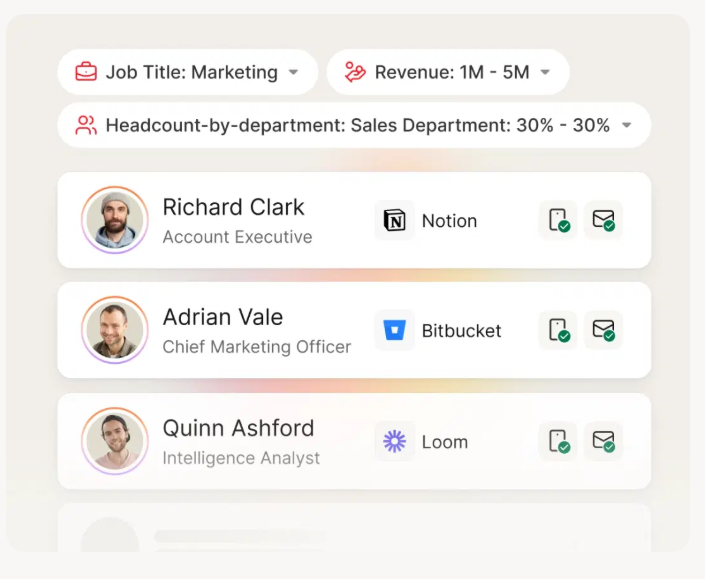
You just defined your target customer profile. Now find them. Prospeo's 300M+ profiles with 30+ filters - industry, headcount, tech stack, funding, buyer intent - let you turn profile fields into prospect lists in minutes, not days.
Stop profiling in docs. Start prospecting with 98% accurate data.
Filled-Out Profile Examples
Here's a filled-out B2B example for a hypothetical sales engagement platform:
| Field | B2B Example |
|---|---|
| Industry | B2B SaaS, FinTech |
| Company size | 50-500 employees |
| Annual revenue | $5M-$50M |
| Tech stack | Salesforce or HubSpot CRM, no sequencing tool |
| JTBD statement | "Automate multi-channel outreach to scale pipeline without adding headcount" |
| Buying committee | VP Sales (decider), CFO (payer), SDR Manager (user), IT (evaluator) |
| Trigger events | New VP Sales hire, Series B+ funding, headcount growth >20% |
| Tier score | 85 (Tier A) |
| No-go signals | Under 3 SDRs, no CRM, annual contract with competitor |
The full JTBD statement behind that shortened version: "When our SDR team can't hit 50 qualified meetings/month, I want to automate multi-channel outreach so I can scale pipeline without adding headcount." Put the complete version in your internal docs - the table just needs enough to jog memory.
And a B2C example for a DTC fitness supplement brand:
| Field | B2C Example |
|---|---|
| Age range | 25-40 |
| Income | $60K-$120K household |
| Lifestyle | Active 4+ days/week, tracks macros |
| JTBD statement | "Clean supplement for sustained energy without junk ingredients" |
| Purchase behavior | Subscribes to 2+ wellness brands, buys online, reads labels |
| Channels | Instagram, YouTube fitness creators, Reddit r/supplements |
| Tier score | 75 (Tier B - high intent but price-sensitive segment) |
| No-go signals | Price-first shoppers, under 18, no fitness routine |
Smartsheet offers free downloadable templates in Excel, Google Sheets, and PDF if you want a pre-built starting point.
Mistakes That Kill Your Profile
Five mistakes we see repeatedly - and how to fix each one.
Building from intuition instead of data. Start with closed-won analysis, not a brainstorm. If your profile doesn't reference actual deal data, it's fiction. Pull the CRM export before you book the workshop.
Too broad to be useful. "Mid-market companies in North America" isn't a profile - it's a continent. Apply the mandatory checks and scoring rubric. If you can't score an account against your profile, it's too vague.
No customer conversations. I once watched a team build their entire profile from Google Analytics and HubSpot dashboards - firmographics, traffic sources, content engagement, the works. It looked rigorous. Then sales started calling the accounts and discovered the actual buying trigger was a compliance deadline that appeared nowhere in the analytics. You can't build a profile from data alone. Conduct 10+ interviews using JTBD questions. Ask what triggered their search, what alternatives they considered, and what outcome they expected. The language customers use is gold for both profiling and messaging.
Ignoring profitability. A customer who closes in 2 weeks but churns in 60 days isn't ideal.
| Metric | "Fast Close" Customer | Ideal Customer |
|---|---|---|
| Time to close | 2 weeks | 6 weeks |
| Churn | 60 days | 18+ months |
| LTV | $2,400 | $36,000 |
| Support hours/month | 8 | 1.5 |
Run an 80/20 analysis on profit contribution, not just revenue. Weight your profile toward customers who stay and expand.
Never updating. Your market shifts. Your product evolves. Your best customers change. Review profiles every 6 months, with specific triggers: new product launch, entering a new vertical, or win-rate drops below threshold.
Turn Your Profile Into a Prospect List
Here's the thing: if your deal sizes are under $10K, you probably don't need a 47-field ICP document and a six-week research process. You need a tight profile with 5-7 fields and a way to turn it into a list in 15 minutes. The whole point of building a target customer profile is making it actionable - turning a strategic document into actual accounts and contacts your reps can work.
Every dimension in your profile should map directly to a search filter in your B2B data platform. Industry maps to industry filter. Company size maps to headcount filter. Tech stack maps to technographic filter. Funding stage, headcount growth, job changes - all searchable signals. Once you've nailed your ideal buyer, the translation from profile to filter should be nearly one-to-one. (For a step-by-step workflow, see how to automate target account lists.)
Prospeo's 30+ search filters cover buyer intent via 15,000 Bombora topics, Technographics, job changes, headcount growth, department size, funding, and revenue - essentially every dimension in the profile framework above. You build the profile, then translate each field into a filter. The output is a verified prospect list, not a theoretical document. With 98% email accuracy and a 7-day data refresh cycle, the contacts you pull are current and deliverable. (If you're comparing vendors for this step, start with best sales prospecting databases.)
Meritt went from $100K to $300K/week in pipeline after putting their profile into action this way, with bounce rates dropping from 35% to under 4%. (If you're seeing high bounces, benchmark against email bounce rate and fix list hygiene first.)

Tools for Building and Maintaining Profiles
You don't need a massive tech stack. Here's what covers each stage:
| Tool | Use Case | Price Range |
|---|---|---|
| HubSpot CRM | Closed-won analysis, contact data | Free tier available |
| Salesforce | Enterprise CRM, deal analytics | From ~$25/user/mo |
| Twilio Segment | Unify customer data (CDP) | Free tier; paid plans ~$120/mo |
| Salesforce Data Cloud | Enterprise CDP | Enterprise pricing, typically ~$50K+/yr |
| Google Forms | Customer interviews, surveys | Free |
| SurveyMonkey | Structured customer research | From ~$25/mo |
For the final step - turning your profile into a live prospect list with real-time verification - tools like Prospeo handle the translation from strategy document to working outbound list across 300M+ profiles.
Mapping the buying committee is step one. Reaching them is step two. Prospeo gives you verified emails and 125M+ direct dials for every role on the committee - decider, payer, user - at $0.01 per email with a 30% mobile pickup rate.
Reach every stakeholder on the buying committee, not just the gatekeeper.
FAQ
How many profiles should I create?
Two to three maximum. Each profile needs its own scoring rubric, messaging framework, and outbound workflow - that's unsustainable beyond three. If you're struggling to narrow it down, run the 80/20 profitability analysis on your closed-won deals first and let the data decide.
What's the difference between a target customer profile and an ICP?
In practice, they're nearly interchangeable. "Ideal customer profile" is more common in B2B and typically describes a company. "Target customer profile" is broader - it can describe a company in B2B or an individual consumer in B2C. The framework for building both is identical: start with data, define measurable traits, score and tier, build a no-go list.
How do I build a profile with few existing customers?
Start with 10 customer interviews using the Jobs To Be Done framework. Ask what triggered their search, what alternatives they considered, and what outcome they expected. Then validate against your first 20-30 deals as they close. Skip this approach if you're pre-revenue with zero conversations - in that case, study your competitors' case studies and reverse-engineer their best customers until you have your own data to work from.