

Targeted Email Campaigns: The Data-First Playbook for 2026
Most targeted email campaign guides skip the boring part - making sure your data is actually good - because that's not what the platforms writing them sell. Here's the playbook that starts where it should: with your list, not your subject line.
What Is a Targeted Email Campaign?
A targeted email campaign sends the right message to a specific segment based on behavior, demographics, or intent instead of blasting the same promo to everyone. The practical version: it's how you stop annoying 80% of your list to reach the 20% who care.
The ROI case is settled. Email returns roughly $36 for every $1 spent, and fast-growing businesses drive 40% more revenue from personalization than competitors. Yet only 60% of ecommerce brands personalize based on customer activity. That gap is your opportunity.
What You Need First
- Clean your list before you segment. Dead addresses tank sender reputation and skew every metric downstream.
- Focus on CTR, not open rate. Apple Mail Privacy Protection inflates opens. Click-through rate is the reliable signal now (and it helps to know the click rate formula).
- Start with 3 campaign types, not 8. Nail welcome, cart abandonment, and re-engagement before expanding.
2026 Benchmarks Worth Knowing
Klaviyo analyzed data from 183,000+ brands for their 2026 benchmarks. The campaigns-vs-flows gap tells the whole story of why targeting matters.
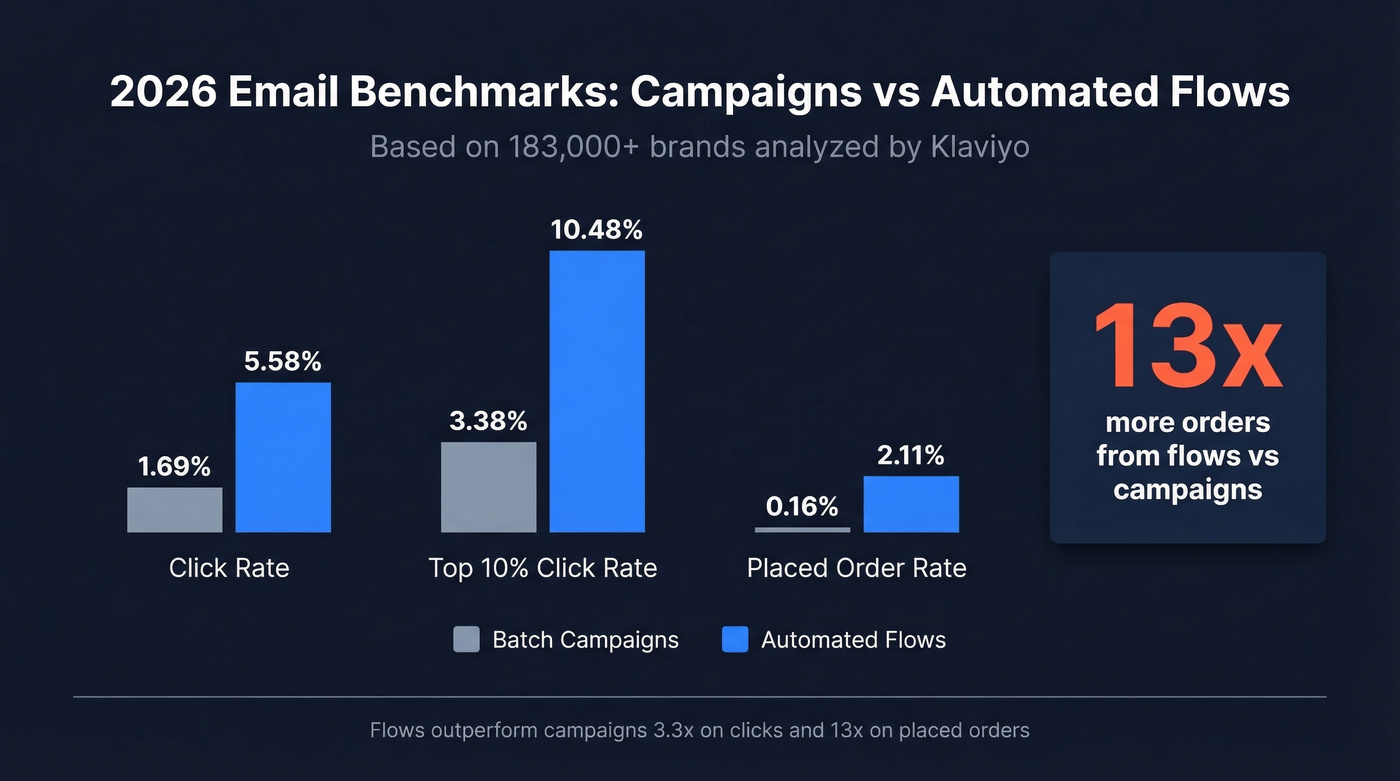
| Metric | Campaigns | Automated Flows |
|---|---|---|
| Open rate | 31% | - |
| Click rate | 1.69% | 5.58% |
| Top 10% click | 3.38% | 10.48% |
| Placed order | 0.16% | 2.11% |
Flows outperform campaigns by roughly 3.3x on clicks and 13x on placed orders. That's not a rounding error - it's the difference between sending to a segment and sending to someone who just did something.
Salesforce benchmarks put a "good" CTR at 2-5%, with promotional emails averaging 1-3%. If your sends aren't clearing 2%, the problem is usually data quality or segmentation, not copy (see a full email deliverability guide if you need the root-cause checklist).
Six Campaign Types That Convert
Cart abandonment is the single highest-ROI automation most ecommerce brands can build. 70.19% of online carts are abandoned, and a three-email sequence at 1 hour, 24 hours, and 72 hours post-abandonment recovers revenue that's already halfway out the door.
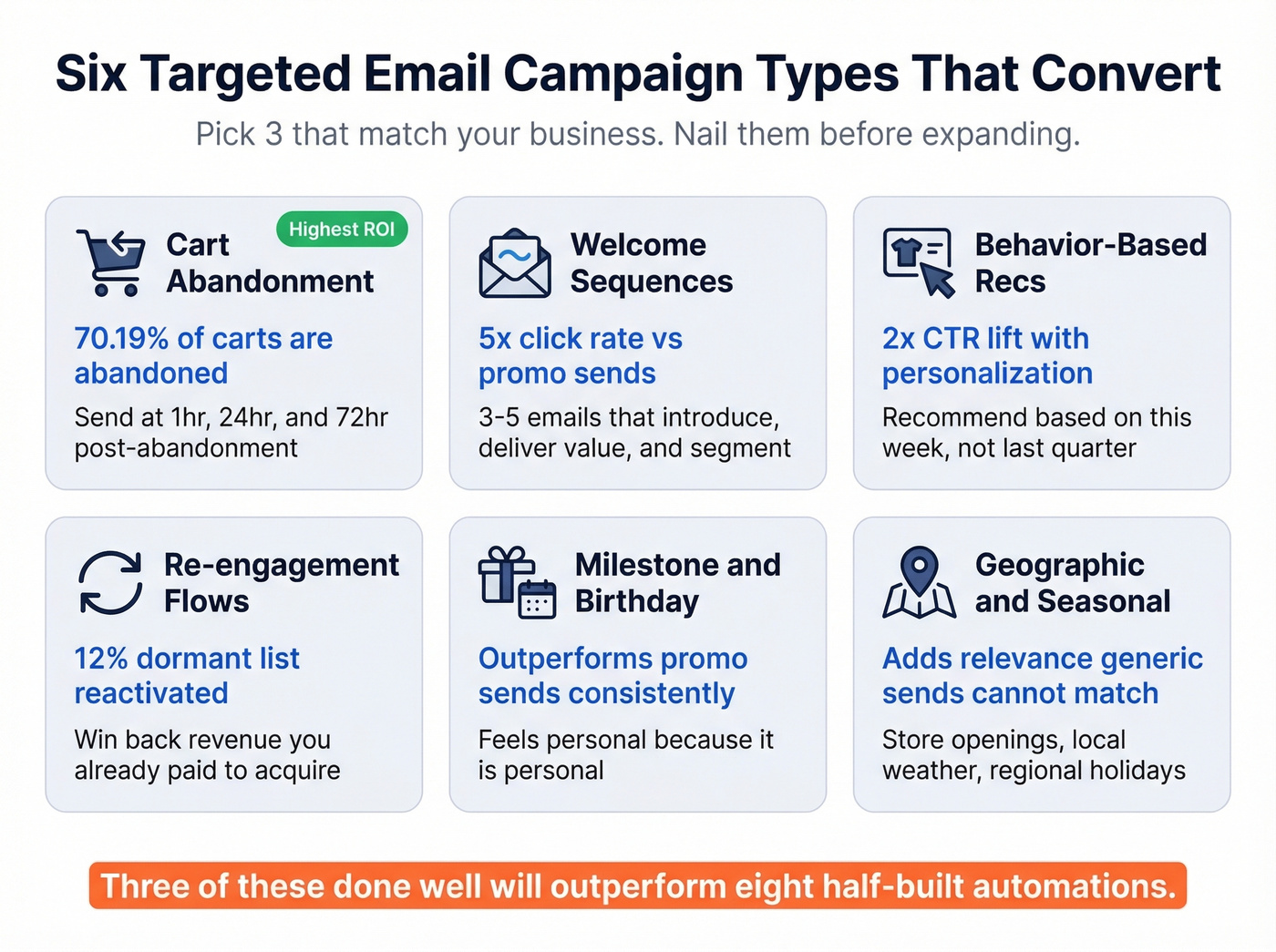
Welcome sequences set engagement patterns. A 3-5 email flow that introduces your brand, delivers a quick win, and segments by interest outperforms a single "thanks for signing up" every time. We've seen welcome flows with 5x the click rate of standard promotional sends, and that tracks with the Klaviyo data above.
Behavior-based recommendations work when they're recent. Recommend based on what someone browsed this week, not last quarter - one case study showed personalized recommendations lifting CTR by 2x.
Re-engagement flows reactivate revenue you already paid to acquire. One subscription service won back 12% of its dormant list with a targeted sequence. Milestone and birthday emails consistently outperform promotional sends because they feel personal. Geographic and seasonal campaigns - store openings, regional weather, local holidays - add relevance generic sends can't match.
Here's the thing: three of these executed well will outperform eight half-built automations. Pick the ones that match your business model and nail them.

Every segmentation strategy in this playbook depends on two things: valid emails and rich contact data. Prospeo's 5-step verification delivers 98% email accuracy with spam-trap and catch-all handling - keeping bounce rates under 3%. Enrichment adds 50+ data points per contact so you can segment by job title, company size, tech stack, and buyer intent.
Stop blaming your copy when your list is the problem.
The Foundation Everyone Skips: Data Quality
You built 12 segments in Klaviyo. Three have fewer than 50 contacts. Nobody checked if the emails are valid. This is how most targeted sends actually start.
The chain reaction is predictable. Dirty list leads to high bounce rates, which damages sender reputation, which tanks inbox placement, which means even your good segments stop performing. We've watched teams blame their copy, their subject lines, their send times - when the real problem was a double-digit percentage of their list being dead addresses.
Clean every 3-6 months at minimum. Use double opt-in for new subscribers to reduce invalid addresses at the source. And set up SPF, DKIM, and DMARC before your first send - without authentication, even clean lists hit spam folders.
For B2B campaigns especially, running your list through a verification tool before every major send is the cheapest deliverability insurance you can buy. Prospeo's bulk verification checks addresses at 98% accuracy with catch-all handling and spam-trap removal (see spam trap removal), and its enrichment pulls 50+ data points per contact - job title, company size, tech stack - giving you the fields you need to segment properly (more on lead enrichment if you want the workflow).
The benchmarks are clear: targeted flows convert 13x better than batch sends. But targeting requires data fields most lists don't have. Prospeo enriches your CRM or CSV with department, seniority, technographics, and intent signals across 15,000 topics - at $0.01 per email. No contracts, no sales calls.
Turn a flat email list into a segmentation-ready database in minutes.
Five Mistakes That Kill Campaigns
No segmentation at all. Sending the same email to your entire list isn't targeting - it's a newsletter. 78% of marketers say subscriber segmentation is their most effective email strategy, and the benchmark data backs them up (especially when you use intent based segmentation).
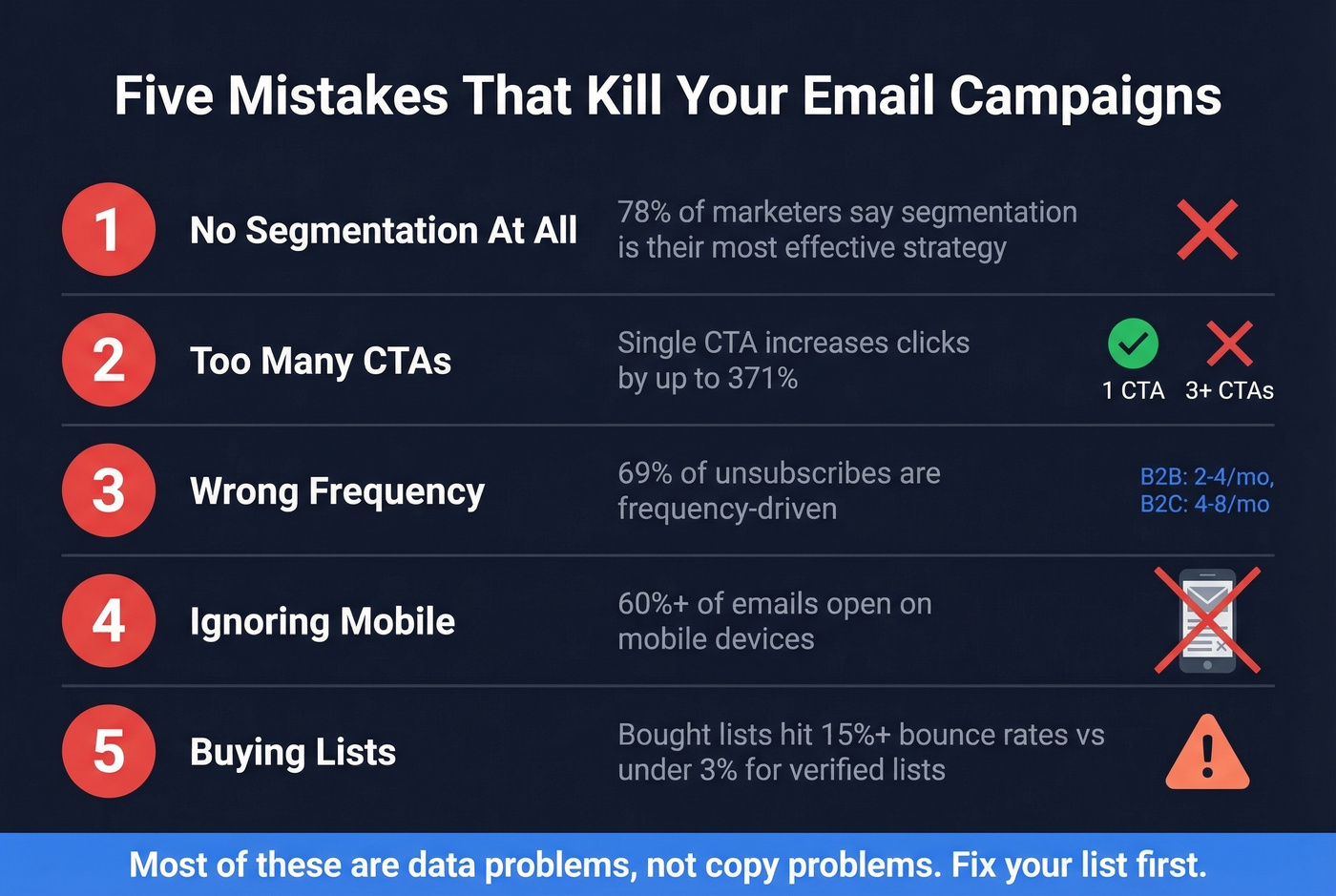
Too many CTAs. Emails with a single call-to-action increase clicks by up to 371% compared to multiple competing links. Pick one action per email. One. (If you want examples, see email call to action.)
Wrong frequency. B2B: 2-4 emails per month. B2C retail: 4-8. Ecommerce with good segmentation can push 4-5 per week. Since 69% of email unsubscribes are frequency-driven, monitor opt-out rates closely and let the data guide cadence rather than gut feel.
Ignoring mobile. Over 60% of emails open on mobile devices. Keep subject lines under 50 characters. If your template breaks on a phone screen, nothing else matters.
Buying lists. Purchased lists are a deliverability death sentence and a legal liability under both CAN-SPAM and GDPR. Build through opt-ins, or use a verified B2B data platform to find contacts matching your ICP (start with an ideal customer profile). In our experience, teams that verify before every major send keep bounce rates below 3% - bought lists routinely hit 15%+ (see email bounce rate benchmarks and fixes).
Choosing the Right Sending Platform
The ESP handles sending. The data layer underneath determines whether your targeting works. At 5,000 contacts and 2 sends per month, expect $15-$95/mo depending on the platform.
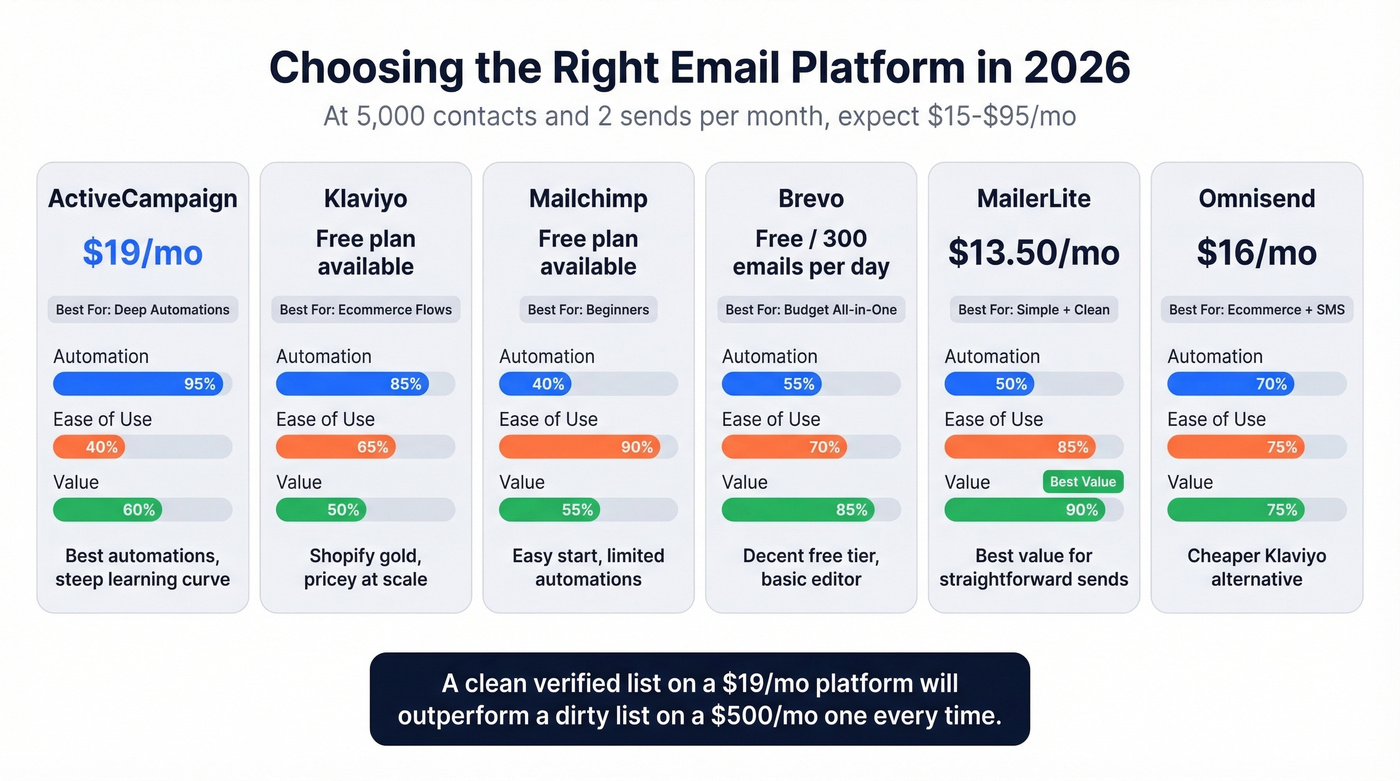
| Tool | Best For | Starting Price | Verdict |
|---|---|---|---|
| ActiveCampaign | Deep automations | $19/mo | Best automations, steep learning curve |
| Klaviyo | Ecommerce flows | Free plan available | Shopify gold, pricey at scale |
| Mailchimp | Beginners | Free plan available | Easy start, limited automations |
| Brevo | Budget all-in-one | Free / 300 emails per day | Decent free tier, basic editor |
| MailerLite | Simple + clean | $13.50/mo | Best value for straightforward sends |
| Omnisend | Ecommerce + SMS | $16/mo | Cheaper Klaviyo alternative |
ActiveCampaign has the best automation builder on this list, but the consensus on r/MarketingAutomation is that the learning curve is brutal and costs climb fast as your contact list grows. Mailchimp is fine for getting started, but limited free automations and list-based pricing push most teams to switch within a year.
Let's be honest: if your average deal size stays in the low four figures, you probably don't need the most expensive ESP on the market. A clean, verified list sent through a $19/mo platform will outperform a dirty list blasted through a $500/mo one every single time.
Compliance Essentials
CAN-SPAM requires a clear unsubscribe mechanism, valid physical address, and accurate sender info in every commercial email. Penalties run up to $51,744 per email. GDPR demands clear affirmative consent - pre-checked boxes don't count - with fines up to EUR 20M or 4% of global revenue. Keep detailed consent records. CPRA/CCPA applies if you process data from 100,000+ consumers or earn $25M+ annually: honor access, delete, and opt-out requests within 45 days, with penalties of $2,500-$7,500 per violation and no cap.
Use double opt-in for new subscribers. It adds friction but protects deliverability and keeps you on the right side of every regulation listed above. The FTC's CAN-SPAM compliance guide and the GDPR official text are worth bookmarking if you're building campaigns at any real scale.
FAQ
What's a good CTR for a targeted email campaign?
2-5% for segmented sends; automated flows like cart abandonment often exceed 5%. Focus on click-through rate over open rate - Apple's privacy changes make opens unreliable. If you're below 2%, audit your segments and data quality first.
How often should I send targeted emails?
B2B: 2-4 per month. B2C: 4-8. Ecommerce with solid segmentation can push 4-5 per week. Since 69% of unsubscribes are frequency-driven, monitor opt-out rates closely and let the data guide cadence.
How do I choose the right email campaign recipients?
Start with your cleanest, most engaged segment - people who've opened or clicked in the last 90 days. Layer in behavioral and demographic filters so recipients match the offer. Sending a discount code to high-intent browsers converts far better than blasting your entire list. Skip anyone who hasn't engaged in 6+ months until you run a dedicated re-engagement flow.
Do I need to verify my list before sending?
Yes. Dirty lists spike bounce rates and damage sender reputation, sometimes permanently. Bulk verification catches invalid addresses, spam traps, and honeypots before they do damage, keeping bounce rates under 3% even at scale. If you haven't cleaned your list in the last 90 days, do it before your next send - not after you notice deliverability dropping.