

Telecom Lead Generation Playbook: Fewer Leads, Better Pipeline
Eighty dials before lunch. Six connects. Three are locked into contracts signed eighteen months ago. One asks you to call back "next quarter." The other two want a price match you can't profitably offer.
That's a Tuesday in telecom sales - and it's why the old telecom lead generation playbook is broken.
PwC projects global telecom service revenue climbing from $1.15T to roughly $1.32T by 2029 - a modest 2.8% CAGR while mobile ARPU declines and margin pressure intensifies. One rep on r/sales counted 1,000+ B2B telecom companies in their market alone, all selling what buyers perceive as the same product. The answer isn't more leads. It's better ones.
What You Need (Quick Version)
Three things separate telecom teams building real pipeline from those burning through SDRs:
- A telecom-specific ICP built on intent signals, not just firmographics. Contract renewals, office relocations, and infrastructure upgrades matter more than company size.
- A coordinated multi-touch sequence - not 130 robotic dials a day. Five to nine touches across phone, email, and social, timed to buying signals.
- Verified contact data so you stop wasting huge chunks of activity on dead numbers and bounced emails. A 98%-accuracy database with a 7-day refresh cycle changes the math entirely.
Get those three right and the rest is execution.
Build a Telecom ICP That Filters
Most telecom ICPs are firmographic checklists - headcount, industry, geography. That's table stakes. The ICP that actually filters needs three layers.
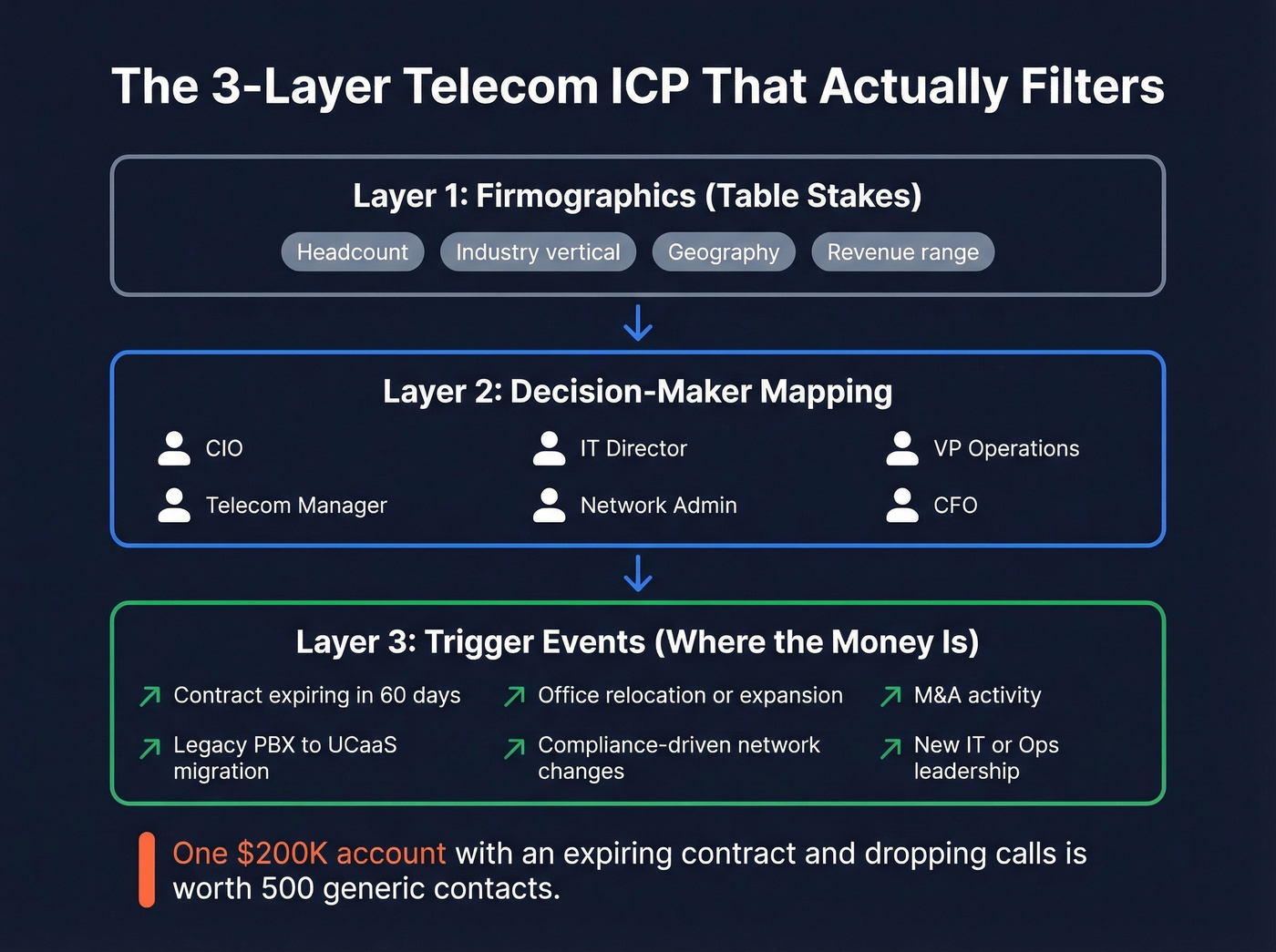
Decision-maker roles worth targeting: CIOs, IT Directors, VPs of Operations, Telecom Managers, Network Admins, and CFOs - especially for cost-consolidation plays. The buying committee on a mid-market telecom deal is usually multi-stakeholder, so map the full committee, not just one contact.
Trigger events that signal real buying intent:
- Contract renewals nearing expiration (the 60-day window is gold)
- Office relocations or expansions
- M&A activity requiring infrastructure consolidation
- Technology infrastructure upgrades like legacy PBX to UCaaS migrations
- Compliance shifts forcing network changes
- Leadership changes in IT or operations
Here's what a high-value lead actually looks like: a $200K-budget account with a contract expiring in 60 days and remote workers dropping calls on a legacy system. That single lead is worth 500 generic contacts.
Sub-vertical differentiation matters. A team selling UCaaS to mid-market professional services firms needs a fundamentally different message than one selling SD-WAN to multi-location retail. Deloitte's 2026 telecom outlook highlights the push toward B2B tech services - cloud, cybersecurity, IoT - which means generating telecom leads increasingly means selling technology solutions, not phone lines. Your ICP should reflect what you're actually selling.
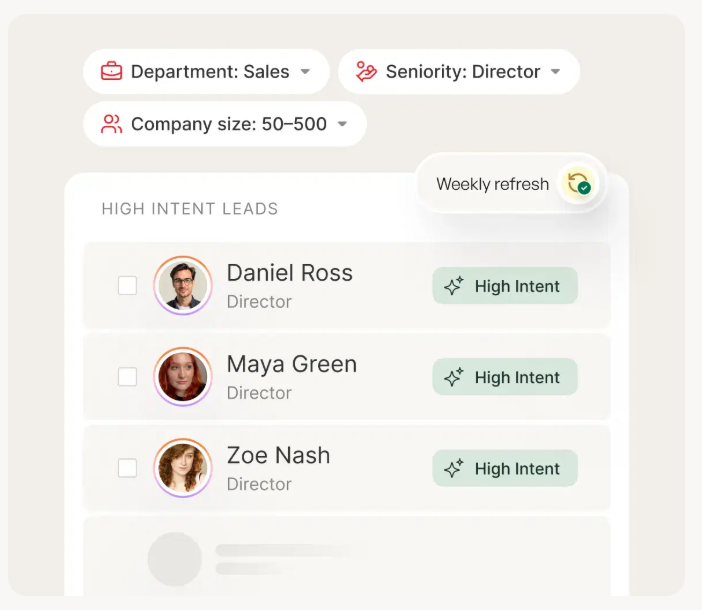
Layer intent data on top of firmographics to find accounts actively researching your category before your competitors even know they're in-market.
Channels That Generate Telecom Leads
Cold Calling
Phone still cuts through in telecom. 57% of C-level and VP buyers prefer phone calls over other outreach methods, and 82% of B2B buyers accept meetings at least occasionally from proactive outreach. In a commoditized market where email inboxes are flooded with identical pitches, a well-timed call with a relevant trigger ("I noticed you're opening a second office in Dallas") creates differentiation no email template can match.
Use this if: You're selling mid-market or enterprise deals where relationships drive decisions. Skip this if: Your entire value prop is price - you'll lose that fight on the phone.
If you want to systematize it, borrow a repeatable cold calling system instead of improvising every dial.
Email Outreach
The average B2B cold email reply rate sits around 5.1%. That's workable if your targeting is tight and your copy leads with pain. PAS (Problem-Agitate-Solution) and BAB (Before-After-Bridge) frameworks consistently outperform generic feature dumps - pain-first messaging converts at 3-5x the rate of offer-first messaging.
Works best when: You've got verified emails and a clear pain angle for your segment. Not the right fit if: Your list is unverified - bounces will tank your domain reputation fast.
If you're tightening deliverability, start with email bounce rate benchmarks and fixes before scaling volume.
Field and Relationship Prospecting
Here's the channel nobody writes about. A telecom rep on Reddit described a playbook that's genuinely clever: visit properties, build relationships with property management companies, and cover 100+ properties on a bi-monthly rotation. Small relationship deposits - snacks, coffee, just showing up consistently - make property managers and maintenance staff remember you when tenants move in and need connectivity. You're selling through people customers already trust instead of cold-knocking doors where skepticism is the default.
Use this if: You're selling to SMBs in a defined geographic territory. Skip this if: You're selling enterprise UCaaS to Fortune 500 companies - this doesn't scale to that motion.
Referrals
The highest-converting channel and the hardest to scale. Referral-sourced leads close 69% faster and convert at much higher rates than other channels. Build a formal referral program with existing customers - even a simple "introduce us to your IT contact at another company" ask during QBRs compounds over time.
If you need structure for those asks, use a simple QBR questions checklist.
Events, Paid, and Content
Trade shows like Channel Partners and Enterprise Connect work for relationship building but have long payback cycles. Paid search captures existing intent - useful for SMB telecom where buyers Google "business phone system." Content marketing is a 6-18 month investment. None of these replace outbound for near-term pipeline, but they compound alongside it.
If you're building the long game, align it with what is B2B content marketing so it supports pipeline, not vanity traffic.

You just read that 35-40% bounce rates destroy outbound. Prospeo's 98% email accuracy and 7-day data refresh mean your telecom sequences actually land. Layer intent data across 15,000 topics to catch accounts researching UCaaS, SD-WAN, or infrastructure upgrades before competitors even know they're in-market.
Stop feeding your cadence dead data. Start reaching telecom buyers who are actually buying.
The 14-Day Outbound Sequence
It takes an average of 5 touches to engage a prospect and roughly 9 for executives. Here's a practical 14-day cadence:
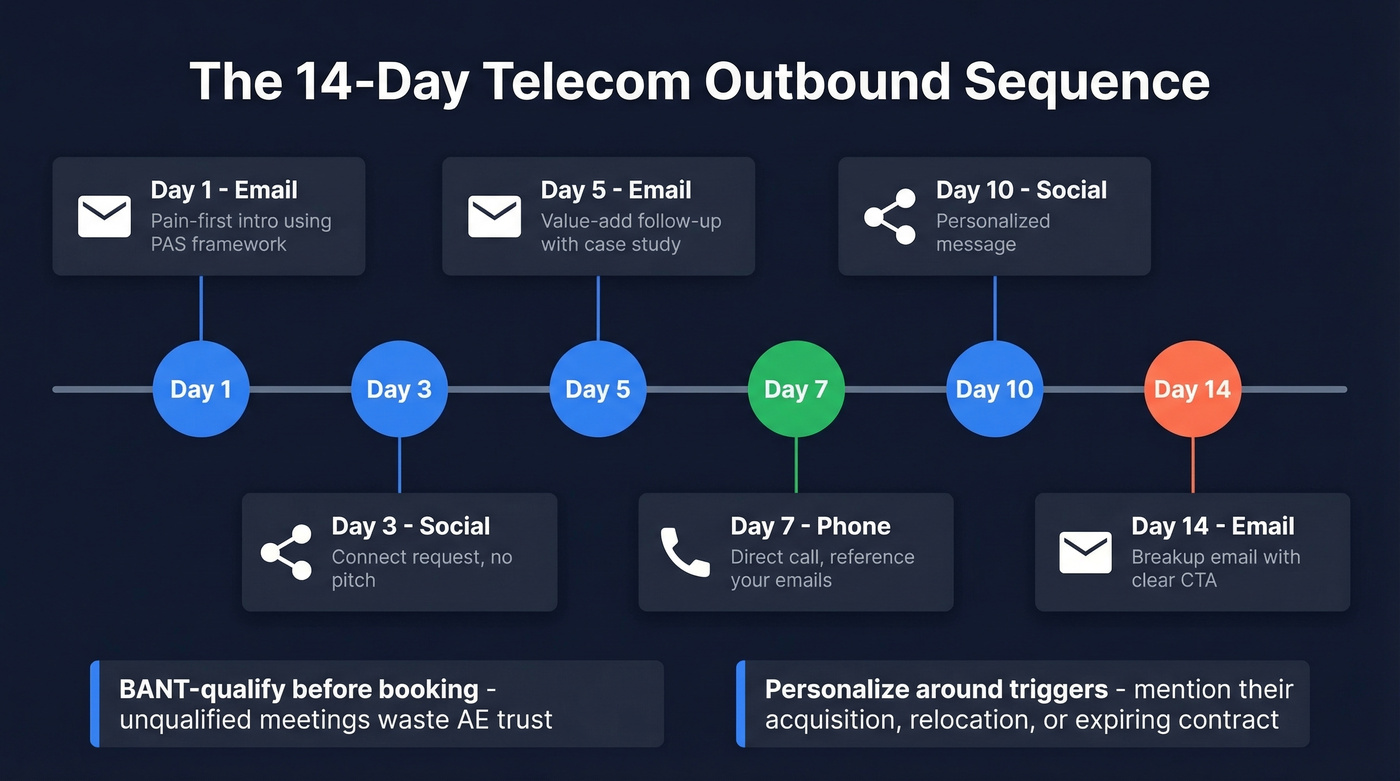
| Day | Channel | Action |
|---|---|---|
| 1 | Pain-first intro (PAS framework) | |
| 3 | Social | Connect request, no pitch |
| 5 | Value-add follow-up with a case study or insight | |
| 7 | Phone | Direct call, reference emails |
| 10 | Social | Personalized message |
| 14 | Breakup email with clear CTA |
Two things matter more than the exact cadence. First, BANT-qualify before booking - passing unqualified meetings to AEs wastes everyone's time and erodes trust between SDRs and closers. Second, personalize around trigger events. "I saw your company just acquired [X] - consolidating telecom vendors after M&A is usually a headache" is worth ten generic templates.
To improve replies without reinventing the wheel, keep a set of sales follow-up templates your team can personalize fast.
The Right Tech Stack
Your sequence tool doesn't matter if your data is wrong. We've watched teams burn months of outbound on lists where 35-40% of emails bounced. The stack starts with data quality.
| Tool | Best For | Email Accuracy | Pricing |
|---|---|---|---|
| Prospeo | Data accuracy + intent | 98% | Free tier; ~$0.01/email |
| Apollo | Large DB + free tier | 79% | Free; $49/user/mo+ |
| Lusha | Quick lookups | N/A | Free; $29/user/mo+ |
| Cognism | EU compliance + mobiles | N/A | ~EUR10K-30K/yr |
| ZoomInfo | Enterprise GTM suite | 87% | ~$15-40K/yr |
| Clay | Enrichment workflows | Varies by source | $149/mo+ |
| Dealfront | Website visitor ID | N/A | EUR99/mo+ |
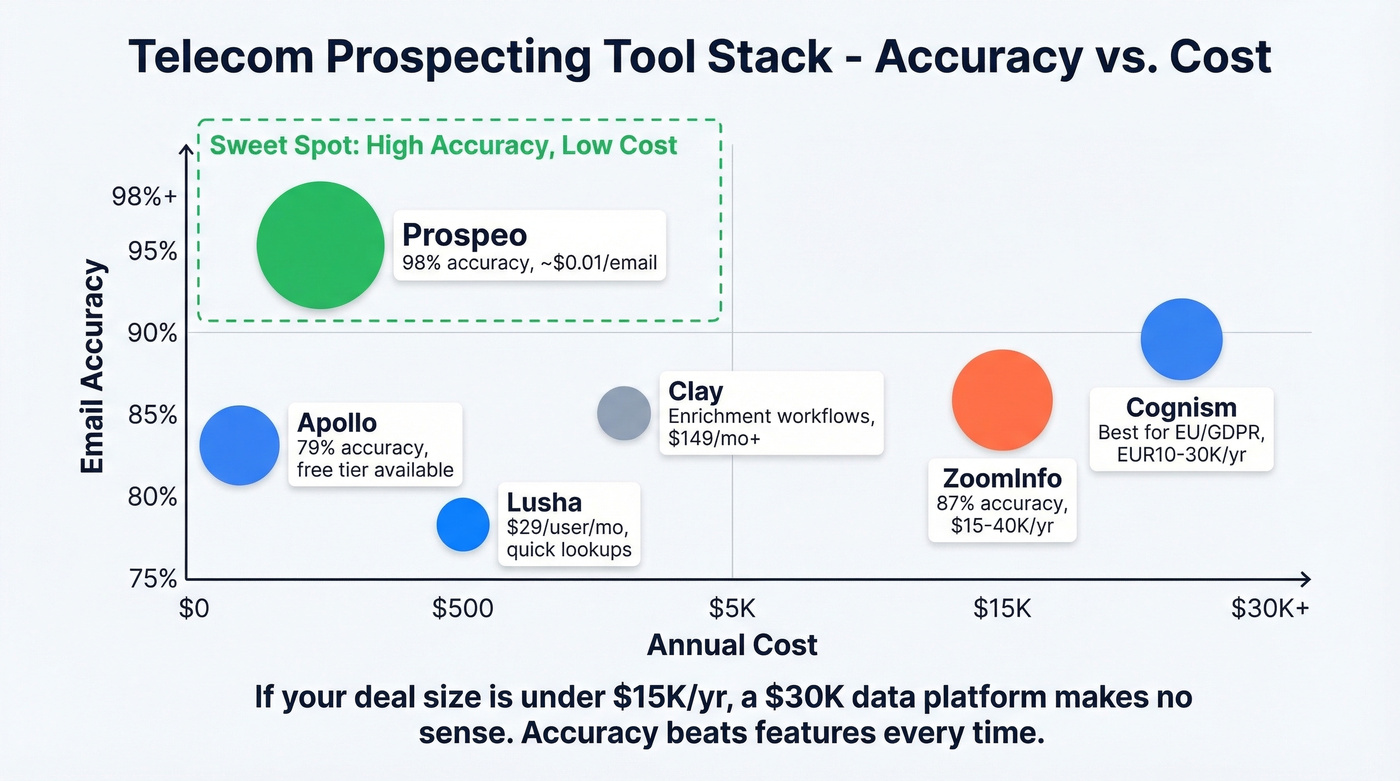
Let's be honest - in our experience testing these platforms, the accuracy gap between tools matters far more than the feature gap. Prospeo's 30+ search filters include technographics and buyer intent powered by Bombora across 15,000 topics, so you can find IT Directors at companies actively researching UCaaS or SD-WAN. With a 7-day refresh cycle and 98% verified email accuracy, it's built for teams that care about deliverability and connect rates. At roughly $0.01 per email, it's 90% cheaper than ZoomInfo with measurably better accuracy. Meritt tripled pipeline from $100K to $300K per week after switching, while dropping bounce rates from 35% to under 4%.
If you're comparing databases more broadly, use a shortlist of sales prospecting databases before you commit to a contract.
Apollo is the obvious starting point if you're bootstrapping - the free tier is generous and the database is massive. Email accuracy runs lower, which means more bounces and more domain risk on high-volume sequences.
Selling into European telecom? Cognism is your pick. GDPR-compliant verified mobiles are its real differentiator. Expect to pay EUR10K-30K/year.
A 10-seat ZoomInfo contract with intent data and mobile numbers often lands in the $15-40K/year range depending on seats and modules. That's hard to justify for a telecom team that primarily needs accurate contact data and intent signals - you're paying for a platform most reps will use at 20% capacity. Lusha works for quick one-off lookups at $29/user/month. Clay is a workflow tool for enrichment orchestration if you're already technical. Dealfront identifies website visitors, a nice supplement but not a primary prospecting channel.
Look, if your average deal size is under $15K/year, you don't need a $30K data platform. A low-cost tool with 98% accuracy will outperform an expensive one with 87% accuracy every single time - because the math on bounced emails and dead dials compounds against you at every stage of the funnel.
Why Telecom Lead Gen Programs Fail
Misaligned handoffs. Marketing and sales don't share a definition of "qualified." MQLs get tossed over the wall with no context, AEs ignore them, and both sides blame each other. Fix this with a shared scoring model and an SLA on follow-up speed.
If you need a clean operational model, map it as a lead generation workflow so nothing falls through cracks.
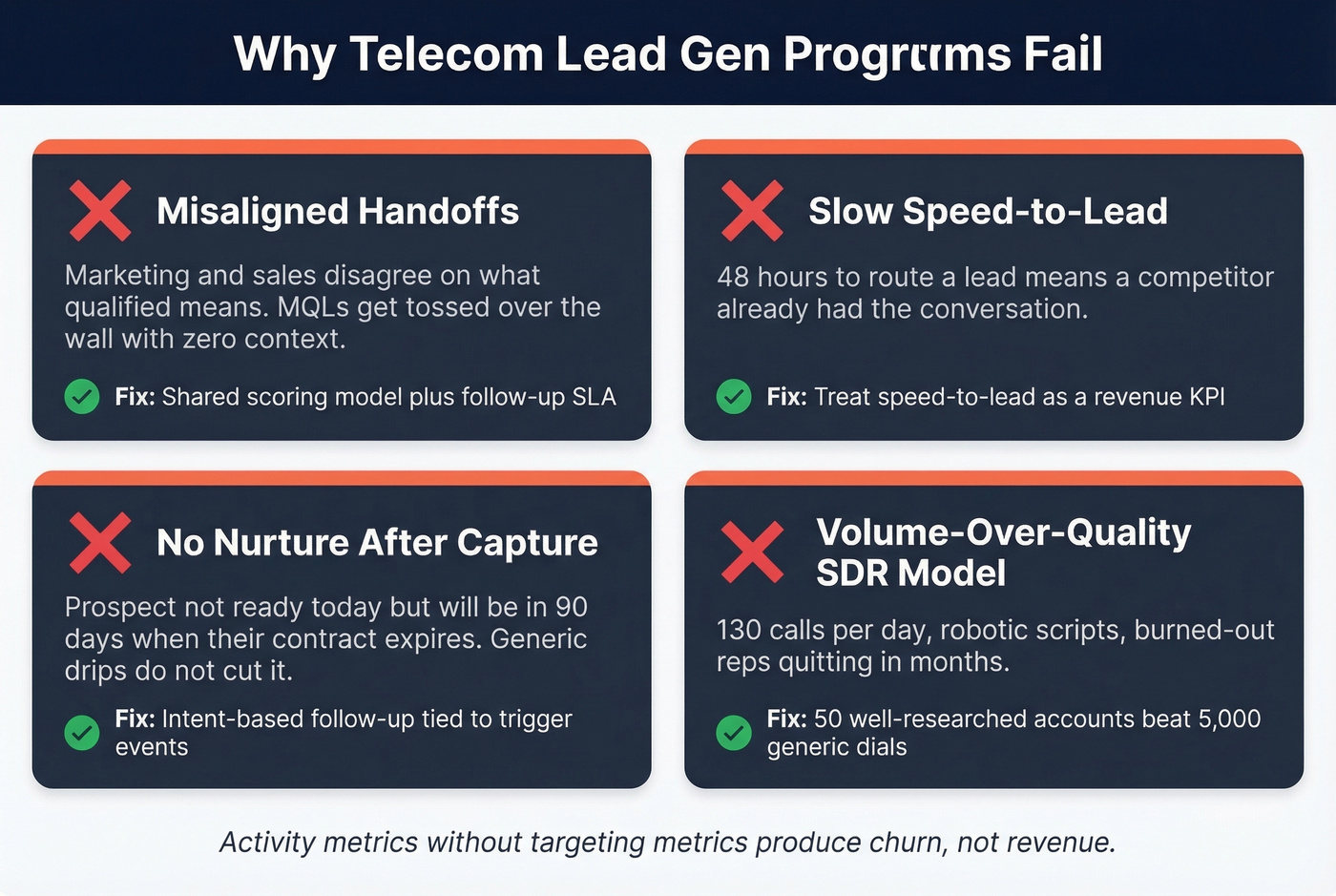
Slow speed-to-lead. If it takes 48 hours to route a lead to a rep, a competitor has already had the conversation. Speed-to-lead is a revenue lever - treat it as a KPI, not an afterthought.
No nurture after capture. A prospect who isn't ready today will be ready in 90 days when their contract expires. Generic drip sequences don't cut it - intent-based follow-up tied to trigger events does.
Volume-over-quality SDR models. This one drives me nuts. Reddit threads from telecom SDRs describe 130 calls per day, 2.5 hours of talk time, 50-hour weeks - starting with zero pipeline. That pressure makes reps sound robotic and burns them out in months. Fifty well-researched accounts will outperform 5,000 generic dials. The consensus on r/sales is pretty clear: activity metrics without targeting metrics produce churn, not revenue.
Benchmarks: What Good Looks Like
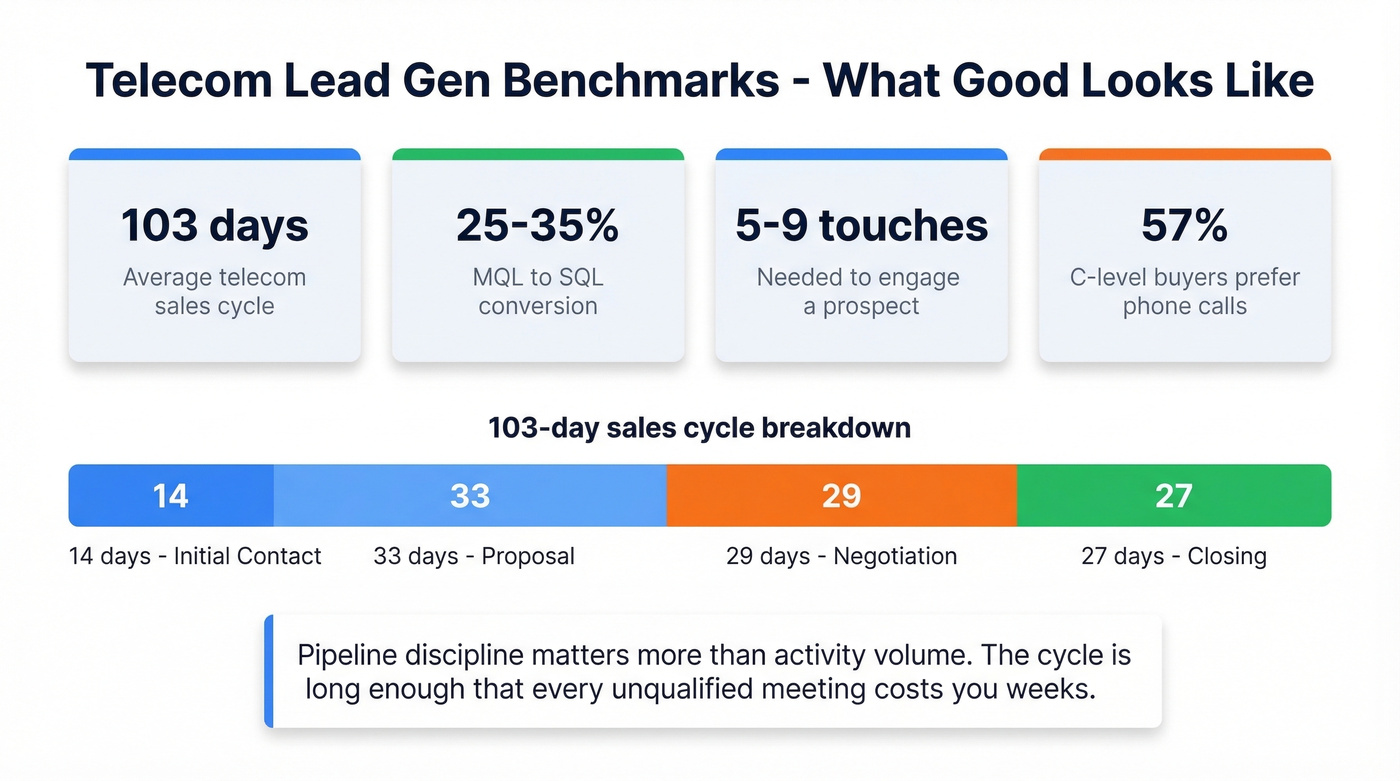
The average telecom sales cycle runs 103 days - 14 days for initial contact, 33 for proposal, 29 for negotiation, and 27 for closing. That's long enough that pipeline discipline matters more than activity volume.
| Metric | Benchmark |
|---|---|
| MQL to SQL | 25-35% |
| Sales cycle (total) | 103 days |
| ABM: meetings per 100 surging accounts | 5-10 in 30 days |
| Cold email reply rate | ~5.1% |
| Enrichment rate | 80%+ target |
If your enrichment tool returns contact data for fewer than 80% of the accounts you feed it, your database coverage is too thin. According to Forrester's B2B marketing research, 71% of B2B companies now run some form of ABM. For telecom teams, the ABM motion makes particular sense - you're targeting a finite set of accounts with identifiable trigger events. If you're booking fewer than 5 meetings per 100 surging accounts in 30 days, your targeting or messaging needs work.
To tighten targeting, build a simple scoring rubric with an ideal customer profile template.
Your 14-day sequence only works if CIOs and IT Directors pick up. Prospeo gives you 125M+ verified mobile numbers with a 30% pickup rate - nearly 3x the industry average. At $0.01 per email, you build verified telecom lists for less than your team's daily coffee run.
Get direct dials to the decision-makers who actually sign telecom contracts.
FAQ
How long does it take to see results from telecom outbound?
Outbound campaigns typically produce qualified meetings within 30-60 days of launch, assuming your ICP and data are solid. Inbound and content-driven programs take longer - expect a 6-18 month ramp. Start with outbound for near-term results while building inbound in parallel.
Should we outsource telecom lead gen or build in-house?
Build your ICP, messaging, and qualification criteria in-house first - you need to know what converts before handing it to an agency. Outsource execution only after you've proven the motion works, otherwise you're paying someone to guess on your behalf.
What's a realistic cost per qualified telecom meeting?
Expect roughly $150-$500 for SMB meetings, $500-$1,500 for mid-market, and $1,500+ for enterprise. Verified data cuts cost per meeting significantly by eliminating wasted activity - teams like Meritt saw bounce rates drop from 35% to under 4%, directly reducing cost per conversation.
How do I find accurate contact data for telecom decision-makers?
Use a verified B2B database with intent filters to target CIOs, IT Directors, and VPs of Operations at companies showing buying signals. A 98% email accuracy rate and 125M+ verified mobiles outperform bulk list purchases where 20-40% of contacts bounce on day one.
What's the biggest mistake in telecom lead gen?
Prioritizing volume over targeting. Fifty well-researched accounts with verified contacts and active buying signals will outperform 5,000 generic contacts every time. The math is simple - better data and tighter targeting compound at every stage of the funnel.