

How to Build a Territory Business Plan That Isn't Theater
It's January 2nd. You've got 200 accounts, a $1.2M quota, and a blank template your manager sent over with "please complete by Friday." As one rep put it on r/sales: "These annoy me cause I really don't think they're for you, they're to make your boss feel/look better." They're not wrong - 58% of B2B sales organizations rate their own territory business plan as ineffective. So let's build one that actually earns its keep.
The framework in five bullets:
- Know your pipeline coverage number. Quota x 4 = the pipeline you need. Without it, everything else is decoration.
- Score and tier your accounts. Not all 200 deserve the same effort. Top 15 get the real work.
- Set weekly activity targets per tier. Monthly goals are too abstract. Weekly numbers keep you honest (use these sales activities as a menu).
- Review weekly, not quarterly. A 15-minute Monday pipeline check beats a quarterly deep-dive that's already stale (especially if you track pipeline health).
- Use verified contact data. The best plan dies when 35%+ of your emails bounce on day one (see email bounce rate benchmarks and fixes).
What a Territory Business Plan Actually Is
Think of it as the business plan for your own patch. It answers three questions: which accounts deserve your time, how much pipeline you need to build, and what you're doing each week to close the gap. Whether you call it a sales territory plan or just "the plan," the function is the same - turn a list of accounts into a revenue engine.
Here's the thing most reps miss: territory design and territory planning aren't the same job. Design builds the structure - boundaries, assignment rules, rep allocation. Your manager handles that. Planning is what you do inside that structure. You own the plan.
Why It Matters More Than You Think
Industry benchmarks put [average quota attainment at 47-50%](https://www.forrester.com/blogs/your-companys-quota-attainment-is-probably-around-50-and-thats-not-a-bad-thing/). In recent years, up to 70% of B2B reps missed quota per EBSTA benchmarks. And here's the stat that should bother you: HBR research found 300% performance variability between top and bottom quintile reps working similar territories. Same product, same market, wildly different results.
Effective territory realignment alone can lift revenue 2-7% without adding headcount. On a $10M team, that's $200K-$700K found in the couch cushions. The reps hitting quota aren't necessarily better sellers. They're better planners (and usually more data-driven).
A Filled-Out Example
Here's a rep with a $1.2M annual quota, 200 accounts, and a 4x pipeline coverage target. Use this as a territory business plan template you can adapt to your own numbers.
Pipeline Math
| Metric | Number |
|---|---|
| Annual quota | $1.2M |
| Coverage ratio | 4x |
| Pipeline needed | $4.8M |
| Current pipeline | $1.9M |
| Gap to fill | $2.9M |
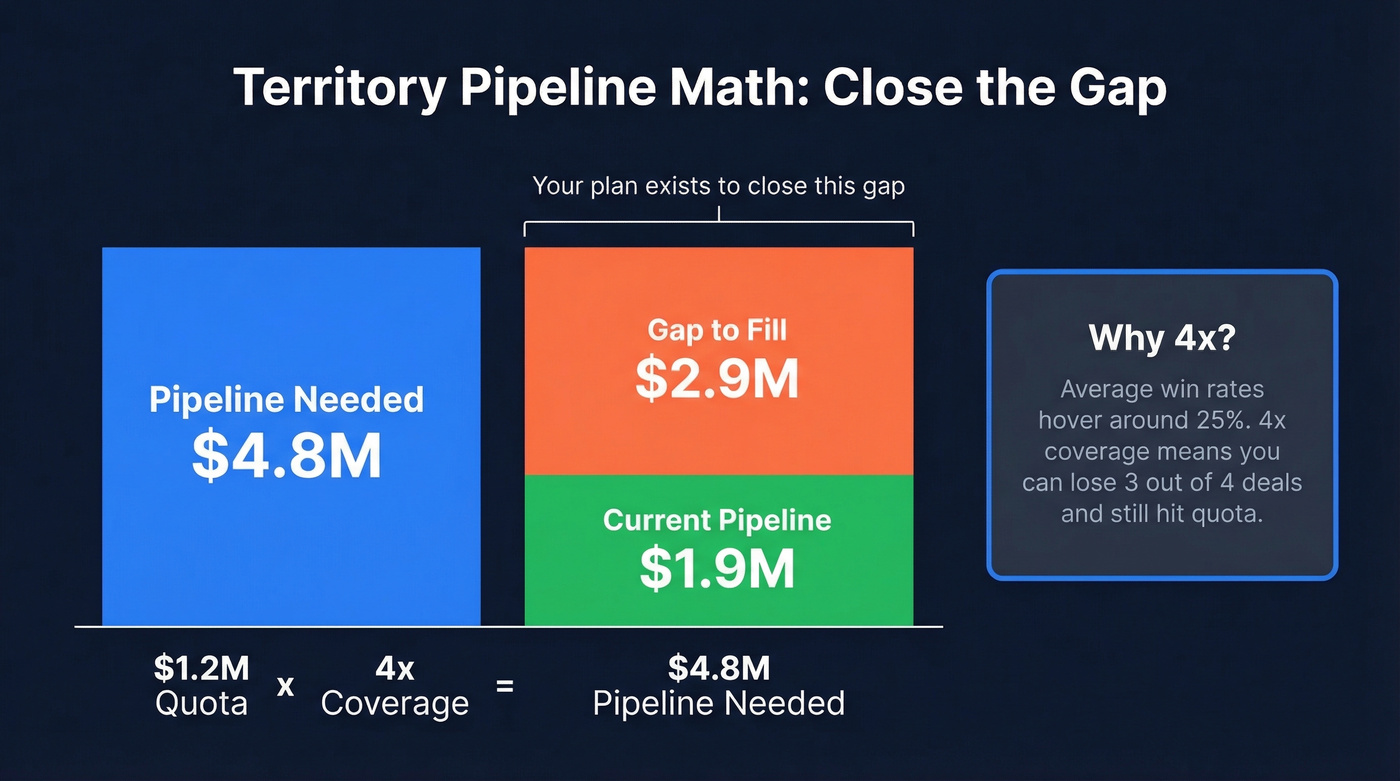
That $2.9M gap is the entire point of the plan. Everything below exists to close it.
Account Scoring Model
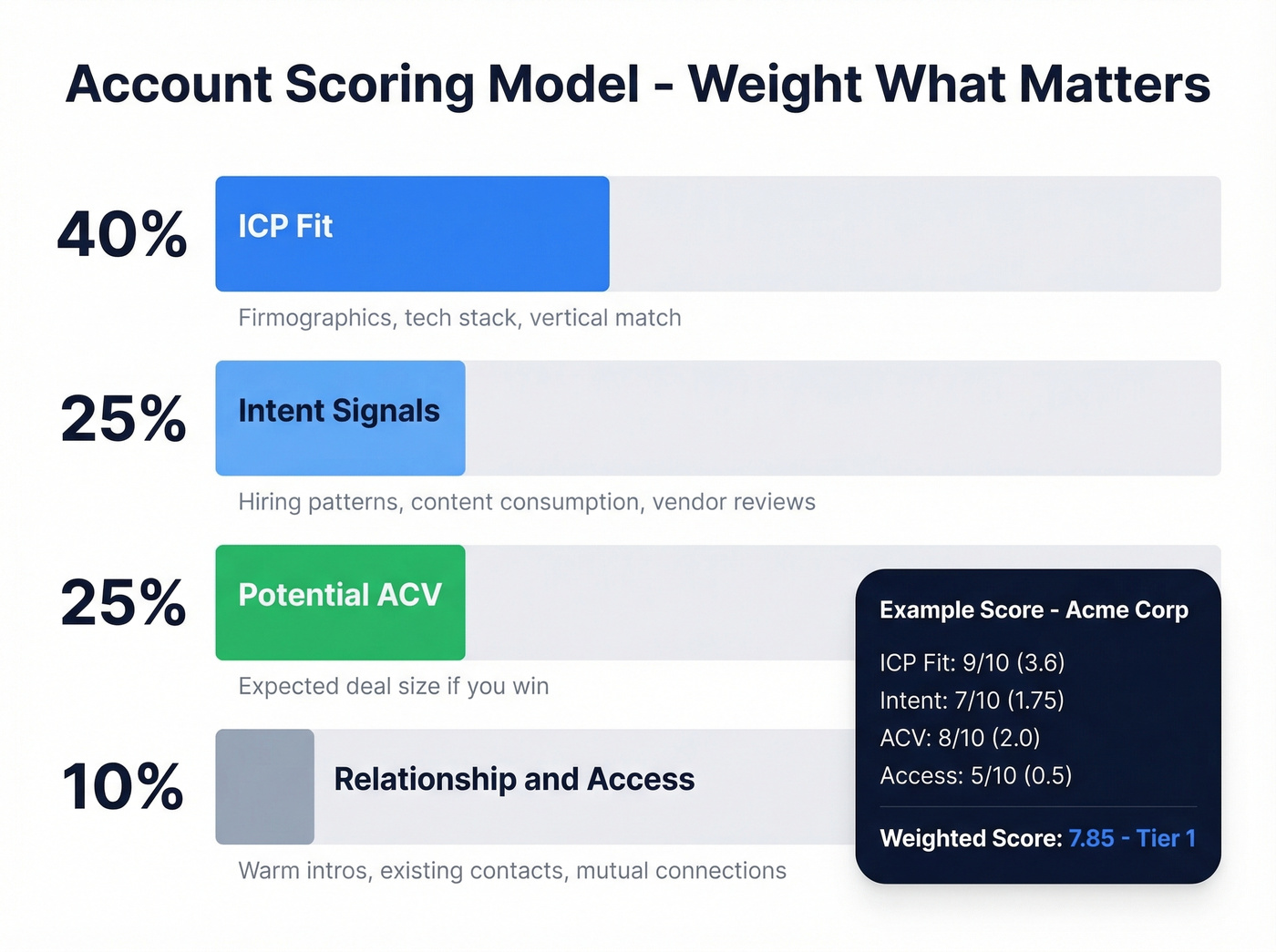
Score every account on four criteria:
| Criterion | Weight | What you're measuring |
|---|---|---|
| ICP Fit | 40% | Firmographics, tech stack, vertical |
| Intent signals | 25% | Hiring, content consumption, vendor reviews |
| Potential ACV | 25% | Deal size if you win |
| Relationship/Access | 10% | Do you know anyone? Warm intro possible? |
If you can't explain why an account is Tier 1, the scoring needs work (start with an ideal customer profile template).
Tier Strategy and Weekly Targets
- Tier 1 (top 15 accounts): Multi-threaded, personalized outreach. Map the buying committee, build custom business cases. 5+ personalized touches per week (use personalized outreach patterns that scale).
- Tier 2 (next 40 accounts): Semi-personalized sequences by vertical or pain point. 2 targeted sequences per week (tighten your sequence management).
- Tier 3 (remaining ~145 accounts): Automated sequences. Monitor for intent signals that bump them up. Review trigger alerts weekly (see identifying buying signals).
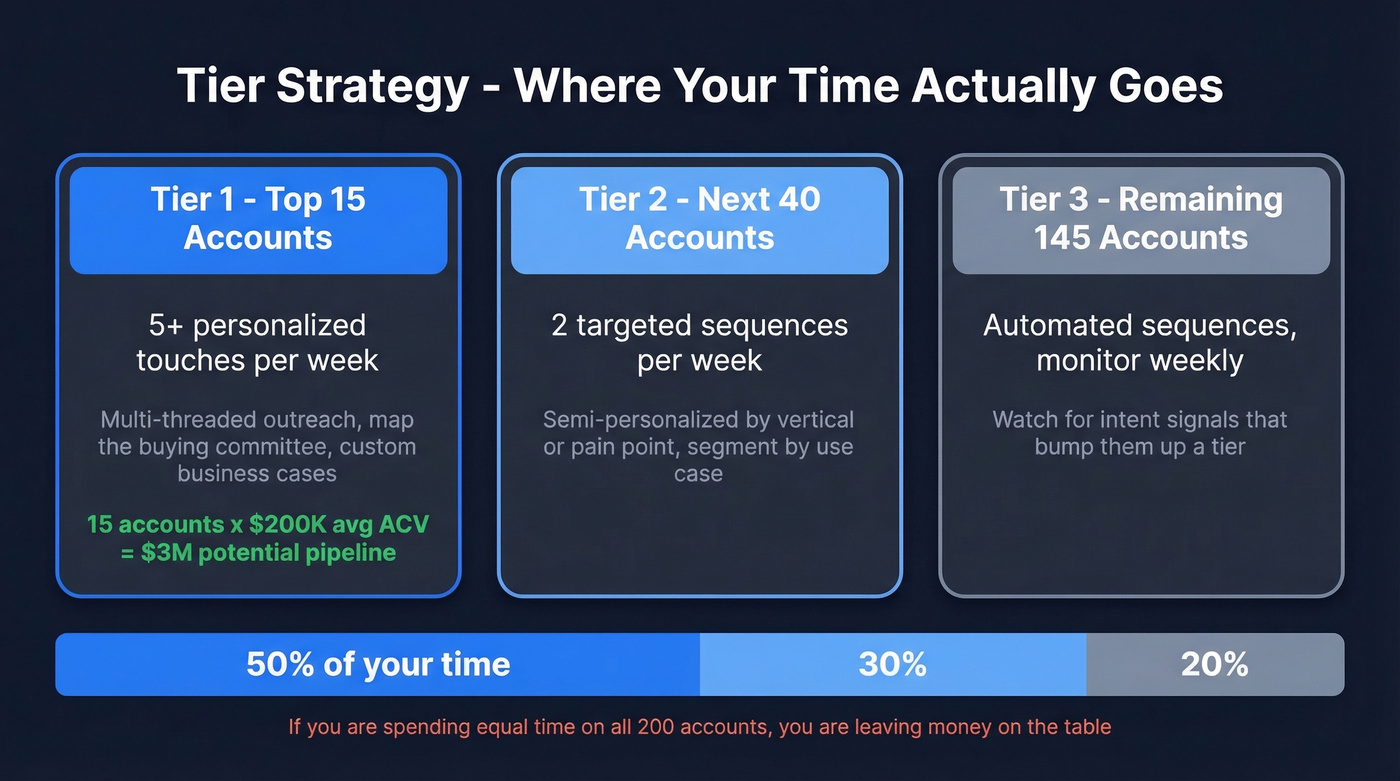
Fifteen Tier 1 accounts at $200K average ACV = $3M in potential pipeline from your best-fit targets alone. That already covers your gap with room for slippage.

Your Tier 1 accounts deserve verified contacts, not bounced emails. Prospeo's 300M+ profiles refresh every 7 days - so the buying committee you mapped this morning has accurate emails by this afternoon. At $0.01 per email with 98% accuracy, your territory plan stays alive all quarter.
Stop losing Tier 1 deals to stale data. Start prospecting for free.
How to Build Yours Step by Step
1. Analyze your market. Map your total addressable territory - existing customers, open opportunities, and whitespace. Where's the revenue today, and where's the gap? We've found that most reps skip this step and jump straight to outreach, which is like driving without checking the map first (ground it with TAM, SAM, SOM).
2. Score and tier accounts. Use the weighted model above. Pull firmographic, technographic, and intent data to score objectively rather than going with gut feel. Layering buyer intent signals - like Bombora topics tracking 15,000+ categories - helps you spot accounts actively researching solutions in your space.
3. Set pipeline targets with focus. Work backward from quota. 3x-5x coverage is the standard range; 4x is a solid default. Translate your gap into weekly activity numbers. This keeps effort aligned to revenue goals, not arbitrary territory lines (sanity-check against sales pipeline benchmarks).
4. Build verified prospect lists per tier. Refresh prospect data monthly so your sequences don't rot. One reason this matters: reps hit peak performance around year 3, and performance often declines by year 5 as territories go stale. Fresh data keeps the territory alive regardless of tenure.
5. Document in your CRM and build in flexibility. If the plan lives in a PowerPoint that nobody opens after QBR, it's theater. Put your tiers, scores, and activity targets where you actually work, and update them as markets evolve. A good territory management plan lives in your CRM, not on a shared drive.
5 Mistakes That Kill Territory Plans
1. Building the plan once and never touching it. 83% of companies still build territories manually, and most of those plans gather dust by February.
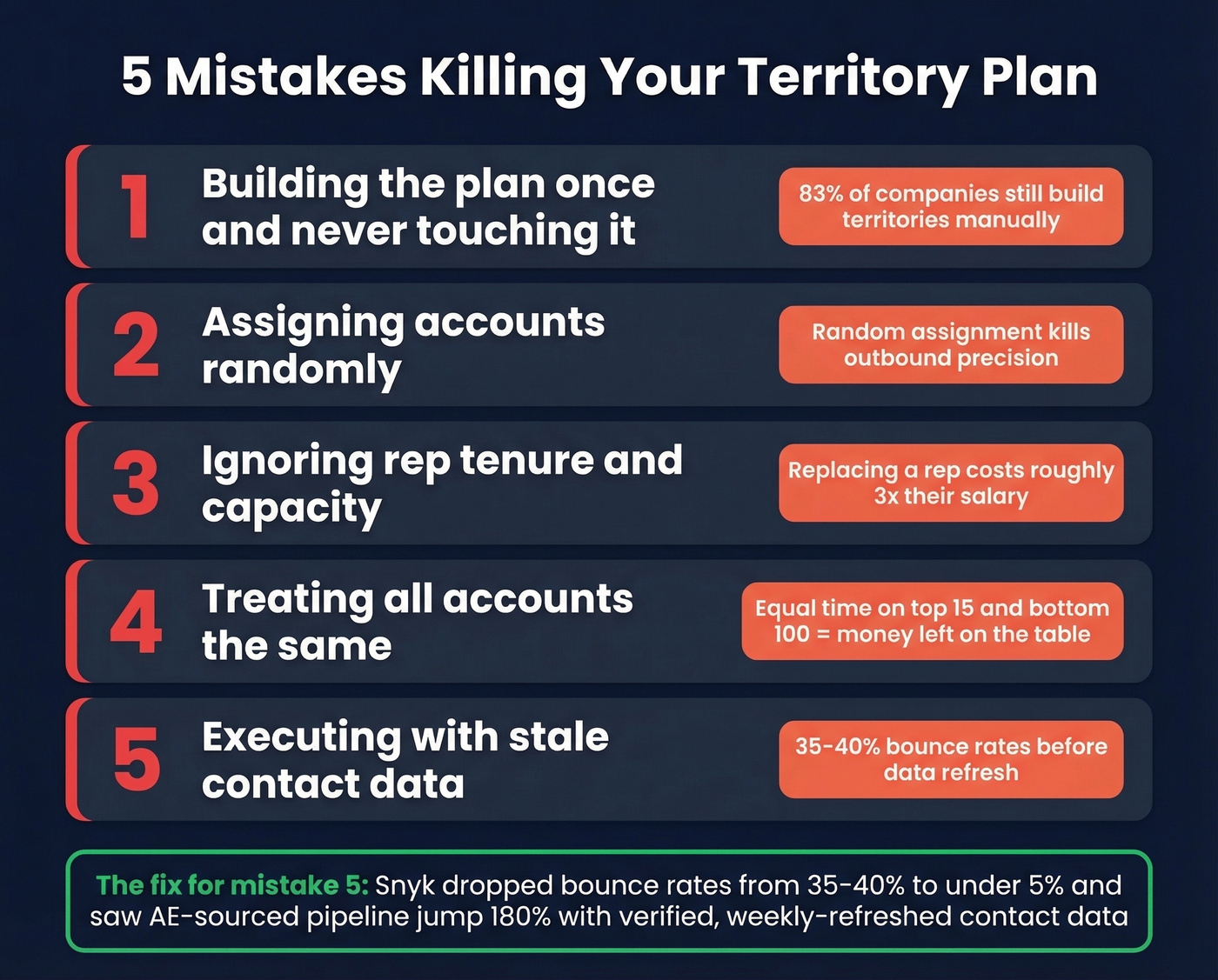
2. Assigning accounts randomly. Cognism's VP of Global Sales admitted they had "a real lack of focus on what a good fit account looked like because we were randomising the accounts that reps were being assigned to." Random assignment kills outbound precision, and no amount of hustle fixes a bad list.
3. Ignoring rep tenure and capacity. Average sales rep turnover sits around 35%. Overloading new reps accelerates that - and replacing a rep costs roughly 3x their salary. Skip this if you're an IC without direct reports, but flag it to your manager if you see it happening on your team.
4. Treating all accounts the same. If you're spending equal time on your top 15 and your bottom 100, you're leaving money on the table. Period.
5. Executing with stale contact data. You build a beautiful plan, score your accounts, set your activity targets - then 35-40% of your emails bounce because the data's outdated. We saw this firsthand with a customer (Snyk) whose AE team was dealing with 35-40% bounce rates before switching to Prospeo, which refreshes its 300M+ profiles every 7 days. Their bounce rate dropped under 5%, and AE-sourced pipeline jumped 180%. The best territory plan in the world can't survive bad data.
Your Execution Rhythm
Let's be honest: stop building annual territory plans. Markets shift too fast for that.
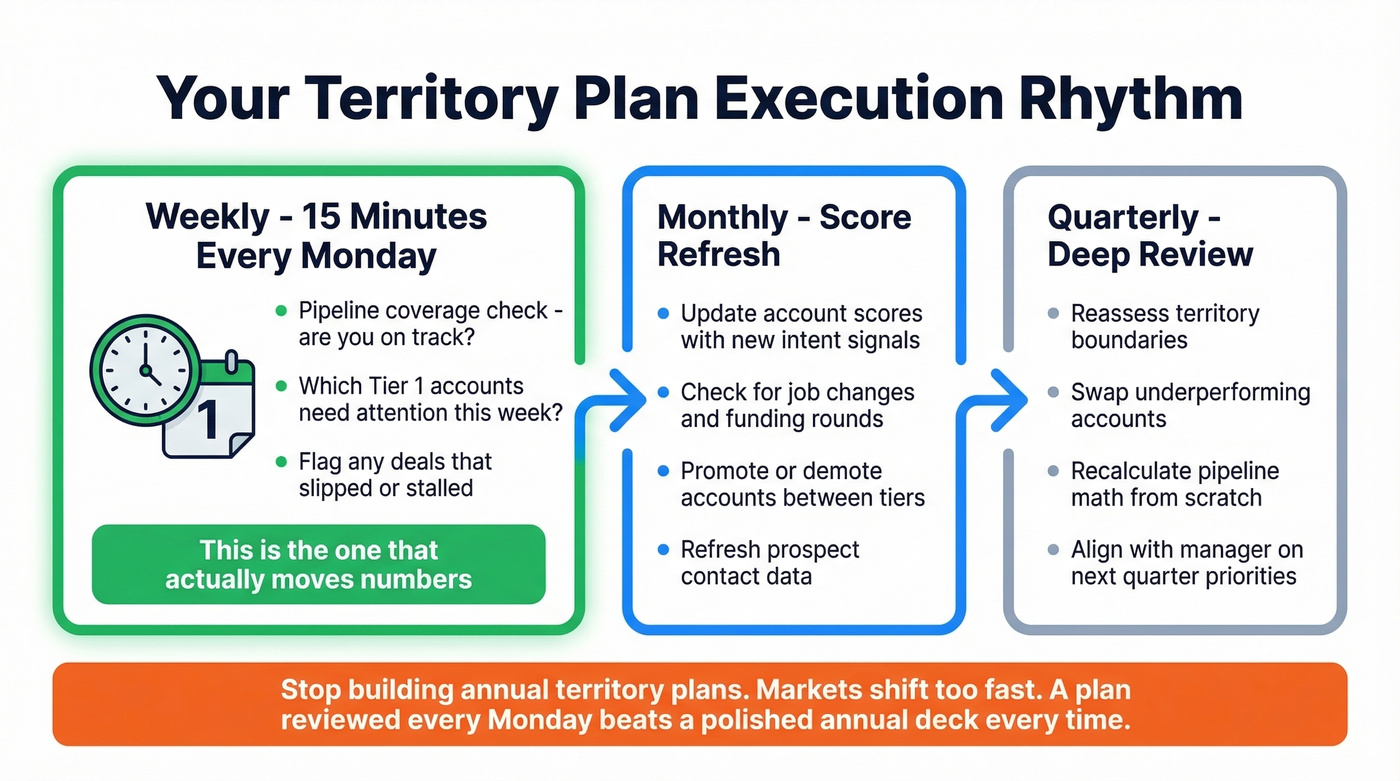
- Weekly (15 min): Pipeline check. Are you on track for coverage? Which Tier 1 accounts need attention this week?
- Monthly: Refresh account scores. New intent signals, job changes, or funding rounds can bump a Tier 3 account up overnight.
- Quarterly: Deep review. Reassess boundaries, swap underperforming accounts, recalculate pipeline math.
In our experience, the weekly check is the one that actually moves numbers. Everything else is maintenance. A territory business plan that gets reviewed every Monday will outperform a polished annual deck every single time - and it doesn't need to be pretty. It needs to be current.
Snyk's 50 AEs went from 35-40% bounce rates to under 5% - and AE-sourced pipeline jumped 180%. The difference wasn't a better territory plan template. It was verified contact data across every tier. Prospeo gives you 30+ filters including buyer intent, tech stack, and headcount growth to score and reach accounts in one platform.
Turn your territory plan from theater into pipeline. Try Prospeo free.
FAQ
What's the difference between a territory plan and an account plan?
A territory plan covers your entire patch - account assignment, pipeline targets, and weekly activity cadence across all tiers. An account plan goes deep on a single customer's buying committee, pain points, and deal strategy. You need both. The territory plan comes first and tells you which accounts deserve a dedicated account plan.
How often should I update my territory business plan?
Run a 15-minute pipeline check every Monday, refresh account scores monthly, and do a full territory reassessment quarterly. Annual-only planning is a relic - buying committees and market conditions shift too fast for a plan that sits untouched for 12 months.
What tools do I need for territory planning?
At minimum: your CRM for tracking tiers and activity, a spreadsheet for scoring, and a verified data source for prospect lists. For the data layer, you want something with intent signals and technographic filters so you can score accounts objectively rather than guessing. Whatever tool you pick, make sure the email accuracy is high enough that your sequences don't bounce on launch day.
Is there a ready-made template I can start with?
The filled-out example above works as a ready-made template. Copy the pipeline math table, the account scoring model, and the tier strategy into your CRM or spreadsheet, then swap in your own quota, account list, and coverage ratio. Adjust the 4x multiplier based on your average win rate - lower close rates need higher coverage.