

Time Management for Salespeople: Stop Being Busy, Start Closing
It's 9:15 AM. You've already answered 14 emails, updated three opportunity stages in Salesforce, sat through a 30-minute pipeline review, and Slacked your manager a deal update. You haven't talked to a single prospect. By the time you pick up the phone, it's 10:45 - and your "selling day" is already half gone.
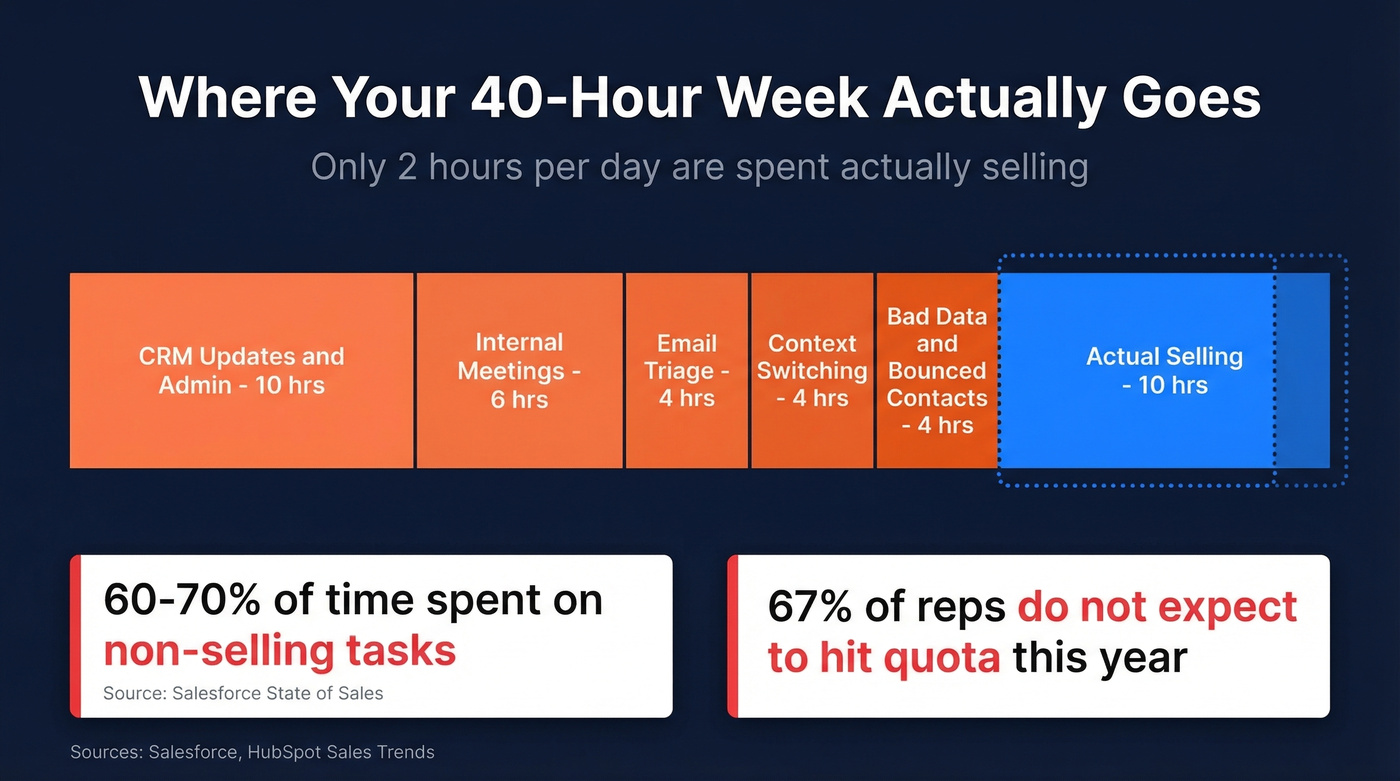
We've watched reps lose their entire morning this way. It's not a discipline problem. It's a structural one. Sales reps spend 60% of their time on non-selling tasks, and 67% don't expect to hit quota this year. Those two facts aren't a coincidence. Better time management for salespeople starts with understanding where the hours actually go - then building a system to reclaim them.
The Quick Version
If you only do three things after reading this:
- Audit where your time actually goes for one full week. Most reps are shocked when they see the numbers.
- Automate CRM updates and follow-ups with an AI assistant - this alone can reclaim 5+ hours a week.
- Verify your prospect data before you start dialing. Bad numbers and bounced emails destroy every scheduling strategy. A tool like Prospeo - 98% email accuracy, 7-day refresh cycle - makes this automatic.
Where Your Time Actually Goes
HubSpot's sales trends research puts it at about two hours per day actually selling. Two hours. Out of eight or nine. Salesforce reported 70% non-selling time in their latest data, virtually unchanged from 72% in 2022. Tools have gotten better. The problem hasn't.
And if you've ever felt like you spend more time logging activities than doing them, you're not imagining it.
| Time Drain | What It Looks Like | Fix |
|---|---|---|
| Manual CRM updates | Logging calls, emails, notes, next steps | AI auto-logging via Gong, Demodesk |
| Internal meetings | Pipeline reviews, forecast calls, approvals | Async updates, dashboards |
| Context switching | Jumping between calls, inbox, CRM, Slack | Tighter tool stack + batch work |
| Admin follow-ups | "Just checking in" emails, task reminders | Automated sequences (use these sales follow-up templates) |
| Bad numbers / bounced emails | Disconnected lines, wrong contacts, bounces | Verified contact data (see data enrichment services) |
| Email triage | Constant inbox checking | 2-3 check windows per day |
Put it against that benchmark and the math is brutal: in a 40-hour week, 60-70% non-selling time is roughly 24-28 hours spent on things that don't generate revenue.
Five Mistakes Killing Your Numbers
1. Treating every opportunity as equal. If you're spending the same energy on a $5K deal with no champion as a $50K deal with an exec sponsor, you're misallocating your most valuable resource. Qualify and rank your pipeline weekly (use sales activities examples to prioritize what actually moves deals).
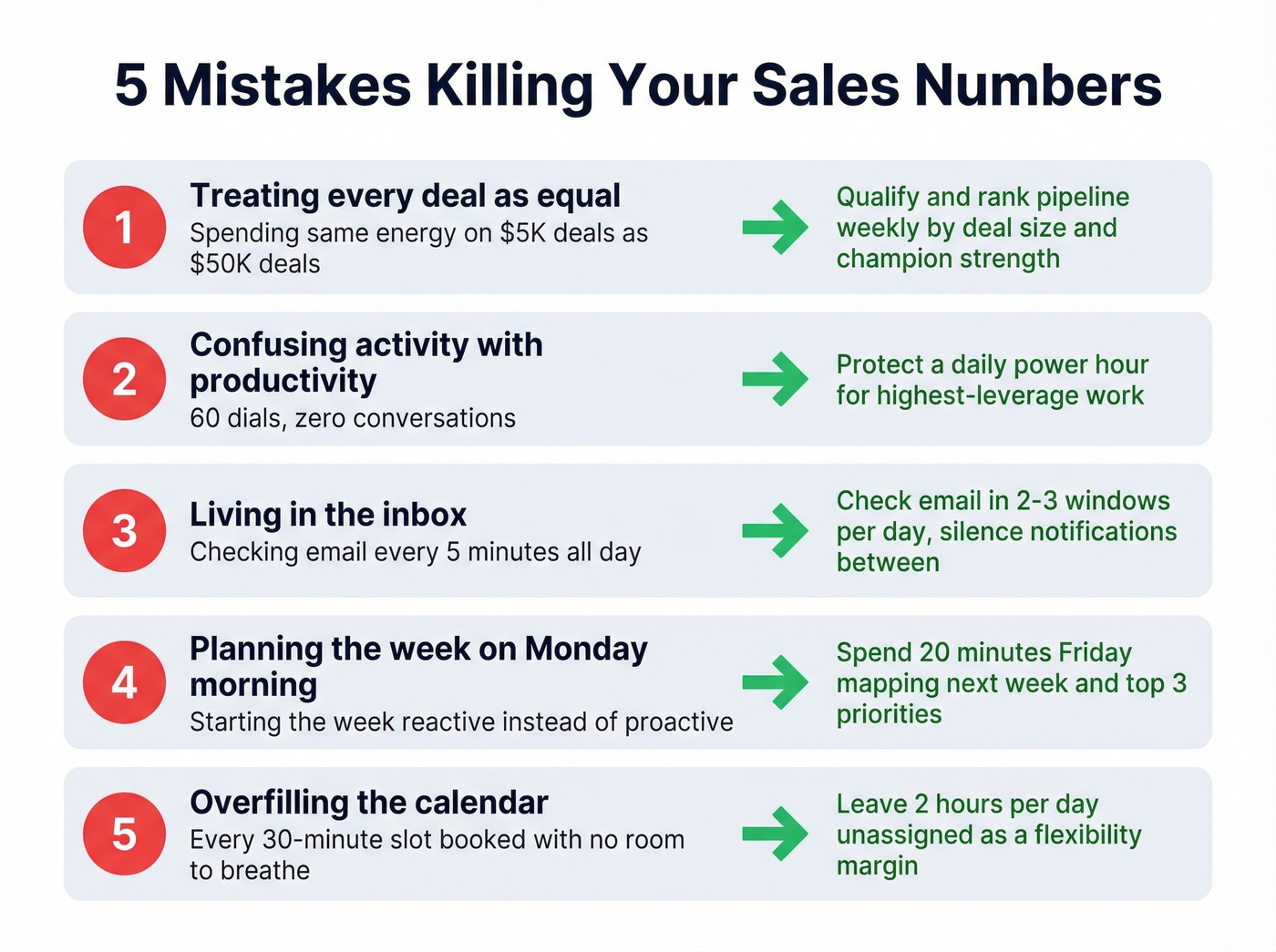
2. Confusing activity with productivity. Sixty dials and zero conversations isn't a productive morning - it's a busy one. Protect a daily "power hour" for your highest-leverage activity, whether that's advancing late-stage deals or prospecting into your best accounts (borrow from these sales prospecting techniques).
3. Living in the inbox. Email is other people's to-do list for you. Check it in two to three windows per day. Silence notifications between those windows. The urgent stuff will find you through Slack or a phone call.
4. Failing to plan the week on Friday. Monday morning is too late. Spend 20 minutes on Friday mapping your next week - identify your top three priorities, block time for them, and front-load your hardest outreach to Tuesday and Wednesday mornings. This single habit has done more for the reps we've coached than any tool purchase (pair it with a 30-60-90 day plan for sales reps if you're ramping).
5. Overfilling the calendar. If every 30-minute slot is booked, you have zero capacity for the deal that suddenly needs attention or the prospect who replies unexpectedly. Leave a couple of hours per day unassigned. That buffer isn't wasted time - it's your flexibility margin.
Strategies That Actually Stick
Most sales productivity advice boils down to "be more disciplined." That's not a system. Here's one that is.
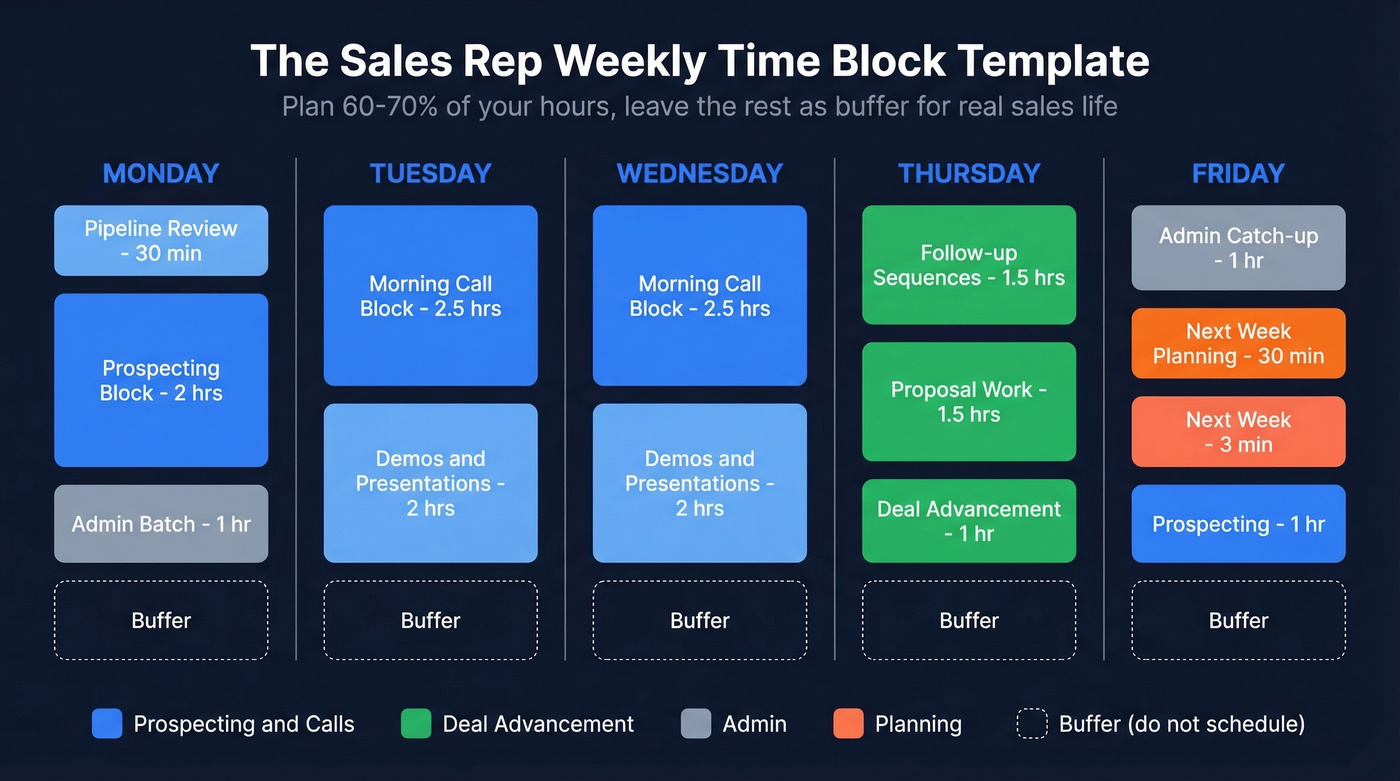
Start with the 60-70% rule: only plan 60-70% of your working hours. The rest is buffer for the unpredictable reality of sales - urgent deal requests, last-minute demos, a prospect who finally picks up. Time blocking at this capacity can increase productivity by 20-30% compared to reactive scheduling. In our experience, this is the one framework that actually sticks because it accounts for how sales really works.
Then layer in cyclical monthly planning. Early in the month, weight your calendar toward prospecting and first meetings. Mid-month, shift toward presentations and proposals. End of month, protect your time for closing activities and negotiation (use these steps to close a sale as your checklist). This mirrors how pipeline naturally flows and prevents the end-of-quarter scramble where reps try to prospect and close simultaneously - and do neither well.
Here's why this matters more than ever: the average B2B deal now involves 7.4 decision-makers, and 70% of the buyer's journey is complete before they ever talk to a rep. Your selling window is already compressed. Wasting it on admin makes it nonexistent.
A sample weekly structure: Mondays start with a 30-minute pipeline review, followed by a two-hour prospecting block and a one-hour admin batch. Tuesdays and Wednesdays are your peak selling days - morning call blocks of two to three hours, demos and presentations in the afternoon. Thursdays are for follow-up sequences, proposal work, and deal advancement. Fridays close out with an hour of admin catch-up, 30 minutes of next-week planning, and an hour of prospecting to keep fresh pipeline flowing into the next week.
The key is batching similar tasks together. Context switching between calls, emails, CRM updates, and Slack kills your momentum. When you batch, you stay in the same mental mode and move faster.

You just read that reps spend 70% of their time on non-selling tasks. Bad contact data makes it worse - every bounced email and disconnected number is time you'll never get back. Prospeo delivers 98% email accuracy on a 7-day refresh cycle, so your prospecting blocks actually produce conversations instead of dead ends.
Stop burning your two selling hours on contacts that don't exist.
Let AI Handle the Admin
Sellers who partner with AI sales assistants are 3.7x more likely to meet quota. And 85% of reps using AI say it frees them for higher-value work. This isn't about replacing reps - it's about eliminating the CRM data entry, call summarization, and follow-up drafting that eats your selling hours (more options in our guide to generative AI sales tools).
Skip Gong if you're a solo rep or small team. At roughly $5K/year in platform fees plus $1,360-1,600 per user annually, it's built for sales leaders coaching at scale.
Demodesk at $59/mo per user is the sweet spot for most teams. It handles AI note-taking and reduces the time reps spend on CRM updates, saving 30-40% of the time previously spent on manual logging. For the price, that's a strong ROI.
Already on HubSpot? Don't add another tool. HubSpot Sales Hub at $90/seat/mo for Professional integrates natively with your CRM, and 63% of users report saving at least four hours per week per rep. That's a full half-day back (compare CRMs with these examples of a CRM).
One distinction worth making: sales automation - sequencing, CRM logging, call recording - is different from marketing automation like nurture campaigns and lead scoring. You need the former. The latter is your marketing team's problem.
Fix Your Data Before Your Schedule
Here's the thing most time management advice ignores completely.
You've blocked your 10-11 AM cold call window, batched your outreach, and protected your power hour. You sit down, dial 30 numbers - and eight are disconnected, five go to the wrong person, and three emails bounce before lunch. That's not a discipline problem. That's a data problem, and no amount of time blocking fixes it (start with email bounce rate basics if you're diagnosing deliverability).
When Snyk rolled out Prospeo across 50 AEs, their bounce rate dropped from 35-40% to under 5%. AE-sourced pipeline jumped 180%, with 200+ new opportunities per month. The reps didn't suddenly get better at selling - they stopped wasting time on dead contacts. The search interface lets you filter by job title, headcount, industry, and intent signals across 300M+ professional profiles, so you build targeted lists in minutes instead of hours (see what to look for in a sales prospecting database).

The best time-blocking system in the world falls apart when your prospect list is full of stale data. Prospeo's 300M+ profiles are refreshed every 7 days - not every 6 weeks like competitors - so your Tuesday morning call block connects you to real buyers at $0.01 per verified email.
Make every time block count with data that's never more than a week old.
Build a Lean Tech Stack
29% of sales reps say reducing their tech stack would make them more efficient. We've seen this firsthand - teams running seven or eight tools spend more time switching between tabs than actually using any of them.
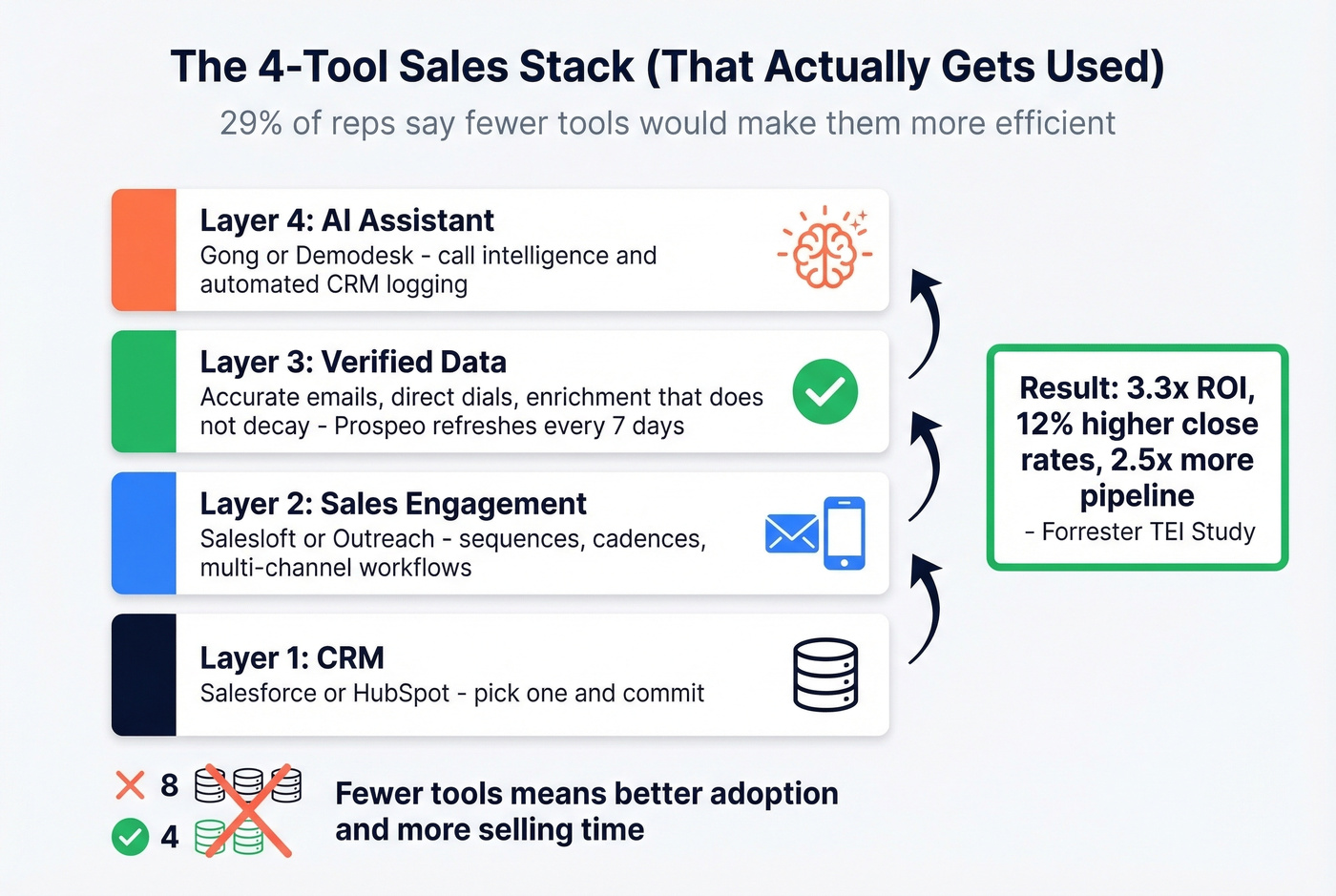
The ideal sales stack has four layers:
- CRM - Salesforce or HubSpot. Pick one and commit.
- Sales engagement - Salesloft or Outreach for sequencing, cadences, and multi-channel workflows (implementation tips: implementing a sales engagement platform).
- Verified data - Accurate emails, direct dials, and enrichment that doesn't decay.
- AI assistant - Gong or Demodesk for call intelligence and automated CRM logging.
That's it. Four tools. A Forrester TEI study on Salesloft found that consolidating tools saved $1.3M in technology costs and drove a 40% increase in selling activity without adding headcount. Fewer tools, better adoption, more selling time.
Let's be honest: if your average deal size is under $15K, you probably don't need a $50K/year data platform or a six-figure tech stack. A lean four-tool setup will outperform a bloated eight-tool mess every time - not because the tools are better, but because your reps will actually use them. The consensus on r/sales backs this up: the threads about "tool fatigue" are endless, and the advice is always the same. Simplify.
What Better Scheduling Is Worth
That same Forrester research reported 3.3x ROI, 12% higher close rates, and 2.5x more pipeline for teams that invested in productivity infrastructure.
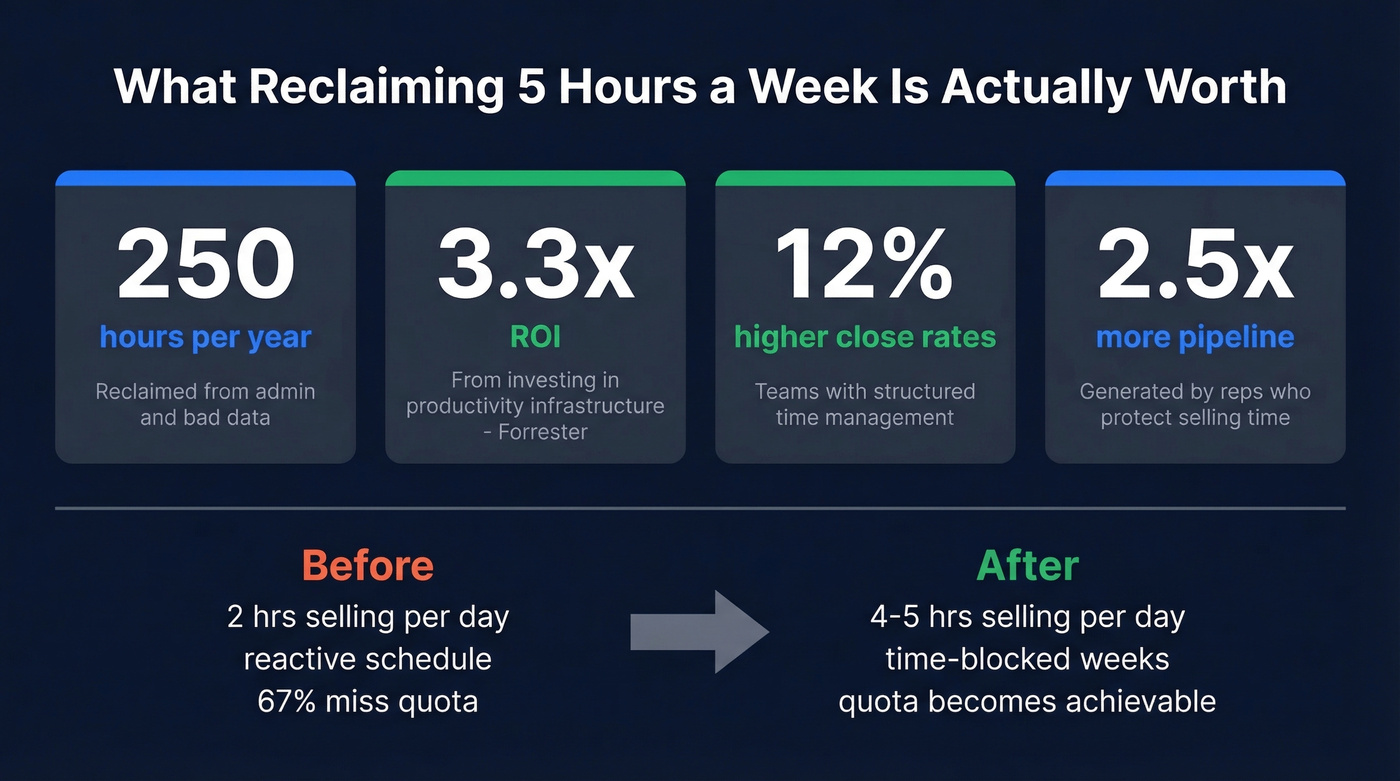
But you don't need a model to do the math. Reclaim five hours a week and that's 250 hours a year. At a conservative 10 additional prospect conversations per week, you're looking at dozens of extra opportunities per quarter. For most reps, that's the difference between hitting quota and missing it.
Start this Friday. Twenty minutes of planning will tell you more about your time problem than any article - including this one.
FAQ
How many hours a day should a rep spend selling?
The current reality is about two hours. The goal is four to five - prospecting calls, demos, negotiations, deal advancement. Closing that gap requires time blocking, AI automation, and verified data rather than longer hours. Reps who reclaim even 90 extra minutes daily see measurable pipeline growth.
What's the best time blocking method for sales?
Plan 60-70% of your available hours and batch similar tasks together. Weight prospecting early in the month, closing at the end. Rigid hour-by-hour schedules break on the first unexpected call - flexible blocks with clear priorities hold up because they mirror how deals actually move through a pipeline.
How do I reduce admin time without my manager noticing?
AI notetakers like Demodesk handle call logging and CRM updates invisibly - your manager sees better data, not less effort. Pair that with verified contact data so you're not wasting dials on disconnected numbers. The result is more conversations and cleaner pipeline, which is what managers actually measure.
How do I stay focused and beat sales procrastination?
Sales procrastination usually isn't laziness - it's unclear priorities or dread around a specific task like cold calling. Batch your hardest outreach into a single morning block, set a timer, and commit to a minimum number of dials before you check anything else. Design your environment so the path of least resistance is the highest-value activity. That's the real fix.