

21 Tips for Sales Backed by Data, Not Motivational Fluff
You just got off a pipeline review where half the "qualified" deals haven't moved in six weeks. The other half are single-threaded to a champion who keeps saying "let me check internally." Meanwhile, your outbound sequence is bouncing more than it should. The gap between sales advice and sales reality has never been wider - so here are 21 tips for sales teams that want results, not platitudes.
These recommendations are built for mid-market and enterprise B2B reps selling $5K+ deals into buying committees. Whether you're looking for beginner guidance or advanced techniques to increase close rates, every recommendation below is anchored to real data.
Key benchmarks to measure yourself against:
| Metric | Underperforming | On Track |
|---|---|---|
| Email bounce rate | >6% | 2-5% |
| Talk-to-listen ratio | Swings 10+ pts | Stays within 5 pts |
| Buyer contacts per deal | 1-2 | 5+ for complex deals (17 avg. on enterprise) |
| Sales cycle | 50+ days | Within 50 days (47% win rate) |
HubSpot's 2026 State of Sales survey paints a cautiously optimistic picture: 59.9% of teams are on track to hit targets, 68% report lead quality improved year-over-year, and 93% say deal sizes are holding steady or growing. But the top deal killers remain no product fit (37%) and poor value for money (35%). Deals are more complex than ever - 81% of revenue leaders confirm it. The reps who win in complex environments share specific habits backed by specific data, and those habits are what separate consistent closers from reps running on gut feel.
Prospecting: Tricks That Move Pipeline
Cold Calling Still Works
The "cold calling is dead" crowd has been wrong for a decade. An analysis of 300M+ cold calls found top-quartile callers book 3x more meetings than average peers. That's not a marginal improvement - it's a completely different pipeline trajectory.
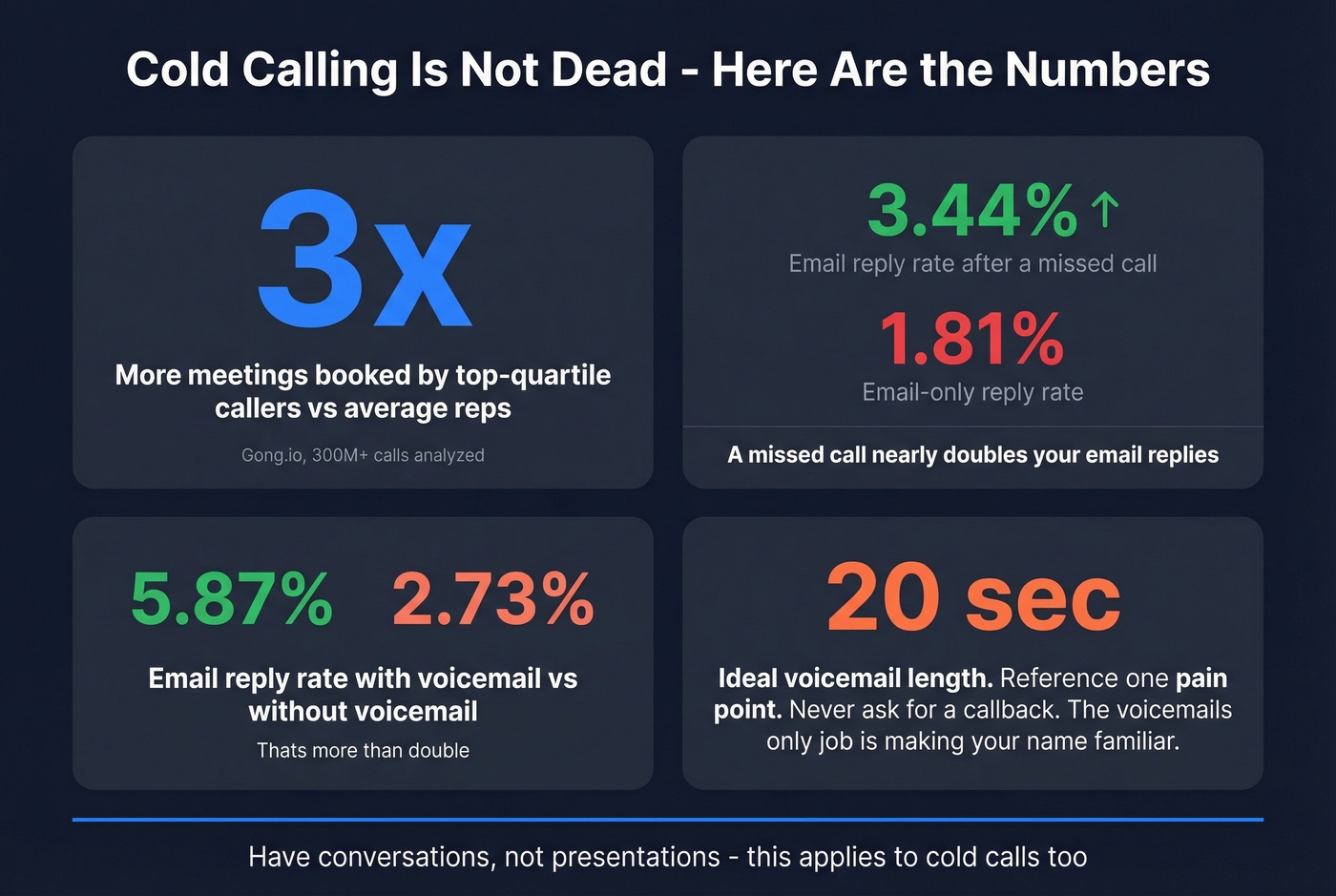
Here's the part most people miss: cold calling nearly doubles email reply rates even when the call doesn't connect. Prospects who see a missed call reply to your follow-up email at 3.44% versus 1.81% for email-only outreach. The phone call creates familiarity. The email capitalizes on it. As one r/sales commenter put it: "Have conversations, not presentations." That applies to cold calls too - the best openers ask a question, not deliver a pitch. If you're building a repeatable motion, a documented cold calling system helps keep quality consistent across reps.
Leave Voicemails (They're Email Fuel)
Do this: Leave a 20-second voicemail referencing one specific pain point, then send your email within the hour. Voicemails push email reply rates from 2.73% to 5.87% - more than double.
Not that: Don't ask for a callback. Nobody's calling you back. The voicemail's only job is to make your name familiar so the email gets opened.
Go Multi-Channel or Go Home
96% of prospects research companies before engaging a rep, and 71% prefer independent research over talking to someone in sales. Meanwhile, 69% of cold email senders say performance declined year-over-year thanks to spam filtering and AI content fatigue.
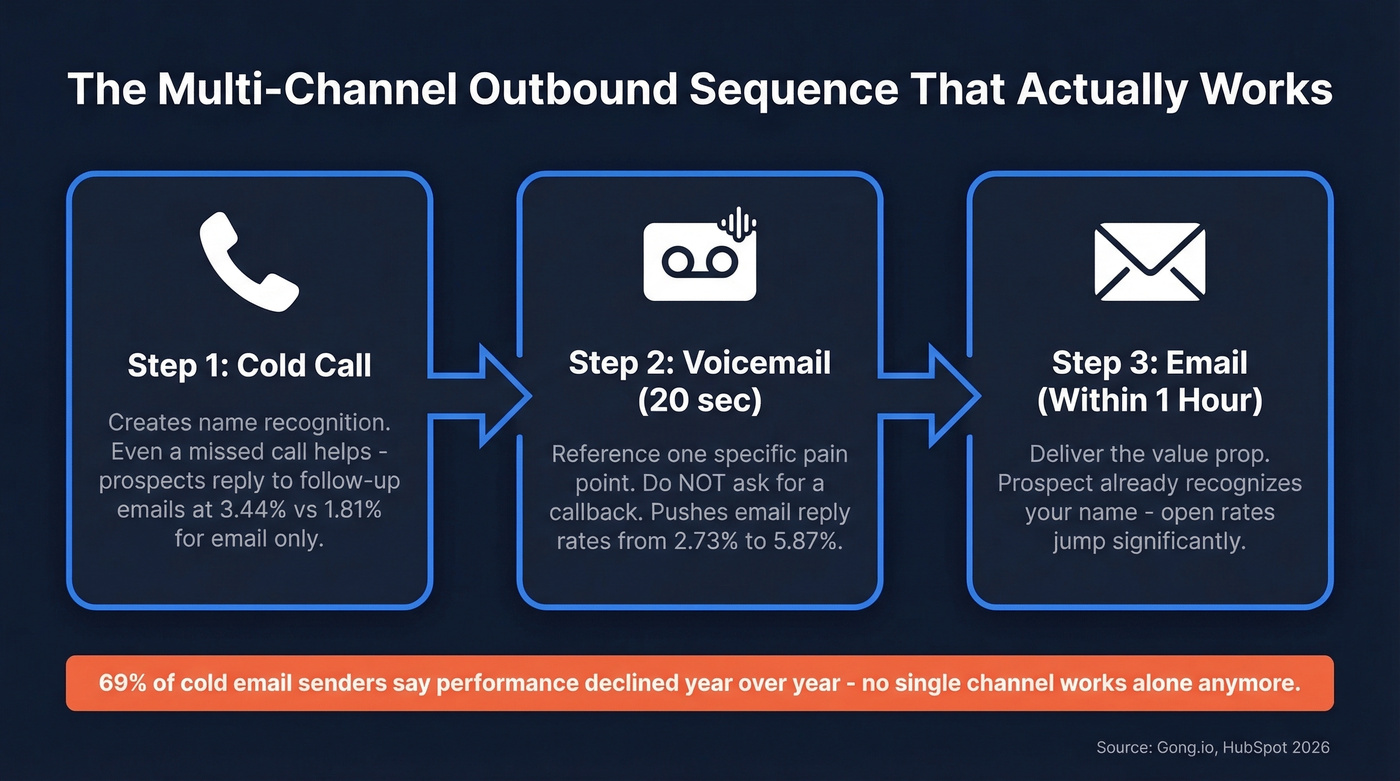
The winning pattern across outbound teams: phone + email + voicemail in coordinated sequences. A cold call creates name recognition. A voicemail drives the email open. The email delivers the value prop. No single channel carries the weight anymore - the combination does. If you want more ideas beyond this playbook, start with these sales prospecting techniques.
Fix Your Data First
You can nail your messaging, timing, and channel mix and still fail if your contact data is garbage. Bad data means bounced emails that torch your domain reputation, dead dials that waste rep hours, and inflated pipeline that never converts. This is among the most effective tips for sales teams at any stage, yet it's the one most often ignored.
Meritt's story makes this concrete. Their bounce rate was running 35% before they switched to Prospeo. After the switch, it dropped under 4%, connect rate tripled to 20-25%, and pipeline went from $100K to $300K per week. That's the difference verified data makes - a 98% email accuracy rate and 7-day data refresh cycle mean reps spend time selling, not chasing dead leads. If you're troubleshooting bounces, this email bounce rate guide breaks down benchmarks and fixes.

Discovery & Qualification
How to Be a Better Listener
The classic 43/57 talk-to-listen ratio gets cited everywhere, but deeper analysis adds a crucial nuance: consistency matters more than the exact ratio. Low performers' talk time swings 10 points between won and lost deals - 54% on wins versus 64% on losses. Top performers stay in a tight band regardless of outcome.
The takeaway isn't "talk less." It's "develop a rhythm and stick to it." If you're naturally at 45/55, that's fine. If you're swinging from 40% to 65% depending on how nervous you are, that inconsistency is costing you deals. Record your calls, review transcripts, and track your ratio week over week. That kind of deliberate practice builds the muscle faster than any coaching session.
Qualify Ruthlessly
Not every lead deserves a discovery call. Use a framework - BANT, MEDDIC, whatever fits your motion - but actually disqualify. Here's a quick checklist:
- Budget authority confirmed? If the person can't sign or influence the deal, ask who can.
- Timeline is real? "Sometime next quarter" isn't a timeline. Get a date or a trigger event.
- Problem is quantified? If they can't put a number on the pain, the deal will stall at procurement.
- Decision process mapped? Know who else needs to say yes before you invest demo hours.
A fast "no" is worth more than a slow "maybe" that clogs your pipeline for two quarters. If you're running MEDDIC, these MEDDIC discovery questions help you disqualify faster without being abrasive.
Sell to the Buying Committee
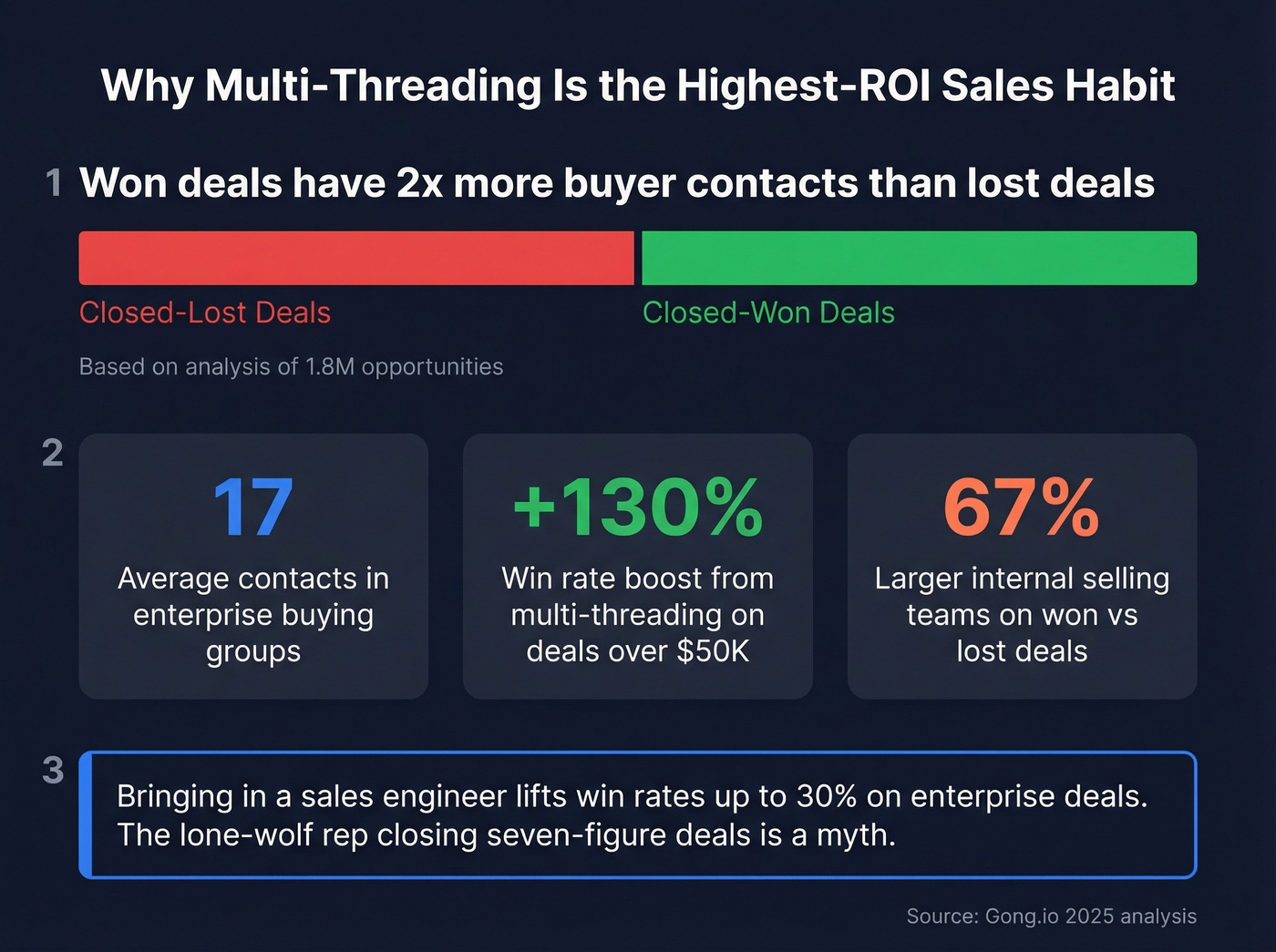
This is the single biggest differentiator in complex B2B sales right now. An analysis of 1.8M opportunities found closed-won deals have 2x as many buyer contacts as closed-lost. Enterprise deals average 17 contacts in the buying group. Multi-threading boosts win rates by 130% on deals over $50K.
Team selling amplifies this further. Internal selling teams on won deals are 67% larger than on lost deals, and bringing in a sales engineer lifts win rates up to 30% on enterprise deals. The lone-wolf rep closing seven-figure deals is a myth. For B2B sellers, multi-threading is the single highest-ROI habit you can build. If you need a shared definition and operating model, see team selling.
Closing Techniques That Work
Control Your Sales Cycle
Deals closed within 50 days carry a 47% win rate. After 50 days, win rates drop to 20% or lower. That's not a gradual decline - it's a cliff.
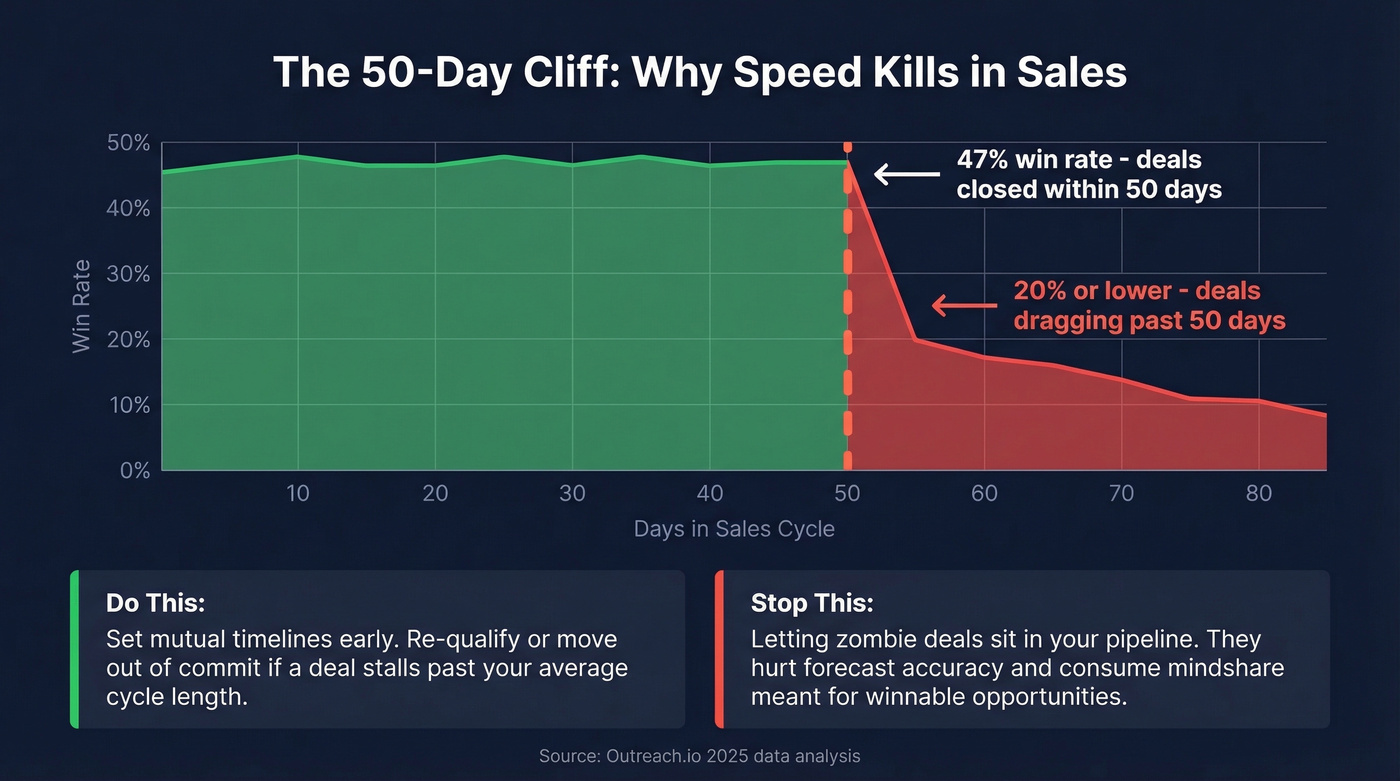
Set mutual timelines early. If a deal stalls past your average cycle length, either re-qualify or move it out of commit. Zombie deals don't just hurt forecast accuracy - they consume mindshare that should go toward winnable opportunities. If you're trying to diagnose why deals stall, these sales pipeline challenges are the usual culprits.
Mention Competitors Early
Most reps avoid bringing up competitors, hoping the buyer won't either. That's backwards. Early competitor mentions increase win odds by 32% on enterprise deals. Competitive mentions in sales conversations are up 57% since 2022 - buyers are doing their homework, and they respect reps who acknowledge the field honestly. If you're afraid to discuss competitors, you probably don't know your differentiation well enough. Fix that first. A simple way to operationalize this is with sales battle cards.
Replace Pressure With Proof
Bryan Vasquez at LinkBuilder.io replaced urgency-based CTAs with data-backed proposals and tailored value maps. The result: a 20% win rate lift over two quarters. No fake scarcity. No "this offer expires Friday." Just relevant case studies with before-and-after metrics and a mutual action plan with 3-5 clear steps.
Pressure tactics backfire by damaging trust and pushing deals to "no decision." Proof - ROI models, benchmark comparisons, customer references - builds the internal business case your champion needs to get the deal through procurement. Anchoring with a strong ROI number and using social proof from similar companies are far more effective than artificial urgency. If you want a stage-by-stage approach, this guide on how to add value in sales is a solid companion.
Follow-Up Templates
Post-Meeting Recap (Within 24 Hours)
Subject: Next steps from our call - [specific pain point]
Hi [Name],
Two things stood out:
- [Specific pain point] is costing your team [quantified impact].
- Your goal is [stated objective] by [timeline].
Attached: a one-pager showing how [Company X] solved a similar problem.
Quick question: should I loop in [stakeholder role], or will you handle that intro?
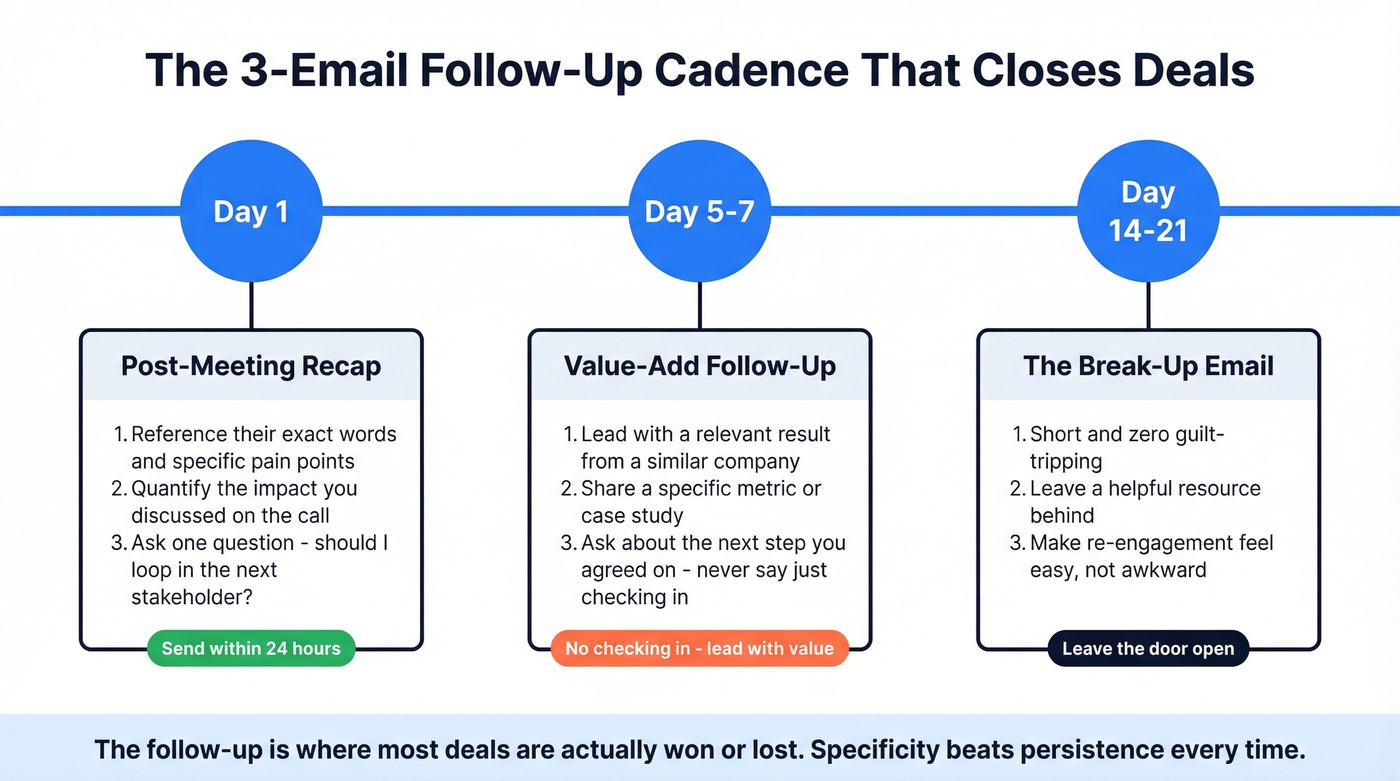
The key is specificity. Reference their exact words. Generic recaps get ignored.
Value-Add Follow-Up (Day 5-7)
Subject: [Relevant metric] at [their company]
Hi [Name],
[Similar company] saw a 40% increase in [relevant metric] after implementing [solution]. Their setup was similar to yours.
Has your team discussed [specific next step from last conversation]?
No "just checking in." Lead with a result relevant to their situation, then ask one question. The follow-up is where most deals are actually won or lost. For more options, keep a swipe file of sales follow-up templates.
The Break-Up Email (Day 14-21)
Subject: Should I close this out?
Hi [Name],
Haven't heard back - I'll assume timing isn't right. If [original pain point] resurfaces, here's a [resource] that might help: [link]
Door's always open.
Short, no guilt-tripping, and it leaves a resource behind. Making re-engagement feel easy, not awkward, is the whole point.

Tip #1 in this article is fix your data - and it's the one that compounds every other tip on this list. Prospeo delivers 98% email accuracy, a 7-day refresh cycle, and 125M+ verified mobiles so your reps spend hours selling, not chasing dead leads.
Meritt tripled their pipeline to $300K/week after switching. Your move.
Multi-threading into buying committees requires verified contact data for every stakeholder - not just your champion. Prospeo's 300M+ profiles and 30+ filters let you map entire buying groups with direct dials and verified emails in minutes.
Stop single-threading deals because you can't find the other buyers.
Using AI as a Selling Tool
The SPOTIO 2026 State of Field Sales Survey breaks down what reps actually use AI for: 30% for email personalization, 28% for conversation intelligence, 26% for content generation, and 24% for automated CRM data entry. A full 33% aren't using AI at all.
Most teams are clustered at surface-level use cases. The bigger wins are in predictive forecasting (20% adoption) and lead scoring (18%). Sellers who frequently use AI generate 77% more revenue than those who don't, and 45% of teams already run a hybrid AI-SDR model. If you're evaluating tooling, this roundup of sales forecasting solutions can help you compare options.
Our advice for novice and veteran reps alike: start with CRM data entry automation and call analysis. These save hours per week with minimal risk. Generative AI for email copy is fine as a first draft, but reps who let AI write entire sequences without editing are the ones whose emails sound like everyone else's - and prospects can tell. If you're going deeper on automation, AI sales follow-up is where most teams see quick wins.
Hot take: If your average deal is under $8K, you probably don't need AI-powered forecasting or intent data. A clean CRM, verified contact data, and disciplined follow-up will outperform any AI tool layered on top of a broken process.
Five Mistakes That Kill Deals
Talking more than listening. Low performers' talk ratio swings wildly between won and lost deals. If you catch yourself monologuing, stop and ask a question. Every time.
Pitching before discovery. The rep who sends a pitch deck two minutes into a call before the buyer has explained their problem can't position value because they don't know what the buyer values. We've seen this tank deals that should've been layups. Discovery first, always.
Failing to multi-thread. Speaking to the wrong stakeholders is one of the most common mistakes in B2B. If you can't confirm budget authority and timeline in the first two calls, you're probably wasting cycles.
Competing on price instead of value. The top deal killer in HubSpot's survey is "poor value for money" at 35%. That's not about being expensive - it's about failing to articulate ROI. Use case studies with before-and-after metrics. Build ROI models. Make the value concrete.
Ignoring data quality. Snyk's sales team was running 35-40% bounce rates before switching their data provider. After the switch, bounces dropped under 5% and AE-sourced pipeline jumped 180%. You can master every technique in this article and still fail if half your emails bounce.
Sales Frameworks Cheat Sheet
| Framework | Best For | Core Idea |
|---|---|---|
| SPIN Selling | Complex B2B discovery | S-P-I-N question sequence |
| Challenger Sale | Commoditized markets | Teach, tailor, take control |
| Sandler | Budget-sensitive deals | Qualify pain + budget upfront; disqualify fast |
| SNAP Selling | Time-starved buyers | Simple, invaluable, aligned, priority-driven |
Frameworks aren't magic. SPIN works best for complex discovery where you need to uncover latent pain. Sandler shines when budget is the sticking point. Challenger is your move when the buyer thinks they already know the answer and you need to reframe their thinking - a solution selling approach that works especially well during economic uncertainty. Pick one that fits your motion and actually practice it. Most reps read about frameworks and never internalize them, which is like reading about swimming and expecting to do laps.
How to Improve Selling Skills Over Time
The tips above cover tactics, but long-term growth requires consistent investment. Subscribe to research-driven sources - Gong's blog, HubSpot's newsletter, and sales-focused Reddit threads surface real-world insights weekly. Build a habit of reviewing one call recording per week and identifying one specific area to improve. That kind of weekly cadence compounds faster than any one-time training.
Let's be honest: exercise also plays an underrated role. Research consistently shows that physical activity boosts focus, reduces stress, and increases energy throughout long selling days. Even 20 minutes of movement before a block of calls sharpens your presence on the phone.
Invest in the skills that don't show up on a dashboard: empathy, curiosity, and the ability to hold silence. The personality traits of top performers aren't innate gifts - they're habits built through repetition. Whether you're a new BDR or an account executive refining your approach, the reps who treat selling as a craft they practice deliberately are the ones who consistently outperform.
FAQ
What's the most important sales skill?
Active listening. Consistent talk-to-listen ratios separate top performers from average reps more reliably than any single technique or framework. Reps who maintain a steady ratio regardless of deal outcome close at significantly higher rates.
How many follow-ups should I send?
Plan for 6-10 touches across email, phone, and voicemail. 80% of deals require at least 5 follow-ups, and most sellers give up after 3-5 attempts. Persistence is one of the most reliable ways to boost close rates without changing anything else.
Is cold calling still effective in 2026?
Yes. Top-quartile callers book 3x more meetings, and cold calling nearly doubles email reply rates - even when the call doesn't connect. Pair calls with verified contact data to avoid wasting dials on dead numbers.
How do I handle objections?
Listen fully, acknowledge the concern, then respond with data - a case study, ROI model, or benchmark. Don't argue. Distinguish real objections from disqualifiers. The core skill is staying calm and leading with evidence, not memorizing rebuttals.
What tools do I need for outbound?
A CRM, a multi-channel sequencer, and a verified data source. Get those three right before adding anything else. For reps just starting outbound, that stack covers 90% of what you need.