

=== CURRENT ARTICLE (slug: value-based-pricing-strategy) ===
Value-Based Pricing Strategy: What Every Guide Leaves Out
Every value-based pricing strategy guide gives you a definition and a pros/cons table. None hand you the actual survey questions, sample sizes, or before/after numbers from a real repricing project.
The practitioner perspective on r/ProductManagement backs this up: frameworks give you structure, but pricing is discovered through experimentation and behavioral response. Zomato and Swiggy subscription prices shift between ₹20-30. Amazon Prime tweaks plans, adds ads, and charges to remove them. Theory gets you a starting point. Testing gets you the answer.
Here's the short version:
- Start with Van Westendorp - four questions, 1-3 weeks, one of the cheapest methods
- Graduate to conjoint when you need feature-level WTP
- Use cost as a floor, value as a ceiling - this isn't either/or
- Track post-launch: NRR as your primary refinement metric, CLV:CAC targeting 3:1, churn targeting 5-7%
Stop reading pricing guides. Start running pricing experiments.
Strategy vs. Model vs. Framework
Most articles use these interchangeably. They're not the same.
A pricing framework is your research inputs - costs, WTP data, competitive benchmarks, value metrics. A pricing strategy is your positioning choice - value-based, cost-plus, competitive, dynamic. A pricing model is your billing mechanism - per user, per feature, usage-based, flat fee.
The classic mistake? Spending months benchmarking competitors, picking a "reasonable" number, then wondering why growth stalls. You picked a model without a strategy, informed by a framework that was mostly vibes. That's product-focused selling dressed up as strategy - you're leading with what you built, not what the buyer values.
Cost-Plus vs. Competitive vs. Value-Based
These aren't mutually exclusive. The smartest teams run a hybrid approach - cost as a floor, value as a ceiling, competitive data as a sanity check.
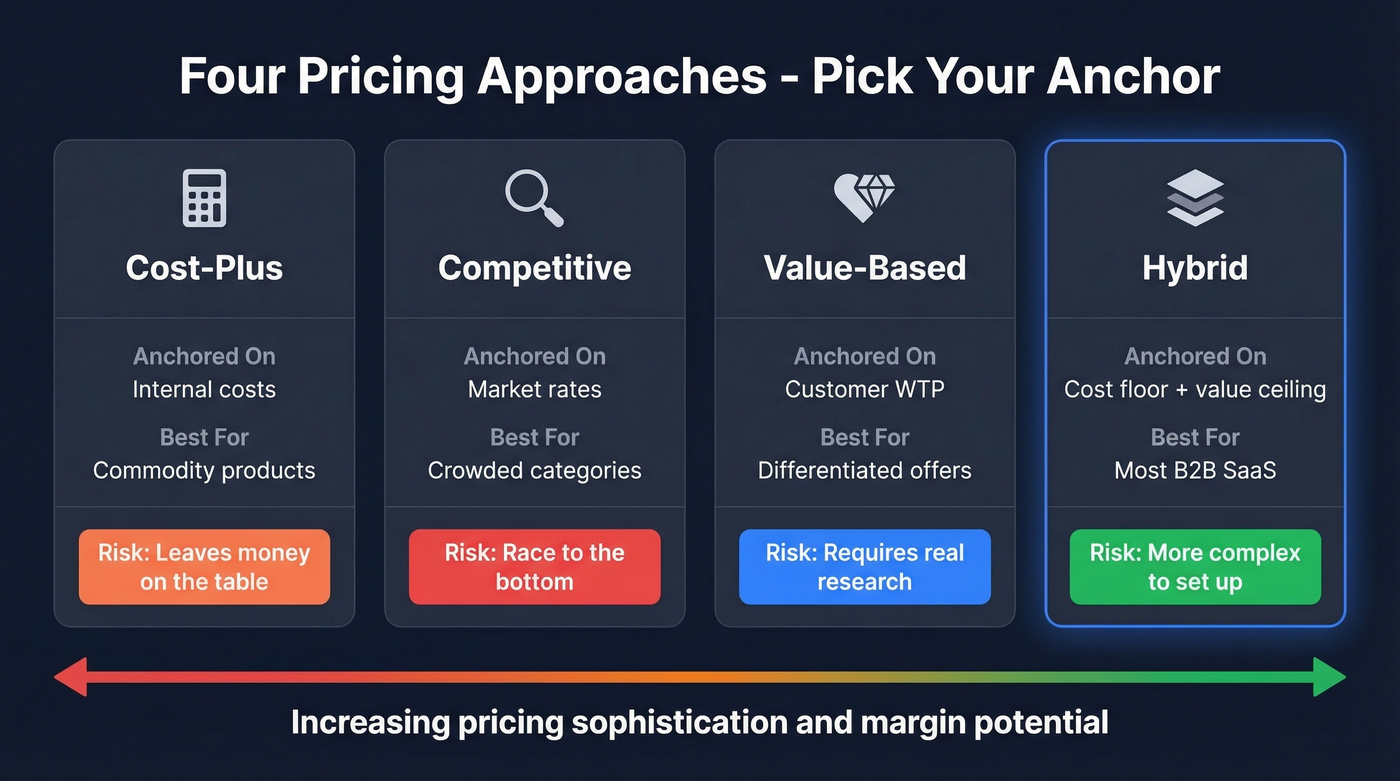
| Approach | Anchored On | Best For | Risk |
|---|---|---|---|
| Cost-plus | Internal costs | Commodity products | Leaves money on table |
| Competitive | Market rates | Crowded categories | Race to bottom |
| Value-based | Customer WTP | Differentiated offers | Requires real research |
| Hybrid | Cost floor + value ceiling | Most B2B SaaS | More complex to set up |
The macro context makes this urgent: three-quarters of 2024 CPG growth came from price increases, but roughly 80% of US and European consumers reported cutting spending. The era of easy price increases is over. If you're raising prices without measuring perceived value, you're flying blind into a headwind. Understanding how to sell based on value - not just raising list prices - is the only sustainable path forward.
How to Measure Willingness to Pay
This is where most guides fail you. They say "understand your customer's perceived value" and leave it there. No survey questions, no sample sizes, no timelines. Let's fix that.
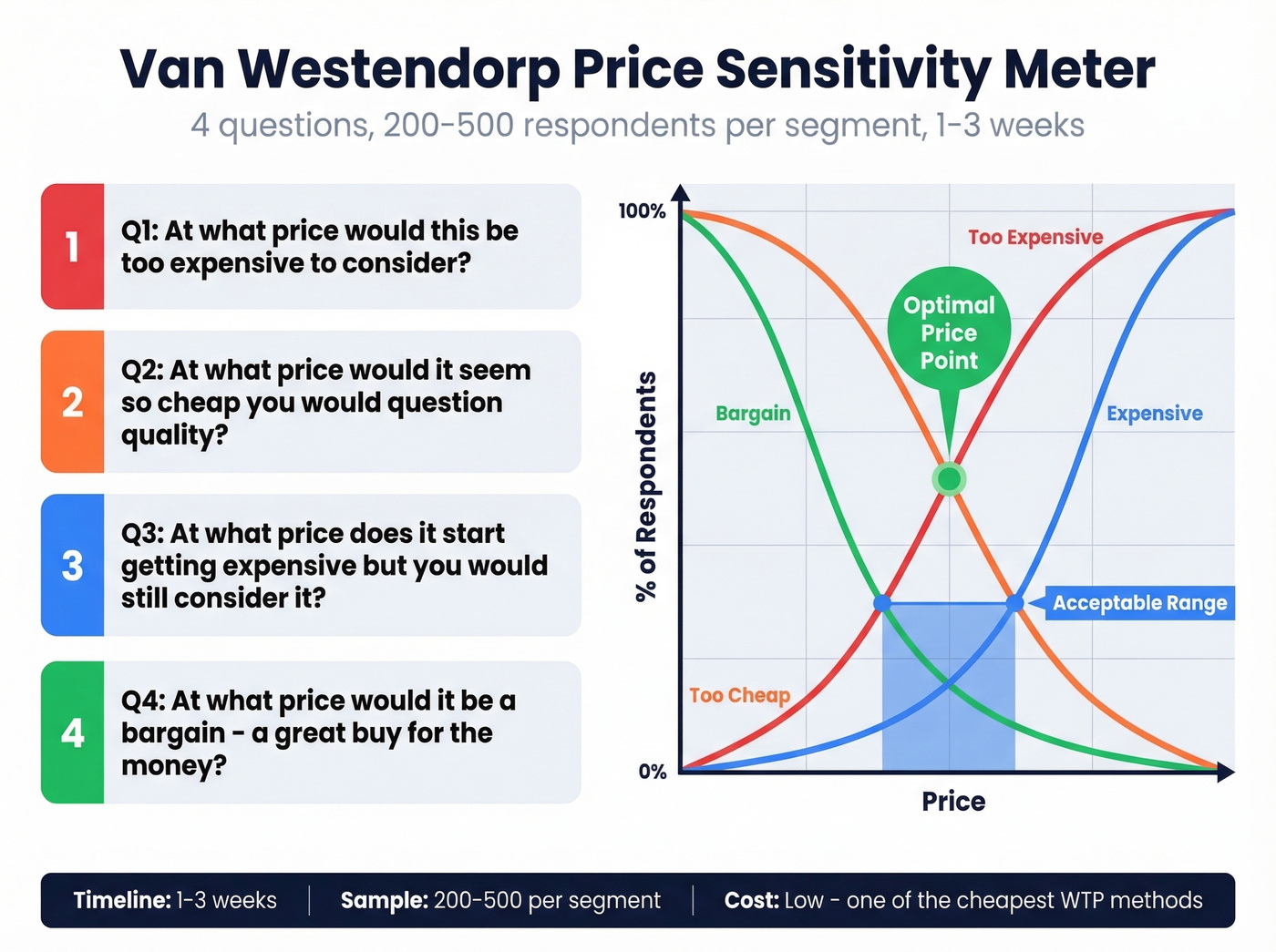
Van Westendorp Price Sensitivity Meter - four questions asked directly to target buyers:
- At what price would this be too expensive to consider?
- At what price would it seem so inexpensive you'd question quality?
- At what price does it start getting expensive but you'd still consider it?
- At what price would it be a bargain?
Plot the cumulative distributions. The intersections give you a lower threshold, upper threshold, and optimal price point. Run this in 1-3 weeks, and plan around 200-500 respondents per key segment for directional outputs.
Conjoint analysis is the heavy artillery. Respondents make trade-offs across features and price levels, and you back out WTP per feature. The Qualtrics method calculates dollars per utility point, computes incremental utility vs. baseline, converts to differentiation value, then adds a reference price for package-level WTP. Budget 4-8 weeks. This is value engineering for sales - decomposing your offer into discrete value drivers so you can price each one precisely.
| Method | Timeline | Sample Size | Best For |
|---|---|---|---|
| Van Westendorp | 1-3 weeks | 200-500/segment | Directional range |
| Gabor-Granger | 1-3 weeks | 200-500/segment | Validating a price |
| Conjoint/DCE | 4-8 weeks | 200-500/segment | Feature-level WTP |
| A/B testing | 4-12 weeks | Depends on traffic | Live validation |
Before surveying, you need the right respondents. Prospeo's 30+ search filters - including intent signals, company size, and technographics across 300M+ professional profiles - help you target in-market accounts instead of random respondents.
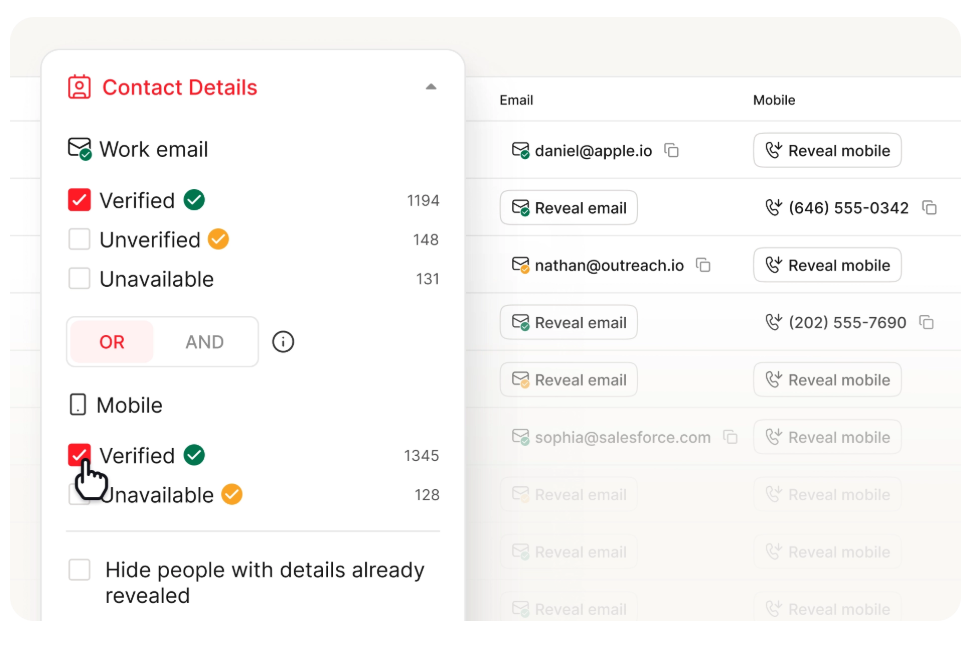

Your WTP research is only as good as the respondents you survey. Prospeo's 30+ search filters - including buyer intent signals across 15,000 topics, technographics, and company growth data - let you target the exact in-market segments that matter for your pricing study. No random panels. Real buyers from 300M+ verified profiles.
Stop surveying the wrong people. Start with verified, in-market buyers.
Case Study: 300% ARR Increase in B2B SaaS
Proper, a B2B SaaS company, was stuck at EUR500K ARR with a flat EUR7/unit/month model. Their repricing project introduced two packages - SMB and enterprise - with a base platform fee scaling from EUR0 to EUR5K/month by customer size. Unit fees started at EUR15 and dropped to EUR4/unit at scale.
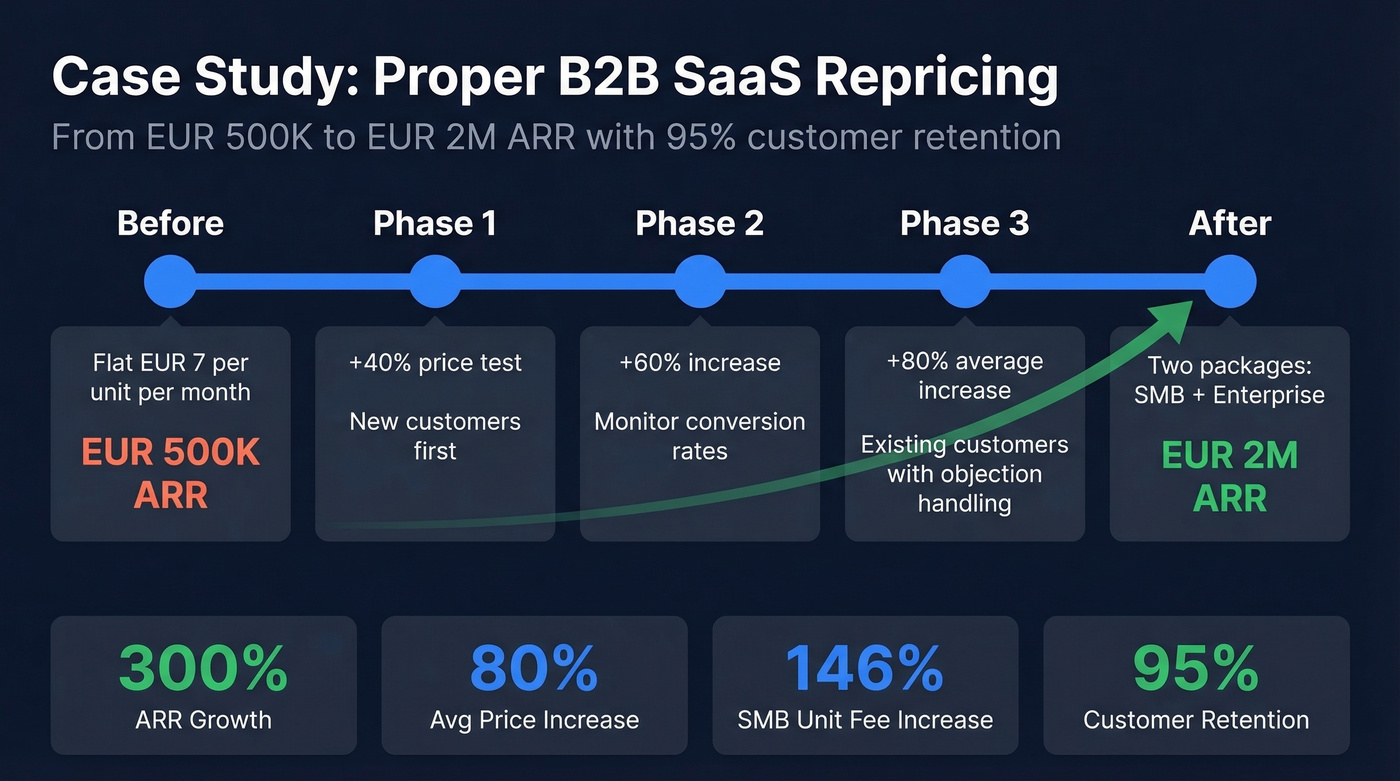
The key move was progressive rollout: they tested 40% increases, then 60%, then roughly 80%, monitoring conversion at each step. New customers got new pricing first. Existing customers followed with a sales enablement framework for objections. The team used cost-savings positioning in sales conversations, showing each segment how the new pricing mapped to measurable ROI, rather than leading with the price increase itself.
Results: ARR jumped from EUR500K to EUR2M. Average price increase hit 80%. SMB unit fees rose 146%. They retained 95% of existing customers. We've seen this pattern repeatedly - progressive rollout beats big-bang repricing every time.
Three Ways to Sell Value in B2B
Pricing is only half the equation. If your sales team can't articulate the value, even perfect pricing falls flat.
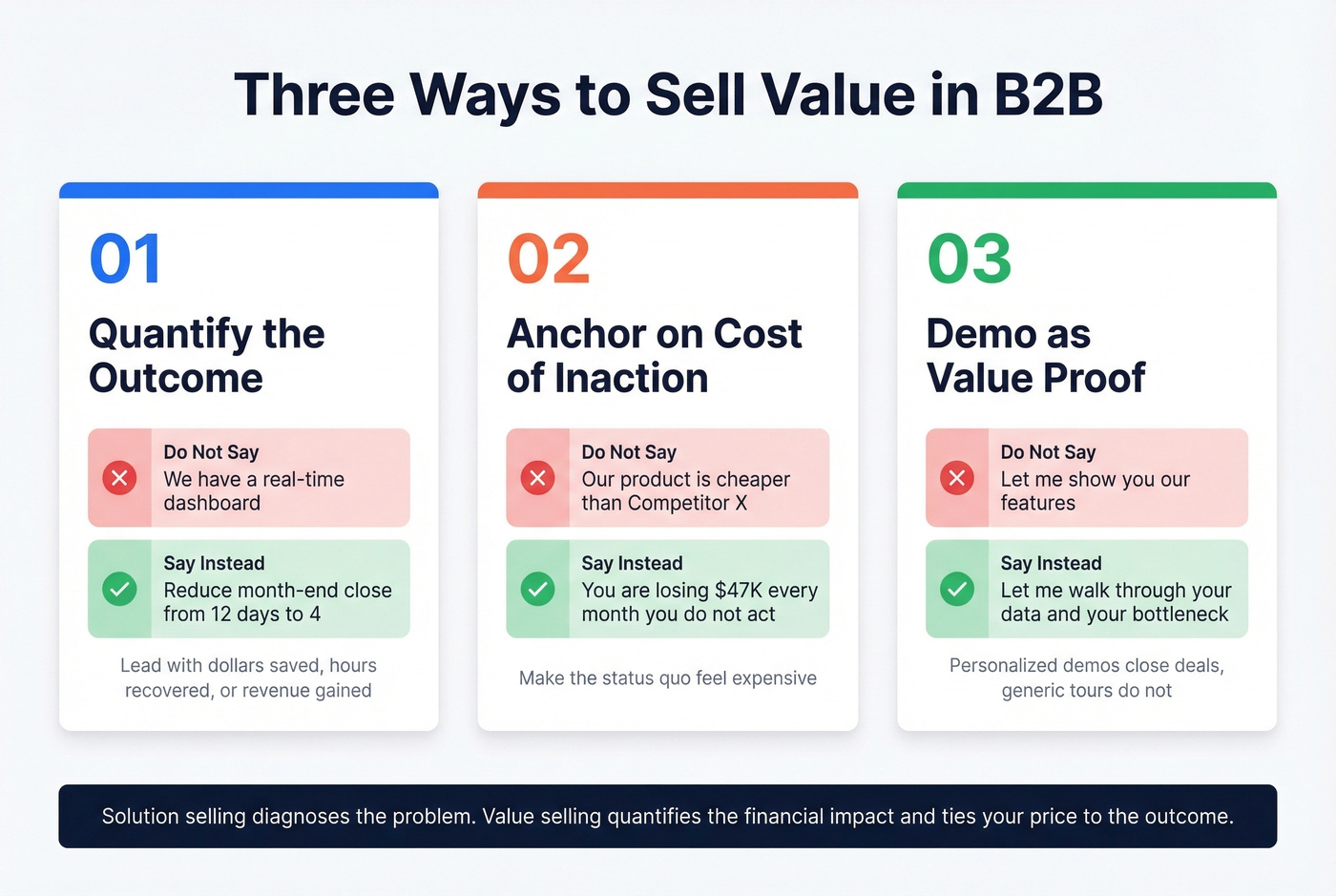
1. Quantify the outcome, not the feature. A "real-time dashboard" means nothing to a CFO. "Reduce month-end close from 12 days to 4" means everything. Outcome-focused selling translates product capabilities into dollars saved, hours recovered, or revenue gained. When presenting to finance stakeholders, always lead with the financial impact.
2. Anchor on the cost of inaction. What does the buyer lose every month they don't act? Frame your price against that number, not against a competitor's feature list. Results-based selling works best when you make the status quo feel expensive.
3. Use the demo as a value proof point. Walk the prospect through their own data, their own workflow, and their own bottleneck - then show the resolution in real time. Generic product tours are product-focused selling. Personalized demos close deals. The difference between solution selling and value selling matters here: solution selling diagnoses a problem and prescribes a fix, while value-added selling goes further by quantifying the financial impact of that fix and tying your price directly to the outcome. The best teams do both, but lead with value. (If you want to operationalize this, start with a tighter product demo motion.)
Mistakes That Kill Margins
Discount creep. Temporary promos become permanent. Customers anchor on the reduced price. Fix: implement discount bands with approval thresholds. If a rep can discount 20% without asking anyone, you don't have pricing - you have suggestions.
Cost-to-serve blindness. Your average margin looks healthy, but some segments eat 3x the support hours. Fix: run a margin waterfall analysis by segment. Reprice or fire the segments that destroy value. Don't waste premium selling techniques on accounts that'll never generate positive unit economics - route low-value products through self-serve channels instead.
Over-indexing on competitors. Spending months benchmarking competitor pricing while underinvesting in actual value research is the most common failure mode we see. Your competitors are guessing too. Don't anchor on their guesses.
Confusing closing the deal with creating value. Reps who discount to close are optimizing for this quarter's number. Reps who build a business case create value that sustains pricing power for years. A value-first sales approach takes longer upfront but produces higher ACV and lower churn. If you need talk tracks, use these price objection handling examples to protect margin without discounting.
Here's the thing: if you haven't run a Van Westendorp study, you're guessing. Full stop.
Metrics to Track After Launch
Pricing isn't a project. It's a process. After launch, watch these numbers:
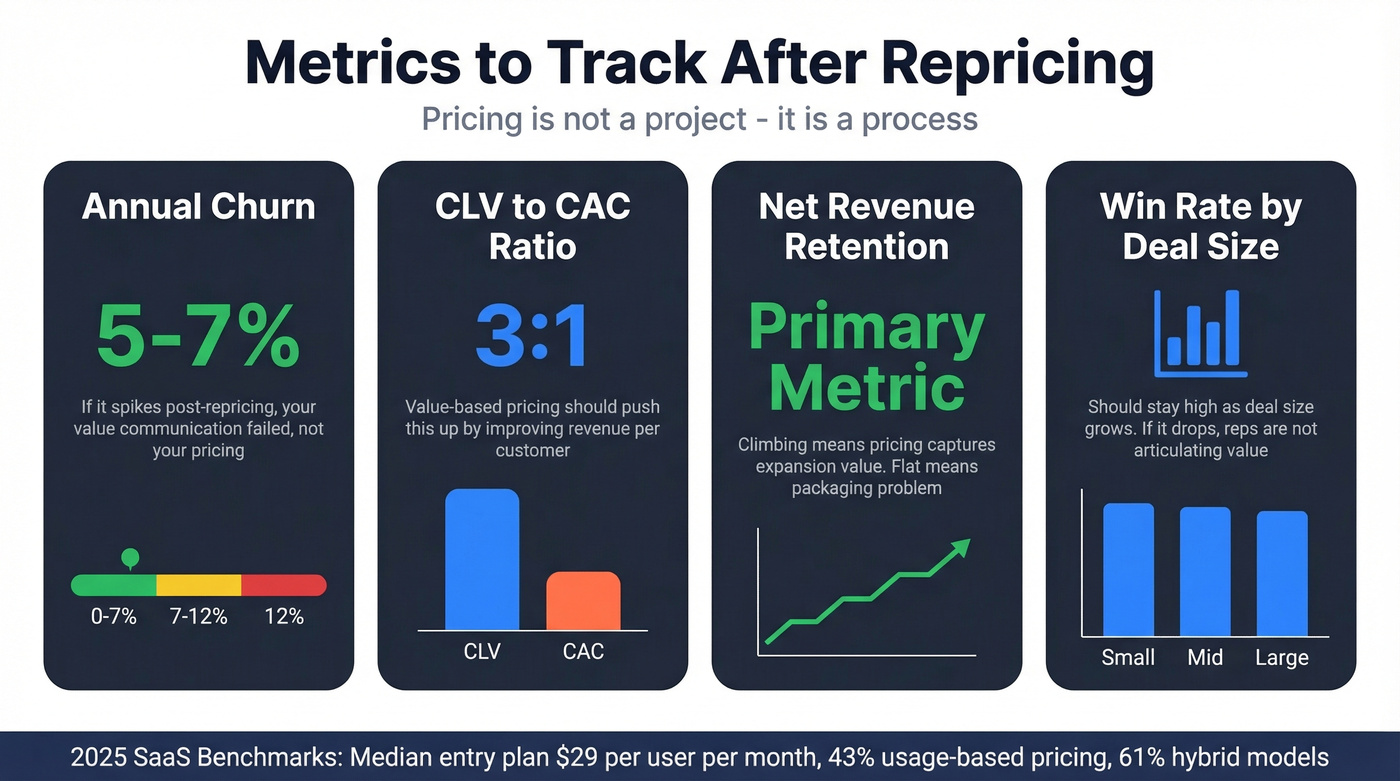
- Churn - target 5-7% annually. If it spikes post-repricing, your value communication failed, not your pricing.
- CLV:CAC - 3:1 is the benchmark. A well-executed value-based pricing strategy should push this up by improving revenue per customer.
- NRR - your primary refinement metric. If NRR is climbing, your pricing captures expansion value. If it's flat, you've got a packaging problem.
- Win rate by deal size - value-oriented sales teams should see higher win rates on larger deals. If win rates drop as deal size grows, your reps aren't articulating value effectively.
The Monetizely benchmark study across 103 SaaS companies found median entry plans at $29/user/month, 43% usage-based pricing adoption, and 61% hybrid model adoption. If you're still on a pure per-seat model, you're in the minority.
Most B2B companies don't have a pricing problem. They have a measurement problem. The strategy is straightforward - anchor on customer willingness to pay. The hard part is actually doing the research instead of copying a competitor's pricing page and adding 10%. To keep the rollout measurable, set up sales funnel metrics and a sales pipeline dashboard before you change pricing.
Selling value means reaching decision-makers who feel the pain your pricing is built around. Prospeo delivers 98% accurate emails and 125M+ verified mobile numbers with a 30% pickup rate - so your sales team can actually have the value conversations that close deals, not bounce off bad data.
Value selling only works when you reach the right person. Get their real contact data.
FAQ
What's the difference between value-based and cost-plus pricing?
Cost-plus adds a fixed margin to internal costs; value-based pricing anchors on customer willingness to pay. Best practice: use cost as a floor and value as a ceiling. This lets the customer's perceived ROI set the upper bound rather than your internal spreadsheet.
How long does willingness-to-pay research take?
Van Westendorp takes 1-3 weeks, conjoint analysis 4-8 weeks, and A/B testing 4-12 weeks. Budget 200-500 respondents per segment for statistically useful outputs.
Does value-based pricing work for SaaS?
Absolutely - adoption is accelerating. In Monetizely's 2026 benchmark, 61% of SaaS companies used hybrid models blending value-based logic with usage metrics. Outcome-based pricing is the next evolution: Intercom Fin charges $0.99 per successful resolution, and Riskified charges only for approved transactions.