

How to Sell Value, Not Price - Scripts, Frameworks, and the Contrarian Truth
You just lost a deal to a competitor charging half your price. Your manager's feedback? "You need to sell more value." Helpful. That's like telling a drowning person to swim harder.
Buyers do care about value. One RAIN Group study found 96% of buyers say a seller's focus on value influences their purchase decision, and it ranked as the top factor in the research. https://www.rainsalestraining.com/blog/value-based-selling
So yes: you need to learn how to sell value, not price. But "sell value" isn't a tactic. Let's turn it into one.
What You Need (Quick Version)
- Run a 5-stage discovery flow so price objections don't show up out of nowhere. By the time you talk numbers, the prospect should already feel the cost of doing nothing. (If you want a tighter call structure, start with a discovery questions bank.)
- When they say "too expensive," use Validate -> Isolate -> Reframe. Don't flinch. Don't discount. (This pairs well with talk track examples when you’re building team-wide consistency.)
- Stop leading with ROI. Use Cost of Inaction (COI) to anchor the conversation on what staying the same is already costing them.
When "Sell Value" Is Bad Advice
Here's the thing: sometimes "sell value" is a cop-out.
The consensus in a lot of r/sales threads is basically this: if prospects keep telling you you're 2-3x the market, that's not a coaching moment. That's market feedback. https://www.reddit.com/r/sales/comments/1ke3cfl/price_is_part_of_value/
Price is part of value. The whole "value vs price in sales" debate misses the point because they aren't opposites. "Price competitive" doesn't mean cheap; it means the price makes sense for what you deliver relative to alternatives. And going too cheap can backfire fast because it triggers the "what's wrong with this?" reflex.
So before you internalize "sell more value," do a quick gut-check with your team: is the pricing defensible for the segment you're targeting? If yes, keep reading. If not, you don't need better scripts - you need a pricing and packaging conversation with leadership. (If you’re building a repeatable approach, sales process optimization helps.)
The Discovery Flow That Prevents Price Objections
Price objections are usually created on the first call, when we skip discovery and jump straight to features. Top performers are 58% more likely to do thorough needs discovery, and it shows up in win rates and margin. https://medium.com/@raingroup/study-reveals-what-top-performing-sellers-do-differently-and-better-than-other-sellers-5dcaa3dfd9e9
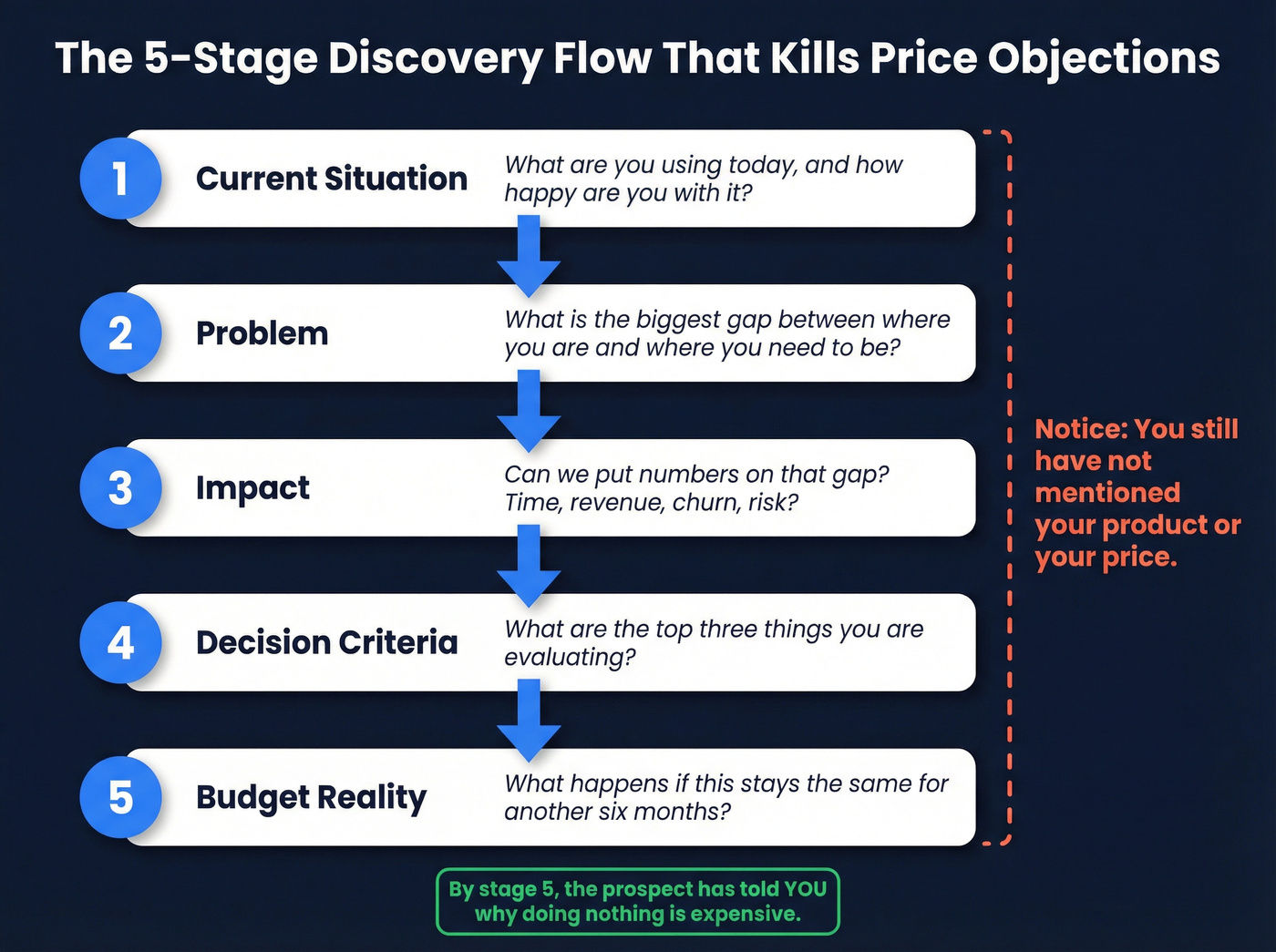
A 5-stage structure adapted from Hyperbound works well in real calls because it forces you to earn the right to talk about price. https://www.hyperbound.ai/blog/12-questions-that-kill-price-objections-before-they-start
- Current situation: "What are you using today, and on a scale of 1-10 how happy are you with it?"
- Problem: "What's the biggest gap between where you are and where you need to be?"
- Impact: "Can we put numbers on that gap? Time, revenue, churn, risk?"
- Decision criteria: "What are the top three things you're evaluating when you pick a solution?"
- Budget reality: "What happens if this stays the same for another six months?"
Notice what isn't in that list: your product.
By stage five, you still haven't said a number. But the prospect has already told you - in their words - why doing nothing is expensive. That's the whole point. Value isn't built in the demo; it's built in the 30 seconds after they answer your question and you ask a follow-up instead of pitching. (If you want a printable version, grab a discovery call script PDF.)
A quick scenario (because this is where reps slip)
We watched an AE sell a workflow tool into a finance team that "just needed approvals." On the surface, it looked like a $12k/year problem.
Two follow-ups later, it turned into: month-end close was slipping by 3 days, the controller was pulling late nights, and the CFO was getting heat from the board. The buyer didn't suddenly "see the value" because of a prettier dashboard. They saw it because the AE made them say the impact out loud, then calmly asked, "What does that delay cost you in real dollars and real trust?"
What "Too Expensive" Usually Means
When a prospect says "It's too expensive," they rarely mean the literal number is too high. That phrase is a cover for one of four things:
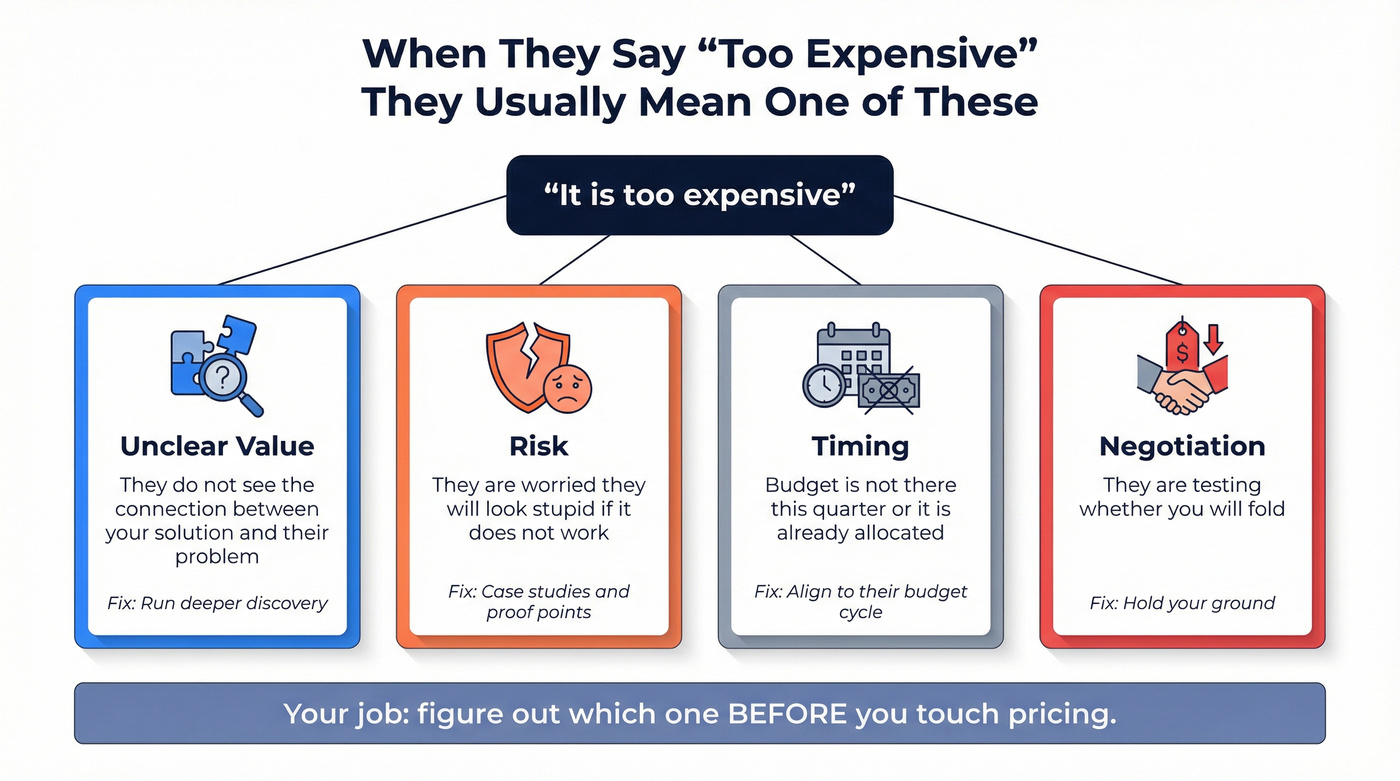
- Unclear value: they don't see the connection between your solution and their problem
- Risk: they're worried they'll look stupid if it doesn't work
- Timing: budget isn't there this quarter (or it's already allocated)
- Negotiation: they're testing whether you'll fold
Your job is to figure out which one you're dealing with before you touch pricing. (If this is a recurring pattern, use a how to reduce sales objection rate checklist.)
Start with a tactical pause: 3-5 seconds of silence after "too expensive." Real talk: it feels awkward the first few times. It also works because people hate dead air, and they'll often fill it with the real objection.
If they push for price early (before discovery), use a simple deflection:
"Happy to get to pricing. First, can I ask a couple questions so I can give you an accurate answer for your situation?"
Then run Validate -> Isolate -> Reframe.
- Validate: "Totally fair - it's a meaningful investment."
- Isolate: "Is price the only thing stopping us from moving forward?"
- Reframe: "If price wasn't an issue, would you choose this to solve [their specific problem]?"
If they say yes, you've got permission to quantify. If they say no, good - you just avoided discounting into a deal that was never going to close.
And yes, this is one of those "simple but not easy" moves. We've tested versions of it across different segments, and the reps who stick with it protect margin way more often than the reps who jump straight to "What budget did you have in mind?"
Top performers are also far more likely to hold their ground on price pressure (81% more likely in the same RAIN Group research). https://medium.com/@raingroup/study-reveals-what-top-performing-sellers-do-differently-and-better-than-other-sellers-5dcaa3dfd9e9

You can't sell value if you're pitching the wrong person. Prospeo gives you 98% accurate emails and verified mobile numbers for the decision-makers who own the budget - so your discovery calls happen with buyers, not gatekeepers.
Reach the buyer who feels the Cost of Inaction. Not their intern.
Quantify Value With Cost of Inaction (Not Wishful ROI)
Classic ROI math is fine:
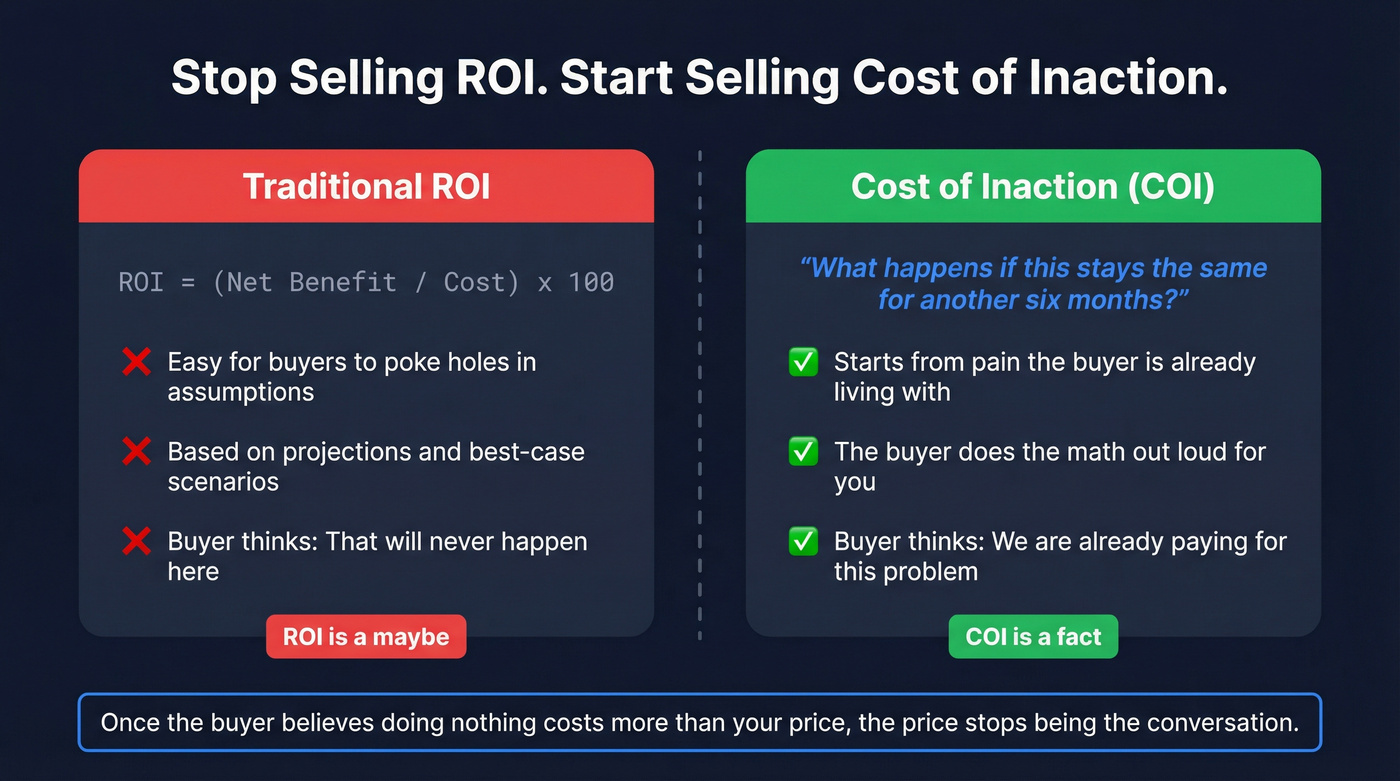
ROI = (Net Benefit / Cost) x 100
If your solution costs $20k and the benefit is $80k, that's 300% ROI. Product School has a clean ROI template you can steal for a spreadsheet. https://productschool.com/blog/analytics/roi-template
But ROI is easy to argue with. Buyers can poke holes in assumptions all day: "We won't adopt that fast," "Those savings won't hit this year," "Our team won't use it."
Cost of Inaction is harder to dodge because it starts from what they're already living with. Databox sums it up well: ROI is a maybe; COI is a fact. https://databox.com/cost-of-inaction-framework
The best live COI prompt is still this:
"What happens if this stays the same for another six months?"
Then shut up. Let them do the math out loud.
When they say, "We'll keep missing SLA," or "We'll keep losing deals in procurement," or "We'll keep burning 10 hours a week on manual work," you don't need to "sell value." They're doing it for you. Your job is to capture it, repeat it back cleanly, and attach your price to that reality. (For a deeper breakdown of value-based-selling in practice, it’s worth skimming.)
Three Ways to Compete Without Discounting
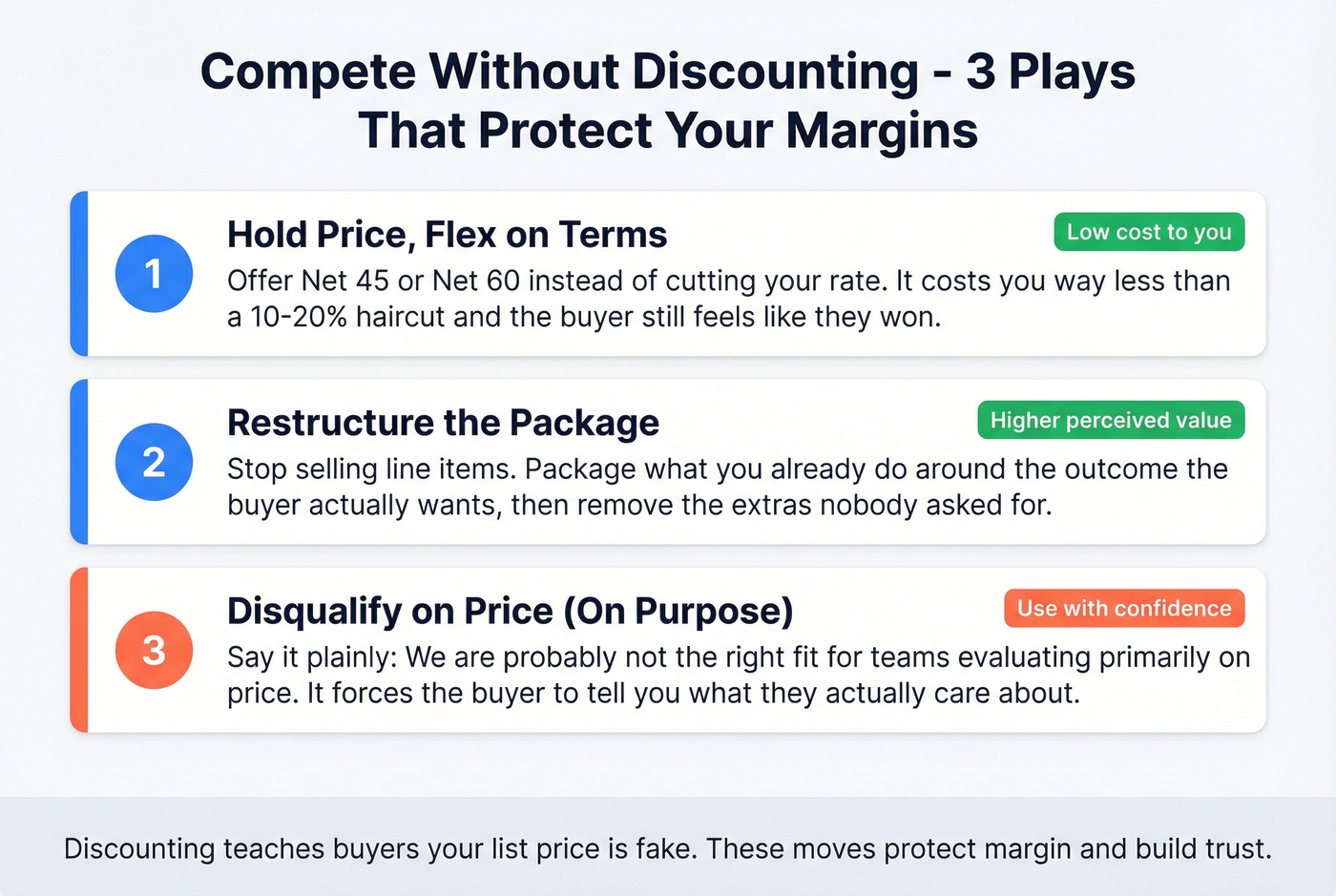
When pressure hits, most reps reach for the discount. Don't. Discounting is the fastest way to teach a buyer that your list price is fake, and it's one of the most frustrating habits to coach out of a team once it becomes normal.
1) Hold price, flex on terms
Offer Net 45 or Net 60 instead of cutting your rate. Extending payment terms costs you a lot less than a 10-20% haircut, and it lets the buyer "win" without you giving away the store. (If you need a clean way to set the first number, see anchor in negotiation.)
2) Restructure the package (sell outcomes, not line items)
A Klozers story about radio sales nails this: the rep stopped selling commodity hardware and started selling a "communications solution" with service wrapped around it. Same underlying product, totally different frame. https://www.klozers.com/sell-value-not-price/
This is where value-based selling gets real. You're not lying or dressing up features. You're packaging what you already do around the outcome the buyer actually wants, then removing the extras that only exist because "that's how we always sell it."
3) Disqualify on price (on purpose)
Say it plainly:
"We're probably not the right fit for teams evaluating primarily on price."
It sounds scary because it is. It also signals confidence, and it forces the buyer to either (a) admit they're shopping on price, or (b) tell you what they actually care about so you can sell to that. (If you want a more structured close, the Ben Franklin close is a solid option.)
Skip this move if you're in a true commodity market where buyers can switch with zero risk and zero switching cost. In that world, you either win on distribution, brand, or unit economics - not on "value conversations."
Make Value Selling Easier by Fixing Targeting
Value conversations die when you're pitching the wrong person or the wrong company. And nothing makes you look "expensive" faster than irrelevant outreach, because the buyer's brain immediately goes, "I don't even need this."
Gartner reports that 73% of B2B buyers avoid suppliers that send irrelevant outreach. https://www.gartner.com/en/sales/trends/future-of-sales
This is also where data quality quietly decides whether your value-based selling skills even get a chance to work. If your emails bounce, your domain gets cooked, and you end up talking to whoever replies - not the person who owns the problem. (If deliverability is a bottleneck, start with an email deliverability guide.)
In our outbound workflows, we've used Prospeo to keep targeting tight and deliverability clean: 300M+ professional profiles, 143M+ verified emails, 125M+ verified mobile numbers, and a 7-day refresh cycle. The 98% email accuracy matters because it keeps you in the game long enough to run the discovery flow above, instead of spending your week chasing ghosts. (To tighten targeting before you ever hit send, use an ideal customer profile template.)
Make It Operational (So It Shows Up in the Number)
That deal you lost to the cheaper competitor? The problem probably wasn't that you "failed to sell value." The problem is that "sell value" is a bumper sticker, and bumper stickers don't survive procurement.
The discovery flow, the Validate -> Isolate -> Reframe script, and the COI prompt are tactics. Use them on every call, especially the easy ones, because that's where habits get built. (If you’re trying to make this repeatable across the org, sales execution is the missing layer.)
If you remember one thing, make it this: stop selling ROI and start selling Cost of Inaction. ROI is a maybe. COI is a fact. Once the buyer believes doing nothing costs more than your price, the price stops being the conversation.
Every hour spent chasing bad contact data is an hour you're not running the discovery flow that prevents price objections. Prospeo's 300M+ profiles refresh every 7 days - so your pipeline stays full of real conversations, not bounced emails.
Protect your margins by protecting your pipeline. Start free today.