

Solution Selling vs Product Selling: What Actually Works in 2026
Your new AE just joined from a transactional role and they're bombing discovery calls because they keep defaulting to feature dumps. Meanwhile, your senior rep spends 45 minutes on discovery and still can't close because the buyer already knows what they want. 84% of sales reps missed quota last year, and 67% of B2B buyers now prefer a rep-free experience. The solution selling vs product selling debate misses the point - the real question is how to blend them so your team stops losing deals on both ends.
Quick Verdict
- Product selling works when the buyer's educated, the product is simple, and the deal closes in under two weeks.
- Solution selling works when the problem is complex, multiple stakeholders are involved, and the deal size justifies a longer cycle.
- The best answer is a hybrid. Product-led signals tell you who's ready to buy; solution-selling discovery tells you how to close them. The teams winning in 2026 run both motions simultaneously.
What Is Product-Focused Selling?
Product selling leads with the product itself - features, specs, pricing, competitive comparisons. The rep's job is to match what the product does to what the buyer needs, then close fast. It's the "here's what it does, here's what it costs, want a trial?" motion.
This approach works best in transactional environments: commodity purchases, self-serve SaaS under $5K, and situations where the buyer already understands their problem and is comparing options. The sales cycle is short - days to a couple of weeks. The demo is a walkthrough, not a conversation. Pricing is transparent, often on the website. One rep can run dozens of these conversations per week, which is the real upside: speed and scalability.
The downside? It commoditizes your offering. When you lead with features, you're inviting a feature-by-feature comparison - and someone always has a cheaper version.
What Is Solution Selling?
Solution selling flips the script. Instead of leading with the product, the rep leads with the buyer's pain.
The approach was coined in the 1970s and widely implemented in the 1980s, popularized as a formal training methodology by Mike Bosworth. The core idea: don't pitch until you understand the problem deeply enough to quantify its cost. Discovery is the main event, not the demo. The rep asks questions, maps the buyer's current state, identifies gaps, and then positions the product as the bridge between where the buyer is and where they need to be.
It works best in complex B2B sales - multi-stakeholder deals, long implementation cycles, high ACV. The tradeoff is time. Solution selling takes longer, requires more skill, and falls apart completely if the rep can't run a good discovery call. When it works, deal sizes are larger and retention is higher because the buyer feels understood, not sold to.
Key Differences at Every Stage
The differences aren't just philosophical. They show up in every conversation, at every stage.
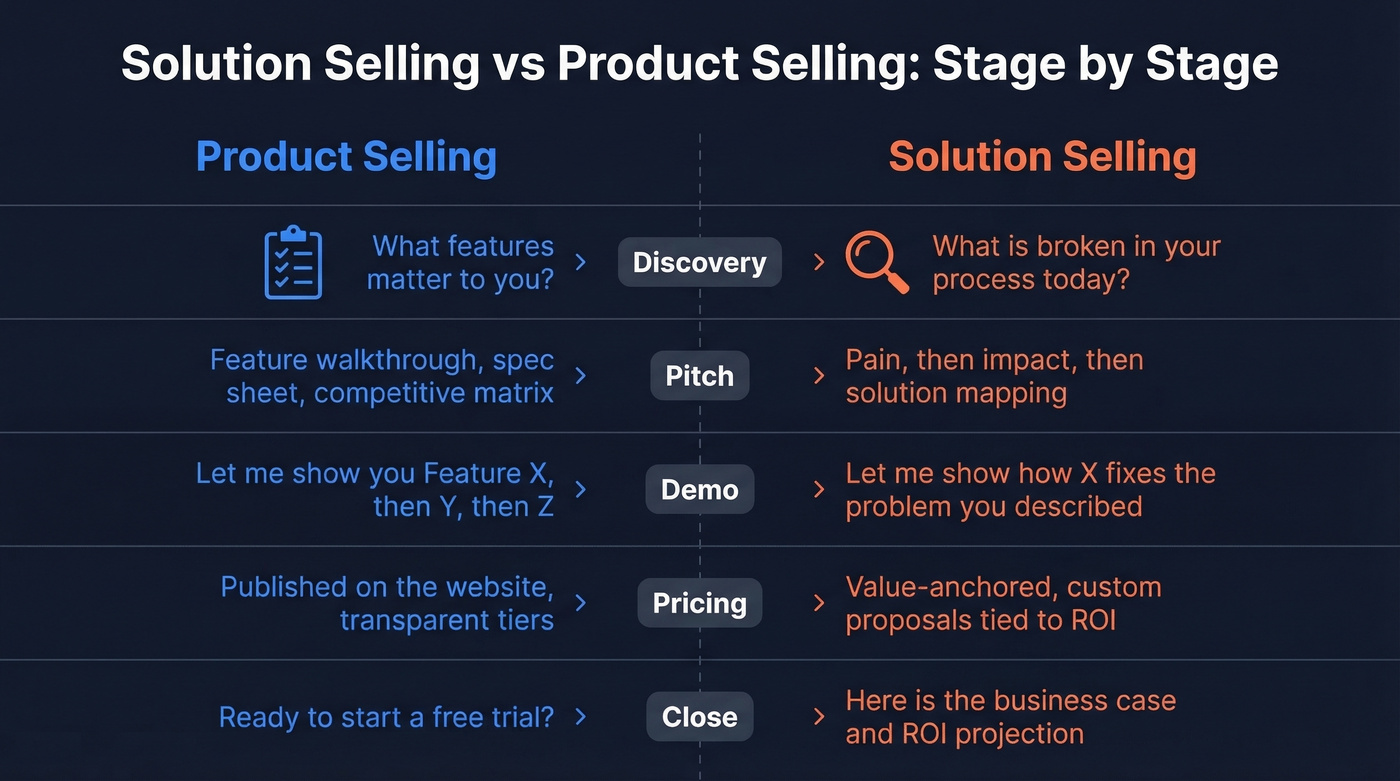
| Stage | Product Selling | Solution Selling |
|---|---|---|
| Discovery | "What features matter?" | "What's broken today?" |
| Pitch | Feature walkthrough | Pain -> impact -> solution |
| Demo | "Let me show you X" | "Let me show how X fixes Y" |
| Pricing | Published, transparent | Value-anchored, custom |
| Close | "Ready to start a trial?" | "Here's the ROI case" |
In a product-selling motion, the rep controls the conversation by knowing the product cold. In a solution-selling motion, the rep controls the conversation by knowing the buyer's problem cold. Both require expertise - just different kinds.
The demo is where the gap is most visible. A product-selling demo walks through features in a logical order - classic feature benefit selling, where each capability is paired with a specific advantage. A solution-selling demo is built around the buyer's specific pain points surfaced in discovery, showing only the features that map to those problems. Same product, completely different experience.
If you want a tighter demo that still feels consultative, use a simple product demo checklist to keep the walkthrough focused on outcomes.
The Math That Decides Your Motion
A product-selling rep closing 20 deals per month at $2K ACV generates $40K in new MRR. A solution-selling rep closing 5 deals per month at $15K ACV generates $75K. Same rep, different motion, nearly double the revenue.
Your ACV determines which motion deserves more investment - run the math for your own team before committing to a methodology overhaul. If you need a clearer view of what to track across stages, map it to funnel metrics so you can see where each motion wins or leaks.
| Product Selling | Solution Selling | |
|---|---|---|
| Speed | Fast (days-weeks) | Slow (weeks-months) |
| Scalability | High | Low |
| Deal size | Lower ACV | Higher ACV |
| Retention | Moderate | Higher |
| Skill floor | Lower | Higher |
| Commoditization risk | High | Low |
Hot take: If your average deal is under $8K ACV, you probably don't need a full solution-selling motion. A well-structured product demo with two sharp discovery questions will outperform a 45-minute interrogation every time. Save the deep discovery for deals that justify the time investment.

Whether you run a product-selling motion closing 20 deals a month or a solution-selling cycle with 5 high-ACV opportunities, every deal starts with reaching the right buyer. Prospeo gives you 300M+ profiles with 98% email accuracy and 125M+ verified mobiles - so your reps spend time selling, not chasing bad data.
Stop losing deals to bounced emails. Start reaching real buyers.
What 2026 Buyer Data Says
The data tells a clear story: pure product selling is losing ground, but pure solution selling is too slow to survive on its own.
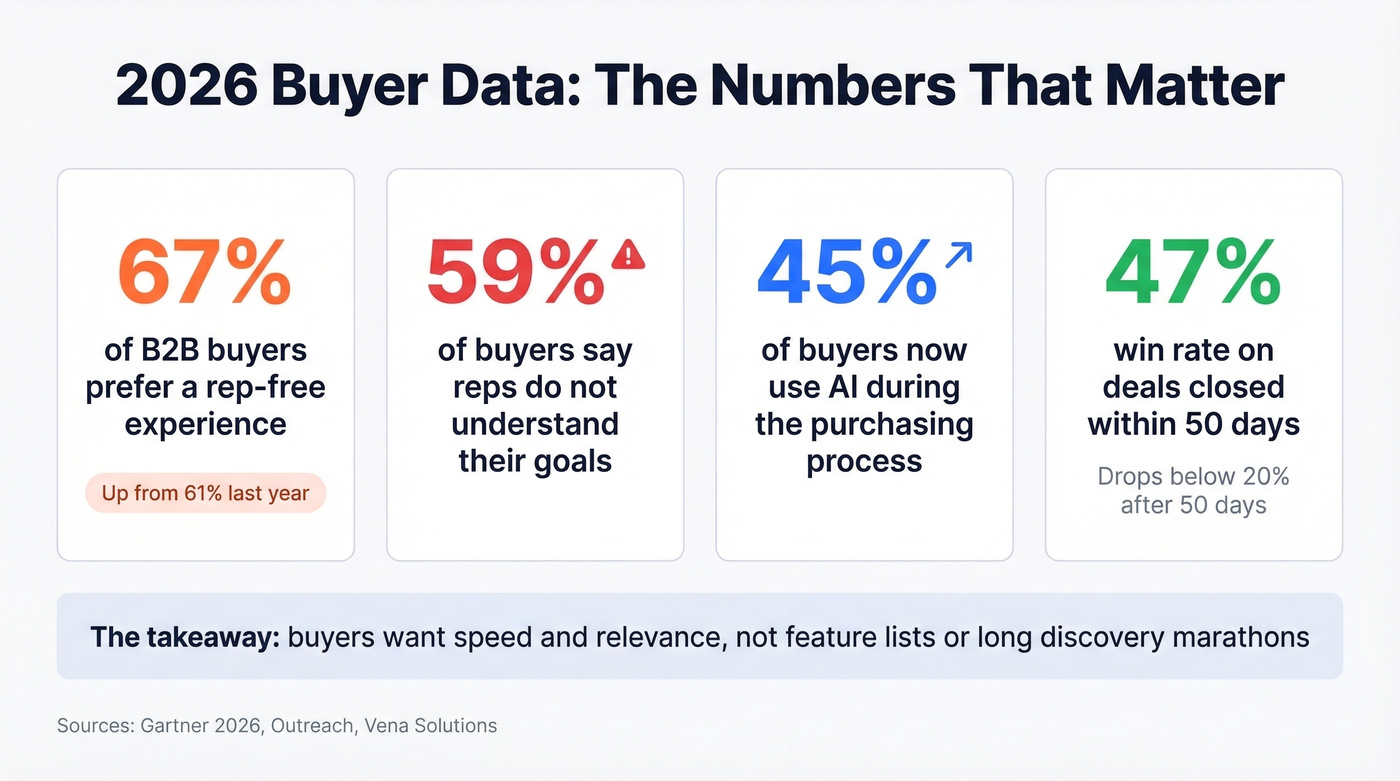
Gartner's buyer surveys show the rep-free preference rising from 61% to 67% in the span of a single year. That's not a blip - it's a trendline. And 45% of buyers now use AI during the purchasing process, meaning they arrive at sales conversations with more context than ever before.
But here's the counterweight: 59% of buyers say reps don't understand their goals. And 73% actively avoid suppliers who send irrelevant outreach. Buyers don't want to be ignored - they want reps who add contextual value when they do engage. The latest buyer research also found that confident buyers are twice as likely to report a high-quality deal, and confidence comes from clarity, not feature lists.
Speed matters too. Opportunities closed within 50 days hit a 47% win rate, while deals dragging past that threshold drop below 20%. Solution selling that turns into a three-month discovery marathon is killing your pipeline. The data points to a specific sweet spot: deep enough discovery to add real value, fast enough execution to close before the buyer loses momentum or a competitor swoops in.
If you're trying to operationalize that "sweet spot," start by tightening your sales process optimization so discovery doesn't sprawl.
Is Solution Selling Dead?
No. But lazy solution selling is.
The critique from practitioners like Anthony Iannarino is valid: clients don't buy solutions - they buy results. When solution selling devolves into a 45-minute interview where the rep asks "what keeps you up at night?" and then maps features to answers, it's just a slower version of product selling with better packaging.
The evolution is from reactive discovery to prescriptive guidance. The best solution sellers in 2026 don't just ask about problems - they walk in with a point of view. They share industry data, name the trends the buyer should care about, and frame the conversation around outcomes the buyer hadn't fully articulated yet. That's the Challenger Sale influence: teach, tailor, take control.
Look, AI is making this more urgent, not less. As Challenger Inc. argues, AI creates a market shift similar to cloud adoption in 2011. Buyers are overwhelmed with options and data. The sellers who win aren't the ones with the best feature list - they're the ones who cut through indecision with insight. Discovery without insight is just an interview. And interviews don't close deals.
To make "insight" repeatable across the team, build lightweight sales battle cards that package your POV, proof, and traps to avoid.
The Modern Hybrid: Product-Led Sales
The answer isn't product OR solution - it's product-led sales. Forrester defines PLS as a blend where buyers self-serve first through trials and freemium, then sales engages the highest-intent accounts with solution-selling discovery for expansion and enterprise deals.
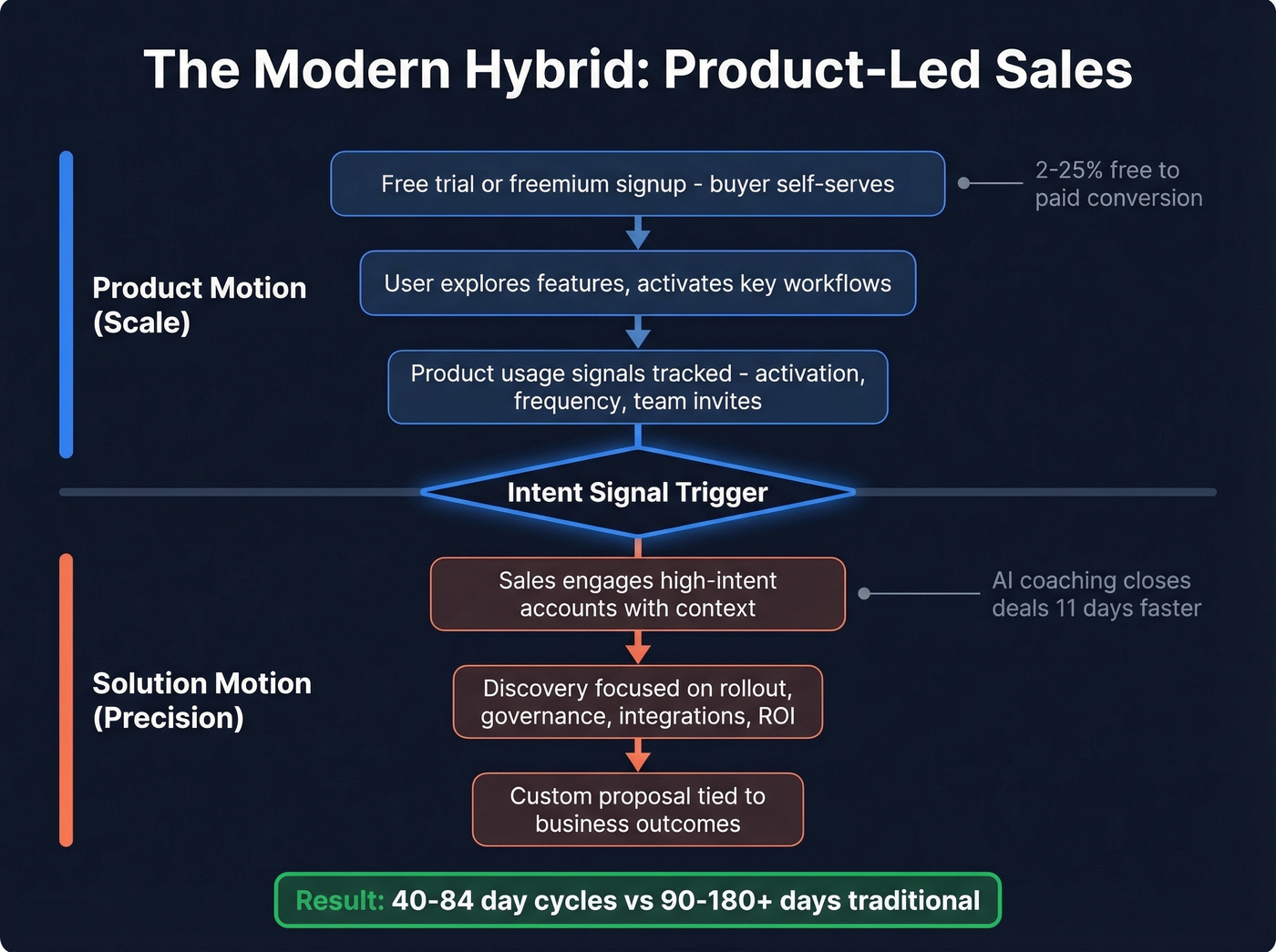
The numbers support the hybrid. PLG sales cycles run 40-84 days on average (up to 170 for larger deals), compared to 90-180+ days for traditional sales-led motions. Free trial to paid conversion ranges from 2-25% depending on activation - but the leads that do convert come in warmer, with product context that makes discovery faster and more productive.
Here's what a common pattern looks like in practice: users self-serve on a free tier or trial, which is your product motion running at scale. Then sales engages the accounts showing high-intent usage signals, running solution-selling conversations about rollout, governance, integrations, and ROI. Same company, both motions, different buyer segments.
To make that handoff work, you need a consistent way of identifying buying signals so sales only jumps in when intent is real.
AI tools accelerate this hybrid. Outreach's AI coaching assistant closes deals 11 days faster on average and boosts win rates by up to 10 percentage points on deals over $50K. AI can handle the product-selling layer - chatbots list features, comparison pages self-update, AI SDRs qualify inbound. Solution selling is the defensible human skill. The reps who thrive use AI to handle the transactional work and spend their time on the conversations that actually require judgment.
If you're leaning into AI for the transactional layer, pair it with a clear AI sales follow-up system so speed doesn't turn into spam.
Discovery Framework That Works
We've seen teams invest in solution selling and still fail because their discovery process is unstructured. Here's a framework organized into three phases that we've refined across dozens of conversations with sales leaders.
Before the Call
Pre-call research is non-negotiable. Showing up cold to a discovery call is the fastest way to lose credibility with a buyer who's already done their homework.
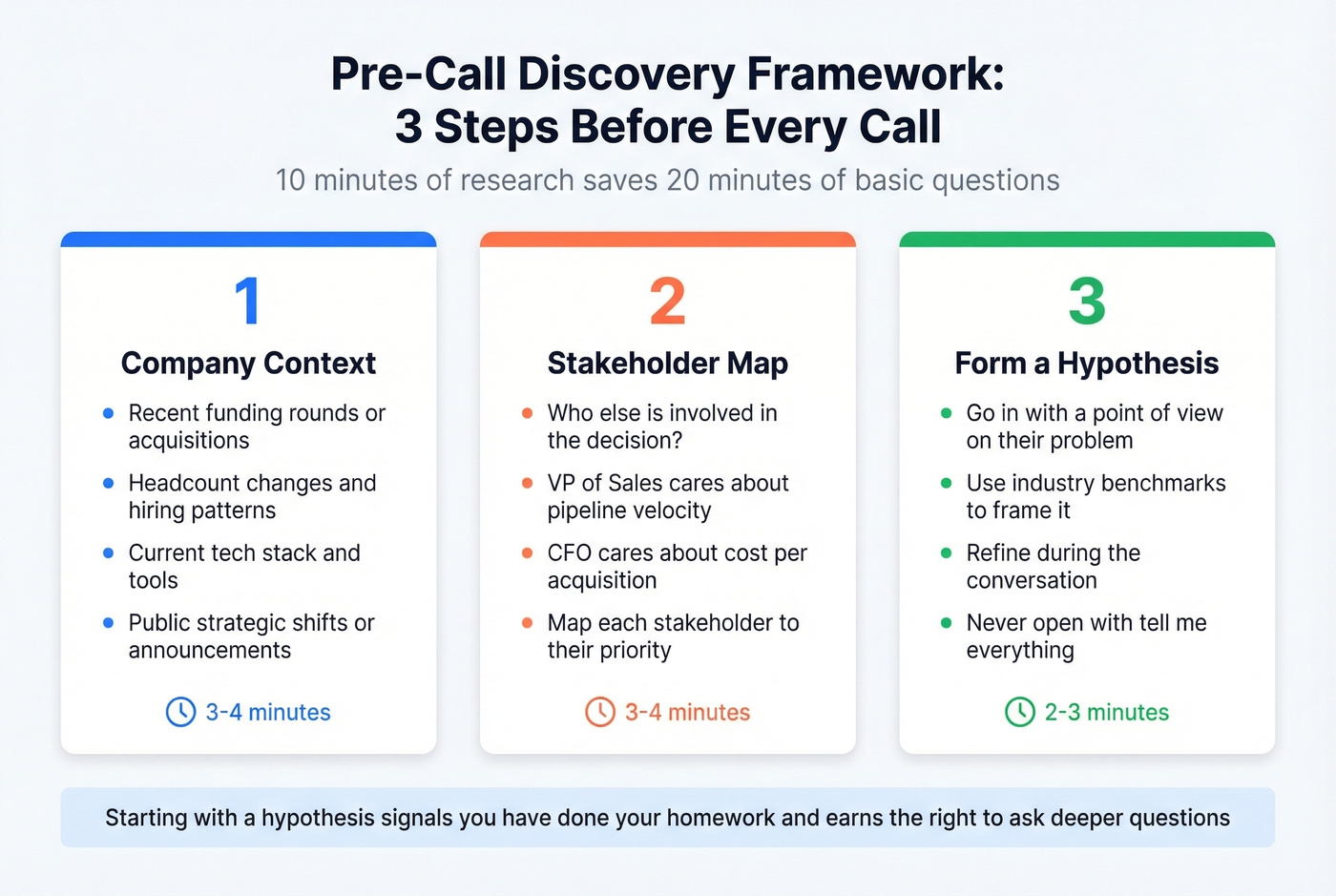
Start with company context - recent funding, headcount changes, tech stack, and any public strategic shifts. Ten minutes of research saves twenty minutes of basic questions. Then build a stakeholder map: who else is involved in the decision? A VP of Sales cares about pipeline; a CFO cares about cost per acquisition. Finally, form a hypothesis - go in with a point of view on what their problem likely is. You'll refine it during the call, but starting with "tell me everything" signals you haven't done your homework.
If you want a reusable way to document that hypothesis and who you sell to, use an Ideal Customer Profile template.
During the Call
Organize your questions using SPIN as the backbone, with MEDDIC-style qualification woven in. If you want a tighter set of prompts, keep a short list of discovery questions your team standardizes on.
Situation (establish current state - keep this short):
- "Walk me through how your team handles [process] today."
- "What tools are you currently using for [function]?"
Problem (surface pain):
- "Where does that process break down?"
- "What happens when [specific scenario] occurs?"
Implication (quantify the cost of inaction):
- "What does that cost you in time per week? Per quarter?"
- "If nothing changes in the next six months, what's the risk?"
Need-Payoff (let the buyer articulate the value):
- "If you could solve [problem], what would that unlock?"
- "What would success look like twelve months from now?"
Qualification (MEDDIC-style):
- "Who else needs to sign off on this?"
- "What criteria will you use to evaluate options?"
- "Is there a timeline driving this decision?"
After the Call
Build a one-page customer profile - a concept from Nextiva's discovery framework that we've found incredibly useful. Capture the buyer's stated problem, the quantified impact, the decision criteria, the stakeholder map, and the timeline. Share it back with the buyer as a summary. It demonstrates you listened, and it becomes the foundation for every subsequent conversation.
Let's be honest: most reps skip this step. Don't. The teams that document discovery consistently outperform the ones that wing it.
Data Quality Makes or Breaks Both Motions
Neither approach works if your data is bad. You can't solution-sell if the email bounces. You can't product-sell at volume if a third of your list is invalid. And Gartner research found that 69% of B2B buyers report inconsistencies between supplier website info and what sellers say - so data alignment matters at every touchpoint.
If you're seeing bounces or deliverability issues, start with email bounce rate benchmarks and fixes before you scale outreach.
Before methodology, fix your data. Prospeo runs 300M+ professional profiles with 98% email accuracy and a 7-day refresh cycle - that freshness matters because job changes, role shifts, and company moves make stale data a bounce-rate time bomb. Meritt saw their bounce rate drop from 35% to under 4% after switching, and their pipeline tripled from $100K to $300K per week. Whether you're running product-selling sequences at scale or researching accounts for solution-selling discovery, verified data is the prerequisite that makes everything else work.
The 2026 data is clear: 73% of buyers avoid suppliers who send irrelevant outreach. Prospeo's 30+ search filters - including buyer intent, technographics, and job changes - let you match your selling motion to buyers who are actually in-market. All refreshed every 7 days, not the 6-week industry average.
Target in-market buyers with intent data across 15,000 topics.
FAQ
Who invented solution selling?
Solution selling was coined in the 1970s and formalized as a training methodology by Mike Bosworth in the 1980s. It was designed for selling complex technology solutions to enterprise buyers, where understanding the customer's pain mattered more than listing product specs.
Can you combine both approaches?
Yes - most high-performing SaaS teams run both simultaneously. Forrester calls it product-led sales: buyers self-serve through free trials, then sales engages high-intent accounts with solution-selling discovery for expansion deals. It's the same company running two motions for different buyer segments and deal sizes.
What's the difference between consultative and solution selling?
Consultative selling is the broader philosophy - ask before you pitch, advise before you close. Solution selling is a specific methodology within that philosophy, with structured stages from pain identification through proof of capability. Think of consultative selling as the mindset, solution selling as the playbook.
When should I skip solution selling entirely?
When the product is simple, the buyer's already educated, and the deal closes under $5K. Commodity purchases, self-serve SaaS, and transactional sales all favor product-led approaches where speed and simplicity beat deep discovery. If your average cycle is under two weeks, deep discovery adds friction without proportional value.