

How to Target Leads That Actually Convert
You send 500 cold emails. You get 2 meetings. One ghosts after the intro call. The other wasn't even the right buyer.
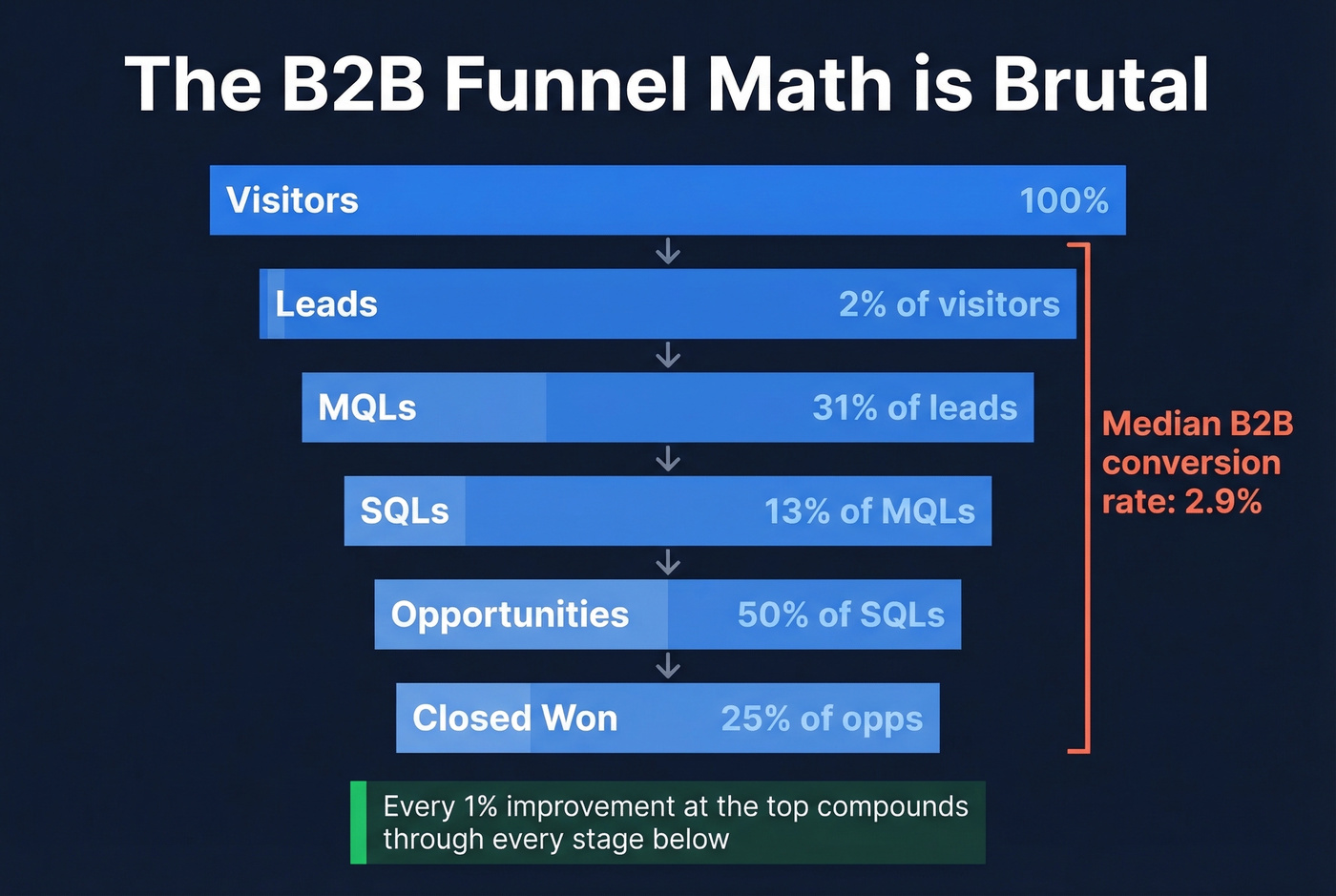
That's not a lead gen problem - it's a failure to target leads who actually fit your ICP. The median B2B conversion rate sits at 2.9%, and the funnel math is brutal: roughly 2% of visitors become leads, 31% of leads become MQLs, 13% of MQLs become SQLs, 50% of SQLs become opportunities, and 25% of those close. Every percentage point you gain at the top - by targeting the right accounts - compounds through every stage below it.
SDRs on r/sales say it constantly: the #1 reason cold outreach fails isn't messaging. It's going after the wrong accounts.
What You Need (Quick Version)
- A scored ICP - not a vague persona doc, but a point-based rubric that grades every account on a 100-point scale.
- A verified database refreshed quarterly at minimum. 22.5% of your B2B data decays every year. If you're working off a list older than 90 days, it's already meaningfully degraded.
- Multichannel outreach sequencing against Tier A accounts first. Email, phone, and social - coordinated in a single sequence aimed at the accounts most likely to close.
What Are Targeted Leads?
Targeted leads are prospects who match specific, predefined criteria - your ICP - before you ever reach out. They're the opposite of a bulk purchased list where you're hoping quantity compensates for fit. The distinction matters because B2B buying committees average five decision-makers per deal on average, which means you're not targeting a contact - you're targeting an account and the people inside it who influence the purchase.
A targeted lead has been scored against your rubric and shows signals like firmographic fit, tech stack overlap, or active intent that make outreach worth the rep's time. Get this wrong and your reps burn hours on accounts that look good in a spreadsheet but will never sign a contract.

Your ICP scoring rubric is only as good as the data behind it. Prospeo gives you 30+ filters - buyer intent, technographics, job changes, funding, headcount growth - across 300M+ profiles with 98% email accuracy. Every lead exports pre-verified so your reps target accounts that actually close.
Build a scored, verified target list in minutes - not months.
How to Build a List That Converts
Define Your ICP With a Scoring Rubric
Look, most teams have an ICP doc buried in a Google Drive folder that nobody's opened since the offsite. That's not an ICP - it's a wish list. What you need is a scoring rubric that assigns points to every account so reps know exactly where to focus.
If you want a plug-and-play starting point, use an ICP scoring rubric and adapt it to your closed-won data.
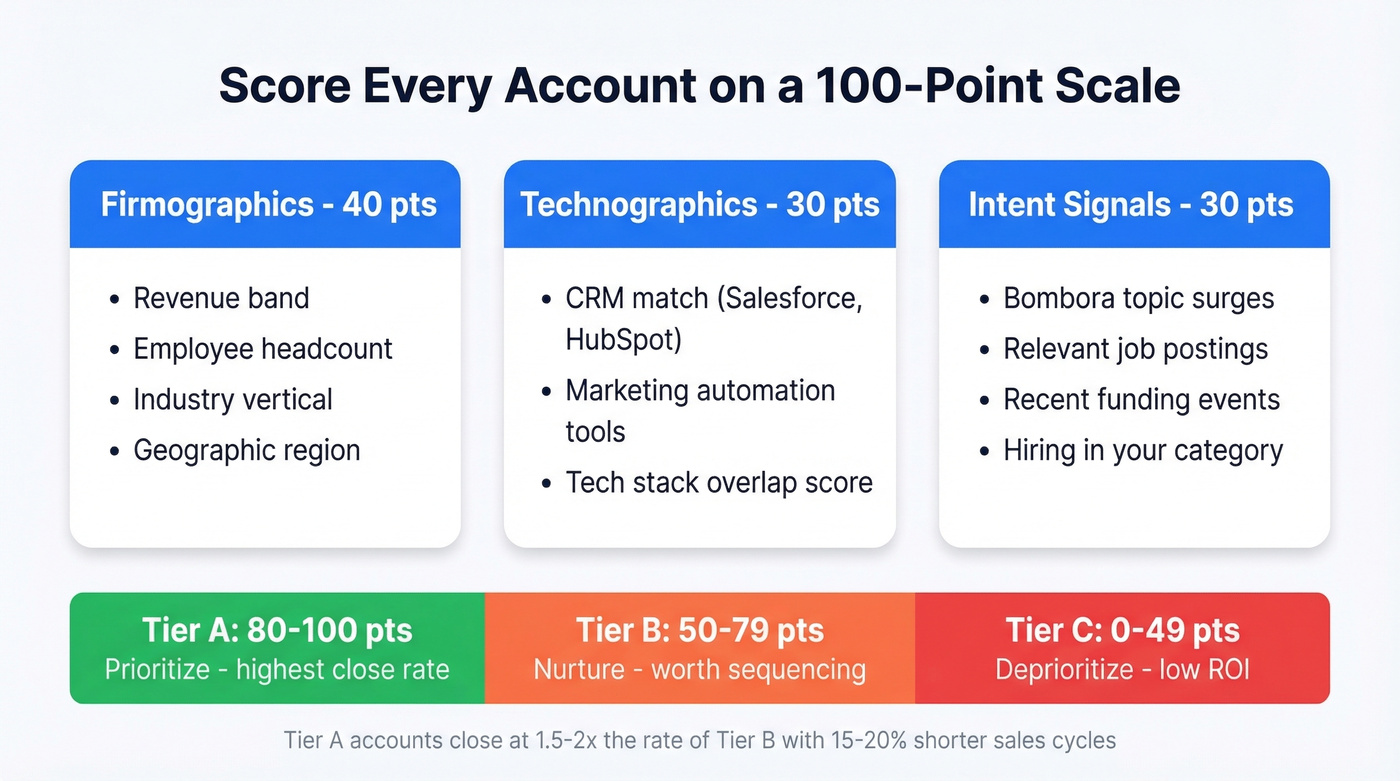
Here's a 100-point model that works:
| Category | Weight | Example Criteria |
|---|---|---|
| Firmographics | 40 pts | Revenue, headcount, industry, geo |
| Technographics | 30 pts | Tech stack match (e.g., uses Salesforce/HubSpot) |
| Intent signals | 30 pts | Bombora topics, job postings, funding events |
Set tier thresholds: Tier A = 80-100, Tier B = 50-79, Tier C = 0-49. Then validate quarterly against closed-won data. In our experience, Tier A accounts close at roughly 1.5-2x the rate of Tier B, with 15-20% shorter sales cycles. If your Tier A accounts aren't closing faster, your rubric needs recalibrating.
Size Your TAM
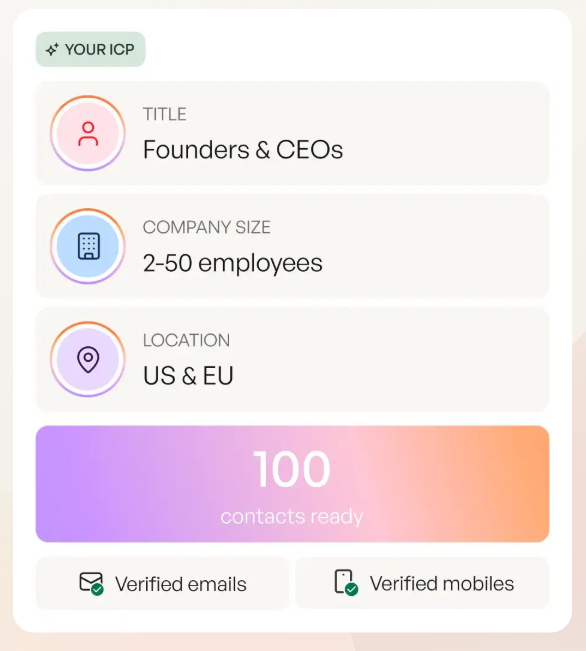
Your total addressable market isn't your ICP. TAM is every account that could theoretically buy; your ICP narrows that to accounts worth pursuing, and buyer personas narrow further to the individuals inside those accounts. With five decision-makers per deal on average, a TAM of 5,000 accounts means you're potentially engaging 25,000 contacts. Size accordingly - and don't confuse a big TAM with a good one.
If you need a clean framework for this, start with TAM, SAM, SOM and work backward into your list build.
Build Your Database
Manual research gets you 20-50 contacts per day. At that rate, building a 10,000-contact list takes months. Purchased lists run $0.10-$1.00 per contact, decay fast, and can create GDPR compliance risk if the data isn't accurate or properly sourced (see: Is it illegal to buy email lists?).
The better approach is a verified database with filters that match your scoring rubric. Prospeo brings the cost down to roughly $0.01 per verified email across 300M+ profiles, with 30+ search filters covering buyer intent powered by Bombora (15,000 topics), technographic signals, job change alerts, headcount growth, funding rounds, and department-level headcount. The output isn't a name list - it's a scored set of accounts with contacts who are actively in-market, and every lead in the export comes with verification data so your reps can prioritize with confidence.

The 98% email accuracy means you're not burning your domain on bounces, and 125M+ verified mobile numbers give your SDRs direct dials instead of switchboard roulette.
Segment by Fit + Intent
Once you've built the list, segment it before you sequence it. The dimensions that matter:
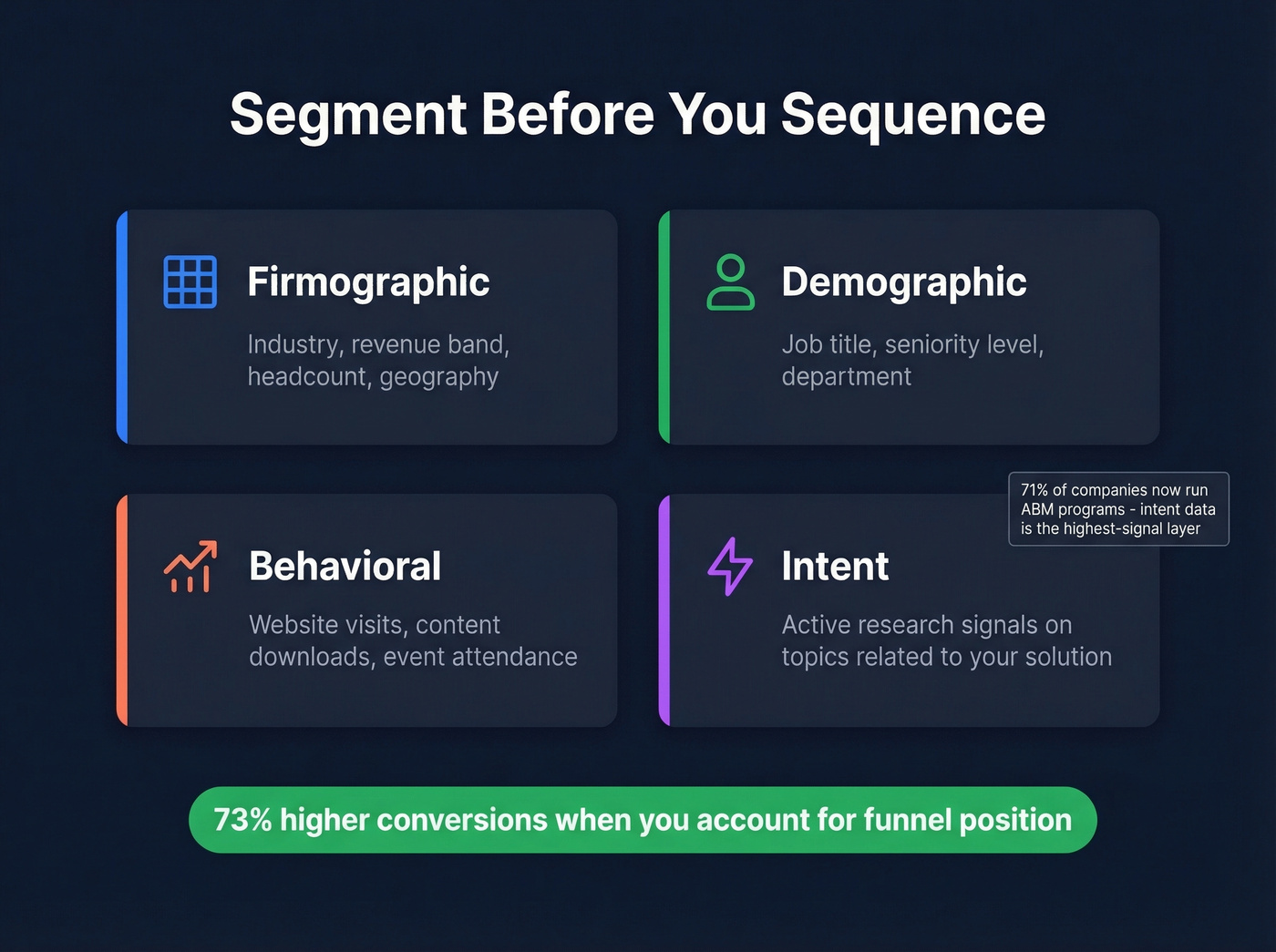
- Firmographic: industry, revenue band, headcount, geography
- Demographic: job title, seniority, department
- Behavioral: website visits, content downloads, event attendance
- Intent: active research signals on topics related to your solution
71% of companies now run ABM programs, and intent data is the highest-signal layer. A VP of Engineering at a Series B company researching "API security" is a fundamentally different prospect than the same title at a company showing zero intent. Accounting for a lead's position in the sales funnel increases conversions by 73%. Treat these segments differently.
To operationalize this, build an intent-based segmentation model your SDRs can actually run weekly.
Verify and Refresh Quarterly
B2B data decays at 22.5% per year. At the field level, work emails decay 20-30% annually, job titles 15-25%, and direct phone numbers 15-20%. A list you built six months ago is already significantly degraded.
Fresh, verified lists bounce under 2%. Stale ones bounce 5-10% - and that kills your sender reputation. If you're managing lists manually, audit and re-verify every 90 days at minimum (or use a process aligned with email deliverability best practices).
Tools for Targeted Lead Generation
| Tool | Best For | Email Accuracy | Data Refresh | Starting Price | Contract? |
|---|---|---|---|---|---|
| Prospeo | Verified data + intent | 98% | 7 days | Free / ~$39/mo | No |
| Apollo | SMB outbound + sequences | ~79% | ~4-6 weeks | Free / ~$49/mo | No |
| ZoomInfo | Enterprise GTM | ~87% | ~4-6 weeks | ~$15K-$40K/yr | Yes (annual) |
| Clay | Custom enrichment flows | Varies by source | Real-time | Free / ~$149/mo | No |
Prospeo is the strongest option if data accuracy is your priority - and it should be, because everything downstream depends on it. Snyk's sales team saw bounce rates drop from 35-40% to under 5% after switching, generating 200+ new opportunities per month across 50 AEs.
Apollo works well for SMB teams that want prospecting and sequencing in one tool. The built-in email sequences and dialer save time, but lower email accuracy means more bounces and more domain risk on high-volume campaigns.
ZoomInfo is the enterprise default. Org charts, technographics, and intent data are all strong. But here's my honest take: if your average deal size is under $15K, you almost certainly don't need ZoomInfo-level infrastructure. A 10-seat contract with the modules you actually need runs $15K-$40K/year with annual commitments. That's a lot of overhead for a database. Skip it unless you're running enterprise-scale ABM.
Clay isn't a database - it's an enrichment orchestration layer. RevOps teams use it to chain multiple data sources into waterfall enrichment workflows. Powerful if you have the technical chops, but it's a tool for builders, not a plug-and-play solution. (If you're using it for list building, this Clay list building workflow helps.)
Mistakes That Kill Lead Targeting
Emailing outdated data. If your database is older than a quarter, you're fighting 22.5% annual decay. That means bounced emails, wrecked sender reputation, and sequences that never reach a human inbox. Here's the thing: bad data doesn't just waste time - it actively damages your ability to reach good prospects on the same domain.
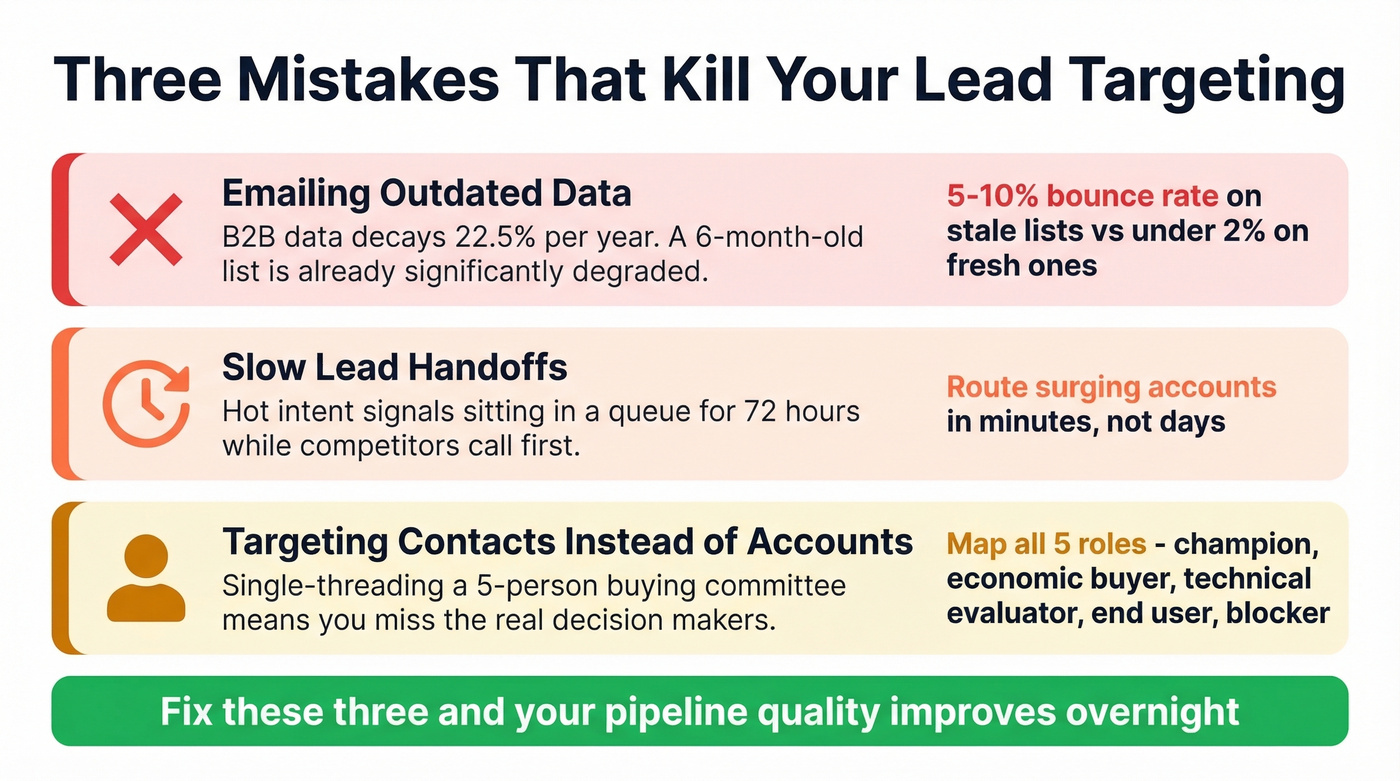
Slow handoffs. Speed-to-lead is a revenue lever, not a nice-to-have. Set SLAs between marketing and sales - if a surging account hits your intent threshold, routing should be measured in minutes, not days. We've seen teams lose deals simply because a hot intent signal sat in a queue for 72 hours while a competitor's SDR was already on the phone.
Targeting contacts instead of accounts. Remember the five-person buying committee. If you're emailing one contact per account, you're single-threading a multi-threaded decision. Map the committee - champion, economic buyer, technical evaluator, end user, blocker - and sequence all of them. Multi-threading isn't optional in enterprise sales; it's how deals actually close.
If you need a tighter system for the outreach side, pair this with a B2B cold email sequence and a simple sequence management process.
B2B data decays 22.5% per year, but Prospeo refreshes every 7 days - not the 4-6 week industry average. That means your targeted leads stay accurate between quarterly audits. Snyk's 50 AEs dropped bounce rates from 35% to under 5% and generated 200+ opportunities per month.
Stop burning your domain on stale data. Start with verified contacts at $0.01 each.
FAQ
What are targeted leads vs. qualified leads?
Targeted leads match your ICP before outreach - selected on firmographic, technographic, and intent criteria. Qualified leads have been vetted through engagement or conversation. Targeting is the input; qualification is the output after a rep interaction.
How often should I refresh my lead database?
Quarterly at minimum. B2B data decays at 22.5% per year - roughly 5-6% goes stale every quarter. Tools with a 7-day refresh cycle keep bounce rates under 2% without manual audits.
How many prospects do I need to book one meeting?
With verified data and multichannel outreach against ICP-fit accounts, expect 50-100 prospects per meeting booked. Broad, unverified lists require 500+. The math favors precision over volume every time.
What's a good free tool for building targeted lead lists?
Prospeo's free tier gives you 75 verified emails per month with full access to 30+ search filters and intent data - enough to test ICP-fit lists before committing budget. Apollo also offers a free plan, though its 79% email accuracy means more bounces at scale.