

Value-Based Selling Examples: Real Companies, Real Numbers, Real Scripts
Your manager just told the team to "lead with value" in Q4. Everyone nods. Nobody knows what that actually means in their next email or cold call.
That gap isn't just awkward - 35% of lost deals die because the buyer saw "[poor value for money](https://blog.hubspot.com/sales/hubspot-sales-strategy-report)", and 38% of business leaders admit they can't execute a value-based proposition even though they know it matters. We've watched teams nod along in training sessions and then go right back to pitching features on their next call. Let's fix that with real value-based selling examples, a formula you can steal, and scripts that actually work.
What Is Value-Based Selling?
Value-based selling centers every conversation on the measurable outcomes your buyer gets - not the features you ship. You quantify ROI, tie it to the buyer's specific pain, and let the numbers do the persuading.
| Dimension | Value-Based | Consultative | Feature-Based |
|---|---|---|---|
| Focus | Buyer's ROI | Buyer's problem | Product specs |
| Buyer role | Business case owner | Collaborator | Evaluator |
| Key tactic | Quantify outcomes | Advise on solutions | Demo features |
| Outcome metric | Revenue/cost impact | Trust & fit | Feature checklist |
Consultative selling positions you as a trusted advisor. Value-based selling gives that advisor a calculator.
Real Examples With Revenue Impact
92% of buyers want to hear a value proposition early in the sales cycle. These four companies built their entire sales motion around that insight.
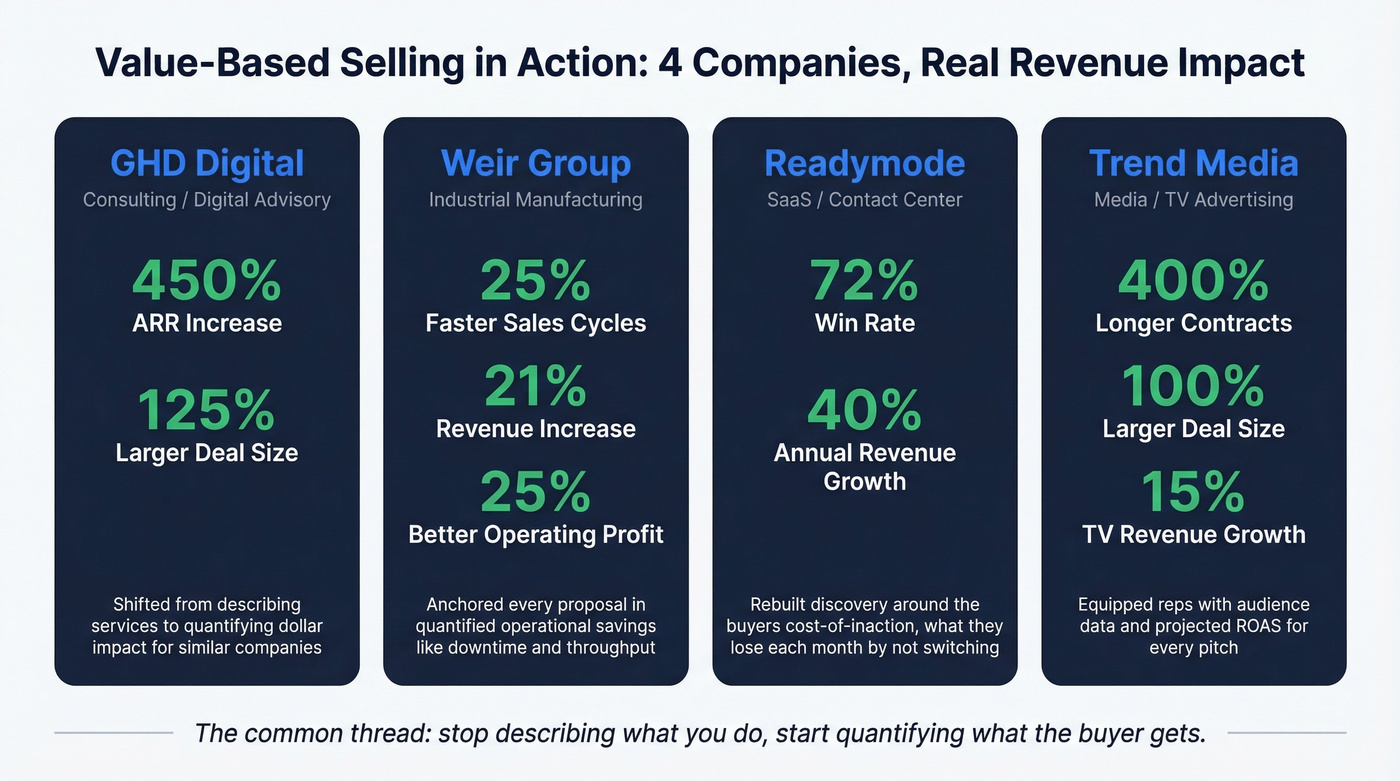
GHD Digital
A consulting firm drowning in a crowded digital advisory market shifted every sales conversation from "here's what we do" to "here's the dollar impact we've delivered for companies like yours," implementing the ValueSelling Framework. The result: 450% increase in ARR over two years and 125% larger average deal size. GHD didn't change their service. They changed how they talked about it.
Weir Group
Long, complex industrial sales cycles with multiple stakeholders were dragging deals out for months. Weir anchored every proposal in quantified operational savings - downtime reduction, throughput gains, maintenance cost avoidance. The payoff: 25% faster sales cycles, 21% revenue increase, and 25% improvement in adjusted operating profit. That's what happens when you stop selling machinery and start selling uptime.
Readymode
This SaaS company had a solid product but inconsistent win rates. They rebuilt discovery around the buyer's cost-of-inaction - what prospects lose every month by not switching. The shift produced a 72% win rate on sales-accepted opportunities and 40% annual revenue growth. Simple reframe, massive impact.
Trend Media
Here's one that surprised us. A media sales team selling TV ad inventory on relationships (not ROI) equipped reps with audience data and campaign performance benchmarks so every pitch included projected return on ad spend. The results: 15% growth in TV revenue, 400% growth in average contract length, and a 100% increase in average deal size across key accounts.
Notice the common thread: every company shifted from describing what they do to quantifying what the buyer gets. Across these four case studies, the headline revenue lift ranged from 15% to 450%. Bigger lifts usually came from making value quantification a repeatable process, not a one-off pitch deck. The consensus on r/sales threads is that reps want named companies and real numbers, not theory - which is exactly why we led with these.
How to Quantify Value
Most reps calculate ROI once for the proposal. Top reps recalculate it at every stage - after discovery, after demo, after negotiation - because the buyer's perception of value shifts as conversations progress and new stakeholders weigh in.
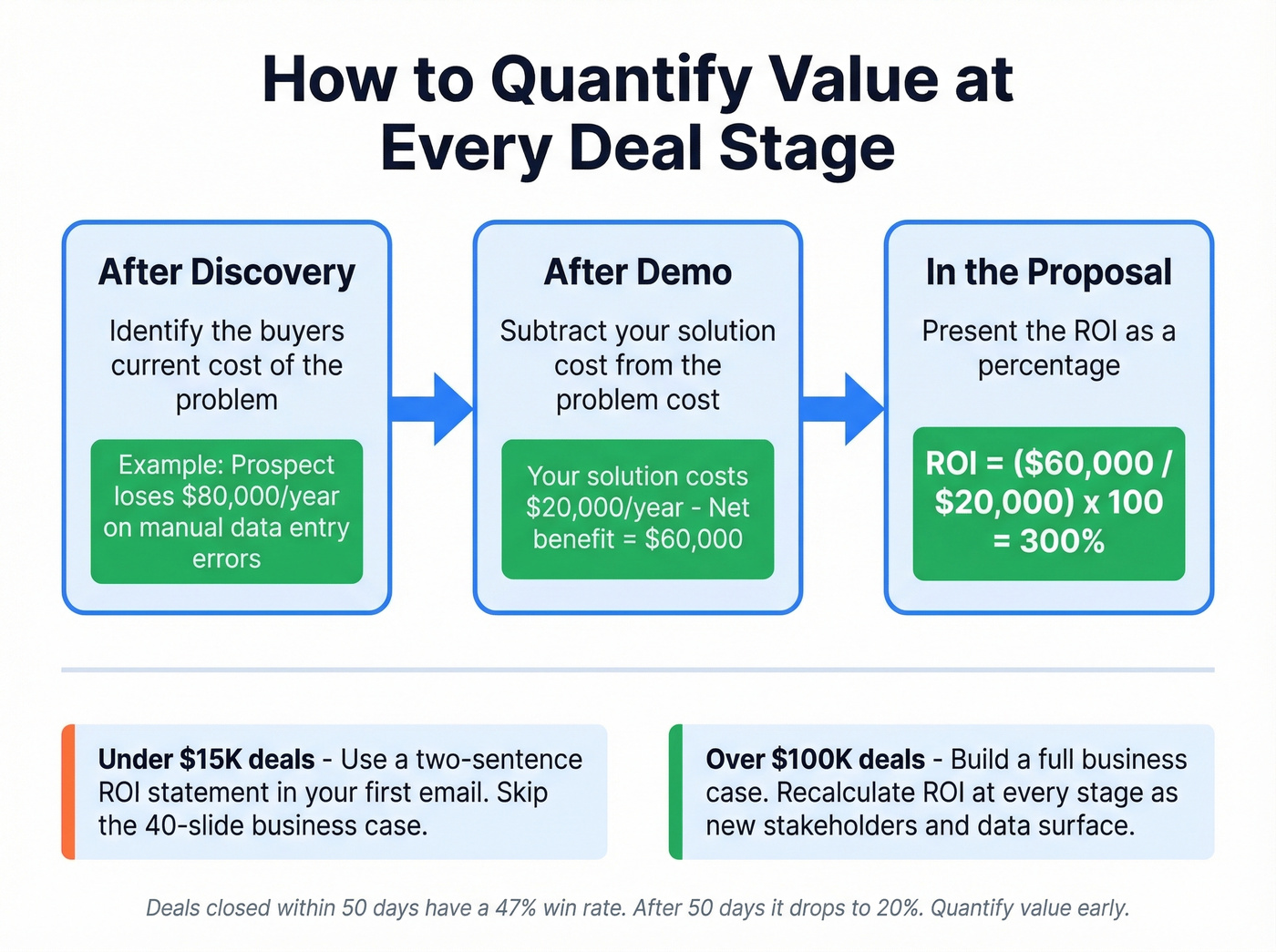
ROI = (Net Benefit / Cost) x 100
Your solution costs $20,000/year. The prospect's current problem costs them $80,000/year. ROI = (($80,000 - $20,000) / $20,000) x 100 = 300%. Put that number in your proposal deck, your email, and your talk track.
Here's a positioning exercise from GTMnow that forces clarity: fill in the blank - "Our customers hire us because ________." If you can't finish that sentence with a number or a specific outcome, you're not ready for a value-based conversation.
Here's the thing: if your average deal size is under $15K, you probably don't need a 90-minute discovery call to quantify value. A two-sentence ROI statement in your first email will outperform a 40-slide business case every time. Save the heavy frameworks for six-figure deals.
Speed matters too. Deals closed within 50 days carry a 47% win rate; after that threshold, win rates drop to 20% or lower. Quantifying value early compresses cycles because the buyer stops shopping - they've already seen the math.

You can't quantify value without knowing what your buyer cares about. Prospeo tracks buyer intent across 15,000 topics and flags job changes so you walk into every call with the context that turns generic pitches into ROI conversations.
Stop guessing what buyers care about. Start knowing.
Discovery Questions That Uncover Value
The best value-selling reps don't pitch first. They ask. The O-P-C technique from ValueSelling gives you a structure:
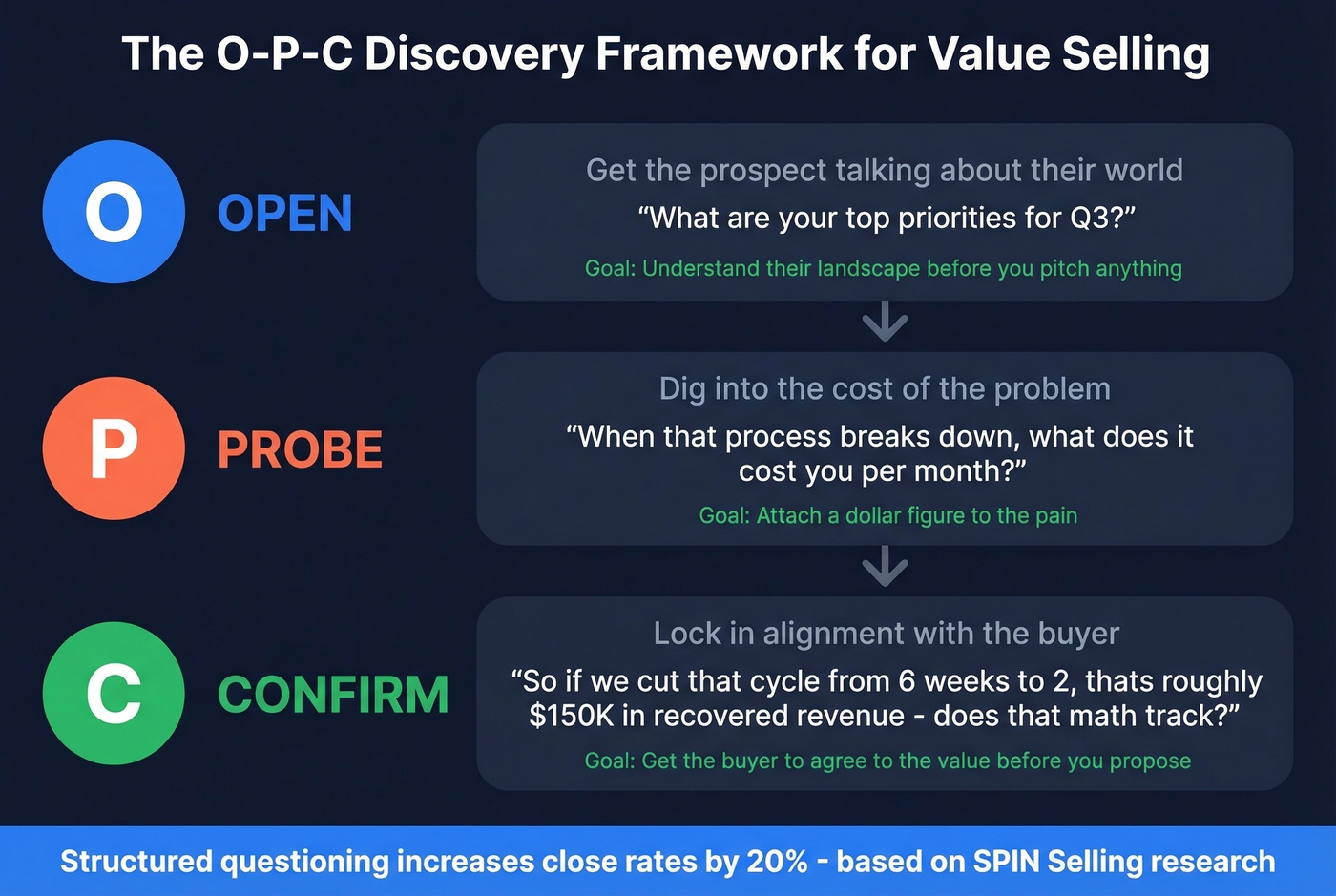
- Open: Broad questions that get the prospect talking. "What are your top priorities for Q3?"
- Probe: Follow-ups that dig into the cost of the problem. "When that process breaks down, what does it cost you per month?"
- Confirm: Restate what you've heard to lock in alignment. "So if we could cut that cycle from 6 weeks to 2, that's roughly $150K in recovered revenue - does that math track?"
One research-trigger question we love: "I saw that [company] brought on a new CFO - how does that impact your priorities right now?" That kind of specificity earns the right to ask deeper questions. Structured questioning increases closure rates by 20%, per Rackham's SPIN research.
Value-based discovery requires knowing something about the prospect before you dial. Tools like Prospeo - with 30+ search filters including job change signals and buyer intent across 15,000 topics - let you walk into every call with context that matters, not generic small talk. If you want a deeper bank of prompts, start with these discovery questions.
Value-Based Outreach Scripts
You're 45 seconds into a cold call and the prospect says "just send me the pricing." Here's how to pivot back to value.
Cold call opener (value-framed):
"Hi [Name], this is [You] from [Company]. Companies like [peer] are losing roughly $[X] a quarter on [specific problem] - we helped them cut that by [X%] in [timeframe]. Is that a priority for your team right now?"
Leading with a quantified dollar figure - not your name and company description - drives a 2.1x higher success rate than generic openers. The same value frame works in email, video messages, and voice notes. For more patterns you can reuse, see these talk tracks and sales prospecting techniques.
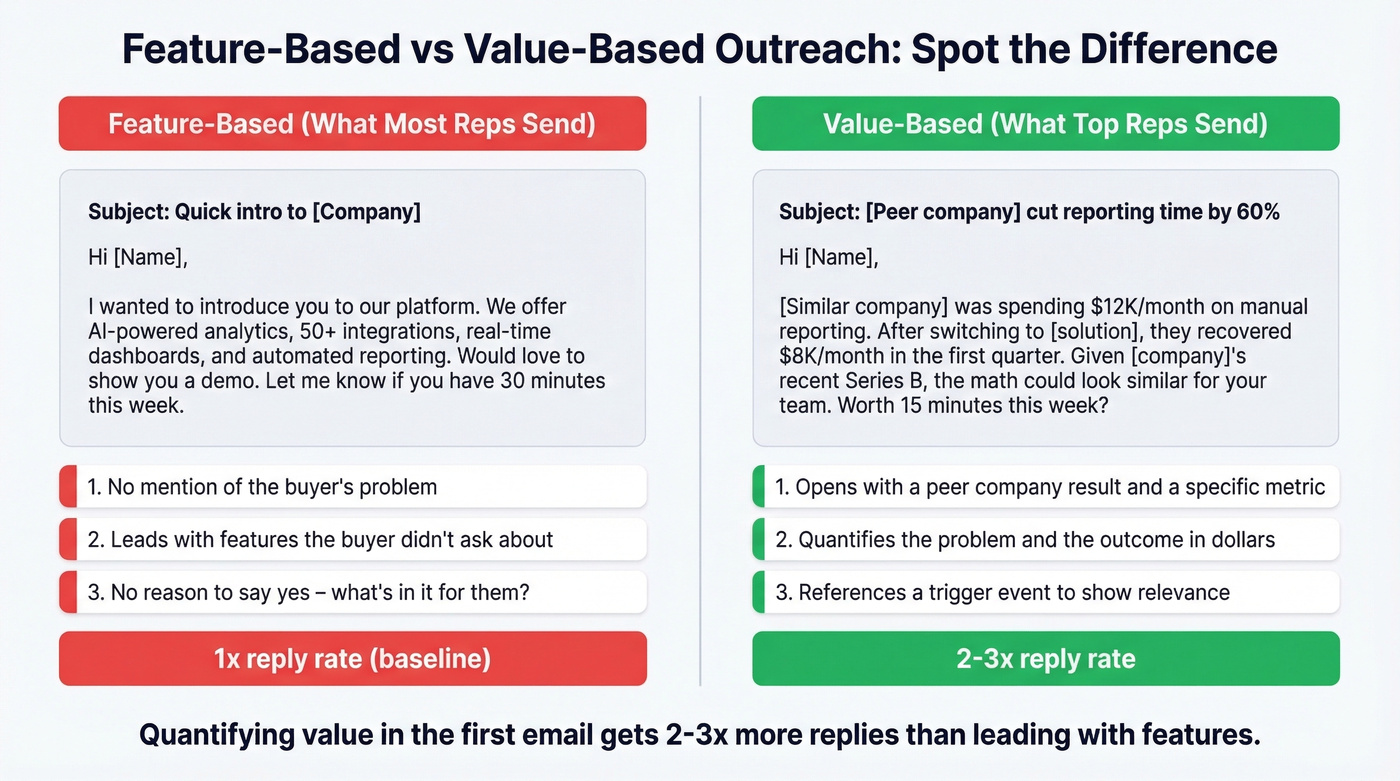
Cold email template:
Subject: [Peer company] cut [metric] by [X%]
Hi [Name],
[Similar company] was spending [$$] on [problem]. After switching to [your solution], they recovered [$$] in [timeframe].
Given [company]'s recent [trigger], the math could look similar for your team. Worth 15 minutes this week?
If you want more variations, pull from these sales follow-up templates and email subject line examples.
In our experience, reps who quantify value in the first email get 2-3x more replies than those who lead with features. But those emails only work if they reach the inbox. Bad data tanks sender reputation fast - one reason we built Prospeo's 5-step verification with catch-all handling, spam-trap removal, and honeypot filtering to hit 98% email accuracy. If you're tightening the whole outbound system, pair that with an email deliverability guide and a plan to improve sender reputation.
When Value Selling Backfires
Skip value-based selling if your operations team can't back the claims you're making. Seriously.
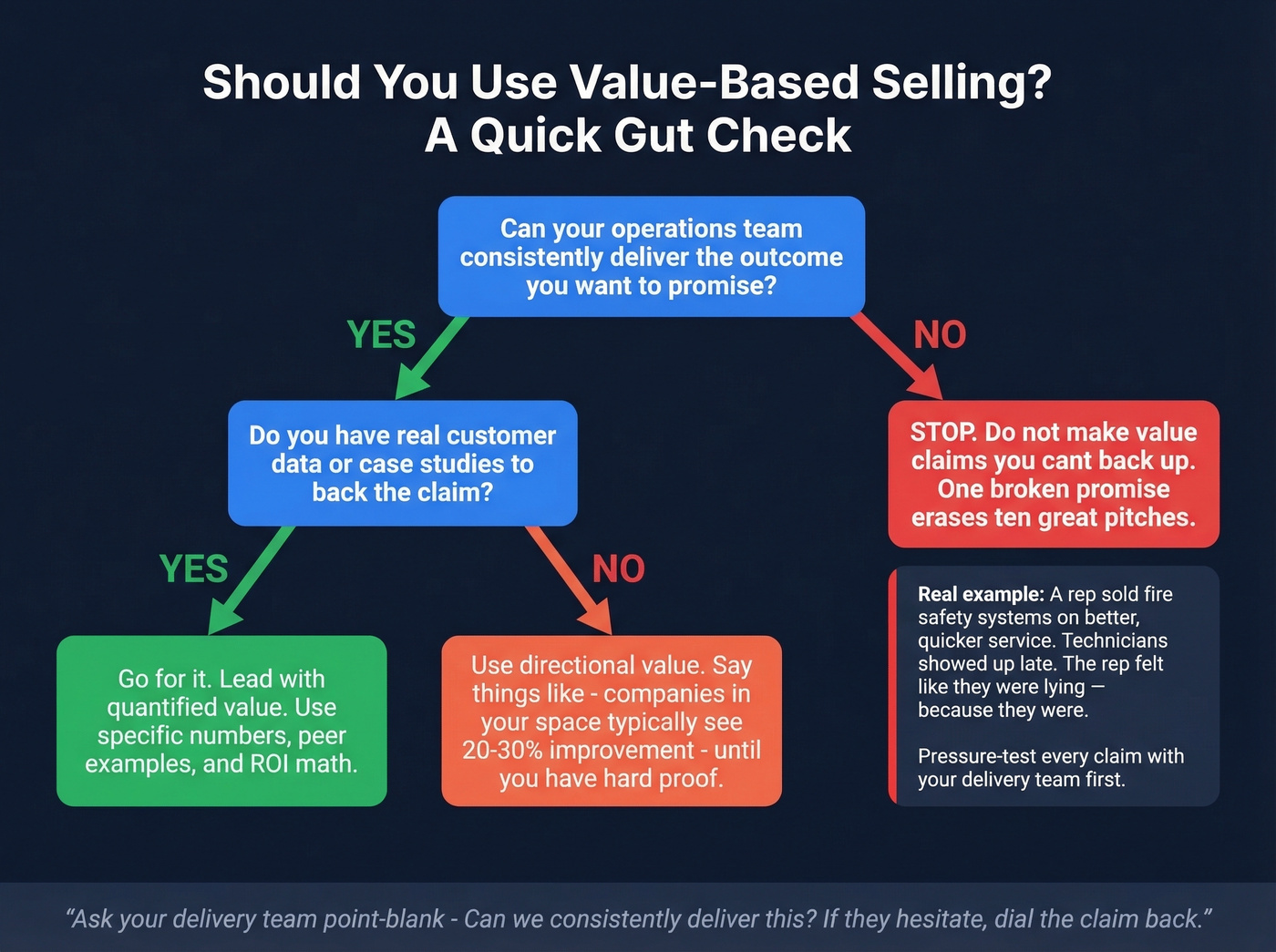
A rep on r/sales shared a story about selling fire safety systems on the promise of "better, quicker service." Then technicians showed up late. Service was equally lackluster. The rep felt like they were lying - and they were right to feel that way.
We've seen this pattern repeatedly: the pitch writes checks that operations can't cash. Before you build a value narrative, pressure-test it with your delivery team. Ask them point-blank: "Can we consistently deliver a 40% cost reduction?" If they hesitate, dial the claim back. One broken promise erases ten great pitches, and in B2B, word travels fast through buyer communities and review sites. (If you need a practical framework for this, use a stage-by-stage approach to add value in sales.)
Those value-framed cold emails only work when they land in real inboxes. Prospeo's 98% email accuracy and 7-day data refresh mean your quantified ROI message reaches the right decision-maker - not a bounce folder.
Your best ROI pitch is worthless if it bounces.
FAQ
Is value-based selling the same as consultative selling?
No. Consultative selling positions you as a trusted advisor who diagnoses problems. Value-based selling adds a quantification layer - you calculate and communicate specific ROI in dollars or percentages. They're complementary, not interchangeable.
How do I calculate ROI for a prospect?
Use ROI = (Net Benefit / Cost) x 100. A $20K solution solving an $80K problem delivers 300% ROI. Put that number in your proposal, your first outreach email, and your demo recap. Recalculate at each stage as new data surfaces.
What data do I need before a value-based sales call?
At minimum: the prospect's role, company size, recent triggers like funding rounds or leadership changes, and their likely pain points. Intent data tracking buyer signals across thousands of topics can cut your research time from hours to minutes, so you walk into conversations already armed with context.
What's the biggest mistake reps make with value selling?
Promising outcomes their company can't deliver. Every value-based selling example that succeeds long-term has tight alignment between sales and operations. If your delivery team can't back a 40% cost-reduction claim, don't make it.