

7 Virtual Selling Challenges That Kill Deals - and How to Fix Each One
Your SDR prepped for 45 minutes. The prospect joined late, camera off, clearly checking email. The deal went dark two days later.
That story plays out thousands of times a day. 92% of B2B buyers now prefer virtual sales interactions, and more than 75% favor digital or remote engagement over face-to-face. But most teams are still running an in-person playbook over Zoom - and that's where deals die. The medium isn't the issue. The process is.
All 7 Challenges at a Glance
- Attention drops off at 15 minutes - cap meetings at 25 min, add a real break around the 30-45 min mark.
- Trust without a handshake - video-first follow-ups and personalized pre-call research.
- Video fatigue is measurable - hide self-view, go camera-optional after the open.
- Buyers decide before the call - lead with insight, not demos.
- Bad prospect data kills your one shot - verify every email and number before outreach.
- Sales cycles stretch and deals stall - multi-thread early, use async recaps.
- Remote teams lose coaching - record calls, codify the virtual process.
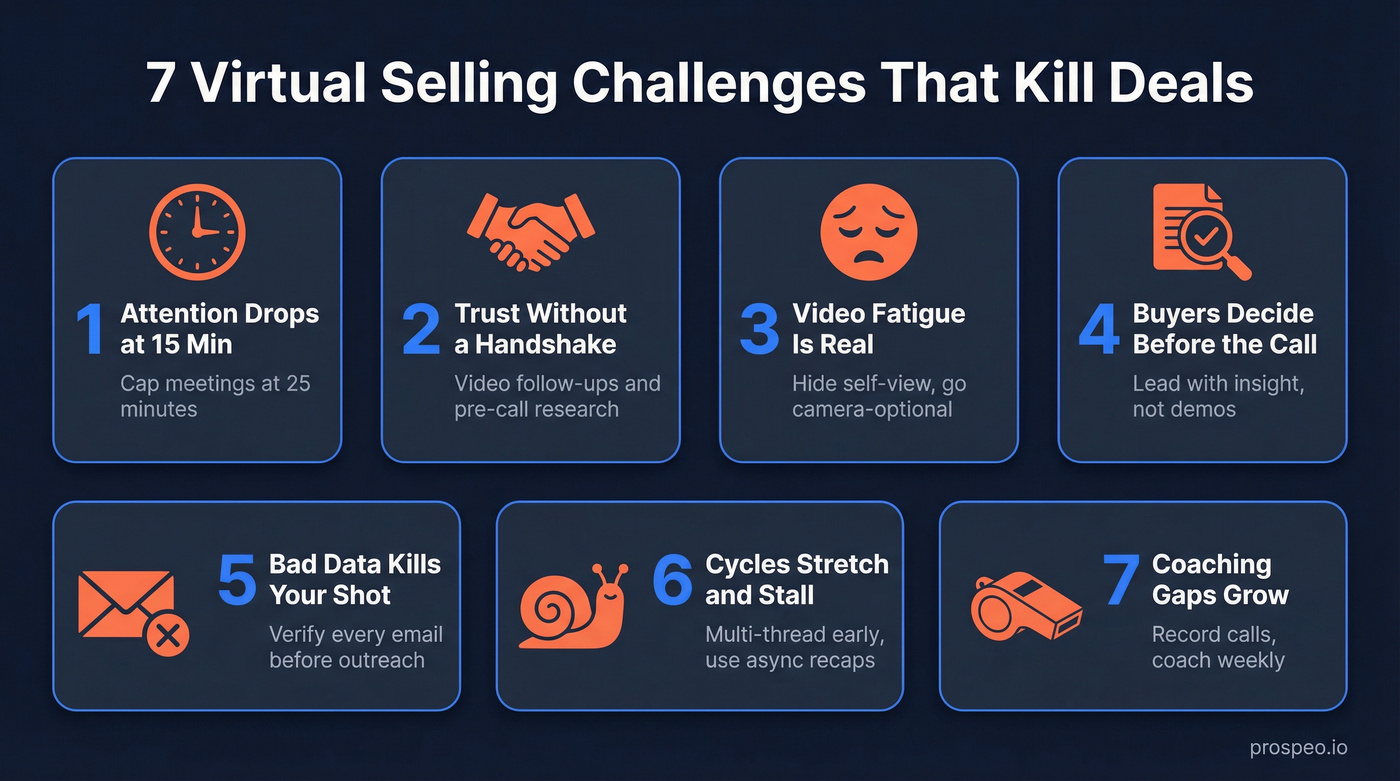
The 7 Challenges (+ Fixes)
1. Buyer Attention Drops Off in 15 Minutes
A controlled study using EEG and ECG monitoring found that participants struggled to focus roughly 15 minutes into a virtual session. That's why your 45-minute discovery call feels like pulling teeth after minute 20.
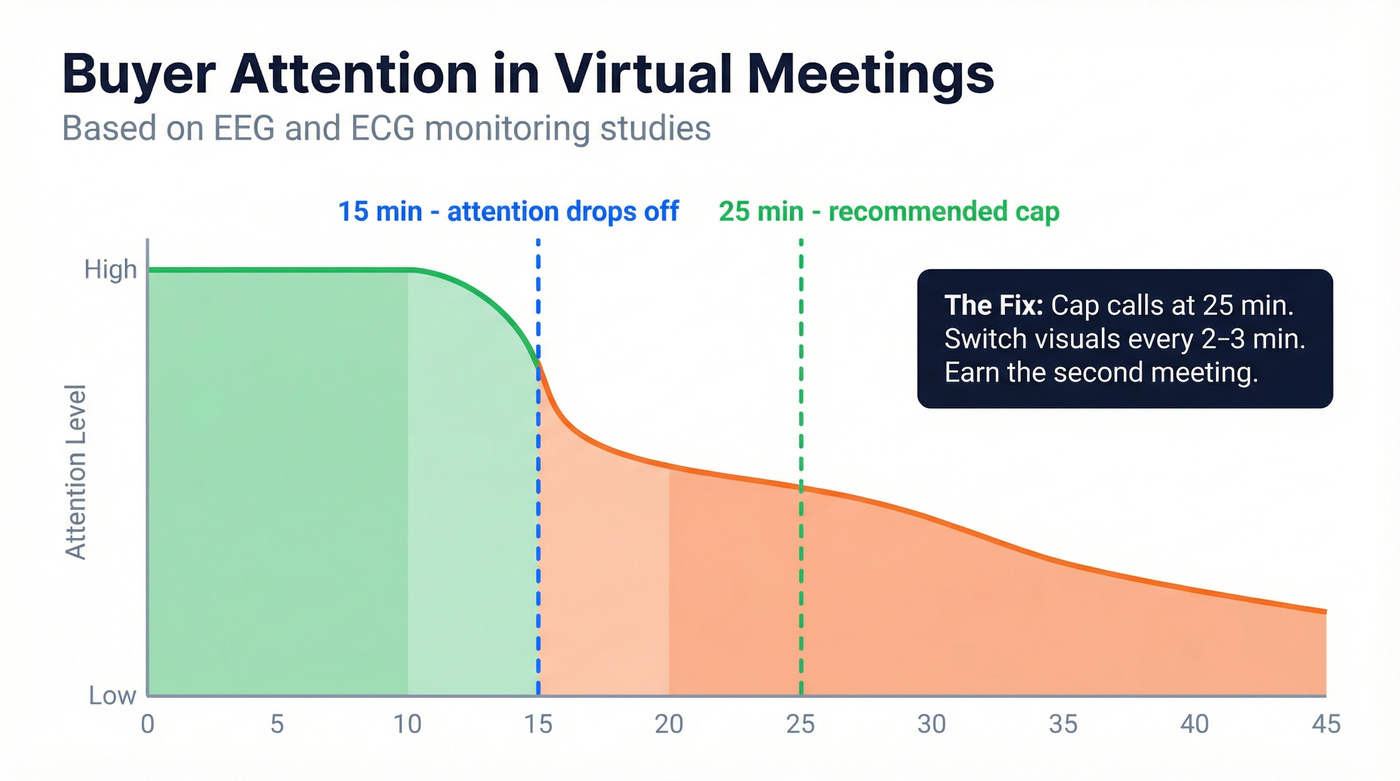
In our experience, a 25-minute cap is the highest-ROI change a team can make. Keep the agenda tight, switch the visual every couple of minutes - slides to camera to doc to whiteboard - and if you're running longer sessions, build in a real break around the 30-45 minute mark. Need the full 45? Split it into two shorter calls and earn the second one.
2. Building Trust Without a Handshake
Here's the thing: the biggest trap in virtual selling isn't the tech. It's the assumption that trust requires a handshake. Integrity Solutions calls it the first trap - reps decide virtual relationships are "less real," then show up flat and transactional. This compounds over time if left unaddressed.
Fix it with a repeatable trust routine. Send a 90-second video clip after the call that recaps decisions and next steps. Do real pre-call research and name attendees in the agenda so it's obvious you prepared. During the meeting, pull people in by name early - "Sam, I want your take on this" - instead of waiting for questions that never come. Small moves, but they signal effort in a way that a generic follow-up email never will (use these sales follow-up templates to speed it up).
3. Video Fatigue Is Real
Stanford's Virtual Human Interaction Lab identified four mechanisms behind video-call exhaustion: intense close-up eye contact, seeing yourself in real time, reduced mobility, and higher cognitive load. This is why "camera on or else" policies backfire.
Do this instead: camera-on for the first five minutes to establish presence, then make it optional. Hide self-view by default. If your team runs internal meetings all day, switch some to audio-only. We've noticed our best external calls happen when reps aren't already fried from three hours of internal Zooms.
4. Buyers Decide Before the Call
About 80% of buyers set specifications before talking to a rep, and the modern buyer is 57% through decision-making before contacting a vendor. If your first call is a demo, you're already late.
Worse, buyers are comfortable making big purchases remotely - so you're not "warming them up," you're competing against the decision they already made in their head. Lead with an insight they didn't get from your website: a risk they're underestimating, a hidden cost, a common implementation failure. Then use the demo to prove the insight, not to tour features (this product demo checklist helps keep it tight). The reps who win these calls are the ones who make the buyer rethink something, not the ones who click through 30 slides.
5. Bad Prospect Data Kills Your One Shot
In virtual selling, you don't get hallway luck. If the email bounces and the number is dead, the conversation never starts. Period.
We've seen this destroy pipeline velocity fast. Snyk's AE team ran bounce rates of 35-40%; after switching to verified data, bounces dropped under 5% and AE-sourced pipeline jumped 180%, generating 200+ new opportunities per month. Prospeo tackles this at the source - 98% email accuracy on a 7-day refresh cycle means your outreach actually lands. When outreach is your only path in, accuracy is the whole game (see email bounce rate benchmarks and fixes).

6. Sales Cycles Stretch and Deals Stall
Virtual makes it easier for buyers to ghost, stall, and drift into "no decision." RAIN Group's enablement survey found 43% of leaders say sales cycles have increased, and 44% say "lost to no decision" has increased. That second number is the one that should scare you - it means deals aren't dying to competitors, they're dying to inertia.
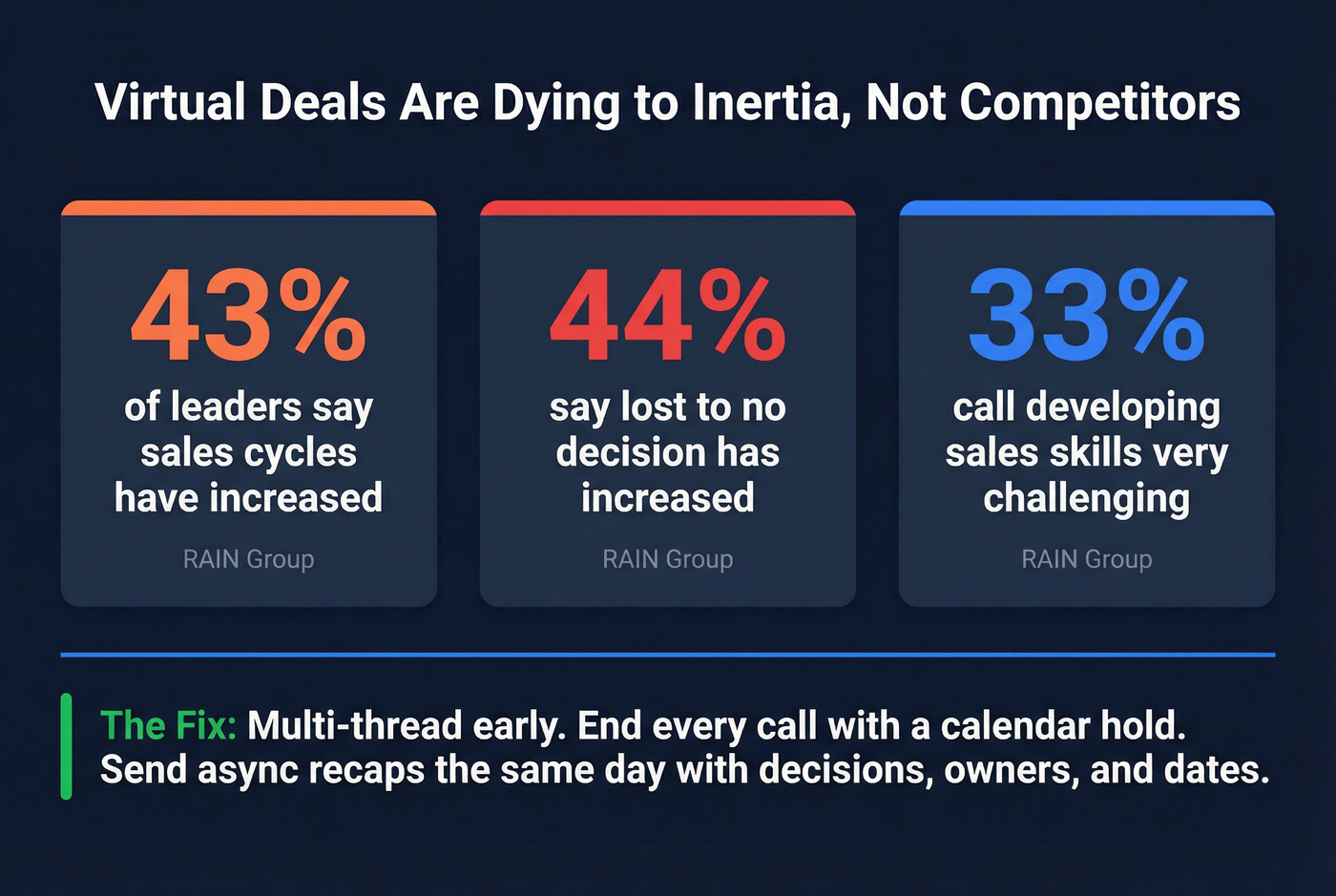
The fix is momentum by design. Multi-thread early - loop in stakeholders before the proposal, not after. End every call with a calendar hold for the next step. Send an async recap the same day with decisions, owners, and dates (a solid sales meeting follow-up email makes this repeatable). Let's be honest: if you let a week pass without a concrete next event, you're choosing "no decision" for them.
7. Coaching and Alignment Gaps
When your team is distributed, the hallway coaching moments disappear - and performance drifts. Integrity Solutions flags being "under-skilled to execute" as a core trap of virtual selling, and the numbers back it up: 33% of leaders call developing sales skills "very challenging," and 32% say the same about developing managers. These gaps only intensify as headcount grows and time zones multiply.
Record calls and review them weekly, not quarterly. Pick one skill per week - opening, agenda-setting, discovery depth, next-step control - and coach to it. Most importantly, codify your virtual sales process so new reps inherit a playbook instead of improvising on live deals (tie it to sales process optimization so it actually sticks). Skip this step if you want every new hire to reinvent the wheel on your prospects' dime.

Bad data is the silent killer of virtual selling. When there's no hallway luck, every bounced email is a dead deal. Prospeo delivers 98% email accuracy on a 7-day refresh cycle - so your outreach actually reaches real buyers.
Stop losing deals before the conversation even starts.
Build Your Virtual Selling Stack
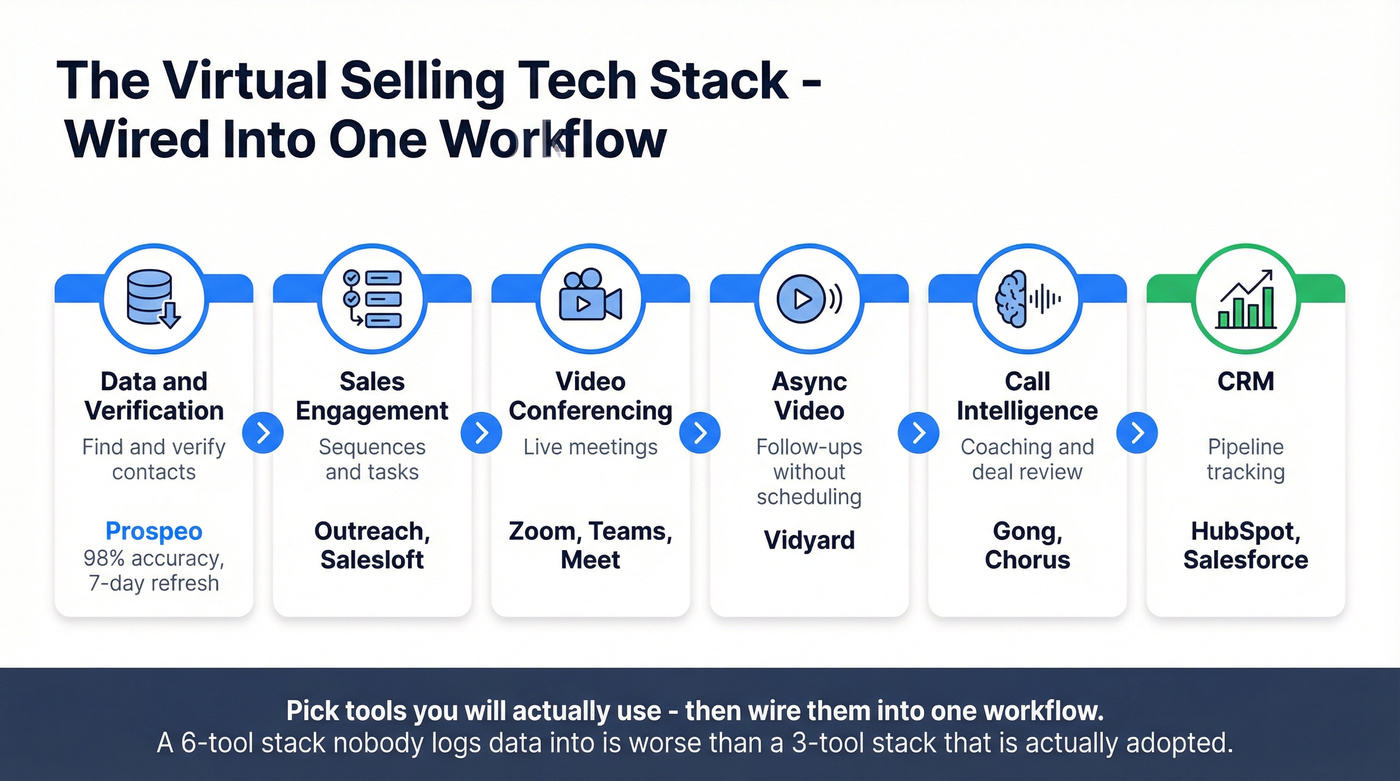
| Category | What It Solves | Example |
|---|---|---|
| Video Conferencing | Live meetings | Zoom, Teams, Meet |
| Async Video | Follow-ups w/o scheduling | Vidyard (free tier) |
| CRM | Pipeline tracking | HubSpot, Salesforce |
| Sales Engagement | Sequences + tasks | Outreach, Salesloft |
| Data & Verification | Accurate contact data | Prospeo (98% accuracy, free tier) |
| Call Intelligence | Coaching + deal review | Gong, Chorus |
Pick tools you'll actually use consistently - then wire them into one workflow. A six-tool stack where nobody logs data is worse than a three-tool stack that's actually adopted (use a clear lead generation workflow to keep handoffs clean).
Snyk cut bounce rates from 35-40% to under 5% and generated 200+ new opportunities per month with verified contact data. Prospeo gives you 300M+ profiles, 125M+ verified mobiles, and 30+ filters to reach the right buyer - before they decide without you.
Fix your data before your next virtual call goes dark.
The Medium Isn't the Problem
Virtual selling works because buyers want it. The teams that win aren't "better on Zoom" - they run a tighter process: shorter meetings, insight-led calls, faster follow-up, and real coaching. Every one of the virtual selling challenges above has a concrete fix. The gap is execution, not technology.
If you fix one thing first, fix your data. When your outreach lands cleanly, everything else gets easier (especially email deliverability).