

Web-Based Sales Force Automation: What It Costs and Which Tool Fits
Sales reps spend 60% of their time on non-selling tasks - updating fields, chasing reminders, logging activities nobody reads. Web-based sales force automation exists to claw that time back. But with 82 products in Gartner's SFA category alone, most teams evaluate a dozen tools and still pick the wrong one.
Here's the short version. Enterprise teams with 20+ reps and a dedicated admin should go with Salesforce Sales Cloud - nothing else matches its depth. SMBs running 5-20 reps who want simplicity should look at Pipedrive or Zoho CRM, where you get 80% of the value with 20% of the admin overhead.
What Is Sales Force Automation?
Sales force automation is software that handles the repetitive operational work of selling: lead capture and assignment, pipeline stage updates, task reminders, follow-up sequences, and forecast rollups. "Web-based" just means cloud/SaaS - browser login, cross-device sync, plugs into your stack. In 2026, that's the default. On-prem SFA is a legacy edge case.
SFA vs. CRM: Key Differences
| Dimension | SFA | CRM |
|---|---|---|
| Scope | Sales execution | Full relationship management |
| Users | Sales teams | Sales + marketing + support |
| Automation focus | Routing, follow-ups, tasks | Cross-team workflows |
SFA is the "do the work" layer - it standardizes execution and removes manual steps. CRM is the "know the customer" layer - it centralizes interactions across teams. Running a focused outbound motion where you mostly need pipeline management plus tasks? A cloud-based SFA tool is all you need. Once marketing, support, and CS all need the same record, you're in CRM territory. (If you want a deeper breakdown, see CRM and SFA.)
Why SFA Pays for Itself
McKinsey estimates over 30% of sales activities can be automated outright. Teams that do it generate about 16% more leads, mostly because follow-up stops being optional.
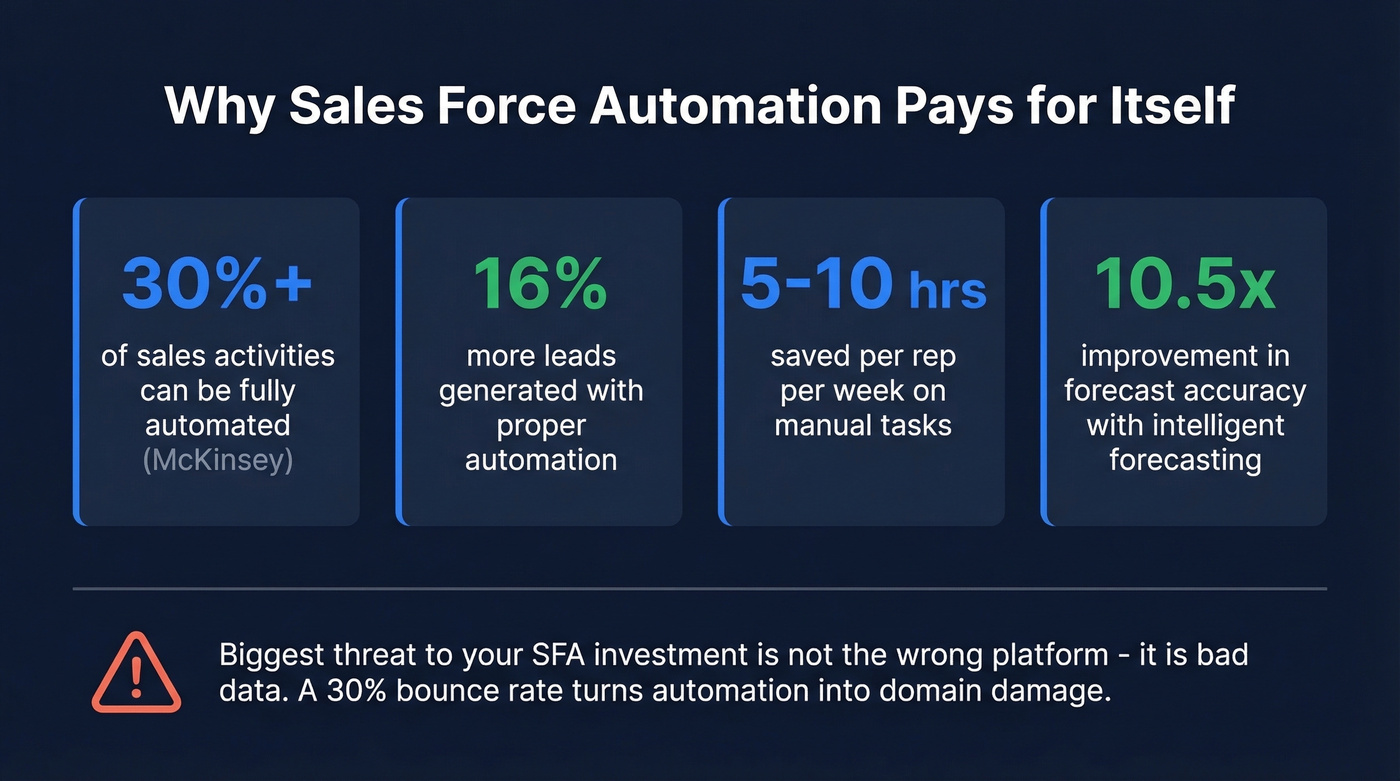
The time savings are concrete: employees reclaim 5-10 hours per week through CRM automation. For a 50-person sales org, non-revenue work represents roughly $3M in salary spent on things that aren't selling. That's not a rounding error.
Forecasting is the other big win. Without automation, forecasts routinely drift 20-30% because they're built on gut feel and spreadsheets. Research tied to Salesforce implementations shows a 10.5x improvement in forecast accuracy when intelligent forecasting is layered in. Most SFA rollouts hit positive ROI within 12-13 months when adoption sticks. (If forecasting is a core pain, compare sales forecasting tools before you commit.)
Here's the thing nobody talks about enough: the biggest threat to your SFA investment isn't the wrong platform - it's bad data. A 30% email bounce rate turns your automation into an expensive way to damage your domain reputation. Fix the data first, then automate. (Start with a bounce checker and a repeatable CRM data management process.)

You just read it: bad data is the biggest threat to your SFA investment. A 30% bounce rate turns every automated sequence into a domain killer. Prospeo delivers 98% email accuracy with 5-step verification, 7-day data refresh, and spam-trap removal - so your Salesforce, HubSpot, or Zoho workflows actually reach real buyers.
Clean data in, booked meetings out. Starting at $0.01 per verified email.
Best SFA Software in 2026
Evaluate three tools, max. Pick based on team size, go-to-market motion, and how much admin you can realistically support. (If you’re building the full stack, use this sales tech stack guide as a sanity check.)
Salesforce Sales Cloud
Overkill for teams under 20 reps. Essential for everyone else. Salesforce is the enterprise default because nothing else matches its depth: custom objects, workflow rules, territory logic, and an ecosystem that handles almost any edge case. Einstein AI is genuinely useful once your data model is clean - it won't save a messy implementation. (If you’re in that camp, plan for Salesforce data cleansing early.)
Pricing runs $25-$550/user/month depending on tier, with a 6% price increase from August 2025 now reflected in current plans per Method's cost breakdown. Gartner Peer Insights gives it 4.4/5 from 1,927 ratings, earning Customers' Choice 2026. We've seen teams get incredible value from Salesforce, but only after investing in proper setup. Skip the implementation budget and you'll regret it within six months.
HubSpot Sales Hub
If your marketing team already lives in HubSpot, don't fight it - Sales Hub keeps everything in one UI that normal humans actually use. Free tier available; paid plans typically run $20-$150/user/month depending on edition and billing. Gartner rates it 4.4/5 from 460 ratings.
The catch: HubSpot gets expensive fast once you need the real automation features. Budget for the inevitable upgrade. If you're not already in the HubSpot ecosystem, skip this and start with Zoho or Pipedrive instead. (If you’re comparing options, this CRM comparison helps.)
Zoho CRM - Best Value, Period
Zoho is the tool we'd hand to any SMB that wants real customization without the enterprise tax. Paid tiers run $14-$52/user/month. Gartner rates it 4.4/5 from 552 ratings.
Where Zoho loses is mindshare - fewer admins know it compared to Salesforce, and the Reddit consensus on r/sales tends to reflect that gap in community support. For most SMBs, that trade-off is worth taking happily. The product itself punches well above its price.
Pipedrive
$14-$99/user/month. Gartner: 4.2/5, 356 ratings. Pipedrive is what we recommend when a team wants something reps won't hate. It's visual, fast, and hard to screw up. You'll outgrow its automation depth eventually, but for 5-15 person teams, nothing gets adopted faster. (If you want more options in this lane, see simple sales CRM software.)

Comparison Table
| Tool | Best For | Starting Price | Gartner Rating | Key Strength |
|---|---|---|---|---|
| Zoho CRM ★ | Most SMB teams | $14/user/mo | 4.4/5 (552) | Cheap + flexible |
| Salesforce | Enterprise SFA | $25/user/mo | 4.4/5 (1,927) | Deep customization |
| Pipedrive | Fast adoption | $14/user/mo | 4.2/5 (356) | Simplest UX |
| HubSpot | Mktg + sales bundle | Free; paid from ~$20/user/mo | 4.4/5 (460) | All-in-one ecosystem |
| Freshsales | Inside sales | Free; paid from ~$9/user/mo | - | Built-in calling + SMS |
| Dynamics 365 | Microsoft shops | ~$65/user/mo | 4.4/5 (558) | Power BI + Teams fit |
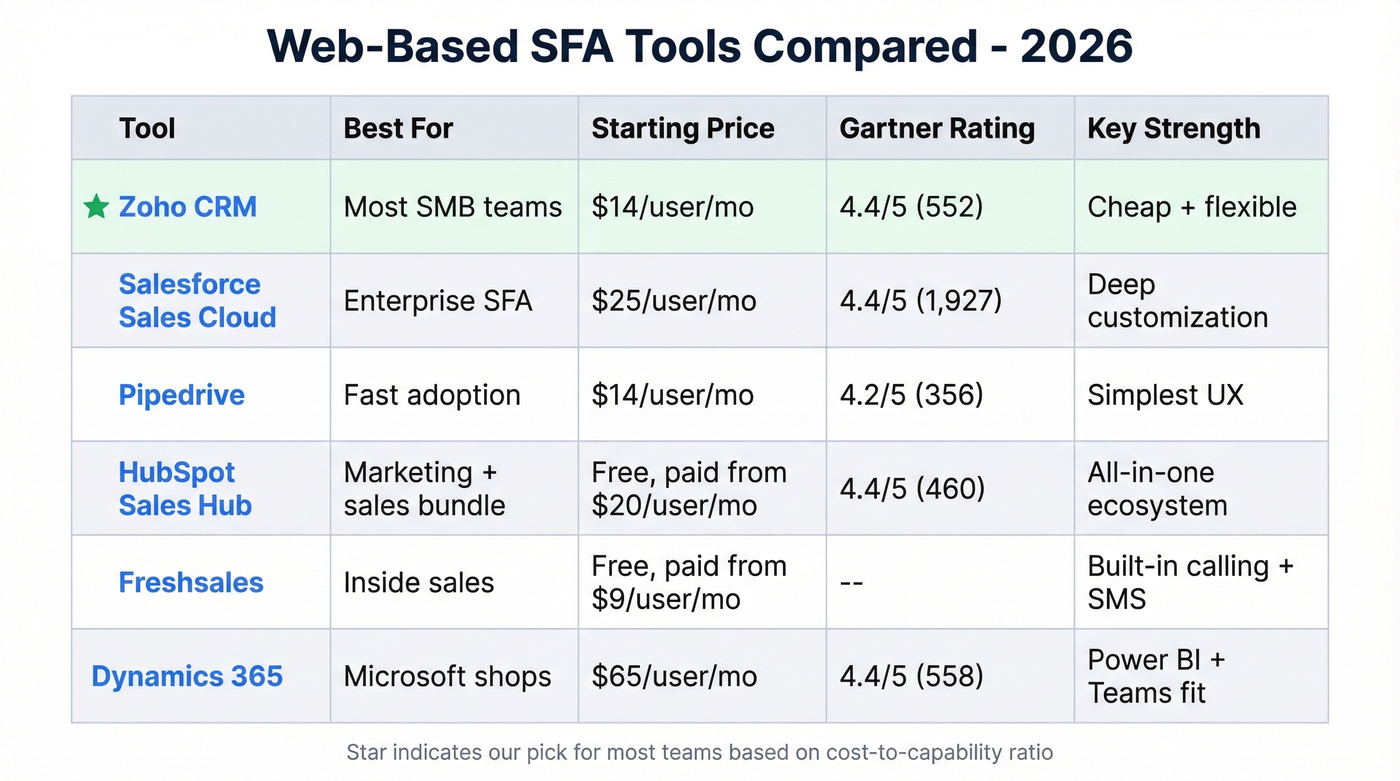
★ Our pick for most teams. Zoho CRM delivers the best cost-to-capability ratio in the category. If you're enterprise or already locked into Microsoft, Salesforce and Dynamics 365 are the obvious choices respectively.
What It Actually Costs
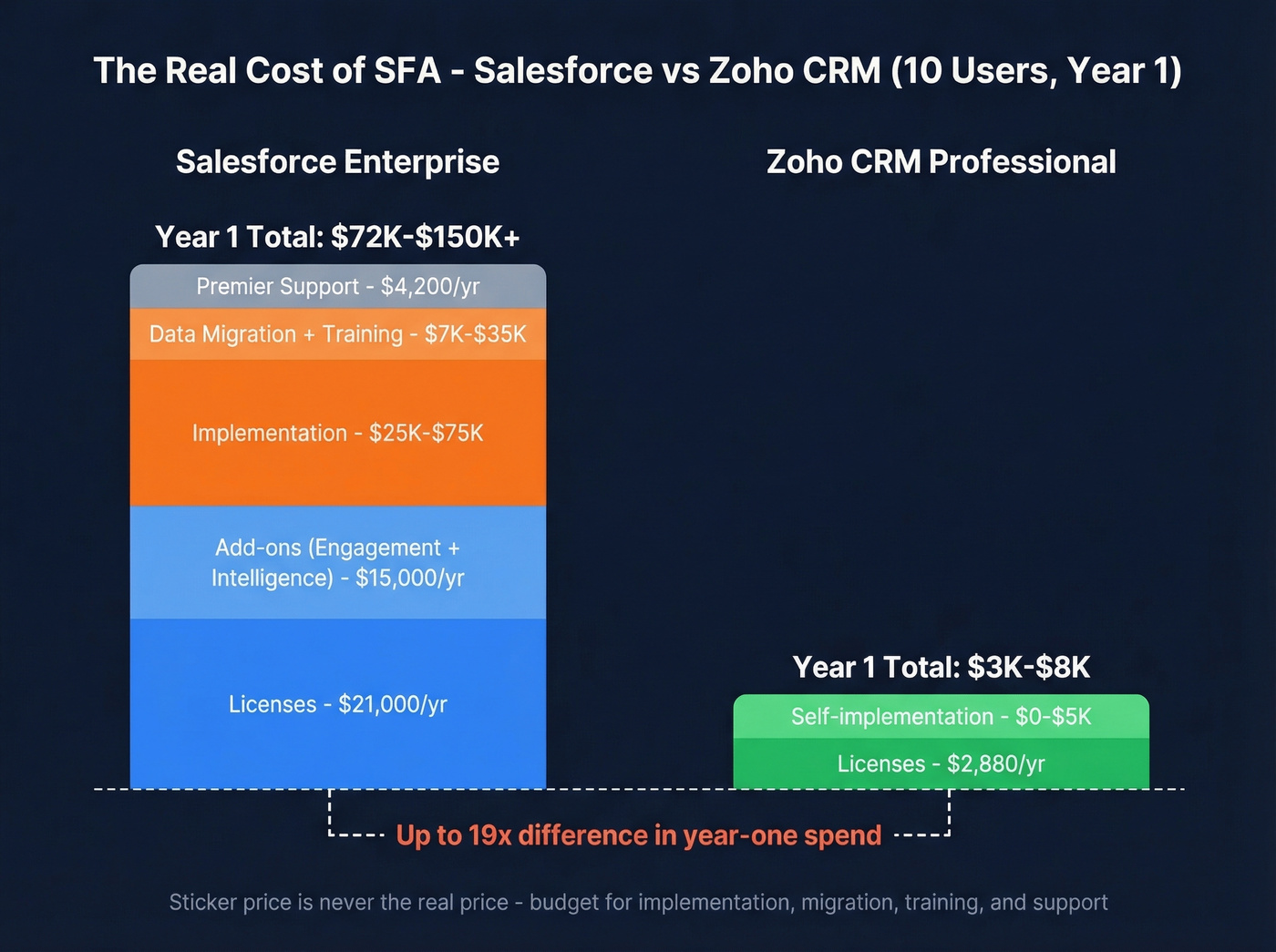
Sticker price is never the real price. Here's a realistic Salesforce breakdown for a 10-user team on Enterprise:
| Line Item | Monthly Cost |
|---|---|
| Enterprise licenses ($175 x 10) | $1,750 |
| Sales Engagement ($75 x 10) | $750 |
| Conversation Intelligence ($50 x 10) | $500 |
| Premier Support (~20% of license) | ~$350 |
| Monthly total | ~$3,350 |
Then add year-one costs that don't show up on the pricing page: implementation for mid-market runs $25K-$75K, data migration adds $5K-$25K, training costs $2K-$10K, and a marketing automation add-on like Pardot/MCAE can tack on up to $1,250/month extra. (To benchmark this against other stacks, use cost of sales tech stack.)
Per MarketBetter's 2026 breakdown, buying Salesforce means buying a process change program. Budget accordingly.
By contrast, a 10-user Zoho CRM setup often lands around $140-$520/month depending on tier, and many SMBs self-implement without paying for a separate project. That's the advantage of online SFA tools designed for smaller teams - lower total cost of ownership from day one.
How to Choose (and Mistakes to Avoid)
Three questions narrow the field fast. Are you enterprise or SMB, and do you have admin capacity? Do you need marketing bundled with sales execution? What's your real budget - licenses plus add-ons plus implementation? (If you’re still unsure, follow a structured how to choose a CRM process.)
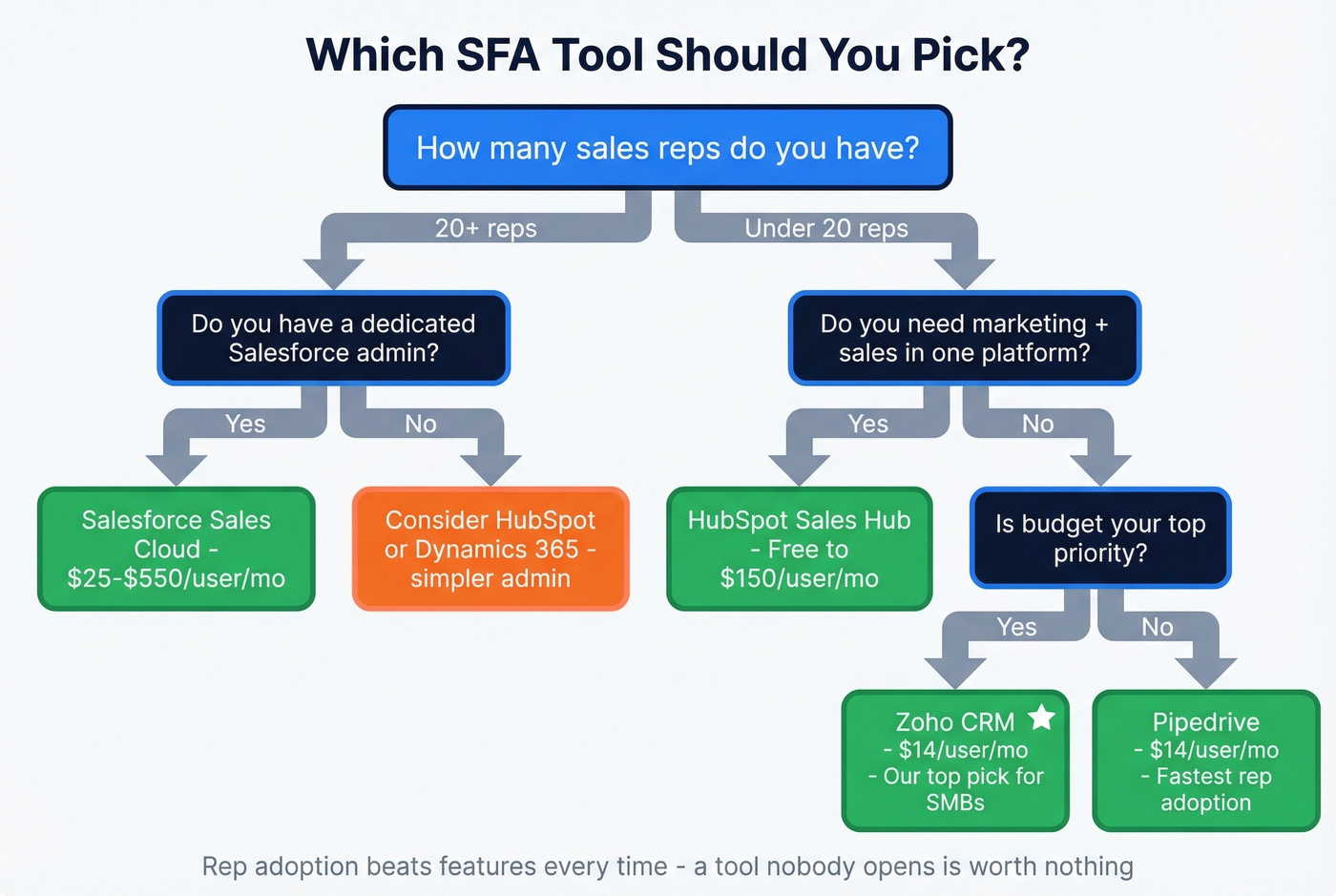
Rep adoption beats features every time. A tool nobody opens is worth exactly nothing.
Let's be honest about the pitfalls we've watched derail rollouts: over-customizing early creates technical debt and painful upgrades. Ignoring UX means reps revert to spreadsheets within weeks. Treating go-live as "done" kills momentum - you need governance and iteration. And underestimating data quality turns your SFA into a machine that scales bad outreach. One agency we spoke with saw bounce rates drop from 35%+ to under 4% after pairing their SFA with Prospeo's email verification, which runs on a 7-day refresh cycle at 98% accuracy. That's the difference between sequences that build pipeline and sequences that burn your domain.

You're about to spend $25-$550/user/month on SFA software. Don't feed it garbage contacts. Prospeo enriches your CRM with 50+ data points per contact at a 92% match rate - plus 125M+ verified mobile numbers so reps actually connect. Teams using Prospeo book 26% more meetings than ZoomInfo users.
Enrich your CRM before you automate it. 75 free emails to start.
FAQ
What's the difference between SFA and CRM?
SFA automates sales execution - lead routing, follow-ups, pipeline updates, and forecasting. CRM is broader, managing customer relationships across sales, marketing, and support. Most modern platforms bundle both, but standalone SFA is enough if only your sales team needs the tool.
How much does web-based SFA cost for a small team?
Budget $14-$100/user/month for the platform itself. Zoho CRM and Pipedrive start at $14/user. Enterprise tools like Salesforce can add $25K-$75K in year-one implementation costs on top of per-seat licensing.
How do I keep my SFA data accurate?
Pair your SFA with a dedicated verification tool. Most providers refresh records every 4-6 weeks, which means contacts go stale fast. A tighter refresh cycle - weekly, ideally - keeps sequences deliverable and forecasts reliable as you scale.
Can small teams benefit from sales force automation?
Absolutely. Teams of 5-10 reps often see the fastest ROI because adoption is easier to enforce. Start with Pipedrive or Zoho CRM at $14/user/month, automate follow-ups and pipeline updates first, and layer in advanced workflows only after reps consistently use the basics.