

Web Scraping for Lead Generation: The Full Pipeline Most Guides Skip
You scraped 5,000 leads from Google Maps last quarter. The export looked clean - names, emails, titles, all there. Then you loaded them into your sequencer and the bounce rate hit 18%. Your sending domain got flagged within a week. 23% of email addresses become invalid every year, which means roughly a quarter of any scraped list is dead on arrival. Data scraping for leads without verification isn't lead generation - it's domain sabotage.
Most guides on web scraping for lead generation stop at the scrape. This one doesn't.
What You Need Before Scraping
Three things make a scraping workflow actually produce revenue:
- Scraping tool - Apify for directories and repeatable workflows at $29/mo, Phantombuster for no-code automation at $56/mo.
- Verification layer - the step most teams skip and most teams regret skipping. Raw data becomes usable pipeline here, or it doesn't become anything at all. (If you’re comparing options, start with email bounce rate benchmarks and what “good” looks like.)
- CRM - HubSpot, Salesforce, or whatever you're already running. The data needs a home that isn't a CSV on someone's desktop. If you need a quick shortlist, see examples of a CRM.
Enterprise data platforms charge $10K-$40K/year. A scrape-verify-enrich pipeline costs under $200/month for most teams. That's the real reason learning to scrape leads yourself is worth the effort.
The Full Scrape-to-Outreach Pipeline
Most teams treat scraping as one step. It's actually six.
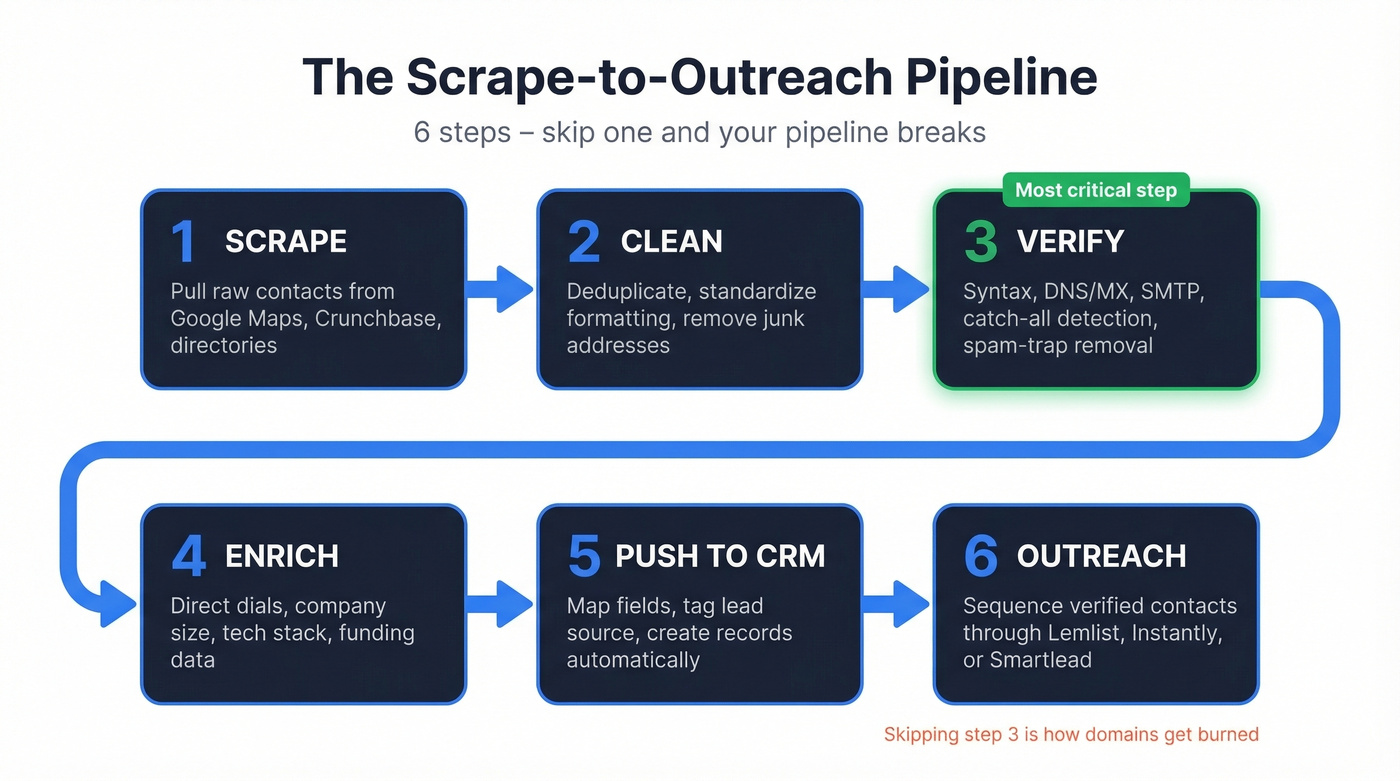
1. Scrape. Pull raw contact data from your target source - Google Maps, Crunchbase, Yelp, job boards, industry directories. You'll get names, titles, company URLs, and sometimes emails. (If you’re building this as a repeatable system, align it to a lead generation workflow.)
2. Clean. Deduplicate, standardize formatting, remove obvious junk like test@test.com and info@ addresses. Five minutes here saves hours downstream.
3. Verify. Run every email through a multi-step verification process - syntax checks, DNS/MX validation, SMTP verification, catch-all detection, and spam-trap removal. This is where a 20% bounce list becomes a sub-3% bounce list. In our experience, step 3 is where 80% of teams either succeed or fail. (If you want the deeper mechanics, see spam trap removal.)
4. Enrich. Fill in the gaps - direct dials, company size, tech stack, funding data. If one provider can't find a number, waterfall enrichment (querying multiple sources sequentially) closes the gap. FullEnrich at $29/mo and Clay both specialize in this. For a broader comparison, check data enrichment services.
5. Push to CRM. Map fields, set lead source tags, create the records. Native integrations beat Zapier duct tape every time. (Related: connect outreach tool to CRM.)
6. Outreach. Sequence the verified contacts through your tool of choice - Lemlist, Instantly, Smartlead, or whatever your team runs. If you’re tightening performance, start with cold email marketing fundamentals.
Three Methods for Scraping Lead Data
Custom Code With Python and Scrapy
Maximum flexibility. You control every request, parser, and output format. The tradeoff: modern anti-bot systems use layered detection - IP reputation, TLS fingerprinting, browser fingerprinting, behavioral analysis - and your scraper will break the moment a target site updates its defenses. Great for engineers with time. Terrible for sales teams who need leads this week.
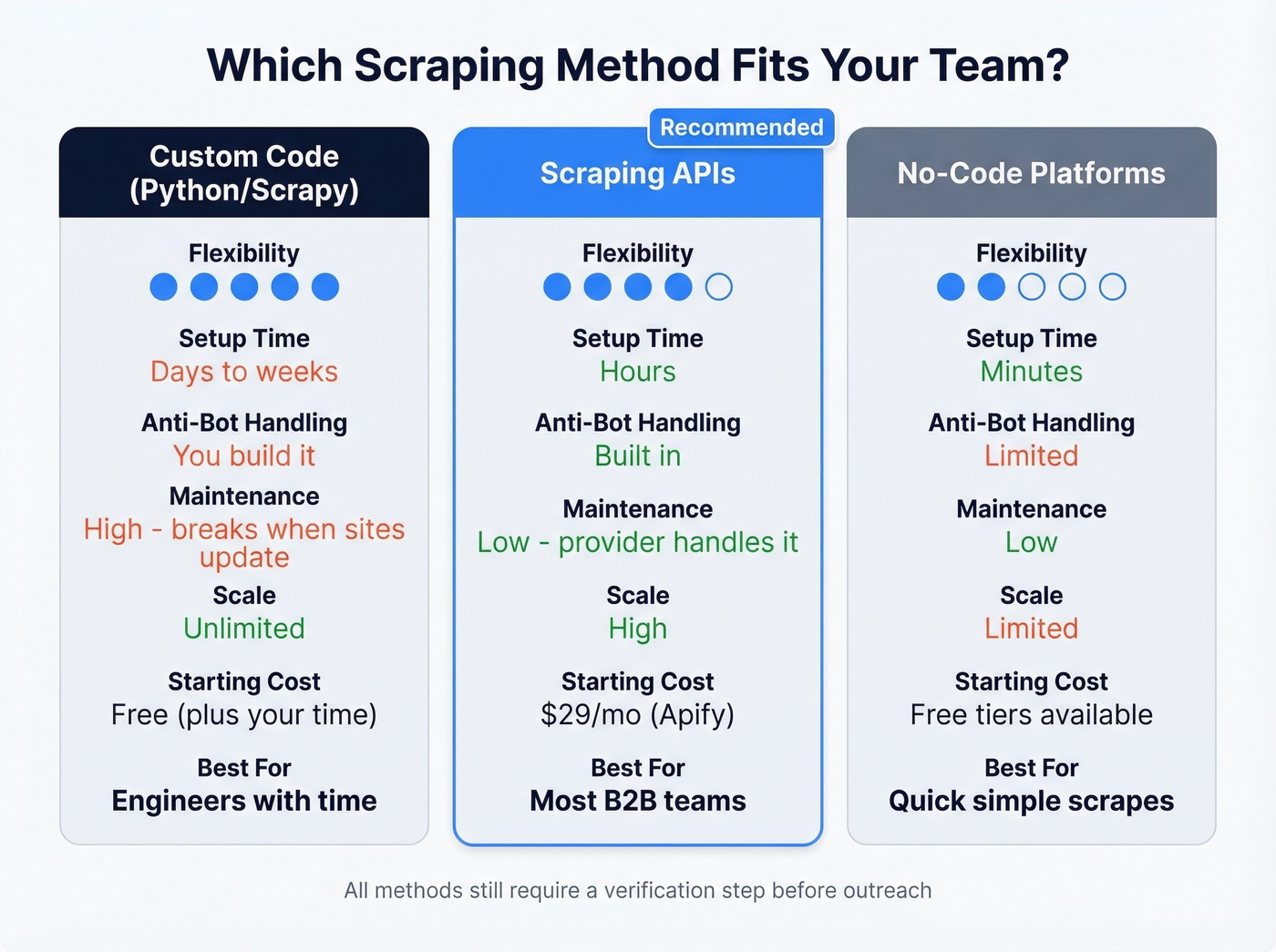
Scraping APIs
Tools like Apify, ZenRows, and Scrapingdog handle anti-bot bypass, proxy rotation, and rendering for you. Apify starts at $29/mo with pre-built actors for sources like Google Maps and Yelp. You get structured output without maintaining infrastructure. For most B2B teams, this is the sweet spot - enough control to target the right sources, enough abstraction that you're not debugging HTTP headers at midnight.
No-Code Platforms
Make, n8n, and Zapier offer the easiest entry point. Wire together a trigger, a scraping step, and a CRM push without writing code. The limitation is scale - complex multi-page scrapes with pagination and anti-bot handling will outgrow these tools fast. (If you’re evaluating options, compare against free lead generation tools before you commit.)

You just scraped thousands of contacts. Now what? Loading raw data into your sequencer is how domains get flagged. Prospeo's 5-step verification - catch-all detection, spam-trap removal, honeypot filtering - turns a 20% bounce list into sub-3%. At $0.01 per email with 98% accuracy, verifying 5,000 scraped leads costs $50.
Verify your entire scraped list before your bounce rate kills your domain.
Why Verification Is Non-Negotiable
Scraped data decays the moment you collect it. People change jobs, companies rebrand domains, mail servers get reconfigured. A bounce rate above 2% signals poor list quality to email providers, and once your sending domain takes a hit, recovery takes weeks - sometimes months. (If you’re troubleshooting deliverability, start with an email deliverability guide.)
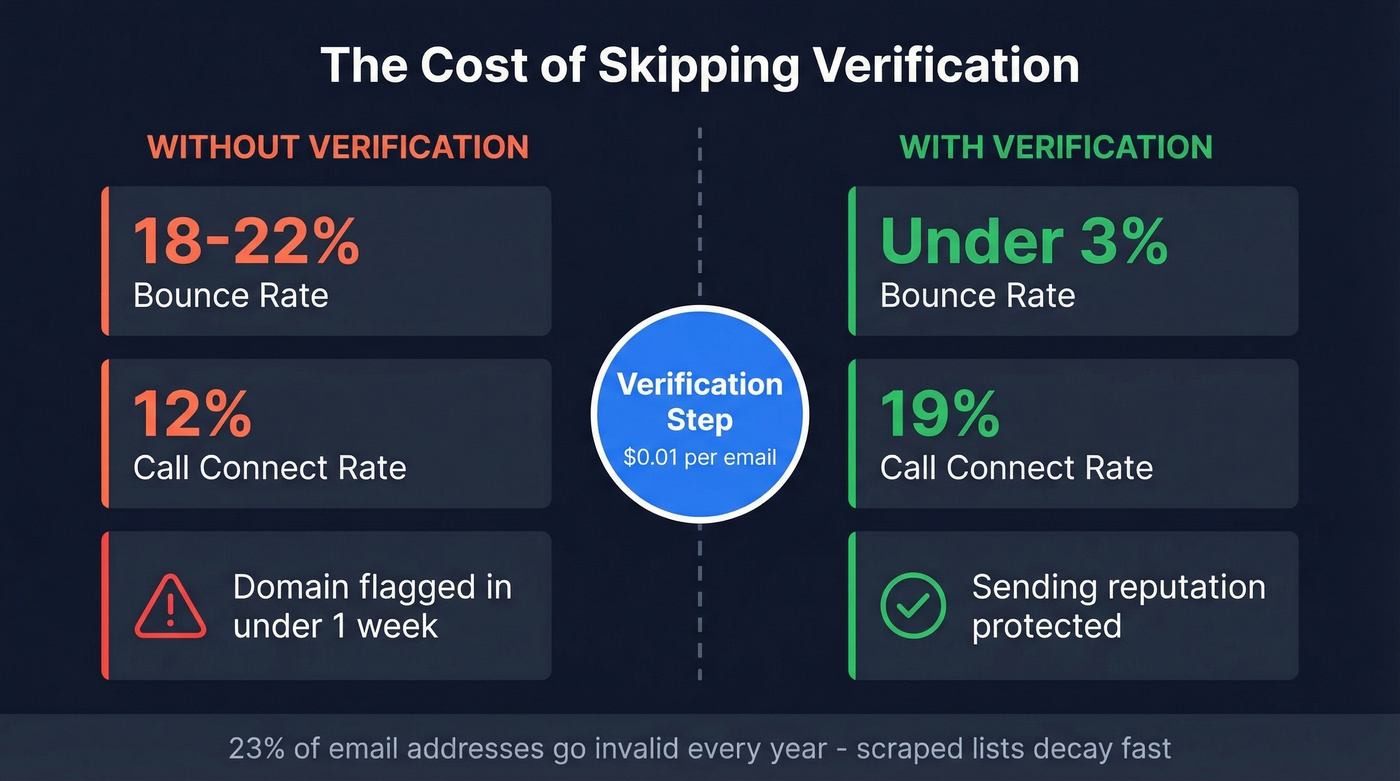
Here's the thing: we've watched teams treat verification as optional, then spend six weeks warming up a replacement domain because they loaded raw scraped data straight into Instantly. Don't be that team.
A thread on r/salestechniques lays out a real stack - WarpLeads for sourcing, ZeroBounce for verification, Clearbit for enrichment, HubSpot as CRM, Lemlist for sequencing. That team dropped their bounce rate from 22% to 7% in three weeks and saw call connect rates jump from 12% to 19% after adding verification and enrichment between the scrape and the sequence.
Syntax checks alone catch 5-10% of bad addresses. DNS and MX validation filter out dead domains. SMTP verification confirms the mailbox exists. But the real killer is catch-all domains - over 9% of "verified" emails sit on catch-all servers that accept everything, meaning your verification tool says "valid" while the email goes nowhere. Prospeo's 5-step verification handles all of this, including catch-all detection and spam-trap removal, at $0.01 per email with 98% accuracy. Verifying 5,000 scraped leads costs $50. Rebuilding a burned domain costs weeks of lost pipeline. The math isn't close.
Tools and Pricing
Scraping Tools
| Tool | Starting Price | Best For |
|---|---|---|
| Apify | $29/mo | Directories, Maps, Yelp |
| ZenRows | $69/mo | Anti-bot heavy sites |
| Phantombuster | $56/mo | No-code automation |
Verification and Enrichment
| Tool | Starting Price | Best For |
|---|---|---|
| Prospeo | Free tier; $0.01/email | Verification + enrichment (98% email accuracy, 7-day data refresh) |
| Apollo | $49/mo | Database with built-in sequencing (verify separately - data is user-populated) |
| Lusha | $22.45/mo | Quick phone lookups |
| Snov.io | $30/mo | Email finder + drips |
| FullEnrich | $29/mo | Waterfall enrichment |
| ZeroBounce | ~$0.008/email bulk | Bulk verification only |
| Clay | ~$149/mo | Enrichment orchestration |
Skip Apollo for verification - their database is user-populated, so accuracy varies wildly. It's fine as a prospecting layer, but you'll want a dedicated verification step after. (If you’re shopping alternatives, see Bouncer alternatives.)
Legal Compliance Checklist
Scraping public data doesn't exempt you from privacy law. Any team running lead scraping at scale needs to understand the regulatory side, and "I didn't know" isn't a defense that holds up.
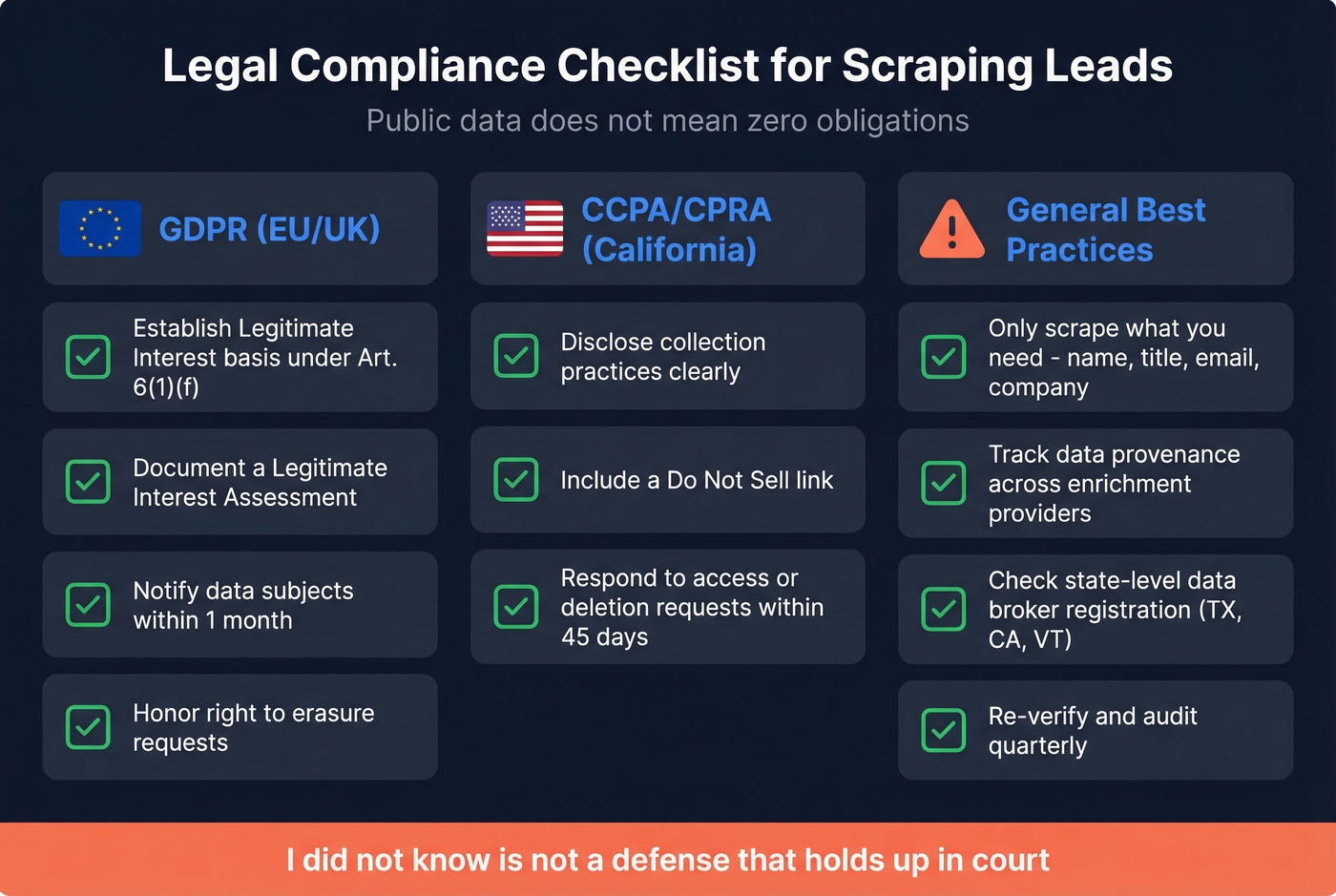
- GDPR (EU/UK): Establish Legitimate Interest basis under Art. 6(1)(f). Document a Legitimate Interest Assessment. Notify data subjects within 1 month or at first contact.
- CCPA/CPRA (California): Disclose collection practices. Include a "Do Not Sell" link. Respond to access/deletion requests within 45 days.
- Data broker registration: Texas, California, and Vermont require registration if you scrape and broadly distribute contact data.
- Data minimization: Only scrape what you need - name, title, email, company. Not home addresses or personal social accounts.
When using multiple enrichment providers, track data provenance. Not every provider is GDPR-compliant, and mixing sources creates compliance gaps that are invisible until an audit.
Mistakes That Kill Your Pipeline
Treating scraping as a one-off. Scrapers break silently. Sites change layouts, anti-bot rules update, APIs deprecate. Monitor your pipelines weekly. (This is also where lead generation metrics keep you honest.)
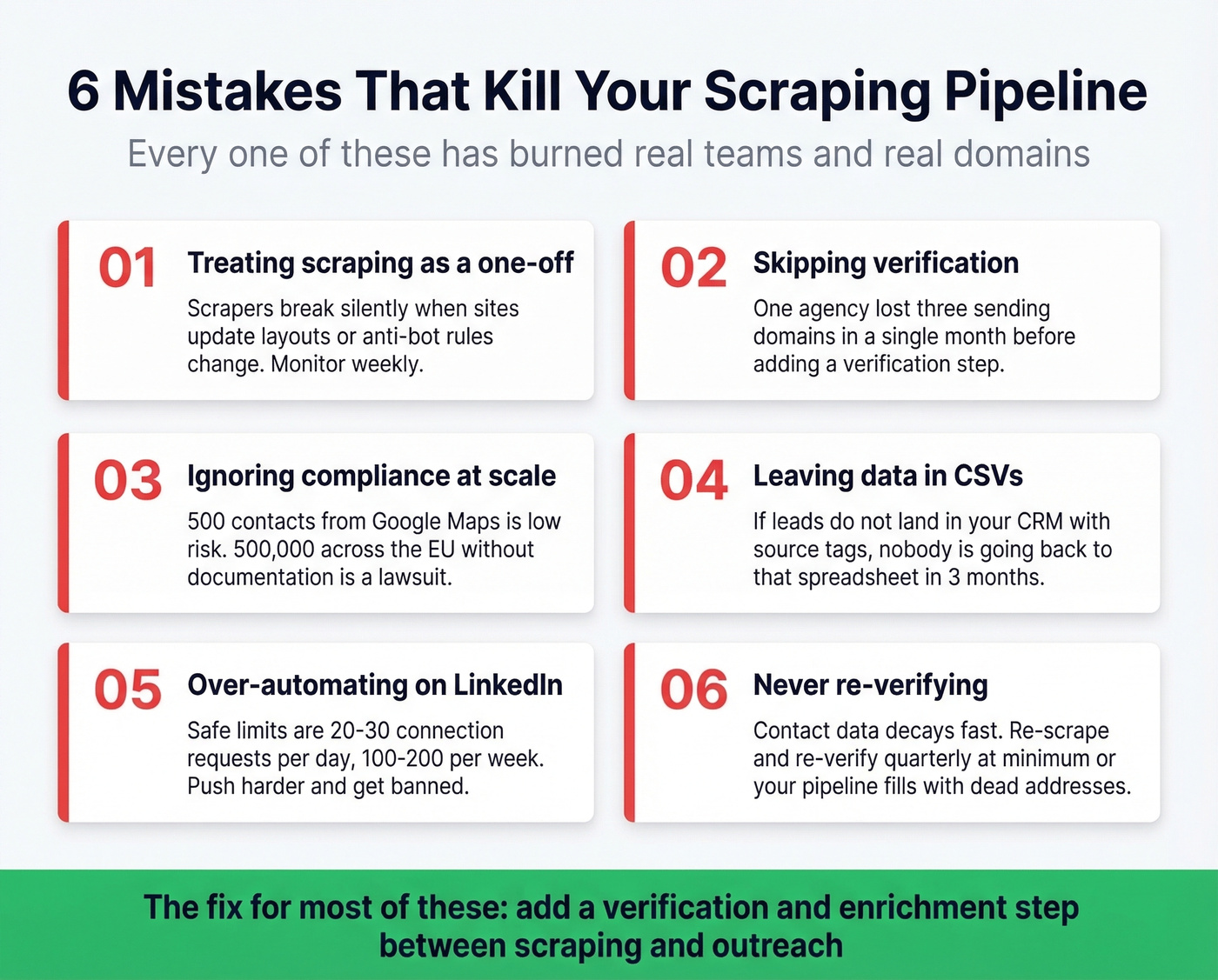
Skipping verification. We've seen teams burn sending domains in under a week loading raw scraped lists straight into their sequencer. One agency we spoke with lost three domains in a single month before they added a verification step.
Ignoring compliance at scale. Scraping 500 contacts from Google Maps is low-risk. Scraping 500,000 across the EU without a Legitimate Interest Assessment is a lawsuit waiting to happen.
Leaving data in CSVs. If scraped leads don't land in your CRM with proper source tags, they rot. Nobody's going back to that spreadsheet in three months.
Over-automating on professional networks. Safe limits run 20-30 connection requests per day, 100-200 per week. Push harder and you'll get restricted or banned.
Never re-verifying. Contact data decays fast - re-scrape and re-verify quarterly at minimum, or your pipeline fills with dead addresses.
Let's be honest: if your average deal size is under $10K, you almost certainly don't need a $30K/year data platform. A $200/month scrape-and-verify stack will outperform it - because you'll actually use the data instead of paying for a dashboard nobody logs into.
Scraping gives you names and companies. Prospeo fills in everything else - verified emails, direct dials from 125M+ mobile numbers, tech stack, funding data, 50+ data points per contact. With a 92% API match rate and 7-day data refresh, your scraped leads stay enriched and current instead of decaying in a spreadsheet.
Turn raw scraped data into a verified, enriched pipeline in minutes.
FAQ
Is web scraping for lead generation legal?
Yes, scraping publicly available data is legal in most jurisdictions, but you still have compliance obligations. GDPR requires a lawful basis - typically Legitimate Interest - and notice within one month. CCPA requires disclosure and honoring opt-out requests within 45 days. Some US states also require data broker registration. The McCarthy Law Group has a solid breakdown of how these overlap.
How do I verify emails after scraping?
Upload your CSV to a verification tool that runs syntax checks, DNS/MX validation, SMTP verification, and catch-all detection. This typically reduces bounce rates from 15-22% down to under 5%. Prospeo charges $0.01 per email with 98% accuracy; ZeroBounce runs about $0.008 per email for bulk verification only.
What's the best free scraping tool for leads?
Apify offers a free tier with $5 in compute credits - enough to scrape a few hundred Google Maps listings or directory pages. For verification afterward, Prospeo's free plan includes 75 verified emails per month with full enrichment, while most competitors cap at 50 credits with limited features.
How is scraping leads different from buying a database?
When you buy a pre-built database, you're getting contacts that are often months or years old with no transparency into sourcing. Scraping lets you target exactly the companies and roles you want, pull fresh data from live sources, and verify everything before it enters your CRM. The tradeoff is more setup work upfront, but the data quality and cost savings make it worthwhile for most B2B teams running outbound.