

How to Build a Website Sales Funnel That Actually Converts
The average conversion rate across 14 industries is 2.9%. That means roughly 97 out of every 100 visitors leave without doing the thing you built the site for. Most teams respond by tweaking button colors or rewriting headlines. The real problem is structural - they don't have a website sales funnel. They have a homepage and a prayer.
Why Most Website Funnels Fail
A website without a deliberate funnel is just a brochure. Visitors land, browse, and leave. 60% of consumers take six or more actions before buying from a new brand, so a single landing page with a "Buy Now" button is fighting human behavior.
The failure isn't usually the copy or the design. It's the absence of a mapped sequence - awareness through purchase - with measurable transitions between each step. Without that map, you can't diagnose where the leak is. You just know the bucket's empty.
What You Need (Quick Version)
- Map four funnel stages with target conversion rates at each transition (use a simple funnel metrics checklist)
- Build with a no-code funnel builder like Systeme.io ($0-$97/mo) or your existing site plus a landing page tool
- Track drop-offs in GA4 Funnel Exploration - open vs. closed funnels matter
- Verify the contact data feeding your nurture sequences - bad emails kill funnels before your copy gets a chance (see email bounce rate)
What a Website Sales Funnel Actually Is
It's the path a visitor follows from first click to conversion - whether that's a purchase, a demo request, or a lead form submission. The key distinction: a website funnel is passive. You publish pages, set up sequences, and users either move through or they don't. A traditional sales funnel is active - reps prospect, qualify, and push deals forward. Given that 67% of customers prefer self-service over speaking to a rep, a well-built website conversion funnel outperforms a sales-dependent model for most businesses.
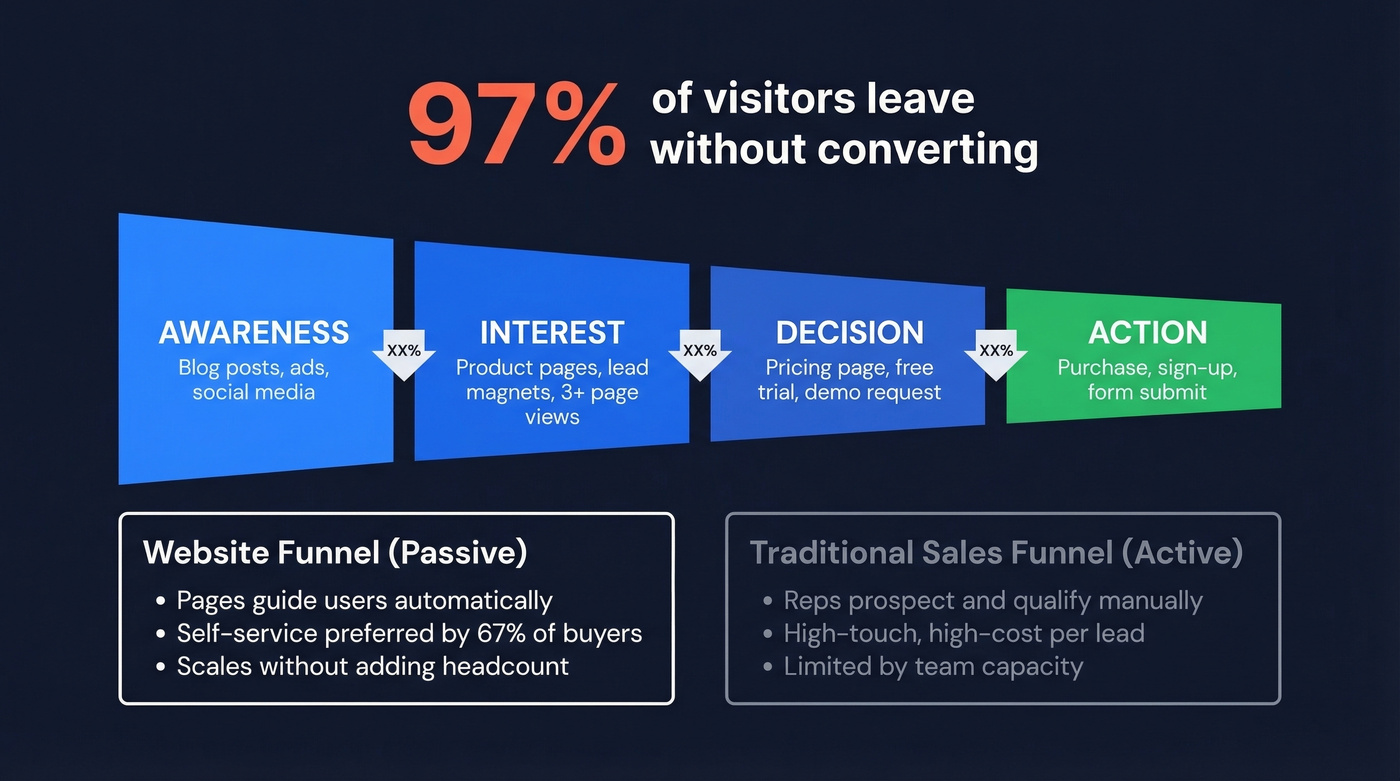
Most teams default to AIDA (Attention, Interest, Desire, Action)) as the framework, and it works fine for straightforward funnels. If you're running a more complex offer ladder - especially in eCommerce - look at Customer Value Optimization, which adds stages like lead magnets, tripwires, and profit maximizers. No universal best model exists. Pick one, launch, then refine once data comes in. (If you want a deeper breakdown, see our AIDA guide.)
Funnel Stages + What "Good" Looks Like
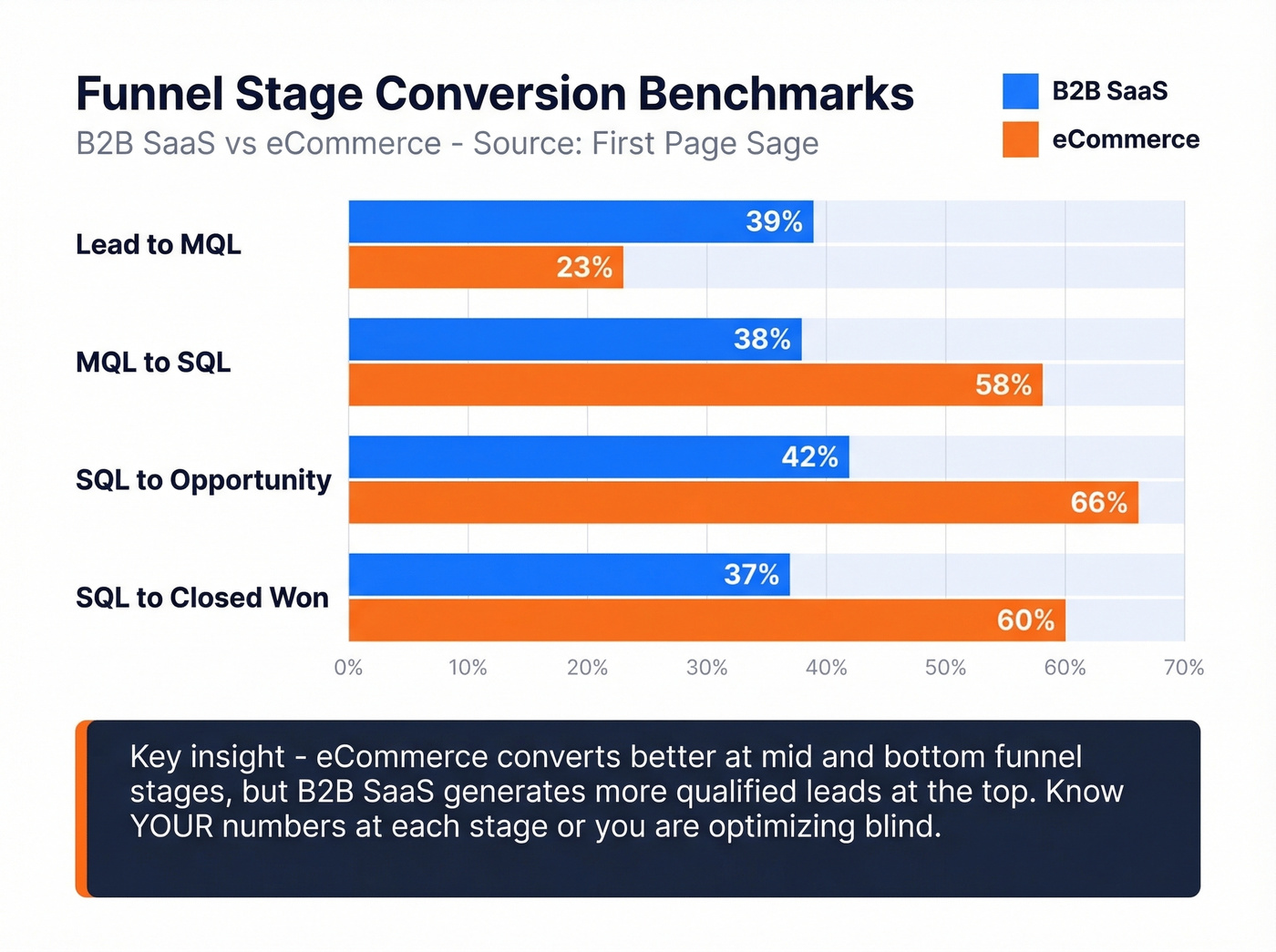
Benchmarks give you something to optimize against instead of guessing. Here's what First Page Sage reports for stage-to-stage conversion rates:
| Stage | B2B SaaS | eCommerce |
|---|---|---|
| Lead to MQL | 39% | 23% |
| MQL to SQL | 38% | 58% |
| SQL to Opportunity | 42% | 66% |
| SQL to Closed Won | 37% | 60% |
These are post-visitor benchmarks - they start after someone becomes a lead. The visitor-to-lead step is notably lower. For eCommerce sites specifically, overall conversion rates hover between 1.84% and 3.71%, and cart abandonment runs 60-80%.
Here's the thing: if you don't know your numbers at each stage, you're optimizing blind. We've watched teams spend months A/B testing headlines while their MQL-to-SQL rate sat at half the benchmark - a problem no headline fix will solve. Print these benchmarks, tape them next to your analytics dashboard, and compare. (For B2B, you can also sanity-check against average B2B lead conversion rate.)

Half of funnel failures happen before your copy even gets read - because the emails bounce. Prospeo's 98% email accuracy and 7-day data refresh mean your nurture sequences actually reach inboxes, not spam folders.
Stop losing leads to bad data before your funnel gets a chance.
How to Build Yours
Step 1: Map the buyer journey. Write down every step from first touch to conversion. For B2B, that's typically ad or content piece, landing page, lead magnet, email sequence, demo, close. For eCommerce: product view, add to cart, checkout, purchase, post-purchase upsell. If you need a starting point, use an ideal customer profile to keep the journey specific.
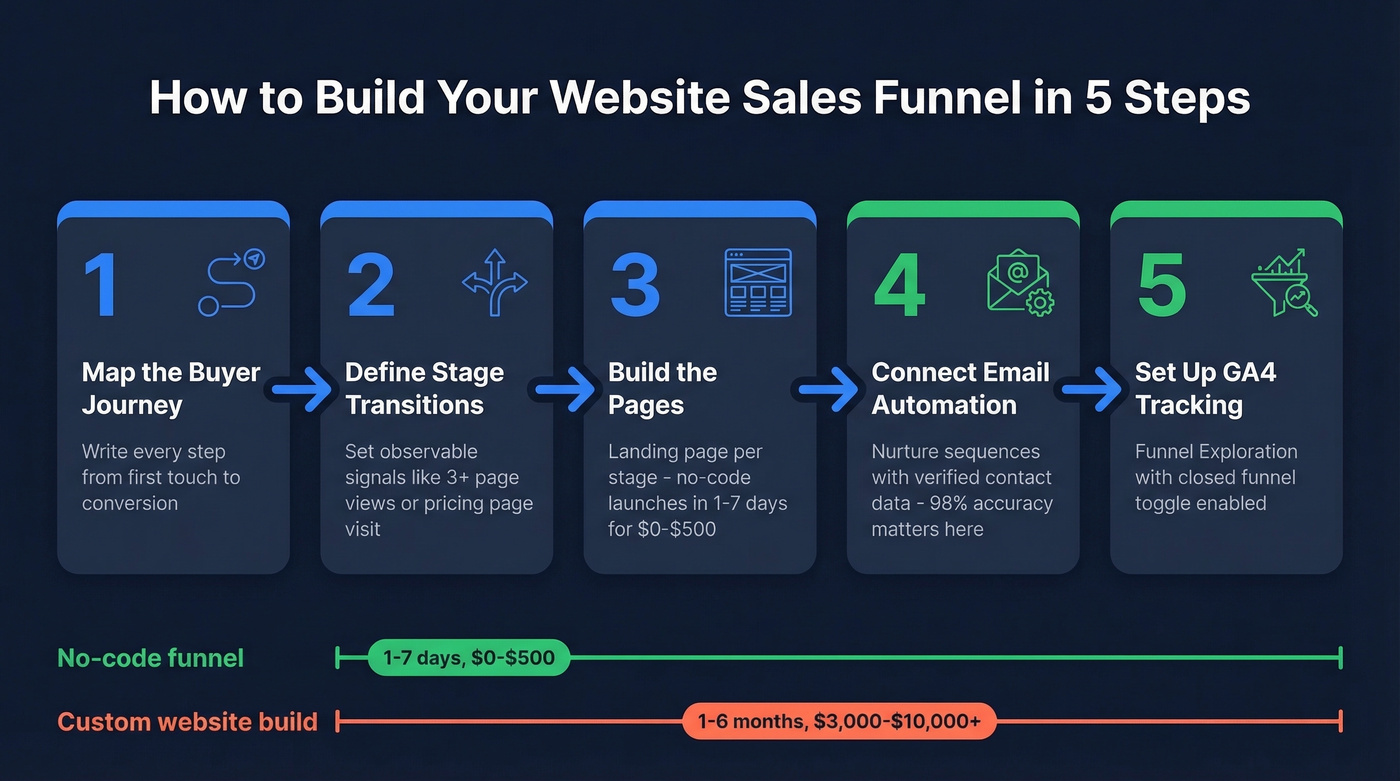
Step 2: Define stage transitions. A visitor moves from Awareness to Interest when they view three or more pages or download a resource. They hit Decision when they visit your pricing page or start a free trial. Without these observable signals, you can't measure movement. (If you're building a B2B motion, align this with lead scoring.)
Step 3: Build the pages. Each stage needs its own page or screen - a landing page for awareness, a product page for interest, a checkout flow for decision. A no-code funnel can launch in one to seven days for $0-$500 plus the platform, compared to one to six months and $3,000-$10,000+ for a custom website build. Dedicated funnel builders make this faster, but WordPress plus a landing page plugin works too.
Step 4: Connect email automation. This is where funnels compound. A visitor who doesn't buy today might convert in two weeks if your nurture sequence is solid. For B2B outbound, use a data platform like Prospeo to find verified emails for your target accounts, then feed those into your sequences. The 98% email accuracy means your nurture actually reaches inboxes instead of bouncing into the void. If you're building sequences from scratch, start with these sales follow-up templates. Step 5: Set up tracking (more on this below).
One real-world example worth studying: a DTC fragrance brand on r/ecommerce discovered their 10ml bottle was cannibalizing sales of the 30ml. Their fix? Remove the 10ml from the main site, reposition it as a cart-only upsell with urgency framing, and offer discovery-set credit toward the full bottle. That's funnel thinking - restructuring the offer ladder so each step pulls the customer forward instead of giving them an off-ramp. (Related: cross selling vs upselling.)
How to Track Drop-Offs in GA4
Go to GA4, then Explore, then Funnel Exploration. You can start from the template or build from scratch. The critical thing to understand: GA4's funnel reports are user-based, not session-based. They show how many users made it from one step to the next, which gives you a cleaner picture of actual behavior.
Set up your steps to match your funnel. A standard eCommerce example: Product view, Add to cart, Purchase. For B2B: Page view, Form start, Form submit, Thank you page.
One practical gotcha: GA4 caps you at 30 key events, so plan your funnel steps carefully and don't waste slots on vanity metrics.
Pay attention to the open vs. closed funnel toggle. A closed funnel only counts users who entered at step one. An open funnel counts anyone who completed a step, even if they skipped earlier ones. Closed funnels are better for diagnosing true drop-off points. Open funnels help you understand how users actually navigate - which is often messier than you'd expect.
Funnel Builder Pricing
| Tool | Best For | Starting Price | Top Tier |
|---|---|---|---|
| Systeme.io | Budget / beginners | Free ($0/mo) | $97/mo |
| ClickFunnels | Full-featured funnels | $81/mo (annual) | $297/mo |
| ConvertFlow | eCommerce / Shopify | Free plan available | Not public |
| Perspective | Mobile-first paid social | $62/mo (annual) | $391/mo |
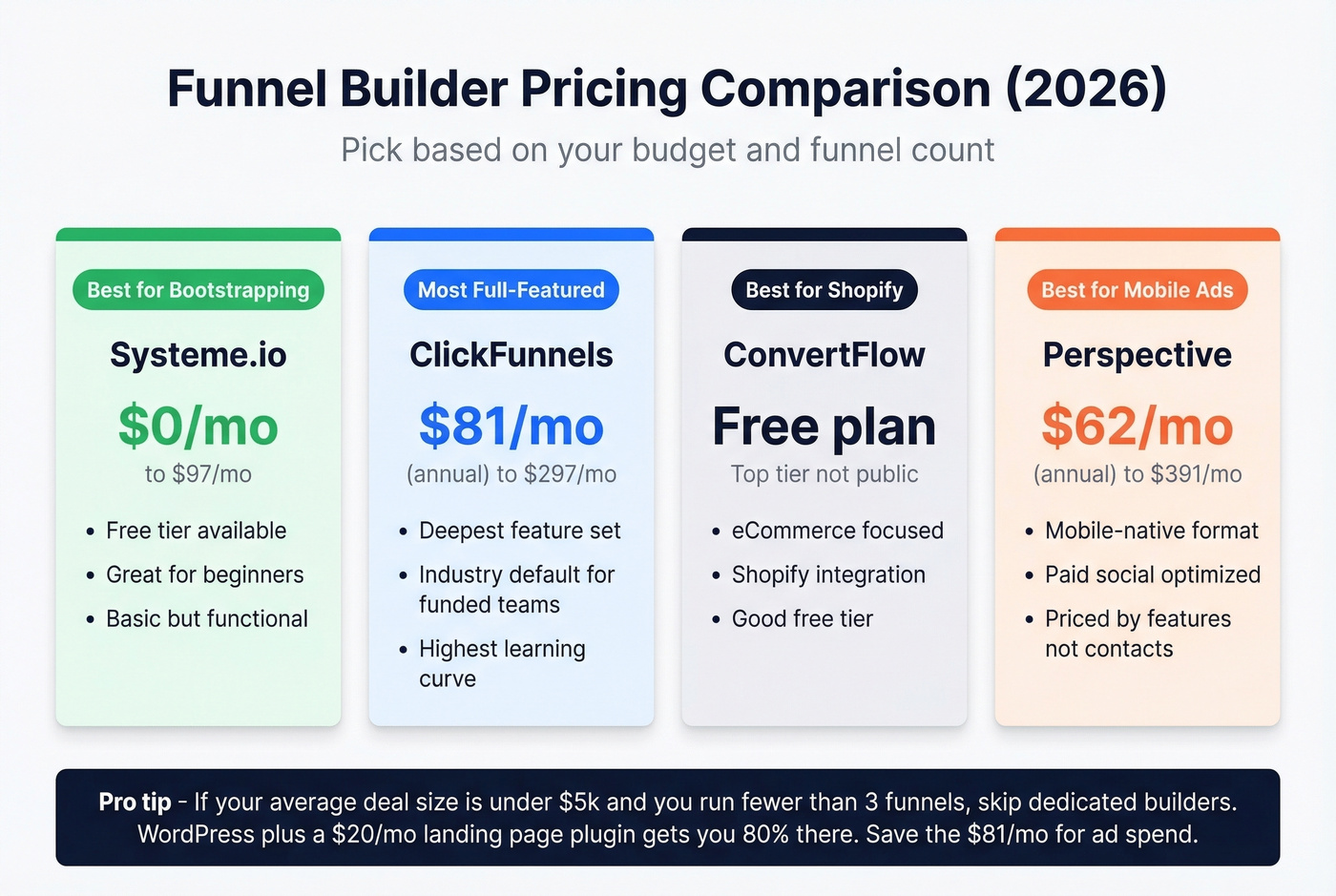
Systeme.io is the obvious starting point if you're bootstrapping. ClickFunnels is the incumbent with the deepest feature set, and for most teams with budget, it remains the default. Perspective is worth a look if your traffic is primarily mobile from paid social - their vertical, mobile-native format converts well in that context, and they price by features and funnel volume rather than contact count.
Skip dedicated funnel builders entirely if your average deal size is under $5k and you're running fewer than three funnels. WordPress plus a $20/month landing page plugin gets you 80% of the way there. Save the $81/month for ad spend.
Mistakes That Kill Your Funnel
Offer cannibalization. Remember that fragrance brand? Their mid-tier product was suppressing premium sales. This happens constantly - every SKU in your funnel either pulls the customer forward or gives them a cheaper exit. Audit your offer ladder and make sure each step increases commitment.
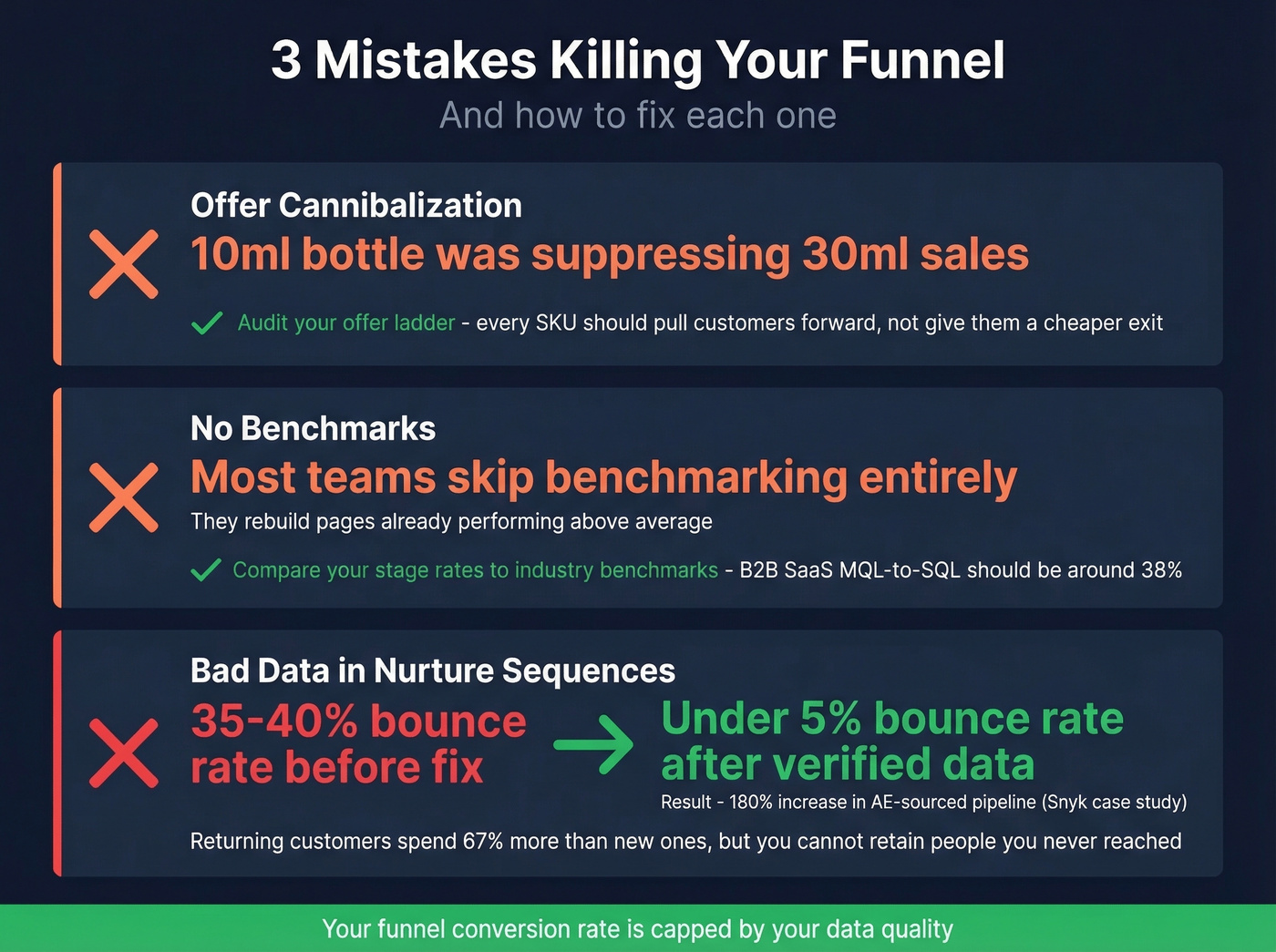
No benchmarks. If you don't know that your MQL-to-SQL rate should be around 38% for B2B SaaS, you can't tell whether your funnel is broken or just normal. In our experience, most teams skip the benchmarking step entirely and end up rebuilding pages that were already performing above average. (If you're pressure-testing the whole motion, compare against sales conversion rate benchmarks.)
Bad data in nurture sequences. This is the invisible funnel killer. We've seen teams running nurture sequences where a third of their emails bounced - the funnel never stood a chance, and their domain reputation took the hit. Returning customers spend 67% more than new ones, but you can't retain people you never reached. Your funnel's conversion rate is capped by your data quality. Snyk's sales team cut their bounce rate from 35-40% to under 5% after switching to verified contact data, and their AE-sourced pipeline jumped 180%. That's the difference clean data makes. (If deliverability is a recurring issue, start with an email deliverability guide.)

Your MQL-to-SQL rate won't improve if your top-of-funnel contacts are outdated. Prospeo gives you 300M+ verified profiles with 30+ filters - buyer intent, technographics, funding - so you fill your funnel with buyers, not ghosts.
Feed your website funnel with contacts that actually convert.
FAQ
What's a good funnel conversion rate?
The average across 14 industries is 2.9% visitor-to-lead. eCommerce sites typically convert 1.84%-3.71% of visitors to buyers. Anything above 3% puts you in the top half of most industries - below 1.5% signals a structural problem, not a copywriting one.
Do I need a funnel builder or can I use my existing website?
You can build a functional website sales funnel on any site with landing pages and email automation. Dedicated builders like Systeme.io (free) or ClickFunnels ($81/mo) just make it faster to launch without developer help. For teams running fewer than three funnels, your existing site plus a landing page plugin is enough.
How do I find where visitors drop off?
Use GA4's Funnel Exploration report with the closed funnel toggle enabled. It shows user-by-user progression through each step you define and highlights the exact transition with the biggest abandonment - typically cart or form-start stages.
How do I fix bounced emails killing my nurture sequences?
Run your contact list through a verification tool before launching any sequence. Even verifying a small batch tells you whether bad data is dragging down your funnel. Teams like Snyk cut bounce rates from 35-40% to under 5% after switching to verified data, and the pipeline impact was immediate.