

What Are Customer Buying Signals - And How Do You Actually Act on Them?
Two-thirds of B2B buyers prefer a rep-free experience. They're researching, shortlisting, and nearly deciding before a seller gets involved. That's why customer buying signals matter more than ever. The average buying cycle has compressed from 11.3 months to 10.1 months in just one year, and 95% of the time, the winning vendor is already on the buyer's Day One shortlist. Sellers are getting pulled in earlier - first contact now happens at 61% of the journey, down from 69% a year ago - but only if they're watching for signals.
So what are these signals? They're the behaviors, events, and data points that reveal a prospect is moving toward a purchase, even when they haven't told you directly. And the ones that convert best usually aren't form fills. They're job changes, funding rounds, and multi-stakeholder pricing page visits.
The Short Version
- Quiet signals - champion moves, hiring sprees, competitor engagement - convert better than content downloads.
- Score every signal using four variables: Depth + Frequency + Seniority + ICP Fit (use an Ideal Customer Profile rubric).
- Stack signals before reaching out. Multi-signal outreach hits 25-40% reply rates vs. 1-5% for single-signal cold outreach.
- Pair signals with verified contact data. A signal without a reachable person is just a notification you can't act on (this is where data enrichment helps).
Three Types of B2B Buying Signals
A useful taxonomy, outlined by 6sense, breaks signals into three functional categories:
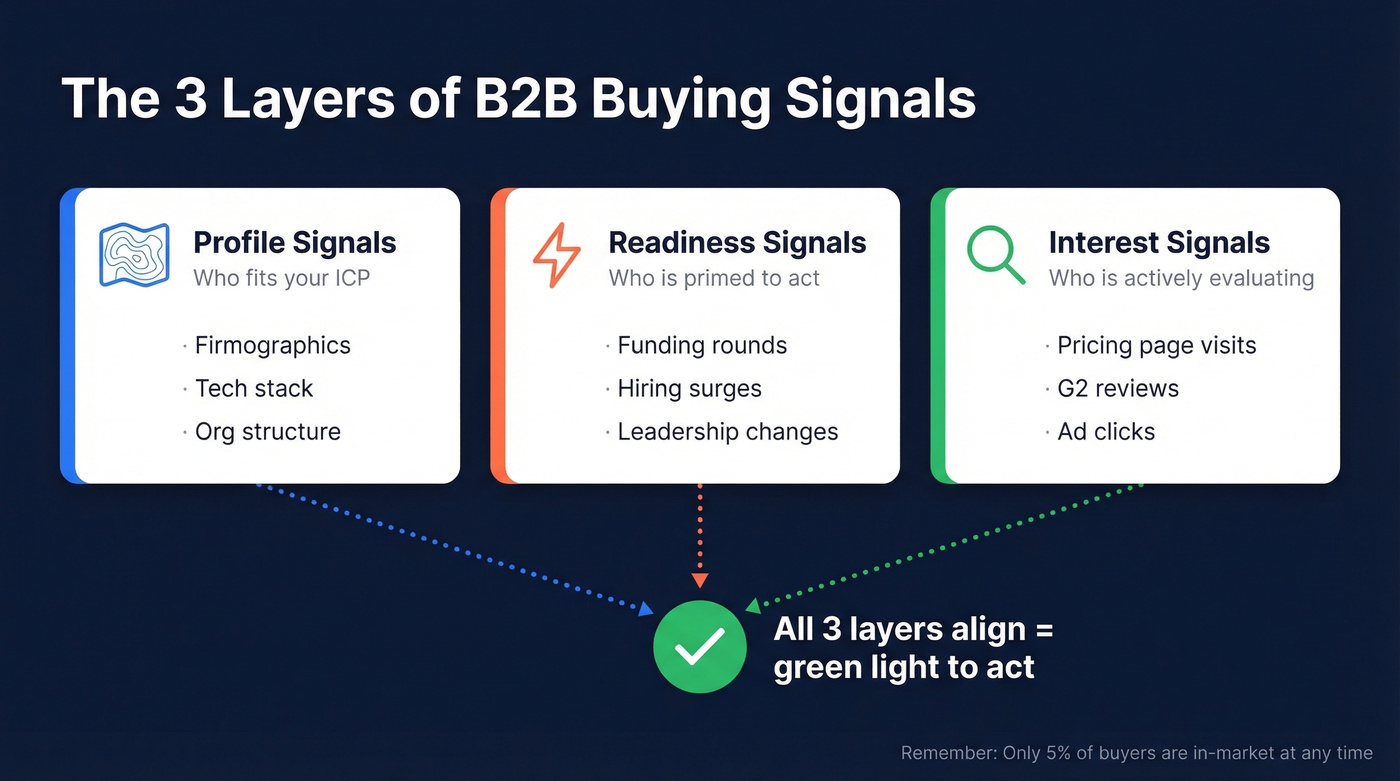
| Signal Type | What It Tells You | Examples |
|---|---|---|
| Profile (topographic map) | Who fits your ICP | Firmographics, tech stack, org structure |
| Readiness (weather) | Who's primed to act | Funding, hiring surges, leadership changes |
| Interest (breadcrumbs) | Who's actively evaluating | Pricing page visits, G2 reviews, ad clicks |
These signals come from first-party sources (your own site analytics), second-party platforms (review sites like G2), or third-party publisher networks tracking content consumption at scale.
Here's the thing most teams miss: the 95/5 rule, based on research from Professor John Dawes at the Ehrenberg-Bass Institute, says only about 5% of B2B buyers are in-market at any given time. The strongest signals emerge when all three layers - profile, readiness, and interest - align on the same account. One layer alone is a guess. Three layers stacking is a green light.
10 Signals That Actually Convert
We've ranked these from strongest to weakest based on common outbound conversion patterns and what we've seen across our own customer base:
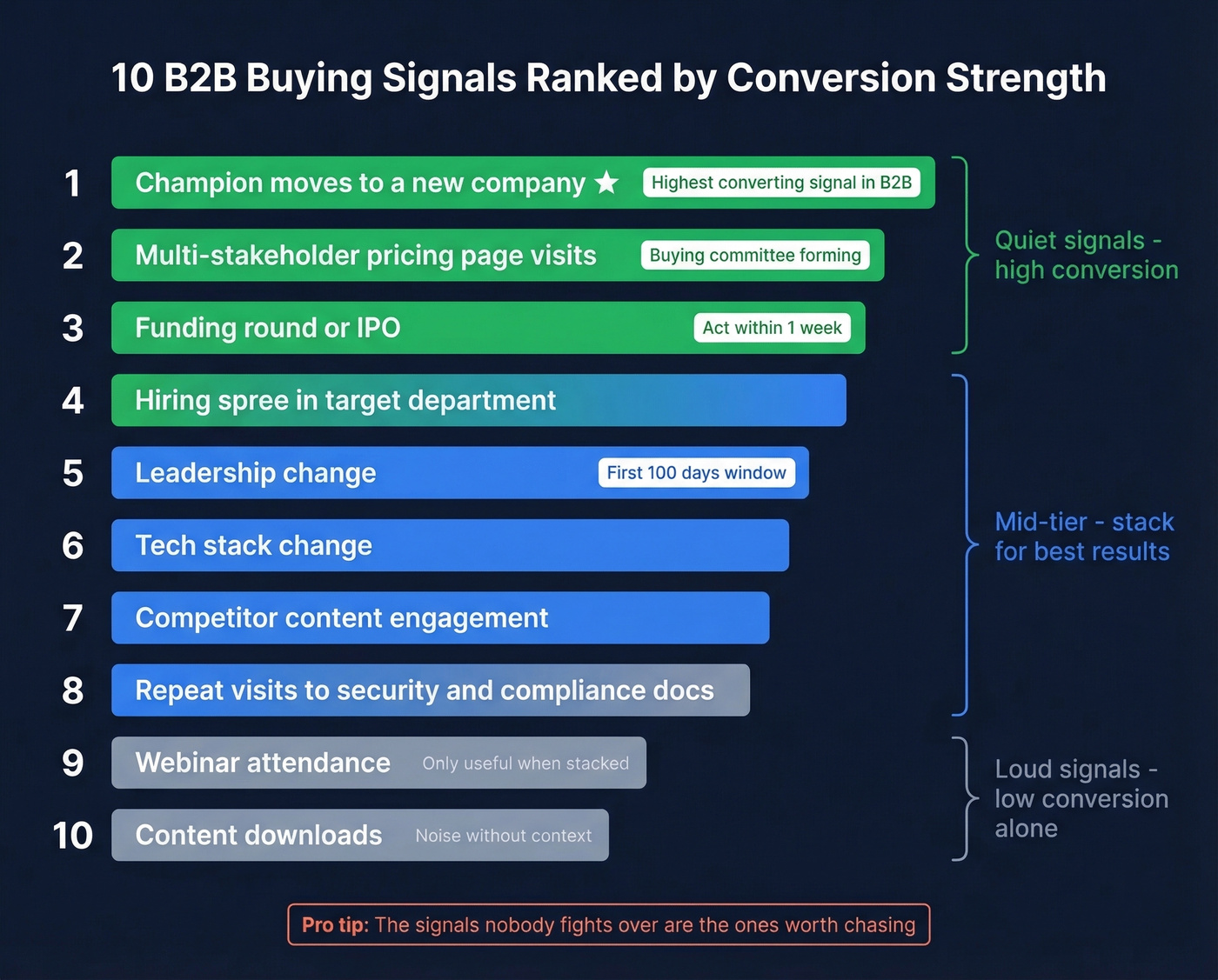
- Champion moves to a new company - They already trust your product. This is the single highest-converting signal in B2B, full stop.
- Multi-stakeholder pricing page visits - One person browsing is curiosity. Three people from the same account is a buying committee forming.
- Funding round or IPO - New money means new budget. Act within a week.
- Hiring spree in your target department - If they're adding five SDRs, they need tools.
- Leadership change - New VPs rewrite the playbook in their first 100 days.
- Tech stack change - Ripping out a competitor's tool is the clearest possible signal.
- Competitor content engagement - Reading G2 comparisons or competitor case studies (tie this into your competitive intelligence).
- Repeat visits to security/compliance docs - Late-stage evaluation behavior.
- Webinar attendance - Useful when stacked with stronger signals, not on its own.
- Content downloads - A student downloading the same ebook as a CISO looks identical in your dashboard. Without context, it's noise.
The thread on r/salestechniques mirrors this: practitioners consistently prioritize "quiet" signals over the "loud" ones like form fills. The consensus is that the signals nobody's fighting over are the ones worth chasing.
Let's be honest: if your average deal size is under $10K, you probably don't need enterprise intent platforms. A disciplined process of tracking job changes and funding rounds on affordable tools often outperforms a $40K/year Bombora contract that your SDRs never actually log into (if you want a system, start with how to track sales triggers).

You just learned that champion job changes and funding rounds are the highest-converting buying signals. Prospeo tracks both - plus 15,000 intent topics via Bombora - and pairs them with 98% accurate emails refreshed every 7 days. No stale records compounding your false positives.
Turn buying signals into booked meetings at $0.01 per verified email.
How to Score Purchase Intent Signals
Not every signal deserves the same response. Leadfeeder's framework gives you a clean formula:
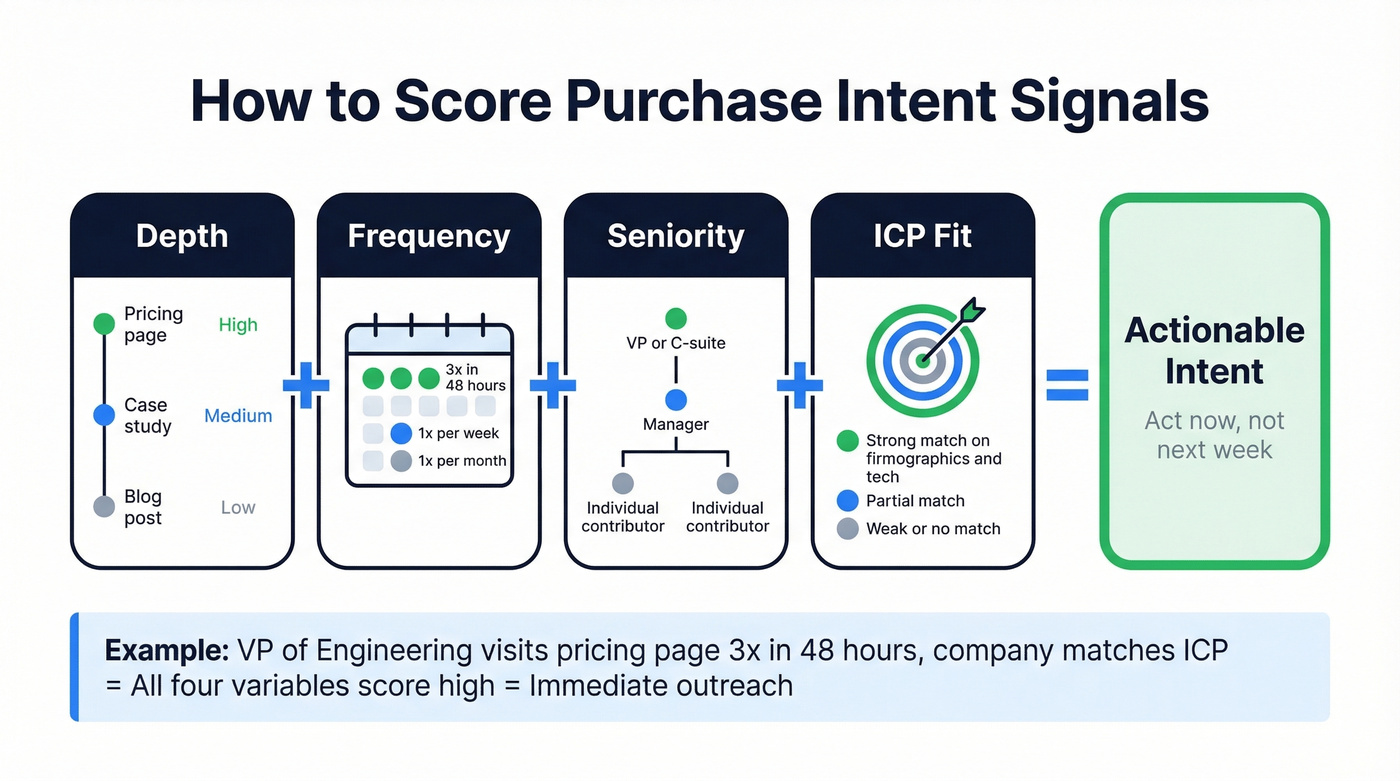
Depth + Frequency + Seniority + ICP Fit = Actionable Intent
Picture this: a VP of Engineering visits your pricing page three times in 48 hours, and their company matches your ICP on firmographics and tech stack. That's high depth (pricing page, not a blog post), high frequency (three visits in two days), high seniority (VP-level), and strong ICP fit. You act now - not next week.
The key distinction is between engagement and true purchase intent. Someone reading your blog once is engagement. A decision-maker repeatedly hitting bottom-of-funnel pages while their company shows readiness signals? That's intent worth acting on. Confusing the two is how teams burn through SDR hours chasing people who were just bored on a Tuesday afternoon (a solid lead scoring model prevents this).
Why Signals Fail: False Positives
52% of sales professionals report frequent false positives from intent data, and 29% cite misattributed IP data as a core problem. Only 24% of B2B marketers report exceptional ROI from intent data - often because of false positives and stale records. We've seen teams waste entire quarters chasing single-signal workflows that generate meetings with the wrong people. It's frustrating, and it's avoidable.
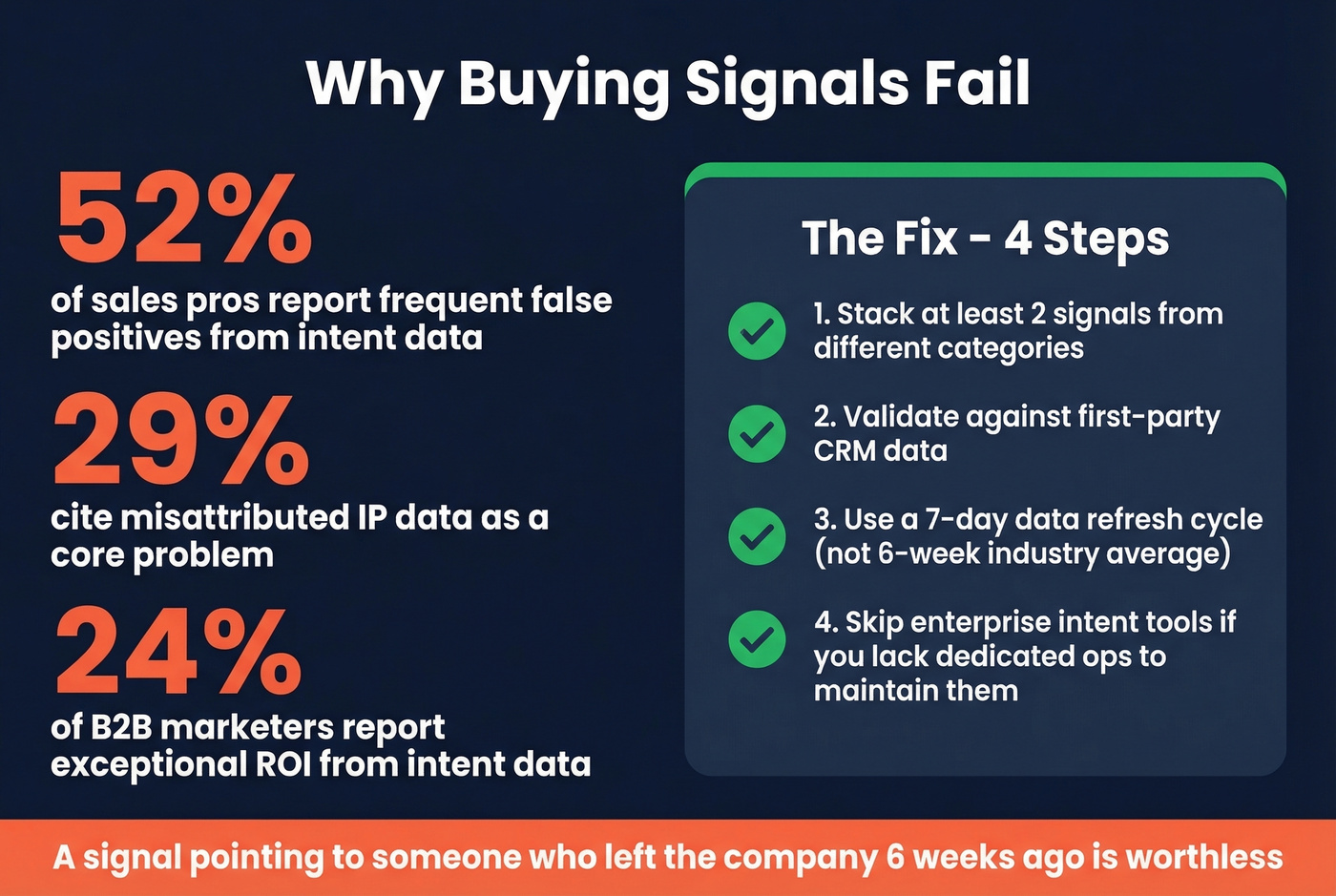
The fix is straightforward: stack at least two signals from different categories before triggering outreach, validate against first-party CRM data, and make sure your contact data is actually fresh. Stale records compound the false-positive problem. If the VP you're targeting left the company six weeks ago, your "signal" is worthless. A 7-day data refresh cycle catches changes that a six-week industry-average refresh misses entirely.
Skip enterprise intent platforms if your team doesn't have dedicated ops to configure and maintain them. A $35K+ annual contract that nobody tunes is worse than no intent data at all - it gives your reps false confidence (especially if your sales process optimization isn't locked in).
The Signal-to-Action Playbook
Signals without prescribed actions are dashboard noise. The Salesmotion framework maps every signal to an owner, channel, and SLA:
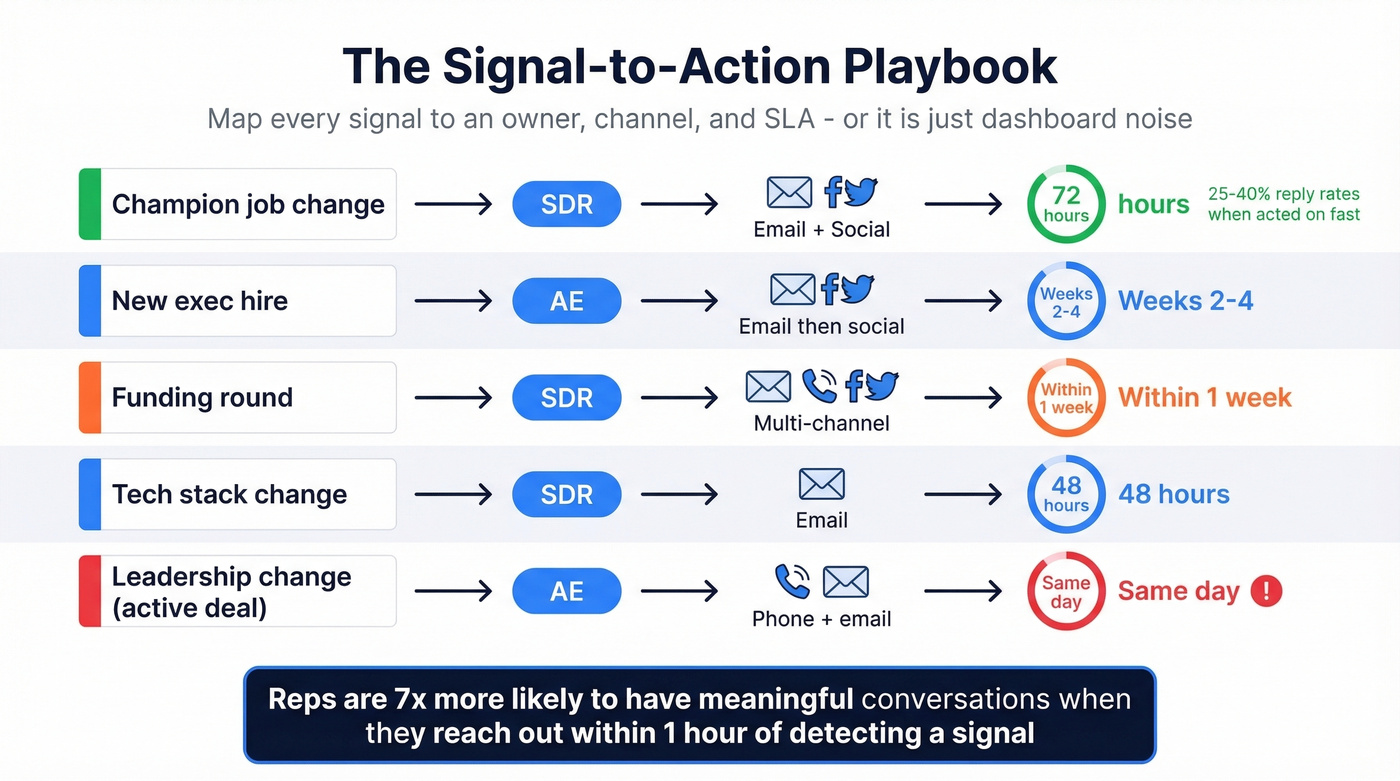
| Signal | Owner | Channel | SLA |
|---|---|---|---|
| Champion job change | SDR | Email + social | 72 hours |
| New exec hire | AE | Email then social | Weeks 2-4 |
| Funding round | SDR | Multi-channel | Within 1 week |
| Tech stack change | SDR | 48 hours | |
| Leadership change (active deal) | AE | Phone + email | Same day |
The difference between teams hitting 25-40% reply rates and teams stuck at 1-5% isn't the signals themselves. It's the speed and specificity of the response. A "congrats on the new role" email sent 72 hours after a champion moves lands far better than the same message sent three weeks later, when four other vendors have already reached out (tighten this with sales follow-up templates).
Speed isn't just a nice-to-have: reps are seven times more likely to have meaningful conversations with decision-makers when they reach out within an hour of detecting a buying signal. But speed requires verified contact data ready the moment a signal fires. In our experience, the teams that collapse the gap between "signal detected" and "meeting booked" to under an hour are the ones consistently outperforming quota. Prospeo tracks 15,000 intent topics via Bombora and pairs them with 98%-accurate emails and 125M+ verified mobiles on a 7-day refresh - on a self-serve, credit-based model with no annual contracts.
Stacking signals only works when you can actually reach the buyer. Prospeo gives you 300M+ profiles with verified emails and 125M+ direct dials, all on a 7-day refresh cycle. That VP who just changed jobs? You'll have their new email before your competitors even notice they left.
Stop watching signals you can't act on - get the contact data to match.
FAQ
What are customer buying signals vs. intent data?
Buying signals are any behavior or event suggesting purchase readiness - a job change, a pricing page visit, a funding round. Intent data is one specific subset: third-party content consumption tracked across publisher networks. The best teams layer intent data with readiness and profile signals for a complete picture rather than treating intent data as the whole story.
How many signals should you stack before reaching out?
Two to three from different categories is the sweet spot. Combine one readiness signal (like funding) with one interest signal (like pricing page visits) and you're in strong territory. Multi-signal outreach consistently achieves 25-40% reply rates compared to 1-5% for single-signal cold outreach.
What's the fastest way to act on a buying signal?
Pair an intent data source with verified contact data so you can move from signal to outreach in minutes, not days. The goal is collapsing the gap between "signal detected" and "meeting booked" to under an hour - that's where the 7x conversation rate improvement kicks in.
Do small teams need enterprise intent platforms?
Not usually. For deals averaging under $20K, tracking job changes, funding rounds, and hiring surges through a self-serve platform often outperforms a $40K/year enterprise contract that requires dedicated ops to configure and maintain. Start with the signals you can act on today, then scale up tooling as your deal size and team size justify it.