

What Is a Buying Signal? A Data-Backed Guide to Finding the 5% Ready to Buy
Most buying signal guides list 15 examples, slap "high/medium/low" labels on them, and call it a day. None of them tell you how to score those signals, which ones are noise, or what to do when your "high-intent" lead turns out to be a competitor's intern poking around your pricing page. So what is a buying signal, really - and how do you separate the ones that convert from the ones that waste your team's time?
Here's the version that answers both.
Buying Signals Defined
A buying signal is any action, behavior, or event that indicates a prospect is moving toward a purchase decision. That's the textbook definition. The useful one is more specific: it's a data point that helps you separate the 5% of buyers who are ready to act from the 95% who aren't.
That ratio comes from research by Professor John Dawes at the Ehrenberg-Bass Institute - at any given time, only about 5% of B2B buyers are in-market. The other 95% aren't ignoring you because your emails are bad. They just don't have a problem to solve right now.
Here's what makes this even harder. According to 6sense's Buyer Experience Report (nearly 4,000 B2B buyers surveyed), the pre-contact favorite wins roughly 80% of the time, and 95% of the time the winning vendor was already on the buyer's Day One shortlist. So by the time you see purchase intent indicators, the race might already be over - unless you were already in the conversation. That's the real job of signal detection: not just identifying interest, but identifying it early enough to matter.
The Short Version
Three strongest signal types: demo/trial requests, pricing page visits (especially repeat visits), and champion job changes at target accounts. They outperform weaker categories because they map directly to evaluation and change moments.
The core takeaway is counterintuitive. Fewer, better signals beat more, weaker ones. A team acting on 20 high-confidence signals will outperform a team drowning in 200 mediocre alerts every single time.
Why Signals Matter - The Math
Let's make this concrete.
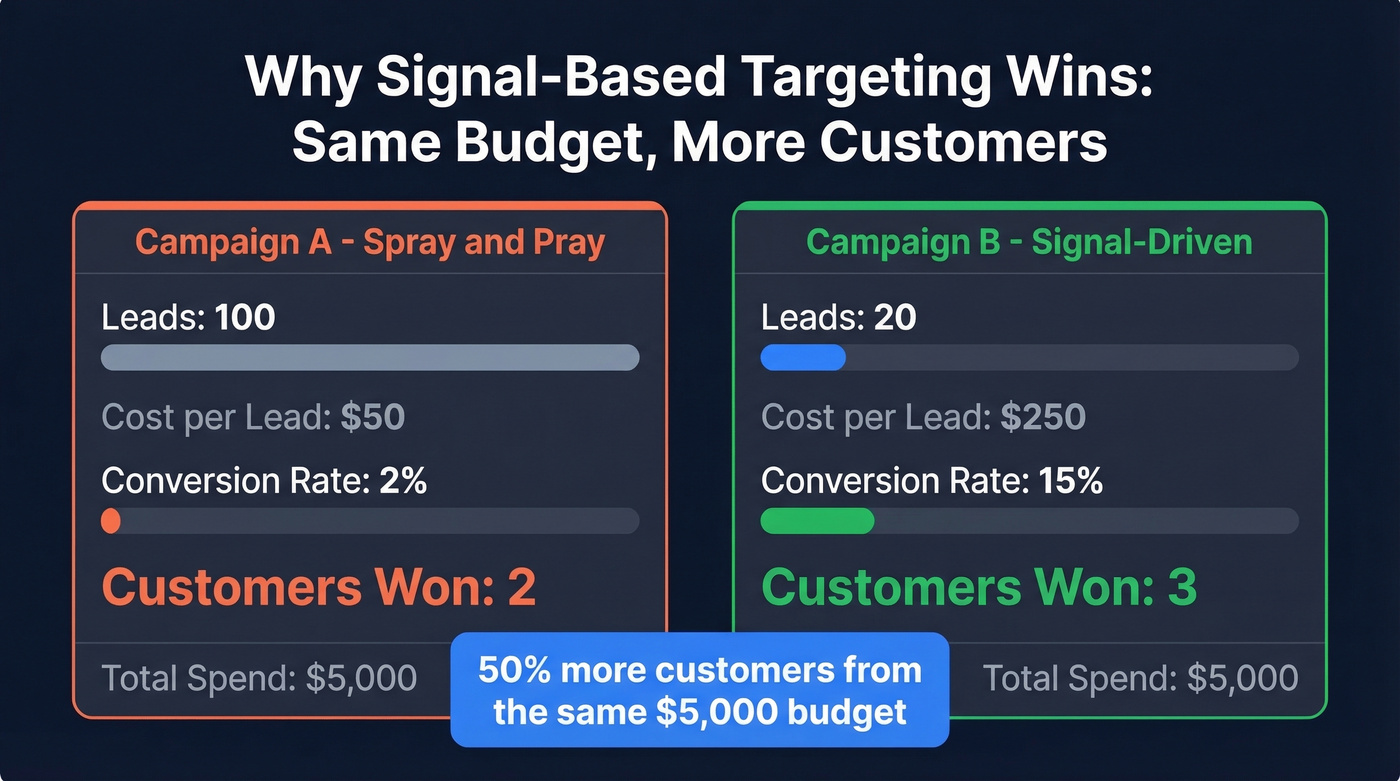
Campaign A: 100 leads at $50 CPL, converting at 2%. That's 2 customers for $5,000 in lead spend. Campaign B: 20 leads at $250 CPL, converting at 15%. That's 3 customers for the same $5,000. Same budget, 50% more customers - because Campaign B targeted prospects showing real purchase intent instead of casting a wide net. Teams that route high-intent signals with fast follow-up see 10-30% higher conversion rates than those using undifferentiated lead lists.
The funnel math reinforces this. Based on aggregated B2B benchmarks from Ruler Analytics (100M+ data points):
| Stage | Conversion Rate |
|---|---|
| Visitor to Lead | ~2.3% |
| Lead to MQL | ~31% |
| MQL to SQL | ~13% |
| SQL to Opportunity | 30-59% |
| Opportunity to Customer | 22-30% |
Every stage is a filter. Buying signals let you skip the leakiest stages by entering the funnel where conversion rates are already higher.
The 6sense data adds urgency: buying cycles compressed from 11.3 months to 10.1 months year-over-year, and the point of first contact shifted from 69% to 61% of the journey - about 6-7 weeks earlier. Buyers are moving faster and engaging sellers sooner. If your signal detection is slow, you're not just late. You're irrelevant.
Types of Buying Signals
Signal Taxonomy
These signals break down along three axes. Channel covers verbal (what prospects say on calls), digital (what they do on your website or third-party platforms), and behavioral (patterns across multiple touchpoints over time). Explicitness separates direct expressions of interest - "Can you send me pricing?" - from implicit signals that require interpretation, like visiting your case study page three times in a week. Data source distinguishes first-party signals from your own properties from third-party signals on external platforms like G2, Bombora, or job boards.
One important distinction: intent data is a subset of buying signals, not a synonym. Intent data specifically refers to third-party behavioral data showing research activity. The broader category includes intent data alongside first-party actions, verbal cues, and trigger events.
15 Examples Ranked by Strength
| Signal | Strength | Recommended Response | Timing Window |
|---|---|---|---|
| Demo/trial request | High | Route to AE immediately | < 1 hour |
| Pricing page visit (2x+) | High | SDR outreach same day | < 4 hours |
| Champion job change | High | Warm outreach to new role | < 1 week |
| RFP/vendor evaluation | High | Full sales engagement | < 24 hours |
| Case study downloads | High | SDR follow-up, case-matched | < 24 hours |
| Competitor comparison page | Med-High | Position against competitor | < 24 hours |
| G2/review site research | Med-High | Targeted outreach | < 48 hours |
| Budget/timeline questions | Med-High | AE qualification call | < 4 hours |
| Fresh funding round | Med | Account-level outreach | < 2 weeks |
| Hiring spree (relevant roles) | Med | Outreach to hiring manager | < 2 weeks |
| Webinar attendance | Med | Nurture sequence | < 1 week |
| Tech stack change | Med | Solution-specific pitch | < 2 weeks |
| Blog content download | Low | Add to nurture | Ongoing |
| Social media follow | Low | Monitor, don't act | - |
| Email open | Low | Ignore as standalone | - |
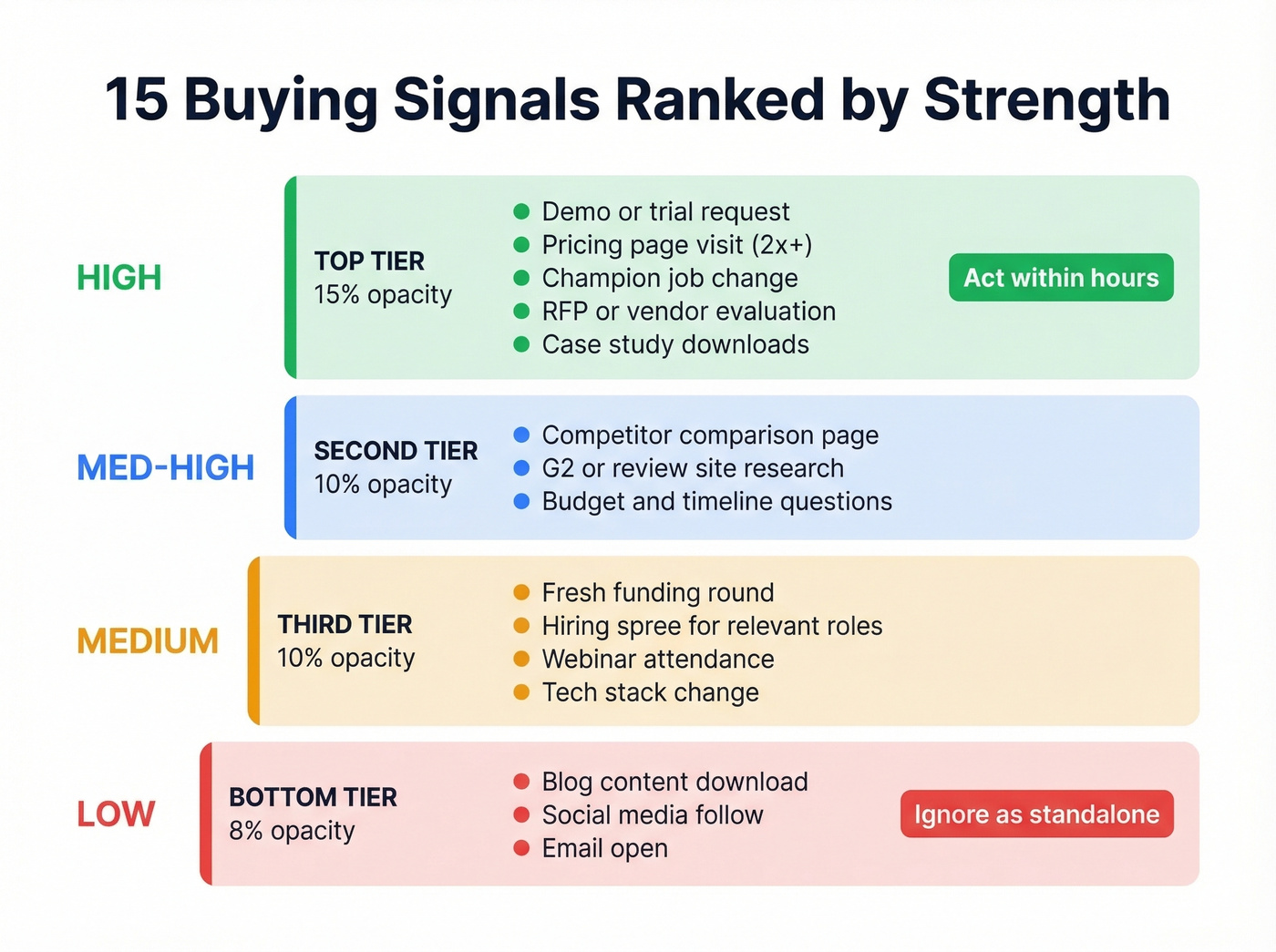
Email opens are barely a signal in 2026. Apple Mail Privacy Protection and bot pre-fetching have made open rates closer to noise than intent. If your scoring model still weights email opens, you're routing garbage to your SDRs. As one r/b2bmarketing thread put it, page views and email opens "feel unreliable" - and the data backs that up.
Content downloads sit in a similar gray zone. Someone downloading your "State of B2B Sales" report is showing curiosity, not purchase intent. Weight them accordingly - or don't weight them at all.
Hidden Signals That Outperform Form Fills
These subtle triggers often outperform traditional hand-raises because they show evaluation and change before someone fills out a form.
Job changes and promotions are one of the most underrated indicators in B2B. A new VP of Sales has their first 100 days to make their mark and is actively evaluating what to keep, replace, or rebuild. That window is gold (use a simple 30-60-90 day plan to time outreach).
Champions moving to new companies is warm pipeline disguised as a notification. Your biggest advocate just joined a company that fits your ICP, and they already trust you. In our experience, champion job changes produce some of the highest average deal sizes of any signal type - the relationship is pre-built, and the new hire has political capital to spend on tools they already believe in.
When a target account starts reading G2 reviews or visiting comparison pages, they're in active evaluation mode - whether or not they've filled out your form. These anonymous signals are invisible to teams relying solely on inbound leads. A Series B close or a burst of SDR job postings signals budget availability and growth ambitions. Companies that recently raised funding are 2.5x more likely to buy new solutions.
Repeat page views deserve special attention. A single visit is noise. Three visits to your pricing page in a week is a pattern. Track the frequency, not just the event. And if a prospect just ripped out a competitor's tool - visible through technographic data or job postings mentioning new platforms - the window is wide open (this is where firmographic and technographic data pays off).

You just learned that 80% of deals go to the pre-contact favorite. Prospeo tracks 15,000 intent topics via Bombora so you can spot buying signals - job changes, funding rounds, tech stack shifts - before your competitors even notice. Layer intent data with 30+ filters to find the 5% who are actually in-market.
Stop guessing who's ready to buy. Let the data tell you.
Negative Buying Signals - When to Walk Away
Not every signal points forward. Watch for scheduling hesitation (repeatedly pushing discovery calls), budget withholding ("we don't have a number yet" in month three), no decision-maker access, and explicit disinterest. Recognizing negative signals early saves your team from investing weeks in deals that were never going to close.
If you're seeing repeated stalls, it helps to standardize your sales qualification so "no budget" and "no authority" get flagged consistently.
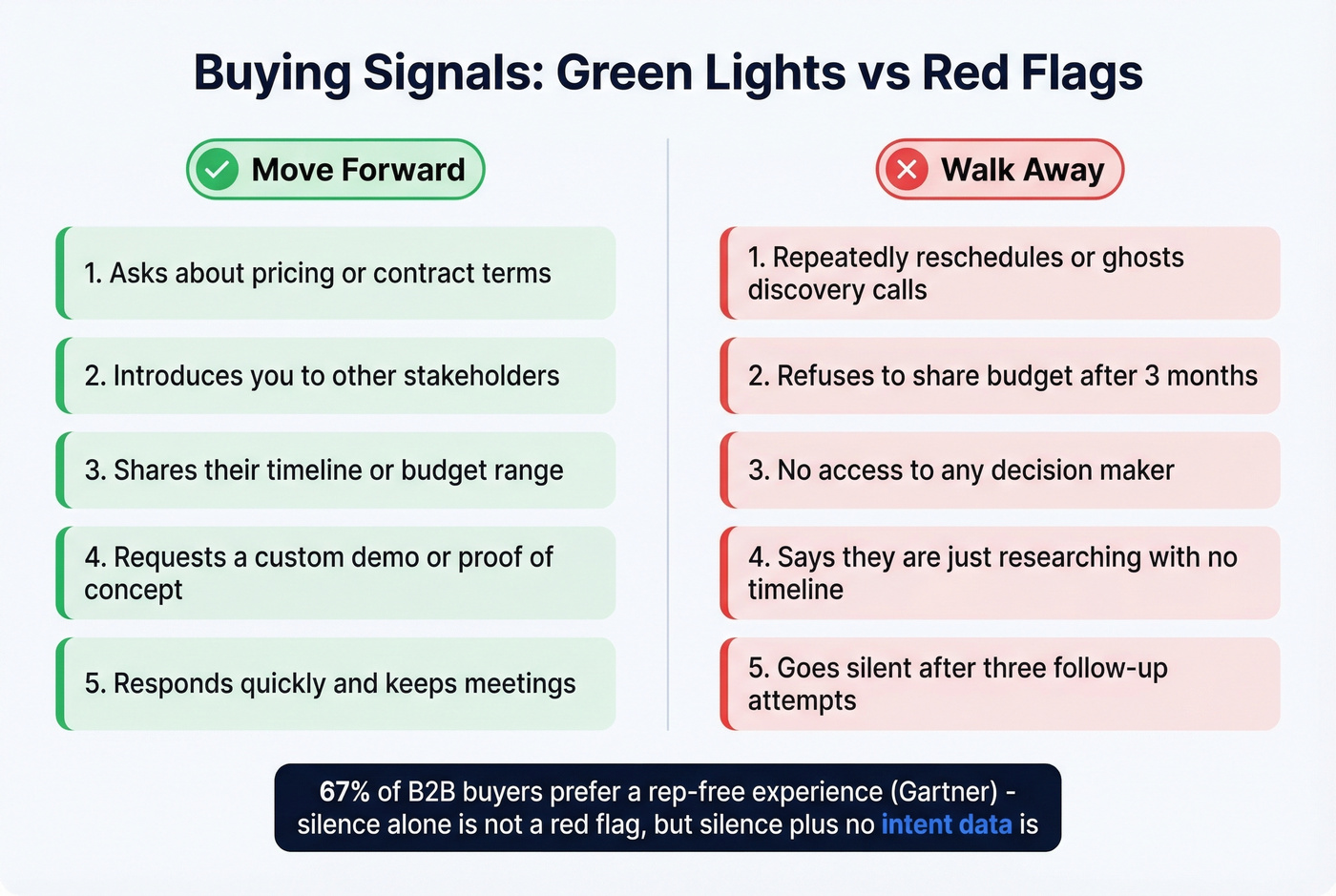
Here's the thing: distinguishing "not now" from "not ever" is genuinely hard. A Gartner survey of 646 B2B buyers found that 67% prefer a rep-free experience. Silence isn't always a negative signal - it's the default buying behavior. That's why third-party intent data matters: it reveals the research happening outside your own properties.
Skip the "nurture forever" approach for prospects showing multiple negative signals. If there's no budget authority, no timeline, and no engagement after three touches, move on. Your SDRs' time is worth more than a maybe.
How to Score Buying Signals
Listing signals is easy. Prioritizing them is where most teams fall apart. Here's a scoring model that works in production:
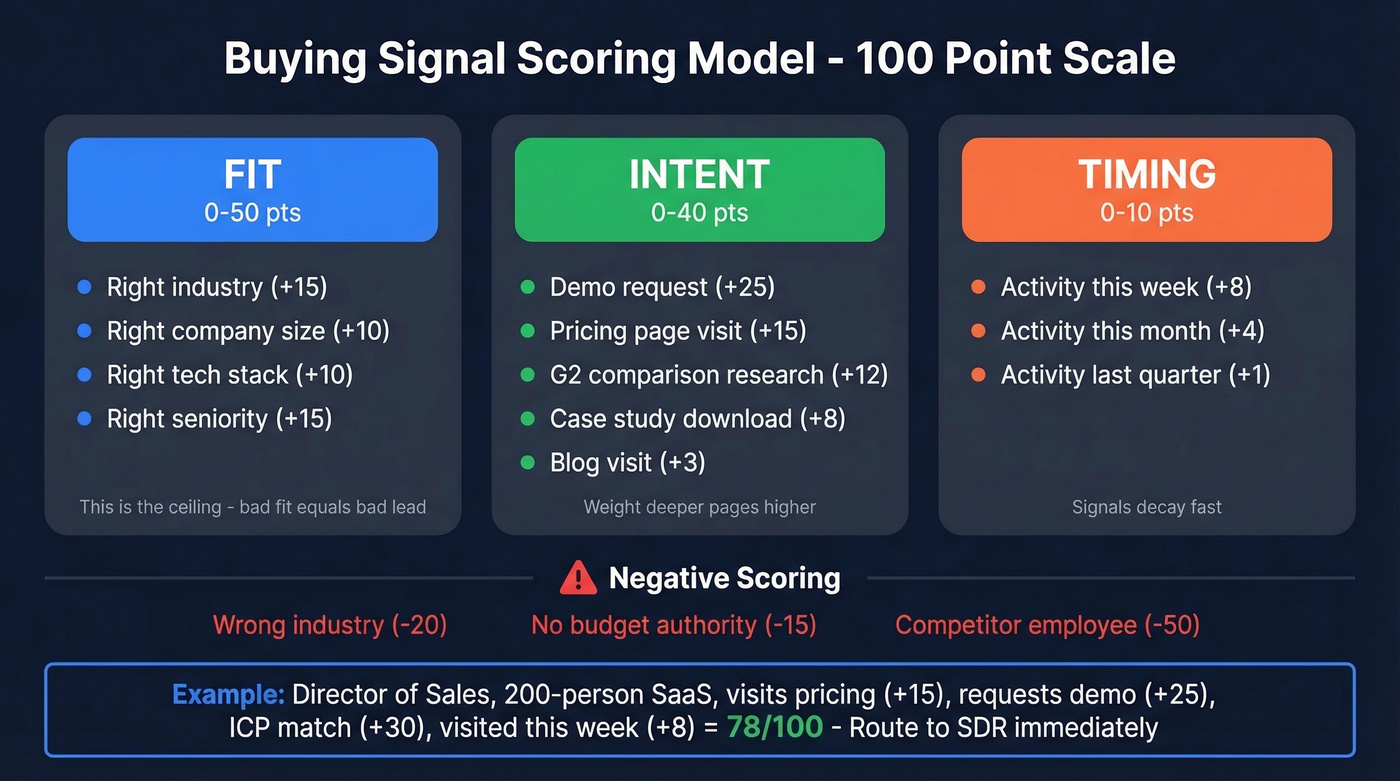
Fit (0-50 points): Firmographic and technographic match to your ICP. Right industry, right company size, right tech stack, right seniority. This is the ceiling - a perfect-intent signal from a bad-fit account is still a bad lead (use an Ideal Customer Profile rubric to keep this objective).
Intent (0-40 points): Behavioral signals weighted by specificity. Pricing page visit (+15), demo request (+25), case study download (+8), blog visit (+3), G2 comparison research (+12). Weight deeper pages higher than surface-level engagement.
Timing (0-10 points): Recency and velocity. Activity this week (+8), this month (+4), last quarter (+1). Signals decay fast - a pricing page visit from three weeks ago is already lukewarm.
Negative scoring matters just as much. Wrong industry (-20), no budget authority (-15), competitor employee (-50). We've tested scoring models with and without negative scoring - without it, you'll route 30% more garbage to your SDRs.
Let's run an example. A Director of Sales at a 200-person SaaS company visits your pricing page (+15), requests a demo (+25), matches your ICP on firmographics (+30), and visited this week (+8). That's 78/100 - route to an SDR immediately.
Now add context. Roughly 10-13 people are involved in a typical B2B buying decision, and 74% of buying teams experience unhealthy internal conflict. Your scoring model should account for multi-threading: signals from multiple stakeholders at the same account are exponentially more valuable than a single champion's activity. To score firmographic and technographic fit accurately, you need current data - Prospeo's 30+ search filters covering technographics, headcount growth, and funding make this step fast.
If you want a deeper framework for weighting and thresholds, this maps cleanly to modern lead scoring systems.
Tools for Detecting Signals
For teams evaluating signal detection tools, look for these capabilities:
- Multi-channel data capture across calls, emails, CRM, web, and third-party sources
- Real-time conversation intelligence
- Priority-tagged signal alerts - not a firehose
- Predictive scoring and workflow automation
- Sales stack integrations and ease of adoption
Forrester now calls the platforms unifying these capabilities Revenue Orchestration Platforms - systems that design, execute, and improve buyer engagement across the full revenue cycle.
The practical warning: avoid tools that flood reps with irrelevant alerts. An SDR getting 40 "intent signals" a day will ignore all of them within a week (this is a common failure mode in sales pipeline challenges).

Real talk: if your average deal size is under $15k, you don't need a six-figure enterprise platform for signal detection. You need accurate data, a simple scoring model, and fast follow-up. Most teams over-buy on tooling and under-invest in process.
Signals decay fast. A job change from five weeks ago is already cooling off. Prospeo refreshes every 7 days (the industry average is six weeks), which means the contact data behind your signals stays current. The platform covers 300M+ profiles with 98% email accuracy and tracks 15,000 intent topics via Bombora, so you're layering behavioral signals on top of verified contact data rather than chasing ghosts. It starts free with no contracts, so you can validate data quality before scaling.
Mistakes That Kill Your Signal Strategy
Treating all signals as equal. A homepage visit and a demo request aren't the same thing. If your routing logic doesn't distinguish between them, your SDRs are wasting half their day on low-intent leads.
Relying on a single data source. First-party data alone misses the 67% of buyers who prefer a rep-free experience. Third-party data alone lacks context. Blend both.
Ignoring the "why" behind the signal. A prospect researching "data enrichment" and one researching "GDPR compliance" have very different pain points. Tailor your outreach to the topic, not just the fact that activity occurred (this is the core of data-driven selling).
Acting too slowly. I've seen teams with beautiful signal detection that routes alerts to a shared inbox checked twice a day. Set up real-time alerts through Slack or your CRM - response within hours, not days.
Generic outreach that references the data source. "We noticed you were researching sales intelligence tools" feels invasive and lazy. Use the signal to inform your message without citing it directly.
Sales and marketing misalignment on signal definitions. If marketing considers a whitepaper download an MQL and sales considers it noise, your handoff is broken. This matters because 86% of B2B purchases stall - often due to internal misalignment on both the buyer and seller side. Define signal tiers jointly and review them quarterly.
Not measuring which signals actually convert. Track signals through to closed revenue, not just meetings booked. You might discover that champion job changes have 3x the deal size of demo requests. That insight changes everything about how you allocate SDR time.
If your follow-up is inconsistent, fix the execution layer with proven sales follow-up templates.
Champion job changes are one of the highest-converting buying signals on this list. Prospeo's database of 300M+ profiles refreshes every 7 days - not every 6 weeks - so you catch role changes, hiring sprees, and funding rounds while the timing window is still open. At $0.01 per email with 98% accuracy, acting on signals fast won't burn your budget or your domain.
Buying signals expire. Your data refresh cycle shouldn't be the bottleneck.
The Future - AI + Human Hybrid
Here's the tension: Gartner predicts that by 2030, 75% of B2B buyers will prefer sales experiences that prioritize human interaction over AI. Meanwhile, 45% of B2B buyers already used AI during a recent purchase, and nearly 90% say AI features are part of the solutions they're acquiring.
These aren't contradictory. AI handles detection and routing - scanning thousands of signals across channels, scoring them, and surfacing the ones that matter. Humans handle the moments that close deals - the nuanced discovery call, the negotiation where trust matters more than data. Build your signal stack accordingly: automate the sorting, protect the human touchpoints.
FAQ
What's the difference between buying signals and intent data?
Intent data is one type of buying signal - specifically, third-party behavioral data showing research activity across the web. Buying signals are the broader category that also includes first-party actions (demo requests, pricing page visits), verbal cues (budget questions), and trigger events (job changes, funding rounds). Intent data is a subset, not a synonym.
How quickly should you act on a buying signal?
Within hours, not days. Responding within 5 minutes makes you 21x more likely to qualify a lead than waiting 30 minutes. Set up real-time routing so high-scoring signals hit an SDR's queue immediately - CRM integrations with tools like Salesforce or HubSpot make this straightforward.
Can you track buying signals without enterprise tools?
Yes. Layer a B2B data platform with intent tracking, a CRM with activity tracking, and basic website analytics. Three good tools working together beat ten mediocre ones. The scoring model matters more than the stack.
What are the strongest B2B buying signals?
Demo or trial requests, repeat pricing page visits, and champion job changes consistently produce the highest conversion rates. These actions map directly to evaluation behavior and change moments. Lower-value signals like social follows or single blog visits indicate awareness but rarely predict a purchase on their own.