

What Is a Good Click Rate for Email? (The Honest Answer)
Your CMO asks in Monday standup: "What's our click rate, and is it good?" You say 2.8%. She frowns. You have no idea if that frown is justified because every benchmark page gives a different number.
So what is a good click rate for email? It's 2-5% for most marketing emails - but that range is nearly useless without context. Your number depends on industry, email type, audience, region, and whether bots are inflating your stats. A single average won't tell you much.
Click Rate vs CTR vs CTOR
Every platform defines these differently. HubSpot separates click rate and click-through rate into two distinct metrics, while Mailchimp often uses them interchangeably. Here's the clearest breakdown:
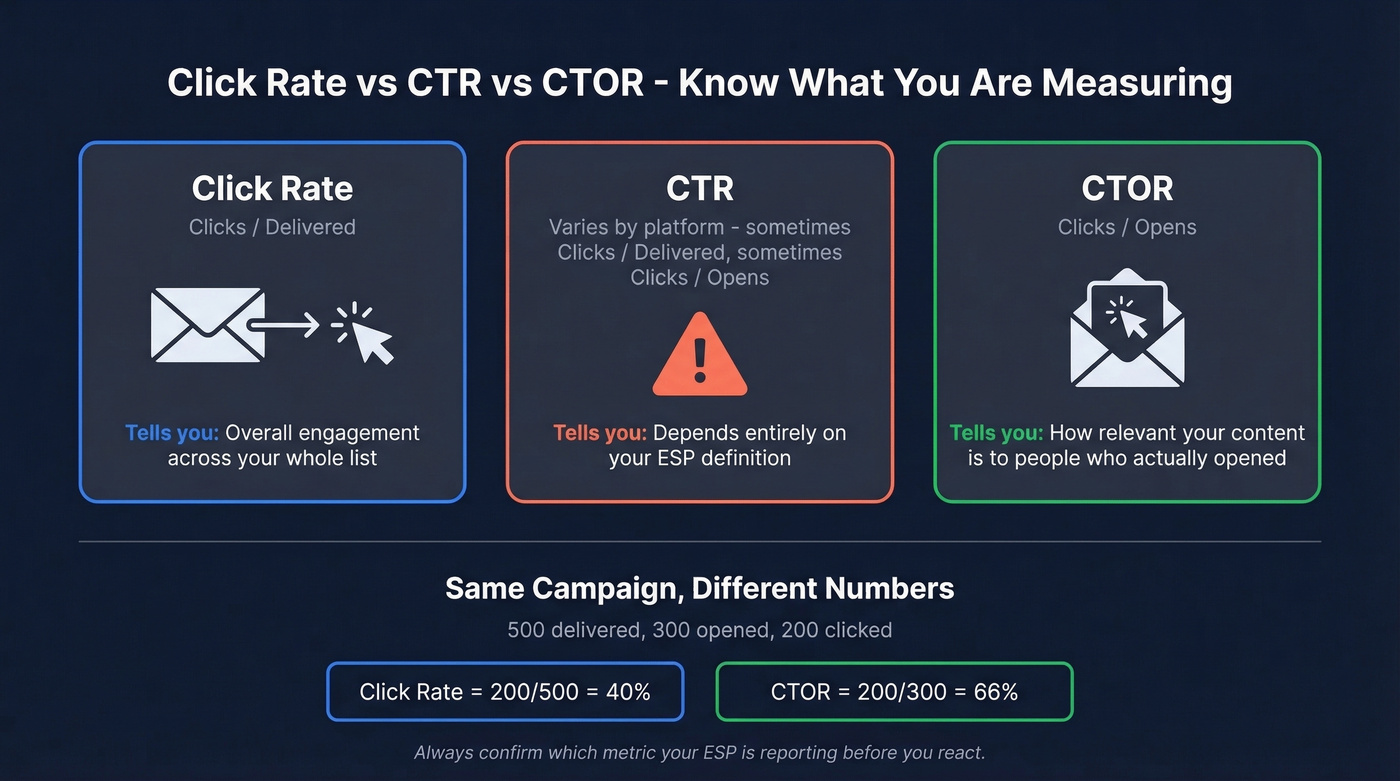
| Metric | Formula | What It Tells You |
|---|---|---|
| Click Rate | Clicks / Delivered | Overall engagement |
| CTR | Depends on platform (sometimes Clicks / Delivered, sometimes Clicks / Opens) | Depends on platform |
| CTOR | Clicks / Opens | Content relevance |
A quick hypothetical: you send to 500 people, 300 open, 200 click. Your click rate is 40% (200/500). Your click-through rate in HubSpot's definition is 66% (200/300). Same campaign, wildly different numbers. Real-world click rates are far lower - this just illustrates the math. Always confirm which metric your ESP is actually showing before you panic or celebrate.
If you want the exact math and definitions, see our click rate formula breakdown.
2026 Benchmarks That Matter
By Industry
Every ESP publishes benchmarks based on their own customers, then presents them as universal truth:
| Industry | Mailchimp | GetResponse | ActiveCampaign |
|---|---|---|---|
| All Industries | 2.62% | 3.25% | 6.21% |
| E-commerce | 1.74% | - | 5.07% |
| Education | 3.02% | - | - |
| Nonprofits | 3.27% | - | - |
Why the gap? Dataset bias and measurement differences. Mailchimp's 2.62% comes from billions of delivered emails on its platform, filtered to campaigns with tracking enabled and at least 1,000 subscribers. ActiveCampaign's 6.21% reflects its own customer base, which skews toward smaller, more engaged lists - so platform-specific datasets can run much higher than cross-ESP market averages. Campaign Monitor's 2021 data showed 2.3% and still gets cited everywhere despite being years old. None of these are wrong. They're measuring different populations.
For a deeper cut, compare average email click-through rate by industry across sources.
By Email Type
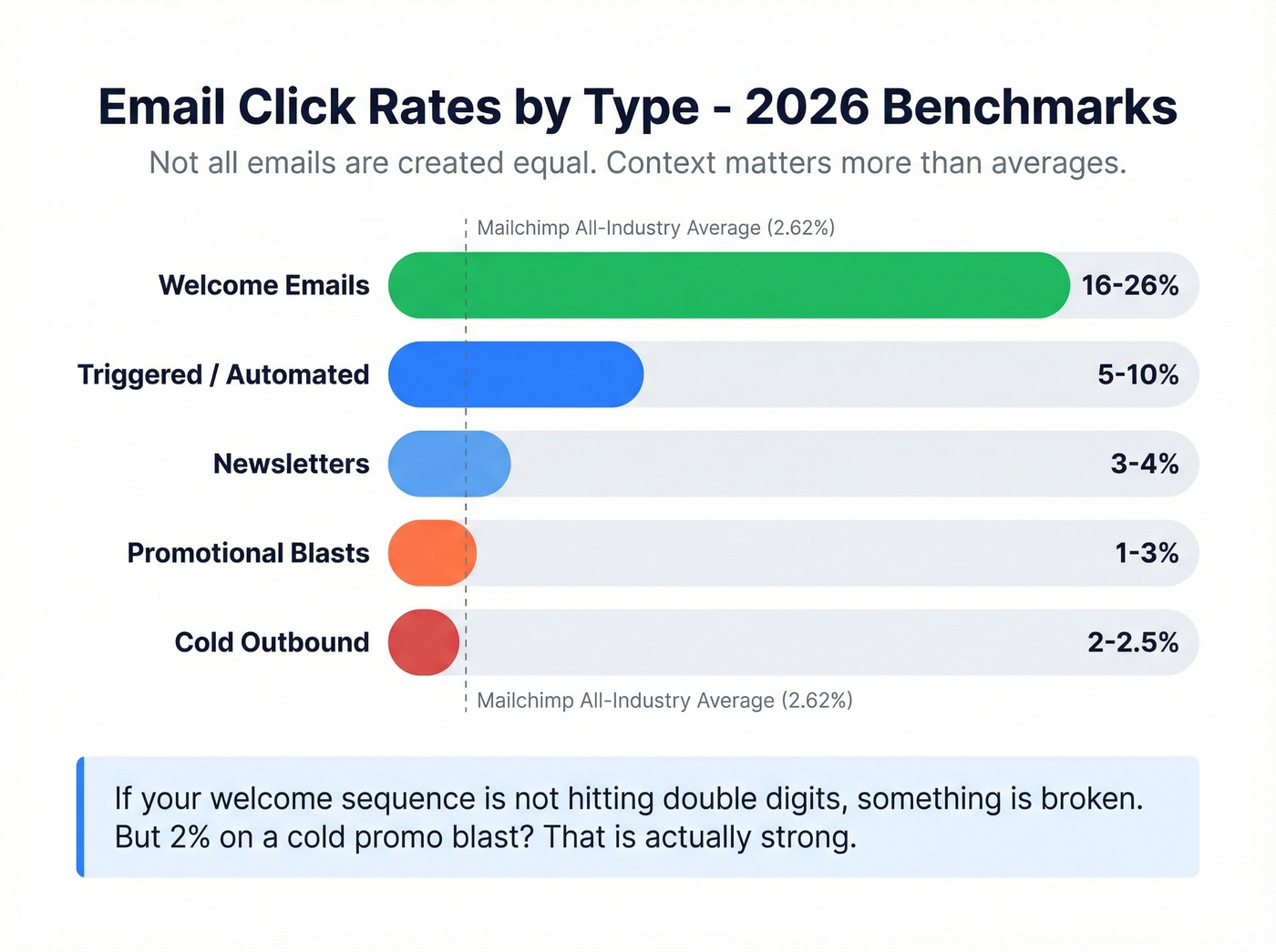
This is where the "2-5% average" falls apart. Comparing a welcome email to a promotional blast is comparing apples to chainsaws:
| Email Type | Typical CTR |
|---|---|
| Welcome emails | 16-26% |
| Triggered/automated | ~5-10% |
| Newsletters | ~3-4% |
| Promotional | 1-3% |
| Cold outbound | ~2-2.5% |
GetResponse's benchmark split shows the same pattern: triggered emails average a 5.02% CTR versus 3.84% for newsletters. If your welcome sequence isn't hitting double digits, something's broken. But a 2% rate on a promotional blast to a cold segment? That's actually strong for the context.
If you're running sequences, these automated email campaigns benchmarks and setup notes help interpret the numbers.
B2B vs B2C
B2B outperforms B2C on click metrics because lists are smaller and more targeted. Per MailMonitor, B2B CTR sits at 3.2% vs 2.1% for B2C. B2B open rates actually trail B2C (37.4% vs 40%), but the CTOR gap - 13% vs 5.5% - tells the real story: B2B recipients who open are far more likely to click.
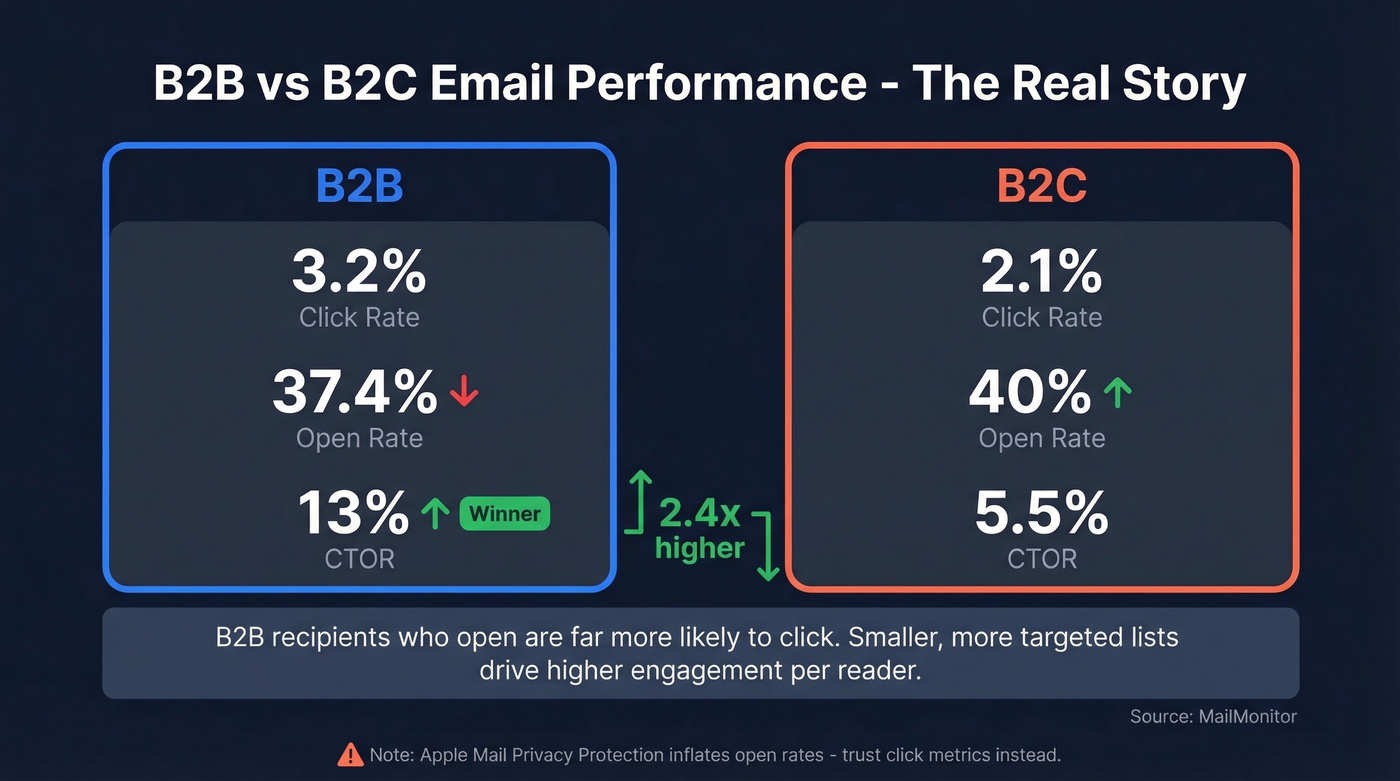
One caveat worth flagging: Apple's Mail Privacy Protection inflates open rates across the board, making CTR and CTOR the only metrics worth trusting post-2021.
We've seen B2B email marketers on Reddit describe click rates feeling harder to sustain than they used to, even as targeting improves. If your B2B clicks are flat, you're not alone. (If you want B2B-specific numbers, start with B2B email click-through rates.)
By Region
GetResponse's regional data is something no other benchmark roundup covers, and the gaps are significant. North America averages 4.77%, Europe 3.58%, and Oceania 2.48%. If you're running global campaigns and benchmarking against a single number, you're misleading yourself.

Regional benchmarks only matter if your emails actually land. Bounces tank sender reputation, push you to spam, and make click rates irrelevant. Prospeo's 7-day data refresh keeps your list current - not 6 weeks stale like competitors.
Snyk cut bounces from 35% to under 5% and grew pipeline 180%.
Why Your Click Rate Is Lying
Here's the thing: if your B2B click rate is above 5% and you haven't filtered for bots, you don't actually have a 5% click rate.
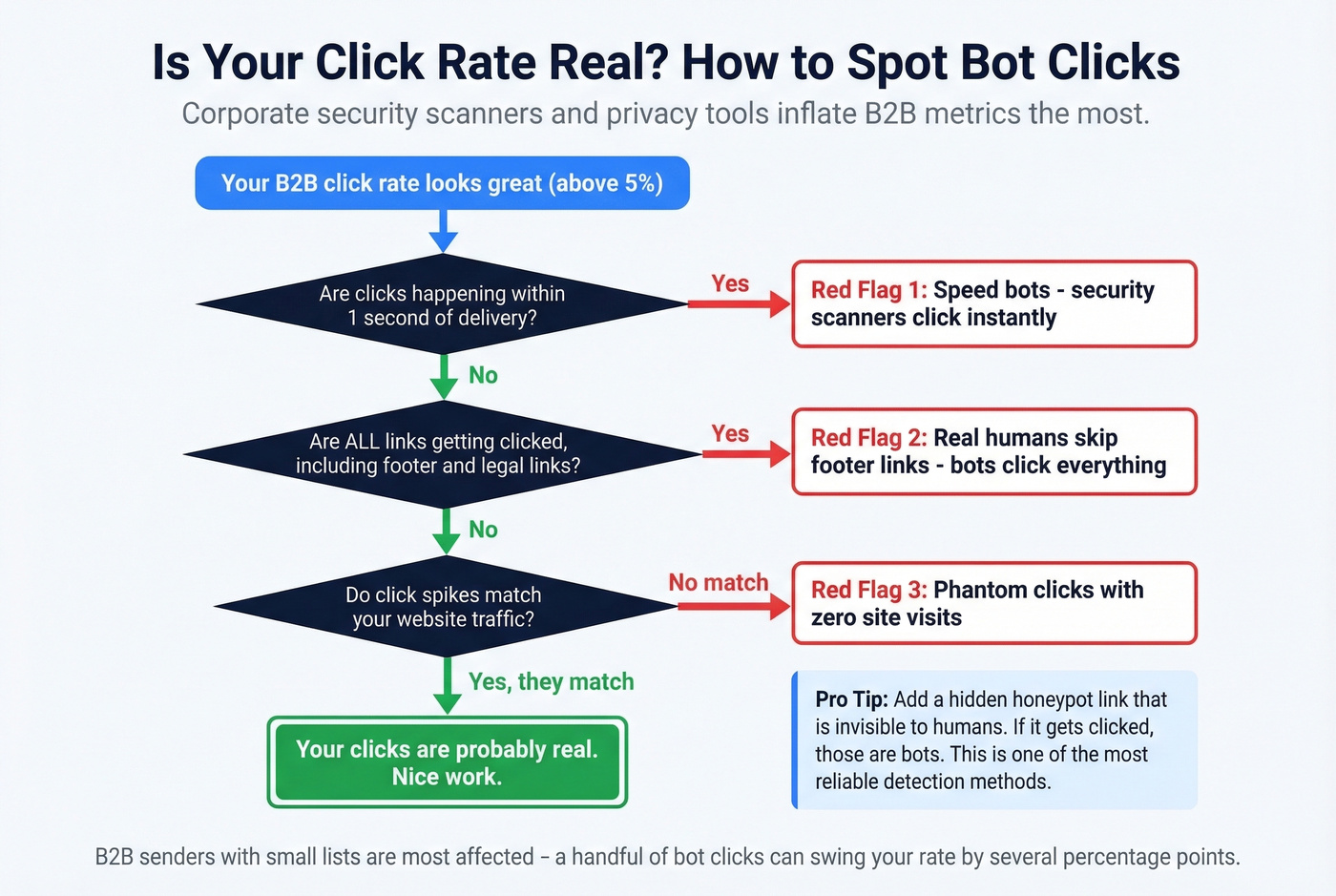
Corporate security scanners click every link within one second of delivery to check for malware. Privacy tools preload links. The result is phantom clicks that inflate your metrics, and B2B gets hit hardest because small list volumes mean a handful of bot clicks swing your rate by several points.
This is also why email marketing measurement needs to separate human engagement from machine activity.
How to spot it: look for clicks within one second of delivery, clicks on every link including footer and legal disclaimers, and click spikes with zero corresponding site traffic. The honeypot tactic - adding a hidden link invisible to humans and tracking clicks on it - is one of the most reliable detection methods we've found.
How to Improve Your Email Click Rate
Let's be honest: most teams obsess over benchmarks when the real work is upstream. A 2% click rate on a clean, engaged list beats a 5% rate inflated by bots on a decaying database every single time.
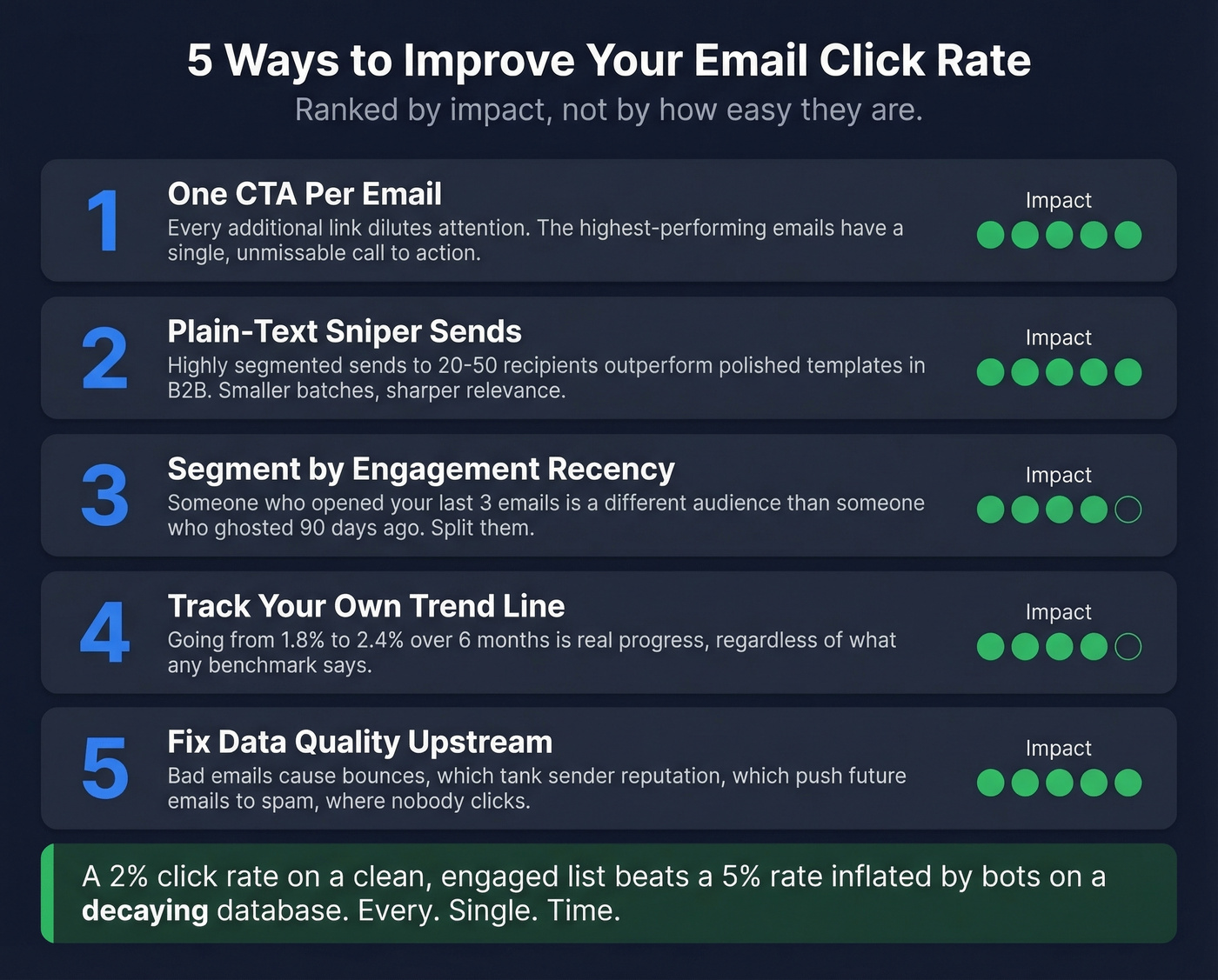
Five tactics ranked by impact:
One CTA per email. Every additional link dilutes attention. The emails with the highest click rates we've tested have a single, unmissable call to action. (More examples: cold email call to action.)
Plain-text sniper sends. The consensus on r/b2bmarketing is clear: highly segmented sends to 20-50 recipients outperform polished templates in B2B. Smaller batches with sharper relevance beat scale. If you're debating format, see plain text vs HTML emails.
Segment by engagement recency. Someone who opened your last three emails is a fundamentally different audience than someone who hasn't engaged in 90 days. Split them and you'll see where the real opportunity sits. This pairs well with a tighter B2B email segmentation model.
Track your own trend line. If your click rate went from 1.8% to 2.4% over six months, that's progress - regardless of what Mailchimp's average says. A good email CTR is one that keeps climbing relative to your own baseline.
Fix data quality upstream. Bad emails lead to bounces, which tank sender reputation, which pushes future emails to spam - where nobody clicks. Prospeo runs 5-step verification with catch-all handling and spam-trap removal at 98% accuracy, so you stop sending to dead addresses in the first place. Snyk cut their bounce rate from 35-40% to under 5% after switching, and their AE-sourced pipeline jumped 180%. If bounces are the root issue, start with email marketing bounce rate.

Bot clicks inflate your metrics. Bad data destroys your deliverability. Fix the upstream problem first: Prospeo's 5-step verification catches spam traps, honeypots, and catch-all domains at 98% accuracy - for roughly $0.01 per email.
Stop benchmarking click rates on emails that never reached the inbox.
FAQ
What is a good click rate on emails?
Mailchimp reports 2.62% across billions of emails, GetResponse shows 3.25%, and MailerLite data via Pushwoosh landed at 2.09%. The true average for marketing emails is 2-3%. Your email type matters far more - triggered and welcome emails routinely exceed 5-10%, while promotional blasts sit around 1-3%.
Is click rate or open rate more important?
Click rate, and it isn't close. Apple's Mail Privacy Protection made open tracking unreliable starting in 2021. Opens suggest a subject line worked (maybe). Clicks prove someone engaged with your content and took a specific action.
How do I know if bots are inflating my clicks?
Look for clicks within one second of delivery, clicks on every link including footers, and click spikes with no corresponding site traffic. Adding a hidden honeypot link - invisible to humans - is one of the most reliable detection methods. B2B senders with small lists are most affected.
Can bad email data lower my click rate?
Yes. Invalid addresses cause bounces, which damage sender reputation, which pushes future emails to spam - where nobody clicks. Verification tools that include catch-all handling and spam-trap removal keep bounce rates under 5% and protect deliverability long-term.
The Real Answer
Better than your last five sends. That's the honest answer to what is a good click rate for email. Industry benchmarks are a sanity check, not a report card. Track your own trend, filter out the bots, and keep your list clean - that's the entire game.