

B2B Email Click-Through Rates: What's Normal, What's Broken, and How to Fix It
Your B2B email click-through rate is probably somewhere around 2-3%. Whether that's good enough depends entirely on what you're sending. A 2% CTR on a weekly newsletter? Fine. A 2% CTR on a nurture sequence? Something's broken.
Quick benchmarks (2026):
- Average B2B CTR: 2.0-4.0% (varies by email type, industry, and calculation method)
- Newsletters: ~1-3% | Nurture sequences: ~8% | Cold outbound: ~3-4%
- Below ~1%? That's a deliverability or list quality problem, not a content problem.
Only 8% of B2B marketers rated email effective for lead generation in a recent survey - which says more about how most teams execute email than about the channel itself. One practitioner on r/Emailmarketing summed up the frustration perfectly: strong open rates, CTR stuck at 2-3%, no idea what lever to pull.
CTR Benchmarks by Industry and Email Type
By Industry
Mailchimp's benchmark data, drawn from billions of tracked campaigns, remains the most transparent large-sample source for understanding average CTR across sectors:
| Industry | Avg CTR | Avg Open Rate |
|---|---|---|
| Nonprofits | 3.27% | 40.04% |
| Education | 3.02% | 35.64% |
| Business & Finance | 2.78% | 31.35% |
| Ecommerce | 1.74% | 29.81% |
ViB's B2B-specific baseline puts the number at 3.2%, which tracks with what we see across mid-market SaaS and professional services.
By Email Type
This is the table that actually matters - and the one most benchmark articles skip entirely.
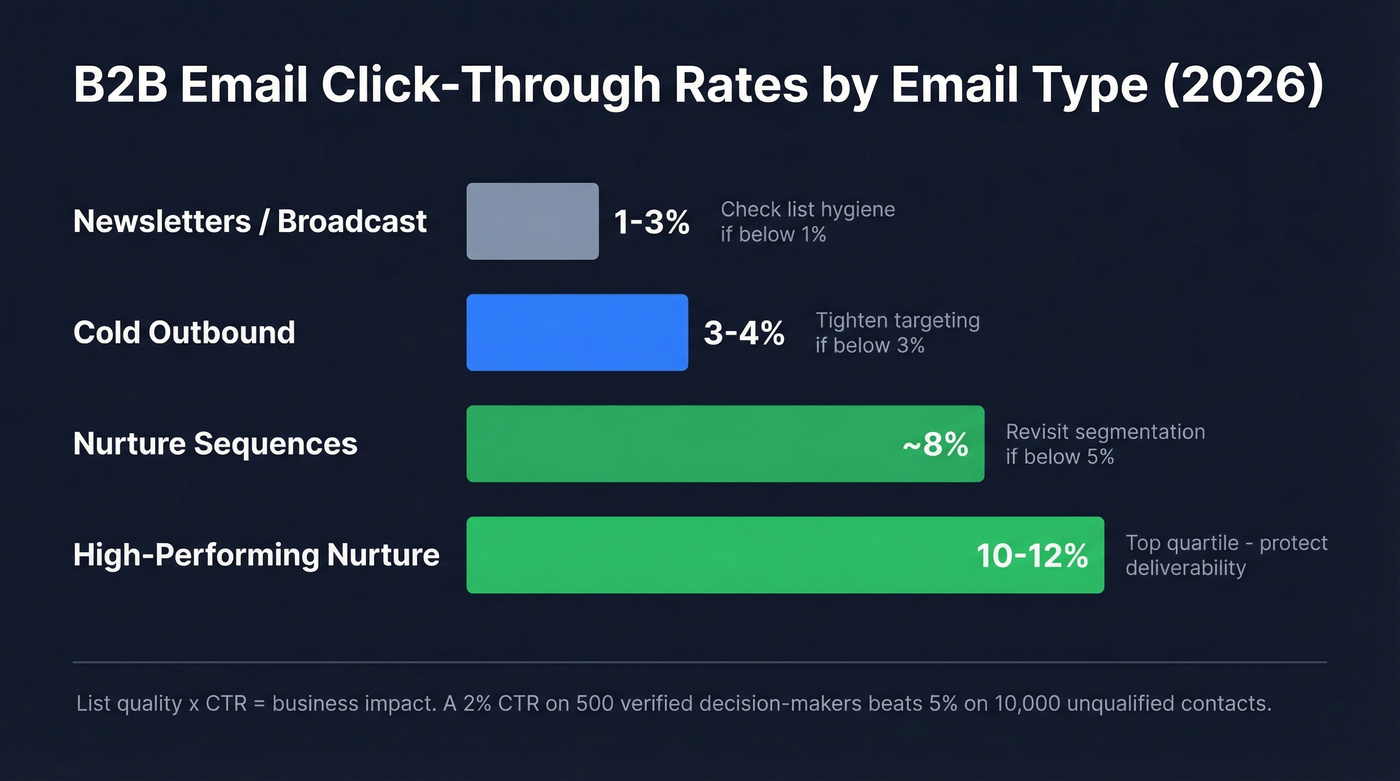
| Email Type | Typical CTR | If You're Below This |
|---|---|---|
| Newsletters / broadcast | ~1-3% | Check list hygiene and send frequency |
| Cold outbound | 3-4% | Tighten targeting or verify addresses |
| Nurture sequences | ~8% | Revisit segmentation and content relevance |
| High-performing nurture | 10-12% | You're in the top quartile - protect deliverability |
Here's the thing: a 2% CTR on 500 verified decision-makers generates more pipeline than 5% CTR on 10,000 unqualified contacts. List quality multiplied by CTR equals business impact. The math isn't complicated, but most teams ignore it.
Why Your CTR Number Might Be Wrong
Before you optimize anything, make sure you're measuring correctly. Brevo's methodology, drawn from 44B+ emails, defines CTR as unique clicks divided by unique emails delivered - not sent, not opened. The gap between your ESP's "delivery rate" of ~98% and actual inbox placement (84.3%, per Verified.email) means a meaningful chunk of your "delivered" emails never reach the inbox.
If you want to go deeper on definitions and reporting differences, see our guide to the click-through rate formula and how it’s calculated across tools.
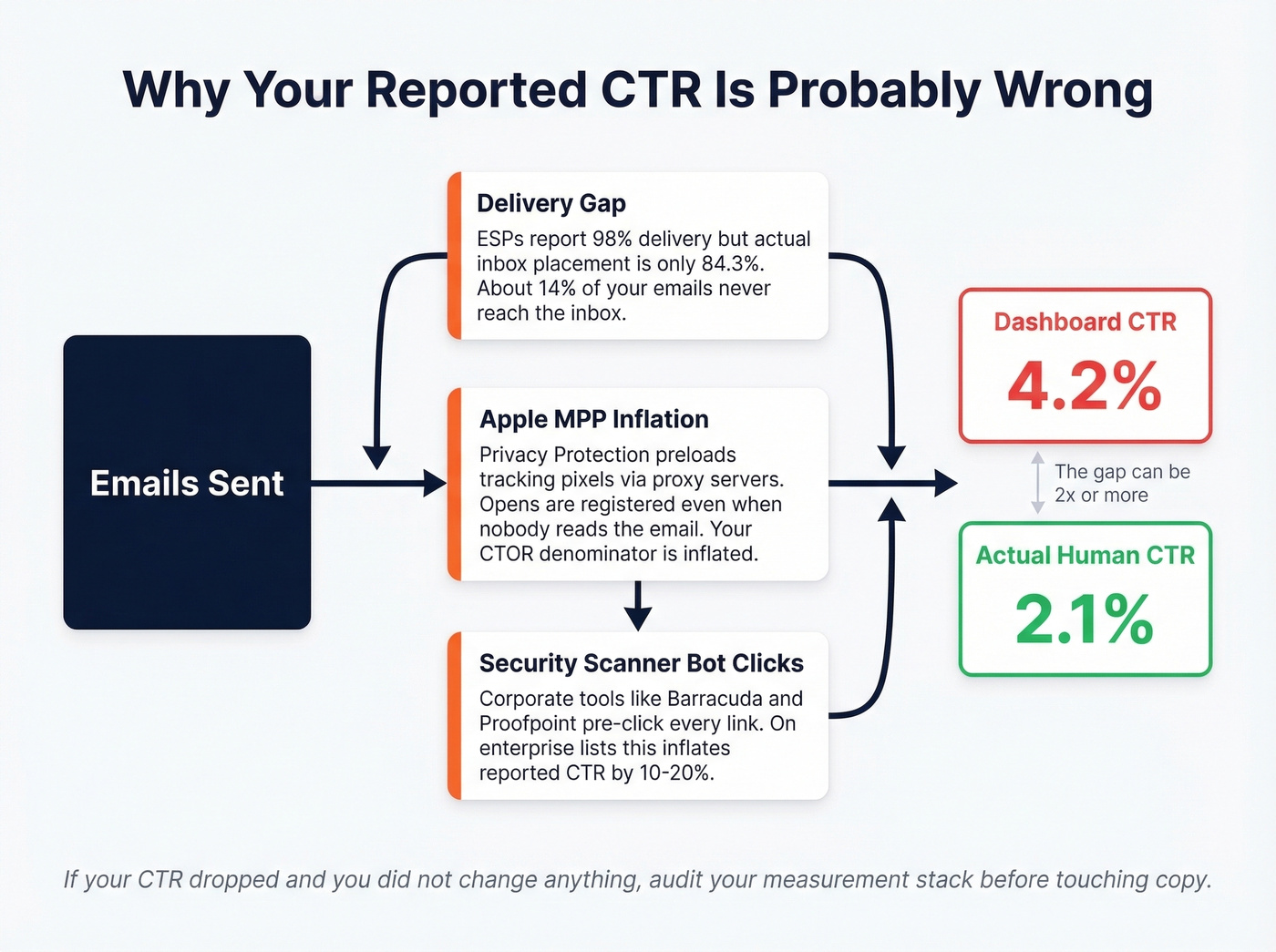
Apple Mail Privacy Protection makes it worse. MPP preloads tracking pixels via proxy servers, registering "opens" even when nobody reads the email. If you're calculating CTOR (clicks divided by opens), your denominator is inflated and your click-to-open rate looks worse than reality.
Bluecore's analysis of 153 retailers found iOS 18 dropped email click-throughs by up to 25% on high-iOS-exposure segments. That's a platform change, not a content problem.
Then there's the B2B-specific problem nobody talks about: corporate email security scanners. Tools like Barracuda, Proofpoint, and Mimecast pre-click every link in an email before delivering it to the inbox. On enterprise-heavy lists, this can inflate your reported CTR by 10-20%. Most ESPs now filter some of these bot clicks, but if your list skews toward large companies with strict IT policies, your "real" click rate is lower than your dashboard shows.
Belkins' experiment across 16.5M cold emails found that removing tracking pixels produced 3% higher response rates - meaning the act of measuring can itself suppress performance.
If your CTR dropped and you didn't change anything, the problem is almost certainly your measurement stack or deliverability - not your copy. Stop A/B testing subject lines and start auditing your infrastructure. A good place to start is an email deliverability guide and a quick check of your tracking domain setup.
Also worth monitoring: your email bounce rate and whether you need an email spam checker to catch issues before they compound.

Most CTR problems aren't copy problems - they're data problems. Prospeo's 5-step verification on a 7-day refresh cycle catches dead addresses, spam traps, and honeypots before they wreck your sender reputation. Snyk dropped bounce rates from 35% to under 5% and saw pipeline jump 180%.
Stop A/B testing subject lines. Start fixing your list.
Why B2B Click-Through Rates Drop
One Reddit poster targeting ~1,000 contacts in large pharma/healthcare watched CTR collapse from 3% to 0.4% over a few months. That pattern - gradual decay, not a cliff - usually points to list rot compounding into deliverability damage.
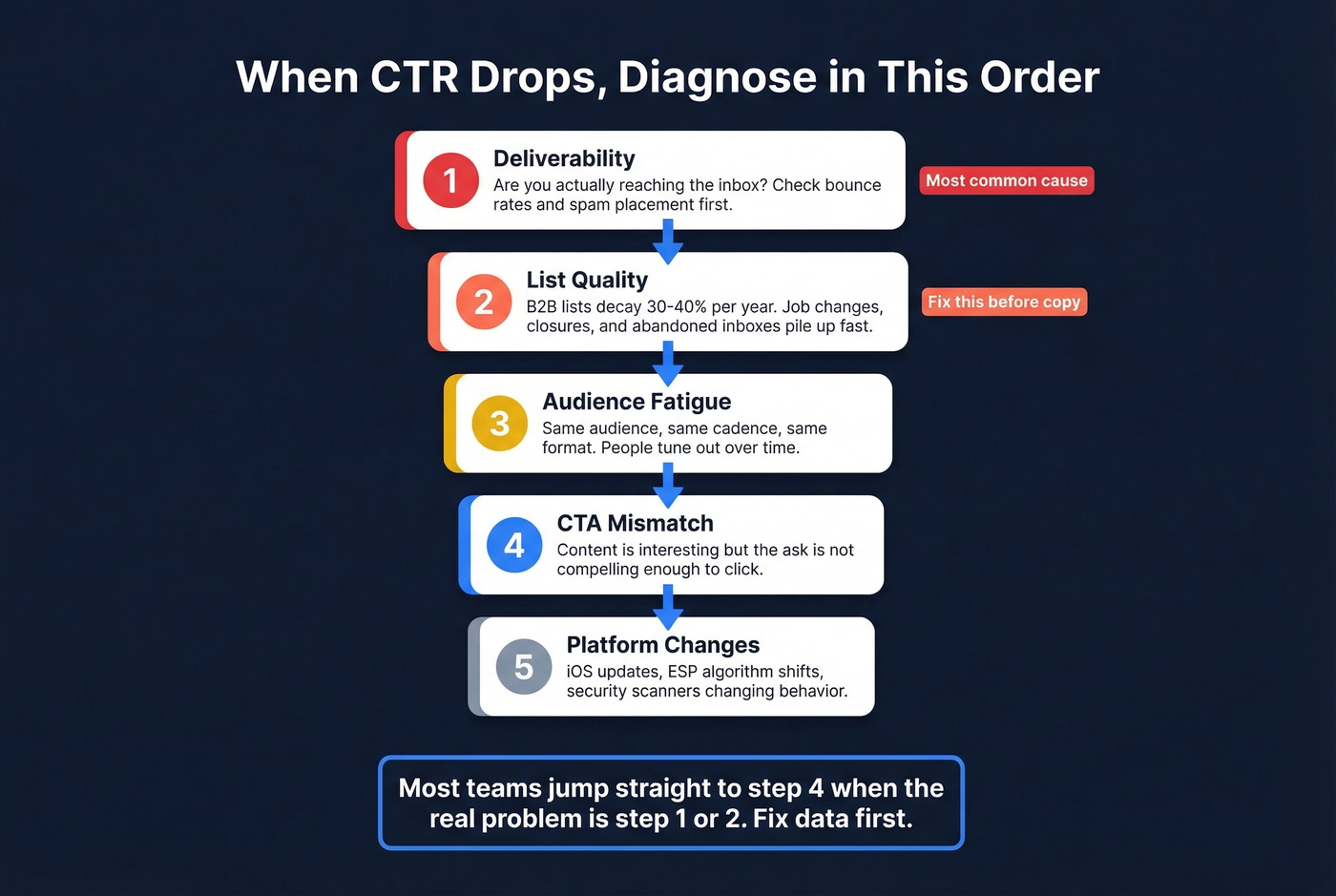
When your click rate drops, diagnose in this order:
- Deliverability - Are you actually reaching the inbox? Check bounce rates and spam placement.
- List quality - B2B lists decay 30-40% annually. Job changes, company closures, and abandoned inboxes pile up fast.
- Audience fatigue - Same audience, same cadence, same format. People tune out.
- CTA mismatch - Content is interesting but the ask isn't compelling.
- Platform changes - iOS updates, ESP algorithm shifts, security scanners.
Most teams jump straight to #4 when the real problem is #1 or #2. In our experience, teams that verify their lists before touching copy see the biggest CTR improvements by far. We've watched bounce rates go from 35% to under 5% and CTR double - without changing a single word of email copy.
If you’re doing cold outbound, it also helps to sanity-check your cold email sequence structure and your email velocity (too fast can tank inbox placement).
How to Actually Improve Your B2B Email Click Rate
Fix data first
If your bounce rate is above 5%, you don't have a content problem. You have a list quality problem. Sending to invalid addresses tanks sender reputation before your content gets a chance. Prospeo's 5-step verification on a 7-day refresh cycle catches dead addresses, spam traps, and honeypots before they hit your ESP. Snyk's team of 50 AEs dropped bounce rates from 35-40% to under 5%, and AE-sourced pipeline jumped 180%.
Shift broadcast to nurture
Nurture sequences pull ~8% CTR versus ~3% for standard emails. That's not marginal - it's nearly 3x. If you're blasting your entire list with the same newsletter, you're leaving clicks on the table. One CTA per email, one clear action, one reason to click.
If you do decide to test messaging, use proven email subject line examples and tighten your email call to action before you rewrite everything.
Segment ruthlessly
This is where the real gains live. A 50,000-person list with no segmentation will always underperform a 5,000-person segment showing buying signals. The teams we see hitting 10%+ CTR aren't writing better emails - they're sending to smaller, more relevant slices and layering intent data with engagement history.
If you need a framework for this, start with an ideal customer profile and then move into intent based segmentation.
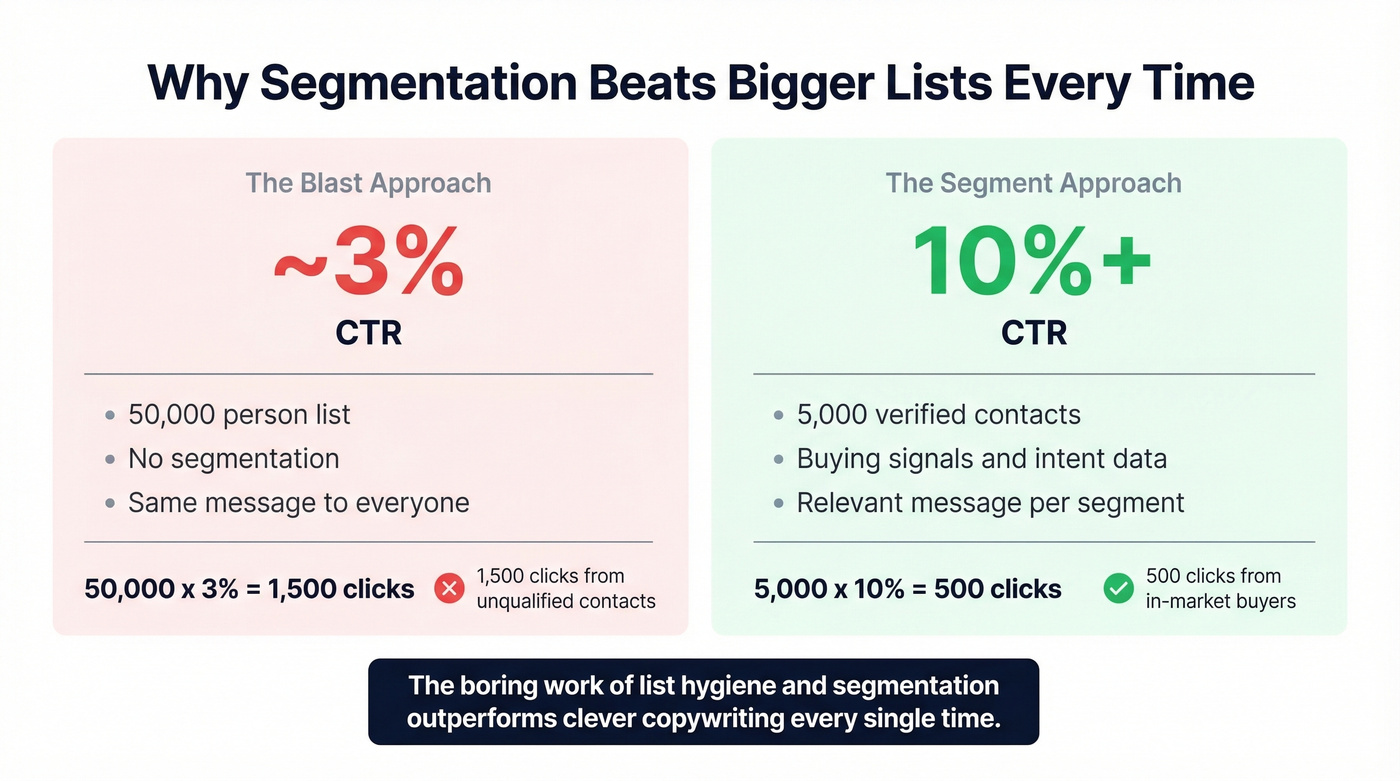
Let's be honest about something: the boring work of list hygiene and segmentation outperforms clever copywriting every single time. Skip this if you're looking for a quick subject-line hack. But if you want CTR that compounds month over month, clean your data, segment your audience, and then worry about copy.
Segmentation drives 3x higher CTR - but only if you're segmenting on accurate data. Prospeo layers 15,000 intent topics with 30+ filters so you send to buyers actually in-market, not a stale list of job titles. At $0.01 per verified email, clean data costs less than one wasted campaign.
Smaller, verified segments outperform massive blasts every time.
FAQ
What's a good B2B email click-through rate?
The average sits around 2-3% for broadcast and newsletters. Above ~5% puts you in the top quartile for most industries. Nurture sequences should target 8%+. Compare against your own email type and industry vertical before deciding something's broken - a 2% newsletter CTR and a 2% nurture CTR are very different problems.
What's the difference between CTR and CTOR?
CTR equals clicks divided by emails delivered. CTOR equals clicks divided by emails opened. CTOR isolates content and CTA performance from deliverability and subject line factors. Post-Apple MPP, CTOR is less reliable because "opens" are artificially inflated by pixel preloading - making CTR the more trustworthy metric for most B2B teams right now.
How do I know if low CTR is a data problem?
Check your bounce rate first. If it's above 5%, you're sending to bad addresses, damaging sender reputation, and reducing inbox placement - which drags performance down before your content even gets seen. Fix the list, then optimize the copy. That order matters.