

What Is an Upsell? Definition, Examples & Tips (2026)
An upsell is when you encourage a customer to buy a higher-tier, more expensive version of what they're already purchasing. The medium coffee becomes a large. The basic plan becomes the pro plan. The standard room becomes the suite. You're replacing the original choice with a better, pricier version of the same product or service - and that's what separates it from a cross-sell, which adds something complementary on top.
Here's the number that should get your attention: upselling and cross-selling together drive roughly 21% of company revenue across sales organizations. The single most important guardrail? Keep the upsell within 25% of the original purchase price.
What Upselling Means for Your Revenue
91% of sales professionals upsell, and 87% cross-sell. That's nearly universal practice - not something you can opt out of and stay competitive.
Acquiring a new customer costs 5-6x more than retaining one. Every dollar from a current customer relationship is dramatically more efficient than chasing a cold prospect. Well-executed upsells lift revenue 10-30% per transaction, depending on industry and execution. If you're not upselling, you're leaving the cheapest revenue on the table.
Upsell vs. Cross-Sell vs. Downsell
These terms get thrown around interchangeably, and they shouldn't. Each serves a different purpose at a different moment. (If you want the deeper breakdown, see Cross Selling vs Upselling.)
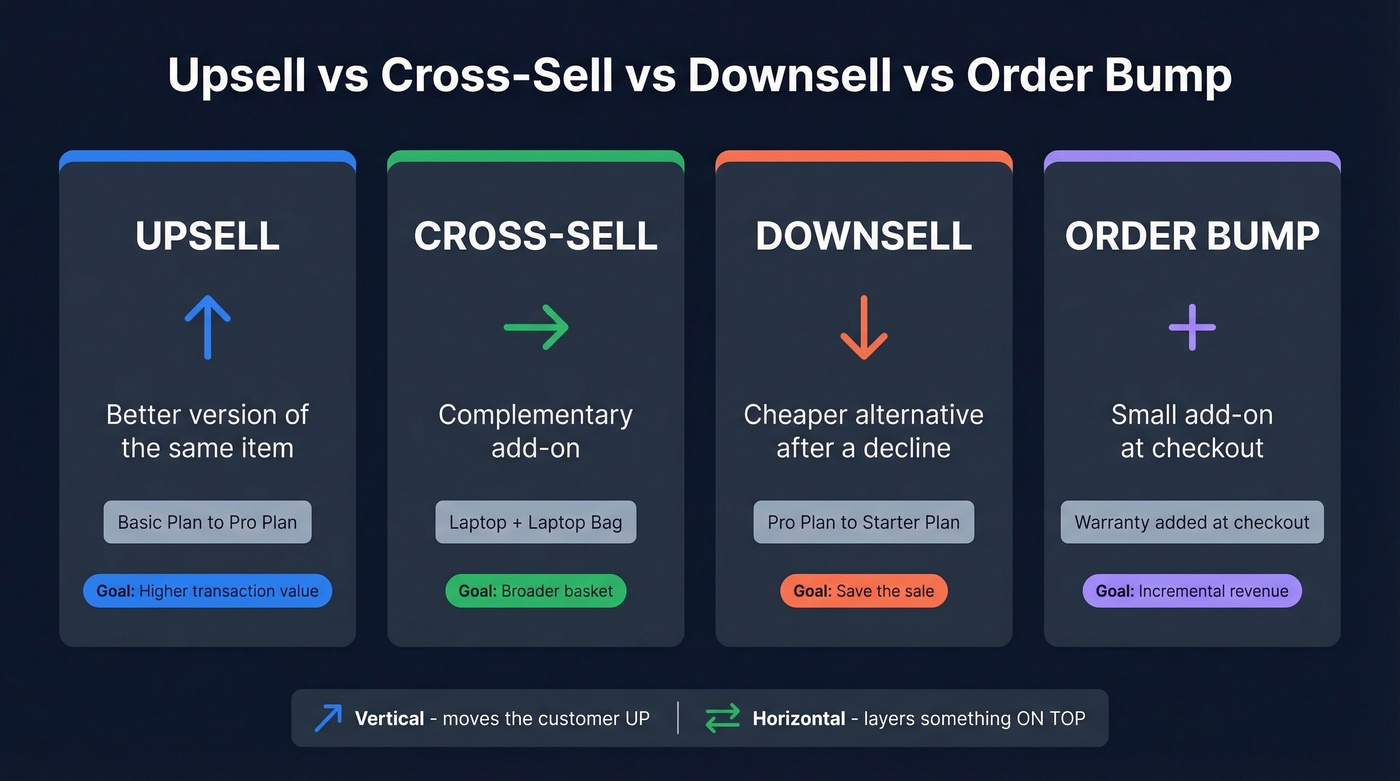
| Upsell | Cross-Sell | Downsell | Order Bump | |
|---|---|---|---|---|
| Definition | Better version of same item | Complementary add-on | Cheaper alternative | Small add-on at checkout |
| Example | Basic to Pro plan | Laptop to laptop bag | Pro to Starter plan | Warranty at checkout |
| Timing | Before purchase completes | During or after purchase | After a declined offer | At the checkout page |
| Goal | Higher transaction value | Broader basket | Save the sale | Incremental revenue |
Think of it as vertical versus horizontal. Upsells move the customer up - swapping one thing for a better version. Cross-sells and order bumps move them across - layering something on top of the original purchase. Downsells are your safety net when the customer balks at the price.
Timing matters more than most teams realize. 58% of pipeline stalls happen when reps fail to add value during the conversation. An upsell at the right moment feels like a helpful recommendation. The same offer at the wrong moment feels like a shakedown. (More on this in How to Add Value in Sales.)
The Psychology Behind Upselling
Upselling works because it taps into predictable cognitive patterns. Five matter most:
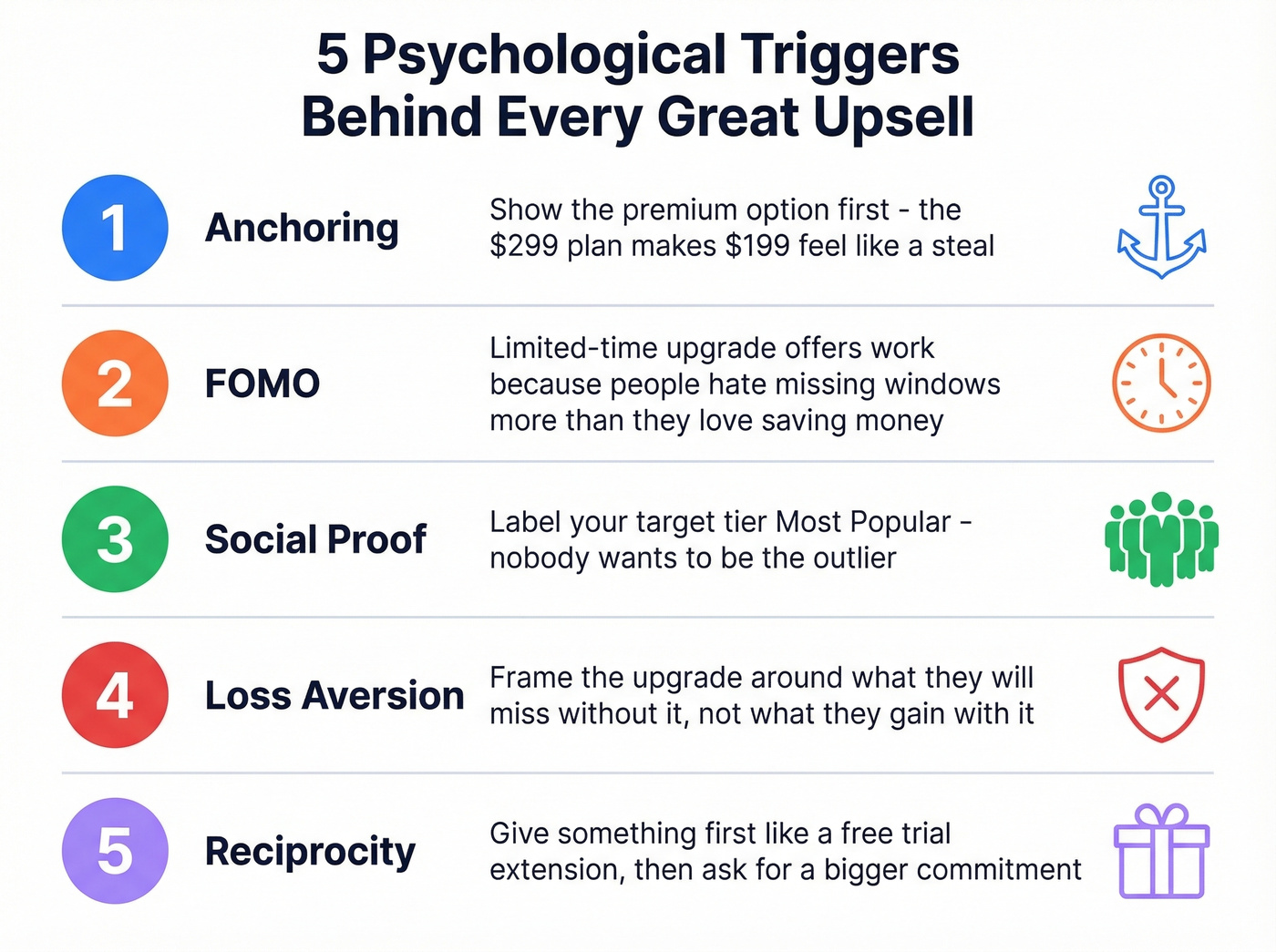
Anchoring. Show the premium option first. Once a customer sees the $299 plan, the $199 plan feels like a deal - even if they planned to spend $99.
FOMO. Limited-time upgrade offers create urgency. "Upgrade to annual billing in the next 48 hours and save 30%" works because people hate missing windows more than they love saving money.
Social proof. Label your target tier "Most Popular." That single label shifts selection rates measurably because nobody wants to be the outlier.
Loss aversion. Frame the upgrade around what they'll miss without it. "Without Pro, you lose access to analytics after your trial" hits harder than "Pro includes analytics."
Reciprocity. Give something first - a free trial extension, a bonus feature unlock - and the customer feels compelled to reciprocate with a larger commitment.

Personalized upsells depend on knowing your customers' growth signals. Prospeo enriches your CRM with 50+ data points per contact and tracks 15,000 intent topics - so you spot headcount growth, funding rounds, and tech-stack changes before your next upsell conversation.
Stop guessing when to upsell. Start using real buyer signals.
Real-World Upselling Examples
SaaS
Spotify's upsell is one of the cleanest in the business. When free users hit the skip limit, the prompt doesn't say "you've been restricted." It says "you discovered a Premium feature." That reframe - from restriction to discovery - turns frustration into curiosity.
Airtable pairs in-app upgrade prompts with email campaigns that catch users outside the product. Squarespace gates integrations behind higher tiers and uses soft "learn more" prompts instead of aggressive CTAs. The pattern across all three: the offer appears at the exact moment the user bumps into a limitation.
SaaS upsell conversion rates run 8-20% for freemium users, and the average SaaS business generates 16% of its new ACV from upselling. Track your freemium-to-paid rate monthly - that benchmark gives you a clear target. (Related: SaaS Sales.)
Ecommerce
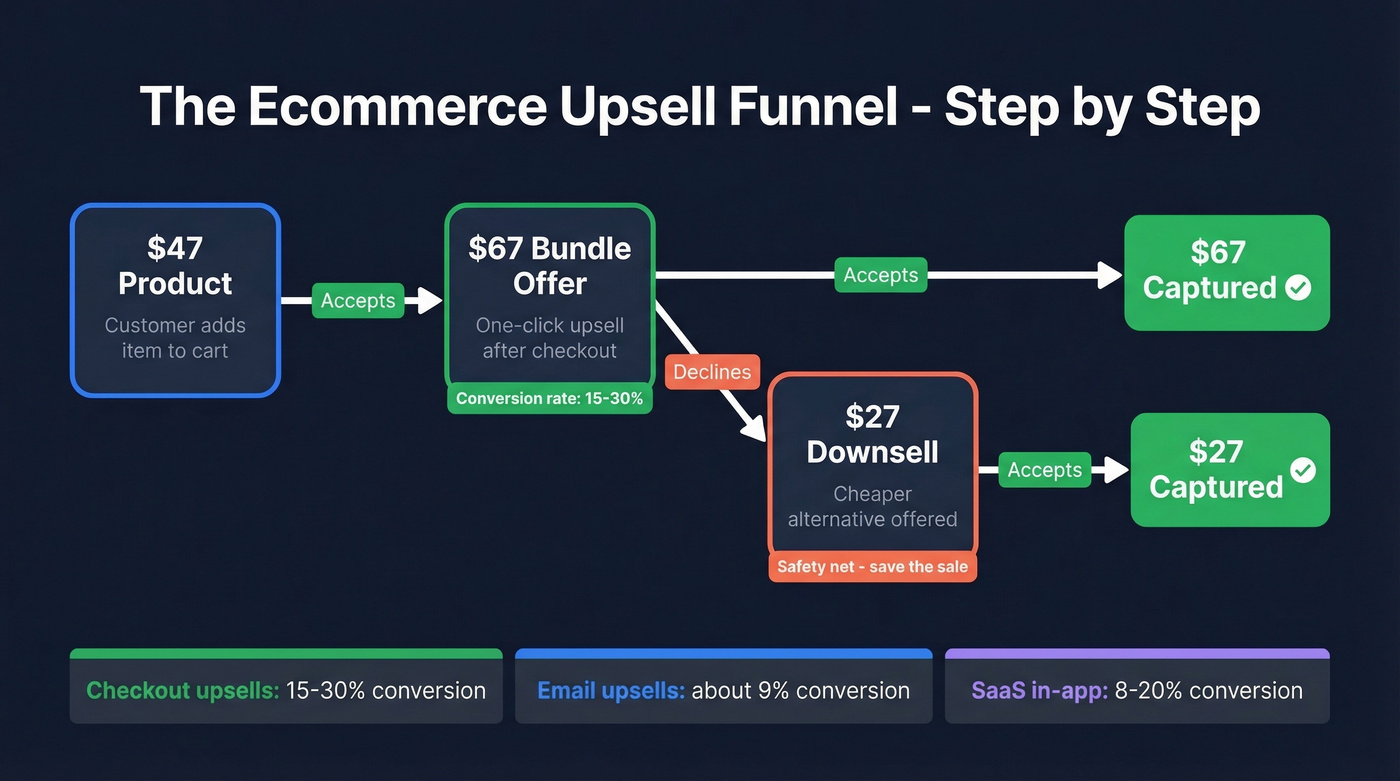
Checkout upsells convert at roughly 15-30%. The friction is nearly zero: the customer has already entered payment info, and accepting is one tap. Email upsell campaigns sit around 9%.
A strong ecommerce flow looks like this: $47 product at checkout, then a $67 bundle offer as a one-click upsell, then a $27 downsell if they decline. Each step captures a different willingness-to-pay segment. Linktree frames its Pro upgrade as a gift - "Try Linktree Pro on us." Athletic Greens stacks explicit value - "$20 monthly savings plus a welcome freebie." What works in every case: quantifying the gap between what the customer chose and what they're missing. (If you’re running these offers via email, see Email Copywriting.)
Restaurants & Hospitality
The best restaurant upsell we've come across? A server who name-drops a specific dessert as their personal favorite - "the chocolate torte is honestly the best thing on the menu." It plants the idea without any sales pressure. The customer feels like they got an insider recommendation, not a pitch. The consensus on r/sales and r/restaurateur backs this up: personal recommendations from staff outperform scripted upsells every time.
Digital ordering platforms have systematized this with decoy pricing, food photography, and "Most popular choice today" nudges, driving 10-30% revenue lifts per transaction.
Upselling Best Practices
Stay within 25% of the original price. A $100 purchase? Your upsell ceiling is $125. Go higher and you trigger sticker shock instead of an easy yes.
Limit options to two or three. More choices create decision paralysis. One recommended upgrade and one premium tier is the sweet spot. According to Hick's Law research, every additional option increases decision time logarithmically - and in a checkout flow, time is the enemy.
Personalize based on behavior, not assumptions. The best upsells fire when the customer hits usage limits, browses premium features, or expands their team. You can't personalize if you don't know the customer's growth trajectory - tools like Prospeo help here by enriching CRM records with 50+ data points and tracking 15,000 intent topics, so upsell timing is based on signals like headcount growth and tech-stack changes rather than calendar reminders. (More on this: Lead Enrichment and Data Enrichment Services.)
Let's be honest: if your average contract value is under $5k, you don't need a complex upsell engine. A single well-timed email triggered by a usage threshold will outperform any AI-powered recommendation system. Sophistication is overrated at low ACVs.
Frame every upsell as a recommendation, not a pitch. "Based on your usage, most teams like yours upgrade to Pro at this point" converts. "Would you like to upgrade for just $49 more?" doesn't. Time the offer to peak intent - the moment after a customer commits to buying but before checkout completes is the highest-conversion window. (If you need messaging ideas, start with Talk Track Examples.)
And A/B test everything. Offer copy, placement, timing, price gap. Most teams launch an upsell and never iterate. The ones that test systematically see compounding gains over quarters, which VWO's case study library documents extensively.
Mistakes That Kill Conversions
The #1 reason upsells fail isn't that you asked. It's that you asked for the wrong thing at the wrong time.
| Mistake | Fix |
|---|---|
| Not understanding the customer | Segment offers by usage pattern and customer profile |
| Being too aggressive | One well-timed suggestion beats three popups. If dismissed, back off. |
| Recommending the wrong product | The upgrade must logically extend what they already chose |
| Skipping A/B tests | Your first offer is almost never your best - test before scaling |
| Bad timing | Don't interrupt the buying flow. Best window: after decision, before checkout |
| Not providing enough value | If you can't explain the upgrade's worth in one sentence, the offer isn't ready |
Skip the upsell entirely if the customer just had a support issue or complained about pricing. Pushing an upgrade on a frustrated customer doesn't just fail - it accelerates churn. (See Churn Analysis.)
One legal note: in many markets, upsells must be clearly optional, with transparent pricing and an easy way to decline. If you sell internationally, make sure your flows include clear opt-in language and easy decline paths. The FTC's guidance on negative option marketing is worth reading if you're in the US.
How to Measure Upsell Performance
Four KPIs to track. Anything else is noise.
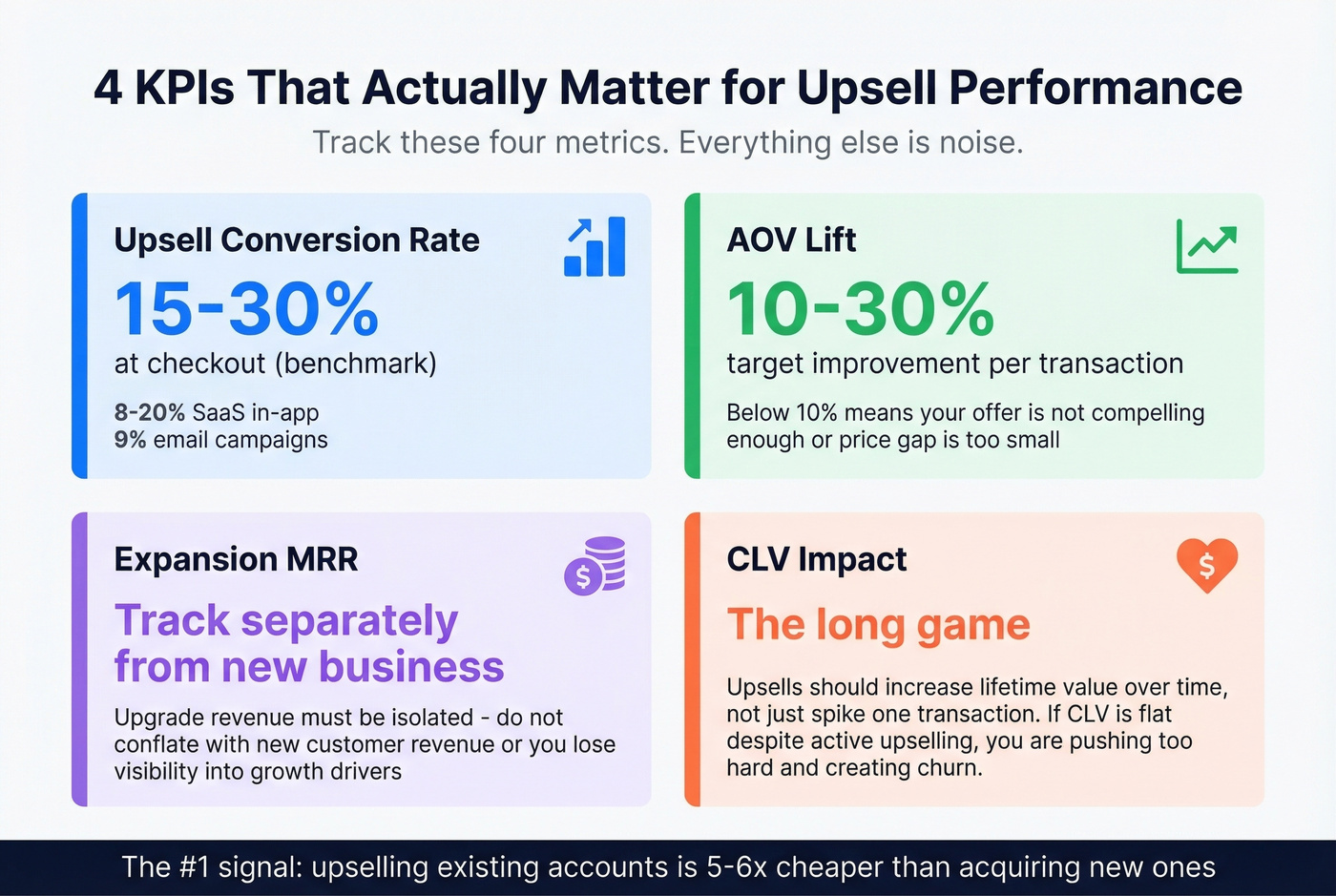
Upsell conversion rate tells you whether your offers resonate. Benchmarks: 15-30% at checkout, 8-20% for SaaS in-app prompts, around 9% for email campaigns. (Related benchmarks: Sales Conversion Rate.)
AOV lift measures the revenue impact per transaction. Target 10-30% improvement after implementation. If you're below 10%, your offer isn't compelling enough or your price gap is too small.
Expansion MRR is the clearest signal of upsell health in subscription businesses. Track upgrade revenue separately from new business - we've seen teams conflate the two and completely lose visibility into what's actually driving growth.
CLV impact is the long game. Upsells should increase lifetime value over time, not just spike a single transaction. If CLV is flat despite active upselling, you're pushing too hard and creating churn downstream.
Upselling existing accounts is 5-6x cheaper than acquiring new ones - but only if you can reach the right decision-maker. Prospeo gives you 98% accurate emails and 125M+ verified mobile numbers so your expansion plays actually land.
Reach the buyers behind your best upsell opportunities for $0.01 per email.
FAQ
Is upselling ethical?
Yes - when the upgrade genuinely improves the customer's outcome. If the customer would thank you for the suggestion after using the product, it's ethical. If they'd feel tricked, it's not. The best upsells create value for both sides, and in regulated markets, transparency about pricing and opt-out options is legally required.
What does upsell mean in simple terms?
It means offering a customer a better, more expensive version of the product or service they're already buying. You're upgrading their existing choice, not adding something new alongside it. A barista suggesting a large instead of a medium is an upsell; suggesting a muffin with the coffee is a cross-sell.
What's a good upsell conversion rate?
Checkout upsells convert at 15-30%. SaaS in-app upsells hit 8-20% for freemium users. Email campaigns average about 9%. If you're below these ranges, test your timing, offer relevance, and price gap - those three variables account for most of the variance.
How do you identify which customers to upsell?
Look for usage signals like hitting plan limits or frequent feature use, growth signals like headcount increases or new funding, and intent signals like researching solutions in your category. The key is acting on real behavior rather than guesswork - whether that's through your CRM's native analytics, a dedicated intent data provider, or enrichment tools that surface these signals automatically.