

What Is Cold Calling in Marketing - And Why Marketers Should Care
Ask a room full of marketers how they feel about cold calling and you'll get eye rolls. Entrepreneurs swear by it; marketing professionals dismiss it as a relic. The truth is more interesting - and more profitable - than either camp admits.
So what is cold calling in marketing? It's proactive phone outreach to prospects with no prior relationship, deployed inside marketing funnels rather than just by lone-wolf sales reps. Cognism's WHAM data shows a 4.82% conversation-to-meeting rate, which is far better than the "2% success rate" people love to quote. It fails when data is bad - reps lose 27.3% of their calling time to wrong numbers and dead lines. Combine it with inbound signals and email sequences, though, and you've got one of the most cost-effective demand gen channels available.
Cold Calling in Marketing, Defined
At its simplest: unsolicited phone outreach to prospects who haven't interacted with your company. No prior relationship, no warm introduction, no inbound form fill.
In a marketing context, this tactic becomes a demand gen channel. Marketing teams deploy it inside outbound funnels, ABM campaigns (/s/abm-goals), and agency client acquisition programs. The SDR picks up the phone because marketing identified the account, built the list, and decided this prospect was worth a call. That distinction matters. 68% of marketers say outbound produces the best quality leads for their sales team, and phone outreach is one of the most effective outbound channels when it's treated as part of the marketing motion - not something sales does on their own in a corner.
Cold Calling vs. Warm Calling
| Cold Calling | Warm Calling | |
|---|---|---|
| Definition | No prior contact or engagement | Prospect has engaged before |
| Prospect awareness | Doesn't know you exist | Engaged with content or email |
| Typical use case | New pipeline, ABM outreach | Inbound follow-up, re-engagement |
| Conversion expectation | Lower per-dial, higher volume | Higher per-dial, lower volume |
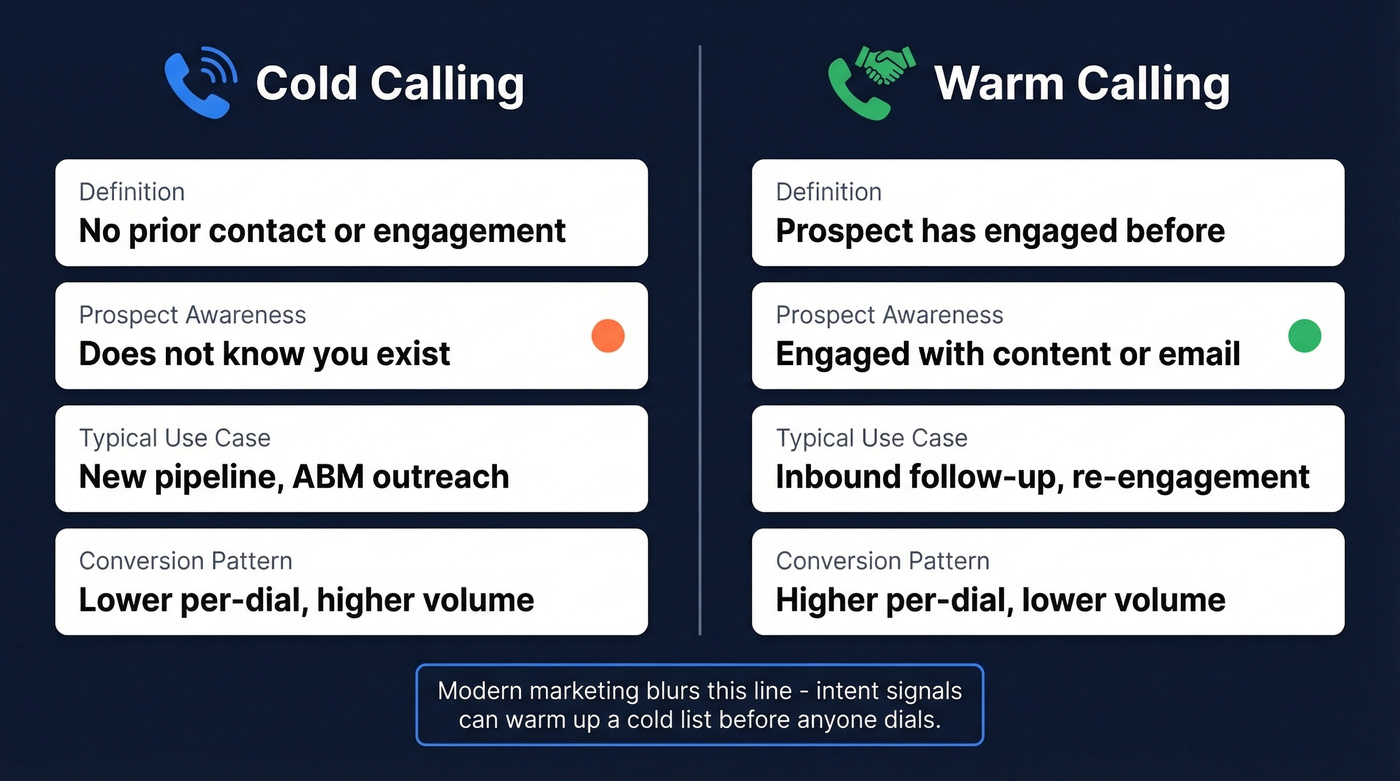
Modern marketing blurs this line constantly. When you use intent signals to prioritize a "cold" list, you're warming up the call before anyone dials. The prospect hasn't engaged with you, but they've been researching your category. That's not really cold anymore. (If you want the full breakdown, see Cold Calls vs Warm Calls.)
Is Cold Calling Dead? 2026 Data Says No
The "cold calling is dead" narrative gets recycled every year. The data tells a different story.
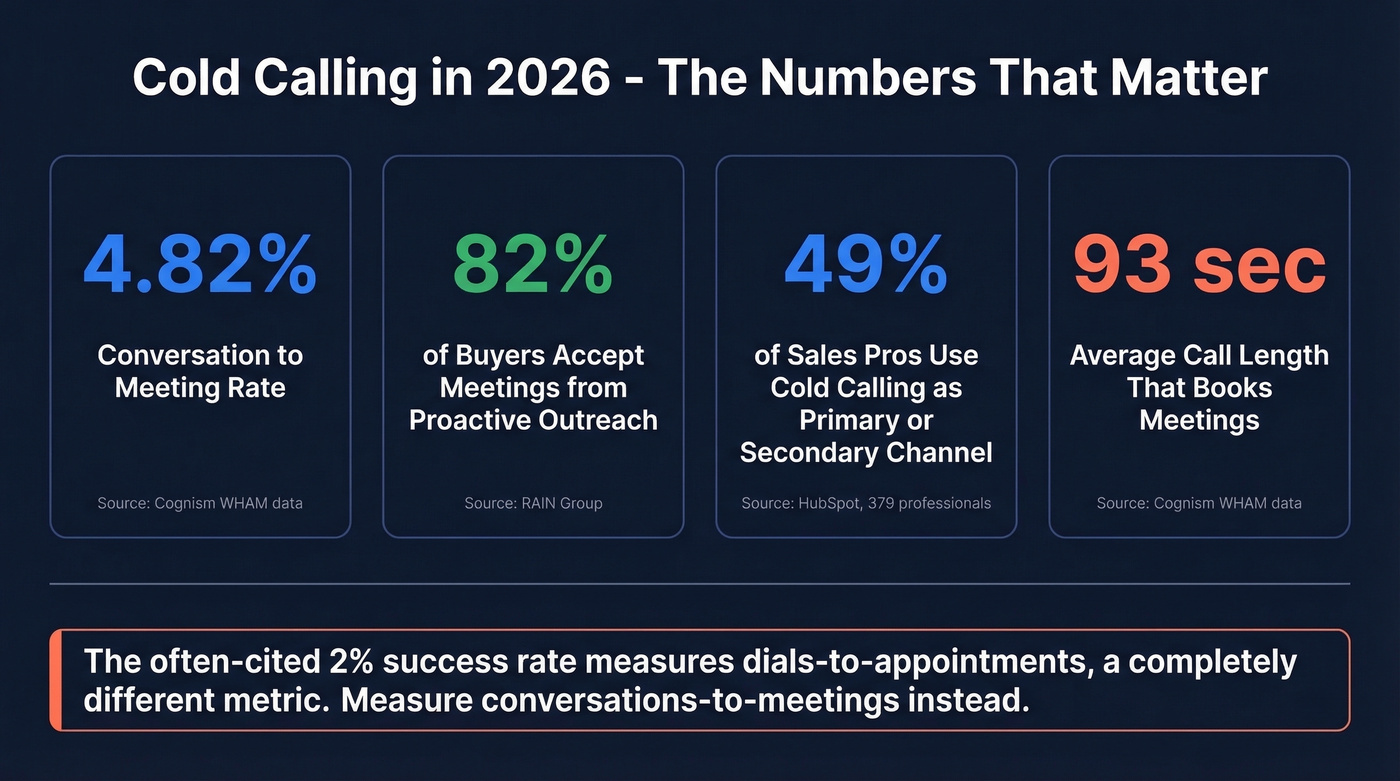
HubSpot's report on 379 sales professionals found that 49% use cold calling as a primary or secondary channel. Only 12% have moved away from it entirely. And 82% of buyers accept meetings from proactive outreach, according to RAIN Group - that's not a dying tactic, that's a mainstream one with staying power that most marketers underestimate because they've never run it properly. (More data: Is Cold Calling Dead in 2026?.)
Cognism's WHAM dataset puts the conversation-to-meeting rate at 4.82%, with an average call length of 93 seconds. The often-cited "2% success rate" measures dials-to-appointments - a completely different metric that makes the channel look worse than it is.
Here's the thing: a marketing agency owner on r/marketing reported landing roughly 23 clients from 300 cold calls in two months, outperforming both Google Ads and lead marketplaces like Thumbtack. That's what happens when outbound phone outreach gets treated as a real channel with proper targeting rather than a random numbers game.
Where It Fits in the Marketing Funnel
Cold calling is most powerful when it plugs into your existing marketing infrastructure:
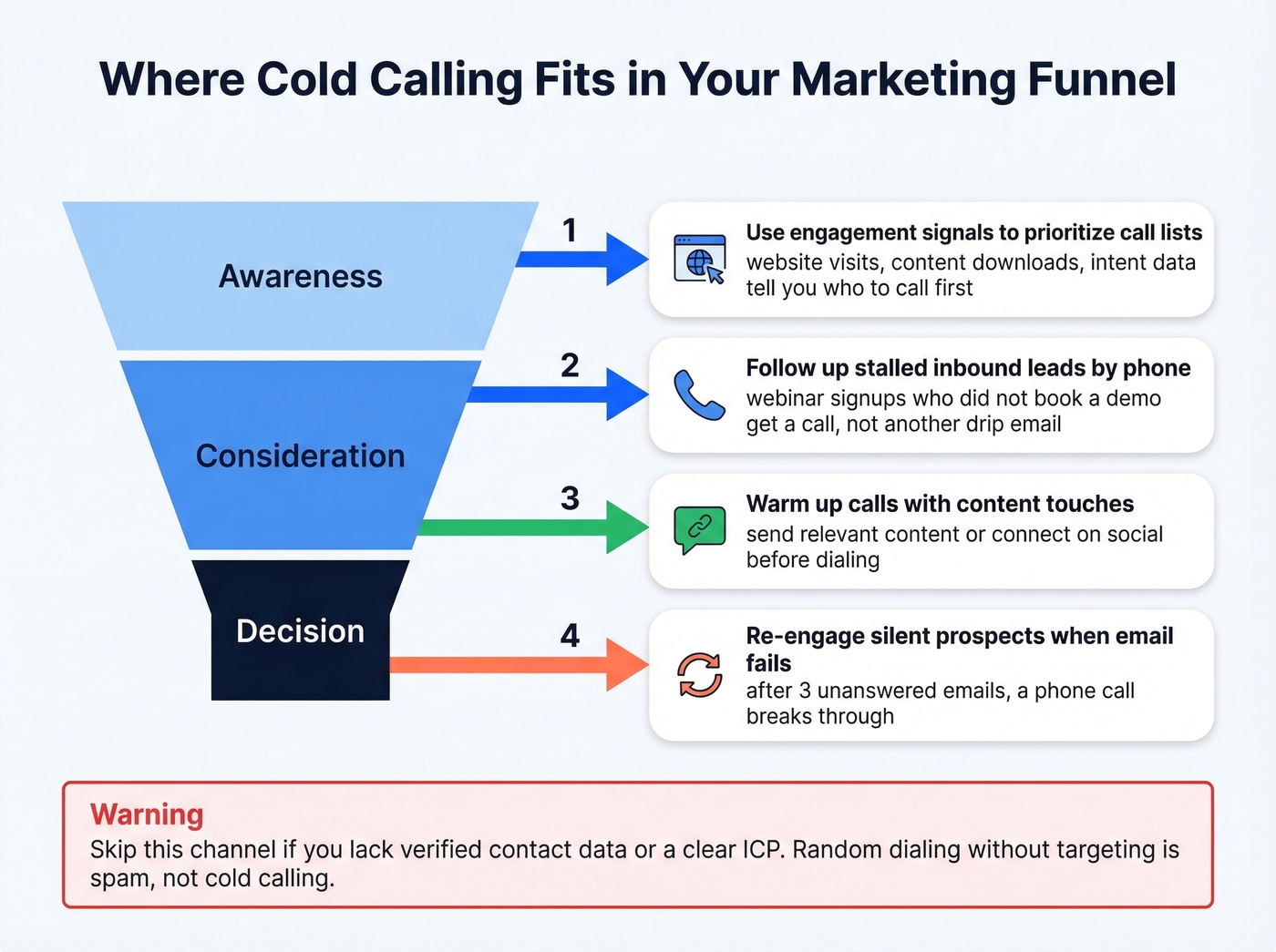
- Use engagement signals to prioritize call lists. Website visits, content downloads, and intent data tell you who's actively researching. Those prospects get called first.
- Follow up on stalled inbound leads by phone. Someone signed up for your webinar but didn't book a demo? That's a phone call, not another drip email. (Related: follow up.)
- Warm up calls with content touches before dialing. Send a relevant piece of content or connect on social first. The call lands differently when they've seen your name.
- Re-engage silent prospects when email fails. After three unanswered emails, a phone call breaks through in a way another email never will. (See cold calling with email.)
Skip this channel if you don't have verified contact data or a clear ICP. Dialing random numbers without targeting isn't cold calling - it's spam, and it'll burn your team out fast. (Use a cold call checklist to keep the motion tight.)

Your cold calling program is only as good as your data. Prospeo gives you 125M+ verified mobile numbers refreshed every 7 days - not the 6-week-old lists that waste 27% of your reps' dial time. Use 30+ filters to build targeted call lists by role, intent signals, and company size.
Stop dialing dead numbers. Start booking meetings.
Best Practices for Marketing Teams
Research Before You Dial
Spend 3-5 minutes per prospect before calling. Review their company, role, recent activity, and any signals from your CRM. Feed a prospect's company news and recent job postings into an AI summary prompt, and you'll walk into the call with context most reps never have. (More on call prep.)
We've seen teams double their connect-to-meeting rate just by adding this prep step. It's the cheapest improvement you can make.
Nail the First 10 Seconds
Skip "Is this Bob?" - it triggers defensiveness immediately. Use an assumptive opener: "Hi Bob, this is [Name] from [Company]. I noticed [specific trigger] and wanted to ask a quick question." Don't ask "Did I catch you at a good time?" - that decreases meeting chances by 40%. (If you need options, start with opening lines.)
Explaining why you're calling yields 2.1x higher success rates. Aim for a 40/60 talk-to-listen ratio. You should be listening more than speaking, and you're selling the meeting, not the product. A 93-second call that books a demo beats a 10-minute monologue every time. (See cold calling script examples.)
Timing and Cadence
Tuesday is the best day to cold call, per Cognism's data. Best windows run Tue-Thu, 10-11 AM and 2-4 PM in the prospect's time zone. In our experience, teams that nail the time-zone math consistently outperform those who batch-dial without thinking about it. (More: best time to cold call.)
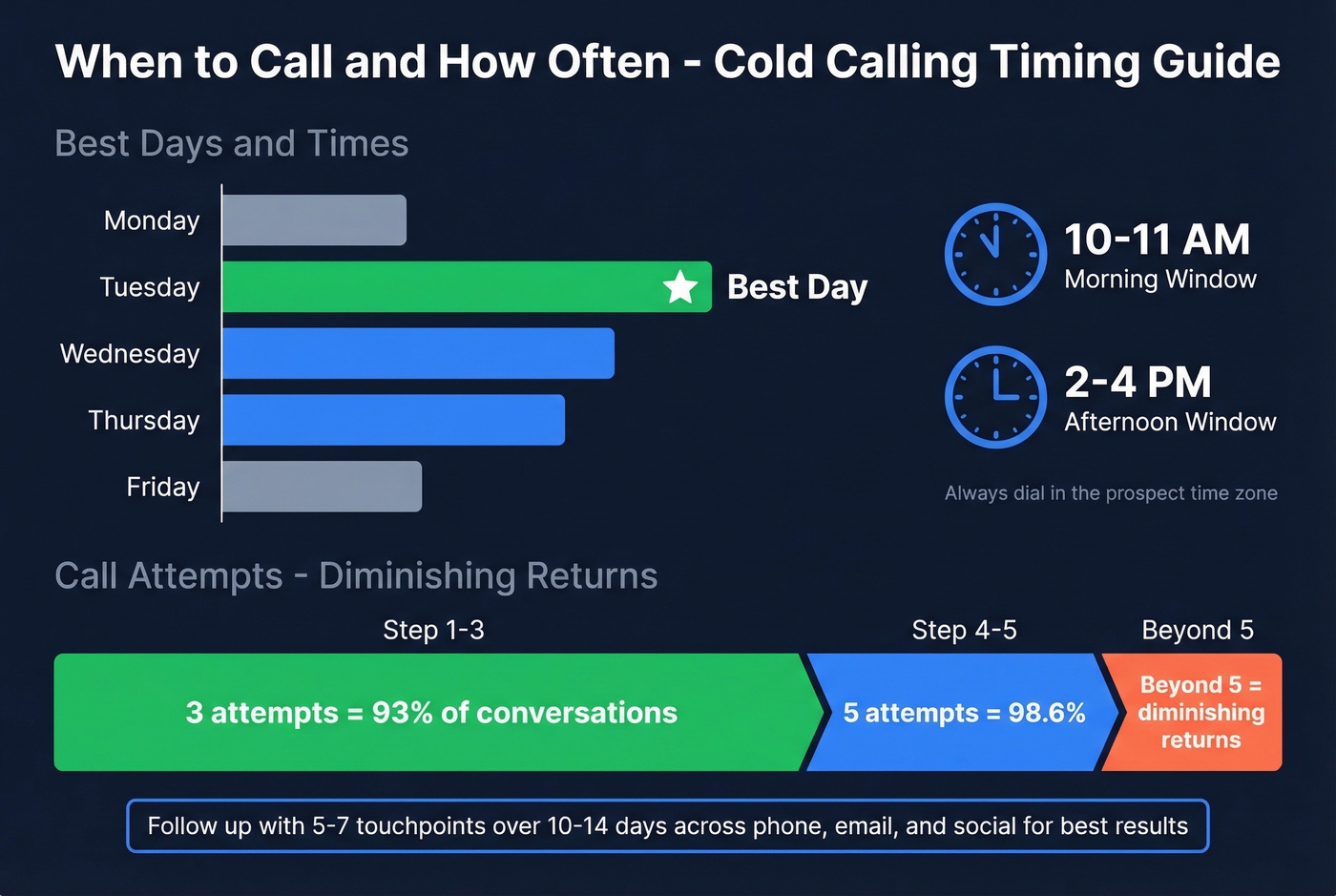
Three call attempts capture 93% of total conversations. Five attempts get you to 98.6% - beyond that, you're chasing diminishing returns. Follow up with 5-7 touchpoints over 10-14 days across phone, email, and social. The multi-channel cadence is what separates marketing-driven outbound from random dialing.
The Data Problem Nobody Talks About
Let's be honest: most cold calling programs don't have a technique problem. They have a data problem. No amount of script optimization fixes a list full of dead numbers. (If you're auditing your stack, start with data quality.)
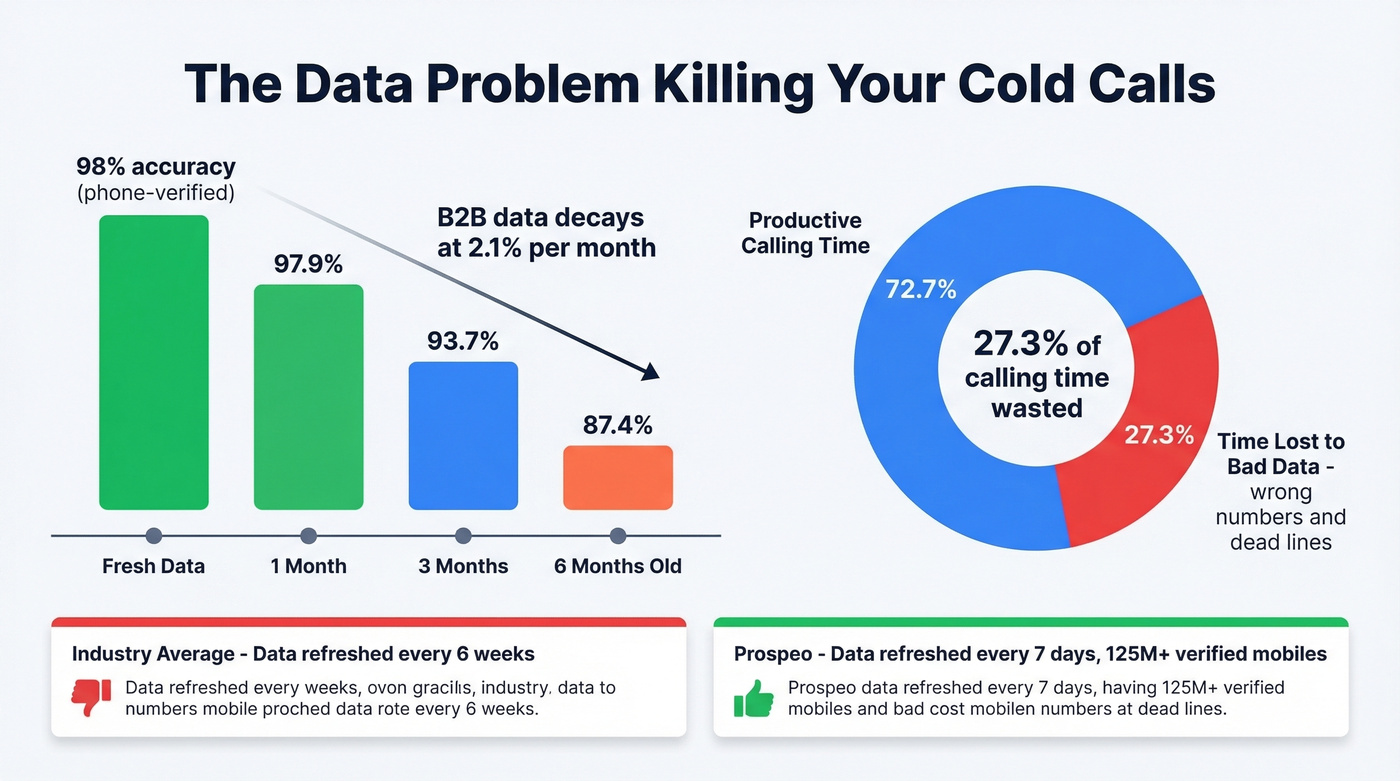
Reps lose 27.3% of their calling time to bad contact data. B2B data decays at roughly 2.1% per month, which means a six-month-old list has lost 12%+ of its accuracy. Phone-verified mobile numbers hit 87% accuracy; AI verification pushes that to 98%.
Before your team dials, make sure those numbers are real. Prospeo's database covers 125M+ verified mobile numbers refreshed on a 7-day cycle - compared to the 6-week industry average - with 30+ search filters to build targeted call lists by role, industry, and company size. (Need the process? How to build a cold calling list.)

Reps who combine cold calls with email sequences book 35% more meetings. Prospeo's database pairs 125M+ verified mobiles with 143M+ emails at 98% accuracy - so your multi-channel cadence actually reaches real buyers, not voicemails and bounced inboxes.
Build the multi-channel call list your outbound deserves.
Compliance Essentials for 2026
Real talk: compliance isn't optional, and the penalties are getting steeper.
- TCPA calling window: 8 AM-9 PM in the recipient's local time zone
- TCPA penalties: $500 per violation, up to $1,500 for willful violations
- DNC fines: up to $53,088 per violation, adjusted for inflation
- Revocation rules: consumers can revoke consent via any reasonable method; you must honor it within 10 business days
- AI-generated voices trigger the same consent requirements as robocalls
- TCPA class actions are up 95% year-over-year
For EU/UK campaigns, GDPR and PECR rules apply separately - consult legal counsel before dialing internationally. Don't assume B2B means you're exempt; many "business" mobile numbers are personal lines treated as consumer contacts under TCPA.
Cold Calling in Marketing FAQ
Is cold calling considered marketing or sales?
Both. Marketing teams use it inside outbound funnels, ABM campaigns, and demand gen programs. The line between marketing and sales outbound is increasingly blurry, especially when intent data identifies high-value accounts that haven't engaged digitally yet.
What's a good cold calling success rate?
Cognism's WHAM data shows a 4.82% conversation-to-meeting rate. The often-cited "2% success rate" measures dials-to-appointments, which includes calls that never reach a human. Benchmark against conversations-to-meetings instead - anything above 4% is solid.
How do you build a cold call list with accurate numbers?
Use a verified B2B database with mobile numbers refreshed regularly. Stale data is the single biggest killer of cold calling ROI, so prioritize providers that verify numbers weekly rather than monthly.
Does cold calling still work for small marketing teams?
Yes. That solo agency owner on Reddit reported 23 clients from 300 calls in two months - outperforming paid ads. Small teams benefit most because phone outreach requires minimal budget, just accurate data and a clear script. Start with 20-30 targeted dials per day and iterate from there.