

What Is Drip Email Marketing? The Data-Backed Guide for 2026
In one 11-brand eCommerce portfolio analysis, automated email flows generated 22x more revenue per recipient than one-off campaigns. That's $0.94 per recipient vs $0.04, measured across 7.5 million emails in February 2026. So what is drip email marketing, exactly? It's a series of automated emails triggered by a specific action and sent on a preset schedule - and it's the reason that revenue gap exists.
If you're still sending batch-and-blast campaigns and wondering why conversions are flat, this is the fix.
What You Need to Get Started
Three things:
- A clear goal. Welcome new subscribers? Recover abandoned carts? Pick one sequence and nail it before building ten.
- A verified contact list. Bad emails mean bounces, bounces tank your sender reputation, and a tanked reputation means your drip never reaches an inbox.
- An automation platform. Klaviyo, ActiveCampaign, Brevo - the tool matters less than the data feeding it.
Drip Email Marketing Defined
Think of it like irrigation. Instead of flooding a field once and hoping something grows, you deliver small, consistent amounts of water exactly where it's needed. A drip email sequence works the same way - a pre-planned series of messages delivered over days or weeks, each one building on the last.
You've probably heard of the "Law of 29," the idea that prospects need 29 exposures before they buy. There's no credible research behind that number. In practice, 3-7 well-timed, relevant emails outperform a rigid 29-touch sequence every time. Volume isn't what drives results. Timing and relevance are.
A drip campaign can be as simple as a three-email welcome series or as complex as a multi-branch onboarding flow. The defining characteristic is automation - you build it once, set the triggers, and let it run. One critical design principle worth remembering: write each email so it stands alone. Recipients skip messages, get distracted, or read them out of order. If email #4 only makes sense after reading emails #1 through #3, you've built a sequence that breaks the moment someone misses one.
Drip Campaigns vs. Nurture Campaigns
These terms get used interchangeably, but they're different strategies:
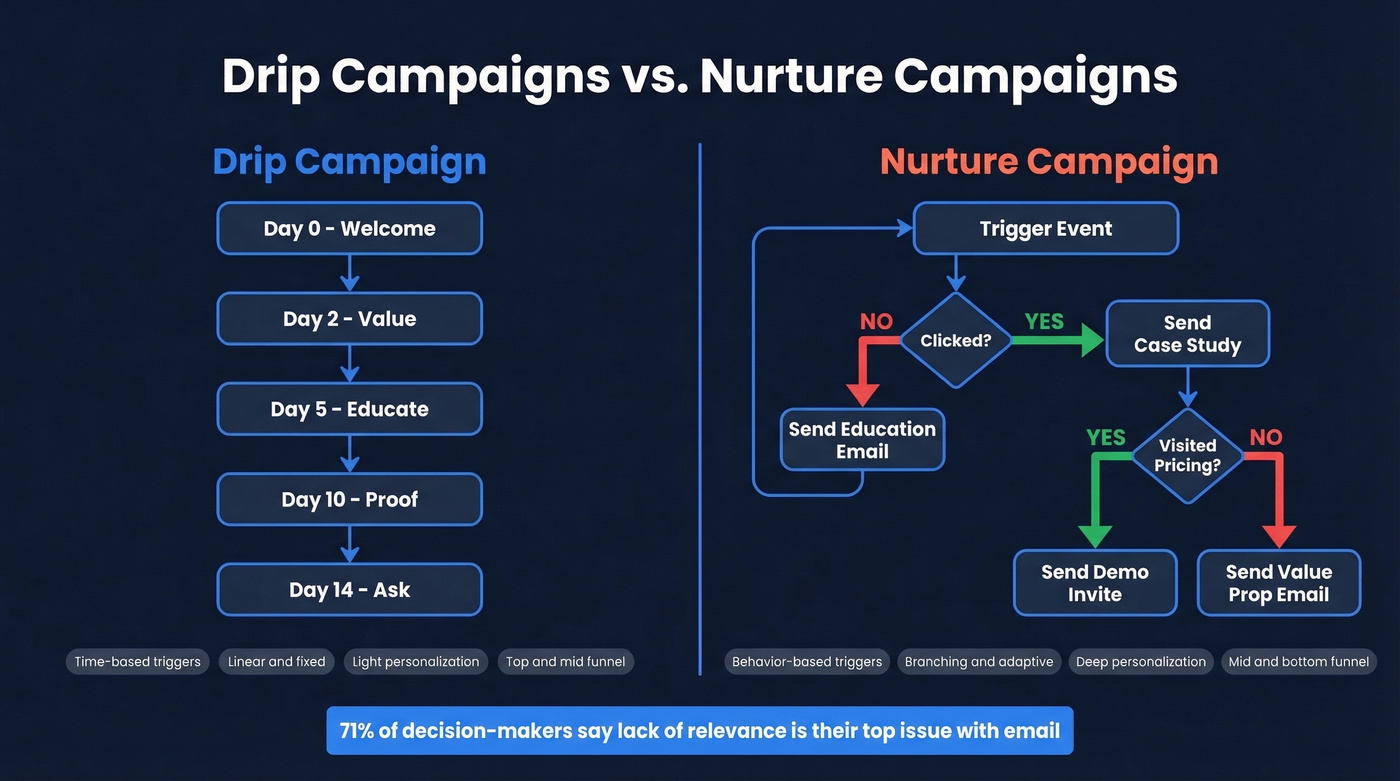
| Drip Campaign | Nurture Campaign | |
|---|---|---|
| Trigger | Time-based (Day 1, Day 3, Day 7) | Behavior-based (clicks, visits, downloads) |
| Logic | Linear, fixed sequence | Branching, adaptive |
| Personalization | Light - name, segment | Deep - behavior, intent signals |
| Funnel stage | Top/mid-funnel | Mid/bottom-funnel |
| Complexity | Low - set and forget | Higher - requires CRM data |
Drip campaigns are the starting point. You don't need behavioral data or lead scoring to launch one. You just need a trigger - someone signs up, downloads a PDF, starts a trial - and a sequence of emails on a timer.
Nurture campaigns are the evolution. Once you have behavioral data about who's clicking, who's visiting your pricing page, and who's going dark, you graduate from fixed drips to adaptive flows. 71% of decision-makers cite lack of relevance as the primary issue with cold emailing, which is exactly what behavior-based nurtures solve. As one VP of Sales at Binalyze put it, companies should "stop relying on drips the moment they have intent data," because static messaging becomes noise.
How Drip Marketing Works
Every drip campaign follows the same framework: trigger, sequence, timing, measurement. Here's a sample five-email welcome sequence for a SaaS product:
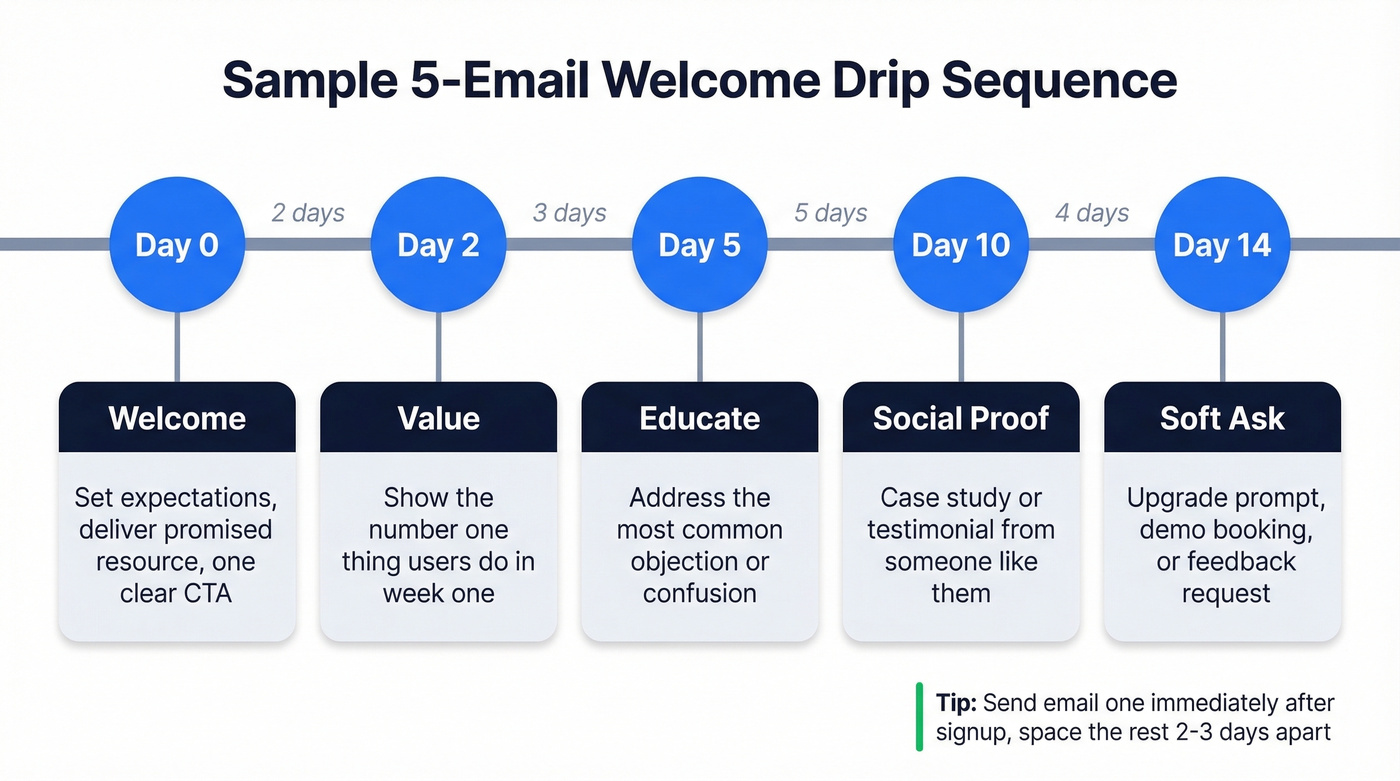
- Day 0 (immediately after signup): Welcome email. Set expectations, deliver the promised resource, one clear CTA.
- Day 2: Value email. Show the #1 thing users do in their first week.
- Day 5: Education email. Address the most common objection or confusion point.
- Day 10: Case study or testimonial. Proof it works for people like them.
- Day 14: Soft ask. Upgrade prompt, demo booking, or feedback request.
Send the first email immediately after the trigger. Space the rest 2-3 days apart for welcome and onboarding sequences, 7-10 days for longer nurtures like post-purchase or re-engagement.
7 Types of Drip Campaigns
Welcome Series. Trigger: new subscriber or signup. Send 3-5 emails over two weeks. This is your highest-engagement window - don't waste it on generic "thanks for signing up" filler.
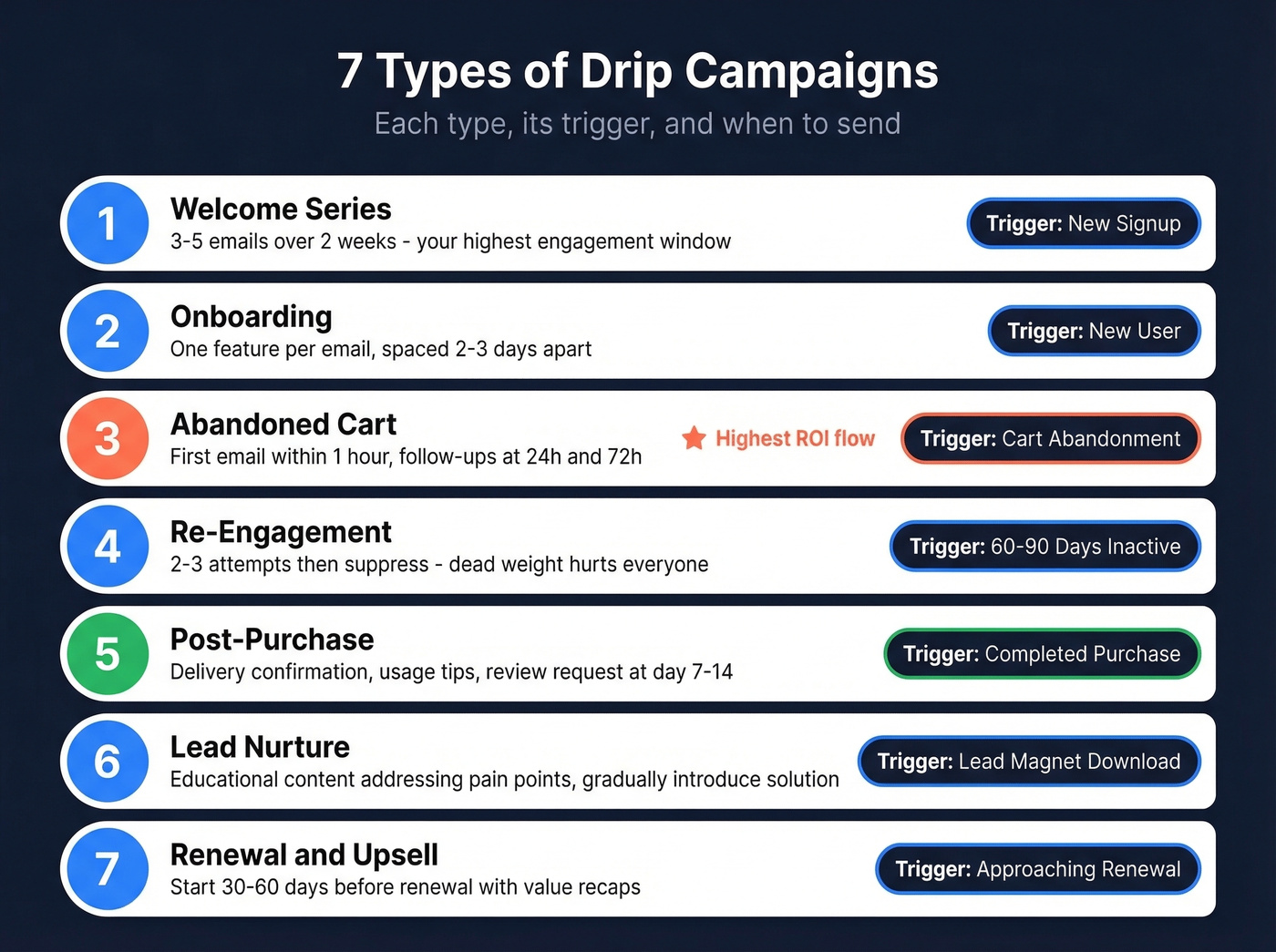
Onboarding Sequence. Trigger: new user or customer. Walk users through key features, one per email, spaced 2-3 days apart to avoid overwhelming them.
Abandoned Cart Recovery. Trigger: cart abandonment, typically 1-4 hours after. The first email should hit within an hour, with follow-ups at 24 and 72 hours. This is the highest-ROI automated flow eCommerce teams can run. Period. One nuance worth noting: avoid showing the exact abandoned item in every email. It can feel surveillance-like. Mix in broader category recommendations.
Re-Engagement Campaign. Trigger: no opens or clicks in 60-90 days. Offer something compelling - a discount, exclusive content, a simple "still interested?" If they don't engage after 2-3 attempts, suppress them. Keeping dead weight on your list hurts everyone.
Post-Purchase Follow-Up. Trigger: completed purchase. Start with delivery confirmation, follow with usage tips, then ask for a review around day 7-14.
Lead Nurture Drip. Trigger: lead magnet download, webinar registration, or form fill. Share educational content addressing pain points, gradually introducing your solution.
Renewal & Upsell. Trigger: approaching contract renewal or usage milestone. Start 30-60 days before renewal with value recaps, then introduce upgrade options. Get the timing wrong and you either annoy them or miss the window entirely.

Drip campaigns that hit bounced emails never convert. Prospeo's 5-step verification delivers 98% email accuracy - refreshed every 7 days, not every 6 weeks. One agency cut their bounce rate from 35% to under 3% and built to $1M ARR on data they trust.
Feed your drip sequences verified emails at $0.01 each.
When Drip Campaigns Don't Work
Here's the thing most guides won't tell you: if you're selling high-ticket B2B deals to fewer than 100 target accounts, automated drips will underperform personalized 1:1 sequences every time. When your average contract value exceeds $50k and your total addressable list fits in a spreadsheet, the ROI math flips. Your prospects can smell automation, and they expect something crafted for them.
Skip drip campaigns for account-based selling. Automated sequences shine at scale - if you don't have scale, invest in personalized outreach instead.
2026 Benchmarks for Automated Flows
Let's separate two useful benchmark views:
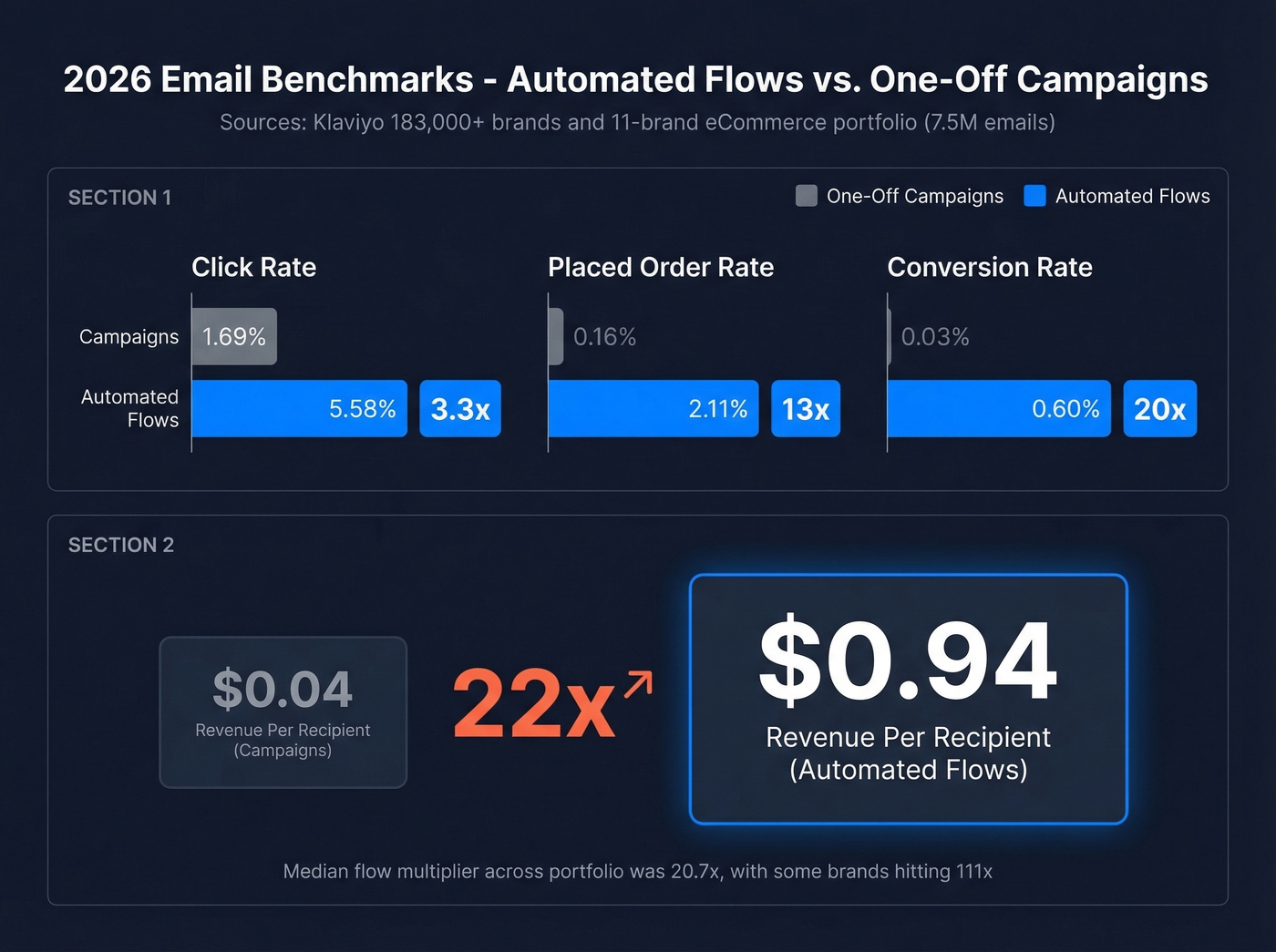
Klaviyo's 2026 dataset (183,000+ brands, published February 2026) shows automated flows outperform one-off campaigns on core engagement outcomes:
| Metric | Campaigns (one-off) | Automated Flows | Difference |
|---|---|---|---|
| Avg. click rate | 1.69% | 5.58% | 3.3x higher |
| Avg. placed order rate | 0.16% | 2.11% | 13x higher |
The 11-brand portfolio dataset adds the revenue layer:
| Metric | Campaigns (one-off) | Automated Flows | Difference |
|---|---|---|---|
| Avg. conversion rate | 0.03% | 0.60% | 20x higher |
| RPR (revenue/recipient) | $0.04 | $0.94 | 22x higher |
The RPR line matters most. That same portfolio tracking 11 eCommerce brands across 7.5 million emails found the median flow multiplier was 20.7x, with some brands hitting 111x. That variance is the real story - a well-optimized flow doesn't just outperform campaigns, it can generate two orders of magnitude more revenue per recipient.
Open rates are increasingly unreliable. Apple Mail Privacy Protection pre-loads tracking pixels, inflating open rates across the board. Click rate and revenue per recipient are the metrics that actually tell you if your automated emails are working. If you're reporting open rates to your team as a primary KPI, you're measuring noise.
How to Set Up a Drip Campaign
Define your goal. One sequence, one goal. "Increase trial-to-paid conversion by 15%" is a goal. "Send some emails to new users" isn't.
Segment your audience. A CMO downloading a whitepaper needs different content than an SDR signing up for a free trial. At minimum, segment by entry point, role, and buying stage. If you need a practical framework, start with an ideal customer profile and layer in intent based segmentation.
Choose your triggers. Form submission, purchase, cart abandonment, trial expiration, or behavioral signals like visiting your pricing page three times. Pick triggers that signal genuine intent, not just activity.
Write the emails. Lead with value, not your product. Each email should answer one question or solve one problem. Keep subject lines under 50 characters and use a single, clear CTA - not three competing buttons. If you want a swipe file, pull from these email subject line examples. We've seen teams overthink copy and underthink structure. Structure wins.
Set the cadence. Two-to-three day gaps for welcome and onboarding sequences. Seven-to-ten days for longer nurtures. Never more than 2-3 emails per week to any single subscriber.
Measure and optimize. Track click rate, conversion rate, and revenue per recipient. Look at drop-off points between emails - if email #3 has a 70% lower click rate than email #2, the problem is email #3, not your audience. A/B test subject lines and send times first; they produce the biggest gains with the least effort. (If you want to standardize reporting, use a consistent click rate formula.)
The Deliverability Checklist
Your drip campaign is worthless if it lands in spam. Here's what healthy looks like, based on Gmail and Yahoo's sender requirements still enforced in 2026, plus real portfolio data.
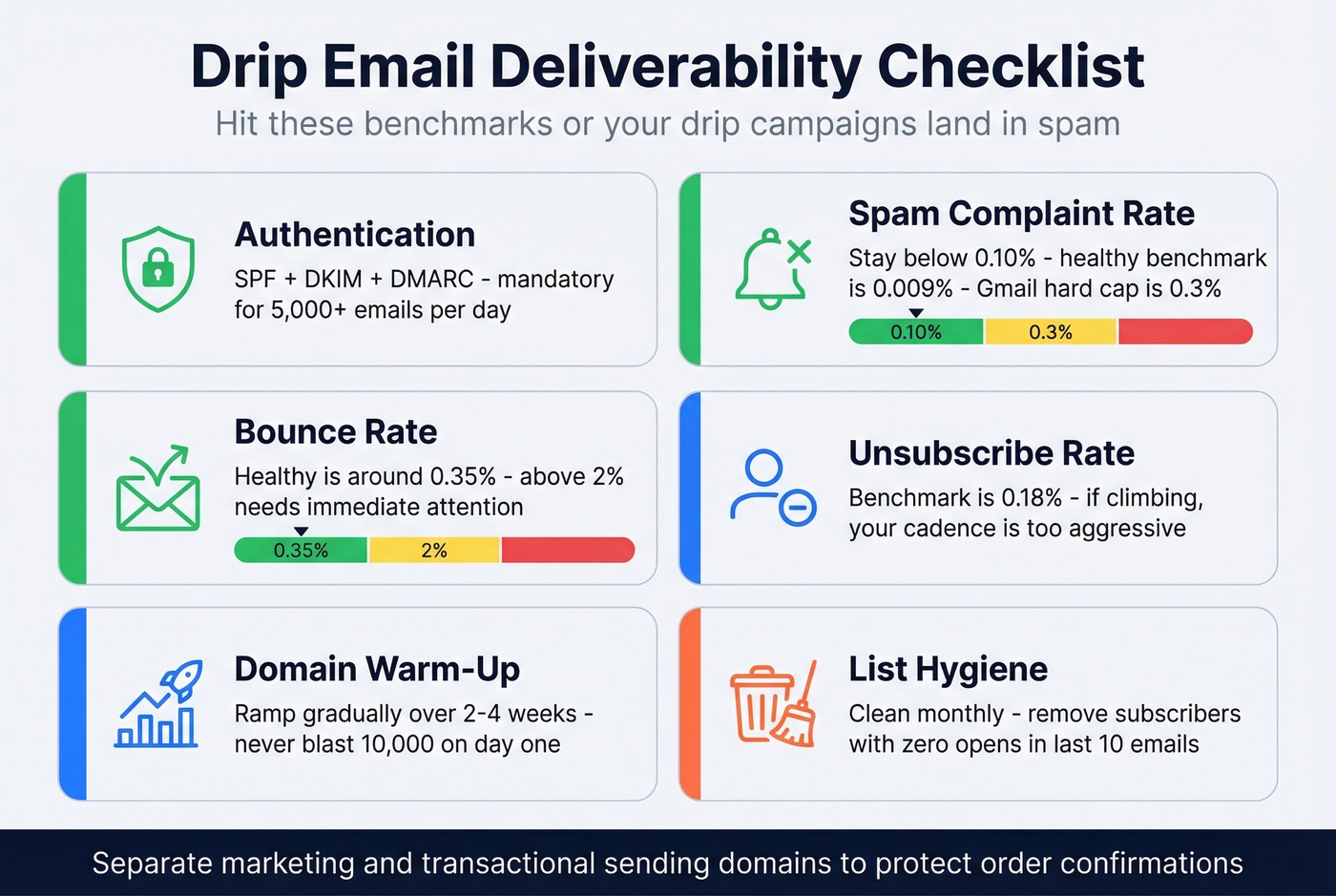
Authenticate your domain with SPF, DKIM, and DMARC - mandatory for senders doing 5,000+ messages per day. Keep your spam complaint rate below 0.10%; one healthy 11-brand portfolio runs around 0.009%, and Gmail's hard cap is 0.3%. Implement one-click unsubscribe via List-Unsubscribe header and process opt-outs within two days.
Warm up new domains gradually over 2-4 weeks instead of blasting 10,000 emails on day one. Separate your marketing and transactional sending domains so promotional spam complaints don't tank your order confirmations. Clean your list monthly by removing subscribers who haven't opened your last 10 emails. A healthy portfolio bounces at around 0.35% - if you're above 2%, something needs immediate attention. Monitor unsubscribe rate against the 0.18% benchmark; if it's climbing, your cadence is too aggressive or your content isn't relevant. For a deeper playbook, follow an email deliverability guide and keep an eye on your email bounce rate.
5 Mistakes That Kill Drip Campaigns
1. Over-automation without personalization. Automation is the delivery mechanism, not the strategy. If every subscriber gets the same generic sequence regardless of behavior, you're spamming on a schedule. A common complaint in practitioner discussions on r/emailmarketing is "personalized" recommendations that are completely irrelevant. Segment by behavior, not just demographics.
2. Too many emails too fast. Reddit threads consistently flag excessive frequency as the fastest way to spike unsubscribes and spam complaints. Cap at 2-3 emails per week. If engagement drops after email #3, the answer isn't email #4.
3. Poor mobile optimization. Tiny text, broken layouts, CTAs you can't tap. Test every email on mobile before it goes live.
4. Ignoring deliverability. You built a beautiful sequence, but half your emails land in spam because you never set up DMARC. Authenticate your domains, monitor spam rates weekly, and warm up new sending infrastructure before going full volume.
5. Dirty contact data. This is the one nobody catches until it's too late. Your drip platform doesn't verify your list for you. If 10% of your contacts are invalid, you're generating bounces on every send, and your sender reputation degrades with each one. Run contacts through verification before launching any sequence - tools like Prospeo catch invalid addresses, spam traps, and honeypots with 98% email accuracy through a 5-step verification process. Bad data means bounces, bounces mean a destroyed sender reputation, and the whole drip fails before email #2 arrives.
The article says it: 71% of decision-makers cite lack of relevance as the #1 issue with cold email. Prospeo's 30+ filters - buyer intent, technographics, job changes, headcount growth - let you segment before the first drip ever sends. Better segments, better sequences, 22x more revenue per recipient.
Stop dripping to the wrong people. Start with the right list.
Best Tools for Drip Email Marketing
Many modern platforms include AI features like send-time optimization and subject line generation. The real differentiator isn't AI - it's how well the tool fits your workflow.
| Tool | Best For | Starting Price | Key Strength |
|---|---|---|---|
| Prospeo | List building + verification | Free; paid from ~$39/mo | 98% email accuracy |
| Klaviyo | eCommerce drip flows | $20/mo | Shopify-native ecosystem |
| ActiveCampaign | Complex B2B automation | $15/mo (1K contacts) | Advanced branching + CRM |
| Brevo | Budget-friendly starter | $9/mo | Generous free tier |
| MailerLite | Simple, clean UI | $10/mo | Easiest learning curve |
| Mailchimp | Free tier for small lists | Free (500 contacts) | Ubiquitous integrations |
| Omnisend | eCommerce multi-channel | $16/mo | SMS + email in one flow |
Klaviyo is the default for eCommerce drip campaigns. The flow builder is powerful, and the analytics go deep on revenue attribution. It gets expensive past 10,000 contacts, but for eCommerce, the ROI math usually works.
ActiveCampaign is where B2B teams should look. The automation builder handles complex branching logic, lead scoring, and CRM pipeline stages without needing a developer. We've seen teams outgrow Mailchimp and land here happily.
Brevo starts at $9/mo and does the basics well. MailerLite has the cleanest UI in the category - genuinely pleasant to use. Mailchimp still offers a popular free tier for tiny lists, though its automation feels dated compared to newer competitors. Omnisend combines email and SMS drips in one platform, which is genuinely useful for eCommerce brands running multi-channel flows. If you're also running outbound sequences, compare options in our guide to follow up email software.
FAQ
How many emails should a drip campaign have?
Three to seven. Engagement drops sharply after the first few messages, and longer rigid drips underperform shorter sequences with behavioral exit conditions. Start with five, measure drop-off, and trim from there.
What's a good click rate for automated email flows?
Automated flows average 5.58% click rates across 183,000+ brands - that's 3.3x higher than one-off campaigns. Track click rate and revenue per recipient, not open rates, which Apple MPP has made unreliable.
How often should drip emails be sent?
Send the first email immediately after the trigger. Space the rest 2-3 days apart for welcome sequences, 7-10 days for longer nurtures. Never exceed 2-3 emails per week to any single subscriber.
How do I keep drip emails out of spam?
Authenticate your domain with SPF, DKIM, and DMARC. Keep spam complaints below 0.10%. Verify your contact list before sending. Warm up new sending domains gradually and process unsubscribes within two days.
Drip vs. nurture campaigns - what's the difference?
Drip campaigns follow a fixed, time-based schedule. Nurture campaigns adapt based on recipient behavior like clicks and page visits. Graduate from drips to nurtures once you have enough behavioral data to branch meaningfully.