

What Is Email List Segmentation (And Why Most Marketers Do It Wrong)?
Your open rate is 18% and you're wondering if email is dead. It's not - your list is unsegmented and half-invalid. The latest DMA benchmark puts average open rates at 35.9%. If you're below that, segmentation is the fastest fix you'll find.
The short version: segmentation means splitting your list so each group gets relevant emails instead of the same blast. Start with two segments - engaged (opened in last 90 days) vs. lapsed - and that alone beats batch-and-blast every time.
What Email List Segmentation Actually Is
It's dividing your subscriber list into smaller groups based on shared characteristics - behavior, demographics, purchase history, job title - so you can send each group something relevant instead of one generic message to everyone.
Here's the distinction most guides blur: segmentation decides who gets the email; personalization decides what it says. You need both, but segmentation comes first. There's no point personalizing a subject line if you're sending it to the wrong audience (and if you need ideas, steal from these subject line examples).
"Do I need this if my list is only 500 people?" Yes. A 500-person list with two smart segments will outperform a 5,000-person unsegmented list every time. Size doesn't determine whether segmentation works. Relevance does.
Why Segmented Campaigns Outperform
The DMA's latest benchmarks look solid on paper: 35.9% open rates, 2.3% click rates, 98% delivery rate. But those are averages. Segmented campaigns blow them away (and if you want to sanity-check your KPIs, use this click rate formula).
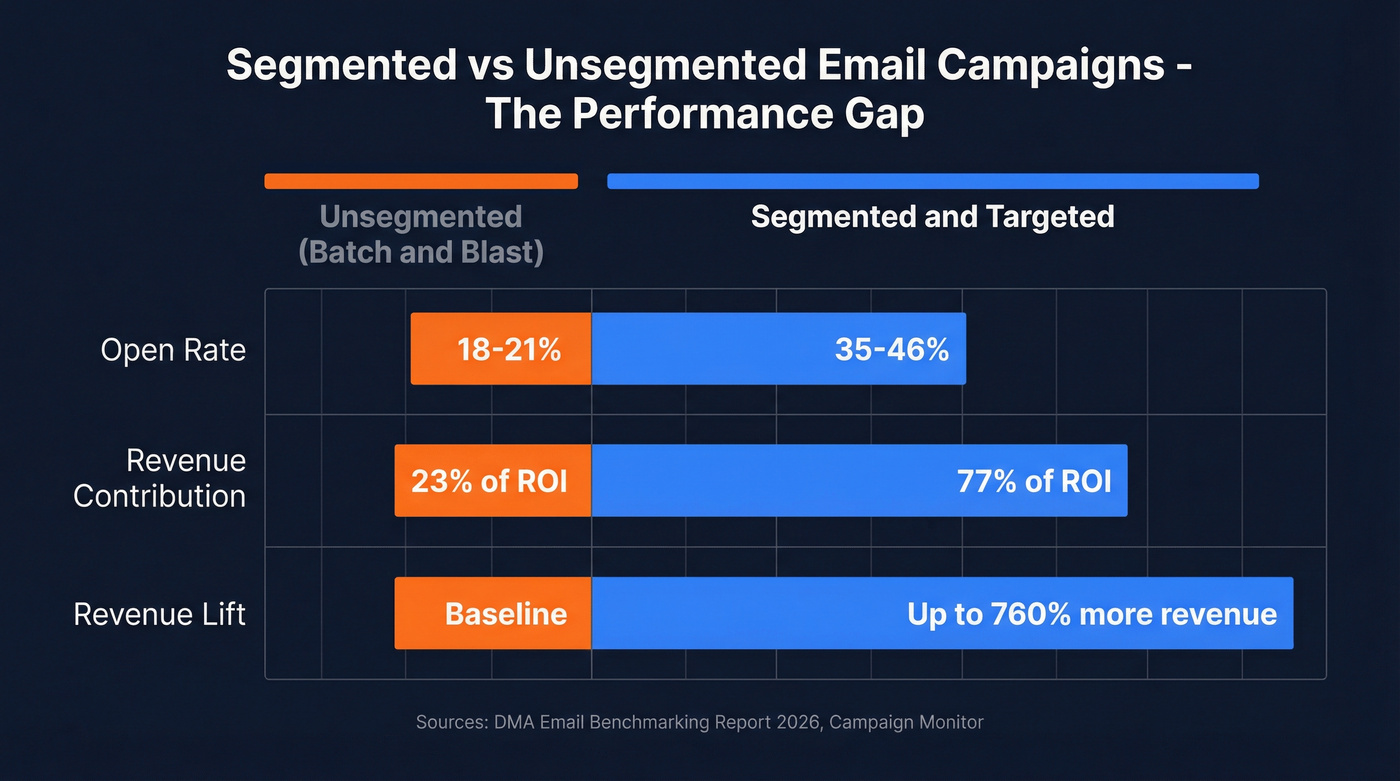
Segmented campaigns drive up to 760% more revenue than unsegmented ones, with open rates jumping 14-46% higher. The stat that should end every internal debate: 77% of email marketing ROI comes from segmented, targeted, and triggered campaigns. The other 23%? That's your batch-and-blast leftovers.
There's a deliverability angle too. ISPs track engagement. If half your list never opens, your sender reputation degrades, and eventually even your engaged subscribers stop seeing your emails in their inbox (here’s a deeper guide on how to improve sender reputation). Segmentation isn't just a conversion play - it's infrastructure maintenance for your entire email program.
The 6 Core Segmentation Types
| Type | What It Is | Best For | Example Segment |
|---|---|---|---|
| Demographic | Age, gender, income | B2C | Women 25-34 in loyalty program |
| Behavioral | Opens, clicks, purchases | Both | Opened 3+ emails in 90 days |
| Geographic | Location, timezone | Both | US West Coast for 10am send |
| Lifecycle stage | New, active, lapsed | Both | Subscribed < 30 days ago |
| Psychographic | Values, interests | B2C | Sustainability-focused buyers |
| Firmographic | Industry, size, role | B2B | SaaS CMOs at 50-200 employee cos |

Most guides stop at demographics and call it a day. That's a mistake, especially in B2B. A typical B2B buying committee involves 6-10 decision-makers, and 74% of those groups experience internal conflict during the purchase process. You can't send the same email to a CFO and an end-user and expect both to care.
B2B segmentation needs firmographic data - industry, company size, tech stack - layered with role-based targeting and funnel stage (more on firmographic filters). "Marketing managers at SaaS companies with 50-200 employees who've visited pricing" is a segment. "People in marketing" is not.

B2B segmentation without firmographic data is guesswork. Prospeo's database gives you 30+ filters - industry, company size, tech stack, job title, buyer intent - so you can build segments like 'SaaS CMOs at 50-200 employee companies showing purchase intent.' 300M+ profiles, 98% email accuracy, refreshed every 7 days.
Build segments on verified data, not assumptions. Start free.
How to Segment Your Email Audience
Don't build 30 segments on day one. Start with two or three, prove they work, then expand.
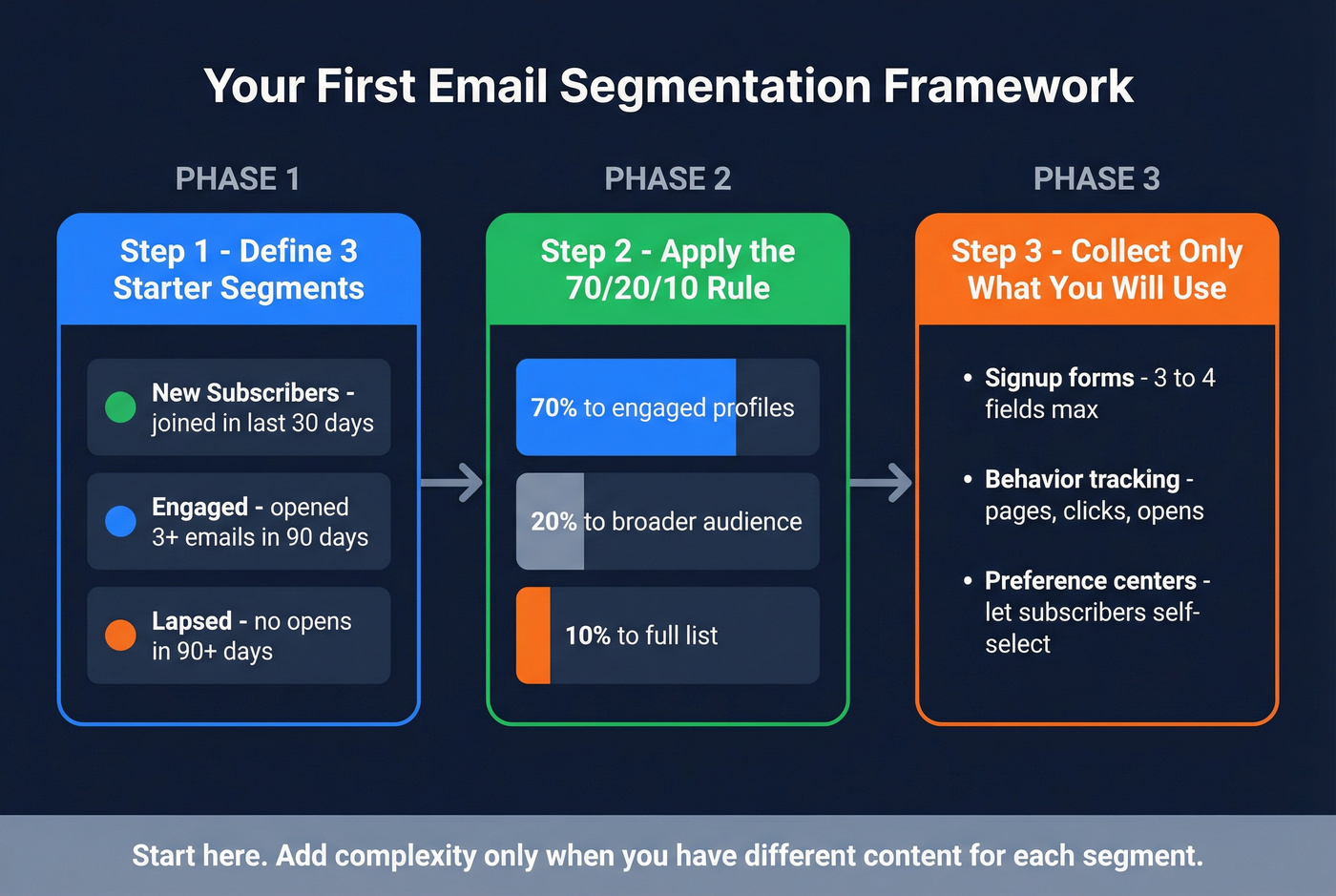
Create engagement tiers first. A 70/20/10 framework works well: send 70% of campaigns to engaged profiles, 20% to a broader audience, 10% to your full list. This protects deliverability while still reaching lapsed contacts occasionally (and if you’re doing any outbound, keep an eye on email velocity).
Define your starter segments. New subscribers (under 30 days), engaged (opened 3+ emails in last 90 days), and lapsed (no opens in 90+ days). Three segments that immediately change how you write and send. That's it for now - resist the urge to add more until you've actually written different copy for each of these (a simple way to operationalize this is with personalized drip campaigns).
Collect the right data. Use signup forms, behavior tracking, and preference centers. Don't ask for 12 fields on a form - collect what you'll actually use. Every extra field drops your conversion rate, and data you never act on is just clutter.
Practitioners on r/Emailmarketing have observed that after three opens, unsubscribes drop dramatically. That third open is the inflection point where a subscriber becomes a committed reader. Build your engagement thresholds around it.
Let's be honest: if your list is under 2,000 contacts, you probably don't need marketing automation software at all. A spreadsheet, two segments, and a basic ESP will outperform a $500/month platform you're using at 10% of its capacity.
Mistakes That Kill Results
Over-segmenting into 47 micro-segments nobody maintains is the most common trap. We've seen teams spend weeks building elaborate segment trees only to send the same email to all of them because nobody had bandwidth to write different copy. Start with 2-3 segments. Add more only when you have the content to serve them differently.
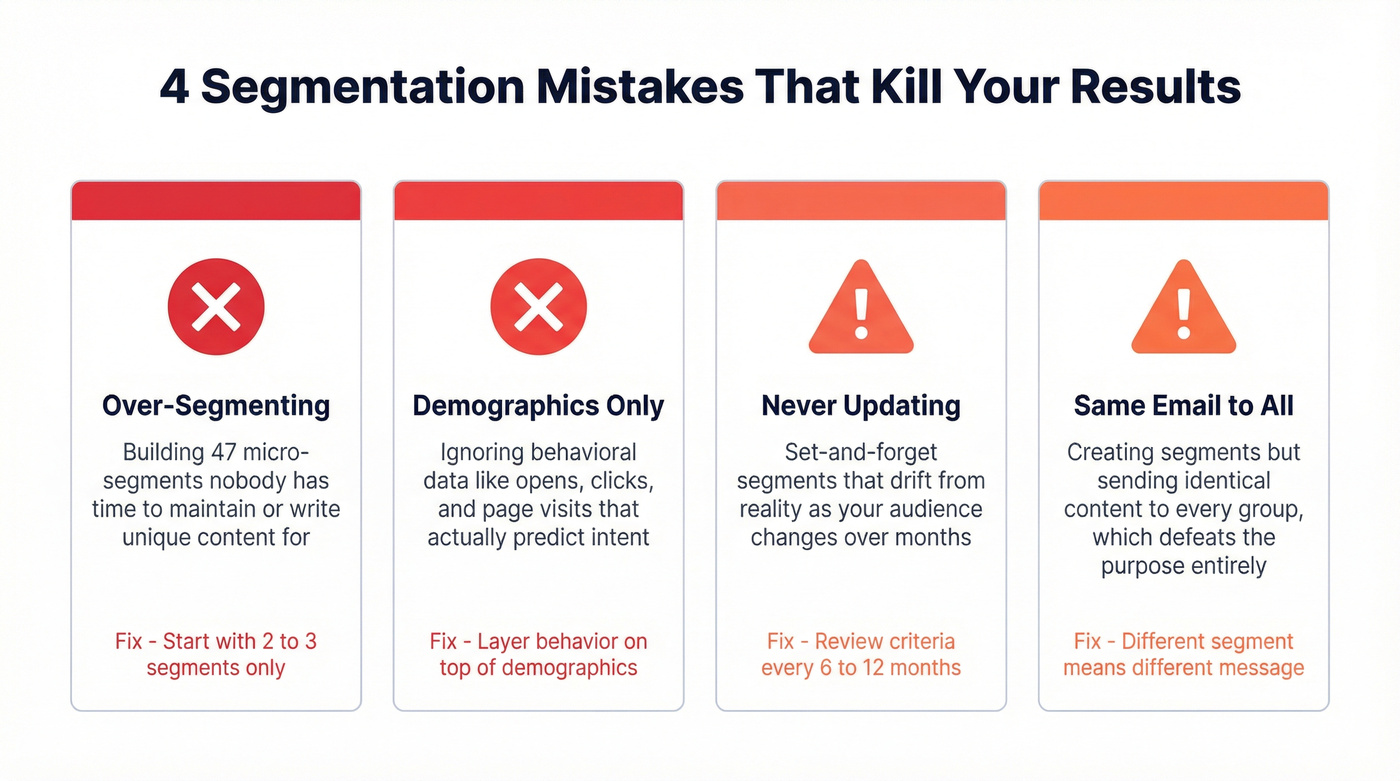
Relying only on demographics while ignoring behavioral data is almost as bad. What someone does - which pages they visit, which emails they click - matters more than who they are on paper. Layer behavior on top of demographics, not the other way around.
Two more that quietly kill campaigns: never updating segments (review criteria every 6-12 months, because your audience changes) and segmenting without personalizing the message. If every segment gets the same email, you haven't segmented. You've just made extra lists.
Clean Data First, Segment Second
Segmentation built on dirty data is theater.
If your list has invalid emails, duplicates, and outdated contacts, your engagement metrics are lying to you. Your "lapsed" segment might include people who never received an email because the address bounced. In our experience, teams waste months building segmented lists on data that's around 15-20% invalid - and they don't realize it until deliverability craters (if you’re seeing this, start with your email bounce rate).
The compliance stakes are real too. GDPR fines have hit roughly EUR 5.88B across 2,245 enforcement actions, and CCPA penalties run up to $7,500 per intentional violation. Segmenting unverified data isn't just ineffective - it's a liability.
We built Prospeo for exactly this problem. Its 5-step email verification runs at 98% accuracy with a 7-day refresh cycle, so the data underneath your segments stays current. Catch-all domain handling and spam-trap removal mean your deliverability stays protected even as you scale list size (here’s a full email deliverability guide if you want the technical checklist).
You just read that 15-20% of most lists are invalid - and that bad data corrupts every engagement metric you track. Prospeo's 5-step verification with catch-all handling and spam-trap removal keeps your segments clean at 98% accuracy. Data refreshes every 7 days, not every 6 weeks. Your 'lapsed' segment will actually mean lapsed, not bounced.
Stop segmenting on lies. Verify your entire list for $0.01/email.
Segmentation in Action
Huda Beauty stopped blasting their full list and shifted to sending regular campaigns only to subscribers engaged in the last 120 days. Full-list sends were reserved for major annual sales. The result: they doubled year-over-year email-attributed revenue. The lever wasn't a new tool or a redesign - it was simply not emailing people who weren't listening.
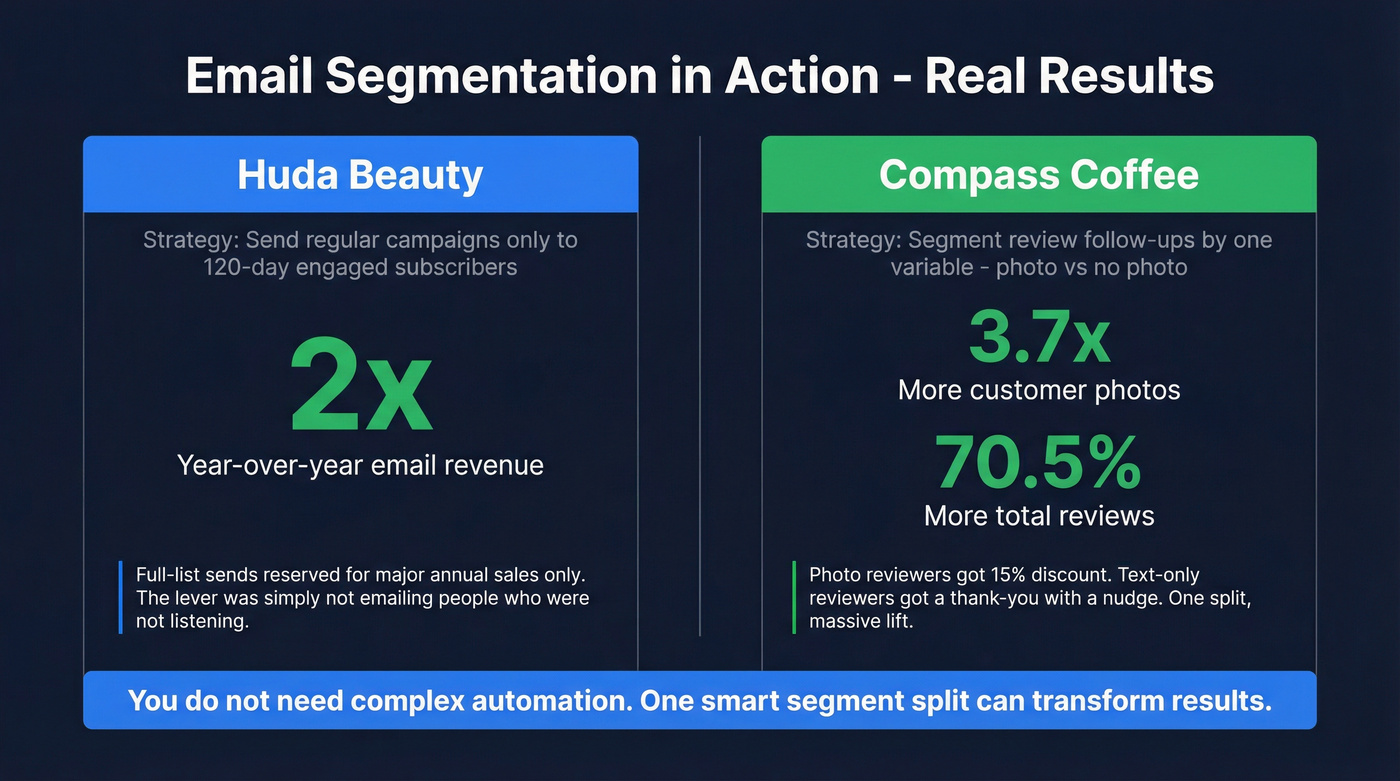
Compass Coffee segmented review follow-ups by a single variable: whether the review included a photo. Photo reviewers got a 15% discount offer; text-only reviewers got a thank-you with a gentle nudge. The result: a 3.7x jump in customer photos and 70.5% more total reviews.
One split. Massive lift. That's the whole argument for segmentation in two data points.
FAQ
Is email segmentation worth it for small lists?
Yes - even 500 subscribers benefit. Split into engaged vs. lapsed and you'll see open rates climb 14-46% immediately. List size doesn't determine ROI; relevance does. Start with two segments before adding complexity.
What's the difference between segmentation and personalization?
Segmentation picks who gets the email; personalization tailors what it says. You need both, but segmentation comes first - a perfectly personalized subject line sent to the wrong audience still underperforms.
How do I keep my segments accurate over time?
Review segment criteria every 6-12 months and verify emails regularly. Catch-all handling and spam-trap removal are table stakes for keeping engagement data honest. Treat segments as living systems, not set-and-forget filters.
How many segments should I start with?
Two or three: new subscribers, engaged contacts, and lapsed contacts. Only add segments when you've got distinct content for each group. Skip this if you're the type to build 20 segments and then send the same newsletter to all of them - you'll just create busywork.