

What Should Your Outreach Messages Try to Do? The Real Answer
Your SDR sent 400 emails this week. Ninety bounced. Two hundred eighty hit spam. Five people replied - one of those was "remove me from your list." So what should your outreach messages actually try to do? Not what you think. The instinct is to rewrite the subject line, tweak the CTA, maybe add a GIF. But the message isn't your problem. The infrastructure underneath it is.
The quick answer: Your outreach messages should help the buyer make progress in defining or solving their problem - not pitch your product. That's the HubSpot Inbound Sales Certification answer, and it's correct. But the message itself is the last thing to fix. Priority stack: clean, verified contact data first, then tight ICP targeting, then message quality.
Why "Help the Buyer Progress" Is Right
HubSpot's inbound sales methodology rests on three principles: a buyer-first approach, personalized engagement, and value-driven conversations. These aren't just certification talking points - they reflect how B2B buying actually works now.
96% of prospects research companies and products before they ever talk to a rep. Your buyer has already read the G2 reviews, skimmed a competitor's case study, and watched a product demo on YouTube. They don't need your email to tell them what your platform does.
They need your email to help them think about their problem differently. Outreach that pitches competes with information the buyer already has - and loses. Outreach that adds a new angle, names an unrecognized problem, or shares a relevant benchmark earns attention because it's genuinely useful. You're not selling. You're helping someone make progress on a decision they're already working through, and that's how you earn real buyer engagement instead of demanding it.
Helping the Buyer by Stage
The phrase "help the buyer make progress" is abstract until you map it to where the buyer actually is.
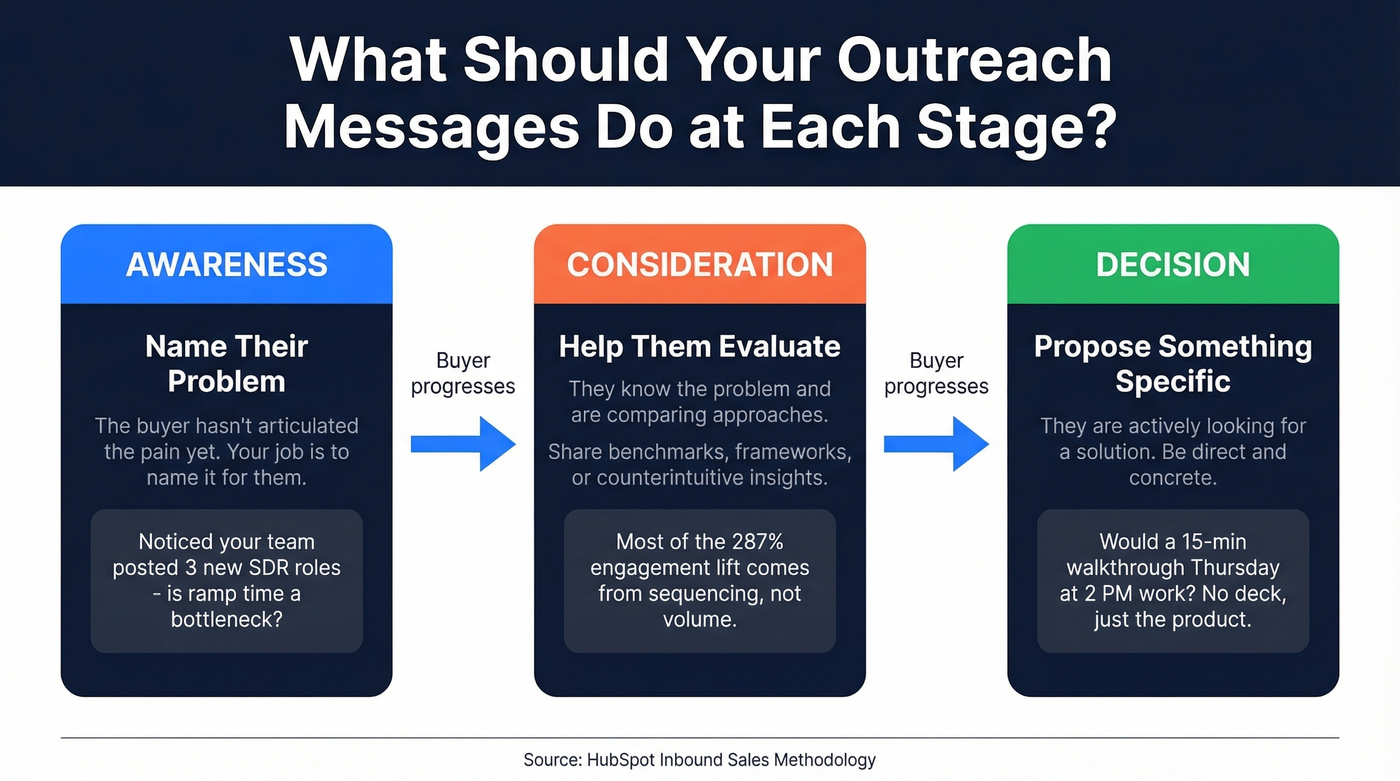
Awareness - Name Their Problem
The buyer might not have articulated the problem yet. Your job is to name it.
Before: "Hi Sarah, we help companies like yours improve sales productivity with our AI-powered platform."
After: "Sarah - noticed your team posted 3 new SDR roles in the last month. When teams scale that fast, the usual bottleneck isn't hiring - it's getting reps to quota before the pipeline dries up. Is ramp time something you're thinking about?"
The second version doesn't mention a product. It names a specific tension the buyer is likely feeling.
Consideration - Help Them Evaluate
Here, the buyer knows the problem and is comparing approaches. Share something that helps them evaluate - a benchmark, a framework, a counterintuitive insight.
"Teams using multichannel outreach can see up to 287% higher engagement than single-channel. But most of that lift comes from sequencing, not volume. Happy to share the cadence framework we've seen work for teams your size."
Decision - Propose Something Specific
62% of buyers want to hear from sellers when they're actively looking for solutions. At this stage, don't be vague.
Before: "Let me know if you'd be interested in learning more about how we can help your team."
After: "Would a 15-minute walkthrough on Thursday at 2 PM work? I'll show you exactly how [specific outcome] works for [similar company] - no deck, just the product."
"Let me know if interested" isn't a call to action. It's a dead end.
2026 Outreach Benchmarks
Before you optimize anything, you need to know what "good" looks like. Here are the numbers from an analysis of 16.5M cold emails plus practical benchmark ranges we've seen across outbound teams.
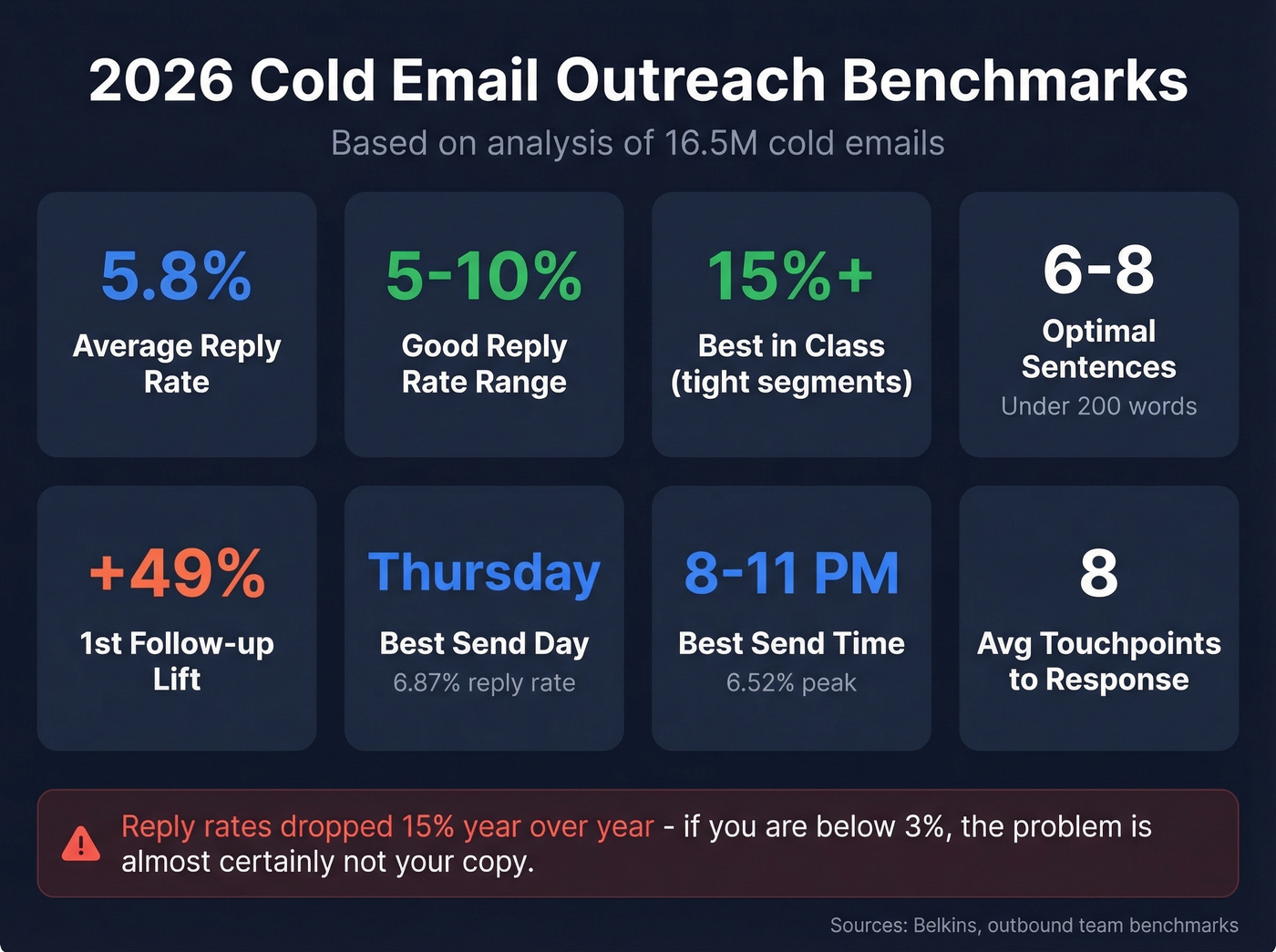
| Metric | Benchmark | Source |
|---|---|---|
| Avg reply rate | 5.8% | Belkins, 16.5M emails |
| Good reply rate | 5-10% | Outbound team benchmarks |
| Best-in-class | 15%+ | Tight segments only |
| Optimal length | 6-8 sentences, under 200 words | Belkins |
| 1st follow-up lift | Up to 49% more replies | Belkins |
| Best send day | Thursday (6.87% reply) | Belkins |
| Best send time | 8-11 PM (6.52% peak) | Belkins |
| Avg touchpoints to response | 8 | Outbound playbook benchmark |
That reply rate dropped 15% year-over-year. Inboxes are more crowded, spam filters are more aggressive, and buyers are more skeptical. If you're hitting 5-10%, you're doing solid work. Below 3%? The problem almost certainly isn't your copy.
Follow-ups have diminishing returns. The first follow-up is gold - up to 49% more replies. But by follow-up #4, response rates drop 55% and spam complaints hit 1.6%. Three follow-ups is the ceiling before you start damaging your sender reputation.

You just read that bounces must stay under 2% or your domain reputation craters. Prospeo's 5-step email verification delivers 98% accuracy - so your carefully crafted, buyer-first messages actually reach the inbox. 143M+ verified emails, refreshed every 7 days, starting at $0.01 each.
Stop polishing outreach that lands in spam. Fix the data underneath it.
Five Principles That Move Reply Rates
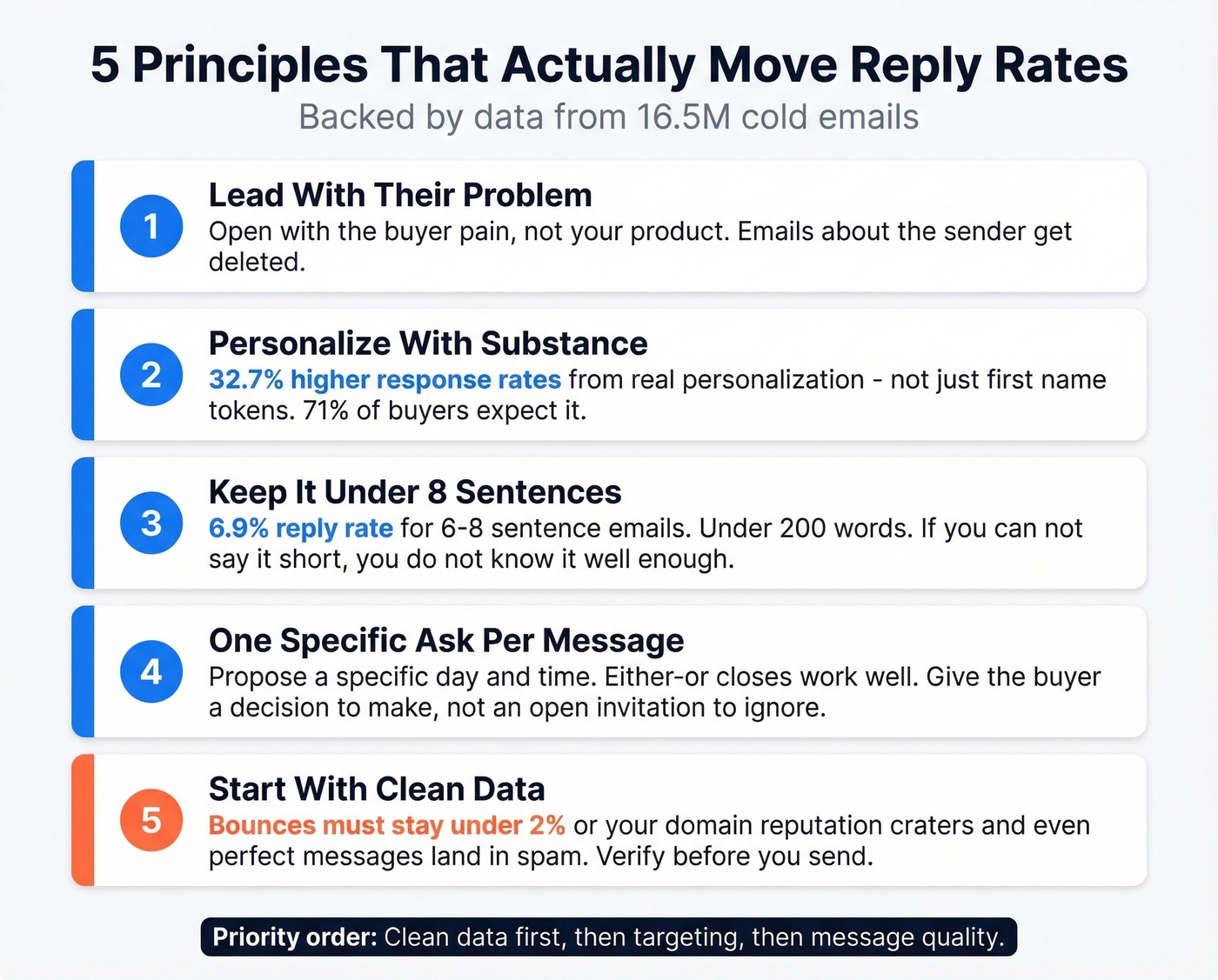
Lead With Their Problem
Outreach that opens with "we help companies like yours..." is dead on arrival. We've seen this pattern fail across dozens of campaigns. Open with the buyer's specific pain - a hiring surge, a tech migration, a funding round - and you earn the next sentence. Open with your product, and you earn the delete button.
Personalize With Substance
Tailoring email content can boost response rates by 32.7%. But {first_name} isn't personalization. Referencing a recent initiative, a job posting, or a public metric is. 71% of buyers expect personalization, and 76% get frustrated without it - the bar isn't high, it just requires 90 seconds of research per prospect.
Keep It Under Eight Sentences
The data across 16.5M emails is unambiguous: 6-8 sentences hit a 6.9% reply rate. Longer emails underperform consistently. If you can't make your point in under 200 words, you don't know your point well enough yet.
One Specific Ask Per Message
"Let me know if you're interested" gives the buyer nothing to respond to. Propose a specific 15-minute call on a specific day, or ask a single qualifying question. Either/or closes work well: "Does Tuesday at 10 or Thursday at 2 work better?" Give the buyer a decision to make, not an open-ended invitation to ignore.
Start With Clean Data
Here's the thing nobody talks about in "how to write better outreach" guides. If 30% of your list bounces, your domain reputation craters and even perfect messages land in spam. The thresholds are tight: bounces under 2%, spam complaints under 0.3%. Verify before you send, or your carefully crafted message never reaches the inbox. If you want a deeper deliverability breakdown, start with this email deliverability guide and then check your email bounce rate.
The Outreach Killer Nobody Talks About
There's a popular take on r/sales that perfecting your outreach message is "fake work" - and they're mostly right. Targeting and data quality account for roughly 80% of your outreach results. Message quality is the remaining 20%. We've watched teams rewrite their cold email templates five times while sitting on a list with a 35% bounce rate. That's like polishing a Ferrari with no engine.
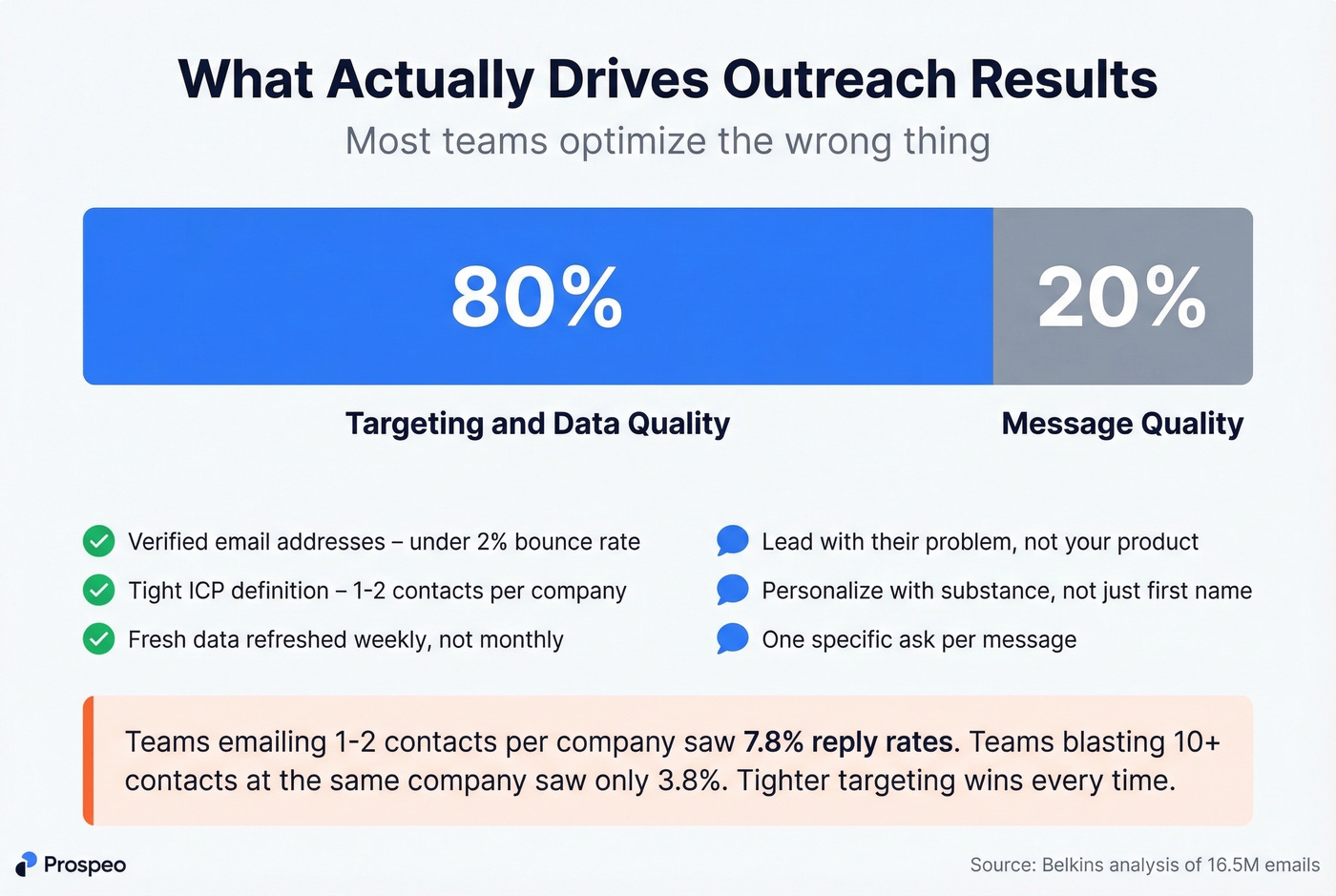
The data backs this up. Teams emailing 1-2 contacts per company saw a 7.8% reply rate. Teams blasting 10+ contacts at the same company? 3.8%. Tighter targeting, better results. It's not complicated - it's just not as fun as wordsmitting subject lines. If you need a practical way to define "tight," use an ICP scoring rubric.
Let's be honest: if your deal sizes sit below five figures, you don't need the fanciest outreach copy or the most sophisticated sequencing tool. You need a clean list, a tight ICP, and a message that respects the buyer's time. That's it. The teams booking the most meetings aren't the best writers - they're the ones whose emails actually land in the inbox. For more on the mechanics, see email velocity and email reputation tools.
Prospeo runs real-time email verification with 98% accuracy and refreshes data every 7 days - compared to the 6-week industry average. One customer, Meritt, saw bounce rates drop from 35% to under 4% after switching, and their pipeline tripled from $100K to $300K per week. Before you rewrite your outreach message for the fifth time, verify your list. The copy isn't your bottleneck. The data is.
What Your Messages Should Never Do
You've read a dozen "perfect cold email" guides telling you to shorten by two sentences. Meanwhile your bounce rate is 25% and your domain is one complaint away from the blacklist. Here's what actually kills outreach - with a real example.
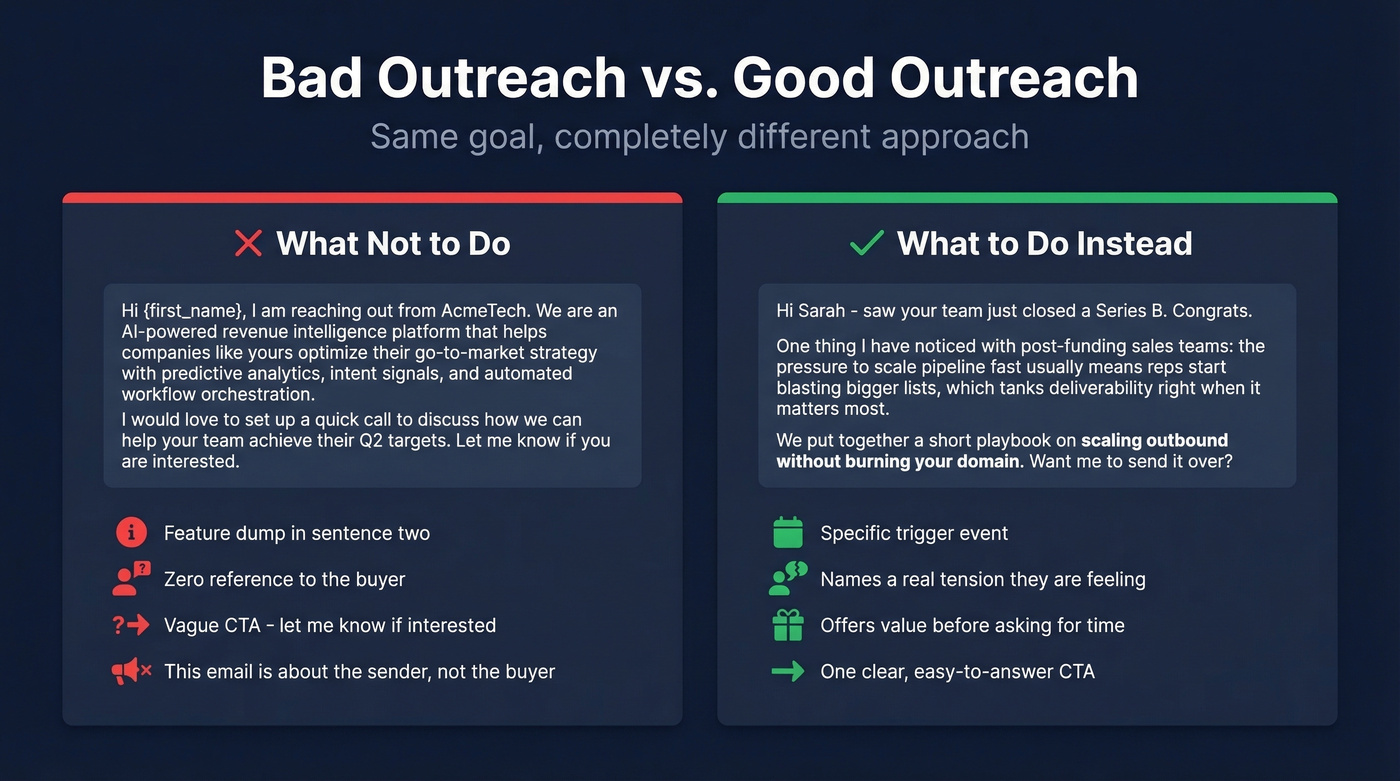
The bad email:
"Hi {first_name}, I'm reaching out from AcmeTech. We're an AI-powered revenue intelligence platform that helps companies like yours optimize their go-to-market strategy with predictive analytics, intent signals, and automated workflow orchestration. I'd love to set up a quick call to discuss how we can help your team achieve their Q2 targets. Let me know if you're interested or if there's a better person to connect with. Looking forward to hearing from you!"
What's wrong: Feature dump in sentence two. No reference to the buyer's situation. Vague CTA. Generic personalization. This email is about the sender, not the buyer.
The fix:
"Hi Sarah - saw your team just closed a Series B. Congrats. One thing I've noticed with post-funding sales teams: the pressure to scale pipeline fast usually means reps start blasting bigger lists, which tanks deliverability right when it matters most. We put together a short playbook on scaling outbound without burning your domain. Want me to send it over?"
Specific trigger event. Names a real tension. Offers value before asking for time. One clear CTA.
Beyond bad copy, here are the structural mistakes that do the most damage:
- Over-following-up. By follow-up #4, spam complaints hit 1.6% and unsubscribes reach 2%. You're not persistent - you're burning your domain. If you need copy that stays human, use these sales follow-up templates.
- Blasting bad lists. If your data is stale, every email you send makes the next one less likely to land. Bad data compounds. A solid fix is data enrichment before you scale volume.
- Automating without thinking. The consensus in practitioner communities is clear: over-reliance on automation without real personalization is the single biggest mistake in 2026 outreach. Teams automate the sending but skip the thinking. That's how you end up with 400 emails sent and one angry reply.
Skip the "spray and pray" approach entirely if you're selling into enterprise accounts. Those buyers can smell a mass email from three paragraphs away, and one spam complaint from a VP at a Fortune 500 can torch your domain for months. If you're building an enterprise motion, align this with account-based selling.
The Bottom Line
Strip away the tactics and benchmarks, and the answer is simple. Your outreach messages should make the buyer's life slightly better for having read them. That means naming a problem they haven't articulated, sharing an insight they haven't encountered, or proposing a next step so specific it's easy to say yes to. Everything else - the subject line hacks, the emoji debates, the send-time optimization - is noise until your data is clean and your targeting is tight. If you want a deeper playbook, start with AI cold email outreach and personalized outreach.
Naming the buyer's problem requires real intel - job postings, headcount growth, funding rounds. Prospeo's 30+ search filters surface exactly these signals so every outreach message is personalized with substance, not just {first_name}. That's how teams book 35% more meetings than Apollo users.
Personalize with real buyer signals, not mail merge tokens.
FAQ
What's the HubSpot Inbound Sales Certification answer?
The correct answer is "help the buyer make progress in defining or solving their problem." This reflects HubSpot's buyer-first inbound methodology - outreach should educate and add value, not pitch. You're positioning yourself as a trusted advisor, not a seller compressing the buyer's timeline.
What's a good cold email reply rate in 2026?
5-10% is solid for B2B cold outreach; above 15% is best-in-class and typically requires tight segmentation plus verified contact data. The industry average across 16.5M emails was 5.8%. Below 3% means your data or targeting needs work before you touch copy.
How many follow-ups should I send?
Cap it at three. The first follow-up can lift replies by up to 49%, but by the fifth email, response rates drop 55% and spam complaints hit 1.6%. After three follow-ups you're damaging sender reputation, not building pipeline.
How do I fix outreach that isn't getting replies?
Start with data, not copy. Verify your list to get bounce rates under 2%, narrow your ICP to 1-2 contacts per account, and only then optimize messaging. Prospeo's free tier lets you run 75 email verifications per month to test whether stale data is the real bottleneck before committing to a platform.