

=== CURRENT ARTICLE (slug: who-is-responsible-for-sales-forecasting) ===
Who Is Responsible for Sales Forecasting in 2026?
Monday morning forecast call. Three managers, three definitions of "commit." One reads from a spreadsheet that doesn't match the CRM. The call runs 90 minutes and ends with zero decisions. A rep on r/sales put it bluntly: "This is the type of shit that makes me want to quit sales."
He's not wrong. 4 in 5 sales and finance leaders missed a quarterly forecast last year - over half missed it twice. The problem isn't bad reps or bad math. It's that nobody owns the system that produces the number.
Quick Answer: It's Not One Person
The VP of Sales is accountable for the forecast number. RevOps owns the process that produces it. Sales managers handle deal-level accuracy. Reps contribute pipeline data. Finance pressure-tests. If one person "owns" your forecast, that's why you're missing it.
Stop asking who owns the forecast. Ask who owns the process. That distinction is the difference between a forecast that drives decisions and one that wastes everyone's Monday.
The Sales Forecasting RACI
The Sales Forecasting RACI
A RACI framework maps every forecasting task to clear roles: R = Responsible (does the work), A = Accountable (final decision-maker), C = Consulted (provides input), I = Informed (kept in the loop).
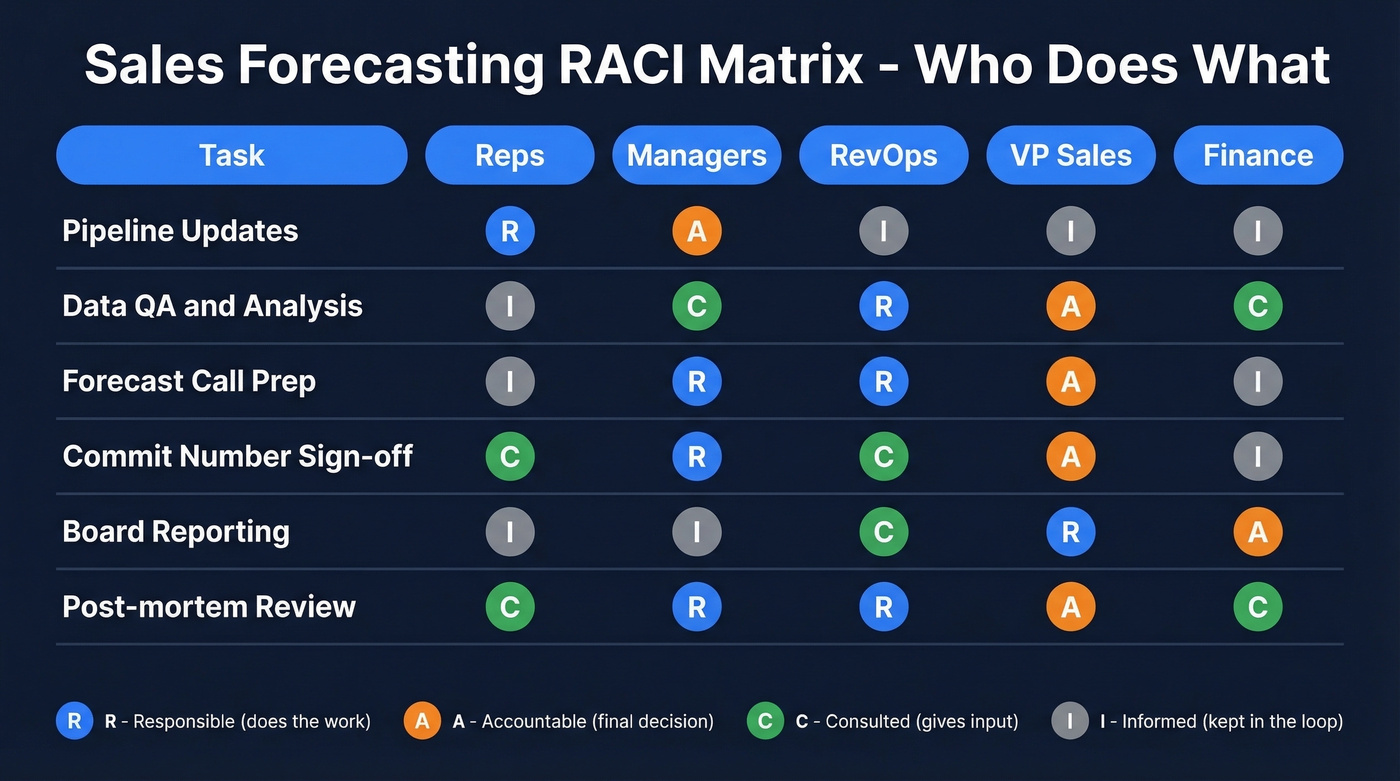
| Task | Reps | Managers | RevOps | VP Sales | Finance |
|---|---|---|---|---|---|
| Pipeline updates | R | A | I | I | I |
| Data QA / analysis | I | C | R | A | C |
| Forecast call prep | I | R | R | A | I |
| Commit number sign-off | C | R | C | A | I |
| Board reporting | I | I | C | R | A |
| Post-mortem review | C | R | R | A | C |
Reps are only Responsible for one task - updating their pipeline. They're not producing a forecast number. That's the manager's job using the rep's data. RevOps carries the heaviest operational load across data QA, call prep, and post-mortems, which is exactly why the function has grown so fast in the last three years. The VP of Sales is Accountable for nearly everything but Responsible for almost nothing day-to-day. That's by design.
In our experience, the moment you stop auditing this RACI quarterly is the moment roles drift and nobody's running the post-mortem.

Bad pipeline data is the silent killer of every sales forecast. When 67% of revenue leaders don't trust their CRM data, the problem isn't your process - it's phantom contacts and stale emails inflating your numbers. Prospeo's 7-day data refresh cycle and 98% email accuracy strip dead weight from your pipeline so every deal in your forecast has a reachable buyer behind it.
Stop forecasting on top of garbage data. Fix the foundation first.
Why Most Companies Get This Wrong
67% of revenue leaders don't trust their revenue data. Let that number sit for a second. When the VP of Sales doesn't believe the CRM numbers, they start calling managers individually and building shadow spreadsheets. That's not forecasting - that's guessing with extra steps.
That breakdown in trust is usually a mix of sales leadership issues and basic data-driven selling hygiene.
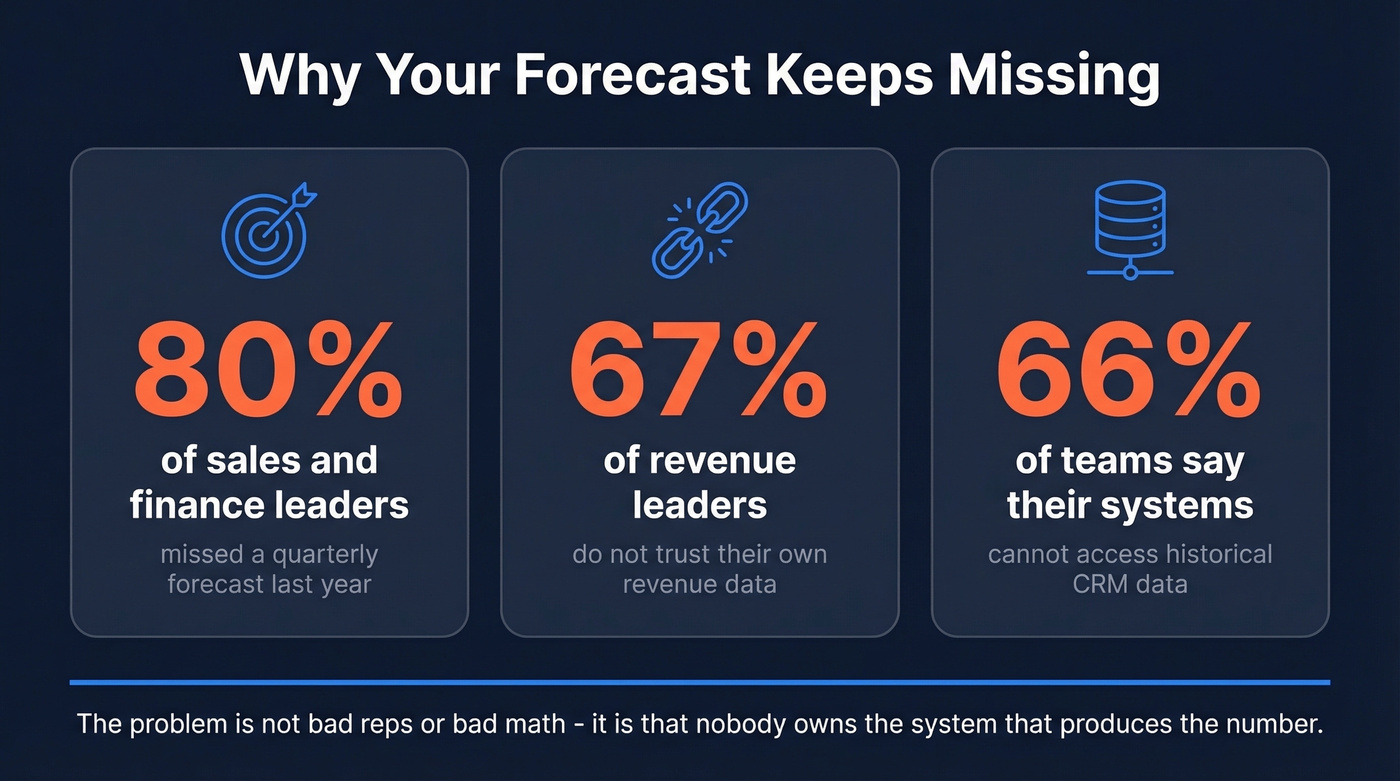
And 66% of teams say their reporting systems can't even access historical CRM data, which makes trend analysis impossible.
A common misconception is that organizations rely on a single methodology. The best-performing teams actually layer multiple approaches - bottom-up pipeline roll-ups, top-down trend models, and AI-weighted scoring - then reconcile the outputs. Relying on one method is how you end up with a blind spot that blows up your quarter.
If you're trying to standardize this, it helps to align on pipeline health metrics and a shared definition of funnel metrics.
Then there's the Finance-Sales cold war. On r/FPandA, one practitioner described being stuck between a commercial team that's "too optimistic" and a finance team demanding earlier deadlines - with no process to reconcile the two. That timing mismatch is structural, not personal. It shows up in finance discussions about forecast governance constantly.
Here's the thing that really gets us: when reps get criticized for close-date accuracy on deals that did close - just not on the predicted date - you've created a system that punishes the people feeding it data. That's a governance failure, not a rep failure.
Why RevOps Is Taking Over
Gartner predicted that 75% of the highest-growth companies would deploy a RevOps model by 2025. BCG found mature RevOps functions drive 10-20% sales productivity gains, and Forrester reported 36% more revenue growth in RevOps-aligned organizations.
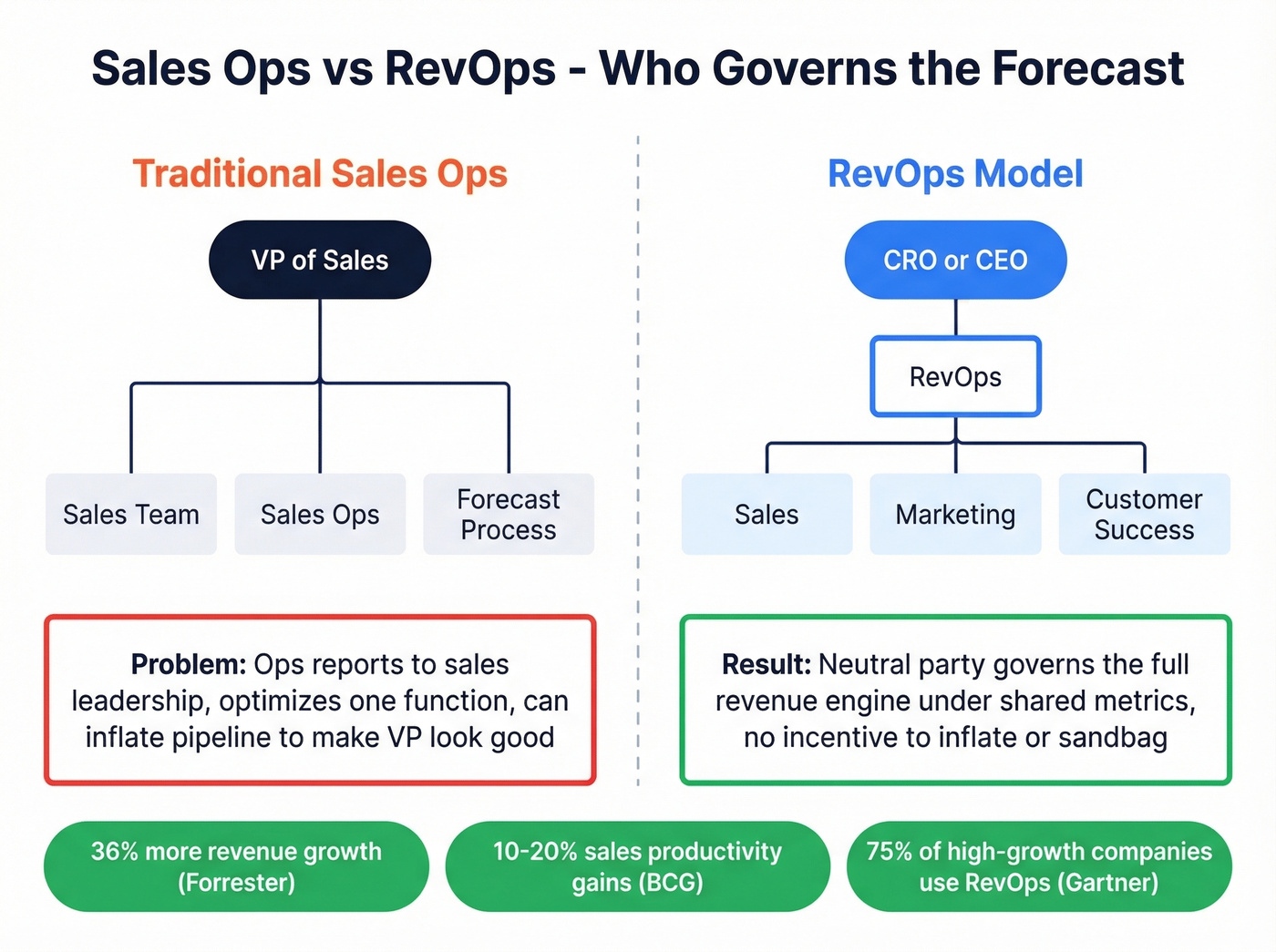
Let's be honest about what's actually happening here. Most companies don't have a forecasting problem. They have a reporting-line problem. Sales Ops reports to sales leadership and optimizes one function. RevOps reports to the CRO or CEO and governs the full revenue engine - sales, marketing, and customer success under shared metrics. That reporting line makes RevOps a neutral party. They're not inflating pipeline to make a VP look good, and they're not sandbagging for Finance. They're governing the process.
We've seen it consistently: teams that centralize forecast governance under RevOps stop having 90-minute argument calls. The calls get shorter, the numbers get tighter, and decisions actually happen.
Skip this approach if your org has fewer than 15 sellers. At that size, a dedicated RevOps hire is overkill - your sales manager can wear both hats as long as the RACI is written down and someone reviews it quarterly.
If you do scale it, document the operating cadence like you would for sales operations metrics and keep it tied to sales performance management.
Fix Your Data Before Your Process
A Forrester analyst said it best: "When you ask questions of data that's not very good, you don't get very good answers back." Your forecast is only as accurate as your pipeline data - and 61% of companies didn't hit their revenue targets last year partly because of it.
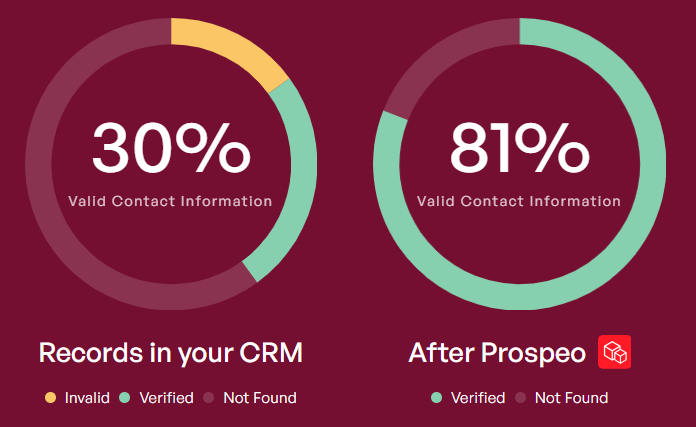
Before investing in a forecasting platform, fix the foundation. Stale contacts, bounced emails, and phantom pipeline inflate every number downstream. We run enrichment workflows through Prospeo's 7-day data refresh cycle with 98% email accuracy, and the difference is immediate - you can see which deals have reachable buyers and which are dead weight sitting in your CRM making your forecast look better than it is.
If you're evaluating vendors for this layer, start with a shortlist of data enrichment services and make sure your CRM is set up like a real contact management software system - not a dumping ground.
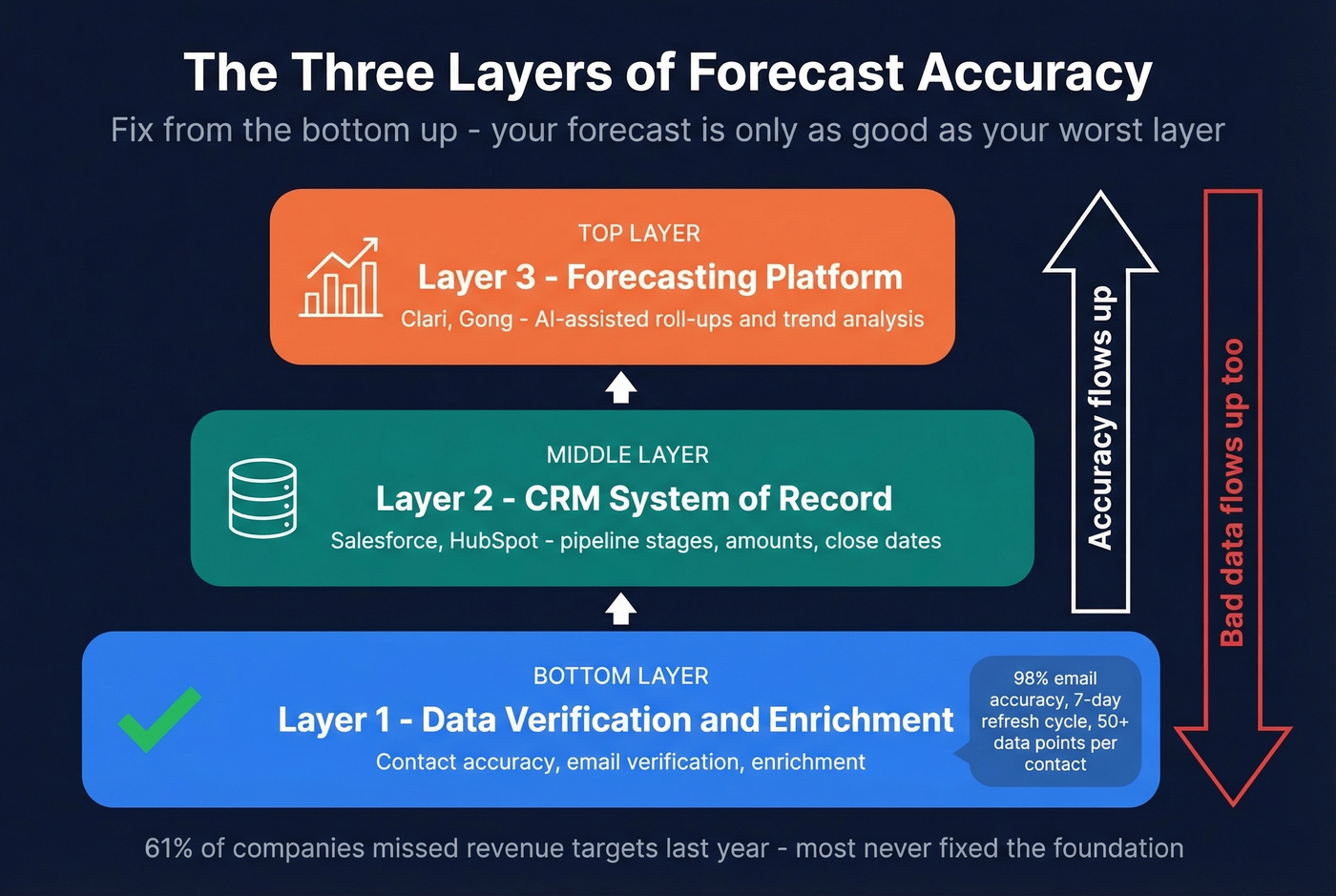
That cleanup is the prerequisite before any forecasting layer adds value.
RevOps teams running forecast governance need pipeline data they can actually trust. Prospeo enriches your CRM with 50+ data points per contact at a 92% match rate - so when your managers roll up commit numbers, they're built on verified emails and live contacts, not six-month-old records from a provider that refreshes every six weeks.
Give your RevOps team data worth governing. 75 free emails, no contract.
FAQ
Does the CEO own the sales forecast?
No. The CEO consumes the forecast - they're "Informed" in the RACI, not Accountable. The VP of Sales owns the number and is answerable for its accuracy. The CEO should be questioning whether the forecasting process works, not building the number themselves.
Should sales reps forecast their own deals?
Reps should update pipeline data: stage, close date, amount, and next steps. The manager then produces the actual forecast number using rep inputs plus historical win-rate patterns. Asking reps to forecast in isolation creates the resentment that tanks CRM hygiene - and inflates the number by 20-30% on average.
What tools improve forecast accuracy?
Three layers work best together: a CRM like Salesforce or HubSpot as the system of record, a data verification layer for contact accuracy and enrichment, and a forecasting platform like Clari or Gong for AI-assisted roll-ups. The verification layer matters most - bad contact data means phantom pipeline that inflates every number downstream.
How often should you review forecast ownership?
Audit your RACI quarterly. Role drift is the top reason forecast processes degrade - someone leaves, a new manager joins, and suddenly nobody runs the post-mortem. A 30-minute quarterly review of who does what prevents months of compounding inaccuracy.