

=== CURRENT ARTICLE (slug: why-am-i-blacklisted) ===
Why Am I Blacklisted? Causes, Fixes & Prevention
You sent a batch of emails last Tuesday. Half bounced. You ran your IP through MxToolbox, found three blacklists you've never heard of, and now you're staring at your screen wondering what went wrong. Here's the thing: "blacklisted" means five completely different things depending on context, and the fix for each one is different.
Which Type of Blacklist Are You On?
Let's triage fast:

- Emails bouncing or landing in spam? Check MxToolbox or multiRBL. Fix authentication, clean your list, request delisting.
- Phone showing "Spam Likely"? High call volume or an inherited number. Register with carrier reputation programs.
- Blocked from a store or website? Chargeback history or flagged payment info. Contact the merchant directly.
- Bank account denied? Check ChexSystems. Dispute errors; investigations typically take around 30 days.
- Can't get hired? Request your background check report. Dispute inaccuracies under the FCRA.
Most of you are here about email. Let's start there.
Email & IP Blacklisting
Email blacklists - formally called DNSBLs - flag IP addresses and domains associated with spam. When your email lands on one, Gmail, Outlook, and Yahoo use that signal to bounce or junk your messages. A major listing can cut deliverability by 50% or more.
Why You Got Listed
Exceed a 2% bounce rate or 0.1% spam complaint rate and you're in the danger zone. Hit a spam trap - an unpublished address designed to catch senders who scrape or don't clean their lists - and you're flagged immediately.
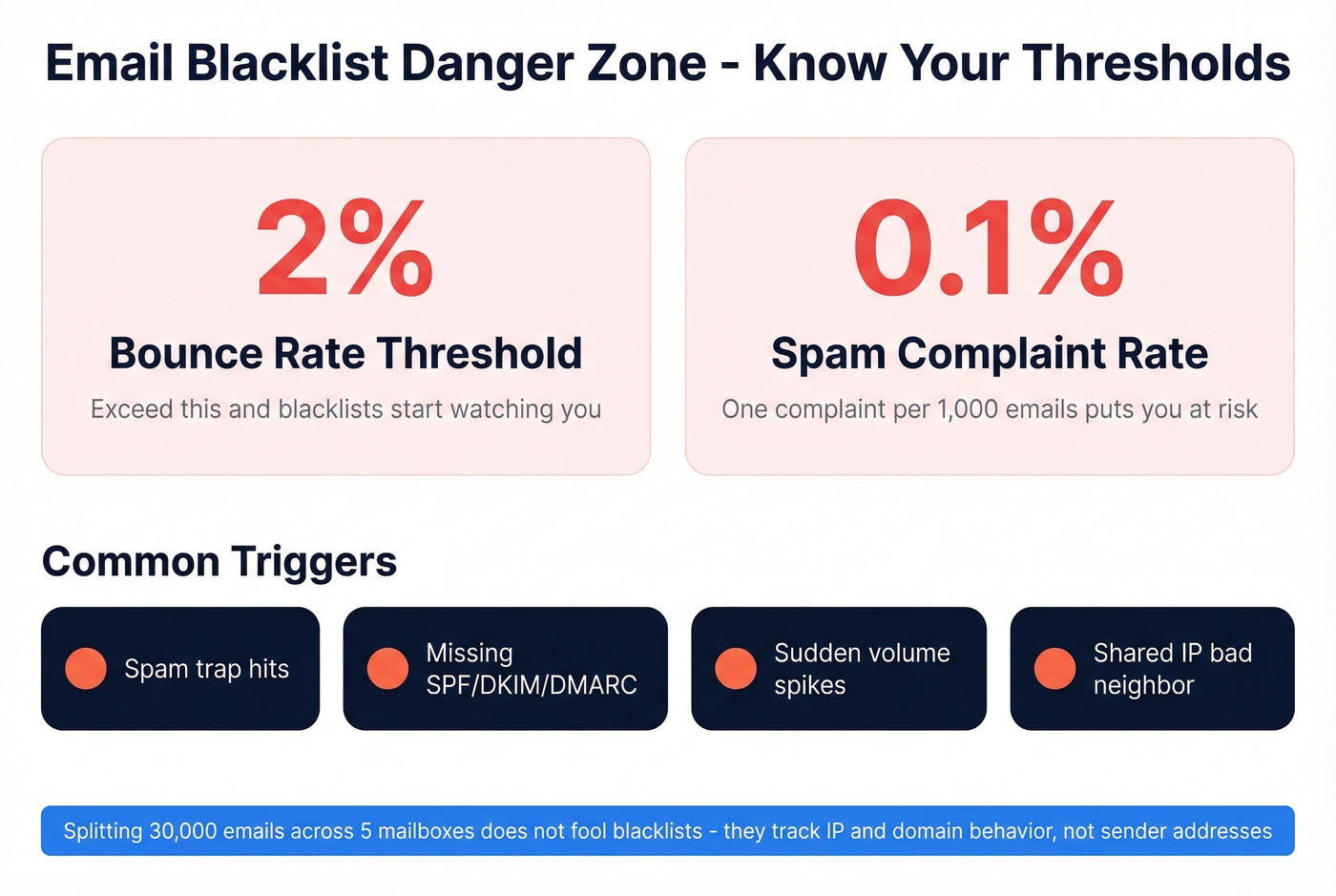
Other common causes: missing SPF/DKIM/DMARC records, sudden volume spikes, purchased lists, and the shared-IP "bad neighbor" problem where someone else on your server trashes the reputation for everyone. If you're buying lists, read Is It Illegal to Buy Email Lists? before you send another batch.
One business owner on r/email was listed on UCEPROTECT L2 and L3 after sending just 500 emails to existing clients, because they were on shared HostGator hosting and another sender on that IP had wrecked things. Three to four years of cyclical deliverability issues, all from someone else's mess.
And splitting 30,000 emails across 5 mailboxes doesn't fool anyone. We've watched startups try exactly this - rotating addresses at 6,000/day each - and end up flagged across every mailbox they touched. Blacklists track IP and domain behavior, not individual sender addresses. If you're unsure what "safe" sending looks like, use an email velocity framework instead of guessing.
One critical distinction: blacklists can be IP-based or domain-based. Domain blacklisting persists even if you change IPs. The "just get a new IP" strategy fails more often than it works. If you're trying to rebuild trust, follow a structured plan to improve sender reputation.
How to Check Your Status
A blacklist bounce typically looks like this in your logs:
550 5.7.1 Service unavailable; client host [x.x.x.x] blocked using zen.spamhaus.org
Run your IP through these free tools:
- MxToolbox - free blacklist check covers 100+ spam blacklists; paid monitoring adds alerts and history
- multiRBL - checks 200+ blacklists, completely free
- WhatIsMyIPAddress - quick single-IP check
If a guide tells you to check SORBS, it's outdated. SORBS is permanently decommissioned.
How to Get Delisted
Each blacklist has its own process:
| Blacklist | Lookup | Process | Timeframe |
|---|---|---|---|
| Spamhaus SBL | check.spamhaus.org | Submit form with identity verification + corrective measures | 24-48h |
| Spamhaus XBL | Uses CBL data | Auto-delists after cleanup | Hours-24h |
| Spamhaus PBL | check.spamhaus.org | Removal form (not a spam accusation) | Same day |
| Barracuda BRBL | barracudacentral.org | Request removal, verify via email | ~12-24h |
| SpamCop | spamcop.net | Auto-delists if no new reports | 24-48h |
| UCEPROTECT L1 | uceprotect.net | Free delist after 7 days | 7 days |
| UCEPROTECT L2/L3 | uceprotect.net | Requires host/operator action | Weeks-months |
For provider-specific blocks: Microsoft uses delist@messaging.microsoft.com - include the full NDR, your IP, and error code (look for 550 5.7.511). Yahoo has its Postmaster portal. Prioritize Spamhaus and Barracuda first; they're the most widely used blocklist providers. If you're specifically dealing with Spamhaus, follow a dedicated Spamhaus blacklist removal workflow.
Fix the Root Cause
Getting delisted without fixing the underlying problem is pointless. You'll be back on the list within weeks. In our experience, the two fixes that matter most are authentication and list hygiene. For a deeper breakdown, use this email deliverability guide as your checklist.
Sending without SPF/DKIM/DMARC in 2026 is like running a website without HTTPS. DMARC adoption hit 53.8% in 2024 and the trajectory is clear - if you haven't set it up yet, you're behind. Setup takes 30-60 minutes. If you want to sanity-check your setup, see how to verify DKIM is working and review DMARC alignment.
Beyond authentication, verify every email before you send. Prospeo runs 5-step verification - including spam-trap removal and catch-all handling - at 98% accuracy, eliminating the bounces and trap hits that trigger blacklist flags in the first place. Stop using purchased lists. Stop sending to addresses you haven't verified in six months. If you're already dealing with traps, use a dedicated spam trap removal process.
Most blacklisting isn't a deliverability problem. It's a data quality problem. Fix the data and the blacklists take care of themselves.
Post-Delisting Warm-Up
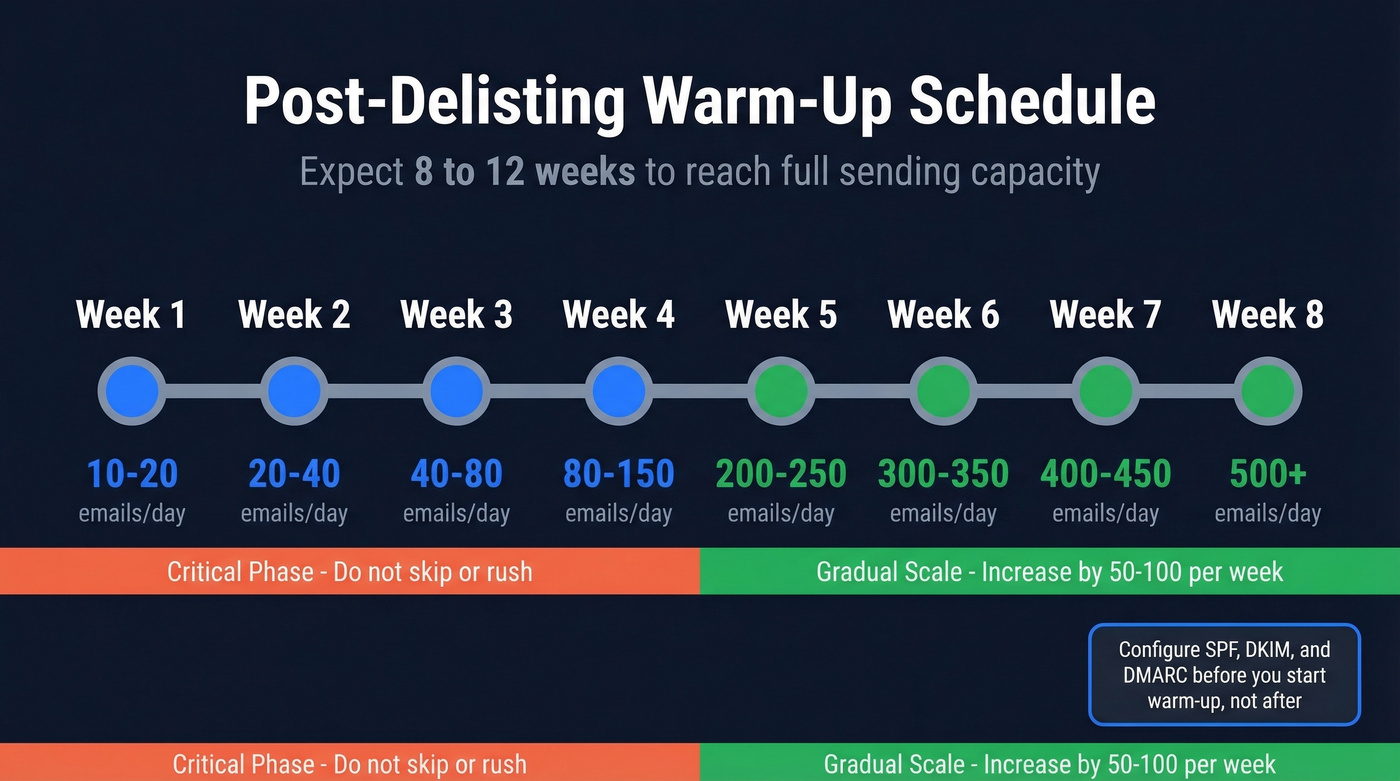
Getting listed is step one of the problem; getting delisted is step two. But if you resume normal volume immediately, you'll be relisted. The consensus on r/coldemail is that skipping warm-up "wrecked" one poster's domain reputation entirely. We've seen the same pattern across dozens of domains - teams that skip warm-up end up relisted within two weeks. If you're scaling outbound, follow the same principles in our guide on the best way to send bulk email without getting blacklisted.
| Week | Daily Volume |
|---|---|
| 1 | 10-20 |
| 2 | 20-40 |
| 3 | 40-80 |
| 4 | 80-150 |
| 5-8 | Increase by 50-100/week |
Expect 8-12 weeks to reach full sending capacity. Configure SPF/DKIM/DMARC before you start warm-up, not after.

Most blacklistings trace back to dirty data - bounces, spam traps, and unverified addresses. Prospeo's 5-step email verification catches all three before you hit send. 98% accuracy, spam-trap removal, and catch-all handling at $0.01 per email.
Stop getting blacklisted. Start sending to verified contacts only.
Phone Number Blacklisting
If your outbound calls show "Spam Likely," you're dealing with carrier-level reputation scoring. Hiya reported 11.3 billion suspected spam calls in Q4 2024 - roughly 123 million per day. Carriers are aggressive about flagging now, and it doesn't take much to trigger it. If you're evaluating calling stacks, compare options like Dialpad alternatives before you commit.
The fix: register with carrier reputation programs like Free Caller Registry and Hiya Connect, ensure STIR/SHAKEN compliance through your provider, keep call volume steady rather than spiking, and if your number's been burned, get a new one and ramp gradually.
Other Types of Blacklisting
Shopping & Merchant Blacklists
Retailers and payment processors maintain internal blacklists tied to chargeback history, flagged payment methods, or suspicious return patterns. If you're blocked from a store, contact the merchant directly, resolve outstanding chargebacks, and use consistent payment information going forward. These are private lists - there's no central lookup tool.
Credit & Employment Blacklists
Banks use ChexSystems and similar registries to flag accounts with overdraft or fraud history. Request your report, dispute errors, and wait for the investigation window to complete.
For employment, background check errors or industry "do not hire" lists can silently block you. Under the FCRA, you're entitled to an adverse action notice. Request your report and dispute inaccuracies directly with the reporting agency. Skip this section if you're only dealing with email - the processes are completely separate.
Prevention Checklist
Most blacklisting scenarios are preventable with basic hygiene:
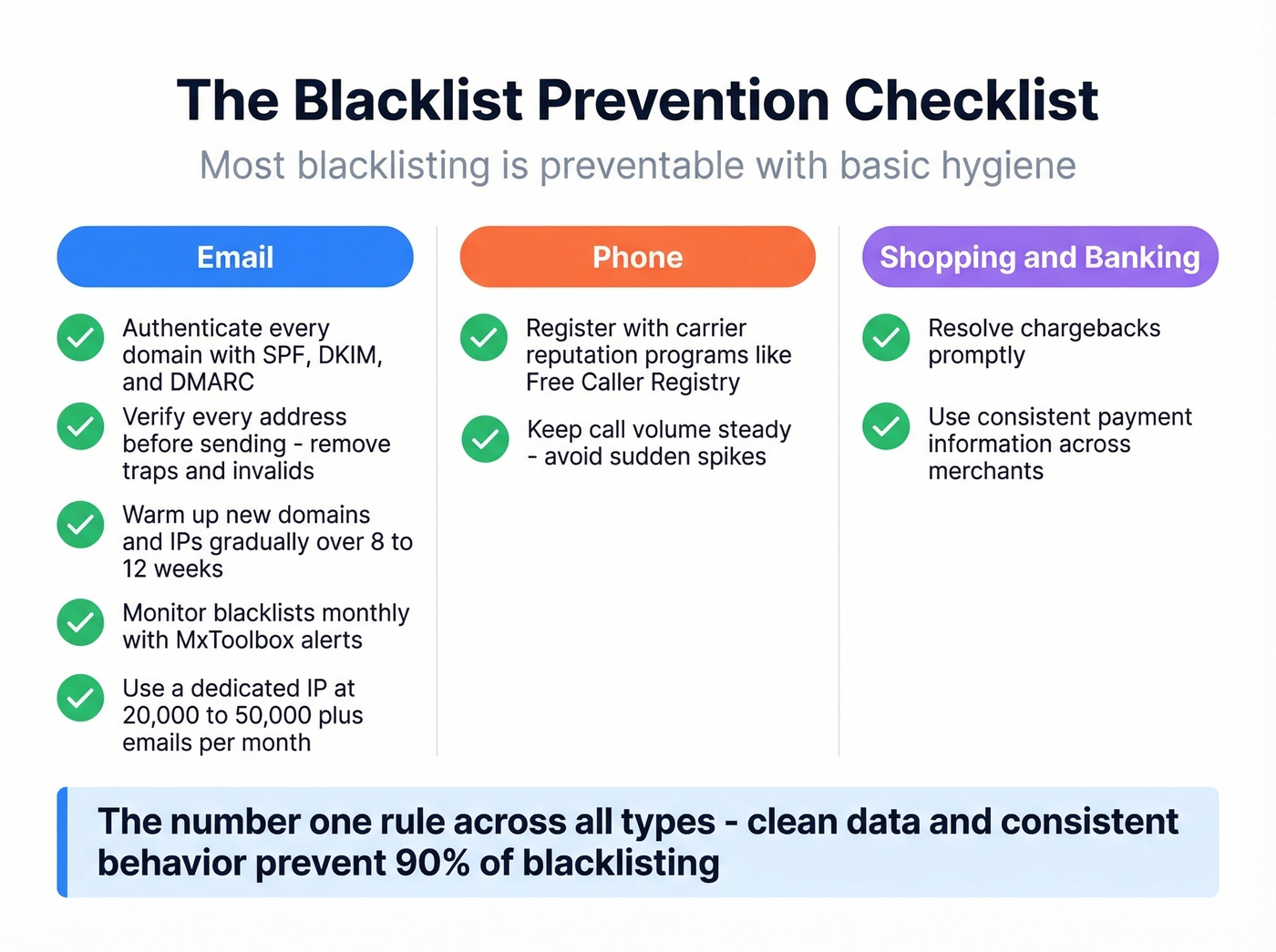
- Authenticate your email - SPF, DKIM, and DMARC on every sending domain (use these SPF record examples if you’re stuck)
- Verify every address before sending - catch spam traps, invalids, and catch-alls before they damage your reputation
- Warm up new domains and IPs gradually - follow the ramp schedule above
- Monitor blacklists monthly - set up MxToolbox alerts, not just one-time checks
- Use a dedicated IP if you're sending around 20,000-50,000 emails/month or more
- For phone: register with carrier reputation programs and keep call volume steady
- For shopping: resolve chargebacks promptly and use consistent payment info

Warm-up takes 8-12 weeks. Rebuilding domain reputation takes longer. Or you skip all of it by never sending to bad addresses in the first place. Prospeo refreshes 300M+ profiles every 7 days - not every 6 weeks like competitors - so your list never goes stale.
Clean data is the only permanent fix for blacklisting. Get it now.
FAQ
Can one blacklisted address take down my whole domain?
Yes. If your domain - not just your IP - gets listed from repeated spam complaints or trap hits, every address on that domain is affected. Domain-level entries persist even if you switch IPs or hosting providers, which is why authentication and list hygiene matter for every sender on your domain.
How long does it take to get off an email blacklist?
Minor listings like SpamCop or Barracuda clear in 12-48 hours. Spamhaus takes 24-48 hours after you submit corrective measures. UCEPROTECT L2/L3 requires your hosting provider to act and can take weeks. Severe multi-list cases can stretch to 3-4 months for full recovery.
What's the best way to prevent getting blacklisted again?
Three things prevent 90% of email blacklisting: authenticated sending with SPF/DKIM/DMARC configured correctly, verified email lists that filter out spam traps and invalid addresses before you send, and gradual volume ramp-up after any sending pause. The data side is where most teams slip up - a single batch sent to an unverified list can undo months of good sender reputation.