

How to Write a Sales Email That Actually Gets Replies
The average cold email reply rate is 3.43%. That's across billions of interactions tracked by Instantly in 2026. Most reps write a sales email that disappears into the void, gets flagged as spam, or sits unread in a tab that never gets reopened.
We've watched teams rewrite their emails five times when the real problem was deliverability - their messages never reached the inbox. The gap between 3% and 10% isn't talent or luck. It's a handful of decisions you make before and during the writing process, starting with whether your email actually lands.
The Three Things That Actually Matter
Three decisions separate a 1% reply rate from a 10% reply rate:
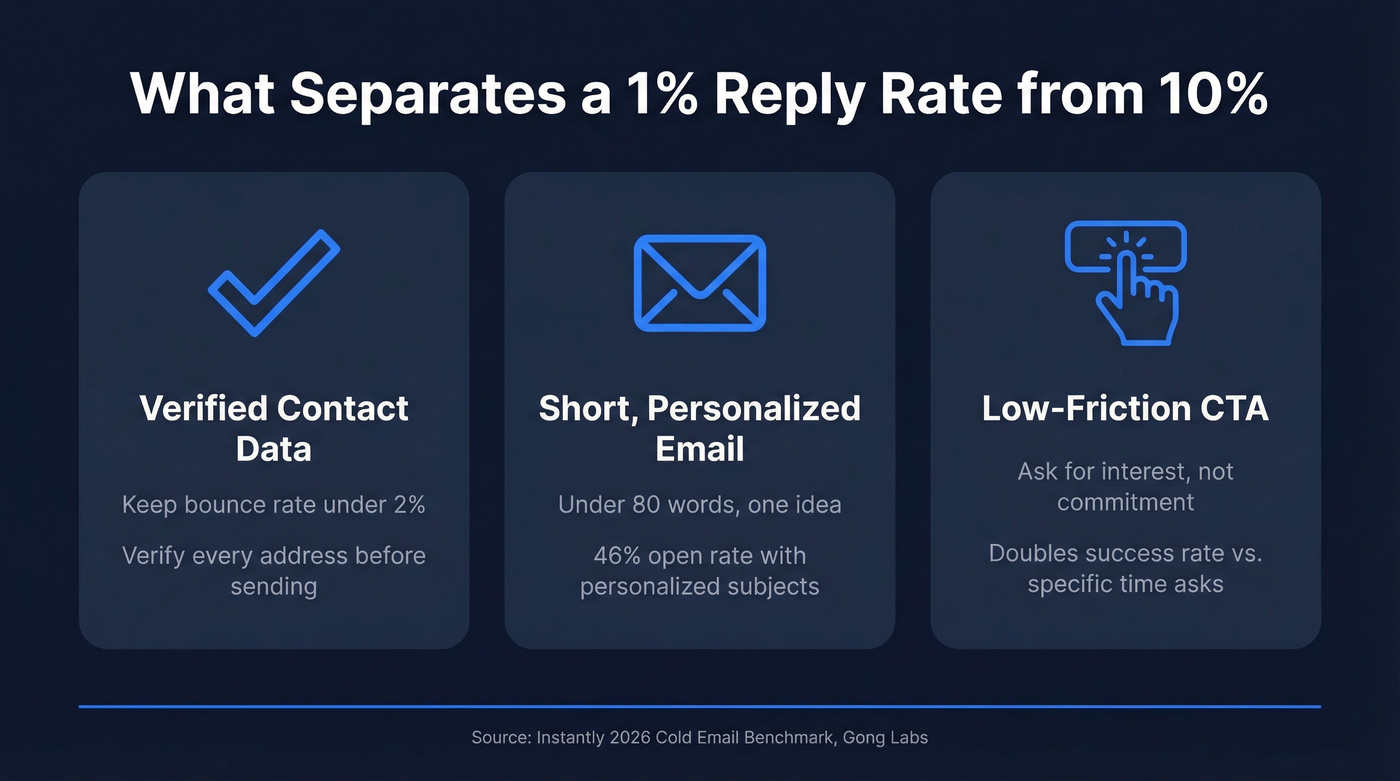
- Verified contact data. If your email bounces, nothing else matters. Your bounce rate must stay under 2%, which means verifying every address before you send.
- A short, personalized email. Under 80 words. One idea, one proof point, one question. Personalized subject lines hit 46% open rates versus 35% without - that lift alone changes your entire funnel.
- A low-friction CTA. "Does this sound relevant?" doubles your success rate compared to pushing for a specific meeting time. Ask for interest, not commitment.
Before You Write - Make Sure It Lands
Here's the thing: most guides on sales email copywriting skip straight to the writing. That's like optimizing a landing page nobody can load. If your email hits spam, your subject line doesn't matter. Your personalization doesn't matter. Your clever CTA doesn't matter.
Google, Yahoo, and Microsoft now enforce bulk sender rules requiring SPF, DKIM, and DMARC authentication plus one-click unsubscribe headers. Miss any of these and you're filtered before a human ever sees your name.
The thresholds that'll kill your domain reputation:
- Spam complaints: Stay under 0.3%. One complaint per 333 emails.
- Bounce rate: Stay under 2%. This is where bad contact data destroys campaigns silently.
- Inbox placement: Target 80%+ on seed tests before scaling.
For warming up a new domain, start at 5-10 emails per day and ramp over 4-6 weeks. Practitioners on r/coldemail recommend capping at 20 emails per inbox per day, turning off open tracking pixels, and skipping images entirely on first touches. These aren't optional best practices - they're survival rules.
Your bounce rate is the one you can control immediately. The only way to guarantee it stays under 2% is to verify every address before you send. Prospeo runs a 5-step verification process with catch-all handling, spam-trap removal, and honeypot filtering - 98% email accuracy. One customer, Meritt, dropped their bounce rate from 35% to under 4% after switching. That's the difference between a domain that builds reputation and one that gets blacklisted.

Anatomy of a Sales Email That Converts
Subject Line
A study of 5.5 million emails by Belkins found that personalized subject lines hit a 46% open rate versus 35% without personalization. That's a 31% lift just from making the subject feel relevant to the recipient. Reply rates jumped from 3% to 7%.
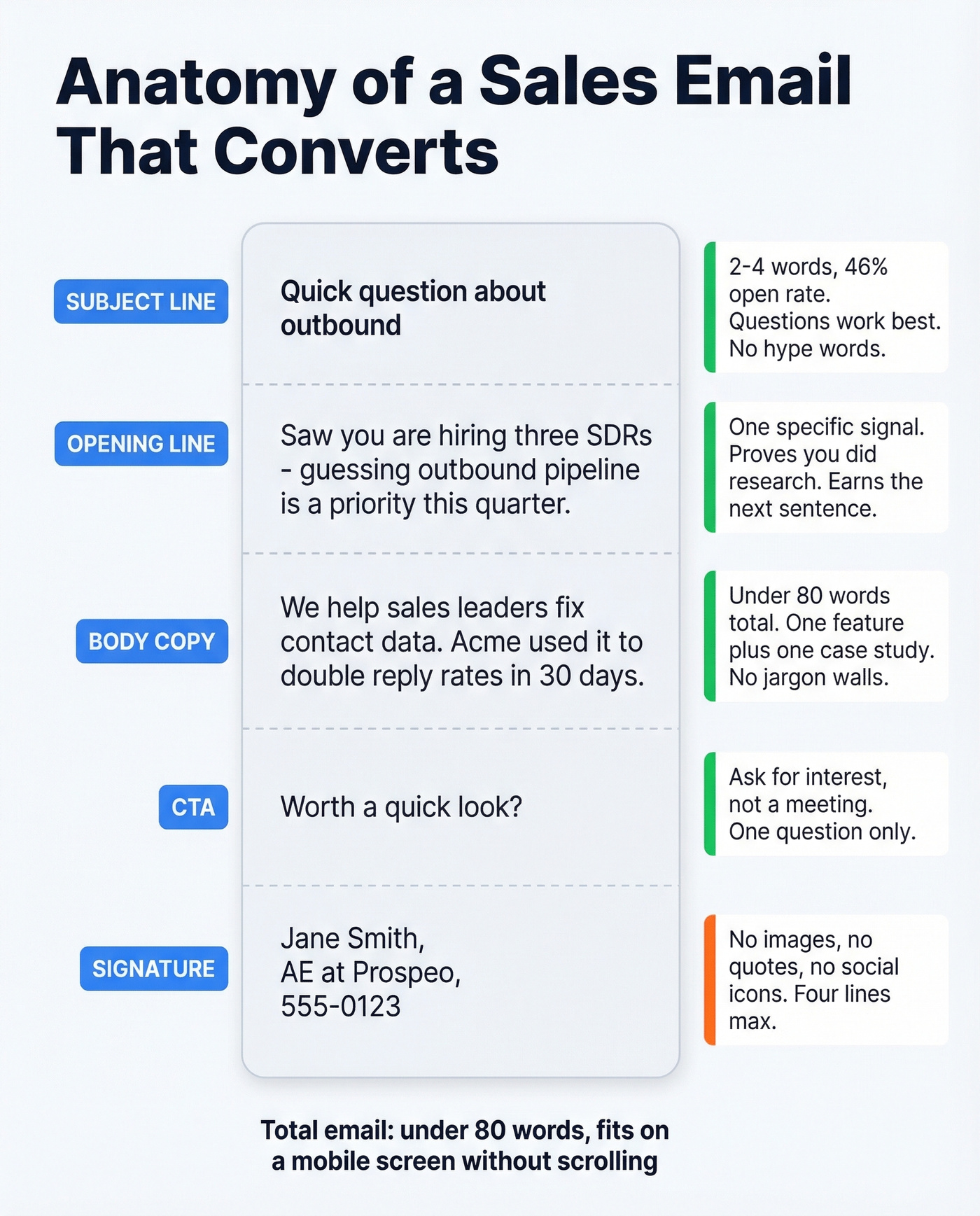
Keep it short. Two to four words hit 46% open rates. Performance drops steadily beyond seven words, falling to 34-35% at nine or ten words. Question-format subject lines were the top performers overall.
What to avoid: urgency words, hype language, and generic greetings. "ASAP," "Don't miss this," and "Hello, friend" all dragged open rates below 36%.
Good subject lines look like this:
- "Quick question about [department]"
- "[Mutual connection] suggested I reach out"
- "Saw your [trigger event]"
Short, specific, and they sound like something a real person would type. If you want more options, pull from these subject lines.
Opening Line
Forget "I noticed your company is doing great things in the [industry] space." Every prospect has read that sentence 400 times. It signals "template" instantly.
One strong personalization signal beats five generic compliments. Reference a specific funding round, a job posting that reveals a pain point, a technology in their stack, or a recent company announcement. The goal is to prove you spent 30 seconds understanding their world - not that you ran a mail merge. For more ideas, use this personalization playbook.
Two strong openers:
"Saw you're hiring three SDRs - guessing outbound pipeline is a priority this quarter."
"Noticed [Company] just closed Series B - congrats. Usually means the growth team is scaling fast."
One sentence each. Specific. They earn the next sentence.
Body Copy
The best-performing cold emails stay under 80 words. A practitioner on r/sales who books 6-7 meetings per week shared a structure that "nearly doubled" their performance: one feature plus one case study. Not a feature dump. Not a company overview. One thing you do, and one result you've driven.
The formula: "We help [role] do [specific thing]. [Company name] used it to [specific result]." Two sentences. Maybe three. Write like you talk - short sentences, white space between paragraphs, no jargon walls. If you want a deeper breakdown, see our guide to email copywriting.
If your email requires scrolling on mobile, it's too long. Practitioners on r/sales estimate prospects give you about 2.7 seconds to decide if they'll read or delete - 80% of people only scan anyway.
The CTA
This is where most sales emails die. You've written a tight, personalized email - then you blow it with "Are you free for 15 minutes next Tuesday at 2pm?" Too much commitment from a stranger.
Gong Labs data shows that asking for interest - "Does this sound relevant?" or "Worth exploring?" - doubles your success rate compared to pushing a specific time slot. One question. Low friction. Let them say yes to the concept before you negotiate logistics. For more examples, use these email call to action rules.
Bad CTAs: "Let me know your thoughts" (too vague), "Book time here: [Calendly link]" (too aggressive for a first touch), "Would love to connect" (means nothing).
Good CTAs: "Is this on your radar for Q3?" or "Worth a quick look?"
Signature
Keep it simple: name, title, company, phone number. No banner images, no inspirational quotes, no social media icons. Images can trigger spam filters, and a cluttered signature undermines the clean, personal feel you just built. Four lines max.

You just read that keeping bounce rates under 2% is non-negotiable. Meritt dropped theirs from 35% to under 4% with Prospeo's 5-step email verification. At $0.01 per email, cleaning your entire list costs less than one bounced opportunity.
Stop rewriting emails when the real problem is bad data.
Two Frameworks That Replace Every Template
Stop collecting templates. Learn two frameworks and you'll never need another template article again.
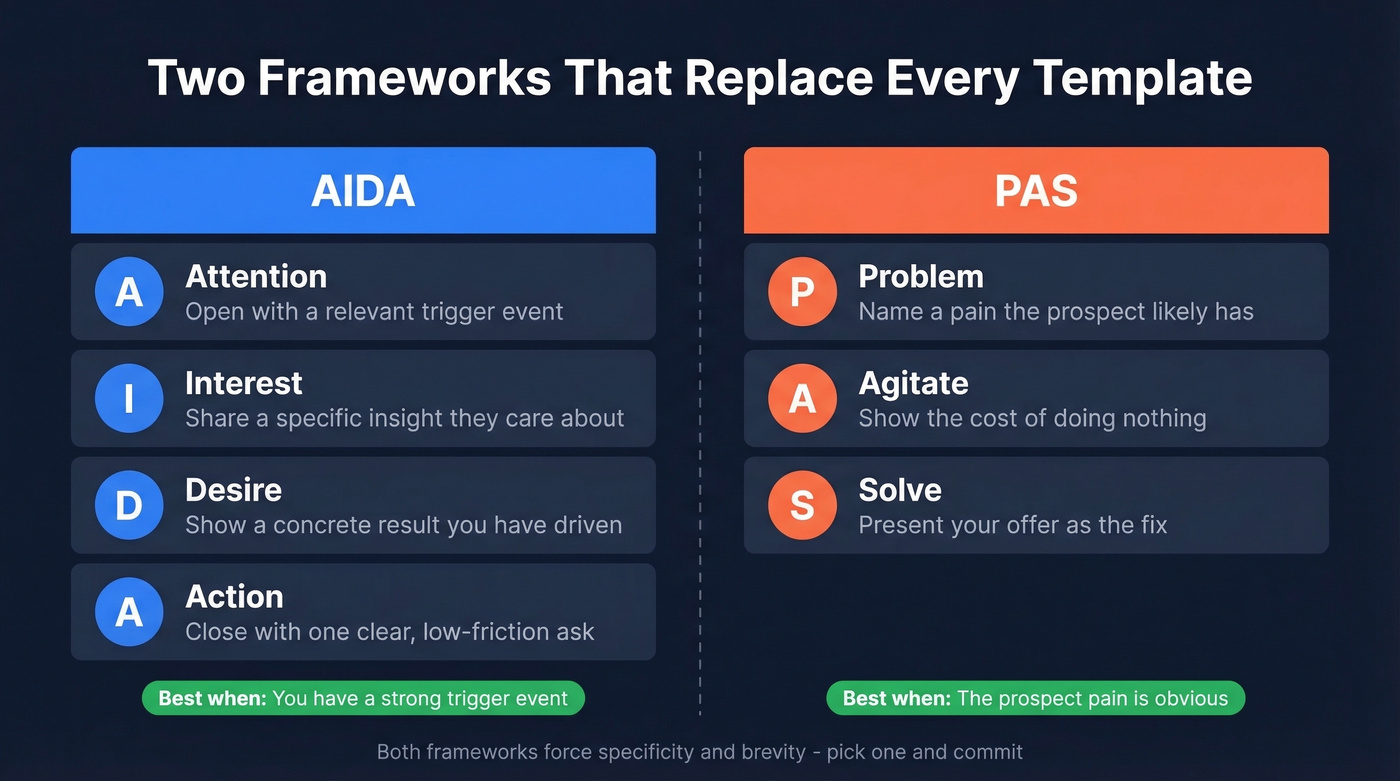
AIDA - Attention, Interest, Desire, Action. Open with something that earns attention via a relevant trigger. Build interest with a specific insight. Create desire with a result. Close with a clear action. (If you want to go deeper, see the full AIDA breakdown.)
Subject: Quick question about outbound
Hi Sarah - saw you're scaling the SDR team to 8. That usually means pipeline targets just jumped.
We helped [Company] increase booked meetings by 40% in 90 days by fixing their contact data layer.
Worth a 10-minute look?
PAS - Problem, Agitate, Solve. Name a problem the prospect likely has. Show the cost of inaction. Solve it with your offer.
Subject: Bounce rates killing pipeline?
Most outbound teams lose 15-20% of their emails to bounces. That's not just wasted sends - it's domain reputation damage that compounds every week.
We fixed this for [Company] and their reply rates doubled in 30 days. Relevant?
Both frameworks force you to be specific and concise. Pick AIDA when you have a strong trigger event; pick PAS when the prospect's pain is obvious.
Five Templates You Can Send Today
Cold Outreach (First Touch)
Subject: [Specific result] for [their role]
Hi [Name] - you handle [function], so I'm guessing [specific challenge] is on your plate.
We help [role] do [one thing]. [Client name] used it to [specific metric improvement] in [timeframe].
Worth exploring?
One feature, one case study, one question. Under 50 words.
Warm Introduction
Subject: [Mutual connection] suggested I reach out
Hi [Name] - [Connection] mentioned you're working on [initiative]. We helped their team with [related problem] last quarter.
Happy to share what worked if it's relevant to what you're building.
The mutual connection earns the open. The offer is low-pressure.
Follow-Up #1 (Reply-Style)
Most reps send a brand-new email restating everything from the first touch. It feels like a second cold email. The prospect ignores it.
Do this instead:
Subject: Re: [Original subject]
Quick follow-up on my note below - worth a look?
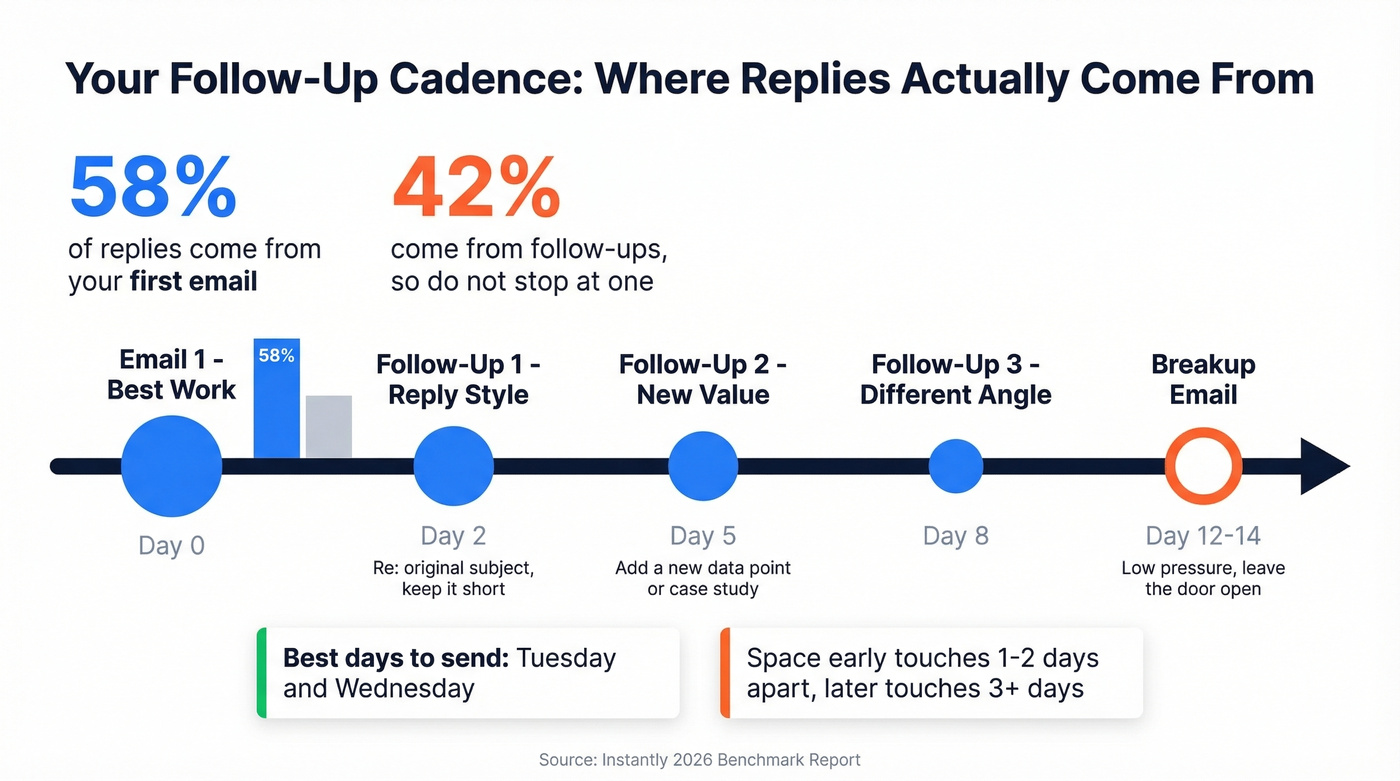
Instantly's data shows reply-style follow-ups outperform formal follow-ups by roughly 30%. It feels like a real reply, not a new pitch. If you want more options, use these sales follow-up templates.
Follow-Up #2 (New Value)
Subject: Re: [Original subject]
Thought this might be useful - [Client] just published a case study on [relevant topic]. They cut [metric] by [number] in [timeframe].
Happy to share the full breakdown if it's relevant.
Every follow-up must earn its existence with a new data point or angle. "Just bumping this to the top of your inbox" isn't a follow-up - it's noise.
Breakup Email
Subject: Should I close the loop?
Hi [Name] - I've reached out a few times and haven't heard back. If the timing isn't right, I'll step back.
If [problem] becomes a priority down the road, I'm easy to find.
Low pressure, leaves the door open, and occasionally triggers a response from prospects who were interested but busy.
Building Your Follow-Up Cadence
58% of replies come from the first email. That means your first touch should be your best work - don't save the good stuff for follow-up #3. But the remaining 42% come from follow-ups, so you can't send one email and quit. (For timing rules, see when should you follow up.)
| Email-Only | Multi-Channel | |
|---|---|---|
| Touchpoints | 4-7 | 8-12 |
| Duration | 10-14 days | 17-21 days |
| Early spacing | 1-2 days | 1-2 days |
| Late spacing | 3+ days | 3+ days |
| Channels | Email only | Email + calls + social |
Multi-channel duration based on Outreach cadence research.
Start with tighter spacing between the first few touches and expand to 3+ days later in the sequence to reduce fatigue. Tuesday and Wednesday are peak reply days - front-load your sends there.
Tools That Make Your Emails Land
You don't need a 12-tool stack. You need three things working together.
For verified contact data, Prospeo gives you 300M+ professional profiles with 98% email accuracy and a 7-day data refresh cycle. The free tier includes 75 verified emails per month - enough to test your first campaigns without spending anything. If you're comparing options, start with these data enrichment services.
For sending infrastructure, Instantly or Smartlead handle inbox rotation, warm-up, and sequencing for roughly $30-100+/mo depending on seats and volume. They're purpose-built for cold outbound at scale. If you're scaling volume, follow safe email velocity limits.
For multi-channel sequencing, tools like Lemlist or Salesloft add calls and social touches to your cadence. These matter more once you've nailed the email-only fundamentals. Skip Salesloft if you're early-stage and don't need enterprise workflows yet.
Let's be honest: if your deal sizes are under $10k, you probably don't need an enterprise sales engagement suite priced in the thousands per month. We've seen teams run flawless sequences on a $30/mo platform and book more meetings than teams spending 50x that with bad contact data underneath. The tool matters far less than the data feeding it. If deliverability is the bottleneck, use an email deliverability guide to diagnose it end-to-end.
Every framework above assumes your email reaches the inbox. Prospeo verifies 143M+ emails at 98% accuracy with catch-all handling, spam-trap removal, and honeypot filtering - refreshed every 7 days. Your copy does the selling. We make sure it lands.
Write the perfect sales email. We'll make sure it gets delivered.
FAQ
How long should a sales email be?
Under 80 words. Instantly's 2026 benchmark data across billions of cold email interactions confirms the best-performing campaigns stay under 80 words. Two to three short paragraphs with one question at the end is the format that consistently wins. If it scrolls on mobile, cut it.
How many follow-ups should I send?
Four to seven for email-only sequences, eight to twelve if you're mixing in calls and social touches. 58% of replies come from the first email, so front-load your best message. Each follow-up must add new value - a case study, a data point, or a fresh angle.
Why are my sales emails going to spam?
Usually one of three things: your domain isn't authenticated (SPF, DKIM, and DMARC are all required), your bounce rate is above 2% because of bad contact data, or you're sending too many emails too fast from a new domain. Fix authentication first, then verify your list to get bounces under 2%.
What's a good cold email reply rate?
The average is 3.43%. If you're clearing 5%, you're above average. If you're hitting 8-10%, you're in the top tier. The biggest lever isn't copywriting - it's making sure your emails actually reach the inbox with verified data and proper domain authentication.