


Zymplify Alternatives: The 7 Best Options in 2026
Most "Zymplify alternatives" lists dump 40+ tools into a directory table with no pricing, no opinions, and no context. That's useless when you're trying to replace a specific stack before renewal hits.
You're probably here because the intent data concept is solid but the execution isn't matching the price tag - the clunky interface, the half-built reporting, the £600/mo question mark. We've helped teams migrate off Zymplify, and the answer is almost never "find another all-in-one." It's "break the stack apart and pick best-in-class at each layer."
Our Top Picks (TL;DR)
Three trials worth running this week:
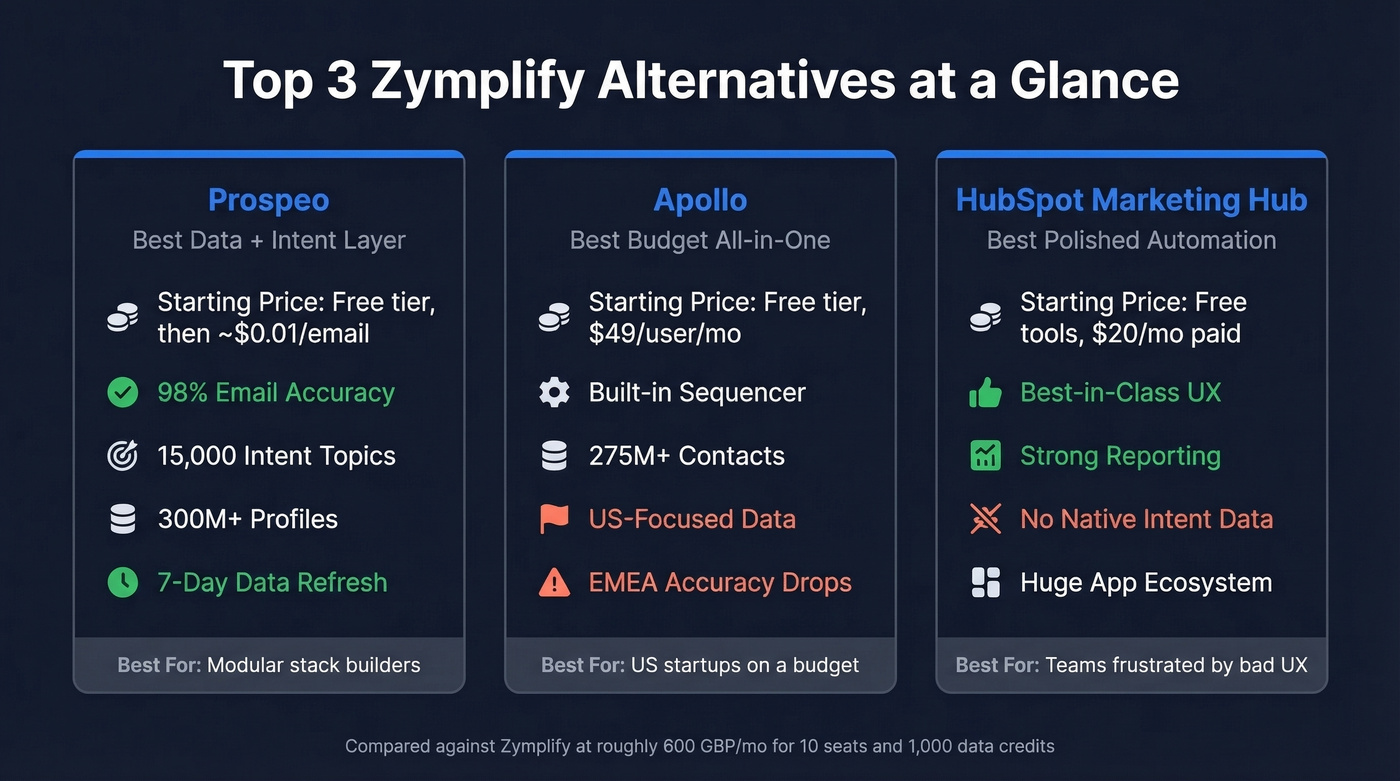
- Prospeo - Best for verified data + intent signals. 98% email accuracy, 15,000 Bombora intent topics, 7-day data refresh. Free tier gets you 75 verified emails/month. Start here if data quality is the core problem and you want a modular stack without the platform tax.
- Apollo - Best budget all-in-one prospecting. Free tier available, paid plans from $49/user/mo. Solid if you need a sequencer and database in one place and your market is primarily North America.
- HubSpot Marketing Hub - Best polished automation. Free tools to start, paid plans at $20/mo. Pick this if your real frustration with Zymplify is the UX, reporting, and ecosystem integrations.
Skip the enterprise jump: Don't leap to 6sense or Demandbase without a $50k+ budget and a dedicated ops person. Only 1 in 5 marketers say ABM meets or exceeds expectations per ITSMA research, and enterprise ABM platforms will crush a 10-person team under their own complexity.
Quick Comparison
| Tool | Category | Starting Price | Best For |
|---|---|---|---|
| Apollo | All-in-One | $49/user/mo | Budget prospecting |
| HubSpot | Marketing Automation | $20/mo | UX + reporting |
| Cognism | Phone-Verified Data | ~$1k-$3k/mo | EMEA outbound |
| 6sense | Enterprise ABM | $35k-$150k/yr | Full ABM orchestration |
| Bombora | Intent Signals | $25k-$30k/yr | Signal-only layer |
| Lead Forensics | Visitor ID | $6k-$95k/yr | High-traffic site ID |
Why Teams Switch From Zymplify
Zymplify holds a 4.2/5 on G2 with 126 reviews - 61% five-star, 26% four-star. Respectable. But the negative themes tell the real story.
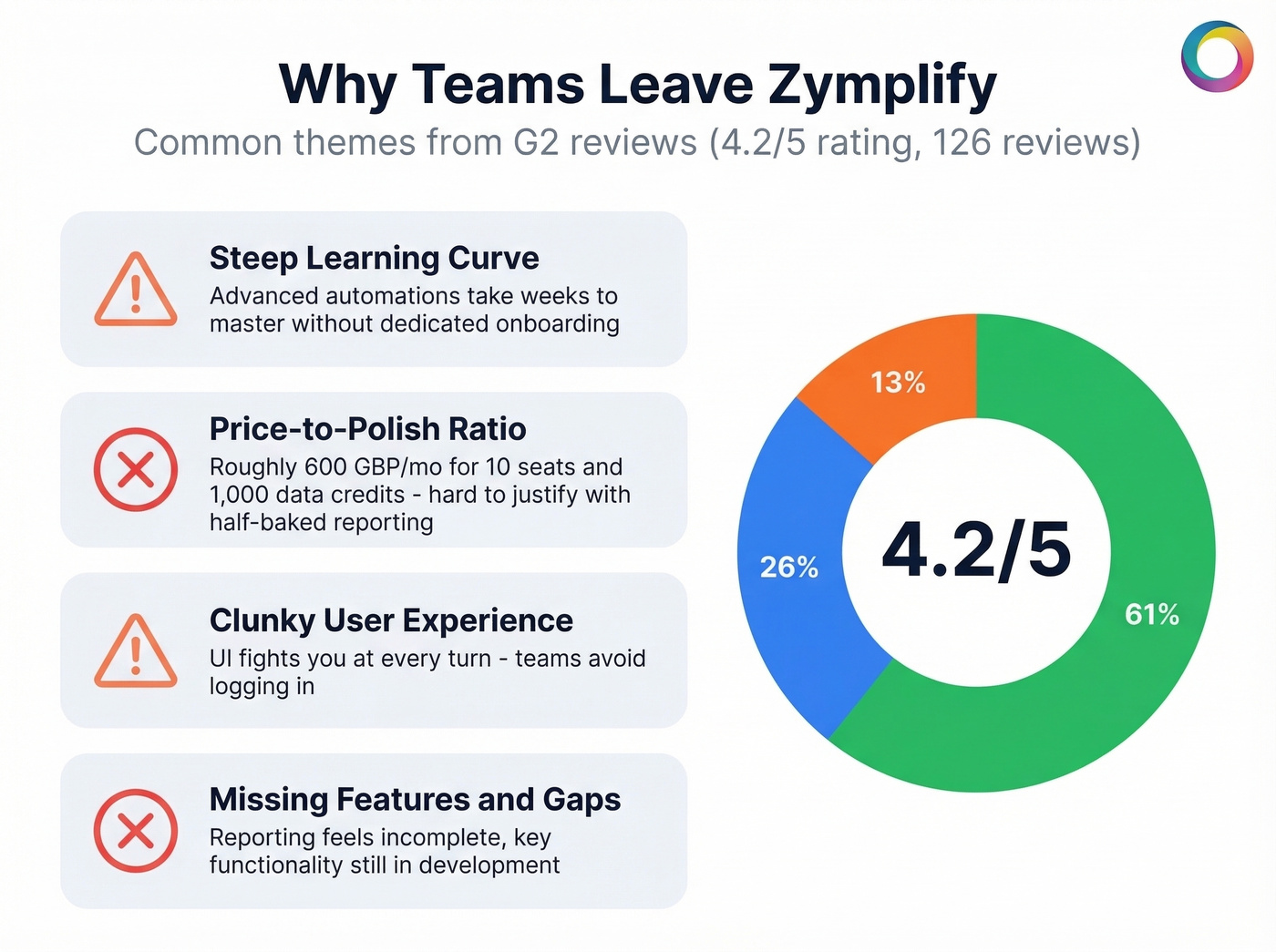
The steep learning curve comes up repeatedly. Advanced automations can take weeks to master without dedicated onboarding support, and review themes also flag missing features, a frustrating user experience, and pricing that feels steep for what you get. At £600/mo for 10 seats and 1,000 data credits, teams start questioning whether the value justifies the spend - especially when the reporting still feels half-baked and the UI fights you at every turn.
That tracks with what we've seen firsthand: the praise for customer support is real, and the multi-source intent idea is sound. The problem isn't the vision. It's the price-to-polish ratio.
What Zymplify Actually Is
Here's the thing most alternatives lists get wrong: they compare Zymplify to generic marketing automation tools. Zymplify isn't Mailchimp with intent data bolted on. It positions itself as a Buyer Intent Activation and Intelligence platform - aggregating signals from 20+ sources, scoring them through its Research Quadrant (signal strength, signal density, journey progression), and letting you activate outreach from the same platform.
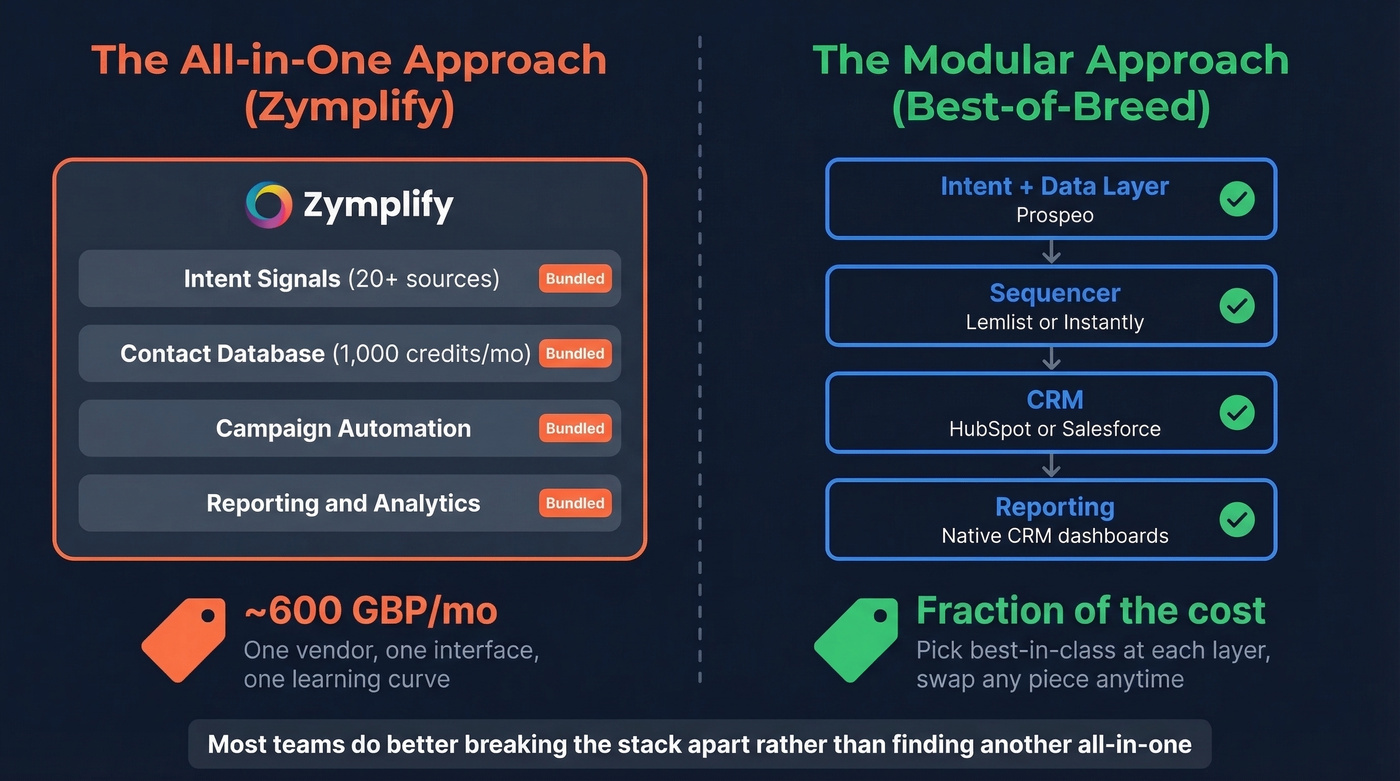
That's a specific category. A true replacement either replicates the full stack or you deliberately break it apart into best-of-breed components. In our experience, most teams do better with the second approach: pick the best intent signals, pair them with the best data, and run activation through a tool that doesn't fight you.
To compare options in the data layer, start with our guide to data enrichment services and the best sales prospecting databases.

Zymplify charges £600/mo for 1,000 data credits and half-baked reporting. Prospeo gives you 300M+ profiles, 15,000 Bombora intent topics, and 98% verified emails - refreshed every 7 days - at roughly $0.01 per email. Teams like Snyk cut bounce rates from 35% to under 5% and grew AE-sourced pipeline 180%.
Break the all-in-one tax and pay only for data that actually connects.
The 7 Best Zymplify Alternatives for 2026
1. Prospeo - Best Data + Intent Layer
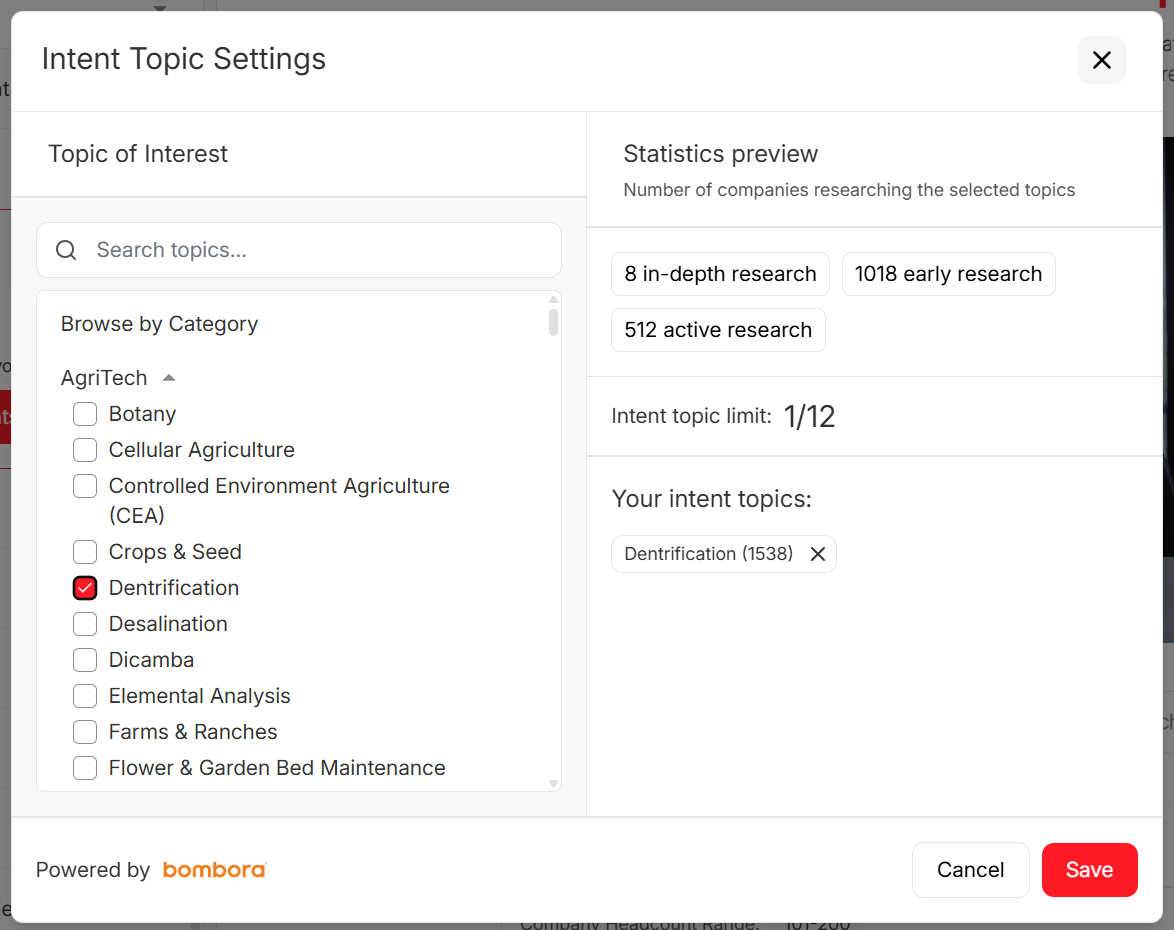
Use this if you want 98% verified email accuracy, 15,000 Bombora-powered intent topics, and a self-serve pricing model that doesn't require a procurement cycle. The database covers 300M+ profiles with 143M+ verified emails and 125M+ verified mobile numbers, all refreshed on a 7-day cycle while the industry average sits at six weeks.
Pick this over Zymplify when your core problem is data quality and intent signal access, not built-in campaign execution. At ~$0.01 per email with a free tier of 75 emails/month, you're spending a fraction of Zymplify's £600/mo entry point. Pair it with a sequencer like Lemlist or Instantly - both have native integrations - and you've got a stack that's cheaper, more accurate, and easier to maintain than anything monolithic.
The 30+ search filters cover buyer intent, technographics, job changes, and headcount growth. That's the same targeting surface as Zymplify's prospecting tools, without the learning curve reviewers keep flagging. Real-world results back this up: teams like Snyk saw bounce rates drop from 35-40% to under 5% and AE-sourced pipeline jump 180% after switching their data layer.
If you're building lists from multiple sources, this pairs well with a lead enrichment workflow and a clean lead generation workflow.
Your Zymplify stack replacement doesn't need another bloated platform. Prospeo plugs directly into Lemlist, Instantly, Smartlead, HubSpot, and Salesforce - so you get best-in-class intent signals and verified contacts without the learning curve reviewers keep flagging. 75 free emails/month, no credit card required.
Build a modular stack that's cheaper, faster, and actually accurate.
2. Apollo - Best Budget All-in-One
Apollo is the tool we'd recommend to any startup founder who says "I just need one platform and I'm selling in the US." It has 275M+ contacts across 73M companies, a built-in sequencer, and a free tier that's genuinely usable. Paid plans run $49/$79/$119 per user/mo.
The catch: data accuracy drops noticeably outside the US. In our testing, bounce rates climbed when targeting EMEA contacts - a dealbreaker if you're selling into Europe. The platform also had data breach incidents in 2018 and 2021 that still make security-conscious buyers nervous.
Bottom line: Apollo is the best single-tool option for North American prospecting on a budget. Skip it if data accuracy is non-negotiable or your market is international.
If you're evaluating the broader outbound stack, see our roundup of SDR tools and outbound lead generation tools.
3. HubSpot Marketing Hub - Best Polished Automation
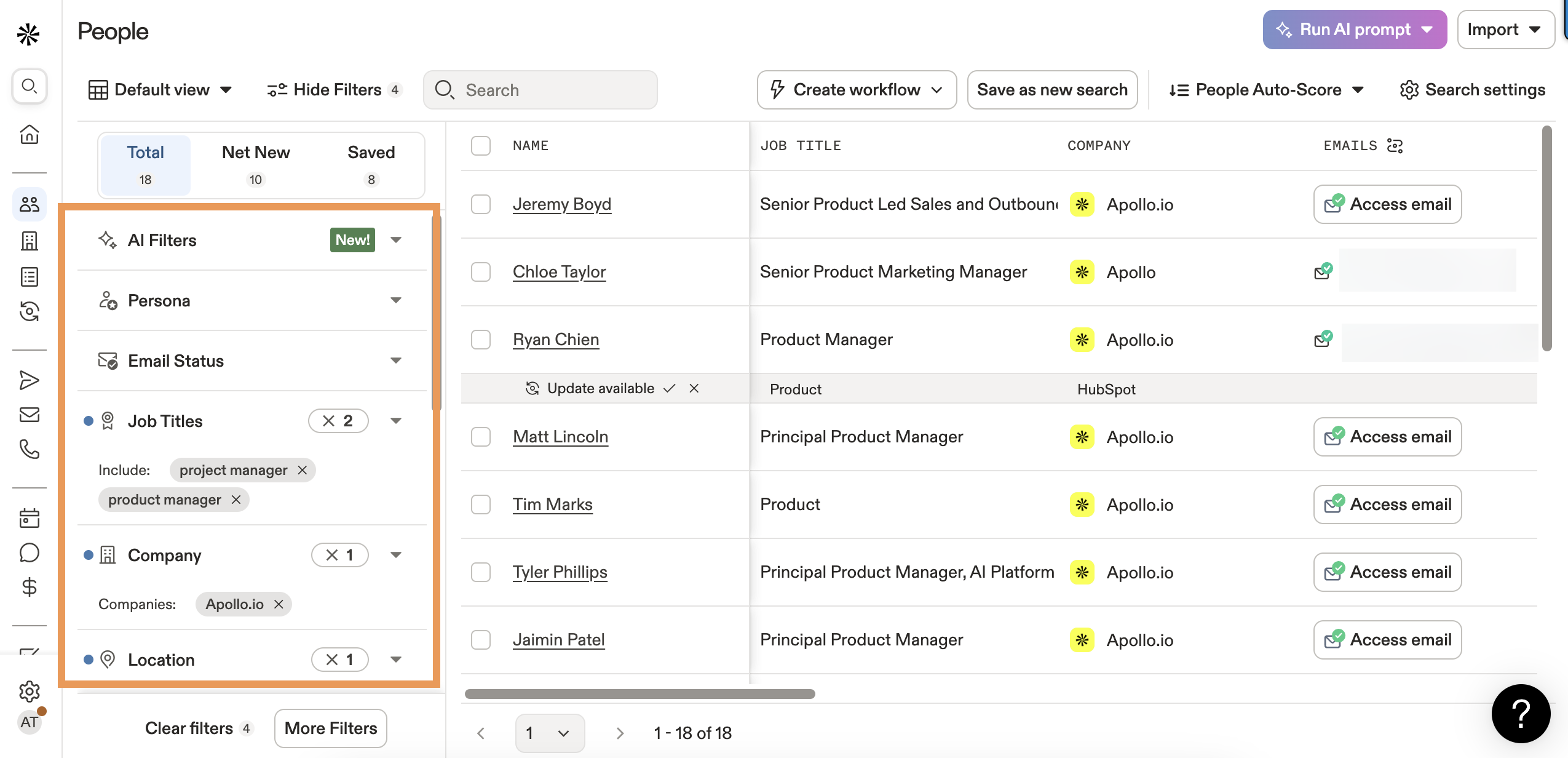
If your biggest Zymplify frustration is the interface, the reporting, and the ecosystem, HubSpot solves that immediately. Free tools let you test the waters, and paid plans start at $20/mo. The workflow builder, attribution reporting, and app marketplace are noticeably more capable than what Zymplify offers.
The tradeoff: HubSpot doesn't do buyer intent the way Zymplify does. You'd need to pipe signals in from a dedicated intent source. But if your pain is "I can't build a decent report" or "my team refuses to log into this tool," HubSpot is the answer.
If you're mapping this into your CRM, it helps to align on examples of a CRM and basic contact management software requirements first.
4. Cognism - Best for Phone-Verified Outbound
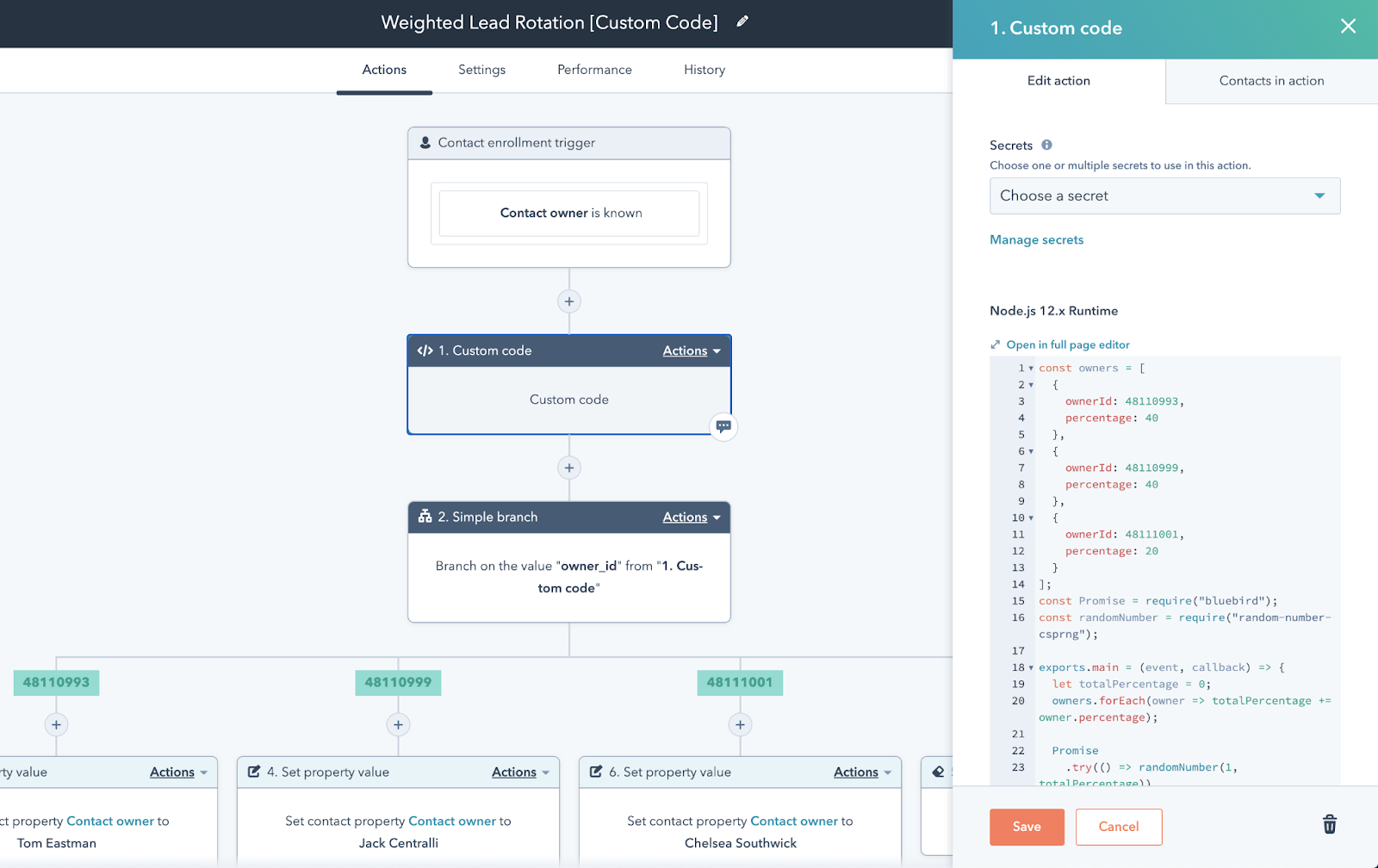
Cognism's pitch is phone-verified mobile numbers with strong EMEA coverage - 12,000+ intent topics and 87% accuracy in reaching your list. Pricing is quote-based, typically ~$1k-$3k/mo for small teams.
Cognism wins over Zymplify on direct dial quality for outbound-heavy teams. Where it loses: no built-in marketing automation or campaign orchestration. It's a data provider, not a platform. If your sales motion is phone-first and your market is European, Cognism deserves a trial.
5. 6sense - Best Enterprise ABM/Intent
6sense is the tool Zymplify wishes it were - and the tool most SMBs can't afford. At $35k-$150k/yr, it's built for mid-market and enterprise ABM orchestration with deep AI-driven intent modeling.
The segment data tells the story: Zymplify's reviewers are 75.8% small business; 6sense skews 54.8% mid-market. These tools serve fundamentally different buyers. Pick 6sense if you've got the budget, the ops team, and the account volume to justify it.
Let's be honest: if you're closing deals under $25k ACV, you almost certainly don't need 6sense-level orchestration. The ROI math doesn't work until deal sizes absorb a five-figure data spend. A modular stack at 1/10th the cost will outperform an enterprise platform your team barely uses.
If you're going down the ABM route, it’s worth grounding the strategy in account-based selling best practices and intent based segmentation.
6. Bombora - Best Intent Signals Only
Bombora offers one of the deepest intent signal catalogs in the market - 16,000+ topics across a consent-based co-op of 5,000+ B2B sites. Entry pricing runs $25k-$30k/yr for basic Company Surge, with enhanced packages hitting $50k-$100k/yr.
This is a signal-only play. Bombora doesn't give you contacts, doesn't send emails, doesn't build sequences. You still need a data layer and a sequencer to actually do anything with the signals. For teams with the budget, Bombora's signal depth is hard to beat. For everyone else, intent data bundled into a data platform gives you 80% of the value at a fraction of the cost.
7. Lead Forensics - Best Visitor ID
Lead Forensics identifies anonymous website visitors at the company level - strong for high-traffic B2B sites that want to convert existing demand into pipeline.
The pricing model is the problem. Annual contracts only, traffic-based pricing that ranges from $6k to $95k/yr, and renewal increases of 10-20% are common. You also only get company-level identification, so you still need contact data from somewhere else. This tool makes sense if you have heavy monthly traffic and want to know which accounts are browsing your pricing page. For most teams, it's an expensive nice-to-have.
Do You Need an All-in-One?
The intent data market hit $4.49B in 2026, and 91% of B2B marketers use some form of intent data. But only 24% report exceptional ROI. That gap isn't a data problem - it's an execution problem. And 94% of buying groups rank their preferred vendors before ever talking to sales, so bad data or slow signals mean you're not even on the shortlist.
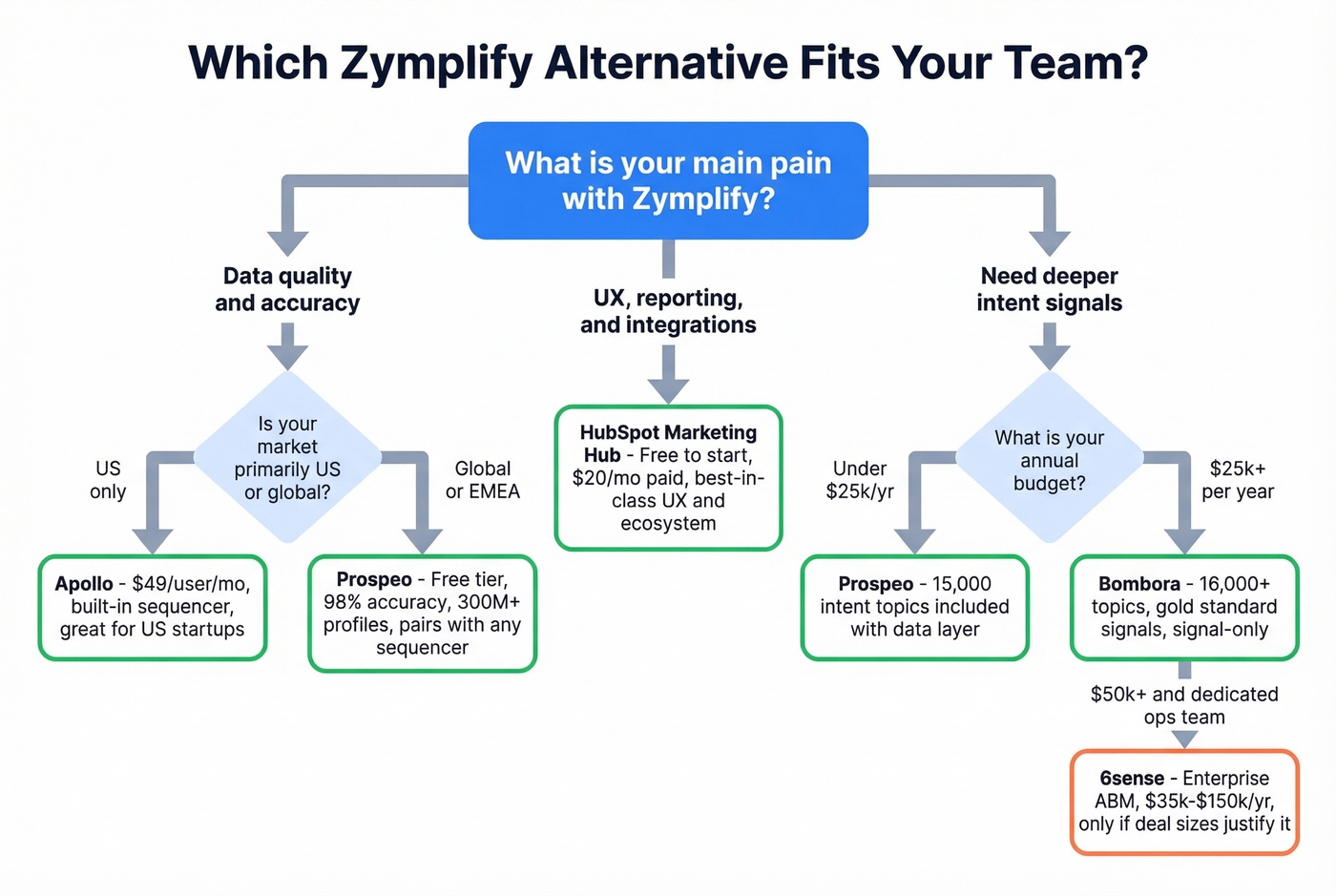
Instead of paying for a monolithic platform that does everything at 70% quality, run this decision checklist:
You need intent-only if you already have a CRM, a sequencer, and a data provider - and you just want to know which accounts are in-market. Bombora is the gold standard, but the $25k+ entry price limits this to well-funded teams.
You need intent + data if your main pain is "I don't know who to contact or when." A data platform with built-in intent signals replaces Zymplify's core value at a fraction of the cost.
You need intent + data + activation if you want a single login for everything. Apollo is the budget option; HubSpot is the polished option. Neither matches Zymplify's intent depth, but both execute better on the automation side.
What It Actually Costs
| Stack | Year-One Cost |
|---|---|
| Zymplify (Demand Gen) | ~£7,200/yr (~£15k-£25k TCO) |
| Zymplify (Revenue) | ~£12,000/yr |
| Data platform + sequencer | ~$500-$1,500/yr |
| Apollo (team of 5) | ~$15,000-$36,000/yr |
| 6sense | $35,000-$150,000/yr |
One frustrating detail: Zymplify's pricing page returns a 404. The £600/mo figure comes from G2's vendor-provided pricing, and directory listings contradict each other - Capterra shows £180/user/month, while SoftwareSuggest lists entirely different plan names at $129-$399/mo. None of those match the £600/mo Demand Gen tier on G2. That level of pricing opacity isn't a great sign when you're trying to budget for a year-long commitment.
Final Decision Guide
- Pick Prospeo if you want the best data accuracy and intent signals at the lowest cost, and you're comfortable pairing it with a sequencer
- Pick Apollo if you need an all-in-one prospecting tool on a startup budget and sell primarily in the US
- Pick HubSpot if your real pain is UX, reporting, and marketing automation - not intent data
- Pick 6sense if you're enterprise, have $50k+ to spend, and need full ABM orchestration
- Pick Cognism if your sales motion is phone-first and your market is EMEA
The biggest decision isn't which tool - it's whether you want another monolith or a modular stack you actually control. For most teams under 50 people, the modular path wins on cost, flexibility, and time-to-value. The consensus on r/sales threads tends to agree: stacking two or three focused tools beats one bloated platform almost every time.
FAQ
What does Zymplify cost in 2026?
Zymplify's Demand Gen plan runs approximately £600/mo for 10 seats and 1,000 data credits, per G2's vendor-provided pricing. The Revenue Platform tier is around £1,000/mo. Directory listings conflict - Capterra shows £180/user/month, SoftwareSuggest lists $129-$399/mo. Expect year-one TCO of £15k-£25k depending on tier and add-ons.
Is Zymplify worth it for small teams?
For teams under 20 people, usually not. The 4.2/5 G2 rating reflects real strengths in intent aggregation, but the steep learning curve and UX gaps hit small teams hardest without a dedicated ops person. A modular stack - like a data platform for contacts plus Instantly for sequences - delivers faster time-to-value at roughly 90% lower cost.
What's the most affordable Zymplify alternative?
Apollo offers a usable free tier, with paid plans from $49/user/mo. Prospeo's free tier gives 75 verified emails/month with intent data access, scaling to ~$0.01/email on paid plans. Either costs a fraction of Zymplify's £600/mo entry point while covering core prospecting and data needs.
Can I replace Zymplify's intent data without enterprise pricing?
Yes. Prospeo bundles 15,000 Bombora-powered intent topics into its self-serve data platform starting at $0.01/email - no $25k+ annual commitment required. You get the same Bombora signal source that powers standalone intent subscriptions, layered with verified contact data and 30+ targeting filters.