

The ABM Framework That Treats You Like a Practitioner, Not a Beginner
Your CMO just came back from a conference buzzing about account-based marketing. Now there's a Slack thread titled "ABM rollout Q3" and everyone's nodding along like they've done this before. They haven't. And the ABM framework they're about to build from a vendor's webinar deck will fall apart by month three.
ABM isn't a campaign type. It's an operating system built on three pillars: shared definitions between sales and marketing on what a target account actually is, signal-based engagement where you act on intent triggers instead of gut feel, and closed feedback loops through quarterly joint reviews. Miss any one, and you're just doing outbound with fancier slide decks.
What You Need (Quick Version)
This framework has 7 stages, but the two that kill most programs are account scoring (Stage 3) and measurement (Stage 7). If you only fix one thing today, fix your data. B2B contact data decays 30-40% annually, and no framework survives a 30% email bounce rate (see Email Bounce Rate). Get the scoring model right, measure pipeline instead of MQLs, and you're already ahead of most teams running "ABM."
2026 Benchmarks Worth Knowing
| Metric | Number | Source |
|---|---|---|
| Adoption rate | 71% | Demand Gen Report |
| Average ROI | 137% | Outcomes Rocket (n=771) |
| Struggle to prove ROI | 47% | Demand Gen Report |
| Email delivers results | 92% | Demand Gen Report |
| Increasing budgets in 2026 | 49.7% | Outcomes Rocket |
| AI used in ABM workflows | 78.7% | Outcomes Rocket |
The tension is obvious: 137% average ROI, yet 47% can't prove it. That's not an ABM problem - it's a measurement problem. Stage 7 exists for a reason.

The 7-Stage Account-Based Marketing Framework
Stage 1 - Define Your ICP and Build the List
Everything downstream depends on this. Get the account list wrong and you'll spend six months personalizing content for companies that were never going to buy.

Start with firmographics: industry, revenue, headcount. Layer in technographics - what tools they run (more on firmographic and technographic data). Then filter by intent signals to find who's actually researching problems you solve right now (see Identifying Buying Signals). The combination of all three separates a real ICP from a wish list, and no amount of technology can shortcut that thinking.
Your list is only as good as the data behind it. With 30-40% annual decay, the list you built in January is already degrading by April. You need a data source that refreshes frequently and verifies aggressively - Prospeo's database covers 300M+ professional profiles with 30+ search filters, including technographics and buyer intent across 15,000 topics, refreshed every 7 days at 98% email accuracy. ICP checklist before you launch:
- Firmographic criteria defined and agreed with sales
- Technographic filters applied
- Intent signals layered
- Contact data verified within the last 30 days
- Sales has reviewed and signed off on the final list
Stage 2 - Tier Your Accounts
Not every account gets the same treatment. Tiering is how you allocate finite resources without pretending you can hyper-personalize for 500 accounts.
| Tier | Touch Level | Content Type | Team Involvement |
|---|---|---|---|
| 1:1 (5-15 accounts) | High-touch, bespoke | Custom research, tailored assets | Dedicated AE + marketer |
| 1:Few (50-100 accounts) | Medium-touch | Industry/vertical personalization | Shared pod |
| 1:Many (200-500+) | Programmatic | Dynamic fields, automated sequences | Marketing-led |
Here's the thing: if your Tier 1 accounts get the same nurture sequence as Tier 3, you don't have tiers. You have a mailing list.
Stage 3 - Score and Prioritize
This is where most ABM programs quietly die. Without a scoring model, every account feels equally important, reps chase whoever responded last, and pipeline reviews become opinion contests. We've seen it happen at companies with $50k ABM platforms and companies running everything out of a spreadsheet - the failure mode is identical.
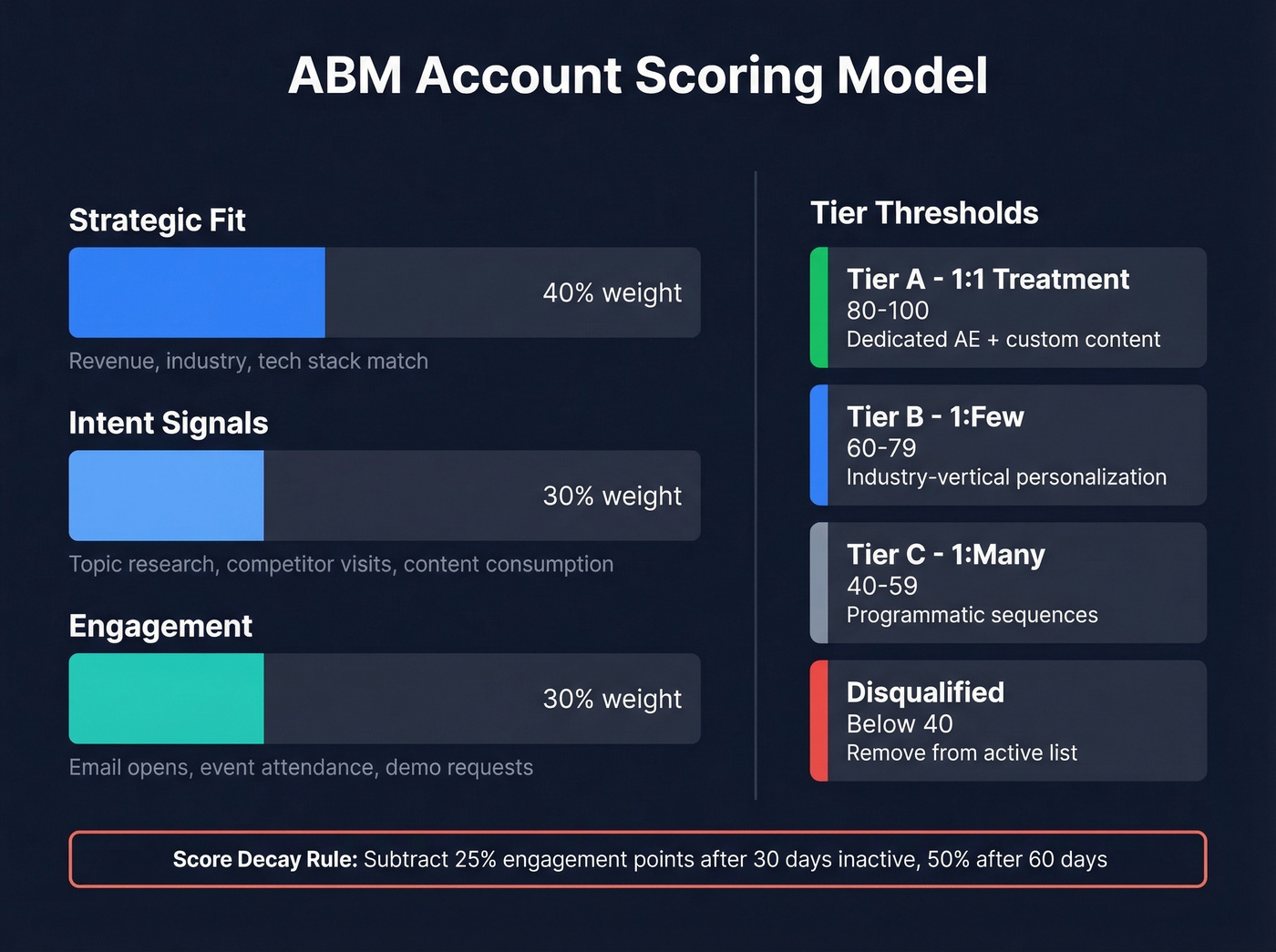
Use a weighted composite score across three dimensions (see Lead Scoring):
| Dimension | Weight | What It Measures | Example Signals |
|---|---|---|---|
| Strategic Fit | 40% | How well they match your ICP | Revenue, industry, tech stack |
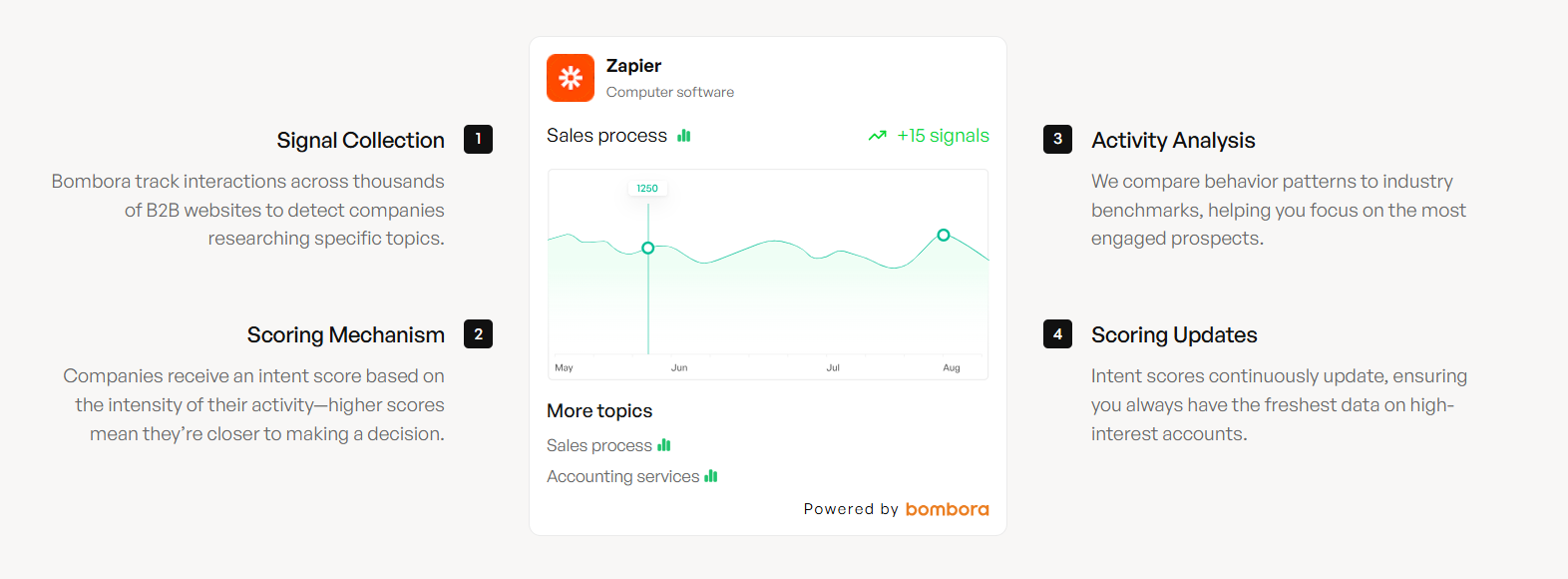
| Intent | 30% | Active buying signals | Topic research, competitor visits |
| Engagement | 30% | Interaction with your brand | Email opens, event attendance, downloads |
Tier thresholds: Composite score 80+ = Tier A (1:1 treatment). 60-79 = Tier B. 40-59 = Tier C. Below 40 = Disqualified.
Score decay matters just as much as scoring itself. Subtract 25% of engagement points after 30 days of inactivity. After 60 days, cut 50%. An account that downloaded a whitepaper in March and went silent isn't a hot lead in June - it's a cold one wearing a warm label.
Stage 4 - Map the Buying Committee
Enterprise deals involve 6-10 decision-makers. Targeting one champion and hoping they'll sell internally is a strategy from 2015.
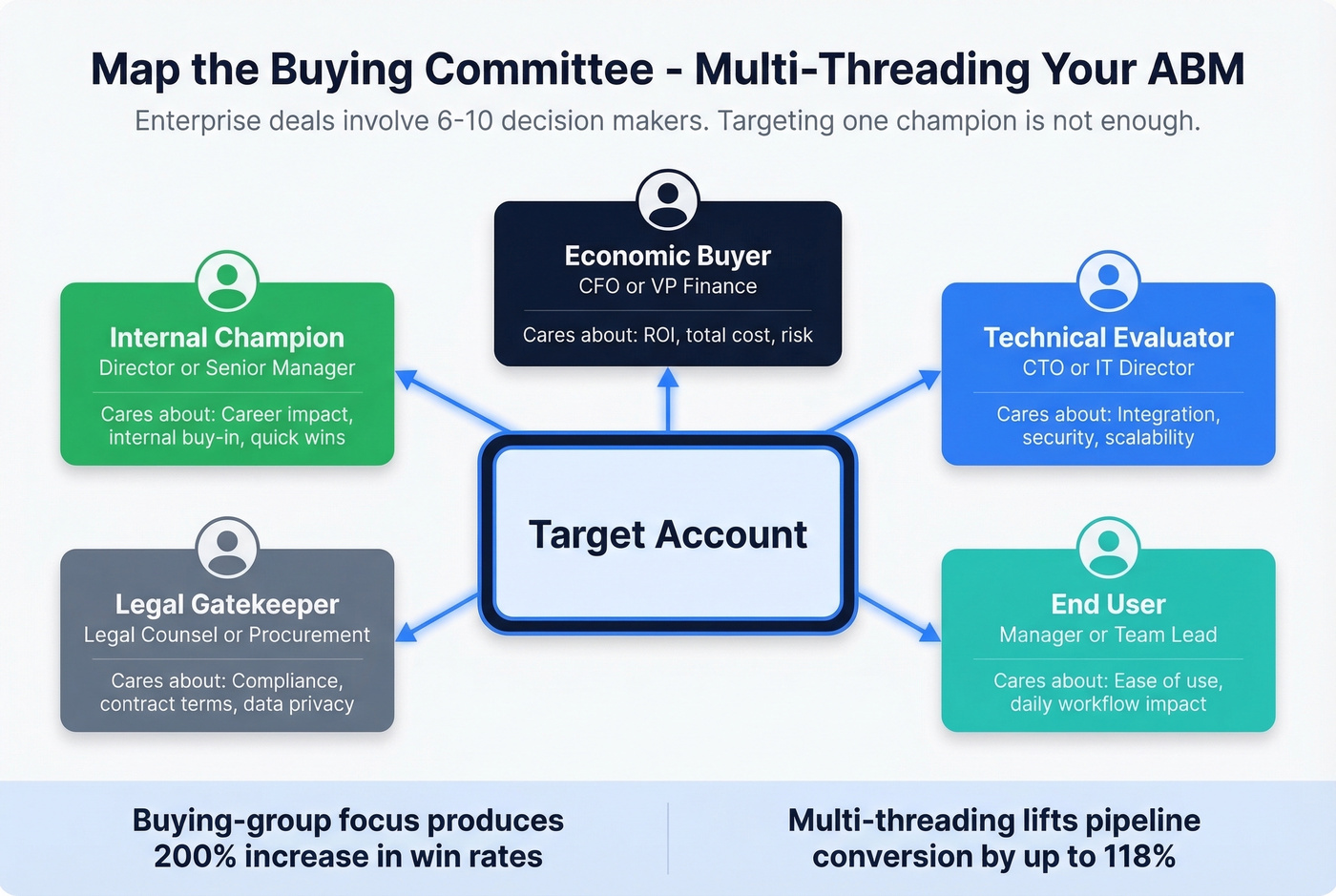
Modern account-based marketing maps the full buying committee: the economic buyer, the technical evaluator, the end user, the legal gatekeeper, and the internal champion (see Technical Buyer vs Economic Buyer). A Forrester Summit keynote highlighted that shifting from individual lead targeting to buying-group focus produced a 200% increase in win rates. Contact-level outreach - reaching multiple stakeholders within the same account - lifts conversion to booked meetings by up to 74% and pipeline conversion by up to 118%.
Multi-threading isn't optional. It's the mechanism that makes ABM work.
Stage 5 - Build Personalized Content
Only 13% of marketers actually hyper-personalize, and 31% say they lack the resources to personalize at scale. Tiering solves this honestly.
Tier 1 gets custom research briefs, bespoke ROI models, and personalized video walkthroughs. This is where you invest real creative hours - think 4-6 hours per account on research alone, producing assets that reference the prospect's specific tech stack, recent earnings calls, or competitive pressures they've publicly discussed. Tier 2 gets industry-vertical content with the same structure but swapped examples and pain points. A fintech case study for fintech accounts, a healthcare one for healthcare. Tier 3 gets automated sequences with dynamic fields like company name, industry, and tech stack. Programmatic doesn't mean generic - it means templated smartly (see Personalized Outreach).
Let's be honest: if you're sending the same whitepaper to all three tiers and calling it "personalized ABM," that's email marketing with a fancier label.
Stage 6 - Execute Multi-Channel Campaigns
Email remains the dominant ABM channel - 92% of practitioners say it delivers results. In-person events come second at 72%. Paid ads, direct mail, and social touches fill the gaps.
Now for the AI reality check. 78.7% of teams use AI in their ABM workflows, but nearly 70% say its current effectiveness is limited. 45% see AI's promise for personalization - the reality hasn't caught up yet. The short-term AI play is practical, not magical: automate list building from messy CRM exports, merge data sources without manual deduplication, and use engagement signals to trigger the next touch instead of relying on static cadences (see How to Track Sales Triggers). The strategy still needs a human brain.
Stage 7 - Measure and Optimize
If you're still measuring ABM with MQLs, you're measuring the wrong thing. ABM metrics live at the account level, not the lead level.
Core metrics:
- Account engagement score - aggregated across all contacts and channels
- Pipeline velocity - how fast accounts move through stages
- Influenced pipeline value - total pipeline ABM touched, even if it didn't create the opportunity
- Account-level conversion rates - target to engaged to opportunity to closed-won
For attribution, use proportional crediting. If an account saw your ads (40% weight), downloaded a whitepaper (30%), and booked a demo (30%), each touchpoint gets partial credit. This isn't perfect, but it's infinitely better than last-touch attribution, which gives 100% credit to whatever happened right before the meeting.
Track expansion revenue by tier, too. Average selling price and net revenue retention by ABM tier tell you whether your 1:1 investments are paying off post-sale - not just at close (see Upsell vs Cross-Sell in SaaS).

Your ICP list decays 30-40% annually. Prospeo's 7-day refresh cycle and 98% email accuracy mean your ABM target accounts always have verified contacts. Layer intent data across 15,000 topics with technographic and firmographic filters to build lists that actually match your scoring model.
Stop running ABM on data that expired two months ago.
Mistakes That Kill ABM Programs
- Replacing demand gen entirely with ABM. A practitioner on r/ABM described a company that moved everything into ABM, targeted ~100 accounts, and after 8 months couldn't show one cent of revenue. Only 40% of teams integrate ABM with demand gen - the rest treat them as separate motions, which is where programs stall.
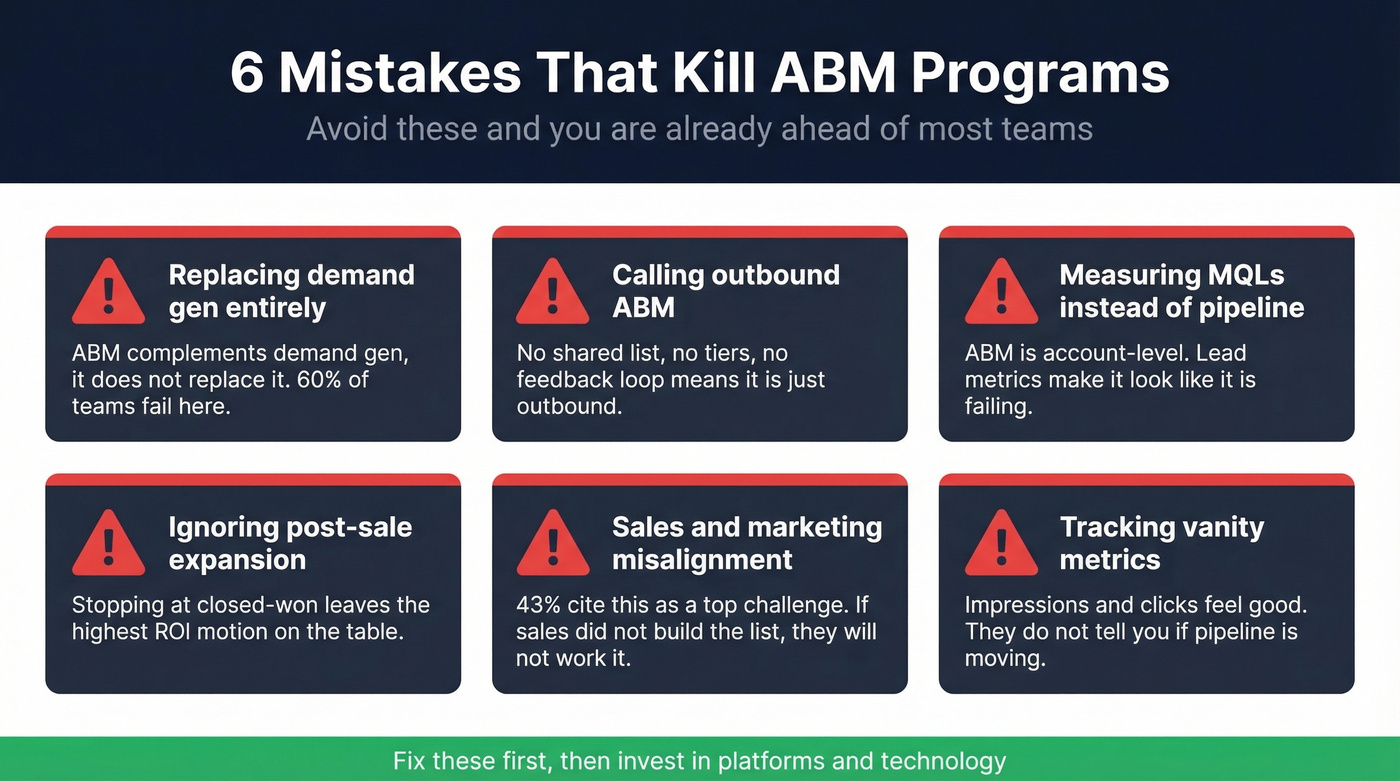
Calling outbound "ABM." The consensus on r/b2bmarketing is brutal: most teams doing "ABM" are really doing outbound with personalization slapped on top. No shared account list, no tiering, no feedback loop - not ABM.
Measuring MQLs instead of pipeline. ABM is an account-level strategy. Lead-level metrics will always make it look like it's underperforming.
Ignoring post-sale ABM. Expansion revenue from existing accounts is the highest-ROI motion in B2B. Stopping at closed-won leaves money on the table.
Sales and marketing misalignment. 43% of practitioners cite this as a top challenge. If sales didn't help build the account list, they won't work it.
Tracking vanity metrics. Impressions, clicks, and email opens feel good in a dashboard. They don't tell you if accounts are moving through pipeline (see Pipeline Health).
Skip the mistake of buying a platform before you've proven the motion manually. We've watched teams burn entire quarters onboarding enterprise software before running a single coordinated campaign.
Tech Stack for Your ABM Framework
You don't need every category on day one. In our experience, teams that start with clean data and a CRM outperform those that buy a platform first.
| Category | Tool | Price Range | Best For |
|---|---|---|---|
| All-in-One ABM | 6sense | ~$30-100k+/yr | Enterprise orchestration |
| All-in-One ABM | Demandbase | ~$25-100k+/yr | Intent + advertising |
| All-in-One ABM | Terminus | ~$15-50k/yr | Mid-market ABM |
| Intent Data | Bombora | ~$25-50k+/yr | Standalone intent |
| Sales Intelligence | Prospeo | Free tier; ~$0.01/email | Data accuracy + intent |
| Sales Intelligence | ZoomInfo | ~$15-40k+/yr | US database depth |
| Sales Intelligence | Apollo | From ~$49/mo | Budget-friendly prospecting |
| Sales Engagement | Outreach / Salesloft | ~$100-150/user/mo | Sequence execution |
| CRM / MAP | HubSpot | ~$800+/mo (bundles vary) | Mid-market CRM + ABM |
If your average deal size is under $10k, you probably don't need a six-figure ABM platform. A CRM, verified contact data, and disciplined tiering will outperform a $50k tool that nobody's configured properly. The all-in-one approach makes sense for enterprise teams running hundreds of accounts across multiple regions - for everyone else, a lean stack wins.

Real Campaign Results
FullFunnel ran an ABM campaign for a high-ticket B2B service provider that generated $300k in revenue with a 37% reply rate - 12 of 30 target accounts replied. The timeline was roughly four months: two months building the GTM strategy and processes, then two months on account research, personalized proposals, warm-up, and outreach.
That's 30 accounts. Not 3,000.
Small, focused ABM with real personalization beat the high-volume alternative by every metric that matters. Each stage - from ICP definition through scoring, content, and outreach - feeds the next, and a break in any link collapses the whole motion. You don't need a massive target list or a six-figure tech stack. You need the right accounts, verified contact data, and content worth responding to.
Multi-threading 6-10 decision-makers per account requires verified contact data at scale. Prospeo gives you 300M+ profiles with emails, 125M+ direct dials, and 30+ filters - so you can map entire buying committees without guessing at contact info.
Map the full buying committee with contacts that actually connect.
FAQ
How long before ABM shows ROI?
Most programs need 2-3 quarters for measurable revenue impact. Pipeline signals like engagement spikes and booked meetings appear within 8-12 weeks. Run ABM alongside existing pipeline generation - never instead of it.
Do I need a platform like 6sense or Demandbase?
Not to start. You need a CRM, a clean target account list with verified contacts, and sales buy-in. Enterprise platforms add value once you've proven the motion works at smaller scale.
What is an ABM framework?
An ABM framework is the structured system - ICP definition, tiering, scoring, personalized content, multi-channel execution, and measurement - that turns account-based marketing from a buzzword into a repeatable revenue motion. Without one, you're doing outbound and calling it ABM.
How do I keep ABM contact data fresh?
B2B data decays roughly 3% per month. Use a provider with weekly refresh cycles, run quarterly data audits, and re-verify any list older than 90 days before launching a new campaign wave.