

Account Based Marketing vs Inbound Marketing: How to Choose in 2026
The account based marketing vs inbound marketing debate keeps surfacing in every B2B strategy meeting - and most articles answering it are useless. They define both terms, list some pros and cons, then tell you to "choose based on your needs."
Here's what actually matters: ABM delivers 81% higher ROI for the teams that execute it well, while inbound generates leads at a fraction of the cost. The ABM market hit $1.07B in 2023 and hasn't slowed down. But 43% of teams cite unreliable data as their biggest challenge when selecting target accounts, which means the strategy you pick matters less than the data feeding it.
The Quick Decision
Before you read another word:
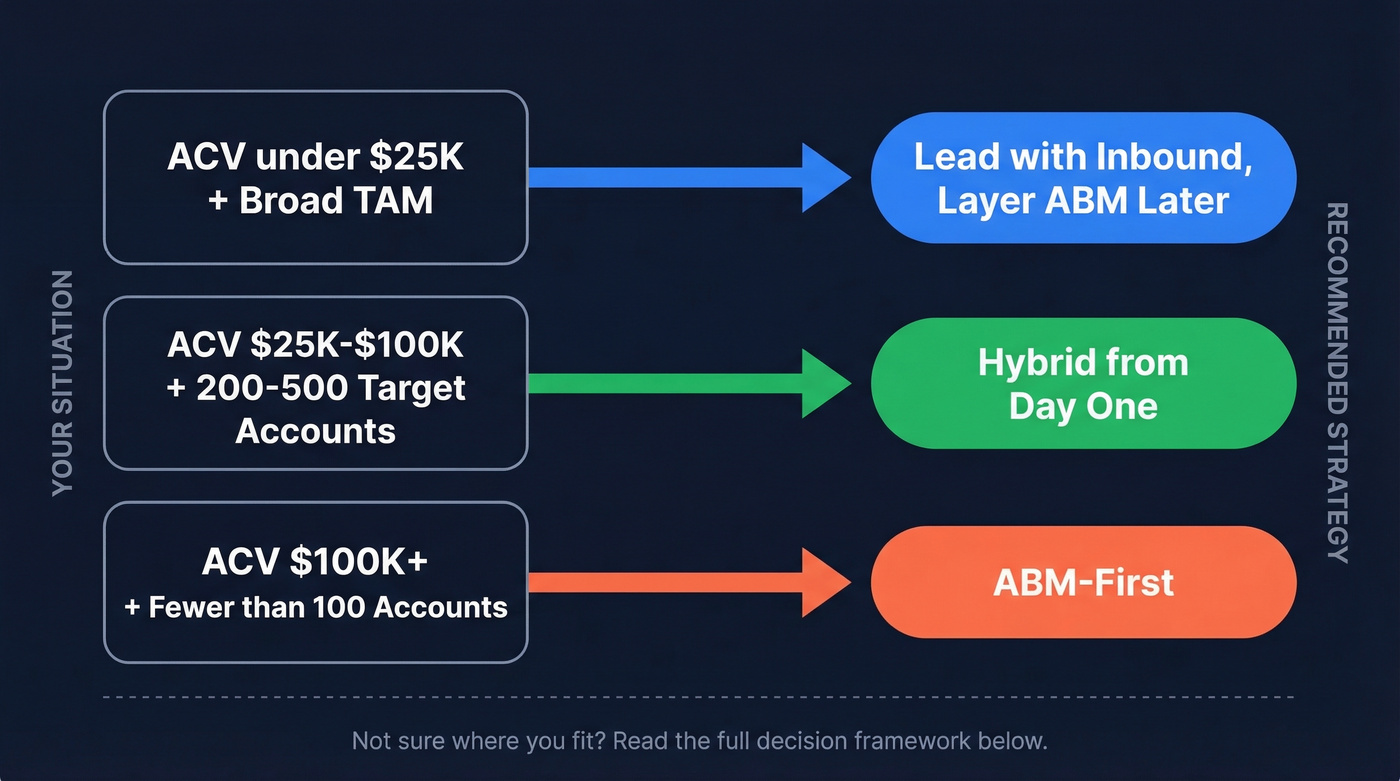
- ACV under $25K + broad TAM - Lead with inbound, layer ABM later.
- ACV $25-100K + defined ICP of 200-500 accounts - Hybrid from day one.
- ACV $100K+ + fewer than 100 target accounts - ABM-first.
If your situation doesn't fit neatly into one of those buckets, keep reading. We'll break down the nuances.
What Is Account Based Marketing?
Traditional marketing starts wide and narrows. ABM inverts the funnel - you begin with named accounts and expand within them. You're choosing your targets before you spend a dollar. ABM typically runs in three tiers:
- 1:1 ABM - Fully custom campaigns for a small set of top accounts. Personalized microsites, bespoke content, executive dinners. Expensive, high-touch, and built for the biggest deal sizes in B2B.
- 1:few ABM - Cluster accounts by shared characteristics like industry, tech stack, or pain point, then run semi-personalized campaigns per cluster.
- 1:many ABM - Programmatic targeting at scale using intent data and automated personalization. Closer to demand gen with an account lens.
The critical concept across all three: you're not targeting a single lead. You're orchestrating touches across a buying committee inside each account. That's why implementing ABM is associated with increases in average annual contract value and marketing-sourced revenue by 171% and 200%, and why 72% of B2B companies use an ABM platform. The flip side: it's also why ABM is harder to execute and easier to screw up.
You don't need a dedicated ABM platform to start. You need a clean contact list, a shared spreadsheet of target accounts, and sales-marketing alignment on who to pursue. The platform can come later.
What Is Inbound Marketing?
Inbound is the long game. You create content - blog posts, guides, webinars, tools - that attracts buyers already searching for solutions. Instead of interrupting prospects, you become the answer they find.
The economics are hard to argue with. B2B SaaS CPL benchmarks tell the story: SEO delivers leads at $31 each, email at $53, content marketing at $92. Compare that to PPC at $181 or trade shows at $811. Inbound's cost advantage compounds over time - a blog post ranking on page one generates leads for years without incremental spend, which is something no paid channel can match.
The catch is patience. Inbound takes 6-12 months to build momentum. If your board wants pipeline next quarter, inbound alone won't deliver.
Some teams lean heavily on ABM for enterprise motions where you need to create demand inside a short list of accounts. PitchBook, for example, used machine learning to analyze 2,000+ accounts, narrowed focus to the top 300, and saw website visits from target accounts jump 79% with brand engagement up 220%.
ABM vs Inbound: Side-by-Side Comparison
| Criteria | ABM | Inbound | Edge |
|---|---|---|---|
| Audience scope | Named accounts | Broad persona | Inbound (reach) |
| Funnel direction | Bottom-up (target then expand) | Top-down (attract then convert) | ABM (precision) |
| Personalization | High to extreme | Moderate, persona-level | ABM |
| Sales cycle fit | Long, complex | Short to medium | ABM (enterprise), Inbound (SMB) |
| Scalability | Limited by resources | Compounds over time | Inbound |
| Measurement | Account engagement, pipeline | Leads, CPL, conversion | ABM (revenue clarity) |
| Cost structure | High fixed, lower variable | Low fixed, scales with volume | Inbound (efficiency) |
| Time to results | Faster when executed well | 6-12 months | ABM (speed) |
| Team requirements | Sales + marketing aligned | Marketing-led | Inbound (simpler) |
| Risk profile | High reward, high effort | Lower risk, slower payoff | Inbound (safety) |
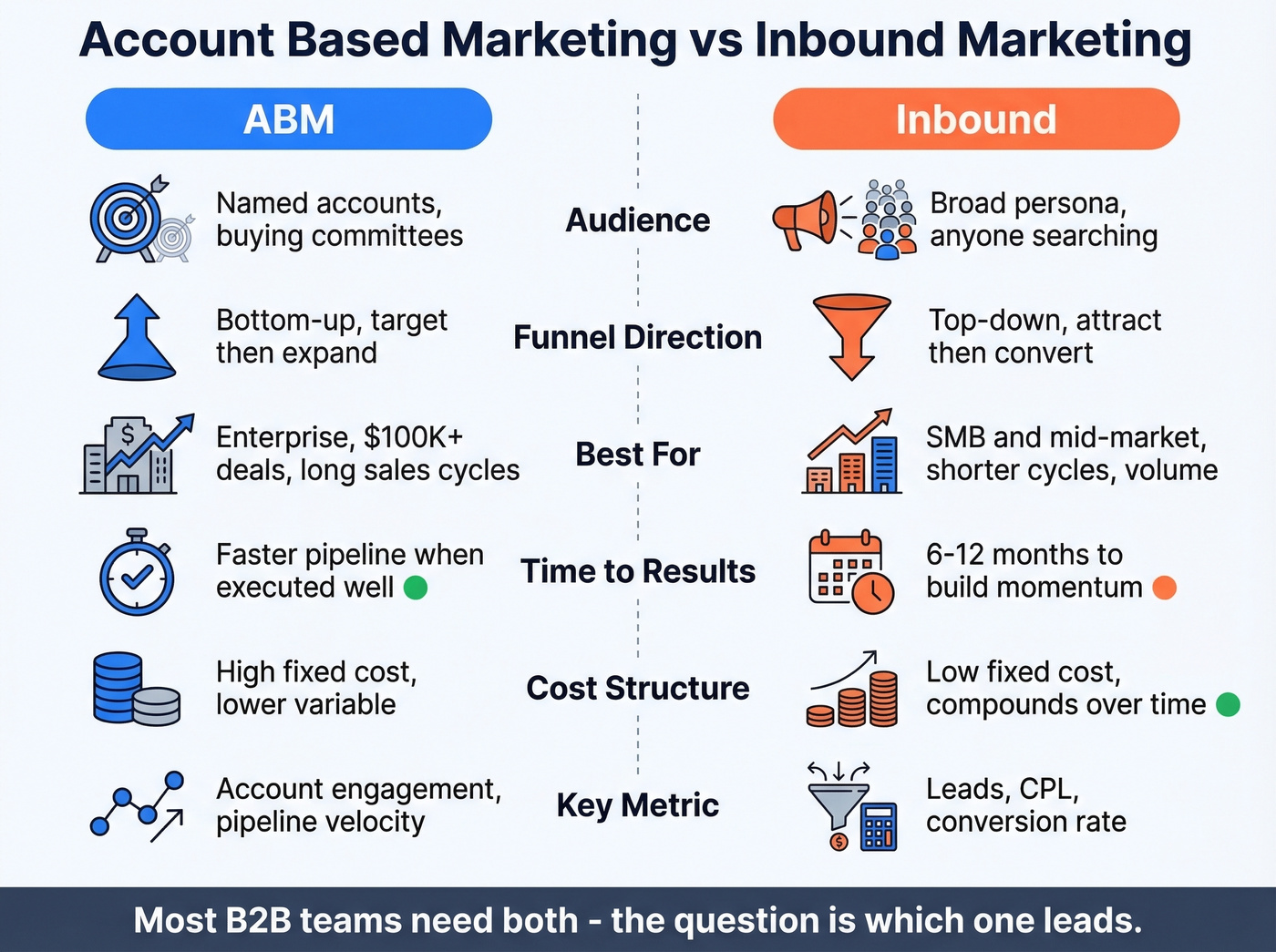
The table makes it look clean, but most B2B companies don't fit neatly into one column. A SaaS company selling $40K deals to mid-market needs inbound to fill the top of funnel and ABM to close the accounts that actually matter. That's why the decision framework below matters more than the comparison itself.

43% of ABM teams cite unreliable data as their biggest challenge. Prospeo eliminates that problem with 300M+ profiles, 98% email accuracy, and a 7-day data refresh cycle - 6x faster than the industry average. Layer intent data across 15,000 Bombora topics to find which target accounts are actually in-market before you spend a dollar on campaigns.
Stop running ABM campaigns into bad data. Start with contacts you can trust.
How to Choose the Right Strategy
Four axes determine which strategy deserves your budget.
ICP concentration. Count your total addressable accounts. Fewer than 500 companies? ABM makes sense - you can realistically name and target each one. TAM in the thousands? Inbound is the more efficient engine. The hybrid sweet spot sits between 200 and 2,000 accounts. (If you need a clean way to define and score your ICP, use an Ideal Customer Profile rubric.)
Sales motion complexity. Deals involving multiple stakeholders and long cycles favor ABM's multi-threaded approach. Transactional sales with a single decision-maker and a two-week close don't need account-level orchestration. (This is also where enterprise B2B sales fundamentals matter.)
Content vs data maturity. ABM struggles without a clean, verified contact database. Inbound stalls without a developed content engine. If your blog gets 200 visits a month, you don't have an inbound foundation yet. If your CRM has 20%+ bounce rates, you don't have an ABM foundation either. (If you're fixing list quality, start with email bounce rate benchmarks and remediation.)
Revenue model. Land-and-expand models favor ABM because you're deepening relationships within accounts. Volume-driven models with low churn favor inbound for consistent new logo acquisition at scale. (If you're modeling efficiency, tie it back to cost to acquire customer.)
Here's a red-flag check: if your website conversion rate sits below 2%, your MQL-to-SQL rate is under 10%, or marketing sources less than 30% of pipeline, something's broken. Layering ABM on top of a leaky funnel won't fix it. Shore up the fundamentals first. (A simple way to diagnose is tracking funnel metrics end-to-end.)
Why ABM Fails (and How to Fix It)
ABM's ROI advantage comes from the teams that execute well. The rest burn $30K+ on platforms and wonder why pipeline didn't move. We've watched this pattern play out dozens of times, and it almost always traces back to one of five root causes.
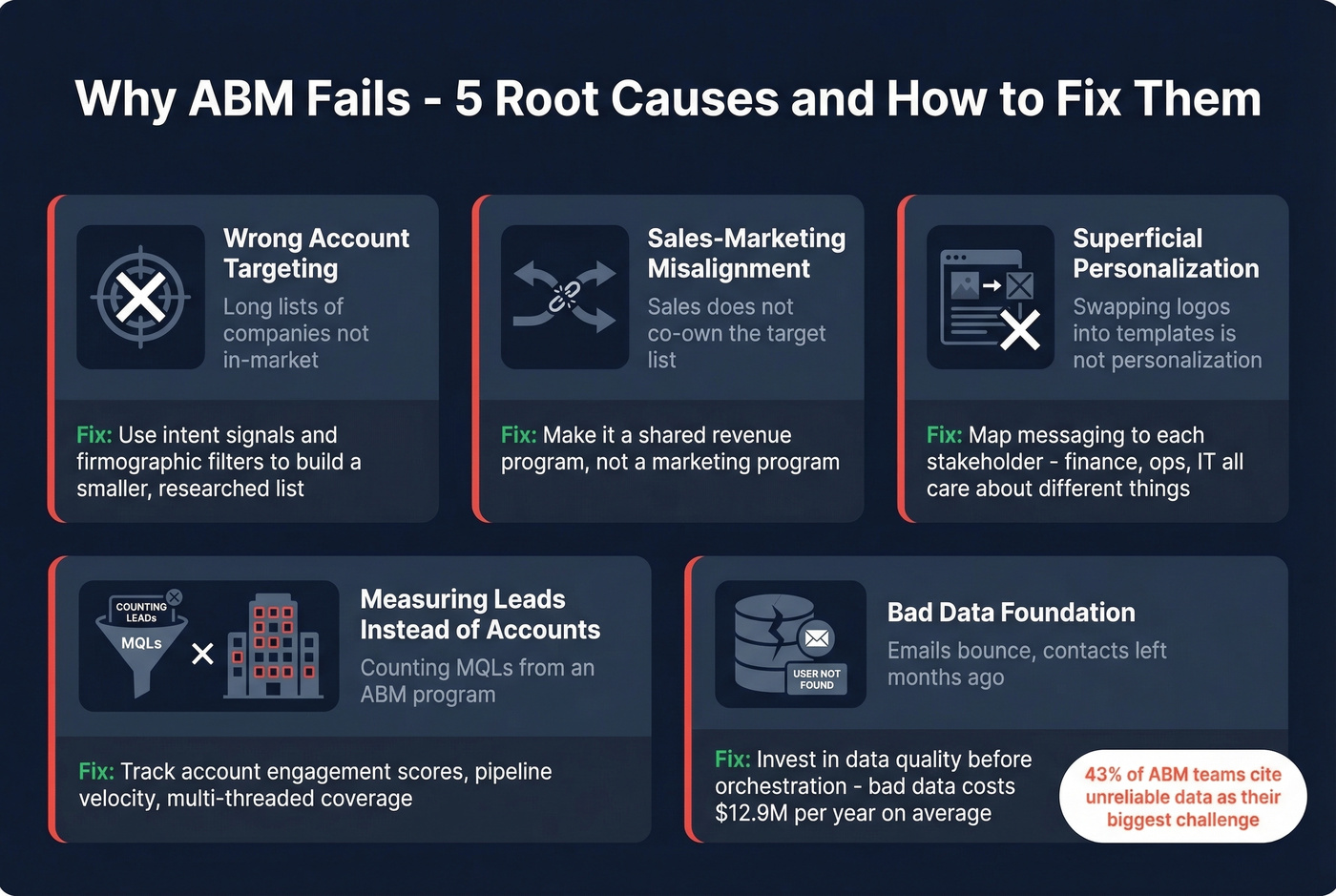
Wrong account targeting. A smaller, well-researched list outperforms a long list of companies that aren't in-market. Use intent signals and firmographic filters to build a list you can actually work. (If you need a tighter definition of filters, see firmographic filters.)
Sales-marketing misalignment. If sales doesn't co-own the target account list, you're running expensive display ads into a void. ABM is a revenue program, not a marketing program. (This is a classic RevOps Manager problem to solve.)
Superficial personalization. Swapping a company logo into a template isn't personalization. Real ABM means understanding each account's specific challenges, tech stack, and buying triggers. Finance cares about pricing and ROI. Operations cares about implementation and access. IT cares about security and integrations. Map your messaging to each stakeholder. (For practical frameworks, use personalized outreach.)
Measuring leads instead of accounts. If you're counting MQLs from your ABM program, you're measuring the wrong thing. Track account engagement scores, pipeline velocity, and multi-threaded coverage. (If you want a KPI set that predicts revenue, use pipeline health.)
Bad data foundation. This is the silent killer. You can't personalize outreach to a VP of Engineering if the email bounces. You can't multi-thread into a buying committee if half your contacts left six months ago. According to Gartner's data quality research, poor data costs organizations an average of $12.9M per year. The consensus on r/sales is blunt: ABM tools like 6sense and Demandbase are "expensive reminders to sell to your ICP." That's what happens when you invest in orchestration before you invest in data quality. (If you're evaluating vendors, start with data enrichment services.)
Combining ABM and Inbound
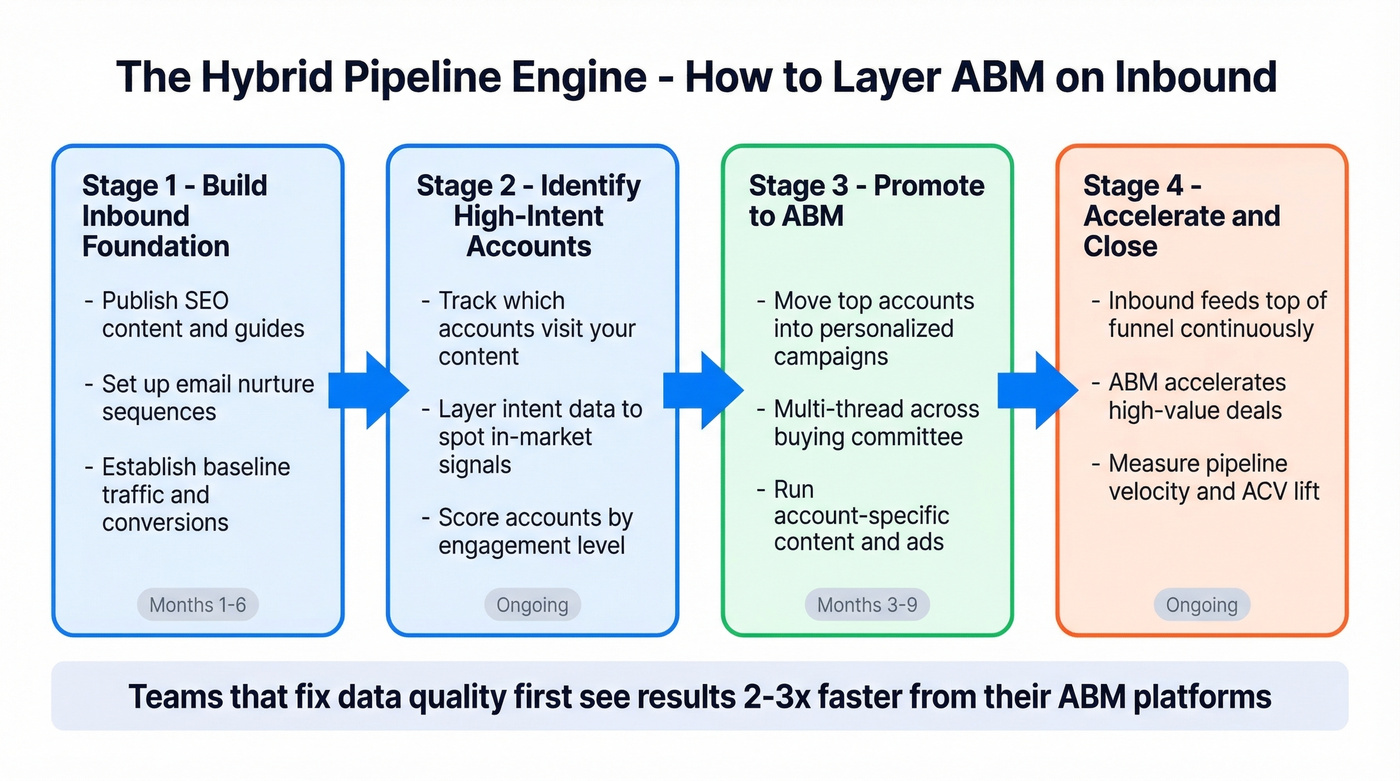
The best B2B teams don't choose between account based marketing vs inbound marketing. They layer both into a unified pipeline engine.
The AVEVA-to-GSK case study is the clearest example. Their one-to-one ABM program drove 2,000 visits to a personalized microsite, built 46 new relationships, and generated $7m in active pipeline - but it was built on top of an existing content and brand awareness foundation. Acxiom took a faster route, generating $1.5m in pipeline within 120 days using a focused ABM blitz on pre-qualified accounts. BlueBotics proves you don't need a massive team: a single marketer ran an ABM program that generated $4m+ in opportunities by starting with awareness across 400 accounts, then promoting the best-fit ones into a deeper 1:few program.
Let's break down the practical sequence. Build your inbound foundation first - content, SEO, email nurture. Use inbound data to identify which accounts are already engaging. Promote those high-intent accounts into an ABM program with personalized, multi-channel campaigns. Let inbound feed the top of funnel while ABM accelerates the deals that matter most. In our experience, teams that fix data quality first see results 2-3x faster from their ABM platforms.
Building Your Stack
Every stack starts with the same layer: verified contact data. Before you spend $30K on an ABM platform, make sure you can actually reach the people inside your target accounts. When evaluating tools, focus on six pillars: data coverage and accuracy, intent detection, personalization capabilities, measurement and attribution, integrations, and team fit. Your stack scales with your maturity:
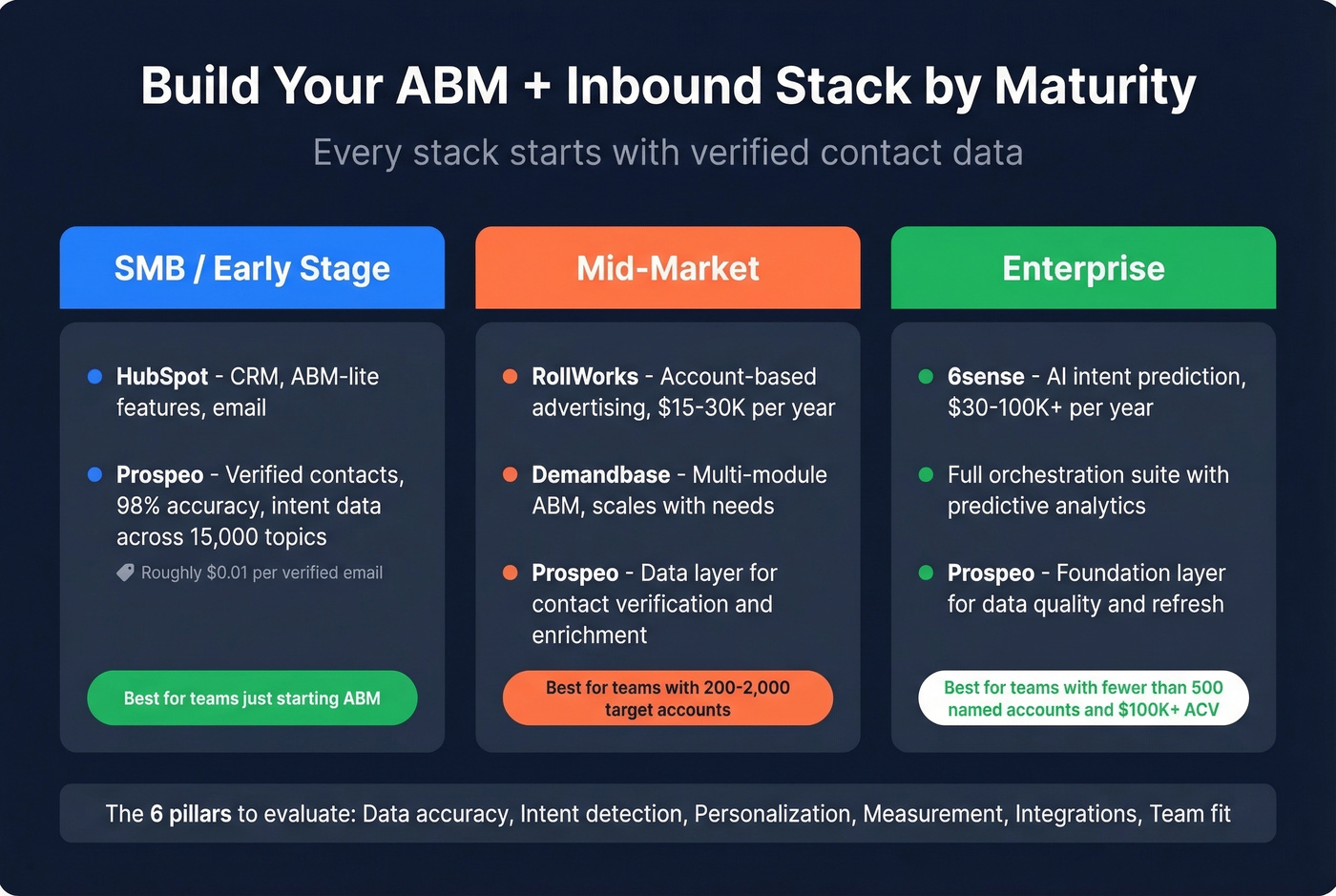
SMB / early-stage - HubSpot is widely used by small to mid-sized B2B teams and includes ABM capabilities like target account lists and account-level dashboards. Pair it with Prospeo for verified contacts and intent data across 15,000 Bombora-powered topics, and you've got a functional ABM-lite setup without enterprise contracts. At roughly $0.01 per verified email with 98% accuracy, it's a rounding error compared to what you'll spend on the rest of your stack.
Mid-market - RollWorks (typically $15-30K/yr) is the ad-first ABM platform, good for teams that want account-based advertising without full-suite complexity. Demandbase typically starts in a similar range but scales quickly with modules.
Enterprise - 6sense (typically $30-100K+/yr) leads on AI-powered intent prediction, processing over a trillion buying signals daily. Demandbase (typically $30-100K+/yr) focuses on buying-group identification. Both require dedicated ops resources to implement properly. Skip these if your team doesn't have at least one full-time marketing ops person - you'll pay for features nobody configures. (If you're building outbound alongside ABM, compare SDR tools before you commit.)
Whether you're running 1:1 ABM on 100 accounts or hybrid inbound-ABM across 2,000, you need verified contacts across every buying committee. Prospeo gives you 30+ filters - intent signals, technographics, headcount growth, funding - to build precisely the list your strategy demands, at $0.01 per email.
Target the right accounts with the right contacts. No guesswork, no bounces.
FAQ
Can you run ABM and inbound at the same time?
Yes - and most B2B teams generating $1M+ in pipeline already do. Start with inbound to build traffic and capture organic demand, then layer account-based plays for your highest-value targets. Inbound feeds awareness while ABM accelerates enterprise deals. The hybrid approach typically outperforms either strategy alone by 30-50% on pipeline contribution.
What budget do you need for ABM?
ABM platform costs range from $15K to $100K+ per year, but you can start manually for under $500/month. Build your target account list, verify contacts at ~$0.01 per email, and run coordinated sequences through your existing CRM. Invest in dedicated platforms once the motion proves out and you need to scale beyond 50 accounts.
How do you measure ABM success vs inbound success?
Inbound tracks leads, conversion rates, and cost per lead. ABM tracks account engagement, pipeline velocity, and average deal size - progress across buying committees, not individual lead volume. Both depend on reaching real people at real companies, which is why a verified data layer with low bounce rates matters before you measure anything else.
Is ABM replacing inbound marketing?
No. ABM complements inbound rather than replacing it. Inbound builds the content foundation and brand visibility that makes ABM outreach more effective - cold ABM to accounts that've never heard of you converts at roughly half the rate of ABM to accounts already consuming your content. The two strategies reinforce each other.