

Account-Based Sales Outreach Strategy That Shows You What to Do
A lot of teams run an "account-based" motion with hundreds of accounts, one contact per account, and an expensive ABM platform - then wonder why pipeline doesn't move. The problem usually isn't the strategy. It's the execution.
Only 31% of reps exceeded quota in 2023, per Ebsta's B2B Sales Benchmarks Report analyzing $54B in revenue. Practitioners on r/b2bmarketing are calling platforms like 6sense and Demandbase "expensive reminders to sell to your ICP." Here's the thing: the motion works. The way most teams run it doesn't. Let's fix that.
The Short Version
Work 50 accounts or fewer with verified data on 6-10 stakeholders each - not 500 accounts with one contact apiece. Build a 7-touch, 10-day cadence where every touch has a job. If it's "just checking in," delete it.
And fix your data layer first. One enterprise team at Snyk cut bounce rates from 35-40% to under 5% and saw AE-sourced pipeline jump 180% after switching to Prospeo. That kind of lift comes from getting the foundation right before you worry about sequencing.
What Is Account-Based Selling?
Account-based sales (ABS) is the execution layer on top of your ABM strategy. Demandbase puts it cleanly: account targeting is who, ABM is how, and ABS is the sales motion that turns target accounts into pipeline through cadences, calls, and multi-threading.
71.2% of organizations implement ABM, with an estimated average ROI of 137%. But the ROI comes from execution, not from buying a platform and hoping.
| ABS | ABM | Traditional Sales | |
|---|---|---|---|
| Focus | Named accounts, sales-led | Named accounts, marketing-led | Volume, territory-based |
| Unit | Buying committee | Account | Individual lead |
| Personalization | 1:1 or 1:few | 1:few or 1:many | Minimal |
The 5-Step ABS Playbook
Step 1: Define Your ICP and Tier Accounts
Every ABS program starts with the same question: which accounts deserve your reps' finite time?
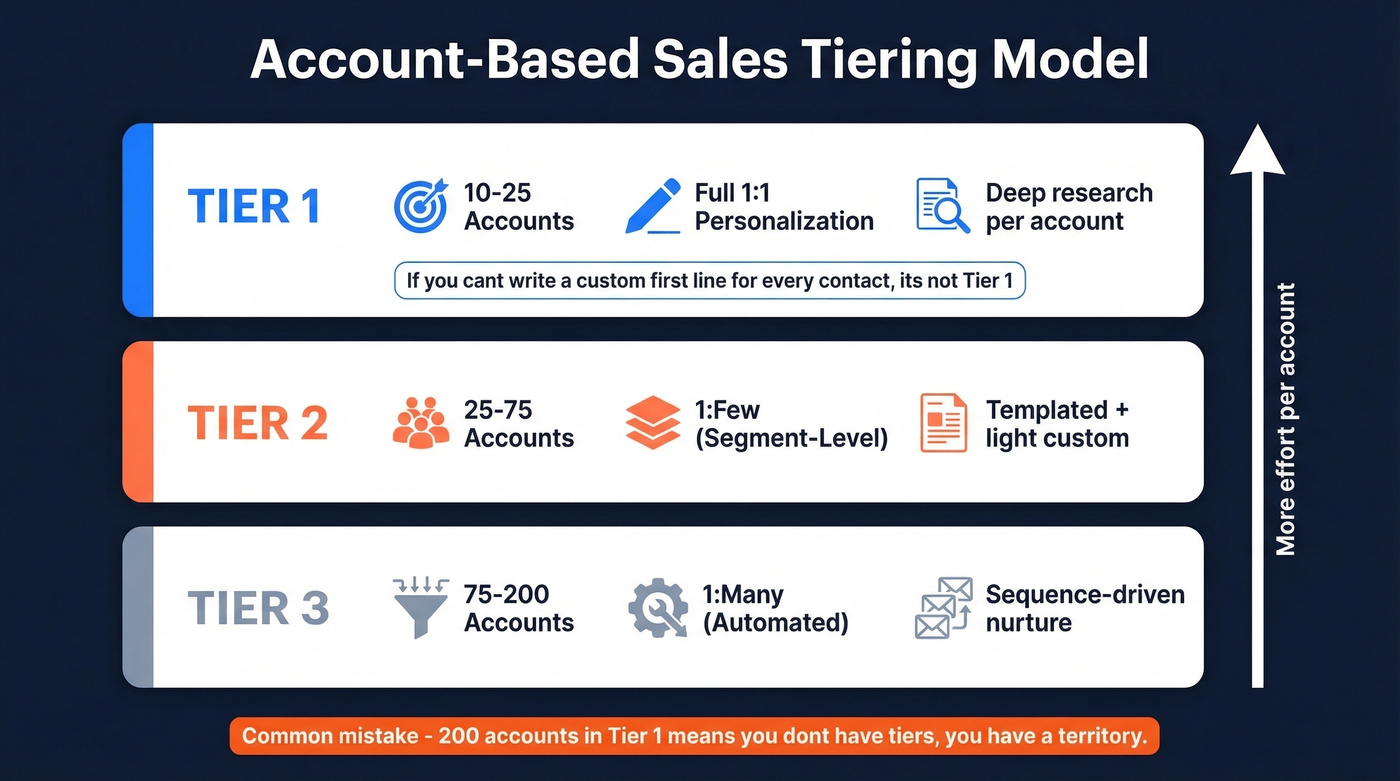
Your ICP criteria should layer firmographics (industry, revenue, headcount) with technographics (what tools they run), intent signals (are they actively researching your category?), and hiring signals - a company posting three SDR roles is probably scaling outbound. Score each account on fit, intent, and timing. Accounts scoring high on all three go to Tier 1.
Reps on r/sales consistently ask how many accounts they can actually work at once. The answer is tiering.
| Tier | Accounts | Treatment | Rep Capacity |
|---|---|---|---|
| Tier 1 | 10-25 | Full 1:1 personalization | Deep research per account |
| Tier 2 | 25-75 | 1:few (segment-level) | Templated + light custom |
| Tier 3 | 75-200 | 1:many (automated) | Sequence-driven nurture |
Most reps overload Tier 1. Keep it tight - if you can't write a custom first line for every contact at an account, it's not Tier 1. If your "Tier 1" list has 200 accounts, you don't have tiers. You have a territory.
Step 2: Map the Buying Committee
Single-threading kills deals. 78% of sales pros take a single-threaded approach, and only 7% connect to six or more people at an account. Gong's data shows closed-won deals involve 3x the people of lost deals.
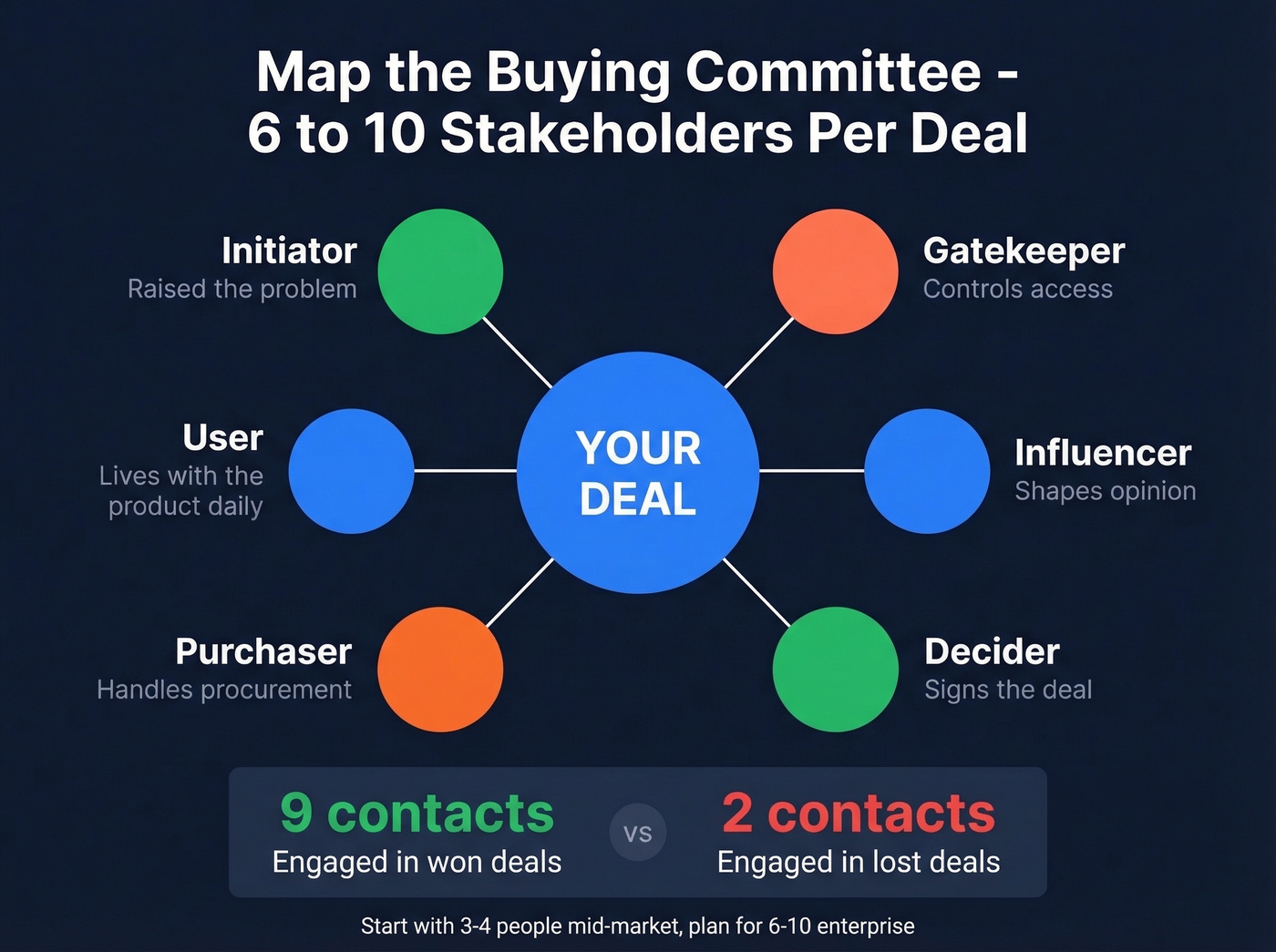
For complex B2B deals, buying groups involve 6-10 decision-makers. Use the HBR stakeholder taxonomy to map them:
- Initiators - who raised the problem
- Gatekeepers - who controls access
- Influencers - who shapes opinion
- Deciders - who signs
- Purchasers - who handles procurement
- Users - who lives with the product daily
You don't need all six roles mapped before you start. Think "minimum viable buying committee" - the smallest set who can validate, fund, and implement. Mid-market: start with 3-4 people, then expand. Enterprise: plan for 6-10.
One discovery question that unlocks multi-threading every time: "Who on your team would feel left out if they weren't part of this meeting?" It's disarming, and it surfaces names your champion wouldn't volunteer otherwise.
Step 3: Build Your Multi-Touch Cadence
Most cadences fail because they're built around the rep's schedule, not the buyer's attention. Every touch needs a job - a new angle, a piece of proof, a specific ask. If a touch exists just to "stay top of mind," cut it.
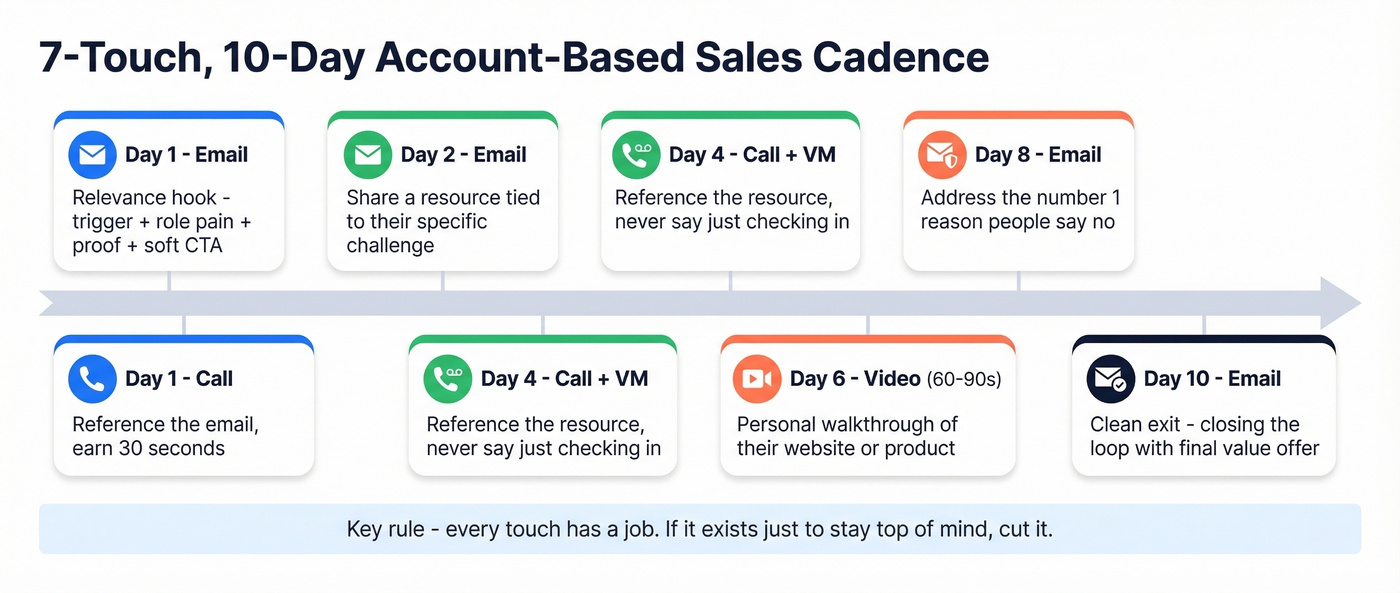
| Day | Channel | Purpose |
|---|---|---|
| 1 | Relevance hook - trigger + role pain + proof + soft CTA | |
| 1 | Call | Immediacy - reference the email, earn 30 seconds |
| 2 | Value - share a resource tied to their specific challenge | |
| 4 | Call + VM | Voicemail that references the resource, not "checking in" |
| 6 | Video (60-90s) | Personal walkthrough - screen share their website/product |
| 8 | Objection handling - address the #1 reason people say no | |
| 10 | Clean exit - "closing the loop" with a final value offer |
BDR teams average about 21 attempts per contact across roughly 8 calls, 8 emails, and 5 social touches over 53 days. But opportunities closed within 50 days win at 47%. After 50 days, win rates drop to 20% or lower. Front-load your best touches. And 21 attempts doesn't mean 21 pings to one inbox - it means combining cold calls and emails with social touches across multiple stakeholders in the account.
Here's a copy-paste template for Touch 1 (personalized subject lines alone boost open rates by 26%):
Subject: [Trigger] → [their company name]
Hi [First Name],
Saw [specific trigger - funding round, job posting, tech adoption]. That usually means [role-specific pain point].
We helped [similar company] [specific result with number]. Thought it might be relevant given [trigger].
Worth a 15-minute look? Happy to share the case study either way.
To populate this cadence, you need verified emails and direct dials for every stakeholder - not just the champion. Stale numbers from a tool that refreshes every 4-6 weeks will tank your connect rates before you even get started. If you need ready-to-use messaging, keep sales follow-up templates handy.

Step 4: Multi-Thread Across the Account
Successful deals engage 9 contacts by the solution presentation stage. Unsuccessful deals? About 2. That gap is the entire game.
Start multi-threading the moment you spot engagement signals. If a prospect forwards your email or shares a resource internally, that's your cue to expand. Send the forwarded-to person a direct message referencing the share.
When your champion goes dark (and they will), don't follow up harder on the same thread. Escalate laterally and vertically: champion → their manager → director/VP → adjacent department. You're not going over their head - you're creating a groundswell of awareness that makes the deal harder to ignore.
Two tactics that consistently work for us. First, reference the champion by name when reaching out to other stakeholders - "Sarah mentioned your team is evaluating X" instantly creates warm context. Second, send different content to different roles. The CFO cares about ROI; the end user cares about workflow. Same deal, different angles. Once you have two stakeholders engaged, suggest a joint call. It creates momentum and social accountability that a dozen follow-up emails never will.
Step 5: Use Signals to Time Follow-Ups
Buyers spend only 17% of their time interacting with sales reps. The other 83% is internal research, committee discussions, and vendor comparison you'll never see.
Signals help you show up during that 17% window instead of guessing:
- Pricing page visits - highest-intent digital signal short of a demo request
- Email forwards - someone's socializing your message internally
- Content engagement - downloading a case study or watching a webinar replay
- Intent topic surges - the account is researching your category across the web
- Hiring signals - posting SDR or BDR roles that indicate they're building the function you sell into
- Tech adoption - installing or removing tools in your competitive landscape
Real-time triggers should override your scheduled cadence. If a Tier 2 account suddenly hits three intent signals in a week, bump them to Tier 1 treatment immediately. If you want a repeatable system for this, see identifying buying signals and how to track sales triggers.

Multi-threading 6-10 stakeholders per account means you need verified contact data for every single one - not just the champion. Prospeo gives you 98% accurate emails and 125M+ verified mobile numbers with 30+ filters to find exactly the right buyers by title, department, and intent signals.
Stop single-threading deals with stale data. Build your buying committee in minutes.
Multi-Channel Outreach Beyond Email
LinkedIn messages pull a 10.3% response rate vs. cold email's 5.1%, and InMails can hit 18-25% reply rates. But 63% of active users ignore unknown DMs. The play is view their profile, engage with their content for a week, then send the connection request. Cold DMs without warmup perform barely better than email - and blasting connection requests isn't ABS, it's spam with a different UI.
If you're tightening your outbound fundamentals, borrow from these sales prospecting techniques and this cold calling system.
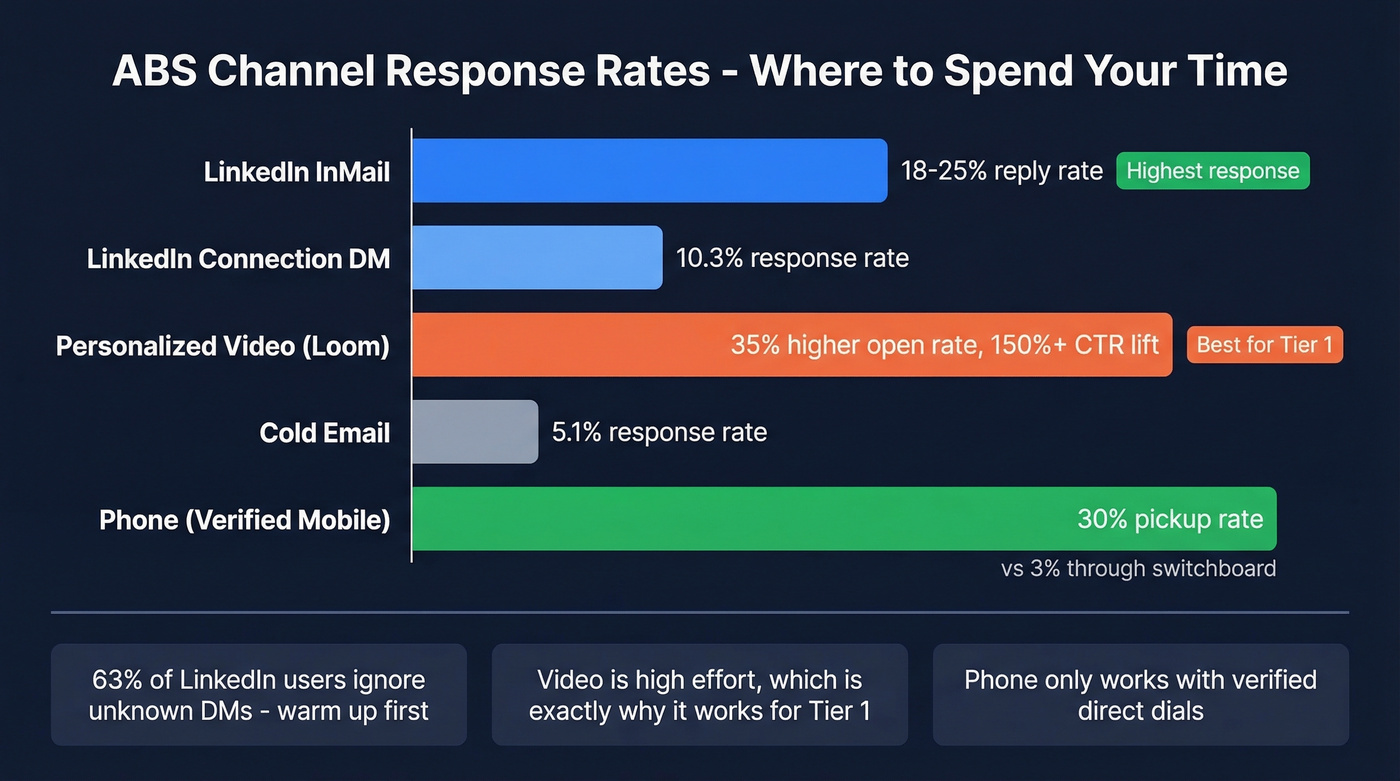
Personalized video is underrated. A 60-second Loom walking through the prospect's website with a specific observation beats any templated email. Open rates jump 35% and CTR climbs 150%+. It's high-effort, which is exactly why it works for Tier 1 accounts. If you want a repeatable workflow, use this Loom video cold email play.
The podcast outreach play deserves more attention than any ABM platform. Build a "Dream 100" guest list of decision-makers at target accounts. Invite them on your podcast - explicitly not a sales call. Repurpose the episode into clips, tag the guest and their company, and you've multi-threaded into the account through content instead of cold outreach. It's relationship-first, it costs almost nothing, and it works.
Phone still works - but only with verified direct dials. A 30% pickup rate on mobile numbers beats a 3% connect rate through the main switchboard every time. For teams selling into the UK or other international markets, verified local mobile numbers are even more critical since switchboard gatekeeping is stricter.
The ABS Tech Stack (With Pricing)
You don't need every category on day one. Start with data and a sequencer. Layer on orchestration and intent once the motion is proven. If you're evaluating vendors, start with this breakdown of data enrichment services and best sales prospecting databases.
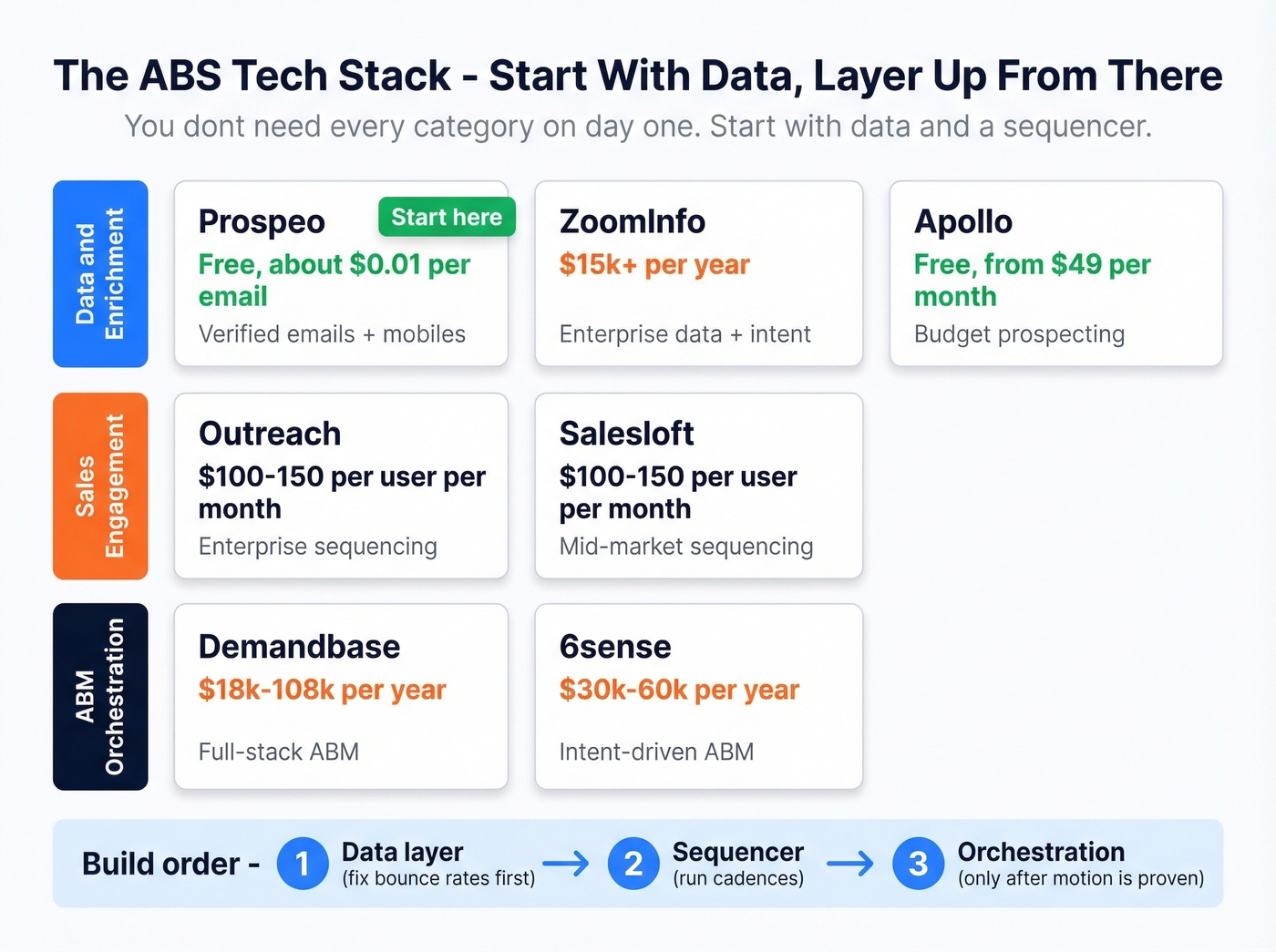
| Category | Tool | Starting Price | Best For |
|---|---|---|---|
| Data & Enrichment | Prospeo | Free; ~$0.01/email | Verified emails + mobiles |
| Data & Enrichment | ZoomInfo | ~$15k+/yr | Enterprise data + intent |
| Data & Enrichment | Apollo | Free; from $49/mo | Budget prospecting |
| Sales Engagement | Outreach | ~$100-150/user/mo | Enterprise sequencing |
| Sales Engagement | Salesloft | ~$100-150/user/mo | Mid-market sequencing |
| ABM Orchestration | Demandbase | $18k-$108k/yr | Full-stack ABM |
| ABM Orchestration | 6sense | $30k-$60k/yr | Intent-driven ABM |
| ABM Orchestration | RollWorks | ~$1k/mo | Mid-market ABM on a budget |
| Intent Data | Bombora | ~$25k+/yr | Topic-level intent |
| CRM | HubSpot CRM | Free | Core CRM |
| Marketing Automation | HubSpot Marketing Hub | $800/mo | Campaigns + automation |
For teams looking to build multi-channel workflows without enterprise pricing, tools like Clay paired with Salesforge let you orchestrate sequences across email, phone, and social from a single workflow. These setups are popular with lean teams that want automation power without the $60k price tag.
In our experience, teams under 20 reps get the most ROI from a data platform plus a sales engagement tool plus their existing CRM. That's it. You can run a serious ABS motion on a lean stack for under $500/month per rep. The $60k ABM platform can wait until you've proven the motion works.
Skip the orchestration layer entirely if you're under 10 reps. Seriously. We've seen teams waste six months on implementation when they should've been calling prospects.
Why Most ABS Programs Fail
Three failure modes kill ABS programs before they produce pipeline.
Wrong accounts. Marketing picks the target list without sales input, treats ABM like scaled demand gen with hundreds of accounts, and spreads resources so thin that personalization becomes impossible. An account-based sales outreach strategy only works when the list is tight enough to personalize. If your reps can't name the top three priorities of every Tier 1 account from memory, the list is too long.
Misaligned KPIs. Marketing measures MQLs. Sales measures pipeline. Nobody measures buying group engagement. The shift from MQLs to buying groups produces a 200% increase in win rates and 800% increase in opportunity progression. That stat alone should end the MQL debate.
Lead-focus instead of account-focus. One unqualified lead from a target account gets dumped into a nurture sequence, and the account is marked "worked." Group signals by account, engage when the threshold is reached, and treat the account as the unit - not the individual. Different stakeholders should get different messages, but the account gets a coordinated experience. If you want a tighter operating model, focus on sales execution and pipeline health.
Snyk's 50 AEs cut bounce rates from 35-40% to under 5% and grew AE-sourced pipeline 180% - because every touch in their cadence hit a real inbox. Prospeo's 7-day data refresh means your 10-day multi-touch sequence runs on contacts verified this week, not last quarter.
Your cadence deserves data that's fresher than your competitors'. Start at $0.01 per email.
FAQ
How many accounts should one rep work?
Tier 1 accounts (full 1:1 treatment) should max out at 10-25 per rep. Tier 2 runs 25-75 with templated personalization. Tier 3 stretches to 75-200 on automated sequences. The most common mistake is overloading Tier 1 - if every account gets the same treatment, you don't have tiers.
What's the difference between ABS and ABM?
ABM is the marketing motion - ads, content, and campaigns targeted at named accounts. ABS is the sales execution layer: cadences, calls, multi-threading, and signal-based follow-ups that turn those accounts into pipeline. You need both, but ABS is where revenue actually happens.
How long before ABS shows results?
Expect 60-90 days for meaningful pipeline impact. The 50-day cliff benchmark shows deals closed within 50 days win at 47% - after that, win rates drop sharply. Build urgency into your cadence from day one, not day thirty.
Do I need an ABM platform to run ABS?
No. Start with verified contact data, a CRM, and a sales engagement tool - that's your minimum viable stack. A data provider at ~$0.01/email, a sequencer like Outreach, and your CRM can power a full ABS motion for under $500/month per rep. Layer on platforms like Demandbase or 6sense only after the motion is proven.
How do I build this strategy from scratch?
Start with 25 accounts, not 250. Tier them by fit, intent, and timing. Map 3-5 stakeholders per account using verified contact data. Build a 7-touch cadence where every touch has a job. Multi-thread from day one. Measure buying group engagement, not MQLs.