

Account Growth Strategies: The Operational Playbook for 2026
You built the account plan in January. It's June. Nobody's opened it since the QBR where it was presented. The spreadsheet lives in a shared drive folder that three people have bookmarked and zero people check.
Meanwhile, only 28% of sales leaders say their account management channels actually meet cross-selling and growth targets. 74% of B2B sales leaders say closing is harder than it's ever been. The problem with most account growth strategies isn't the strategy. It's execution.
The Short Version
If you take nothing else from this piece:
- Tier your accounts by growth potential - not just current revenue - using the Strategic / Growth / Nurture model.
- Track five numbers: health score, share of wallet, whitespace ARR, coverage ratio, weighted pipeline.
- Run a 30-minute weekly review per strategic account. The cadence keeps the plan alive, not the template.
Why Most Growth Plans Fail
Most account plans don't fail because they're bad. They fail because nobody maintains them. Five killers show up again and again.
"Set and forget" culture. The plan gets built for leadership, presented once, and abandoned. As one practitioner on r/sales put it, "the plans just sit there." Leadership is vague about what they actually want, so reps treat planning as admin busywork.
Poor account prioritization. Too many accounts get the "strategic" label. When everything's a priority, nothing is. (If you need a scoring system, start with account prioritization.)
Insufficient customer knowledge. 65% of account managers' time goes to non-revenue activities - internal meetings, reporting, firefighting - leaving almost no bandwidth for real discovery. In our experience, the accounts that churn hardest are the ones where the rep had one contact and that contact left.
Weak goal definition. "Grow the account" isn't a goal. "Expand into the APAC business unit with a $120k whitespace opportunity by Q3" is a goal.
No post-sale engagement rhythm. A plan reviewed weekly beats a perfect plan reviewed never. Without a recurring cadence, even good strategies drift, and the customer relationship quietly decays between renewals.
The Account Tiering Model
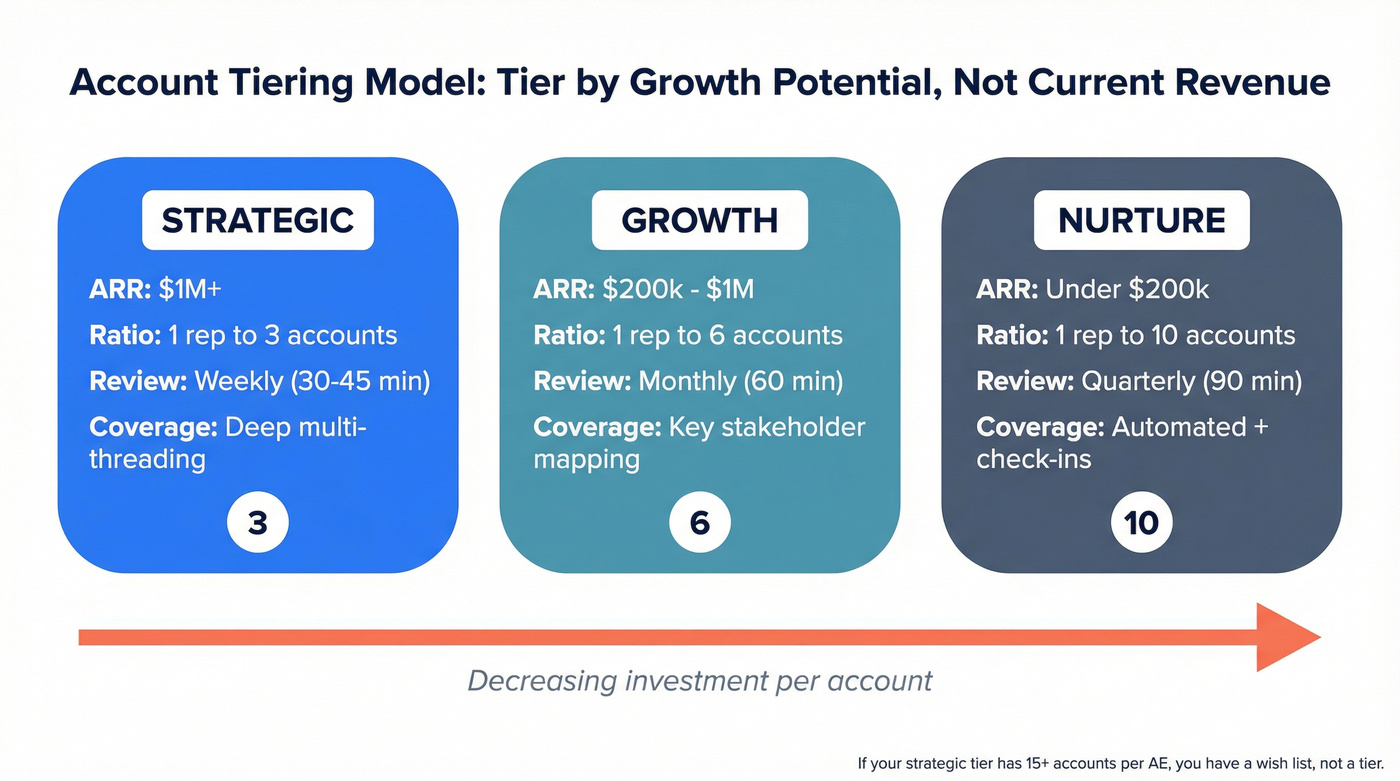
Tiering by current revenue is lazy - tier by growth potential instead. An account doing $300k today with three untouched business units is more valuable than a $1.2M account that's fully saturated.
| Tier | ARR Range | Rep-to-Account Ratio | Review Cadence |
|---|---|---|---|
| Strategic | ≥$1M | 1:3 | Weekly |
| Growth | $200k-$1M | 1:6 | Monthly |
| Nurture | <$200k | 1:10 | Quarterly |
The ratios matter because strategic accounts demand proportionally more coverage. The average B2B purchase involves 11 stakeholders - sometimes nearly 20. Accounts with more than one engaged contact are 37% more likely to close. You can't multi-thread into that many people if one rep is juggling ten "strategic" accounts. (If you want the broader context on stakeholder-heavy deals, see the B2B buying process.)
Here's the thing: we've watched teams label 40+ accounts as "strategic" and then wonder why none of them got real attention. If your strategic tier has more than 15 accounts per AE team, you don't have a tier - you have a wish list.
What Goes in the Plan
A structured account plan doesn't need to be complicated. It needs to be complete. Structured planning correlates with 75% better win rates and 58% shorter sales cycles. Here's the eight-part checklist:
- Account overview - company context, industry, strategic priorities
- Account segmentation - tier, growth potential, risk level
- Financials - current ARR, expansion revenue, contract timeline
- Whitespace analysis - BU × product grid with status flags
- Relationship mapping - champions, blockers, economic buyers
- Competitor analysis - who else is in the account, where you're vulnerable (this is easier with a lightweight competitive intelligence database)
- Communication plan - cadence, channels, stakeholder-specific messaging
- KPIs - health score, share of wallet, pipeline targets
Don't overthink the format. A well-maintained Salesforce record with these eight elements beats a 40-slide deck that nobody updates. If you need a baseline structure, start with our account planning guide.

Multi-threading into 11+ stakeholders per account requires verified contact data for every one of them. Prospeo's 300M+ profiles and 125M+ verified mobiles let you map and reach every champion, blocker, and economic buyer in your strategic accounts - at $0.01 per email with 98% accuracy.
Stop planning account growth you can't execute because you're missing contact data.
Five Formulas That Matter
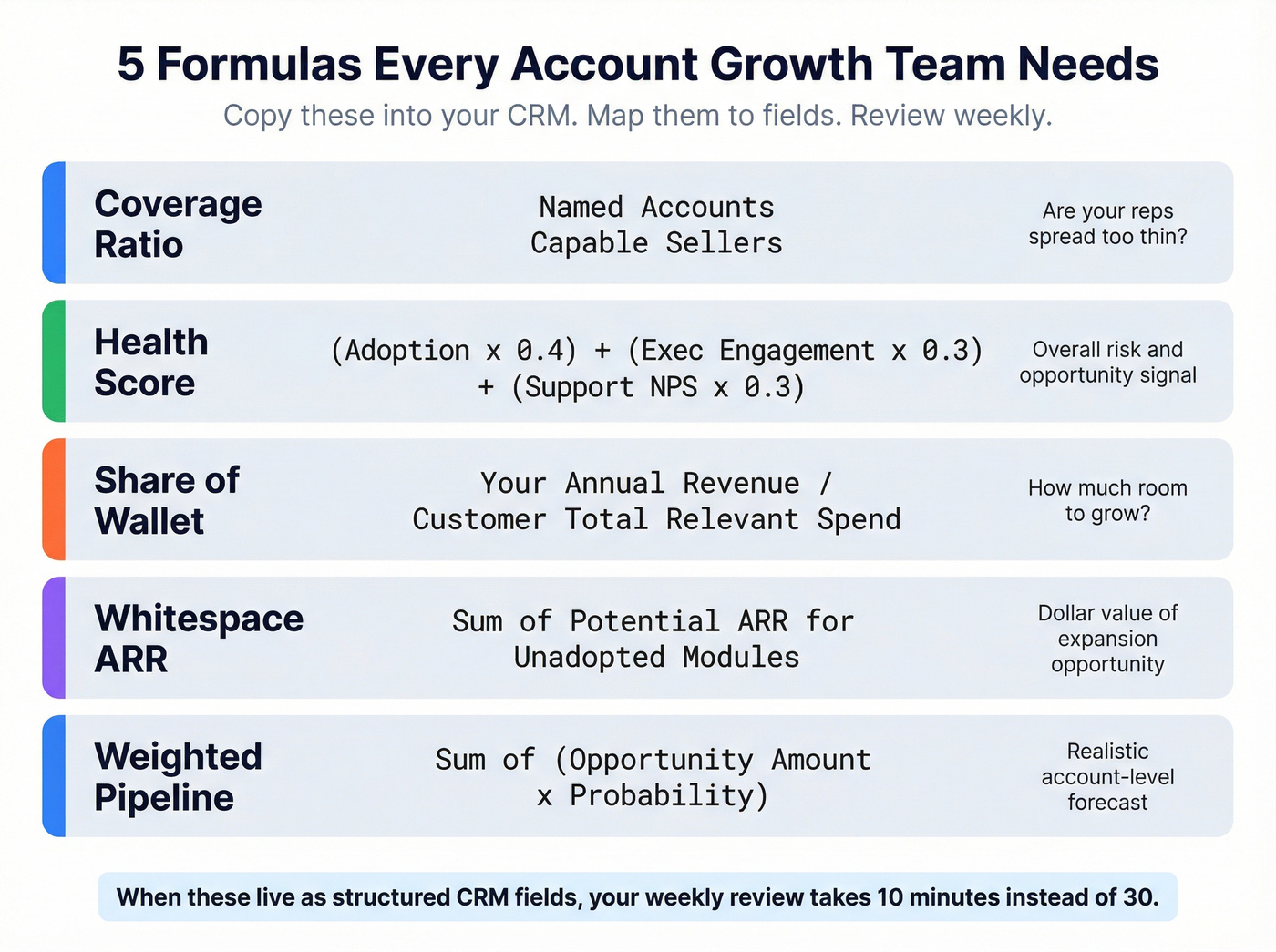
If you can't name your top 10 accounts' health scores right now, you don't have a strategy - you have a wish list. These five formulas turn vague plans into measurable ones.
| Formula | Calculation | What It Tells You |
|---|---|---|
| Coverage Ratio | Named Accounts ÷ Capable Sellers | Whether reps are spread too thin |
| Health Score | (Adoption × 0.4) + (Exec Engagement × 0.3) + (Support/NPS × 0.3) | Overall account risk and opportunity |
| Share of Wallet | Your Annual Revenue ÷ Customer's Total Relevant Spend | How much room you have to grow |
| Whitespace ARR | Σ Potential ARR for unadopted modules | The dollar value of expansion opportunity |
| Weighted Pipeline | Σ (Opportunity Amount × Probability) | Realistic forecast for the account |
Copy these into your CRM. Map them to fields. The Salesforce field mapping approach from CapitalBuildCon is worth stealing - tier, health, stakeholders, hypotheses, mutual plan, and risks all live as structured data, not buried in notes. When the data lives in structured fields, your weekly review takes 10 minutes instead of 30 because you're reading dashboards, not digging through call notes. (If you want to operationalize this across teams, build it into a RevOps dashboard.)
NRR Benchmarks for 2026
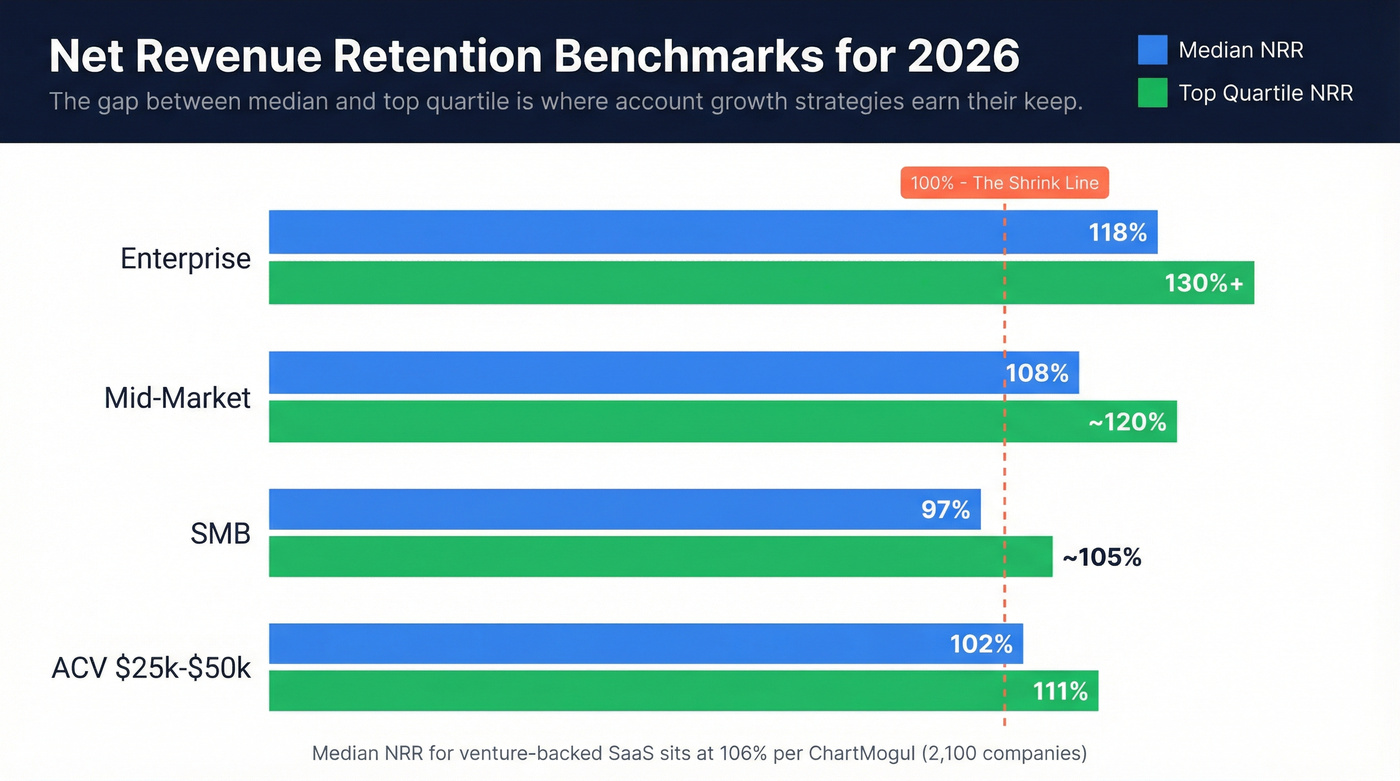
These are the numbers your board cares about. If your NRR is below 100%, you're shrinking - regardless of how many net new customers you close. (If you need definitions and formulas, use this net dollar retention breakdown.)
| Segment | Median NRR | Top Quartile |
|---|---|---|
| Enterprise | 118% | >130% |
| Mid-market | 108% | ~120% |
| SMB | 97% | ~105% |
| ACV $25k-$50k | 102% | 111% |
Median NRR for venture-backed SaaS sits at 106% per ChartMogul's survey of 2,100 companies. The gap between median and top quartile is where account growth strategies earn their keep. You don't close that gap with better renewals. You close it with expansion revenue from whitespace and multi-threading. (For the expansion motion, see expansion revenue.)
If your average deal size is under $25k and your NRR is above 105%, you're already outperforming most of the market. Stop chasing net new customers and double down on the accounts you have.
The Review Cadence That Keeps Plans Alive
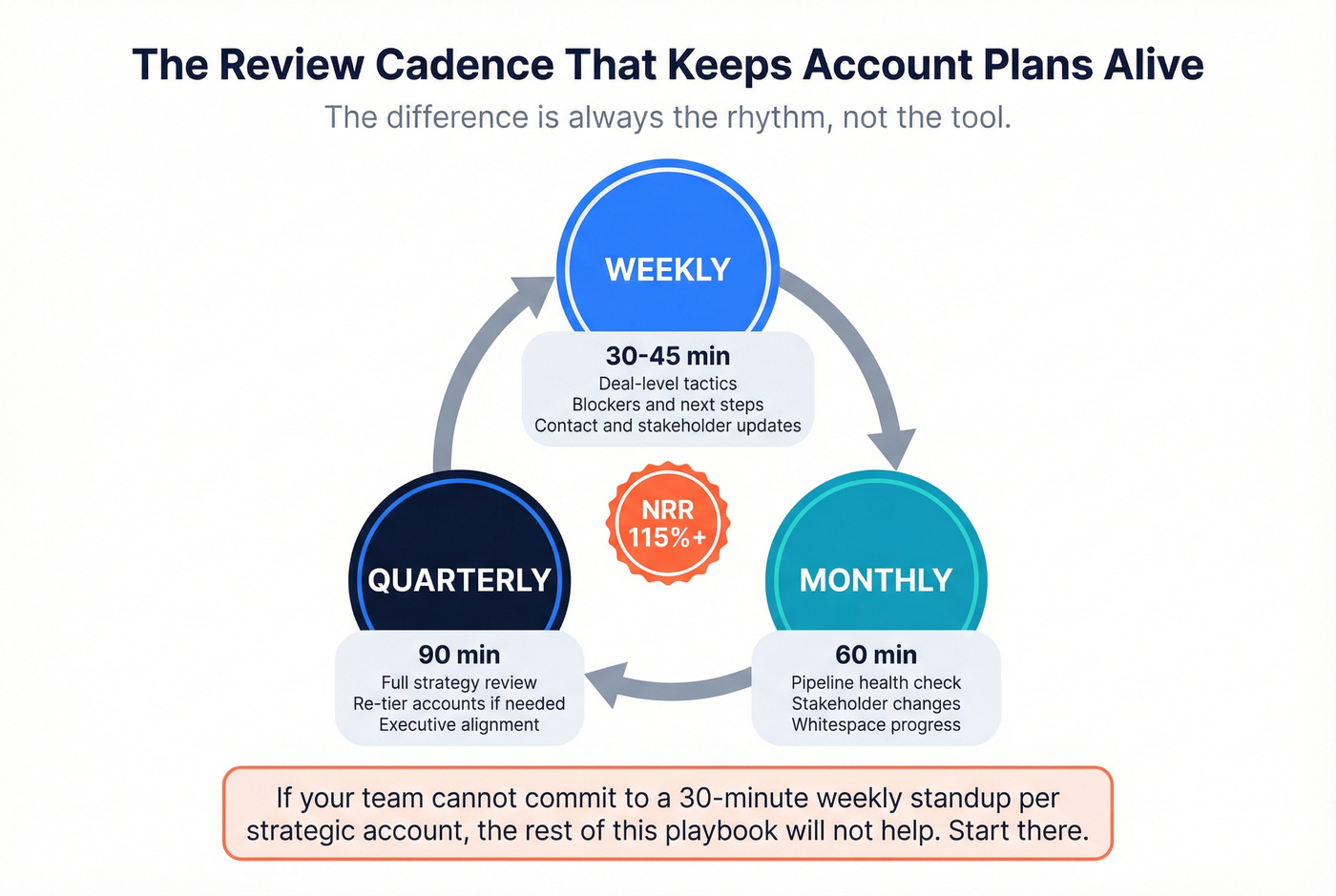
You don't need account planning software to start. You need a CRM, clean data, and a 30-minute weekly review. What SAMA calls "communication maturity" - the ability to run structured, multi-level conversations across an account - only develops through repetition, not through better templates. (This is also where sales operations earns its keep: cadence, hygiene, and accountability.)
| Frequency | Duration | Focus |
|---|---|---|
| Weekly | 30-45 min | Deal-level tactics, blockers, next steps |
| Monthly | 60 min | Pipeline health, stakeholder changes, whitespace progress |
| Quarterly | 90 min | Strategy review, re-tier if needed, exec alignment |
We've seen teams with beautiful Notion account plans that nobody touches, and teams running everything in a shared Google Sheet with a standing Tuesday morning review that consistently hit 115%+ NRR. The difference is always the rhythm, not the tool.
Let's be honest: if your team can't commit to a 30-minute weekly standup per strategic account, the rest of this playbook won't help. Start there.
The Data Problem Behind Every Growth Plan
Frameworks are fine. But poor data quality in account management costs businesses an estimated $15M per year, and the industry-average data refresh cycle is about six weeks.
People change jobs, get promoted, move to new companies. You can't multi-thread into 11 stakeholders if half your emails bounce and the VP you mapped in January left in March. Every account growth strategy depends on what SAMA calls "intelligence aggregation" - the ability to continuously collect and act on fresh account data - and that means your stakeholder maps need to be current, not quarterly-updated. (If you’re building the data layer, start with how to find verified email addresses.)
I watched a team lose a $400k expansion because their champion got promoted to a different division and nobody noticed for two months. The new contact had already started evaluating a competitor by the time the AE reached out. That's not a strategy failure. That's a data failure.
Prospeo helps here with a 7-day data refresh cycle, 98% email accuracy across 300M+ professional profiles, and bulk CRM enrichment that keeps your entire account database current. When Snyk rolled it out across 50 AEs, their bounce rate dropped from 35-40% to under 5%, and AE-sourced pipeline jumped 180%.
Skip this if your account base is under 20 accounts and you can manually track stakeholder changes. For everyone else, automating the data layer is what separates teams that execute from teams that plan.

Your whitespace analysis identified expansion opportunities. Now you need direct lines to the decision-makers in those untouched business units. Prospeo returns 50+ data points per contact with a 92% match rate - so your account plans stay actionable, not theoretical.
Turn whitespace ARR from a spreadsheet number into booked meetings.
Account Growth Strategy FAQ
What's the difference between account management and account growth?
Account management is reactive - renewals, support escalations, relationship maintenance. Account growth is proactive - identifying whitespace, multi-threading into new business units, and expanding share of wallet. The shift requires a fundamentally different cadence, skillset, and data infrastructure.
How many accounts should one rep manage?
Strategic accounts (≥$1M ARR): 3 per rep. Growth accounts ($200k-$1M): 6 per rep. Nurture accounts (<$200k): 10 per rep. Overloading reps with too many "strategic" accounts is one of the most common planning mistakes - and one of the easiest to fix.
What tools do I need for account planning?
Start with your existing CRM and a spreadsheet. Add a data enrichment layer so your stakeholder maps stay current. For CRM-native options, Pipedrive starts at $14/user/month. If you're scaling past $5M ARR, consider dedicated KAM platforms like DemandFarm or Kapta. Don't buy software before you have a cadence.
How often should I update my account plan?
Weekly tactical reviews, monthly pipeline check-ins, quarterly strategy resets. The cadence matters more than the template. A plan reviewed weekly beats a perfect plan reviewed never.
Should I focus on existing accounts or new acquisition?
Expansion revenue from existing accounts almost always delivers better ROI than pure acquisition - it costs less to close, converts faster, and compounds NRR over time. The best teams balance both motions, but if your NRR is below 105%, fix the existing book first.