

Active Listening in Sales: Numbers, Scripts, and Frameworks That Work
Your rep just finished a discovery call. They talked for 68% of it. The prospect said "sounds good, send me some info" and disappeared. That call was dead the moment the rep stopped listening and started pitching.
Data from 350+ B2B sales calls shows reps who talk 38-46% of the time close at 41%. Reps who talk 65% or more? They close at 14%. That's a 3x difference in win rate, and it comes down to one skill most reps think they already have.
Quick Reference
- Optimal talk-to-listen ratio: 43% you, 57% prospect - revalidated by Gong in 2026.
- Cold calls are the exception: Flip it to 55/45. You need to earn the right to ask questions, which means talking more upfront.
- Consistency matters more than hitting the number once. High performers maintain similar ratios whether they win or lose. Low performers swing wildly - 54% talk time in won deals, 64% in lost ones.
- Stage-specific benchmarks exist. Discovery calls, demos, and negotiations each have different targets. "Listen more" is incomplete advice.
- Scripts below are copy-paste ready. Each one maps to a specific listening technique so you know why it works, not just what to say.
What Active Listening Actually Means in Sales
Active listening isn't nodding along while you mentally rehearse your next pitch point. It's a deliberate process: you hear what the prospect says, process the meaning behind it, and respond in a way that proves you understood. The difference between passive and active listening is the difference between waiting for your turn to talk and actually changing your approach based on what you just heard.
Chris Voss calls the critical failure point the "hijack point" - the exact moment you stop listening to understand and start listening to respond. Every rep has been there. NetSuite names "talking too much instead of listening" as one of the top sales mistakes, noting it signals to prospects that you don't care about their perspective.
The fix isn't just talking less. It's listening with a purpose: to uncover the prospect's real problem, not the one you assumed they had before the call started. On virtual calls, it's even harder - you lose body language cues, prospects multitask with their cameras off, and the temptation to check Slack mid-call is constant. The reps who win remote deals compensate for those missing signals with sharper listening techniques.
The Numbers Behind It
The "listen more" advice floating around every sales blog is directionally correct but operationally useless without benchmarks. Here's what the data actually says.
The Consistency Finding
This is the freshest and most counterintuitive insight. Gong Labs [revisited their 43/57 ratio](https://www.gong.io/blog/talk-to-listen-conversion-ratio) and confirmed it still holds. But the bigger finding was about consistency. High-performing reps maintain nearly identical talk-to-listen ratios across won and lost deals. They don't suddenly start monologuing when a deal goes sideways.
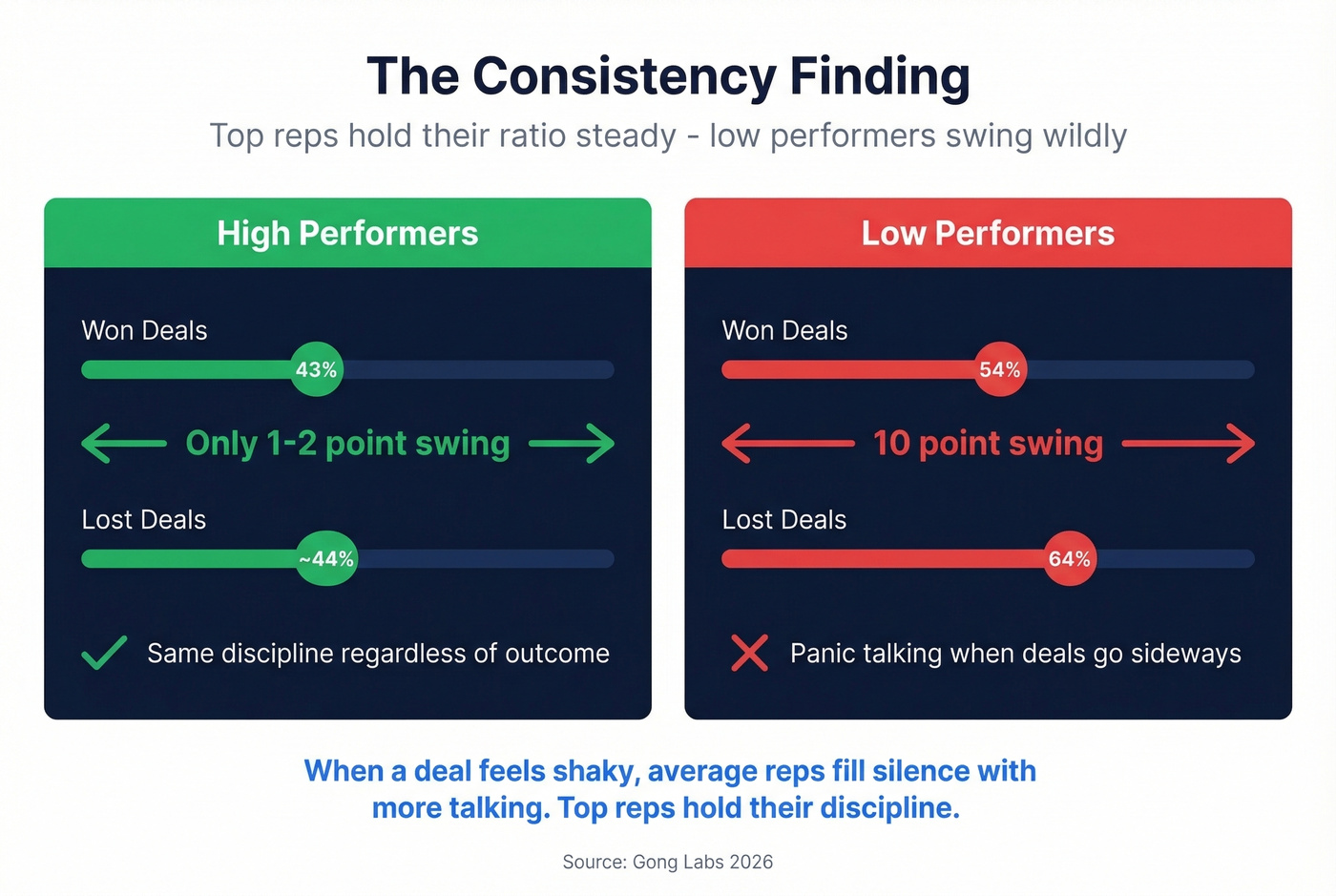
Low performers swing by 10 percentage points - 54% talk time in deals they win, 64% in deals they lose. In our experience, the reps who struggle most aren't the ones who talk too much on one call. They're the ones whose ratio swings wildly from call to call. When a deal feels shaky, average reps panic and fill the silence with more talking. Top reps hold their discipline.
Close Rates by Talk-Time Band
This table comes from Nimitai's analysis of 350+ B2B calls across 47 teams in SaaS, MedTech, and services. Separate benchmarks from CloudTalk (25,000+ calls) and Demodesk (328 B2B meetings) point to the same conclusion: the best calls cluster around the low-to-mid 40% rep talk-time range.
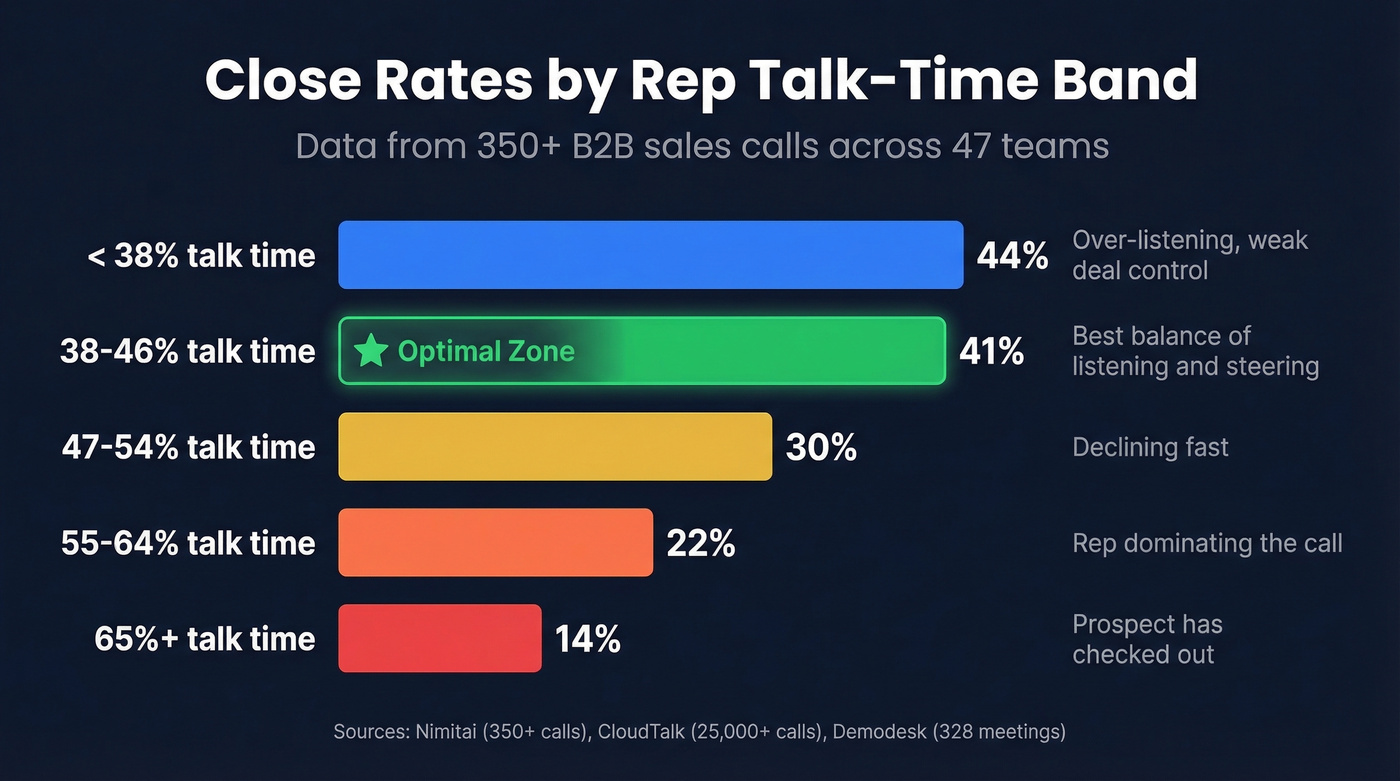
| Rep Talk-Time % | Close Rate | Takeaway |
|---|---|---|
| < 38% | 44% | Over-listening - you're not guiding the conversation |
| 38-46% | 41% | Optimal zone |
| 47-54% | ~30% | Declining fast |
| 55-64% | ~22% | Rep dominating |
| 65%+ | 14% | Prospect checked out |
Notice the sub-38% band. Reps who barely talk at all actually close slightly better than the optimal zone in raw numbers, but they struggle to control deal progression and often lose on next steps. The 38-46% range balances listening with enough steering to move deals forward.
The Cold-Call Exception
Here's where generic "listen more" advice actually hurts reps. Successful cold calls run at 55% talk / 45% listen - nearly the inverse of discovery calls. On a cold call, you haven't earned the right to ask probing questions yet. You need to establish relevance, deliver a hook, and create enough interest that the prospect wants to talk. Telling a cold caller to "just listen" is bad coaching - especially if you’re still refining your cold calling process.
Phrases That Kill (and Create) Deals
Two data points worth memorizing:
"How've you been?" as a cold call opener produced a 6.6x higher success rate than baseline - over 10% booking rate. It's warm, disarming, and signals you're a human, not a script.
"Did I catch you at a bad time?" drops meeting-booking chances by 40%, with a 0.9% success rate. It hands the prospect an easy exit. Stop using it.
Stage-Specific Benchmarks
Blanket ratio advice ignores the reality that different call types demand different balances. A demo requires more rep airtime than a discovery call. A negotiation requires more listening than a cold call.
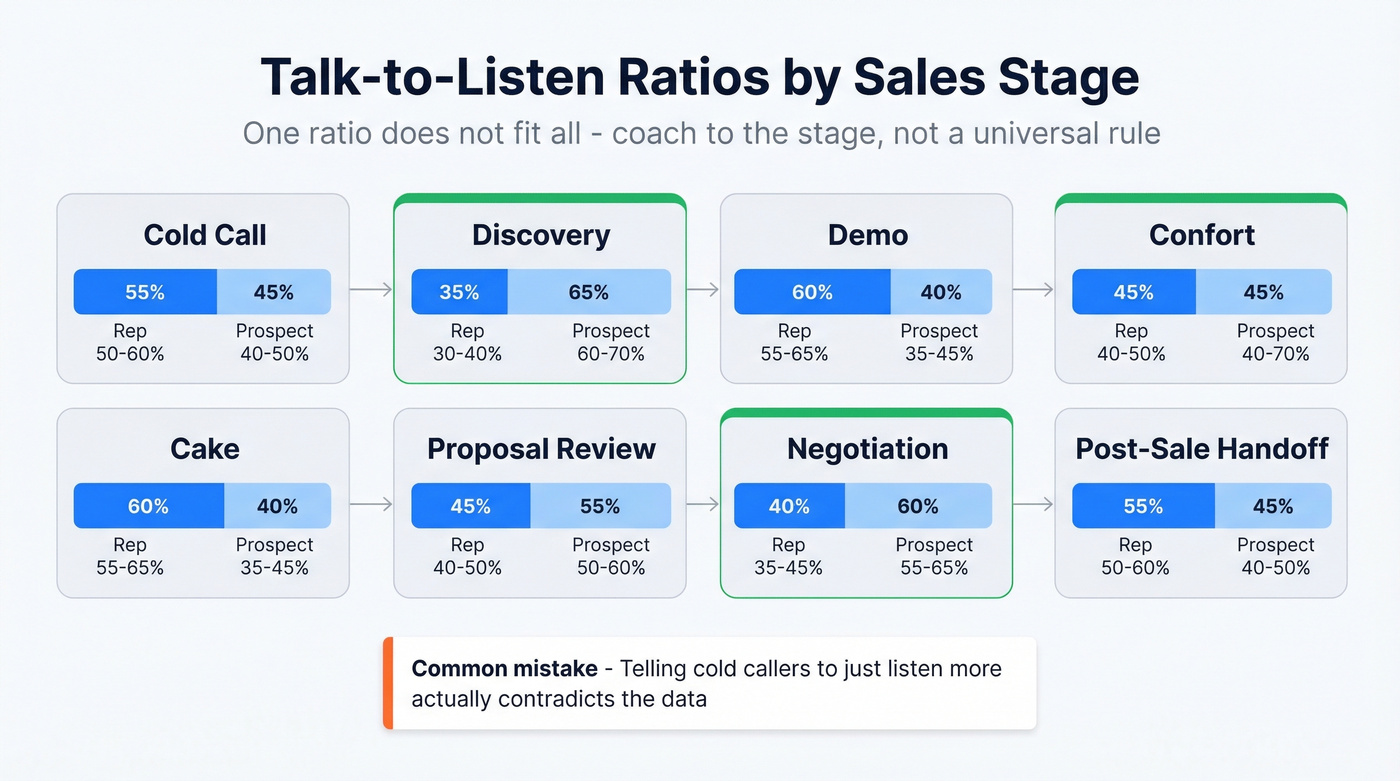
| Call Stage | Rep Talk % | Prospect Talk % |
|---|---|---|
| Cold call / first contact | 50-60% | 40-50% |
| Discovery | 30-40% | 60-70% |
| Demo | 55-65% | 35-45% |
| Proposal review | 40-50% | 50-60% |
| Negotiation / closing | 35-45% | 55-65% |
| Post-sale handoff | 50-60% | 40-50% |
If you're coaching reps to "listen more" on cold calls and demos, you're giving them advice that contradicts the data. Coach to the stage, not to a universal rule.

Active listening only matters when you're on a call with the right buyer. Prospeo gives you 98% accurate emails and 125M+ verified mobile numbers so every conversation counts - not wasted on gatekeepers or dead contacts.
Stop perfecting your pitch for the wrong people.
Techniques With Scripts
Knowing the ratios is step one. Knowing what to do during the listening portion is step two. Here are the techniques that move the needle, each paired with language you can use on your next call.
Before your next call, identify your default listening style: empathetic, analytical, or solution-focused. Knowing your default helps you catch when you're leaning on it instead of adapting to the prospect.
Paraphrasing and Mirroring
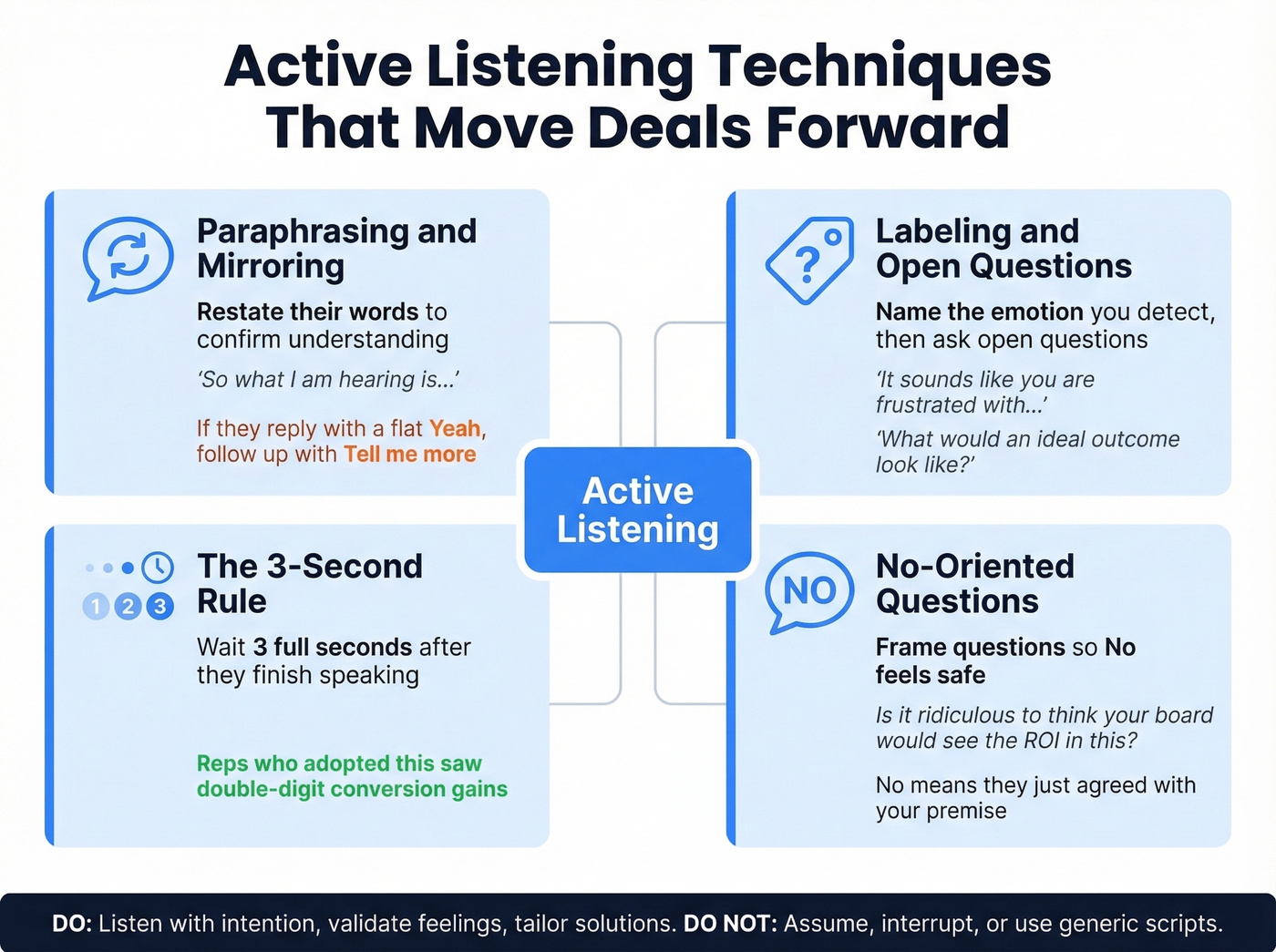
Paraphrasing means restating the prospect's point in your own words to confirm understanding. It proves you were listening and gives the prospect a chance to correct you - which is where the real information surfaces.
Script: "So what I'm hearing is that your team's spending about 10 hours a week on manual data entry, and that's pulling them away from actual selling. Do I have that right?"
Mirroring - repeating the last 2-3 words the prospect said - is a Voss technique that works beautifully until it doesn't. The common failure mode, flagged on r/sales, is when the prospect responds to your mirror with a flat "Yeah." Follow up with "Tell me more" or "Elaborate for me." These prompts reopen the conversation without making you sound like a parrot. (If you want more examples, see our guide to mirroring.)
Labeling and Open-Ended Questions
Labeling is naming the emotion or concern you're detecting. "It sounds like you're frustrated with the implementation timeline" does more work than "I understand." It shows you're processing, not just acknowledging.
Open-ended questions keep the prospect talking. "What would an ideal outcome look like for your team?" beats "Does that make sense?" every time. The goal is to get the prospect describing their world in detail - that's where the actual buying signals surface. On video calls, watch for micro-expressions when you label an emotion: a slight nod or a brief pause before responding usually means you've hit something real. This is also where emotional intelligence shows up in measurable ways.
The 3-Second Rule
After the prospect finishes speaking, wait three full seconds before responding. It feels uncomfortable at first. Do it anyway.
Those three seconds prevent you from interrupting a prospect who was about to say something important, and they signal that you're actually thinking about what they said rather than racing to your next point. We've seen reps who adopted this one habit improve their discovery-to-demo conversion by double digits within a month.
No-Oriented Questions
Instead of pushing for "yes" (which triggers resistance), frame questions so "no" feels safe. "Is it ridiculous to think your board would see the ROI in this implementation?" The prospect says "No, it's not ridiculous" - and they've just agreed with your premise without feeling pressured.
The r/sales consensus on what separates good listeners from bad ones boils down to a simple checklist. Do: listen with intention, acknowledge and validate feelings, provide tailored solutions. Don't: make assumptions, interrupt, or fall back on generic scripted responses.
Tactical Empathy Framework
Chris Voss's tactical empathy framework goes deeper than standard listening techniques. The core idea: you're not just hearing words, you're reading the emotions running beneath the conversation and using that information strategically.
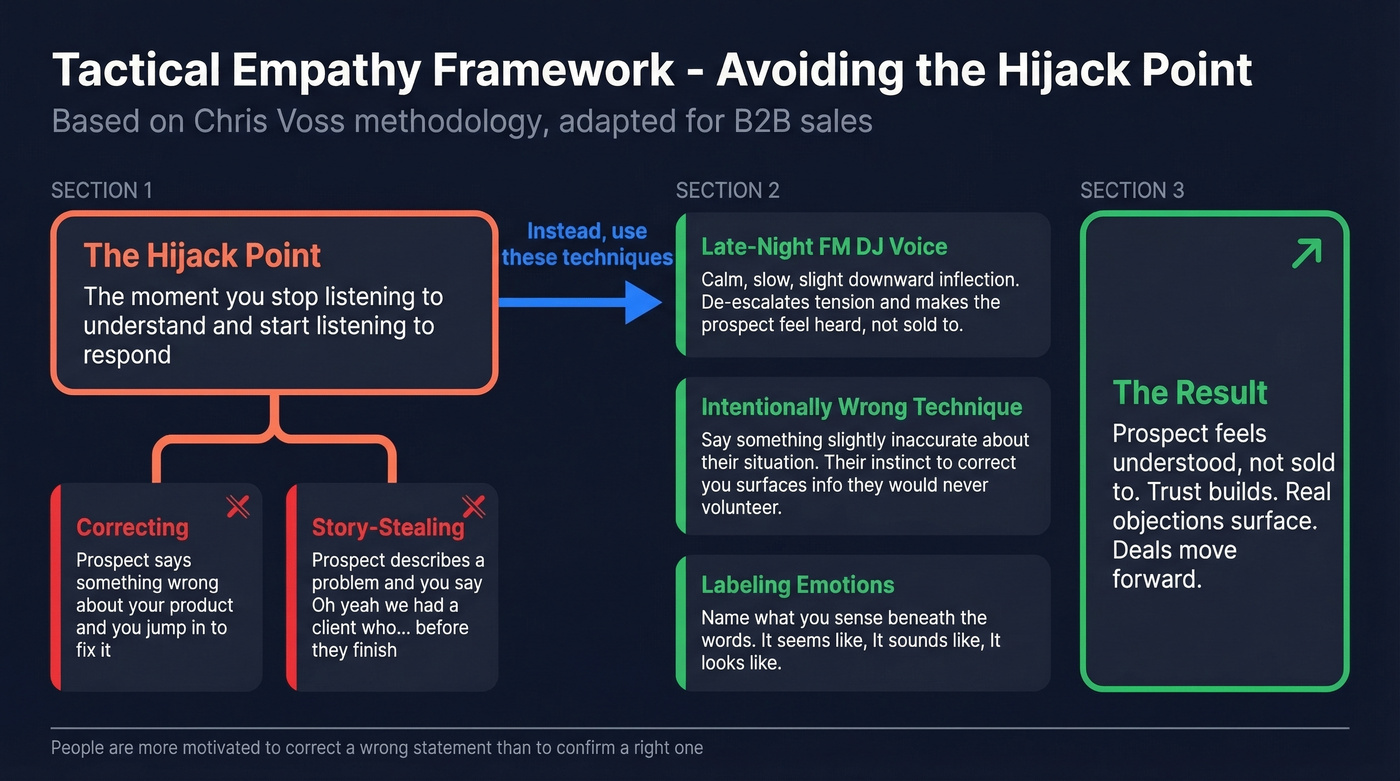
The hijack point is the moment most reps fail. There are two common hijacks. The first is correcting - the prospect says something factually wrong about your product, and you immediately jump in to fix it. The second is story-stealing - the prospect describes a problem, and you respond with "Oh yeah, we had a client who..." before they've finished. Both kill trust because they signal you care more about being right than about understanding.
The late-night FM DJ voice is a tone technique: calm, slow, with a slight downward inflection at the end of sentences. It de-escalates tension and makes the prospect feel heard rather than sold to. I'll admit it sounded gimmicky to me the first time I read about it, but the effect on tense negotiation calls is real - especially when you’re dialing in tonality.
The intentionally wrong technique is counterintuitive but effective: say something you know is slightly inaccurate about the prospect's situation. Their instinct to correct you will surface information they wouldn't have volunteered otherwise. People are more motivated to correct a wrong statement than to confirm a right one.
Objection-Handling Scripts
The Validate-Probe-Prove Pattern
Every script below follows a three-step structure: validate the concern without agreeing or disagreeing, probe with a clarifying question that reveals the real objection, then prove with specific evidence. Some frameworks simplify this to "acknowledge and clarify." That skips the probing step - the part where you actually learn what's going on.
The 6 Most Common Brush-Offs
"Just send me some info."
"Absolutely - what's your email? Quick question though: if you were in my shoes sending information to you, what would you want to make sure was included?"
This open-ended question forces the prospect to articulate what they actually care about - and now you have a reason to follow up with something targeted instead of a generic PDF.
"I need to think about it" / "Your price is too high"
These are cousins. Both are surface objections hiding a real concern. For "I need to think about it," try: "Totally fair. What questions are still open for you?" For price: "Help me understand - is it the total investment, or is it that you're not sure the ROI justifies it? Because those are two different conversations." Price objections are almost always value objections in disguise.
"We're happy with our current provider."
"That's great to hear - who are you working with? What do you like most about them? And if you could change one thing, what would it be?"
You're paraphrasing their satisfaction, then probing for the gap. The "one thing" question is where deals start.
"We're already using a competitor."
Don't position yourself as a replacement - that triggers loss aversion. Instead: "Makes sense. What do you like most about what they're doing for you?" Listen. Then: "A lot of teams we work with started in a similar spot and found that [specific differentiator] filled a gap they didn't realize they had." You're a complement, not a threat.
"It's not a priority right now."
"Understood. When you say 'right now,' is that a timing thing or a 'this doesn't solve a problem we have' thing?"
This is no-oriented framing - you're giving the prospect permission to say "no, it's not that" and reveal the real blocker. If it's genuinely timing, offer to follow up later rather than pushing. Skip the hard close here; it'll only burn the relationship.
How to Measure Your Ratio
You can't improve what you don't measure.
Step 1: Record your calls. Conversation intelligence platforms like Gong and CloudTalk do this automatically and tag speaker segments. (If you’re evaluating options, start with conversational intelligence platforms.)
Step 2: Calculate the ratio. CloudTalk's methodology breaks it down: sum agent talk time, sum customer talk time, express each as a percentage of total speaking time. Silence and hold time get excluded.
Step 3: Review weekly, not per-call. Individual calls vary based on context. The pattern over time tells you whether a rep is trending toward the 43/57 benchmark or drifting into monologue territory.
Step 4: Compare against stage benchmarks. A rep who talks 55% on cold calls is fine. The same rep talking 55% on discovery calls needs coaching.
Teams who actively monitor and coach on talk-to-listen ratios see close rates increase by up to 20%. That's a meaningful lift from a metric that costs nothing to track - and it pairs well with a structured sales call scorecard.
Building These Skills on Your Team
Let's be honest: reading about active listening doesn't build the muscle. Practice does. Here are three exercises you can run in your next team meeting with zero budget.
Exercise 1: The Paraphrase Drill. Pair up reps. One plays the prospect and describes a business problem for 60 seconds. The other listens without interrupting, then paraphrases what they heard - no adding interpretation, no jumping to solutions. The "prospect" confirms or corrects. Switch roles. We run this quarterly and it still catches experienced reps defaulting to solution mode.
Exercise 2: Role-Play with Constraints. Write out 3-4 realistic prospect monologues. The seller's only job is to use paraphrasing, mirroring, and open-ended questions - no pitching allowed. The constraint forces reps to build listening habits instead of defaulting to their pitch. (For a full system, use role playing sales training.)
Exercise 3: The Questioning Gauntlet. Present a scenario - "The prospect is a VP of Ops at a 200-person company evaluating new CRM software." Each rep writes five probing questions they'd ask in discovery. The group votes on which questions would surface the most useful information and discusses why. This one sparks surprisingly heated debates about question sequencing.
Here's the thing: if you're selling a product under $15K ACV, you probably don't need a conversation intelligence platform to track ratios. Have a manager shadow a handful of calls per rep each week and score them on a simple 1-5 listening scale. The feedback loop matters more than the precision of the measurement. If you want a repeatable process, formalize it with call shadowing.
One more "do" for the pre-call checklist: verify your prospect's contact info before the call. Nothing kills a prepared conversation faster than a wrong number or a bounced follow-up email. Tools like Prospeo handle email and phone verification so you're not wasting a sharp discovery call on bad data. (Related: how to verify an email address.)
Your reps nailed the 43/57 ratio. They asked the right questions. Then the follow-up bounced. With Prospeo's 7-day data refresh and 98% email accuracy, the contacts you reach out to actually exist - so great discovery calls turn into pipeline, not dead ends.
Great listening skills deserve data that doesn't bounce.
FAQ
What's the ideal talk-to-listen ratio?
The optimal ratio is 43% rep talk time to 57% prospect talk time, based on Gong's 2026 revalidation. Cold calls are the exception - successful cold calls run closer to 55/45 because you need to establish relevance before earning the right to ask questions.
Why does active listening improve close rates?
Reps who listen more than they talk during discovery close at nearly 3x the rate of those who dominate the conversation (41% vs 14%). Prospects share deeper pain points, reveal budget constraints, and surface objections earlier when they feel genuinely heard - giving reps better information to close on.
How do I practice on virtual calls?
Close every tab except your notes and the video call. Use the 3-second rule after the prospect finishes speaking. Take notes on what the prospect says, not on what you plan to say next. Keep your camera on and nod visibly - on virtual calls, exaggerated nonverbal signals replace the subtle body language cues you'd pick up in person.
Does active listening work on cold calls?
Yes, but the application changes. You talk more upfront to hook interest, then shift into listening mode once the prospect engages. The ratio flips to roughly 55/45. Mirroring and open-ended questions still work - you just deploy them after you've earned a few seconds of attention.
What tools help with pre-call preparation?
Conversation intelligence tools like Gong handle measurement. For contact verification, Prospeo finds and verifies emails with 98% accuracy and direct dials across 125M+ verified mobiles so you actually reach the right person. Combine verified contact data with 10 minutes of account research and you'll walk into every call ready to listen with purpose.