

The Cold Calling Process That Turns 800 Dials Into 18 Meetings
49% of buyers actually prefer to be contacted by cold call. Among C-level and VP buyers, that number jumps to 57%. Cold calling isn't dying. Bad cold calling processes are.
Here's the gap: success rates dropped from 4.82% to 2.3% over the past two years. Meanwhile, 48% of B2B reps still fear picking up the phone. The teams winning right now aren't dialing more - they're running a tighter process before, during, and after every call.
The Short Version
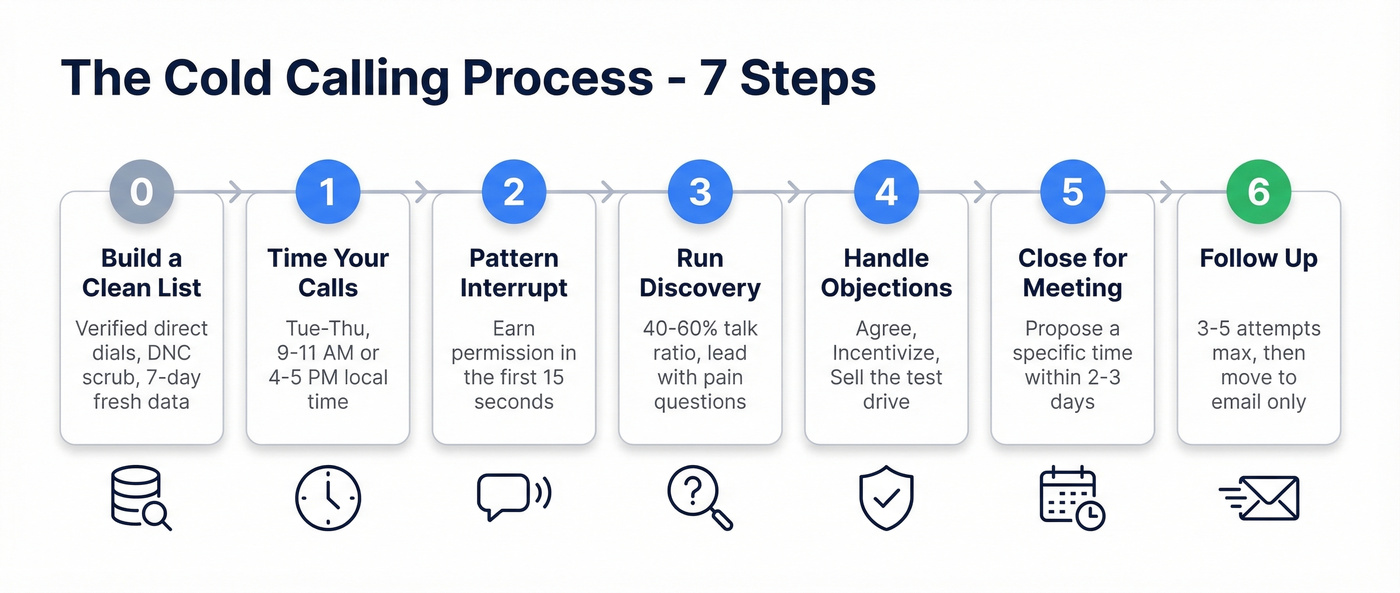
- Clean your list before you dial. Verified direct dials, not scraped numbers. If 20%+ of your dials hit disconnected lines, your data provider is the problem.
- Call Tuesday through Thursday, 9-11 AM or 4-5 PM in the prospect's timezone.
- Open with a pattern interrupt, not a pitch. The first 15 seconds decide everything.
- Handle objections with Agree, Incentivize, Redirect. Don't wing it.
- Cap attempts at 3-5 per prospect, then move on.
The Funnel Math Most Reps Ignore
| Metric | Average Rep | Top 25% Rep |
|---|---|---|
| Dials | 800 | 800 |
| Connects | 43 (5.4%) | 106 (13.3%) |
| Meetings booked | 2 (4.6% of connects) | 18 (16.7%) |
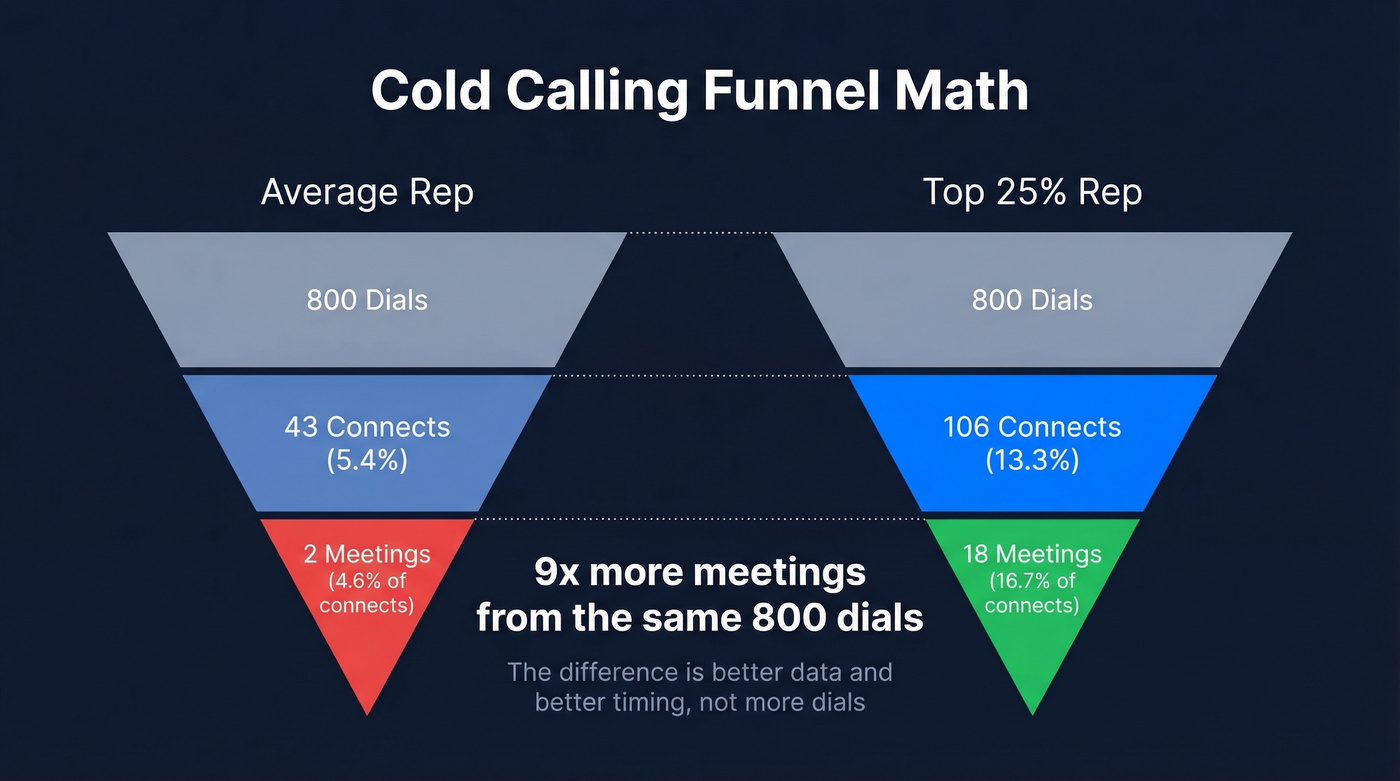
The top-quartile rep doesn't dial more. They connect more - better data, better timing - and convert more of those connects into meetings. That's a 9x difference from the same 800 dials.
Here's the thing: most teams throw money at conversation intelligence tools and dialer upgrades when the real bottleneck is garbage phone numbers. Fix the data layer first. Everything downstream improves.
If you want a full stack view, build it like a cold calling system instead of a random set of tools.

The difference between 43 connects and 106 connects from the same 800 dials? Data quality. Prospeo's 125M+ verified mobile numbers refresh every 7 days - not every 6 weeks - so you're dialing numbers that actually ring. Teams using Prospeo see a 30% pickup rate, nearly 3x the industry average.
Fix the data layer first. Everything downstream improves.
Cold Calling Steps: A Complete Walkthrough
Step 0 - Build a Clean List
This is where most processes silently fail, and it's the step nobody wants to talk about because it isn't glamorous. TCPA penalties run $500-$1,500 per violation, and federal DNC fines hit $50,120 per illegal call. Scrub lists against the DNC registry every 31 days. Only call between 8 AM and 9 PM in the recipient's local timezone.
If you're building lists from scratch, start with an Ideal Customer Profile so your dials go to the right accounts.
For the data itself, we've found that the single biggest lever for connect rates is the freshness of your phone numbers. Prospeo's Mobile Finder covers 125M+ verified mobile numbers with a 30% pickup rate, and the 7-day refresh cycle means you're not calling numbers that went stale six weeks ago. Compare that to the industry average refresh of six weeks and you'll see why stale lists are the silent killer of cold calling programs.
If you're layering in firmographics/technographics, use firmographic and technographic data to tighten targeting before you enrich contacts.
Step 1 - Time Your Calls
A ZoomInfo analysis of 1.4M calls makes this clear: Tuesday and Wednesday account for 44% of all demos booked. Friday is dead last. For time of day, the 9-11 AM window delivers a 15% connection rate lift over other hours, with a second sweet spot at 4-5 PM.
If you're coordinating phone + email, align this with the best time to send cold emails so your touches stack instead of compete.
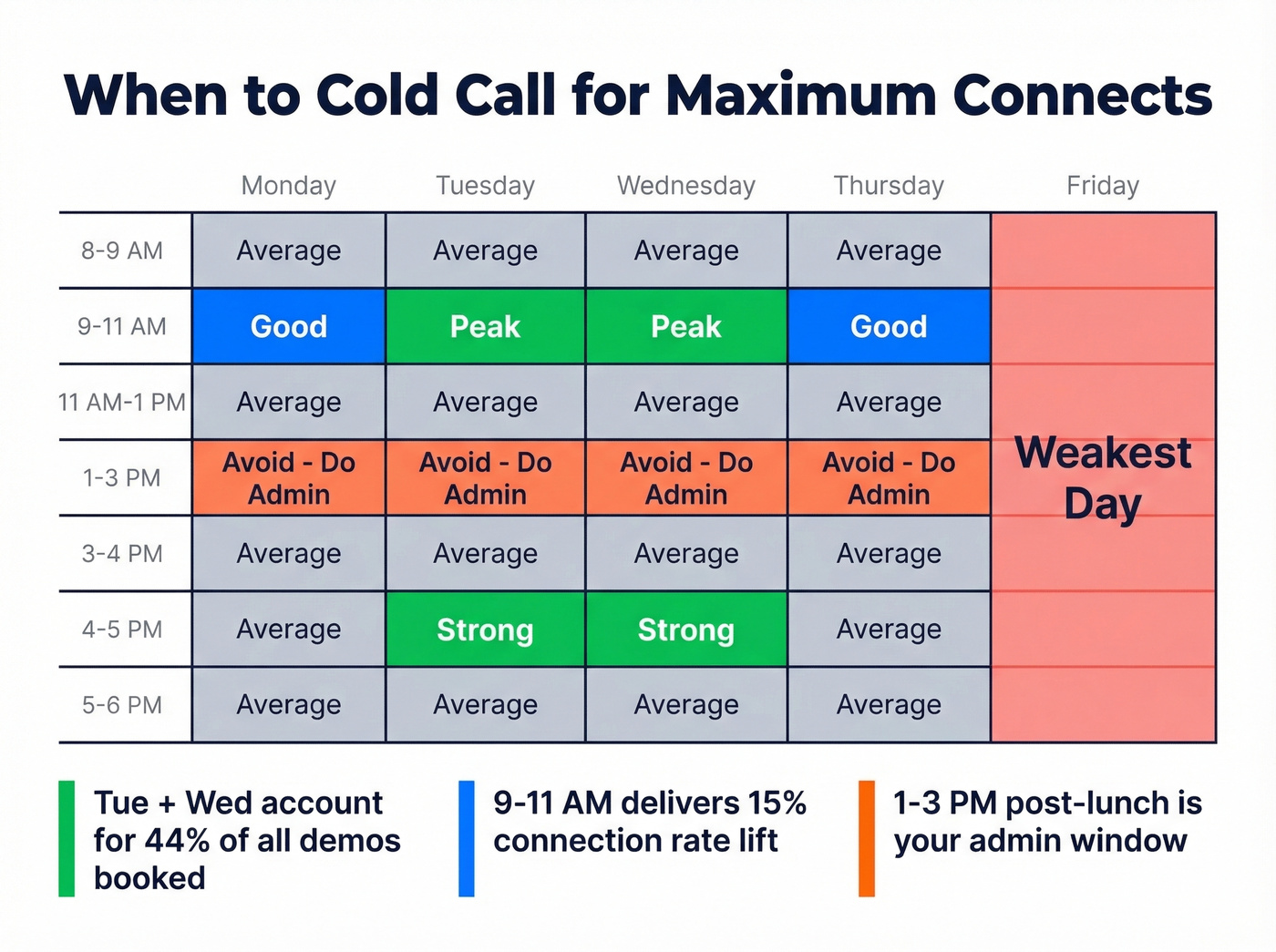
Block these windows. Protect them from internal meetings. The 1-3 PM post-lunch window tends to be the weakest for connects, so that's when you do your admin work, not your dialing.
Step 2 - Open With a Pattern Interrupt
Top performers build rapport about 20% into the call; low performers wait until 40% in. Your first 15 seconds aren't about your product - they're about earning permission to keep talking.
A permission-based opener works: "Hey [Name], I know this is out of the blue - do you have 30 seconds so I can tell you why I'm calling, and you can decide if it's worth continuing?" This reduces early resistance compared to launching into a pitch. And because you're dialing verified direct dials, you often bypass gatekeepers entirely - no "can I speak with the person who handles..." preamble needed.
If you want more variations, pull from these talk track examples and adapt them to your market.
Step 3 - Run Discovery, Not a Pitch
The average cold call lasts 93 seconds. That's it. Aim for a 40-60% talk ratio - you should be listening more than speaking. Lead with problem-focused questions: "How are you handling [specific pain point] right now?" beats any feature dump.
The goal isn't to sell on the call. It's to uncover enough pain to justify a meeting.
To sharpen your questioning, use a structured set of discovery questions instead of improvising every call.
Step 4 - Handle Objections
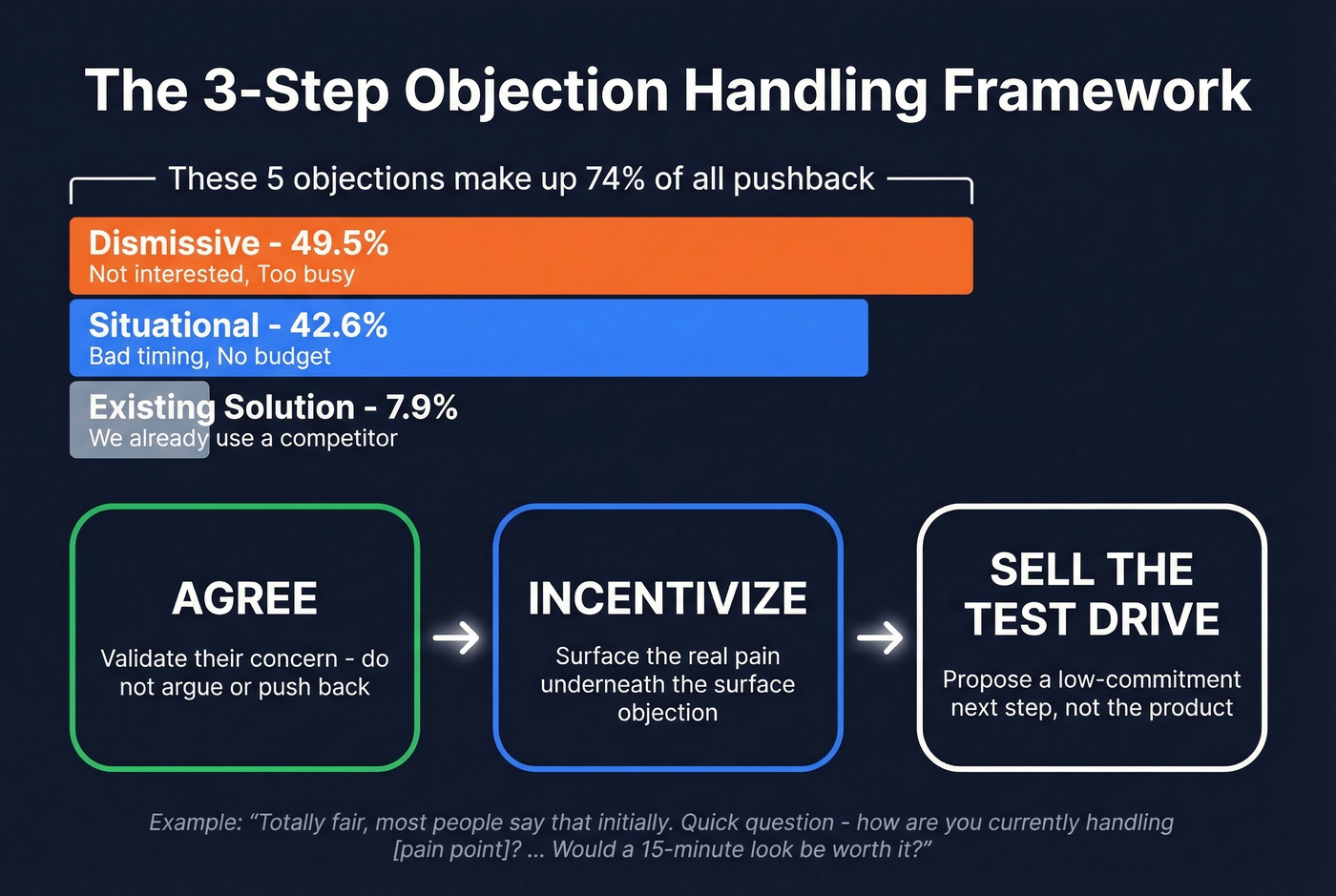
Analysis of 300M+ cold calls by Orum found that five objections account for 74% of all pushback, falling into three buckets:
| Bucket | Share | Examples |
|---|---|---|
| Dismissive | 49.5% | "Not interested," "Too busy" |
| Situational | 42.6% | "Bad timing," "No budget" |
| Existing solution | 7.9% | "We already use [competitor]" |
The framework: Agree with the objection, Incentivize by surfacing the real concern underneath, then Sell the test drive - propose a low-commitment next step, not the product. Connect with the prospect's concern, create curiosity about a better outcome, and convert that curiosity into a concrete next step.
"Not interested" is the most common objection by far, and it almost never means the prospect evaluated your offer. It means they want you off the phone. Agree, redirect, earn 15 more seconds. We've seen reps who master this single objection response increase their meeting-book rate by double digits, because nearly half of all pushback falls into this one category.
If objection volume is killing your conversion, this guide on how to reduce sales objection rate can help you diagnose the root causes.
Step 5 - Close for the Meeting
Don't ask "when works for you?" That's an invitation to say "never." Propose a specific time: "Does Thursday at 2 PM work for a 20-minute call?"
Show rates drop the further out you book, so push for something in the next 2-3 days. Send the calendar invite while you're still on the phone. If you wait, the meeting evaporates.
If you want a tighter end-to-end structure, map this to the steps to close a sale so your call-to-meeting handoff is consistent.
Step 6 - Follow Up Strategically
The industry average is 8 call attempts to reach a prospect, but that's wildly inefficient. WHAM data shows 93% of conversations happen by attempt 3 and 98.6% by attempt 5. Beyond that, you're burning time for near-zero return.
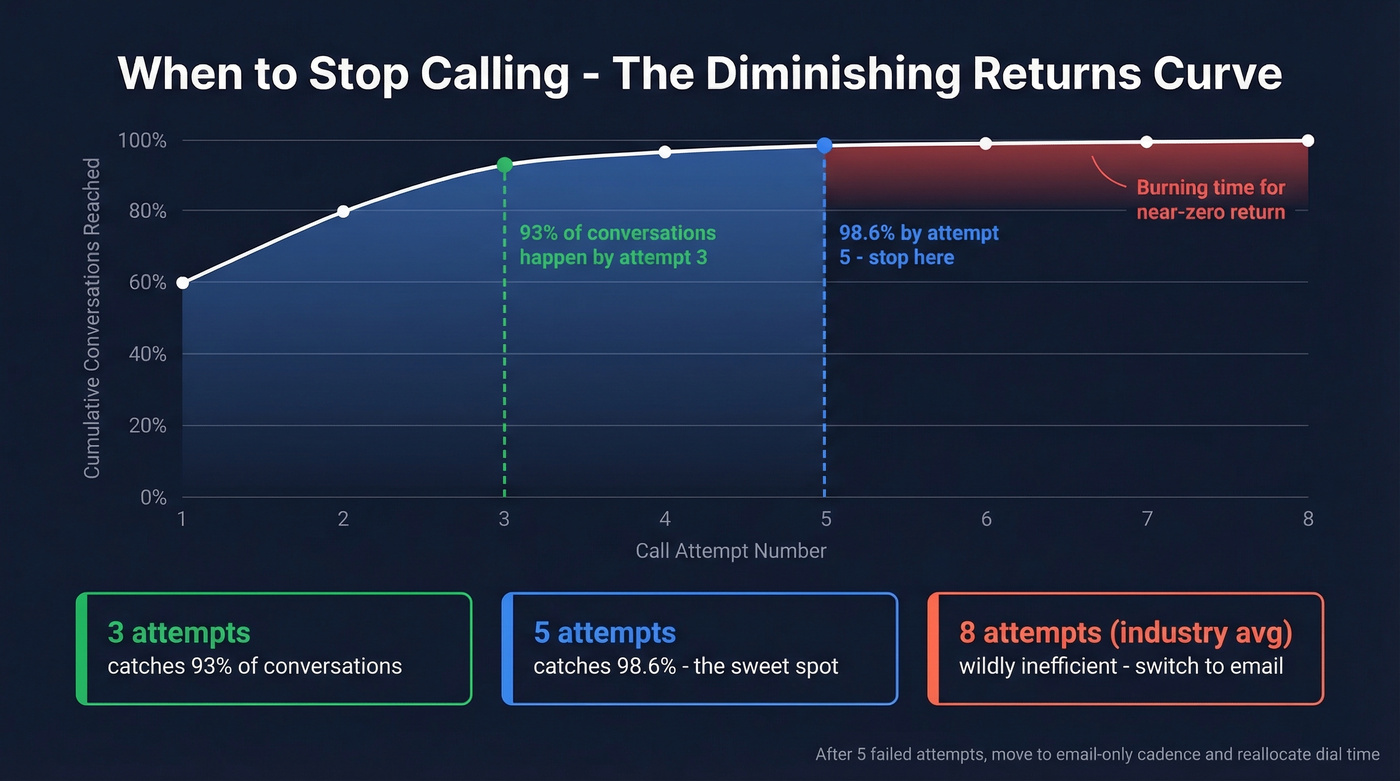
After every meaningful conversation, send an immediate email recap with the agreed next step and a calendar link. Log everything in your CRM. For prospects who don't connect after five attempts, move them to an email-only cadence and reallocate dial time to fresh leads.
If you need copy you can paste, use these sales follow-up templates to standardize recaps and nudges.
You just mapped the entire cold calling process - from timing to objection handling to follow-up cadences. None of it matters if 20% of your dials hit disconnected lines. Prospeo gives you verified direct dials at ~$0.01/lead with no contracts, so every call block you protect actually produces conversations.
Stop wasting your best calling windows on dead numbers.
Mistakes That Kill Results
Pitching in the first 15 seconds. You haven't earned the right. Lead with context and a question instead.
Reading your script verbatim. Prospects hear it instantly. Scripts are guardrails, not teleprompters. In our experience, the best reps internalize the structure and improvise the words - like a jazz musician who knows the chord changes but doesn't read sheet music on stage.
Mistaking politeness for interest. "Send me some info" is a polite rejection 90% of the time. Qualify it: "What specifically would be most useful?" If they can't answer, you don't have a prospect.
Giving up after one attempt. The data says 3-5 attempts. One and done leaves meetings on the table.
Not tracking objection patterns. If your team isn't logging which objections come up most, managers can't run targeted coaching sessions. The consensus on r/sales is that objection tracking is the single most underused coaching tool in outbound - and we'd agree.
If your reps are struggling mentally with the no’s, train for cold call rejection like a skill, not a personality trait.
Your Cold Calling Tool Stack
| Category | What to look for | Est. cost |
|---|---|---|
| Dialer | Manual (<50/day), progressive (50-150), predictive (150+) | $50-$150/seat/mo |
| CRM | Whatever your team already uses | $25-$300/seat/mo |
| Data provider | Verified direct dials + emails | Free tier-$39+/mo |
| Call intelligence | Recording, talk-ratio, objection tagging | $100-$200/seat/mo |
If you're evaluating platforms, start with a ranked list of SDR tools so you don’t overbuy features you won’t use.
For comparison, outsourced cold calling runs $25-$35/hr domestic or $8-$12/hr offshore - roughly $5-$12 per completed call. An in-house rep with clean data and a progressive dialer is easier to manage, improves faster over time, and usually wins on quality. Skip outsourcing unless you're testing a brand-new market and need fast volume before committing to headcount.
FAQ
What's a good cold calling success rate?
The most recent benchmark puts the average at 2.3%. Top-quartile reps hit 16.7% connect-to-meeting conversion. If you're consistently above 5%, your process is working - focus on incremental improvements rather than overhauling everything.
How many times should you call a prospect?
Three to five attempts. 93% of conversations happen by attempt 3 and 98.6% by attempt 5. After five calls with no connection, switch to email-only and reallocate dial time to fresh leads.
How do you get accurate phone numbers for cold calling?
Use a verified data provider with a weekly refresh cycle instead of scraping or buying static lists. Stale data is the fastest way to tank your connect rate - if your numbers are more than a few weeks old, you're wasting dials on disconnected lines and outdated contacts.
What are the 5 stages of a cold call?
Opener (pattern interrupt to earn attention), rapport building (connect early, not late), discovery (problem-focused questions), objection handling (Agree, Incentivize, Redirect), and the close (propose a specific meeting time). Mastering each stage is what separates reps who book 18 meetings from those who book 2.