

AI in Sales and Marketing: The Practitioner's Reality Check for 2026
88% of companies now use AI regularly in at least one business function, up from 78% just twelve months earlier. That sounds like a revolution. It isn't - not yet. Only 39% of those organizations attribute any measurable EBIT impact to AI, and for most of them, that impact is less than 5% of total earnings. Nearly two-thirds haven't even begun scaling AI in sales and marketing beyond pilot projects.
The gap between "we use AI" and "AI makes us money" is enormous. It's not a technology problem. It's a data problem, a workflow problem, and a prioritization problem. The companies seeing real returns aren't the ones with the biggest tool stacks - they're the ones who fixed their foundation first and picked two or three tools that actually fit their process. Fragmented systems cost an estimated 20-30% of revenue in lost signals and duplicated effort. Most AI failures start there, not with the model.
Here's the thing: if your deals average under $10K, you almost certainly don't need an enterprise AI stack. Three well-chosen tools will outperform a bloated ten-tool setup every time.
What You Need (Quick Version)
- Clean your data first. Prospeo gives you 98% verified emails and 125M+ verified mobile numbers on a 7-day refresh cycle. If your prospect data is garbage, every AI tool downstream produces garbage faster. (If you’re evaluating providers, start with our breakdown of the best B2B databases.)
- Pick one general-purpose LLM. ChatGPT handles research, content drafts, and ad-hoc analysis. Pricing is simple: Free, Plus at $20/mo, and Team plans around $25-30/user/mo.
- Add conversation intelligence. Gong captures what's actually happening on calls so you can coach reps with data, not gut feel. (If you’re building a lean stack, map it to a RevOps tech stack first.)
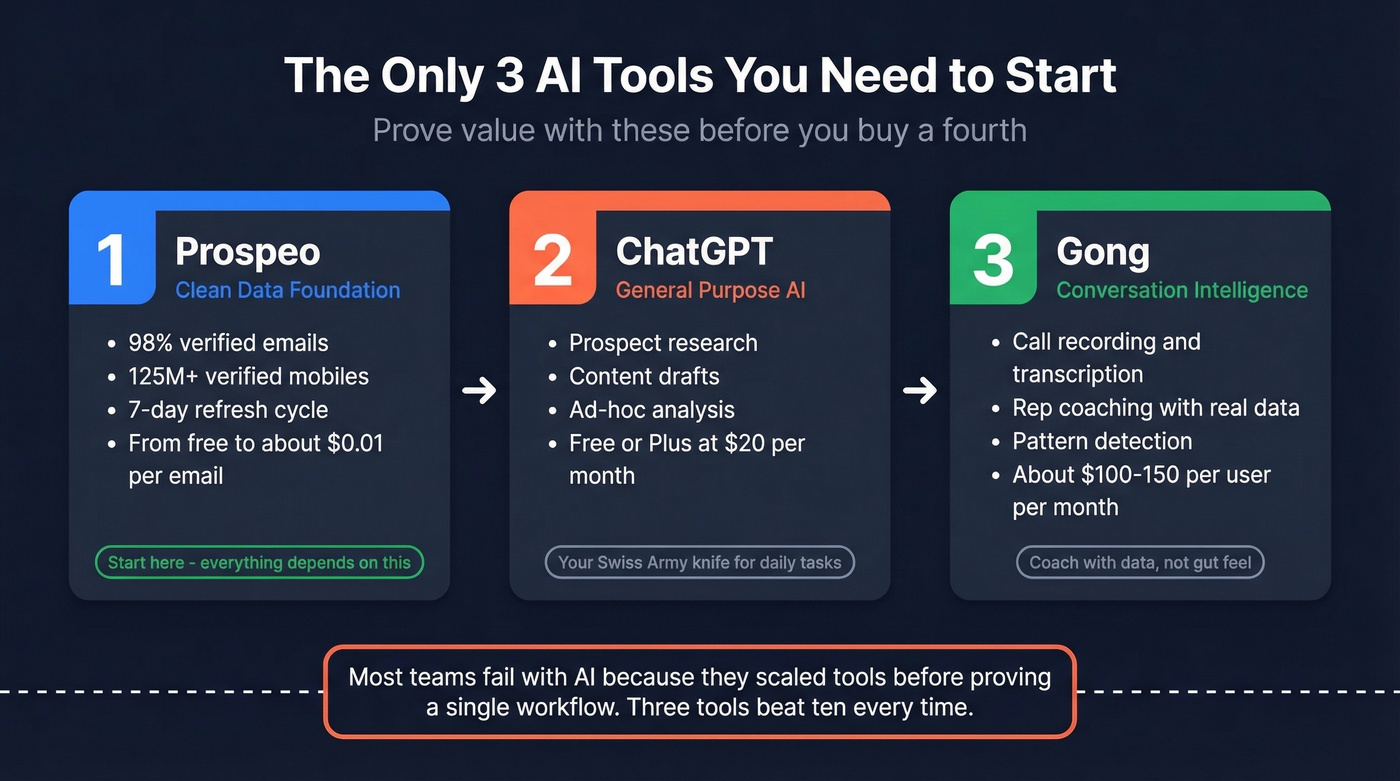
Three tools. Prove value with those before you buy a fourth. Most teams that fail with revenue-focused AI fail because they scaled tools before they proved a single workflow.
What AI Means for Revenue Teams
McKinsey draws a clear line between traditional AI and generative AI. Traditional AI handles a single task - lead scoring, forecasting, anomaly detection - using supervised data and needs retraining for each new use case. Generative AI uses foundation models trained on massive datasets to create new content: emails, images, ad copy, research summaries. Most modern tools blend both approaches to cover the full revenue cycle.
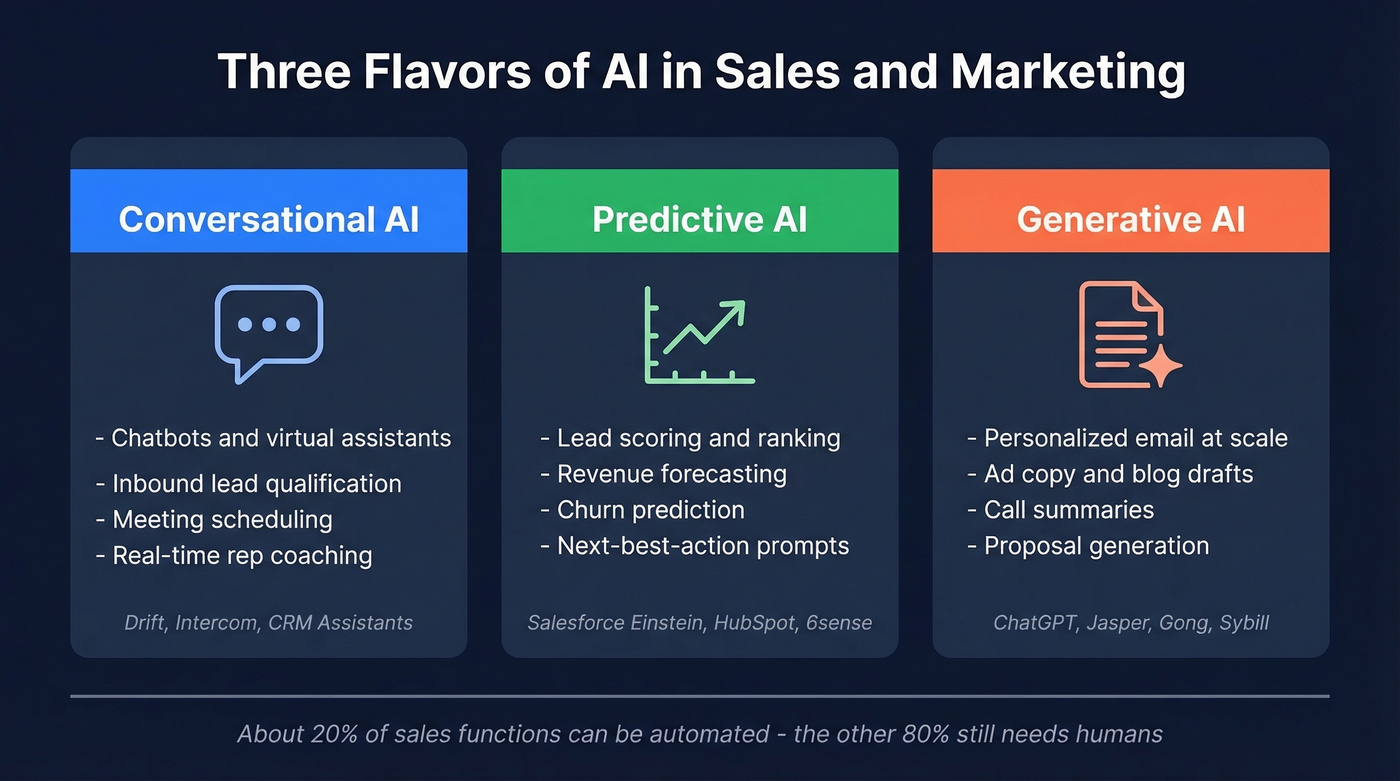
In practice, you'll encounter three flavors:
Conversational AI powers chatbots, virtual assistants, and real-time coaching tools - Drift, Intercom, or the AI assistants embedded in most CRMs. It handles inbound qualification, meeting scheduling, and basic support, freeing reps to focus on complex deals.
Predictive AI drives lead scoring, forecasting, churn prediction, and next-best-action recommendations. Salesforce Einstein, HubSpot's predictive lead scoring, and 6sense all live here.
Generative AI creates content, personalizes outreach at scale, summarizes calls, and drafts proposals. ChatGPT, Jasper, Gong's call summaries, and Sybill's auto-generated follow-ups are the most common examples. (If you’re using GenAI for outbound, see what actually works in AI email personalization.)
McKinsey estimates about a fifth of current sales-team functions can be automated. That's significant - but it also means 80% still requires human judgment, relationships, and strategic thinking.
Adoption, Productivity, and ROI
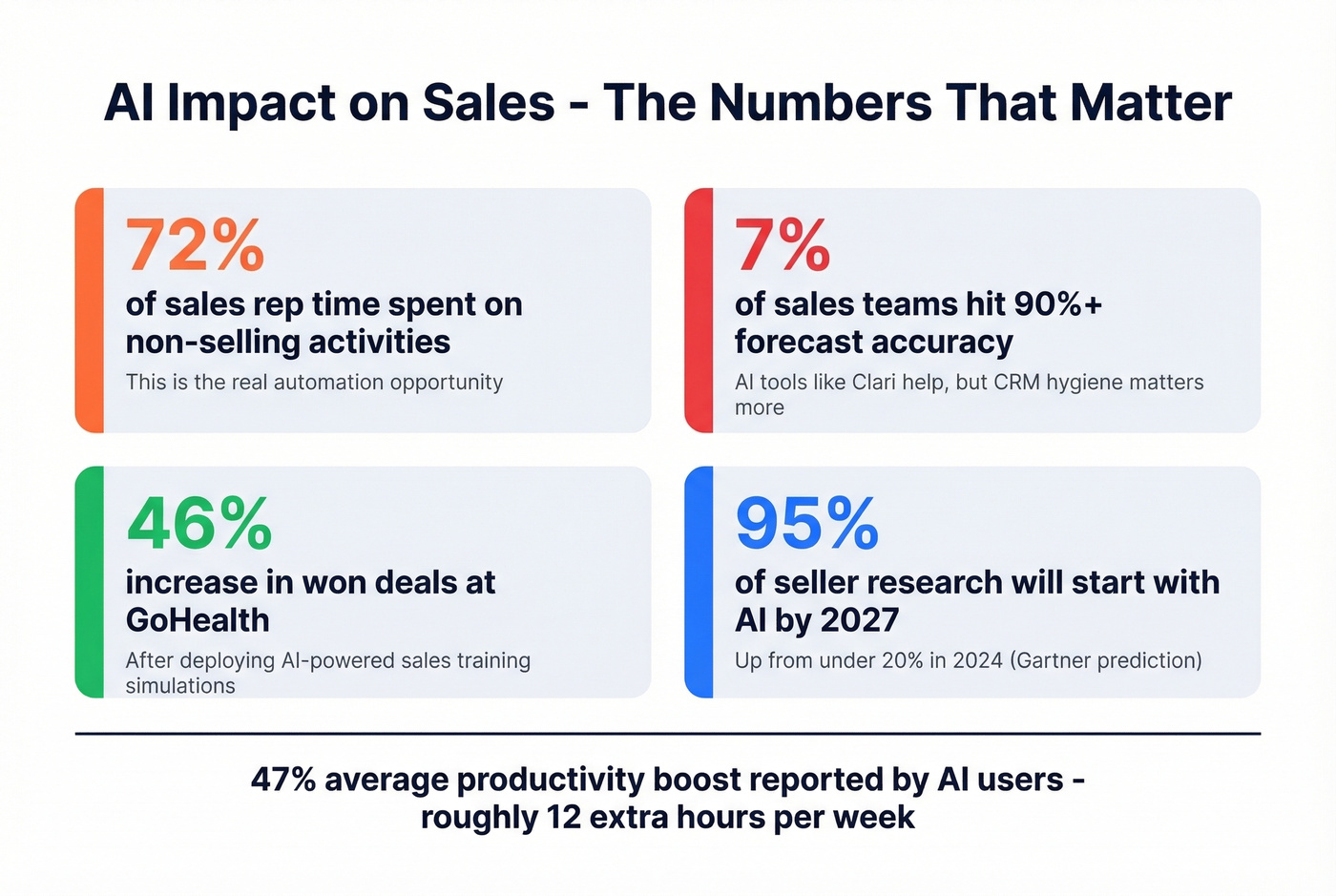
A ZoomInfo survey of 1,000+ GTM professionals found that AI users report a 47% productivity boost and roughly 12 hours per week saved by cutting low-value manual tasks. That's essentially getting a sixth day out of every workweek.
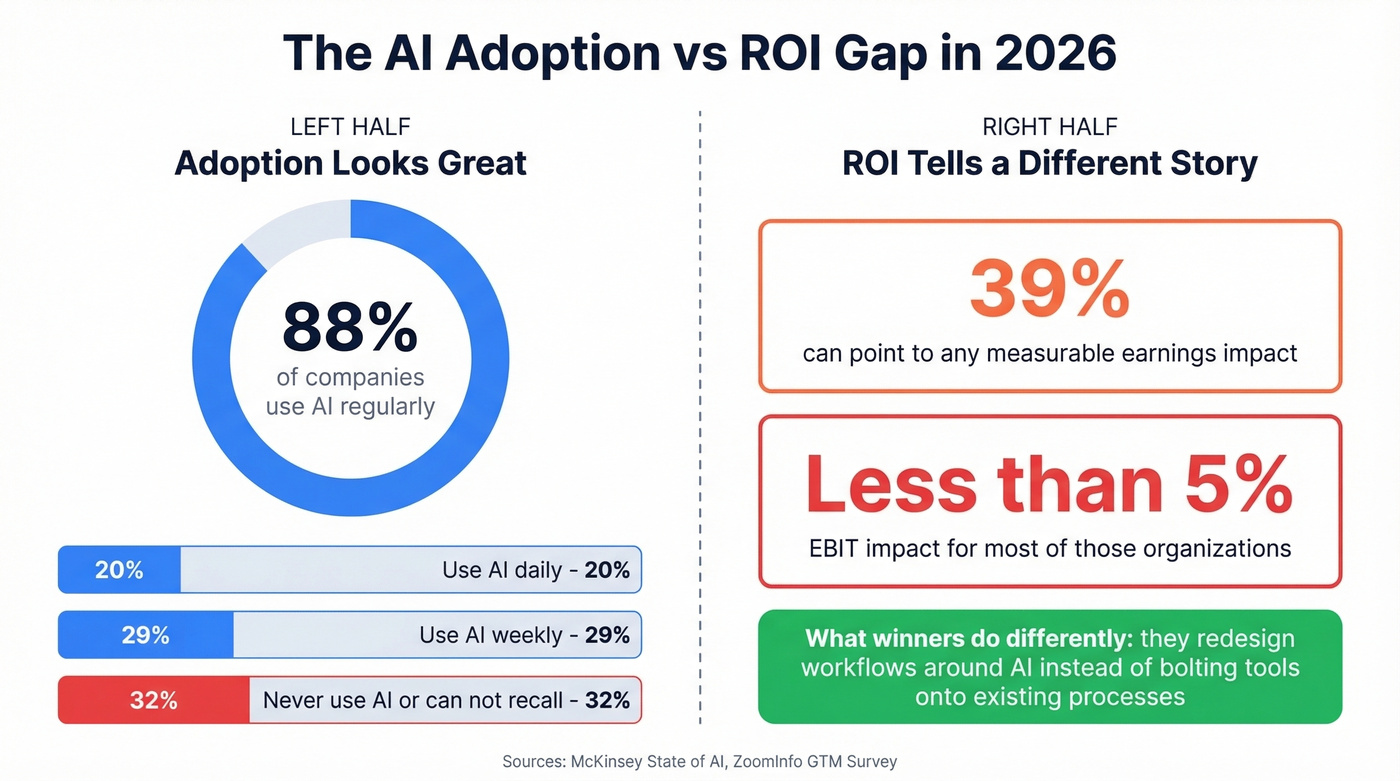
But dig into the usage data and the picture shifts. Just over 20% of respondents use AI daily. Another 29% use it weekly. And 32% never use AI at all - or can't recall the last time they did.
Nearly a third of go-to-market professionals are sitting on the sidelines entirely.
The ROI story is similarly uneven. McKinsey's latest State of AI survey found that 64% of organizations say AI enables innovation, which sounds great until you realize only 39% can point to any enterprise-wide earnings impact. The high performers share a common trait: they redesign workflows around AI rather than bolt tools onto existing processes.
The companies winning aren't just automating tasks. They're making faster decisions driven by real-time insights, from rep-level next-best-action prompts to leadership-level territory reshuffles. Speed compounds. A team that responds to buying signals in hours instead of days closes more deals, period. (If you want a practical system for this, use an automate sales signals playbook.)
Use Cases Across the Revenue Cycle
Sales Use Cases
Sales reps spend roughly 72% of their time on non-selling activities. That's the real opportunity.
Lead scoring and prioritization. Predictive models rank prospects by likelihood to convert, pulling signals from firmographics, engagement history, technographics, and intent data. HubSpot, Salesforce Einstein, and Apollo all offer some version. The real differentiator is data quality feeding the model - a point we've seen firsthand across dozens of customer deployments. (To tighten scoring inputs, use data enrichment tools.)
Forecasting. Only about 7% of sales teams achieve forecast accuracy of 90% or better. Tools like Clari and Zoho Zia analyze pipeline velocity, deal stage progression, and historical patterns to improve predictions. They're better than spreadsheets, but they still depend on reps updating their CRM honestly. (If you’re rebuilding your process, start with B2B sales pipeline management.)
Prospecting and outreach. GenAI personalizes emails at scale, matching messaging to a prospect's industry, role, and recent company news. Gong Engage and Outreach use AI to recommend send times and follow-up cadences. Gartner predicts that by 2027, 95% of seller research workflows will begin with AI, up from less than 20% in 2024 - and prospecting is where that shift starts. (For a broader system, see B2B prospecting strategies.)
Conversation intelligence and coaching. Gong, Chorus, and Sybill record calls, transcribe them, and surface patterns - talk-to-listen ratios, competitor mentions, objection handling. GoHealth used AI-powered sales training simulations and decreased onboarding time by 36% while increasing won deals by 46%. (To level up rep performance, build around phone sales skills.)
CRM enrichment. Automatically filling in missing contact data, company details, and engagement signals reduces manual entry and surfaces relevant context at each deal stage. We've seen teams cut 4-6 hours of weekly data entry per rep with proper enrichment workflows. (If you’re shopping, compare CRM automation software options.)
Marketing Use Cases
Content creation. Jasper, ChatGPT, and Writer generate blog posts, ad copy, social content, and email sequences. The output still needs human editing, but first-draft speed cuts content production from days to hours for small teams.
Personalization at scale. 71% of buyers expect personalized experiences, and companies that deliver earn 40% more revenue than those that don't. AI makes true one-to-one personalization feasible across email, web, and ad channels - something impossible to do manually at any real volume. Delta Air Lines partnered with Alembic to apply AI-driven attribution across their marketing mix and identified $30M in previously unattributed revenue.
Attribution and campaign optimization. AI models track multi-touch attribution across channels, reallocating budget in near-real-time based on what's actually driving pipeline. This is where the ROI case is strongest - not in content generation, but in spend optimization. JPMorgan Chase saw a 450% increase in click-through rates after deploying AI-optimized email copy, proving the impact extends beyond media buying into creative performance.
Predictive audience building. Look-alike modeling, intent-based targeting, and propensity scoring help marketing teams focus budget on accounts most likely to convert.

This article says it clearly: every AI tool downstream produces garbage if your prospect data is garbage. Prospeo gives you 98% verified emails, 125M+ verified mobiles, and a 7-day refresh cycle - so your lead scoring, personalization, and forecasting models actually work.
Fix the foundation before you stack more AI tools on top.
The Data Quality Problem Nobody Talks About
Every AI use case above assumes your underlying data is accurate. Most companies' data isn't.
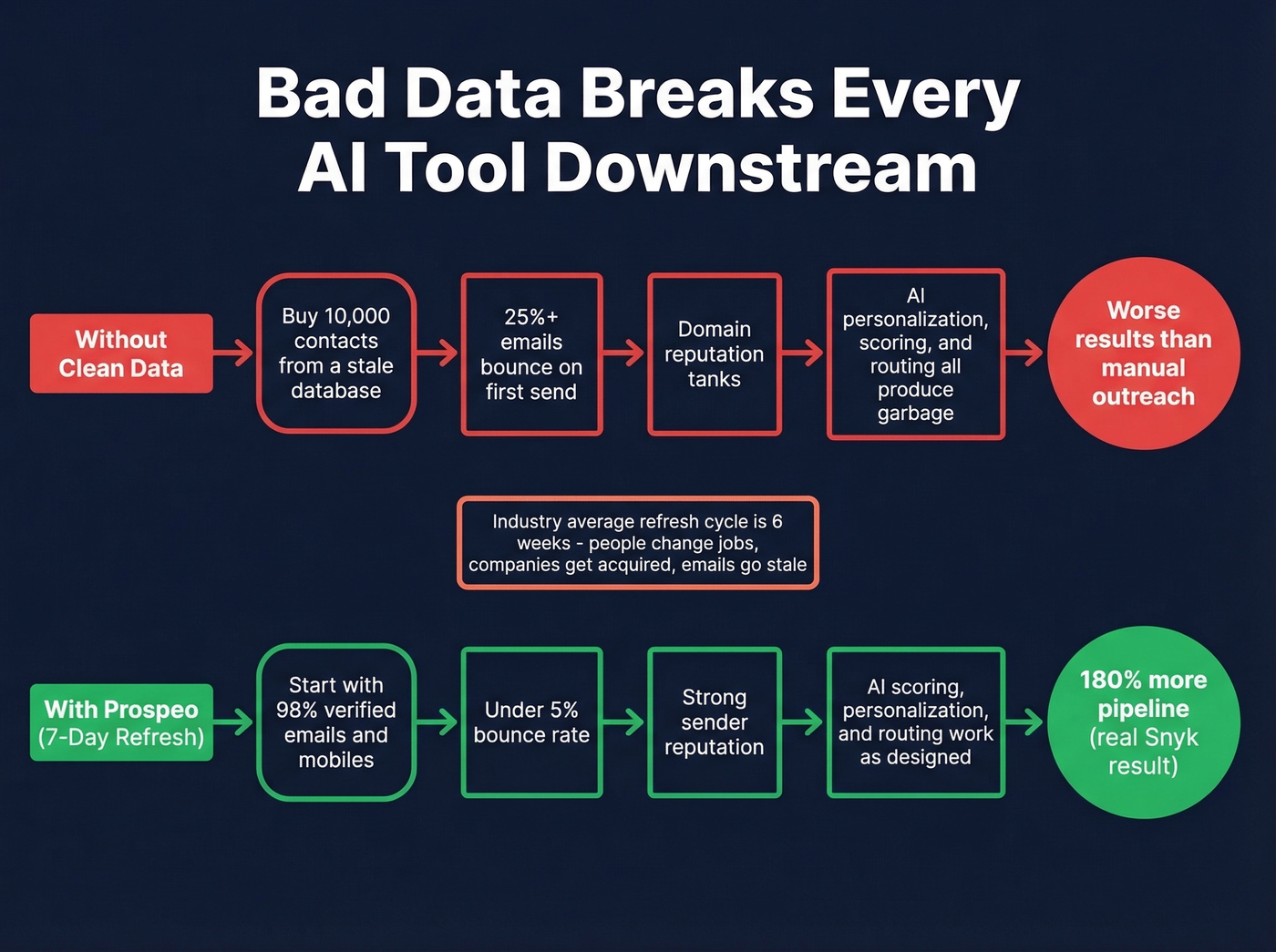
A team buys an expensive prospecting tool, loads 10,000 contacts into their sequencer, and watches 25%+ of emails bounce on the first send. Domain reputation tanks. Deliverability craters. Every AI-powered personalization, scoring, and routing workflow built on that data produces worse results than a manual process would have. (If you’re troubleshooting, start with check bounce.)
The industry average data refresh cycle is six weeks. In that time, people change jobs, companies get acquired, email servers get reconfigured. By the time your "verified" data reaches a prospect's inbox, a meaningful chunk is already stale.
Snyk's sales team of 50 AEs was dealing with bounce rates of 35-40%. After switching to a 7-day refresh data source, bounces dropped under 5%, AE-sourced pipeline jumped 180%, and they were generating 200+ new opportunities per month. That's what clean data does for every downstream AI workflow.

Before you layer AI on top of your stack, verify your data. Everything else depends on it.
Best AI Tools for Sales and Marketing (2026)
| Tool | Category | Starting Price | Best For |
|---|---|---|---|
| Prospeo ★ | B2B Data | Free; ~$0.01/email | Verified emails & mobiles |
| ChatGPT ★ | General AI | Free; Plus $20/mo | Research & content |
| Gong ★ | Conv. Intelligence | ~$100-150/user/mo | Call analysis & coaching |
| Apollo | B2B Data | Free; $49/user/mo | All-in-one prospecting |
| HubSpot Sales Hub | CRM & Automation | Free; ~$100/user/mo | SMB sales automation |
| Salesforce Einstein | CRM & Automation | ~$50-75/user/mo | Enterprise AI in CRM |
| Copilot for Sales | CRM & Automation | $50/user/mo | Microsoft 365 shops |
| Jasper AI | Content Creation | From $49/mo | Marketing content |
| Sybill | Sales Assistant | Free; Pro $30/user/mo | Meeting summaries |
| Outreach | Sales Engagement | ~$100-130/user/mo | Sequence optimization |
| monday CRM | CRM & Automation | From $12/user/mo | Lightweight CRM + AI |
★ = Top Pick in category
B2B Data and Prospecting
Prospeo is the starting point if you care about data accuracy. It delivers 98% verified emails backed by a proprietary 5-step verification process, plus 125M+ verified mobile numbers with a 30% pickup rate - about 2.4x ZoomInfo's 12.5% and nearly 3x Apollo's 11%. The 7-day refresh cycle means you're not emailing someone who left the company last month. Self-serve pricing starts free (75 emails + 100 Chrome extension credits/month), and paid plans run about $0.01 per email with no contracts.

Apollo is the pick if you want prospecting, sequencing, and a basic CRM in one platform. The free tier is generous, paid plans start at $49/user/mo. The tradeoff: Apollo's email accuracy sits at 79%, and mobile coverage is thinner. A great all-in-one for SMB teams who want simplicity over precision.
Conversation Intelligence
Gong remains the gold standard. It records calls, identifies winning patterns, flags at-risk deals, and gives managers actual data for coaching instead of vibes. Pricing runs ~$100-150/user/mo on custom contracts - steep for small teams but pays for itself quickly once you have 10+ reps.
General-Purpose AI
ChatGPT is the Swiss Army knife. Free tier for basic use, $20/mo for Plus, $25-30/user/mo for Team plans. Use it for prospect research, first-draft emails, competitive analysis, and ad-hoc data analysis. ZoomInfo's survey confirmed it's the most frequently used AI tool across GTM teams.
CRM and Automation
HubSpot Sales Hub bundles AI-powered lead scoring, email tracking, and workflow automation into a CRM that's genuinely easy to use. Plans around $100/user/mo unlock the more advanced features. Best for SMBs that want one platform without Salesforce complexity.
Salesforce Einstein is the enterprise play - AI predictions, opportunity scoring, and automated insights baked into the Salesforce ecosystem. If you're not already on Salesforce, this isn't the reason to switch.
Microsoft Copilot for Sales at $50/user/mo surfaces CRM data in Outlook and Teams. Skip it if you're not a Microsoft shop.
monday CRM starts at $12/user/mo for smaller teams. It competes with spreadsheets, not Salesforce.
Content and Sales Assistants
Jasper AI from $49/mo is purpose-built for marketing content with brand voice controls and campaign workflows. Sybill offers 20 free AI meeting summaries per month, and Pro at $30/user/mo adds CRM autofill that saves AEs 4-6 hours per week. Outreach at ~$100-130/user/mo is the enterprise sales engagement platform - powerful but complex, and smaller teams often find it's more than they need.
Teams using AI for prospecting still lose 20-30% of revenue to fragmented, outdated contact data. Prospeo's 300M+ profiles with 30+ filters - including buyer intent and technographics - give your AI stack the clean inputs it needs to deliver real ROI at $0.01 per email.
Stop feeding stale data to expensive AI tools.
Agentic AI: The Next Wave
The buzzword of 2026 is "agentic AI" - autonomous systems that don't just recommend actions but perceive signals, reason about next steps, and execute multi-step workflows on their own. Think of an AI agent that monitors intent signals, identifies a buying committee, enriches contacts, drafts personalized sequences, and launches the campaign without a human clicking "go."
Gartner predicts 40% of enterprise applications will feature AI agents by end of 2026, up from less than 5% in 2025. McKinsey's data shows 62% of organizations are at least experimenting with agents.
But Gartner also predicts that more than 40% of agentic AI projects will be canceled by end of 2027 due to costs, unclear business value, or inadequate risk controls. That's a staggering failure rate for a technology category getting this much investment.
The practical advice: start with a specific, measurable use case. "Automate our entire outbound motion" is a recipe for a canceled project. "Use an AI agent to enrich and score inbound leads within 5 minutes of form submission" is achievable, measurable, and valuable. Prove that works before you hand an agent the keys to your pipeline.
The consensus on r/sales is telling - teams deploying agents successfully treat them like junior employees. Clear instructions, tight guardrails, and constant supervision until trust is earned.
How to Implement AI: 5 Steps
Step 1: Audit and verify your prospect data. Run your CRM contacts through a verification tool and measure your actual bounce rate, fill rate, and data freshness. This isn't optional - it's the step that prevents every downstream failure. (If you need a process, use a data validation automation checklist.)
Step 2: Pick one high-impact use case. Not three. Not five. One. The best candidates are repetitive tasks with clear success metrics: email personalization, call summarization, lead scoring, or content drafting. Pick the one where your team spends the most time on the lowest-value work.
Step 3: Choose 2-3 tools that integrate natively. A disconnected stack creates more work than it saves. Check that your data platform, sequencer, and CRM actually talk to each other - not through a duct-tape Zapier chain that breaks every Tuesday.
Step 4: Redesign the workflow, not just the tool. McKinsey's research highlights workflow redesign as the key differentiator between AI high performers and everyone else. Don't plug ChatGPT into your existing process. Rethink the process around what AI makes possible. If AI drafts the first email, your rep's job shifts from writing to editing and strategic account selection.
Step 5: Measure and scale. Set a 90-day evaluation window with specific KPIs: response rates, time saved per rep, pipeline generated, bounce rates. If the numbers work, expand to the next use case. If they don't, kill it and try something else. In our experience, teams that skip the measurement step end up with five tools and no idea which ones are actually moving the needle.
Risks, Governance, and Mistakes
The regulatory picture is tightening. The EU AI Act now influences global businesses regardless of headquarters. GDPR and CCPA enforcement continues to expand. IP ownership for AI-generated content remains legally uncertain - if Jasper writes your blog post, who owns it? The answer depends on jurisdiction and is still being litigated.
Hallucination risk is real and underappreciated in sales contexts. An AI that fabricates a prospect's job title in a personalized email doesn't just waste a touch - it destroys credibility. Bias in lead scoring models can systematically deprioritize entire market segments without anyone noticing.
Let's be honest about the most common mistakes:
Being tech-led instead of strategy-led. Teams buy five AI tools before defining what problem they're solving. The result is fragmented processes, siloed data, and underused subscriptions.
Ignoring content saturation. Only 58% of Google searches now result in a click. If your AI strategy is just "automate more content," you're fighting a losing battle against declining organic distribution. Quality and differentiation matter more than volume.
Skipping data quality. I've said it three times in this article because it's the mistake that kills everything downstream. Fix your data first. Then automate.
FAQ
Will AI replace salespeople?
No. McKinsey estimates roughly 20% of sales functions can be automated - data entry, scheduling, and first-draft communications. The other 80% - strategy, relationship building, complex negotiations - remains firmly human. AI makes good salespeople faster; it doesn't replace them.
How much does an AI stack cost?
Start free with ChatGPT, Prospeo's free tier (75 emails/month), and HubSpot's free CRM. Mid-tier tools like Sybill Pro ($30/user/mo) and Apollo ($49/user/mo) add capability without breaking the budget. Enterprise tools like Gong run $100-150/user/mo. Most teams can build a meaningful stack for under ~$100/user/mo.
What's the biggest implementation mistake?
Buying tools before fixing data quality. If 25%+ of your emails bounce, every AI workflow downstream - personalization, scoring, routing, sequencing - produces worse results than a manual process. Start with verified data, then layer automation on top.
What's the difference between generative and traditional AI?
Generative AI creates new content - emails, images, summaries - from foundation models trained on massive datasets. Traditional AI handles a single task like lead scoring or forecasting using supervised data and must be retrained for each new use case. Most modern platforms combine both: traditional AI for predictions, generative AI for content and communication.
Which tools should I start with?
Three: a verified B2B data source for clean prospect data, a general-purpose LLM like ChatGPT for research and content, and conversation intelligence like Gong for call analysis. Prove value with these before expanding. The companies seeing real ROI from AI in sales and marketing started narrow and scaled deliberately.