

AI Pipeline Generation: What Works, What Doesn't, and How to Build a Stack That Converts
"Every new tool for outreach and volume has burnt more bridges." That's not a hot take from a LinkedIn thought leader - it's a frustrated sales rep on r/sales describing the state of pipeline generation today.
Here's the uncomfortable math. Only 16% of B2B sales reps hit quota last year. Reps spend roughly 28% of their week actually selling - the rest disappears into research, data entry, and chasing contacts that bounce. Enterprise SDRs now require 4x more outreach activities to book meetings compared to 2022, and cold email reply rates hover between 1-5%. The old playbook of "more volume, more reps, more tools" isn't just underperforming. It's actively destroying buyer trust.
AI pipeline generation is supposed to fix this. In some cases, it genuinely does. But the gap between "AI-powered pipeline" and "pipeline that actually converts" is enormous - and it's almost entirely a data quality problem. Teams pour $30K-$100K+/year into AI, intent, and orchestration tools, then feed them garbage contact data and wonder why nothing works.
If your average deal size is under $10K, you probably don't need ZoomInfo-level data or 6sense-level intent. You need 98% accurate emails, a decent sequencer, and the discipline to iterate weekly.
What You Need (Quick Version)
Generating pipeline with AI only works when your data is clean, your signals are real, and your stack is 2-3 tools - not 11.
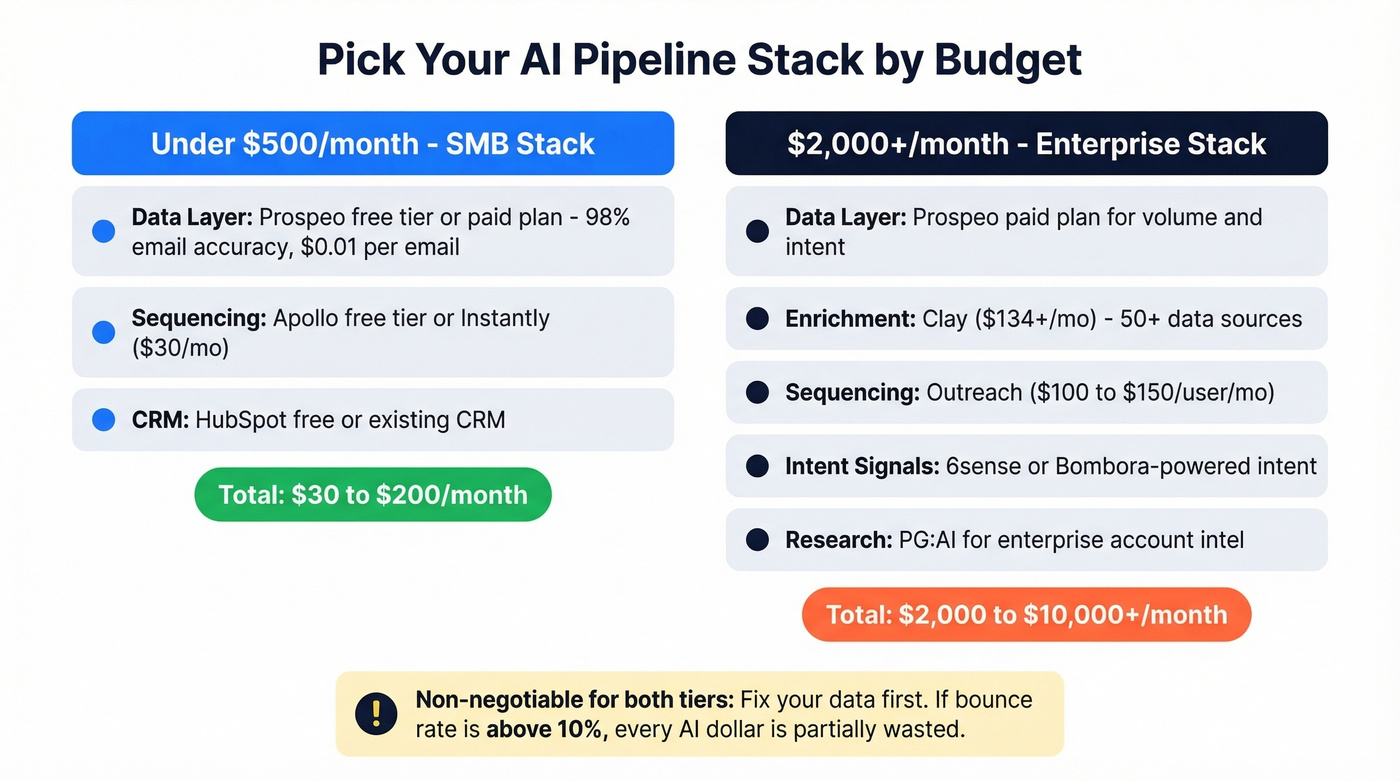
Under $500/month:
- Sequencing: Apollo free tier or Instantly ($30/mo)
$2,000+/month (full stack budget):
- Data layer: Prospeo paid plan for volume + intent data
- Enrichment + orchestration: Clay ($134+/mo)
- Sequencing: Outreach or Apollo paid tier
- Intent signals: Bombora-powered intent or 6sense
The non-negotiable in both tiers: fix your data first. If your bounce rate is above 10%, every dollar you spend on AI sequencing, scoring, and personalization is partially wasted. Everything else is optional until you're closing $100K+ deals.
What Does AI Pipeline Generation Actually Mean?
Let's clear this up, because "AI pipeline" means completely different things depending on who you ask. If you're a data engineer, it's an ML/data processing pipeline - ETL workflows, model training, inference serving. That's not what we're covering here. For that, Snowflake and Databricks are common starting points.
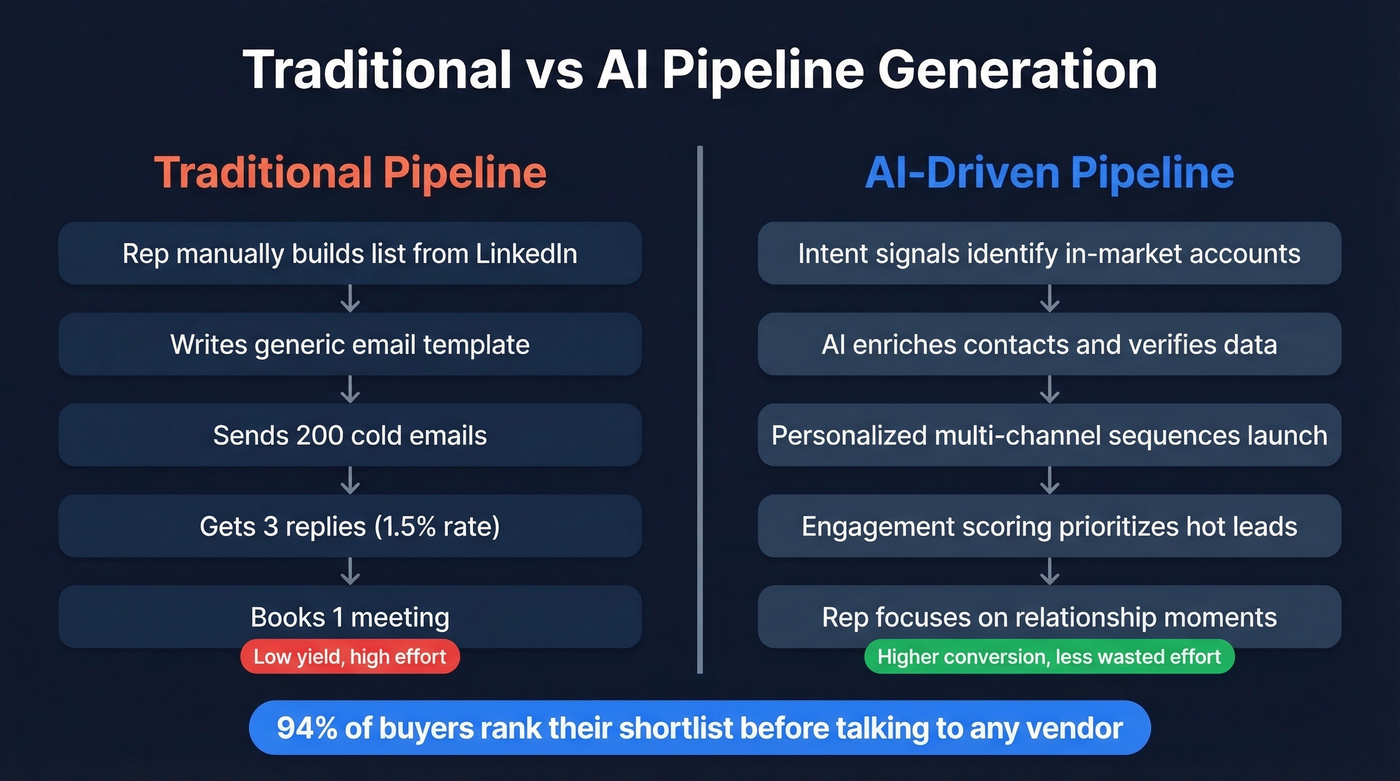
In a sales context, AI pipeline generation means using machine learning, automation, and predictive analytics to find, qualify, and nurture prospects through your revenue pipeline. It covers the entire top-of-funnel motion: identifying accounts showing buying intent, finding the right contacts, personalizing outreach at scale, and scoring leads based on predicted conversion likelihood.
The traditional approach: a rep manually builds a list, writes generic emails, sends 200 messages, gets 3 replies, books 1 meeting. AI-driven pipeline generation flips the sequence. It starts with signals - who's actually in-market - then layers in account intelligence, multi-threaded contact discovery, and personalized messaging that adapts based on engagement data.
Here's why this matters now. 94% of buying groups have already ranked their shortlist before they ever talk to a vendor, and the vendor ranked first wins roughly 80% of the time. If you're not in the conversation early with relevant, personalized outreach, you're not in the conversation at all.
Why It Matters in 2026
The data on AI adoption in sales is splitting into two camps, and the gap is widening fast.
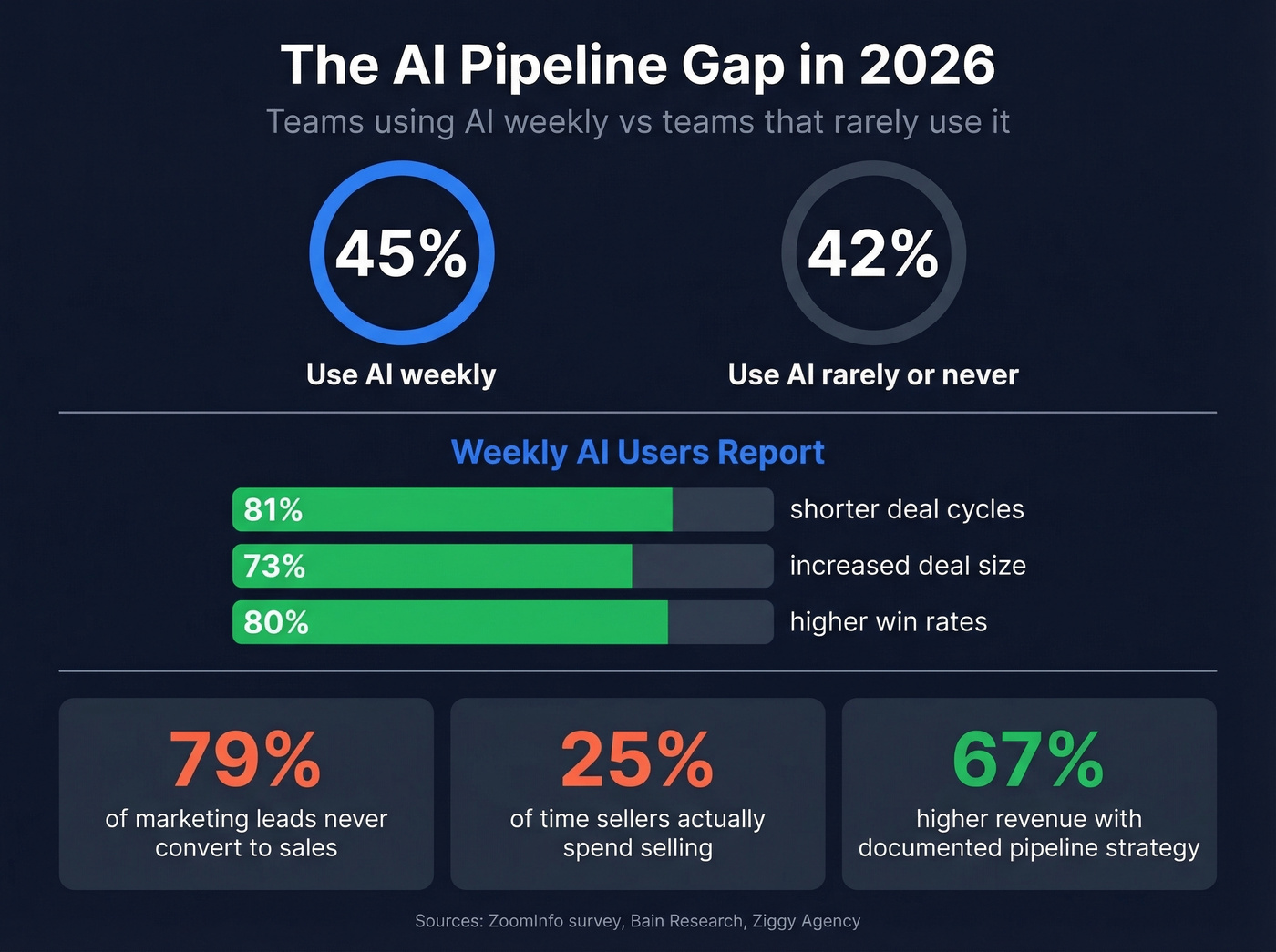
A survey of 1,000+ GTM professionals found that 45% of sellers use AI at least once a week. But 42% use it only a few times a year - or never. That's not a gradual adoption curve. That's a bifurcation. Teams using AI weekly report 81% shorter deal cycles, 73% increased deal size, and 80% higher win rates. Teams not using it are falling further behind every quarter.
Bain's research reinforces this: sellers spend roughly 25% of their time actually selling, and AI can double that by offloading research, data entry, and admin tasks. Early adopters see 30%+ improvement in win rates when AI improves conversion across multiple funnel steps - not just one.
The baseline is grim. 79% of marketing leads never convert to sales. Only 27% of B2B leads are sales-ready when first generated. The average B2B deal now involves 11 stakeholders. Companies with documented pipeline generation strategies see 67% higher revenue growth, yet only 35% have a formal process in place.
The pipeline coverage ratio most B2B companies need is 3-4x: you need $3-4M in pipeline to close $1M in revenue. If your pipeline is thin, leaky, or full of unqualified contacts, no amount of AI sequencing will save you.

Your AI pipeline tools are only as smart as the data you feed them. With a 98% email accuracy rate and 7-day refresh cycle, Prospeo eliminates the garbage-in problem that makes AI sequencing, scoring, and personalization fall flat. Snyk's 50 AEs dropped bounce rates from 35-40% to under 5% - and pipeline jumped 180%.
Stop feeding your AI stack stale data. Fix the foundation first.
Best AI Pipeline Generation Tools
| Tool | Best For | Starting Price | Key Strength | Note |
|---|---|---|---|---|
| Prospeo | Data accuracy | Free / ~$0.01/email | 98% email accuracy | Add a sequencer |
| Apollo | All-in-one SMB | Free / $49/user/mo | Database + sequences | Accuracy varies |
| Clay | Enrichment | $134/mo | 50+ data sources | Learning curve |
| PG:AI | Enterprise research | Custom | Deep account intel | Enterprise-focused |
| Outreach | Sequencing at scale | ~$100-$150/user/mo | 33B signals/week | Enterprise pricing |
| ZoomInfo | Full GTM platform | $15K+/yr | Breadth of features | Cost vs. value |
| 6sense | Enterprise intent | ~$60K/yr | Account-level intent | Enterprise only |
| Instantly | Budget outbound | $30/mo | Affordable sending | Bring your own data |
| Cognism | European data | ~$1K-$3K/mo | EMEA compliance | Smaller US database |
| Qualified | Inbound AI chat | ~$3K-$5K/mo | Real-time conversion | Inbound only |
Prospeo
Use this if: You need verified contact data that won't destroy your sender reputation, and you want to stop paying enterprise prices for it.
If you're comparing providers, start with accuracy-first options like a verified contact database (and sanity-check the broader market in our best B2B database roundup).
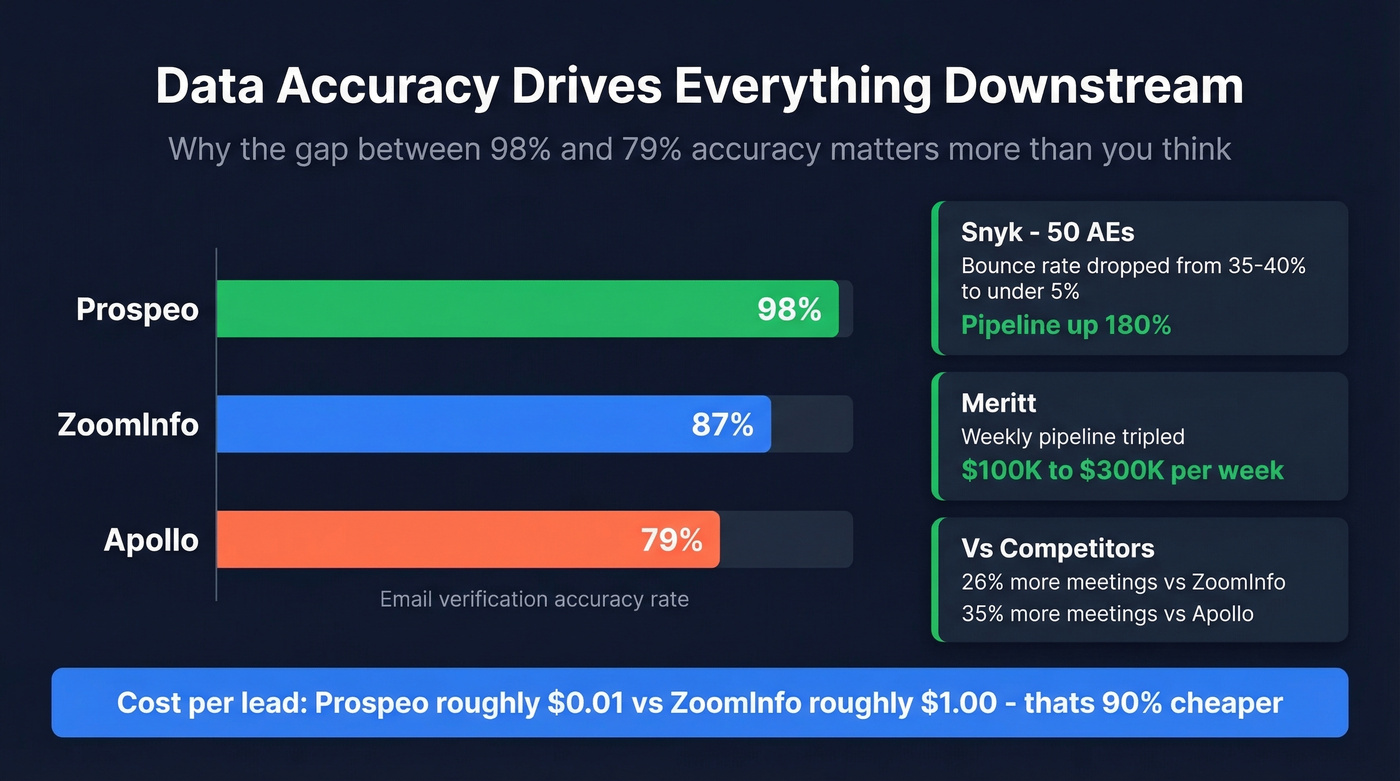
Prospeo's database covers 300M+ professional profiles with 143M+ verified emails and 125M+ verified mobile numbers with a 30% pickup rate. The 98% email accuracy rate isn't a marketing number you should gloss over - it's 98% vs. 87% at ZoomInfo and 79% at Apollo. That gap compounds fast when you're sending thousands of emails a week.
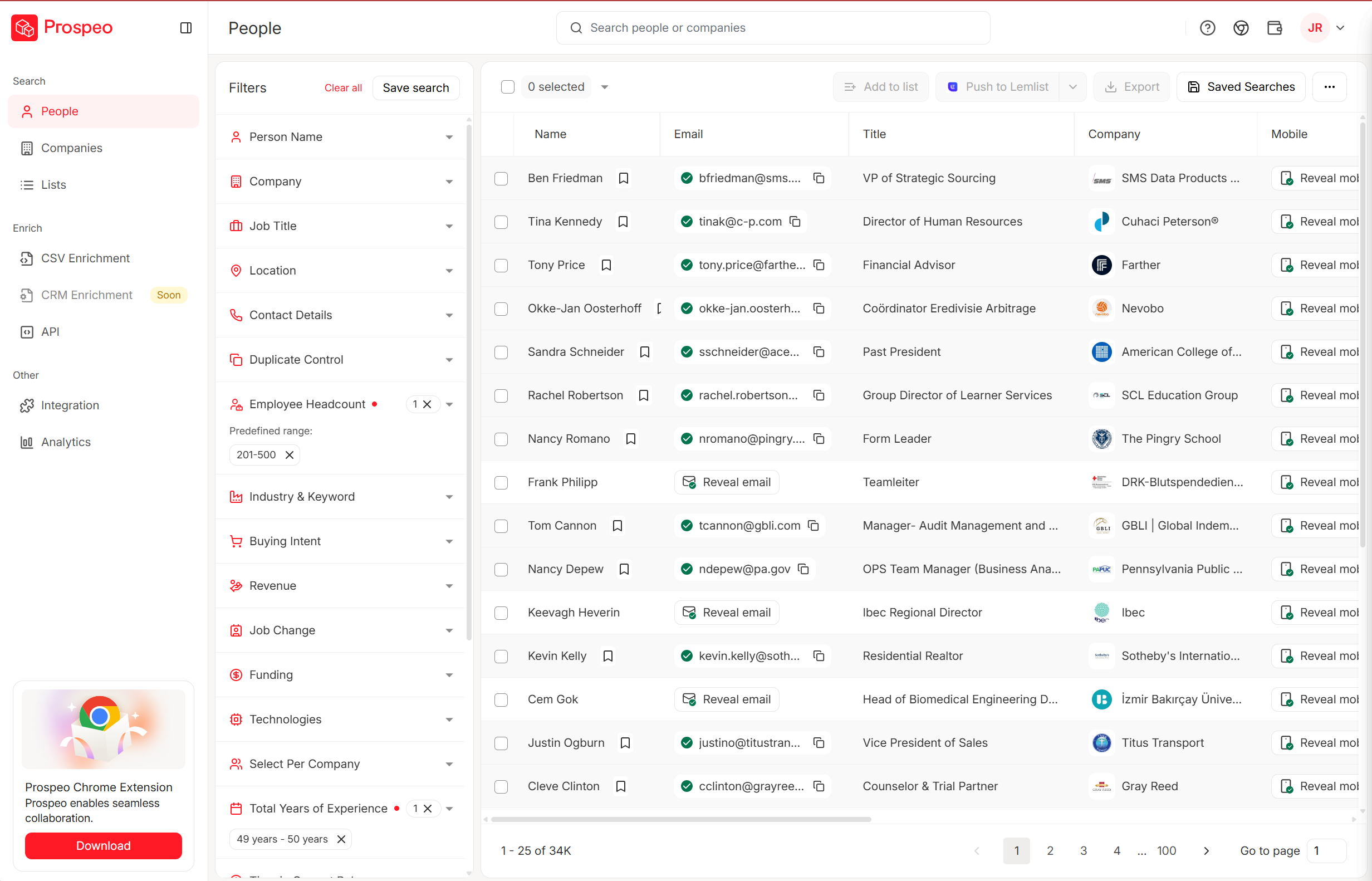
The results speak for themselves. Snyk's team of 50 AEs dropped their bounce rate from 35-40% to under 5% after switching, and AE-sourced pipeline jumped 180%. Meritt tripled weekly pipeline from $100K to $300K. Teams book 26% more meetings compared to ZoomInfo and 35% more compared to Apollo.
The 7-day data refresh cycle is genuinely unusual - the industry average is around 6 weeks, which means most providers are feeding you contacts for people who changed jobs a month ago. Intent data covers 15,000 topics via Bombora, so you can filter for accounts actively researching your category. Pricing starts free (75 emails/month + 100 Chrome extension credits/month) and scales to roughly $0.01 per email - 90% cheaper than ZoomInfo's ~$1/lead.
Apollo
Use this if: You're an SMB team that wants database, scoring, and sequences in one platform without stitching together three tools.
Skip this if: You're selling into EMEA and need consistently accurate European contact data.
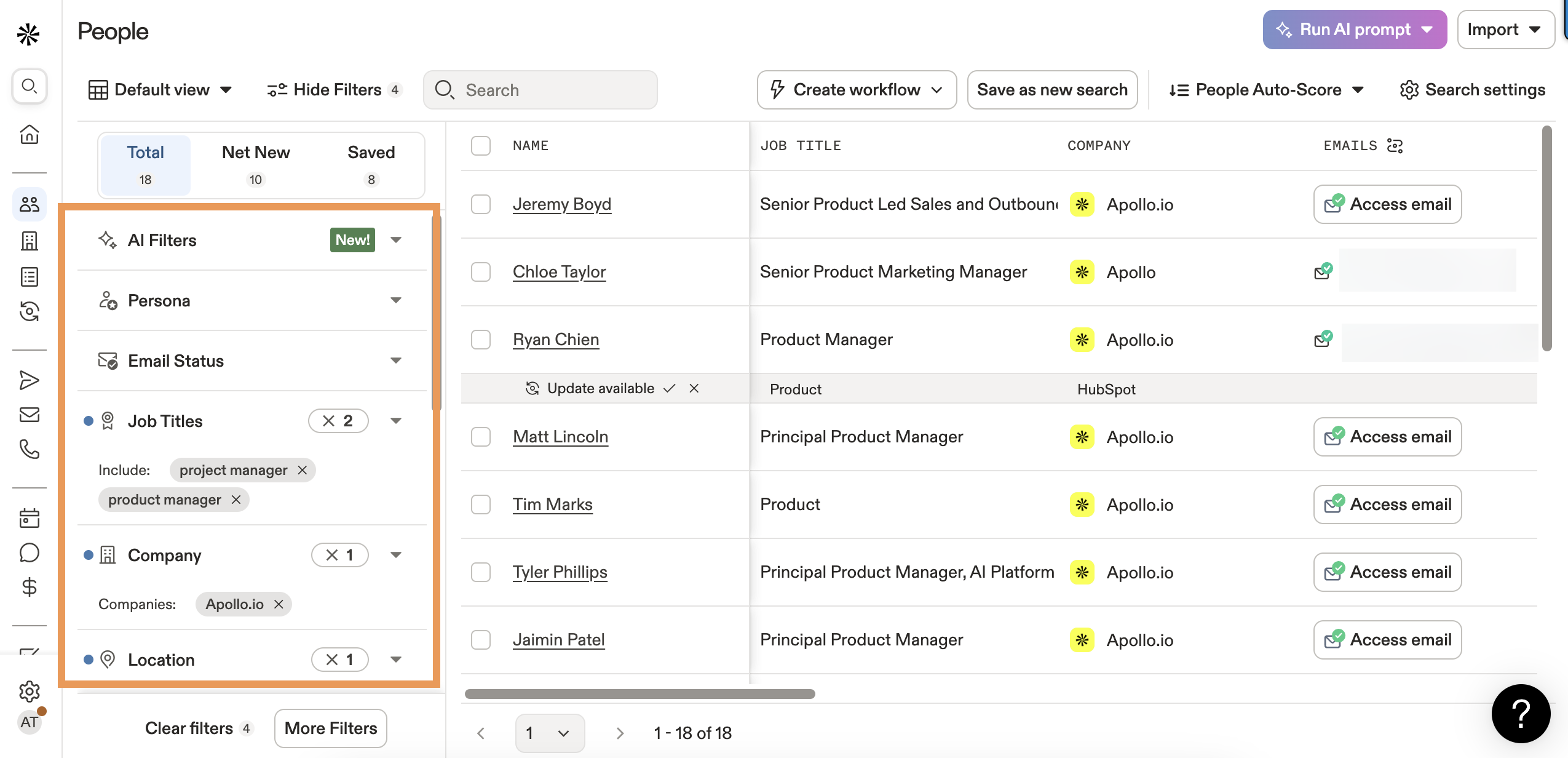
Apollo is the obvious starting point for teams under 20 reps who need to move fast. The free tier is genuinely usable - not a teaser that forces you to upgrade after day two. Paid plans start at $49/user/month and include predictive lead scoring and built-in email sequences.
The tradeoff is data accuracy. Apollo's email verification runs noticeably behind the 98% benchmark you'd get from a dedicated data provider, especially for director+ roles outside the US. If you're running high-volume outbound, that accuracy gap compounds fast - every bounced email chips away at your domain reputation. We've seen plenty of teams use Apollo for sequencing and workflow while pulling verified contacts from a separate data layer, and that hybrid approach works well.
Clay
Clay isn't a database or a sequencer - it's an enrichment and orchestration layer that pulls data from over 50 sources, runs AI-powered research on each prospect, and outputs personalized messaging variables you can push into HubSpot, Salesforce, or any outbound tool. Plans start at $134/mo with 2,000 enrichment credits.
Where Clay earns its price is waterfall enrichment. It checks multiple providers sequentially until it finds verified data for each field, which often means higher match rates than a single provider. The limitation is complexity. Clay rewards teams that invest time building workflows. If you just need clean emails and phone numbers, a dedicated data platform gets you there faster. If you need "pull their latest podcast appearance, summarize their company's Q3 earnings, and reference their recent job change" - Clay is the tool.
If you're evaluating options in this category, compare it against other data enrichment tools and see a practical workflow breakdown in our Clay list building guide.
PG:AI
Medallion attributed 18% of their 2024 revenue to cold outbound powered by PG:AI's "Three Whys" framework. Coralogix cut account research time by 90%. Users on G2 (4.8/5 rating) consistently report condensing 5+ hours of research into 10-15 minutes.
This is an enterprise play. If you're running $100K+ ACV deals and your reps spend hours researching accounts before the first call, PG:AI justifies its price. For sub-$15K deals, deep account research doesn't move the needle enough. Pricing isn't published - expect $1K-$5K/month depending on seats and usage.
Outreach
Outreach processes 33 billion interaction signals weekly and positions itself as replacing 4-6 point solutions. The platform shines when you're running a hybrid AI-SDR model - 45% of teams are doing this now - where AI handles research and personalization while reps handle relationship moments. Pricing is custom, typically ~$100-$150/user/month.
ZoomInfo
Here's the pricing reality: a 10-seat ZoomInfo contract with intent data and mobile numbers typically runs $40-60K/year. ZoomInfo Copilot users booked 60% more meetings in internal benchmarks, and the platform's breadth is unmatched - database, intent, chat, and workflow tools in a single platform. But at $15K+/year starting price, bounce rates above 10% mean you're literally paying to damage your domain reputation. For teams that need the all-in-one approach and have the budget, it's still the broadest platform. For everyone else, you can get better data accuracy at a fraction of the cost.
Also Worth Knowing
6sense (~$60K/yr) delivers enterprise-grade account-level intent data that's powerful for ABM teams with budget - overkill for anyone else. Instantly ($30/mo) is budget-friendly sending infrastructure for cold outbound, great for volume but bring your own verified data. Cognism (~$1K-$3K/mo) is the strongest option for European data and GDPR compliance - if you're selling into EMEA, it belongs on your shortlist. Qualified (~$3K-$5K/mo) is an AI chatbot for inbound pipeline that converts website visitors in real time, a completely different use case from outbound tools.
How to Actually Increase Pipeline with AI
We've seen teams buy three tools on Monday and wonder why pipeline hasn't tripled by Friday. Implementation matters more than tool selection.
Phase 1: Planning (Weeks 1-2)
Start with a CRM data audit. Before you automate anything, verify your existing contacts - if 20% of your database is stale, you're building on a cracked foundation. Define your ICP with behavioral criteria, not just firmographics. "Series B SaaS companies with 50-200 employees" is a start. "Series B SaaS companies actively hiring SDRs and researching sales engagement tools" is an ICP you can actually target with intent data. Set KPIs before you touch a tool: conversion rate by stage, cycle length, CAC, and pipeline coverage ratio (aim for 3-4x).
If you need a tighter definition, use an ideal customer profile framework before you start automating.
Phase 2: Execution (Weeks 3-6)
Build your pipeline infrastructure: custom properties in your CRM, lifecycle stages that match your actual funnel, and lead scoring tied to intent signals - not just job title. Set up automated lead routing so hot accounts don't sit in a queue for three days. Deploy your AI tools for research, enrichment, and personalization.
One Reddit user built a fully automated outreach pipeline in 15 minutes using ChatGPT, Apify, and Gemini - scraping 350 targets, curating to 30, and saving 5+ hours. You don't need enterprise tools to start.
If you're building sequences, it helps to follow a proven sales outreach strategy and keep your tooling lean with a solid RevOps tech stack.
Phase 3: Optimization (Ongoing)
A/B test everything - subject lines, send times, personalization depth, sequence length. Monitor leading indicators weekly: response rates, meetings booked, pipeline velocity. Build closed-loop feedback from won/lost deals back into your scoring models.
The teams that win aren't the ones with the best tools. They're the ones that iterate fastest.
For faster iteration, use a simple pipeline velocity model and track the right account executive KPIs.
Mistakes That Kill Your ROI
Treating AI as a silver bullet. AI doesn't fix a broken sales process. It amplifies whatever you already have - including the problems. Bain's research is clear: piecemeal AI use cases don't move the needle. You need end-to-end implementation.
Neglecting data quality. This is the #1 killer. If your email bounce rate is above 10%, stop buying AI tools and fix your data layer first. That's why 98% accuracy and 7-day refresh cycles matter so much.
Over-automating relationship steps. AI should handle research, personalization, and sequencing logistics. The actual human conversation - the discovery call, the negotiation - still needs a human. Teams that automate everything sound like robots and close like them too.
Skipping KPI definition. If you can't measure it, you can't prove ROI, and your CFO will cut the budget in Q3. Define conversion rate, cycle length, and CAC targets before you launch.
Ignoring change management. 28% of teams cite resistance to change as a barrier to AI adoption. If your reps don't trust the tool, they won't use it. Training isn't optional.
Buying before auditing. The Reddit consensus on "passive lead generation" is blunt: it sounds like fantasy marketing. AI generates demand - it doesn't capture it passively. Set expectations accordingly.
Stacking too many tools. Let's be honest - most teams need 2-3 tools, not 11. Every additional tool adds integration complexity, data fragmentation, and cost. Start lean, prove ROI, then expand.
What ROI to Expect
Payback periods vary by company size and deployment model:
| Deployment Model | SMB | Mid-Market | Enterprise |
|---|---|---|---|
| Hybrid (AI + reps) | 2-4 months | 3-5 months | 4-6 months |
| Full AI SDR | 3-5 months | 4-7 months | 6-9 months |
The hybrid model consistently outperforms full automation, which is why 45% of teams are running it. AI handles the research and personalization; humans handle the conversations that close deals.
Speed matters enormously. Outreach's data shows that deals closed within 50 days carry a 47% win rate - after that threshold, win rates drop to ~20% or lower. AI pipeline tools that compress research time and accelerate first-touch timing directly impact this metric. Among weekly AI users, 81% report shorter cycles, 73% report increased deal size, and 80% report higher win rates.
The ROI is real - but only if your data foundation is solid and your team actually adopts the tools.
You don't need $60K/year intent platforms to generate pipeline that converts. Prospeo gives you 300M+ profiles, Bombora-powered intent data, and 30+ filters - including buyer intent, technographics, and headcount growth - starting at ~$0.01 per verified email. No contracts, no sales calls.
Enterprise-grade pipeline generation data without the enterprise price tag.
FAQ
What's the difference between AI pipeline generation and a data/ML pipeline?
AI pipeline generation uses AI tools to find, qualify, and nurture sales prospects through your revenue funnel. A data or ML pipeline is a technical engineering workflow for processing data and training models. They share the word "pipeline" but solve completely different problems - this guide covers the sales use case.
How much should I budget for AI pipeline tools?
Most SMB teams spend $200-$500/month on a functional stack using free tiers and tools like Prospeo at $0.01/email plus Instantly at $30/mo. Mid-market teams with intent data and sequencing run $2K-$5K/month. Enterprise deployments with 6sense or ZoomInfo hit $60K+/year.
Can AI fully replace SDRs?
Not yet - the hybrid model outperforms full automation in every deployment size we've tracked. AI handles research, enrichment, and personalization while humans handle discovery calls and negotiations. Teams running hybrid AI-SDR motions report 80% higher win rates than those relying on manual processes alone.
What's the single most important factor for success?
Data quality. Full stop. If your email bounce rate exceeds 10%, fix that before buying any AI tool. The benchmark is 98% email accuracy with weekly data refreshes. Bad data poisons every downstream step - scoring, personalization, sequencing, and deliverability all degrade with stale contacts.
How long before I see ROI from these tools?
Hybrid deployments show measurable ROI in 2-4 months for SMBs and 4-6 months for enterprise teams. The fastest wins come from fixing data quality first - teams like Snyk saw bounce rates drop from 35% to under 5% within weeks of switching providers.