

Automated Appointment Setting: The Complete 2026 Guide
A RevOps lead we know ran the math on their SDR team's last quarter: 2,000 cold emails sent per week, 47 replies, 9 meetings booked, 6 that actually happened. That's a 0.3% email-to-completed-meeting rate. The frustrating part? Every piece of that pipeline - from finding the contact to confirming the meeting - can be automated. Most teams just automate the wrong piece first.
The online appointment scheduling market is projected to hit $1.52B by 2032 at a 15.7% CAGR, with 200+ scheduling companies fighting for your attention. But "automated appointment setting" means wildly different things depending on who you are: scheduling software, AI-powered setters, or a full outbound stack. Let's sort that out.
What You Actually Need
Before you evaluate a single tool, figure out which category you fall into:
- Service business booking clients? Calendly or Setmore. Free plans exist, and paid plans start around $5-$16 per seat/month on annual billing. Done.
- Agency qualifying high-volume inbound leads? Appointwise starts at $97/mo for a single client and $297/mo for unlimited clients, handling DM-based qualification and booking at scale.
- B2B sales team booking outbound meetings? You need a stack: Prospeo for verified contact data, a sequencer like Outreach or Salesloft, and Calendly for scheduling. This is where outbound appointment automation really shines - stitching data, sequences, and scheduling into one pipeline.
Pick one approach. But first, understand which type of tool solves your actual problem.
Three Categories, Three Different Problems
The real question isn't "which tool is best." It's which type of automation matches your situation.
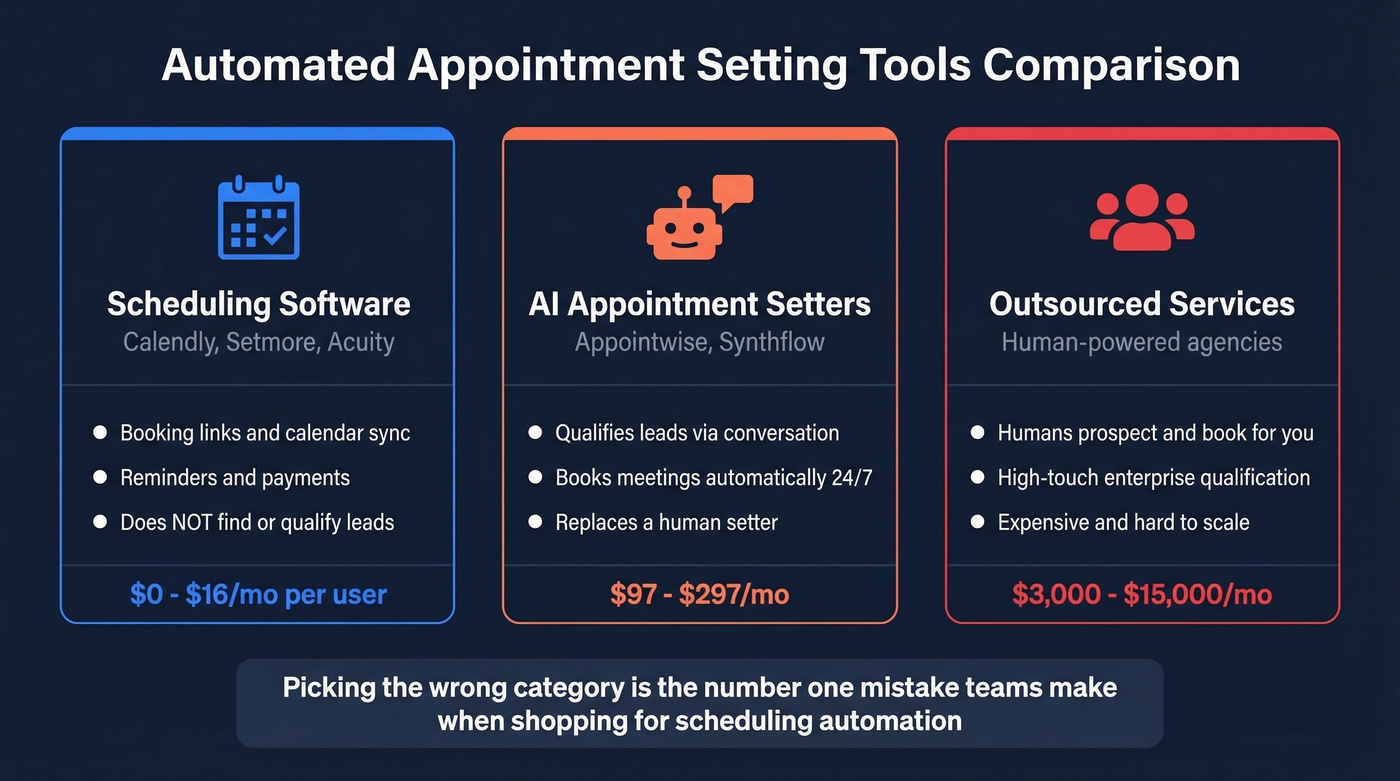
Scheduling software like Calendly, Setmore, and Acuity handles logistics - booking links, calendar sync, reminders, payments. It doesn't find leads or qualify them. It just makes the booking step frictionless.
AI appointment setters like Appointwise and Synthflow go further. They respond to inbound messages or calls, qualify leads through conversation, and book meetings automatically around the clock. They replace a human setter, not a calendar widget.
Outsourced appointment-setting services are the old-school play: you pay a company $3,000-$15,000/mo to have humans prospect and book meetings on your behalf.
Conflating these three categories is the single biggest mistake teams make when shopping for scheduling automation. A $10/mo scheduler won't qualify your leads. A $297/mo AI setter is overkill if you just need a booking link.
For teams looking at AI-powered calendar optimization rather than appointment booking, tools like Motion (starting around $34/mo) and Reclaim.ai (free plan, paid from $8/mo) handle dynamic schedule management - a different problem entirely.
Best Scheduling Software
If you're a solo consultant, service business, or small team, scheduling software solves 90% of your problem. Stop overthinking it.
| Tool | Starting Price | Free Plan | Best For | Key Limitation |
|---|---|---|---|---|
| Calendly | $10/seat/mo (annual) | Yes | Most teams | Free plan is bare-bones |
| Setmore | $5/user/mo (annual) | Yes (4 users, 200 appts) | Small teams on a budget | Limited customization |
| Acuity | $16/mo | No | Service businesses needing intake forms | No free tier |
| YouCanBookMe | $7.20/mo | Yes (1 calendar) | Simple 1-on-1 booking | Fewer integrations |
| Square Appointments | $29/mo/location | Yes (1 location) | Retail + in-person | Gets pricey multi-location |
| SimplyBook.me | $8.25/mo | Yes (50 bookings/mo) | Niche service providers | Low free-tier cap |
| Cal.com | Free (self-hosted) | Yes | Developers, open-source fans | Requires technical setup |
Calendly is the default for a reason. The free plan works for solopreneurs, and the $10/mo Standard plan unlocks enough for most small teams. We've used it across dozens of client engagements and it just works.
Setmore is the best free option for small teams - four users and 200 appointments per month at no cost is genuinely generous. YouCanBookMe slots in between: simpler than Calendly, cheaper than Acuity, solid for straightforward 1-on-1 scheduling.
Square Appointments makes sense if you're already in the Square ecosystem. Skip it otherwise. Acuity is the pick for service businesses that need intake forms and payment collection baked into the booking flow.
Best AI Appointment Setters
A human appointment setter costs $2,000-$4,000/month. AI setters deliver similar output at a fraction of the price, handling lead qualification, conversational booking, and follow-ups across messaging channels or voice.
| Tool | Price | Channels | Best For |
|---|---|---|---|
| Appointwise | $97-$297/mo | SMS, WhatsApp, IG, FB | DM-based lead qualification |
| Synthflow | Usage-based (per minute) | Voice (phone) | AI voice calling at scale |
| SetSmart | $99/mo | DMs, chat | Budget AI setter |
| My AI Front Desk | $100-300/mo (est.) | Phone, chat | AI receptionist + Zapier |
Appointwise: The DM Leader
Appointwise handles multi-channel engagement across SMS, WhatsApp, Instagram, and Facebook Messenger - qualifying leads through natural conversation and booking meetings without requiring a booking link. The vendor reports 30-40% conversion rates versus 10-20% for human setters.
G2 reviewers give it a 4.9/5 across 43 reviews, consistently praising ease of use and support quality. Trustpilot sits at 4.6 with 98 reviews - strong marks for customer service, though a few reviews flag account restrictions around enterprise calls.
Here's the thing: integrations can feel limited if you aren't on GoHighLevel/HighLevel. Pricing runs $97/mo for a single client or $297/mo for unlimited clients, both with a 14-day free trial.
Synthflow: Skip Unless You Need Voice
Synthflow takes a completely different approach - voice AI, not messaging. Their platform powers 65M+ voice calls per month across 30+ countries.
Pricing is usage-based. The core building blocks are $0.09/min for the voice engine, plus telephony (around $0.02/min on Synthflow-managed Twilio), plus LLM usage ($0.02-$0.05/min depending on model). In practice, a 5-minute qualifying call often lands around $0.65-$0.80 all-in. That's dramatically cheaper than a human SDR, but costs add up fast at volume.
If your sales motion is phone-first, Synthflow is worth testing. If it's email or DM-first, skip it entirely.

Your outbound stack is only as good as the data feeding it. Prospeo gives you 300M+ verified contacts with 98% email accuracy and 125M+ mobile numbers - refreshed every 7 days, not every 6 weeks. Plug it into Instantly, Smartlead, or Salesloft and watch your meeting-booking rate climb.
Stop automating sequences built on bad data. Fix the foundation first.
Cost Per Approach
This is the table most teams need before making any decision:
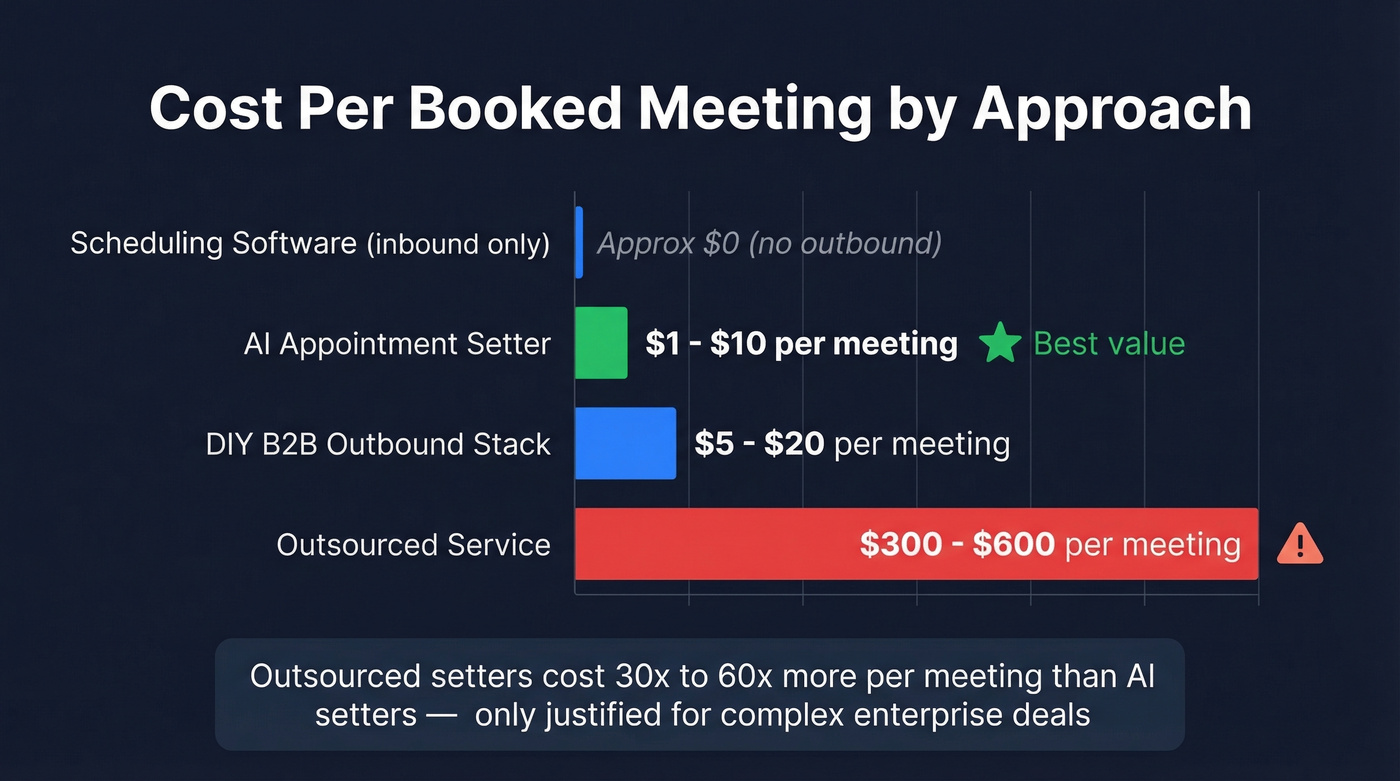
| Approach | Monthly Cost | Typical Meetings/Month | Cost/Meeting |
|---|---|---|---|
| Scheduling software | $0-$16/user | N/A (inbound only) | ~$0 |
| AI appointment setter | $97-$297 | 30-100+ | $1-$10 |
| Outsourced service | $3,000-$15,000 | 10-50 | $300-$600 |
| DIY B2B outbound stack | $100-$300 | 15-40 | $5-$20 |
Outsourced appointment setting is wildly overpriced for what most teams get. At $300-$600 per meeting, you're paying 30-60x more than an AI setter booking the same meeting. The only scenario where outsourcing still makes sense is complex enterprise sales with nuanced qualification that AI genuinely can't handle yet. For everyone else, it's a legacy cost structure waiting to be replaced.
If your average deal size is under $10K, you almost certainly don't need outsourced setters or an AI setter. A clean contact list, a solid three-email sequence, and a Calendly link will outperform any $5,000/mo agency. We've seen this play out repeatedly with early-stage teams who overcomplicate their stack before proving the basics work.
Building the B2B Outbound Stack
For B2B sales teams, automated appointment setting isn't one tool - it's a stack. And the biggest problem isn't scheduling. It's data.
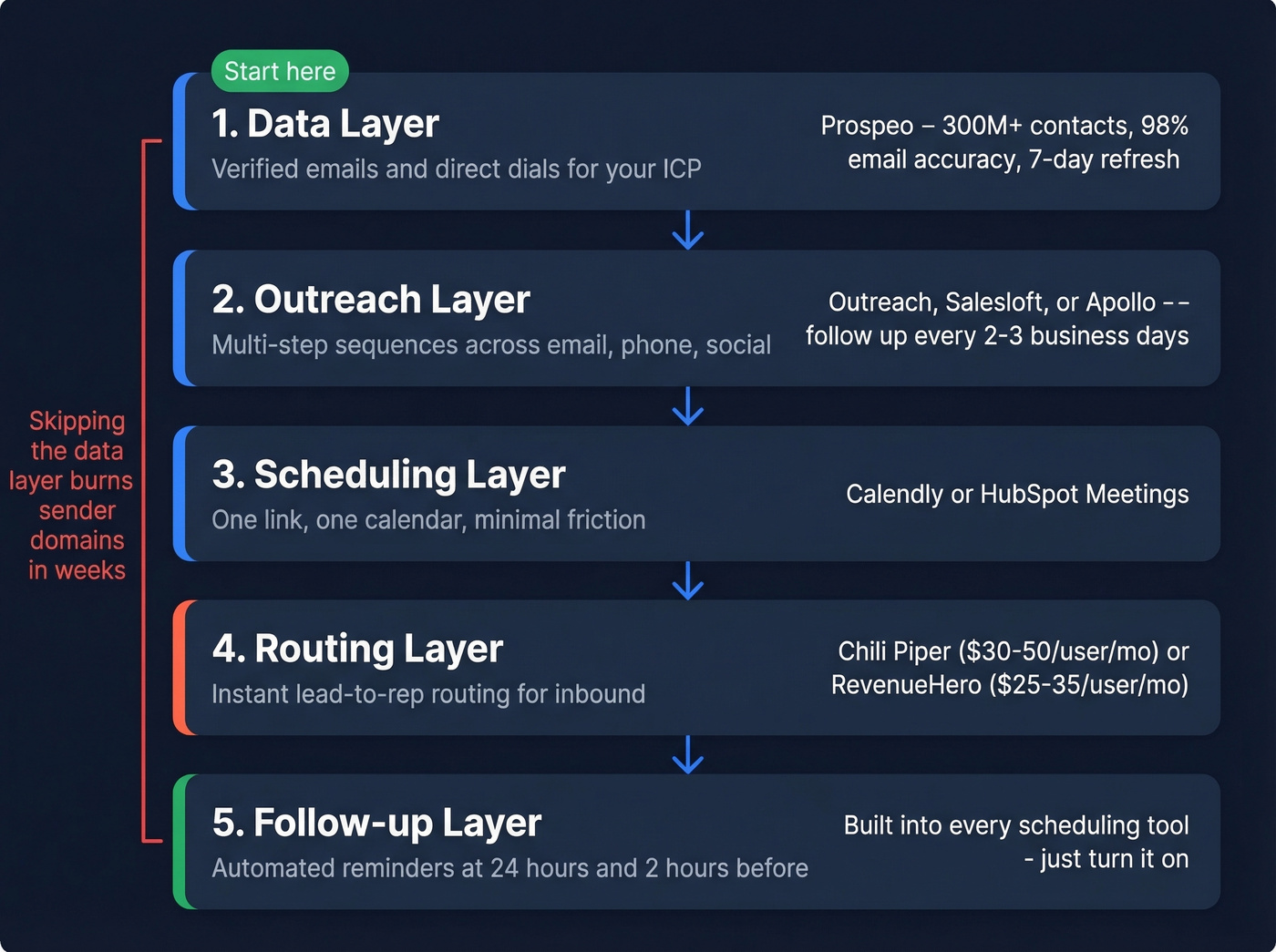
Companies using a structured omnichannel approach see a 287% increase in response rates and bookings. But none of that matters if your emails bounce or your phone numbers are wrong. Here's the stack that works, layer by layer:
Data layer - Verified emails and direct dials for your ICP. Prospeo covers 300M+ professional profiles with 98% email accuracy and 125M+ verified mobile numbers, all on a 7-day refresh cycle. At roughly $0.01 per lead, it's 90% cheaper than ZoomInfo. (If you're comparing providers, start with B2B company data providers.)
Outreach layer - Sequences across email, phone, and social. Outreach, Salesloft, or Apollo handle multi-step cadences. Space automated follow-ups every 2-3 business days; 80% of sales require 5+ follow-ups to close. If you need copy, use these sales follow-up templates and a tighter B2B cold email sequence.
Scheduling layer - Calendly or HubSpot Meetings for the actual booking. One link, one calendar, minimal friction.
Routing layer - For inbound leads, Chili Piper (around $30-50/user/mo) or RevenueHero (around $25-35/user/mo) handle instant lead-to-rep routing so hot leads don't sit in a queue.
Follow-up layer - Automated reminders at 24 hours and 2 hours before the meeting. Every scheduling tool does this. Turn it on.
The order matters. Starting with outreach before you've verified your data is like building on sand. We've seen teams burn through sender domains in weeks because they skipped the verification step. When you get the layers right, the entire pipeline becomes a predictable, measurable engine rather than a gamble on individual rep performance. (For the scheduling + outreach handoff, see automated cold email scheduling.)
Reducing No-Shows
Every scheduling tool claims to "reduce no-shows." Here's what the actual studies say.
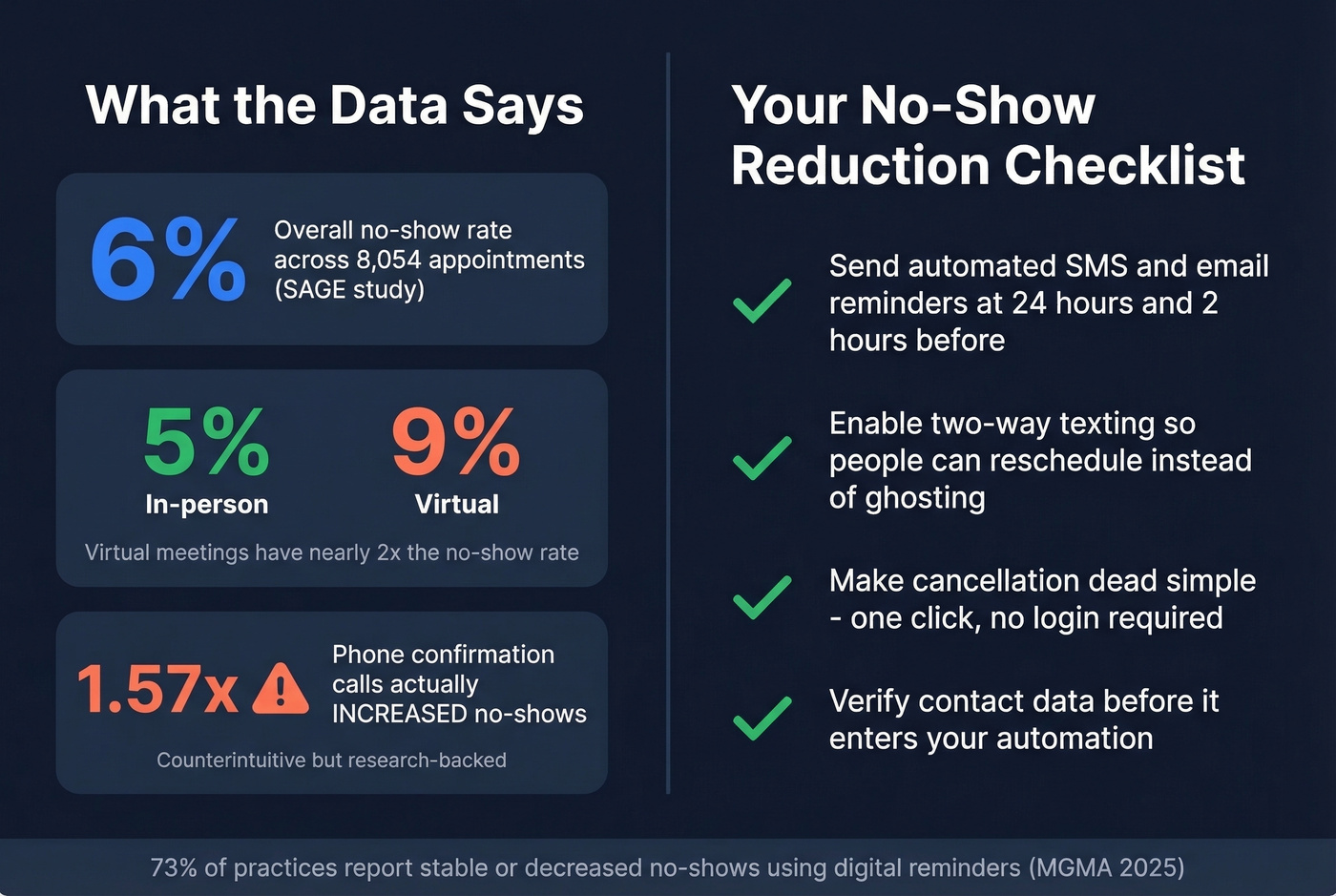
A SAGE-published study of 8,054 scheduled appointments found a 6% overall no-show rate - but the split was telling: in-person appointments had a 5% no-show rate versus 9% for virtual meetings. Counterintuitively, patients who received a phone confirmation call were more likely to no-show (OR 1.57).
An MGMA poll of 265 practices found that 73% reported stable or decreased no-show rates using digital reminders.
Your no-show reduction checklist:
- Send automated SMS and email reminders at 24 hours and 2 hours before
- Enable two-way texting so people can reschedule with a tap instead of ghosting
- Make cancellation and rescheduling dead simple - one click, no login required
- Verify contact data before it enters your automation so you're reaching the right person
What to Automate vs. Keep Human
| Automate This | Keep Human |
|---|---|
| Scheduling and calendar management | Relationship building |
| Reminders (email, SMS, automated calls) | Nuanced objection handling |
| Rule-based lead qualification | Complex negotiation |
| Follow-up sequences | Strategic account planning |
| CRM data entry and enrichment | High-stakes discovery calls |
The line is simple: automate everything repetitive and rule-based. Keep humans where judgment, empathy, and creative problem-solving matter. An AI setter can qualify "Do you have budget for X?" perfectly well. It can't navigate a VP's political concerns about switching vendors mid-quarter. (If you're formalizing qualification, use lead scoring and a clear ideal customer profile.)
Common Mistakes to Avoid
Buying the wrong category. Teams buy a $297/mo AI setter when they need a $10/mo scheduler, or they invest in scheduling software when their real problem is data quality. Match the tool to the problem.
Skipping data verification. Automation amplifies whatever you feed it. If your contact list is full of invalid records, you're automating domain reputation damage. Verify first, sequence second. The consensus on r/coldemail is that bad data is the #1 reason outbound campaigns fail - not messaging, not timing, not subject lines. If you're fixing this systematically, start with an email deliverability guide and track your email bounce rate.
Ignoring integrations. Integration with your existing stack saves roughly 20 hours per employee per month. A tool that doesn't connect to your CRM creates more manual work than it eliminates. (If you're wiring the stack together, use this guide to connect outreach tool to CRM.)
Overcomplicating workflows. Start with a simple three-step flow - data, outreach, scheduling - and add complexity only when you've proven the basics work.
Not testing before committing. 57% of businesses regret their tool selection within the first year. Use free tiers and trials aggressively. Run a 2-week bake-off with your actual data before signing an annual contract.
At $0.01 per verified email, Prospeo costs less per month than a single outsourced meeting. Teams using Prospeo book 35% more meetings than Apollo users - because 98% accuracy means fewer bounces, better deliverability, and more replies that turn into booked calls.
Cut your cost-per-meeting from $300 to under $5. Start with accurate data.
FAQ
What's the difference between scheduling software and an AI appointment setter?
Scheduling software handles booking logistics - calendar sync, links, reminders - while AI setters qualify leads through conversation and book automatically. Need a booking page? Calendly at $10/seat/mo. Need automated qualification across DMs? Appointwise from $97/mo. They solve different problems entirely.
How much does automated appointment setting cost?
Scheduling software runs $0-$16/mo per user. AI setters cost $97-$297/mo. Outsourced services charge $3,000-$15,000/mo. A DIY B2B outbound stack (data provider + sequencer + Calendly) runs $100-$300/mo total for a small team - the best cost-per-meeting ratio for most orgs.
Do automated reminders actually reduce no-shows?
Yes. A SAGE study of 8,054 appointments found a 6% baseline no-show rate, and 73% of MGMA-polled practices maintained or decreased no-shows using digital reminders. SMS and email reminders outperform phone confirmation calls.
What's the best free appointment scheduling tool?
Setmore offers 4 users and 200 appointments per month at no cost - the most generous free tier available. Calendly's free plan works for solopreneurs with basic needs. Cal.com is completely free if you self-host, though it requires technical setup.
How do B2B sales teams automate the full appointment pipeline?
Build a stack: verified contact data feeds into multi-step outreach sequences with embedded scheduling links, followed by automated reminders. 80% of sales need 5+ follow-ups, so multi-step cadences aren't optional. This turns a manual, rep-dependent process into a repeatable system.