

Automated Lead Enrichment: The Practitioner's Guide to Data That Doesn't Bounce
You pull up the bounce report from last week's campaign. 12% hard bounces. A dozen replies from people who left the company months ago. Three disconnected phone numbers in a row. The list your enrichment tool "verified" is burning your domain reputation in real time.
Automated lead enrichment is supposed to solve this. But we've watched teams cycle through three vendors in a year before figuring out the problem isn't the vendor - it's the architecture. Here's what actually works.
The Short Version
- Single-source enrichment plateaus at 40-50% usable emails. Use a waterfall with 2-3 providers queried sequentially.
- Verification is non-negotiable. Enrichment without it just adds garbage faster.
- For waterfall orchestration across dozens of providers, Clay connects 100+ sources via API - but CRM sync requires the $800/mo plan.
What Is Lead Enrichment Automation?
Lead enrichment automation is the process of programmatically appending missing data to lead records - verified emails, direct dials, job titles, company size, tech stack, funding stage, intent signals - without a human touching a spreadsheet. Manual enrichment doesn't scale past a handful of leads per day. Automating this handles thousands of records with consistent logic, speed, and output quality.
The data types that actually drive outbound results: verified work emails, direct-dial mobile numbers, current job titles, firmographic fields like headcount and revenue, technographic signals, and buyer intent data.
Why Fresh Data Matters
B2B contact data decays 30-70% per year. That's not theoretical. A third to two-thirds of your CRM contacts are degrading right now. Poor data quality costs the US economy $3.1 trillion annually, and Gartner pegs the average enterprise cost at $12.9 million per year, and Gartner pegs the average enterprise cost at $12.9 million per year.
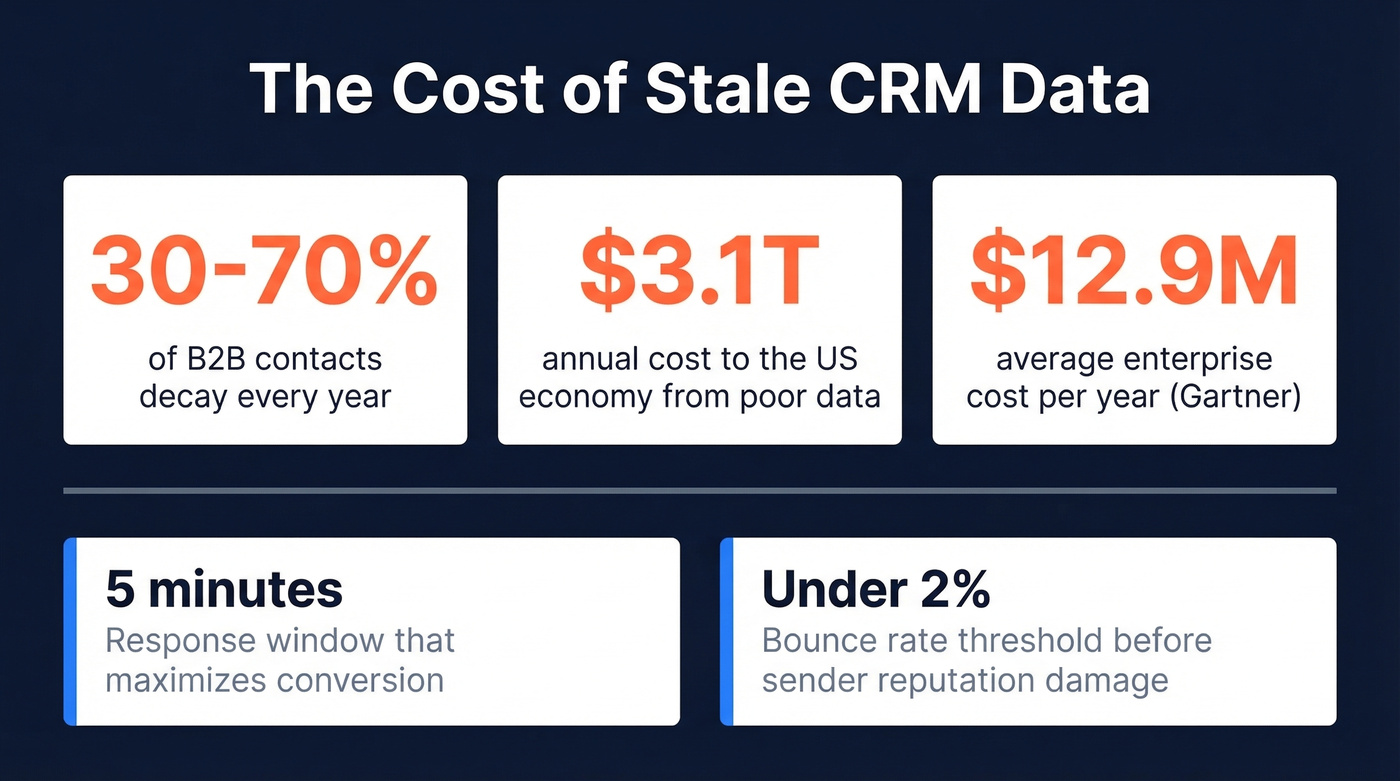
Speed compounds the problem. Workato's research shows that responding within 5 minutes maximizes conversion odds. You can't hit that window if you're manually enriching inbound records. And Twilio SendGrid's guidance is clear: keep bounces under 2% per send. Above that, your sender reputation takes compounding damage.
If you're not enriching and re-verifying continuously, your CRM is rotting.
Why Single-Source Enrichment Fails
Every enrichment provider claims 90%+ accuracy. The Reddit threads tell a different story. Agency operators report that even after combining Apollo, ZoomInfo, and manual scraping, "bounces shoot up" and "titles are outdated." In n8n community discussions, practitioners debate stacking Apollo with People Data Labs and API-first providers because no single source covers enough ground alone.
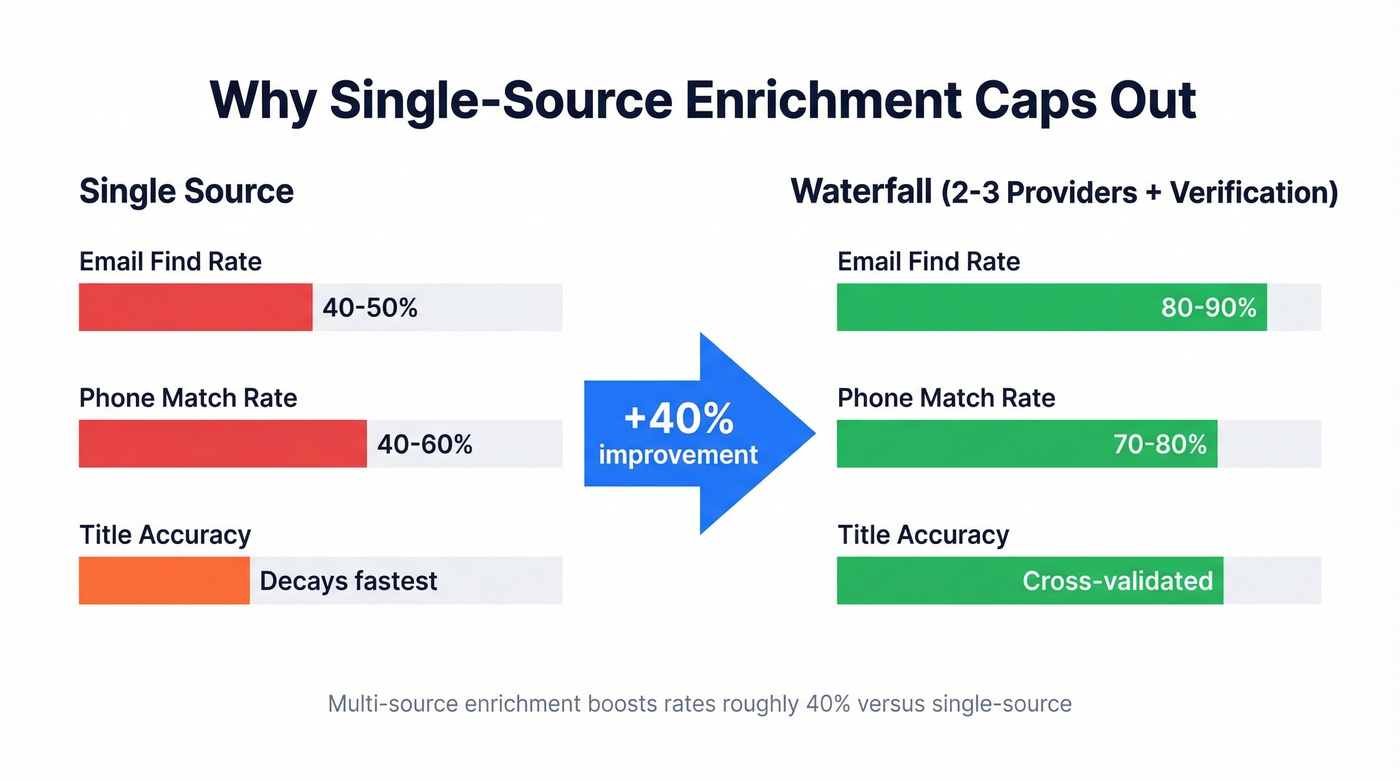
Single-source email find rates plateau at 40-50%. Phone match rates for direct dials typically land around 40-60%. Job titles go stale fastest. Direct dials are the worst category for accuracy. No single database covers all of it well, because no single database can.
Here's the thing: if your average deal size is under $10K, you almost certainly don't need ZoomInfo-level data. You need two solid providers, a verification layer, and the discipline to monitor bounce rates weekly. (If you want the broader landscape, compare data enrichment services before you commit.)

Single-source enrichment caps out at 50% usable emails. Prospeo's 5-step verification with catch-all handling, spam-trap removal, and honeypot filtering is the verification layer this article keeps telling you to build. 98% email accuracy. 92% API match rate. 50+ data points returned per contact.
Stop enriching leads just to watch them bounce.
Waterfall Enrichment: The Fix
Waterfall enrichment routes a record sequentially through prioritized providers until verified data is found for each field. Provider A returns an email but no phone? The record falls through to Provider B. Provider B misses the job title? Provider C takes a shot. Each field gets the best available data from the best available source.
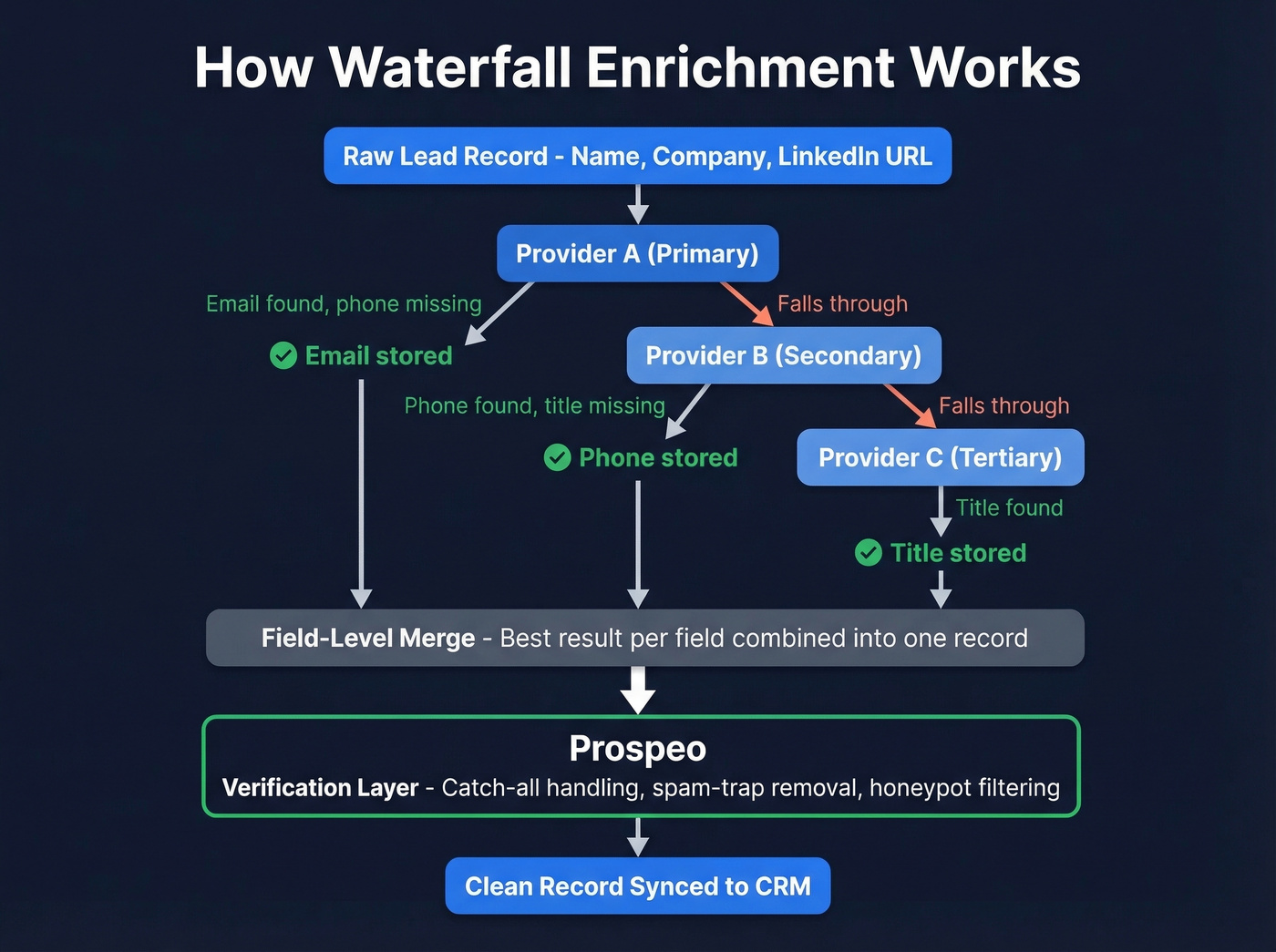
A true waterfall means multiple independent data sources, sequential querying, field-level merging, and built-in verification at the end. Multi-source enrichment boosts enrichment rates ~40% versus single-source. That tracks with what we've seen running these workflows in production.
You don't need 12 enrichment tools. Two or three good ones plus a verification layer that catches what they miss - that's the whole recipe. If you're still deciding what to enrich, start with a clean lead enrichment spec.
How to Build the Workflow
The implementation follows a predictable sequence:
- Define target fields. Verified email, direct dial, title, company size, tech stack - enrich what your reps and sequences actually need. (Tie this back to your ideal customer profile so you don't collect junk fields.)
- Normalize inputs. Clean source data before enrichment. Garbage in, garbage out.
- Set provider order. Rank sources by accuracy per field type. Your best email provider might not be your best phone provider.
- Query provider 1. Send records through your primary source first.
- Validate results. Check confidence levels. A "maybe" email isn't a verified email. (If you're troubleshooting, use an AI email checker to spot risky patterns fast.)
- Fall through for gaps. Missing or low-confidence fields route to the next provider.
- Consolidate best value per field. Merge the strongest result for each field into a single record.
- Verify before syncing. Run every email through verification before it touches your CRM. This is where most workflows break - and where a dedicated verification layer with catch-all handling, spam-trap removal, and honeypot filtering separates clean data from expensive bounces.
- Sync to CRM. Push verified records to Salesforce, HubSpot, or your sequencer. Don't overwrite user-confirmed fields without controls. (If you're wiring systems together, follow a checklist to connect outreach tool to CRM.)
- Monitor continuously. Track fill rate, bounce rate, and cost per source. Kill underperforming providers. (Benchmarks help - track your email bounce rate alongside deliverability.)
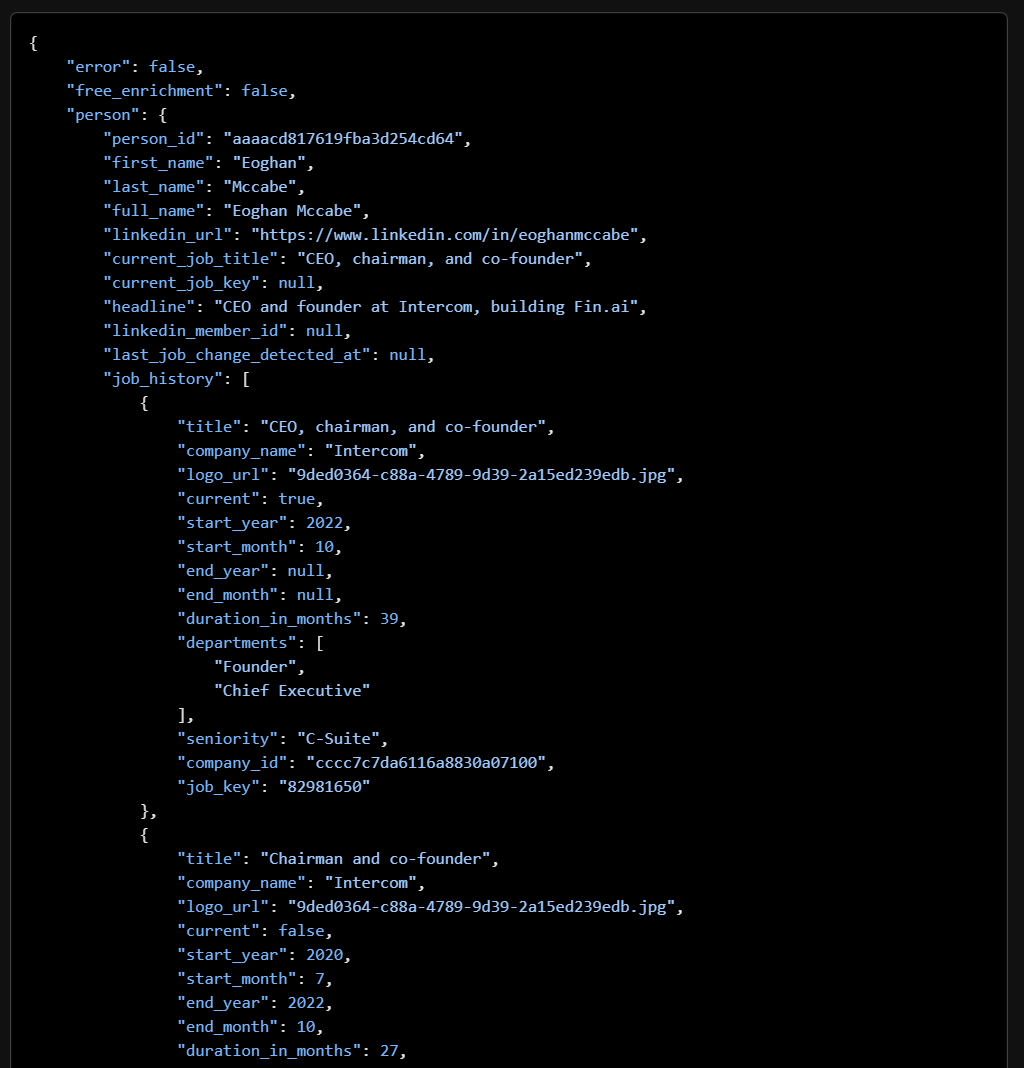
For orchestration, Zapier, Make, and n8n handle the routing logic without code. Workato documents a pattern where a Slack command triggers enrichment, checks for duplicates, and creates the lead with enriched fields - all automated. Keep source lineage for every field so you can audit which provider delivered what.
Tools That Actually Work
Prospeo - Best for Accuracy and Verification
Prospeo covers 143M+ verified emails and 125M+ verified mobile numbers across 300M+ professional profiles, all on a 7-day refresh cycle. At ~$0.01/lead, that's a 100x cost difference versus ZoomInfo - with higher email accuracy (98% versus ZoomInfo's 87%). The API returns 50+ data points per contact at a 92% match rate, plus intent data across 15,000 topics so you can prioritize leads actively researching solutions.
One team using Prospeo for verification dropped their bounce rate from 35% to under 4% while tripling pipeline from $100K to $300K per week. The free tier gives you 75 emails and 100 Chrome extension credits per month to test - no contracts, self-serve from day one. Native integrations with Salesforce, HubSpot, Clay, Zapier, Make, Smartlead, Instantly, and Lemlist.
Clay - Best for Waterfall Orchestration
Use this if you need to query 100+ data providers via API in a single workflow and you're comfortable with a 4-6 week learning curve. Clay's waterfall logic is the most flexible on the market, and 100K+ users run enrichment through it. (If you're building lists inside Clay, see Clay list building to avoid credit blowups.)
Skip this if your budget is tight. CRM integration requires the $800/mo Scale plan, and credit costs add up fast. Basic email enrichment runs 2-3 credits per match; full profile enrichment can hit 15-25 credits per prospect.
Apollo - Budget All-in-One
Apollo gives you enrichment plus sequencing in one tool for teams watching every dollar. Free plan available, paid plans from $59/user/mo. The trade-off is coverage: Apollo is a single-source tool, so email find rates plateau around 40-50% without a supplementary provider. We've tested it as a standalone enrichment source and consistently needed a second provider to fill gaps. Solid starting point, not a complete solution.
ZoomInfo - Enterprise Scale
ZoomInfo typically runs $15K-$50K+/year on annual contracts. It's the deepest US database and the most complete sales intelligence suite. It's also overkill for enrichment-only use cases - like buying a Ferrari to drive to the grocery store. Best when you need the full platform: intent, chat, and workflow automation.
Cognism is worth a look for European phone coverage, and Clearbit (now HubSpot Breeze Intelligence) is solid if you're already in the HubSpot ecosystem.
Pricing at a Glance
| Tool | Starting Price | Contract | Best For |
|---|---|---|---|
| Prospeo | Free (75/mo); ~$0.01/email | No contract | Accuracy & verification |
| Clay | $185/mo (Launch) | Monthly | Waterfall orchestration |
| Apollo | Free; $59/user/mo | Monthly/Annual | Budget all-in-one |
| ZoomInfo | ~$15K+/year | Annual | Enterprise suite |
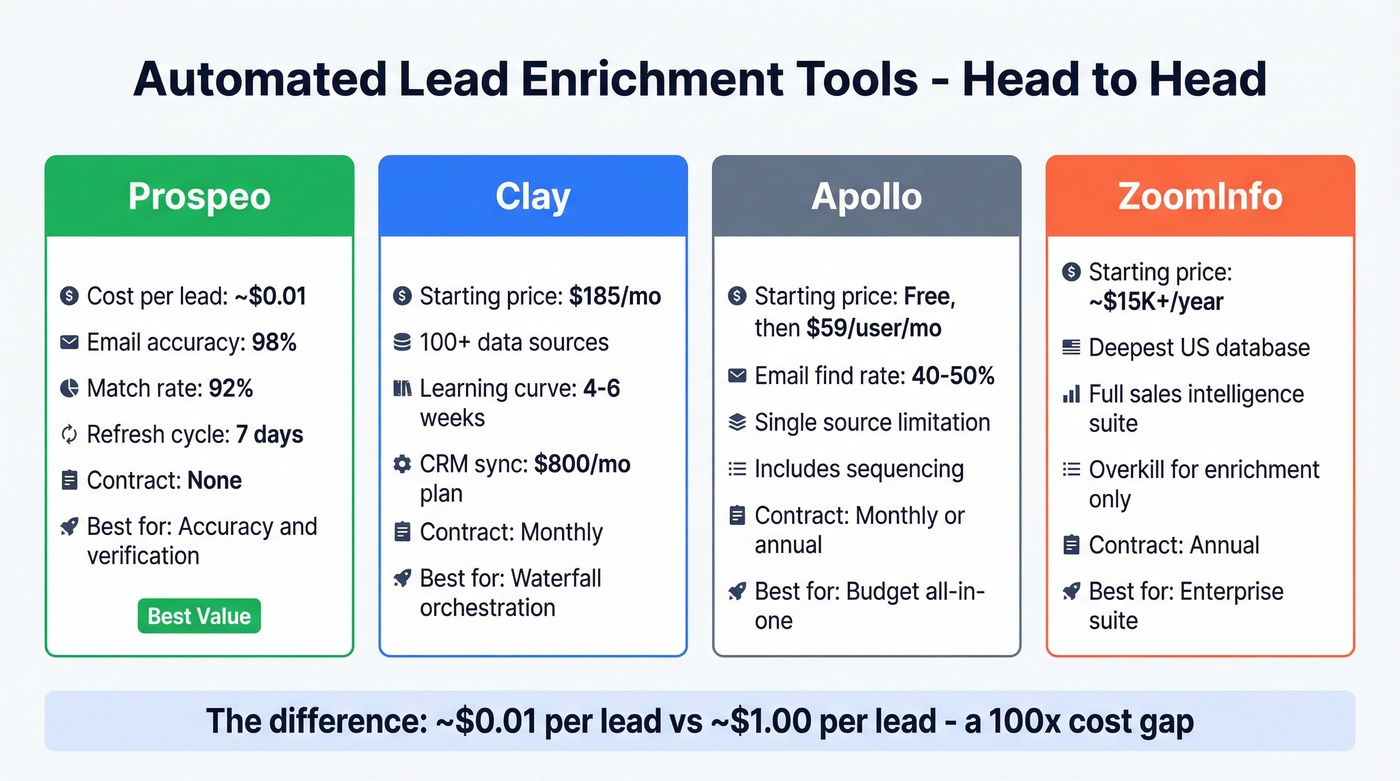
That's a 100x cost difference: ~$0.01/lead with Prospeo versus ~$1/lead with ZoomInfo.
Compliance You Can't Skip
GDPR fines reach EUR20M. CCPA penalties hit $7,988 per intentional violation. Over 20 US states now have privacy laws on the books. This isn't optional. (If you're building outbound at scale, also read up on is it illegal to buy email lists.)
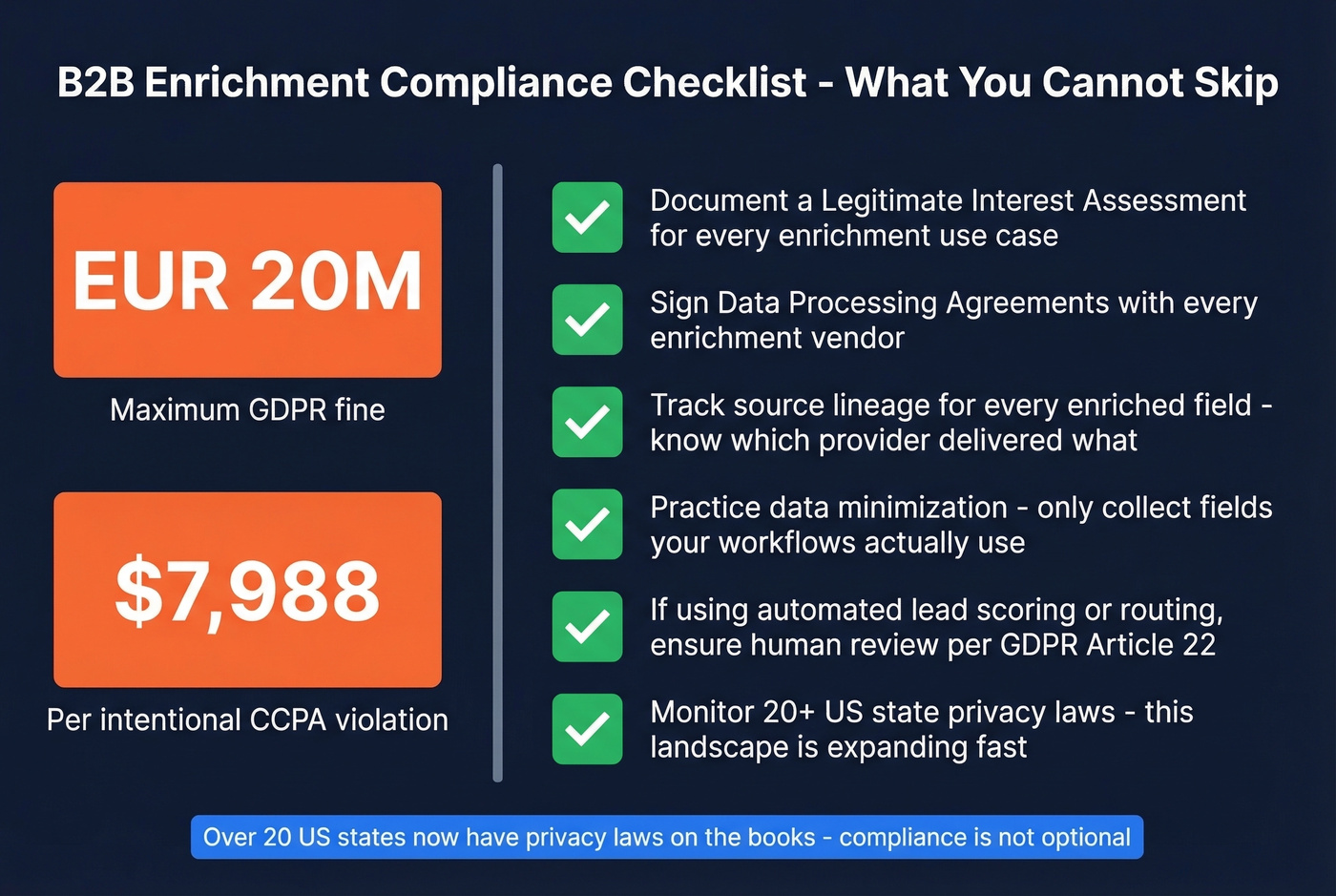
For B2B enrichment, the standard lawful basis is legitimate interest - but you need to document a Legitimate Interest Assessment. Sign Data Processing Agreements with every enrichment vendor. Track source lineage for every field. Practice data minimization: collect only what your workflows actually need. If your enrichment feeds automated lead scoring or routing, GDPR Article 22 requires human review and the right to contest automated decisions - an angle most teams overlook entirely.
Your waterfall workflow needs a provider that refreshes every 7 days - not every 6 weeks. Prospeo covers 143M+ verified emails and 125M+ mobile numbers at ~$0.01/lead, with native integrations for Salesforce, HubSpot, Clay, and every sequencer in your stack. One team dropped bounces from 35% to under 4% and tripled pipeline.
Build the enrichment workflow that actually keeps your domain safe.
FAQ
How often should I re-enrich CRM data?
Re-enrich at least quarterly, ideally monthly. B2B contact data decays 30-70% per year, so a 90-day-old list can already have 10-15% stale records. Tools with a 7-day refresh cycle reduce this burden significantly.
Can I automate lead enrichment without code?
Yes. Zapier, Make, and n8n connect enrichment APIs to your CRM without writing code. Most teams set up a basic waterfall workflow in under a day using pre-built templates and webhook triggers.
How does AI enrichment differ from rule-based enrichment?
AI enrichment uses machine learning to match records across sources, resolve conflicting data, and score confidence levels dynamically - rather than relying on static if/then rules. The result is higher match rates and smarter field-level merging, especially with incomplete input data.
What's a good free tool for automated lead enrichment?
Prospeo's free tier includes 75 email credits and 100 Chrome extension credits per month with full verification - enough to test a real workflow. Apollo also offers a free plan, though its single-source coverage means you'll likely need a second provider to fill gaps.