

How to Build an Automated Sales Funnel That Actually Converts
It's Monday morning. Your 500-email sequence fired over the weekend, and you're staring at a 34% bounce rate. Half your "verified" contacts never existed. The automation worked perfectly - it just automated failure.
Here's the thing most guides on automated sales funnels won't tell you: the funnel isn't broken. The data is.
What You Need (Quick Version)
An automated sales funnel captures leads, nurtures them with behavior-based sequences, and hands warm prospects to sales - without manual babysitting. You need three things: clean contact data, a CRM with automation workflows, and email sequences triggered by behavior rather than arbitrary timers.
Total cost for a working setup: around $200/month. A stack like HubSpot's free CRM, Prospeo for verified contacts at roughly $0.01 per email with 98% accuracy, and Instantly for email sequences gets you there without enterprise pricing.
What Is an Automated Sales Funnel?
An automated sales funnel moves prospects from first touch to closed deal with minimal manual intervention at each stage. Think of the AIDA framework) - Awareness, Interest, Desire, Action - with software handling the transitions instead of a rep manually following up.
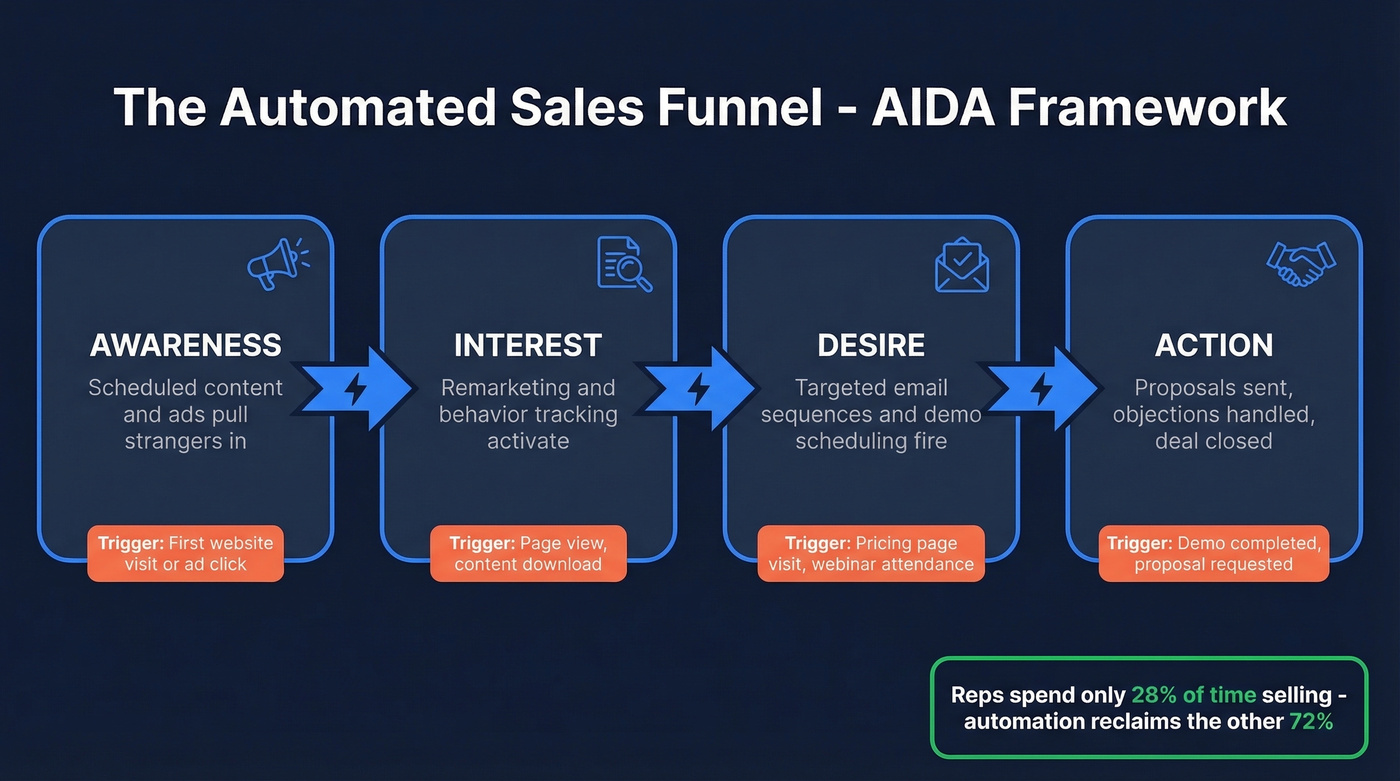
At the Awareness stage, scheduled content and ads pull strangers in. Interest triggers remarketing and tracking. Desire fires targeted email sequences and demo scheduling. Action delivers proposals, handles objections, and closes. Each transition happens based on what the prospect does, not what day it is on your calendar.
The contrast with a manual funnel is stark. Reps spend just 28% of their time actually selling - the rest goes to CRM updates, internal meetings, and chasing leads who went cold three weeks ago. Automation reclaims much of that other 72%.
And here's the stat that should reshape your thinking: the average B2B buying committee now includes 13 people across two or more departments. No single rep can manually nurture 13 stakeholders across dozens of active deals. Automation isn't a nice-to-have. It's the only way to keep up with how modern B2B sales actually works.
Why Sales Funnel Automation Matters
Speed kills - in a good way. An MIT/InsideSales.com study found that 35-50% of sales go to the business that responds first. Not the best product, not the cheapest option. The fastest reply. And 92% of B2B buyers enter the process with at least one vendor already in mind, which means if you're not in the conversation early, you're fighting uphill from the start. Automation makes you the fastest reply every time, even at 2 a.m. on a Saturday.
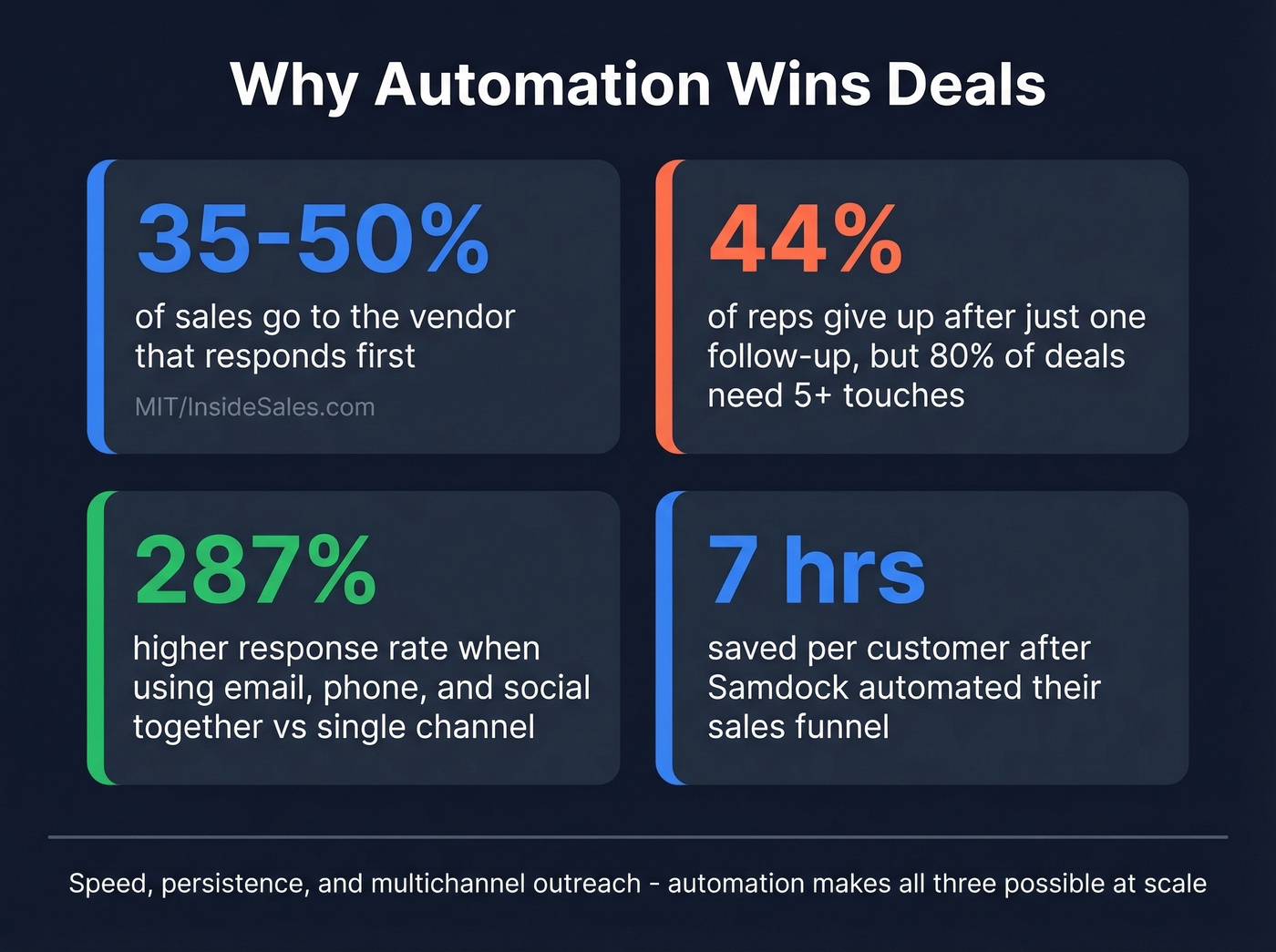
Then there's persistence. 80% of deals require five or more touches, but 44% of reps give up after just one. That's not a motivation problem - it's a bandwidth problem. No human can manually follow up with 200 prospects across five touchpoints without dropping balls. Automation doesn't forget.
Cold email reply rates average 1-5%, and only 0.2-2% convert into actual sales. Those numbers look grim until you add channels. Using email, phone, and social together increases response rates by 287% compared to single-channel outreach, and automation is what makes multichannel feasible at scale. (If you're rebuilding your outreach, start with proven sales follow-up templates.)
The time savings are concrete. Samdock, a CRM company, used to spend 3-5 hours in sales plus 2-4 hours in customer success per new customer. After automating their funnel, that dropped to under one hour each - saving up to 7 hours per customer. Multiply that across dozens of new customers per month and you're looking at a full headcount saved.

Automation multiplies everything - including bad data. Snyk's 50 AEs cut bounce rates from 35% to under 5% and grew pipeline 180% after switching to Prospeo's 5-step verified emails. At $0.01 per email with 98% accuracy, clean data costs less than one bounced sequence.
Stop automating failure. Verify your list before you hit send.
How to Build One in 7 Steps
1. Map Your Current Sales Process
Define your process before you touch any software. We've seen teams spend weeks configuring automation tools only to realize they automated a broken process. Sit down and map the stages a prospect actually moves through: lead, MQL, SQL, opportunity, closed-won or lost. Write down what happens at each transition. Who touches the deal? What triggers the handoff? If you can't describe it on a whiteboard, you can't automate it. (If you need a framework, use a sales process optimization checklist.)
2. Set Stage Goals with Real Benchmarks
You can't optimize what you don't measure. Here are conversion benchmarks by industry to use as baselines:
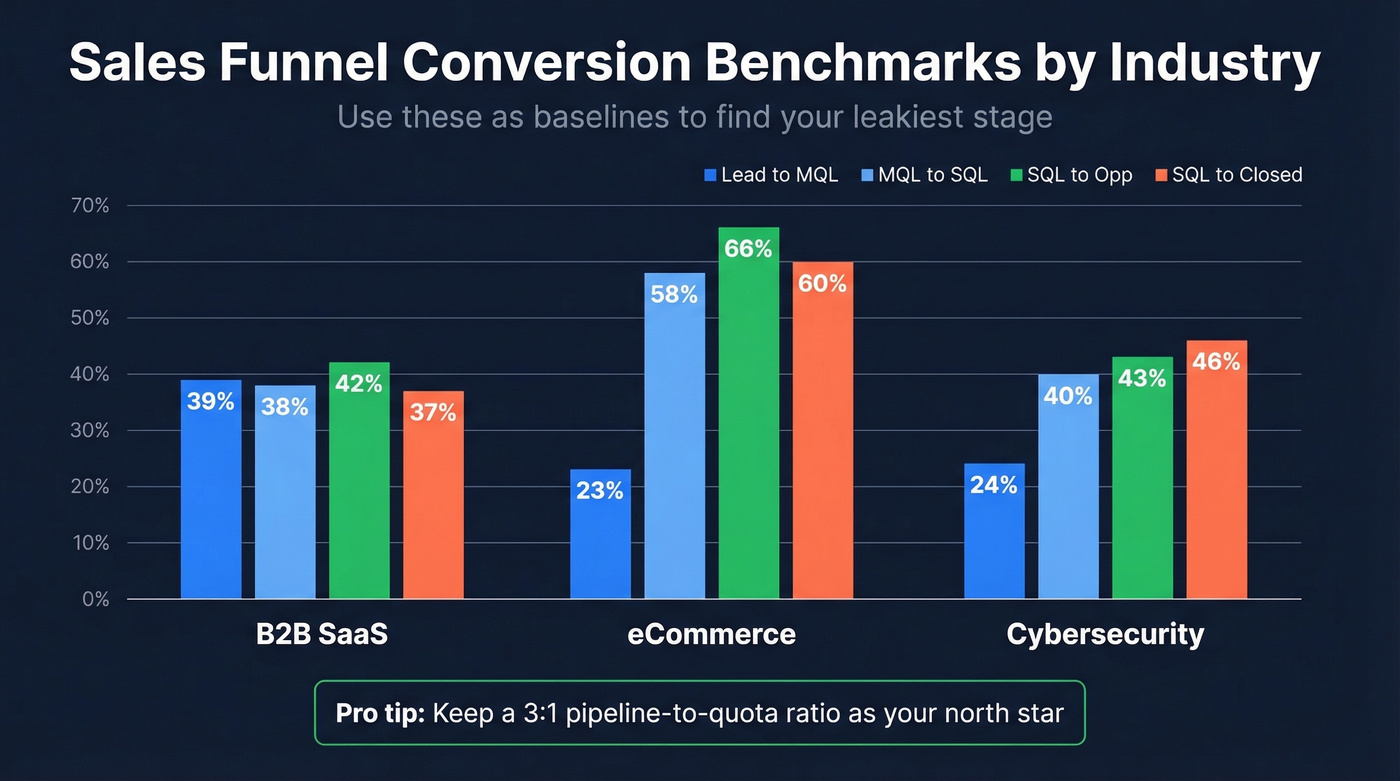
| Industry | Lead to MQL | MQL to SQL | SQL to Opp | SQL to Closed |
|---|---|---|---|---|
| B2B SaaS | 39% | 38% | 42% | 37% |
| eCommerce | 23% | 58% | 66% | 60% |
| Cybersecurity | 24% | 40% | 43% | 46% |
If any of your stages fall significantly below these numbers, that's your leakiest point. Fix it first. Keep a 3:1 pipeline-to-quota ratio as your north star - if your team carries a $1M quota, you need $3M in active pipeline to hit it reliably. (For deeper tracking, see funnel metrics.)
3. Build Lead Capture Assets
Your funnel needs an entry point. Landing pages, forms, lead magnets, webinar registrations - whatever matches your buyer's journey. The math here is humbling: roughly 1-3% of website visitors convert into leads. That means you need serious top-of-funnel volume or extremely targeted traffic.
Don't build five landing pages on day one. Build one, optimize it until it converts above your industry baseline, then expand. If you're starting from scratch, use a shortlist of free lead generation tools to get initial volume.
4. Design Behavior-Based Sequences
This is where funnels diverge from "good" to "great." Time-based drips - send email two on day three, email three on day seven - treat every prospect identically. Behavioral triggers respond to what the prospect actually does.
Concrete examples that work: a post-purchase three-email series that onboards new customers, a re-engagement sequence that fires after 60 days of inactivity, a webinar follow-up that only triggers for attendees (not registrants who no-showed). Each sequence has a single goal and fires based on a meaningful action, not an arbitrary timer. (If you're building outbound nurture, start with a B2B cold email sequence structure.)
5. Verify Your Data Before Automating
Skip this step and your funnel dies quietly.
About 17% of cold emails get blocked or land in spam. Bounced emails tank your sender reputation, which means even your good emails stop reaching inboxes. Every dollar you spend on automation multiplies the damage of bad data. If you're diagnosing issues, start with email bounce rate benchmarks and fixes.
We've audited dozens of funnels, and the number-one killer is always the same: unverified contact lists. Snyk's sales team went from a 35-40% bounce rate to under 5% after switching to Prospeo's bulk verification, and their AE-sourced pipeline jumped 180%. The 5-step verification process includes catch-all handling, spam-trap removal, and honeypot filtering, so you're not just checking syntax - you're confirming deliverability. Upload a CSV, run verification, and export a clean list before you automate anything. (For the full playbook, see our email deliverability guide.)
Your funnel nurtures 13-person buying committees across dozens of deals. That only works if every email actually lands. Prospeo's 7-day data refresh keeps contacts current - not 6 weeks stale like competitors - so your sequences reach real inboxes, not dead ends.
Feed your funnel data that's refreshed weekly, not monthly.
6. Add AI Where It Helps
Predictive lead scoring and smart routing genuinely help. Assigning scores - 0-30 nurture, 31-70 marketing-qualified, 71-100 sales-qualified - and routing sales-qualified leads directly to reps while nurturing the rest automatically is a real efficiency gain. Layering in intent data tracking 15,000 topics lets you prioritize prospects actively researching your category, not just those who opened an email. (If you want a system, start with lead scoring.)
Where AI doesn't help: generating your email copy wholesale. AI-written sequences read like AI-written sequences, and your prospects can tell. Use AI to score, route, and prioritize. Write the actual messages yourself, or at minimum, heavily edit what AI drafts.
7. Test One Metric Per Stage
Don't optimize everything at once. Pick the leakiest stage and fix it. Run A/B tests on one variable at a time: subject line, CTA placement, or send time. Review drop-off rates between stages quarterly. Check for stale content, broken links, and outdated offers that silently erode conversion. (If you're testing opens, pull from these email subject line examples.)
A quarterly audit cadence works well for most teams. Pull your stage-by-stage conversion rates, compare them to the benchmarks above, and identify the single biggest gap. Fix that gap, measure for 30 days, then move to the next one.
Mistakes That Kill Automated Funnels
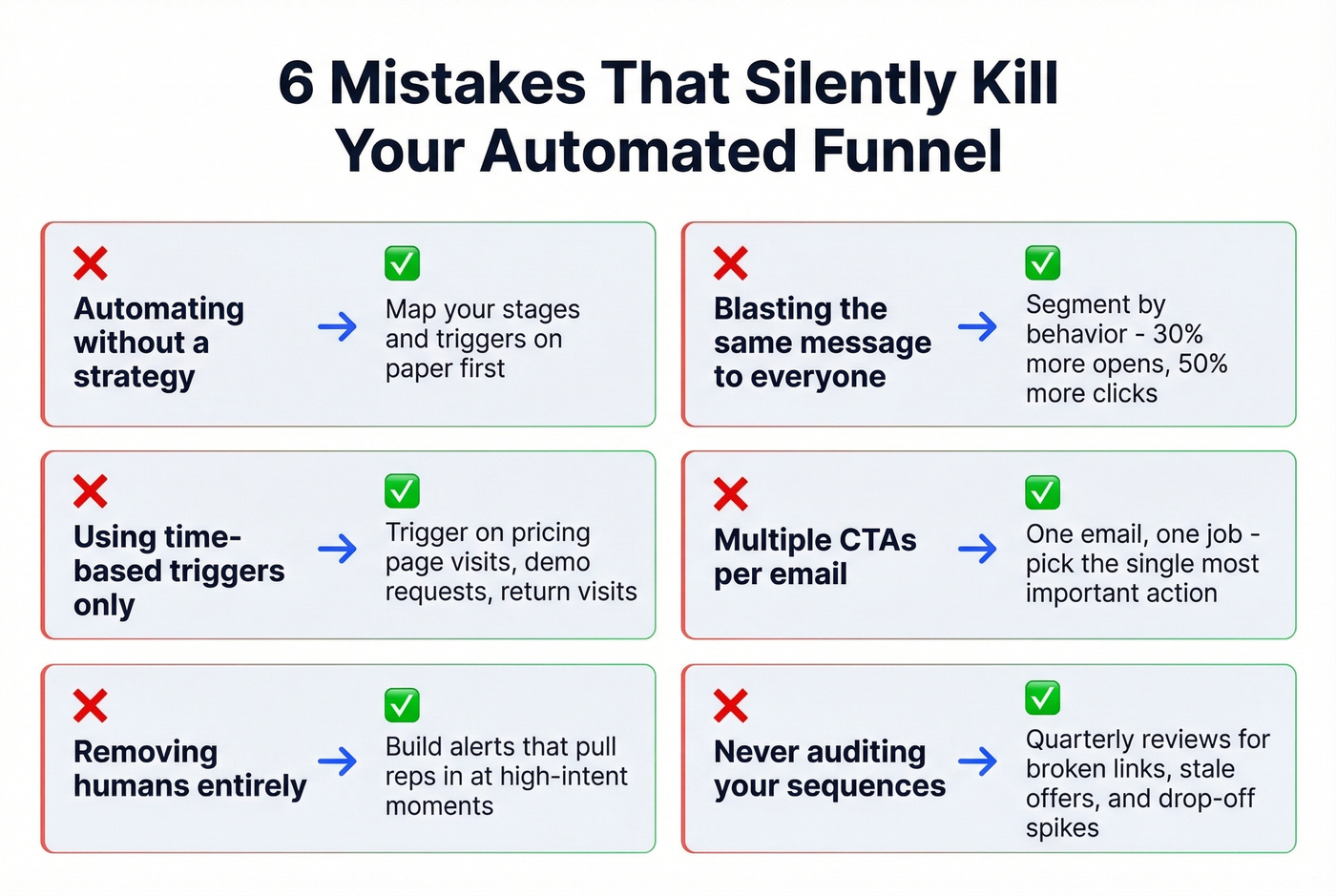
Automating Without a Strategy
The biggest mistake isn't technical - it's strategic. Teams buy automation software before they've defined their sales process, then wonder why the funnel doesn't convert. If you can't describe your stages, triggers, and handoff criteria on paper, no tool will save you.
Blasting the Same Message to Everyone
Segmented campaigns generate 30% more opens and 50% more clicks than unsegmented blasts. Someone who visited your pricing page three times needs a different message than someone who downloaded a whitepaper once. Segment by behavior and interests, not just demographics - that's where sales funnel marketing automation earns its keep.

Time-Based Triggers Instead of Behavioral
Sending email three on day five regardless of what the prospect did is lazy automation. Trigger on meaningful events: a pricing page visit, a demo request, a return visit after 30 days of silence. Behavioral triggers convert because they respond to intent, not calendars.
Multiple CTAs Per Email
One email, one job. If your nurture email asks the prospect to book a demo, read a case study, and follow you on social, it accomplishes none of those things. Pick the single most important action for that stage and make it unmissable.
Removing Humans Entirely
Let's be honest: the best automated funnels aren't fully automated. They have deliberate human intervention points at high-intent moments. When a prospect requests a demo, views pricing three times in a week, or replies with a question - those moments need a real person, fast. Build alerts that pull reps into the conversation at exactly the right time. Automation handles the 90% that's repetitive so humans can own the 10% that closes deals.
Never Auditing Your Sequences
Sequences rot. Offers expire, links break, messaging gets stale, and nobody notices because the automation keeps running. Set a quarterly audit cadence. Review every active sequence for broken links, outdated content, and drop-off spikes. Add fallback logic for non-responders - if someone doesn't engage after your full sequence, route them to a different nurture track or flag them for manual review.
What It Actually Costs
You don't need a $14,995/year ZoomInfo contract to run a funnel on autopilot. Here's what you'll actually pay:
| Tool | Category | Starting Price | Best For |
|---|---|---|---|
| HubSpot | CRM + Automation | Free; paid from ~$20/user/mo | All-in-one CRM |
| Prospeo | B2B Data & Verify | Free; ~$0.01/email | Email accuracy |
| Instantly | Email Sequences | ~$30-$100/mo | Cold outreach at scale |
| Pipedrive | CRM | ~$15-$30/user/mo | Simple pipelines |
| Zoho CRM | CRM | ~$14/user/mo | Budget CRM |
| GetResponse | Email + Funnels | $59/mo (1K contacts) | Email-first funnels |
| ClickFunnels | Funnel Builder | $81/mo (billed annually) | Landing pages |
| GoHighLevel | All-in-One | $97/mo | Agencies |
| ZoomInfo | Enterprise Data | $14,995/yr+ | Large sales orgs |
A word on GoHighLevel: Reddit threads and reviews consistently flag poor email deliverability and unexpected charges tied to its Mailgun-based email infrastructure. If deliverability matters to you - and it should - test carefully before committing.
Our recommended ~$200/month stack: HubSpot free CRM for pipeline management and basic automation, Prospeo for verified contact data with native integrations for Instantly, HubSpot, and Salesforce, and Instantly for sequences. That covers capture, verification, nurture, and pipeline tracking without enterprise overhead. For teams comparing options, start with sales funnel automation tools. For list quality, consider data enrichment services alongside verification.
A Real Funnel in Practice
Here's what a working automated sales funnel looks like stage by stage, based on a practitioner's setup shared on r/sales:
Awareness - Scheduled social posts and blog content drive organic traffic. SEO and PR run on autopilot.
Interest - Automated remarketing ads retarget visitors, with tracking pixels capturing behavior across your site.
Consideration - Triggered email campaigns fire based on engagement. Demo scheduling happens automatically through tools like Calendly or Chili Piper.
Decision - Value-focused content and targeted offers go out. Feedback requests gauge buying temperature and surface objections before they stall the deal.
Sale - Automated invoicing, payment processing, and onboarding welcome sequences close the loop.
The entire system runs without daily manual intervention. ROI typically materializes within 3-12 months depending on your sales cycle length - B2B cycles average 70-162 days, so patience matters.
FAQ
How long does it take to build an automated sales funnel?
A basic funnel - capture, nurture, handoff - takes 2-4 weeks to build and configure. Expect 3-6 months before you have enough data to optimize meaningfully. Most teams see measurable ROI within 3-12 months, depending on sales cycle length and data quality at launch.
How do I create one on a tight budget?
Start with free tools: HubSpot's free CRM, a free verification tier for your first batch of contacts, and a low-cost sequencer like Instantly. Map your process on paper first, build one landing page, and design a single behavior-based email sequence. A functional setup runs for under $200/month - the key is verifying your data before you scale.
How do I know if my funnel is working?
Track conversion rates between each stage and compare them to the industry benchmarks in this guide. If any stage drops significantly below average - say, MQL-to-SQL under 30% in SaaS - that's your leakiest point. Audit quarterly, fix the biggest gap first, and measure for 30 days before moving on. HubSpot's reporting docs are a solid starting point for setting up stage-by-stage dashboards.