

Average Cold Email Conversion Rate: What the Data Says in 2026
Your SDR sent 2,000 cold emails last month and booked 4 meetings. The team's asking if that's good. Your VP wants to know why the numbers seem so low. Here's the thing - the problem isn't the number. It's that everyone in the room is measuring something different.
What "Conversion Rate" Actually Means
Most benchmarks conflate three separate metrics:
- Reply rate - replies divided by emails sent. The most commonly cited number, and the least useful on its own. A "not interested" counts as a reply.
- Opportunity conversion rate - qualified opportunities divided by emails sent. This is what actually predicts pipeline.
- Closed-deal conversion rate - customers acquired divided by emails sent. The only number your CFO cares about.
When someone says "our cold email conversion rate is 5%," ask which one. The answer changes everything.
We're deliberately excluding open rates from this analysis. Apple Mail Privacy Protection inflates them beyond usefulness, and Belkins found that disabling tracking pixels actually improved response rates by roughly 3%. (If you still track it, see open rates and the average cold email open rate.)
2026 Cold Email Benchmarks
Reply Rate
Instantly's 2026 benchmark report analyzed billions of cold email interactions. The average reply rate: 3.43%. Top quartile campaigns hit 5.5%+, and the elite top 10% exceeded 10.7%. For more context on what “good” looks like, compare against cold email reply rate benchmarks.
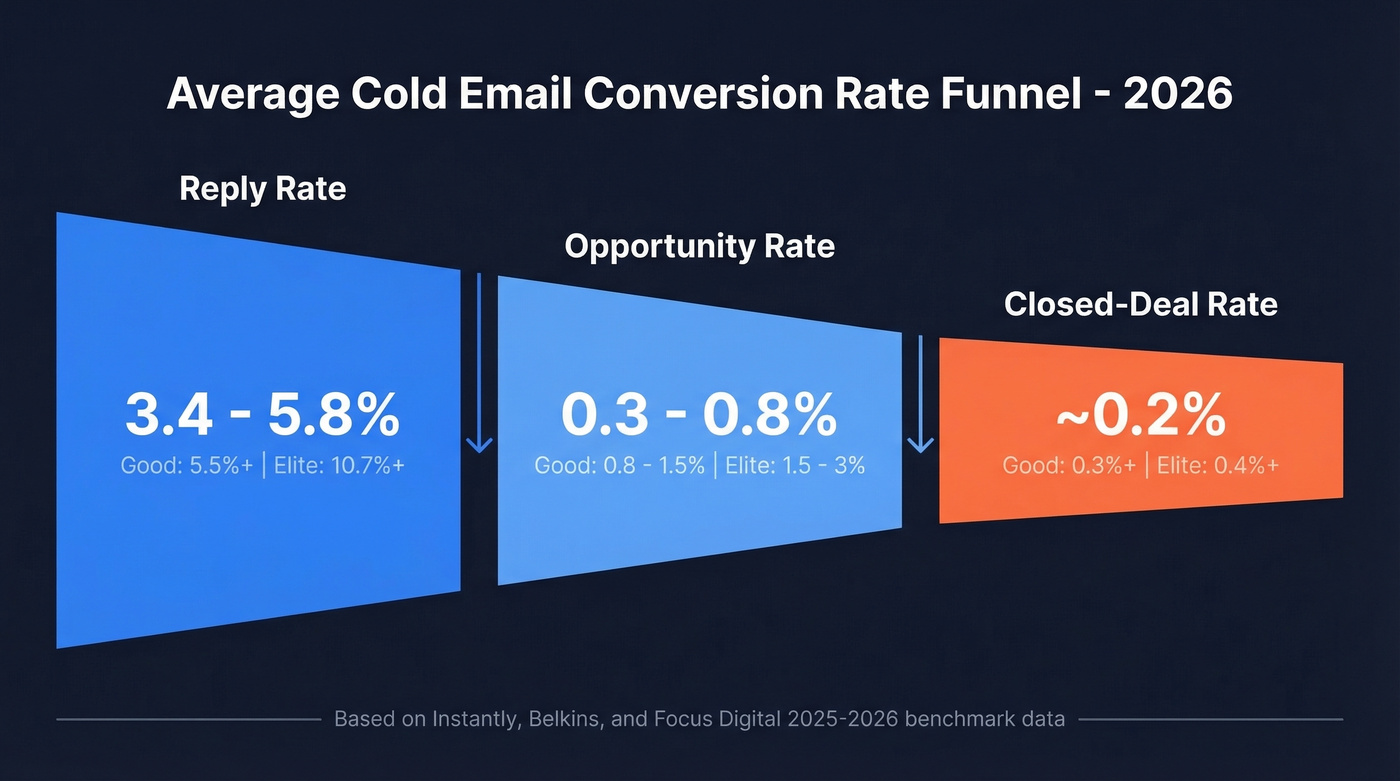
Belkins' study of 16.5 million emails puts the average slightly higher at 5.8%, though that's down from 6.8% the prior year. The trend is clear across every major benchmark set: reply rates are falling as inbox providers tighten filtering. Instantly shows 5.1% in 2024 dropping to 3.43% in 2025-2026, and Belkins shows a similar slide alongside stricter deliverability requirements from Google, Yahoo, and Microsoft. If you’re diagnosing drops, start with cold email deliverability infrastructure.
Opportunity Conversion Rate
This is where the numbers get sobering.
| Performance | Opp Rate |
|---|---|
| Excellent | 1.5-3% |
| Good | 0.8-1.5% |
| Average | 0.3-0.8% |
| Poor | <0.3% |
Martal frames this as the metric that actually predicts pipeline: prospects contacted to sales-qualified opportunities. (If you want a tighter definition of stages, map it to your cold email pipeline.)
Replies to Booked Meetings
DemandNexus pegs traditional cold email at 0.3%-1% when you measure "conversion" as replies turning into booked meetings. Multi-channel sequences can push higher, but that's a different playbook entirely - usually a better fit for a structured cold email cadence.
Closed-Deal Rate
Focus Digital's analysis across hundreds of campaigns found an average closed-deal conversion rate of 0.2153% - roughly 1 deal per 464 emails sent.
The volume modifier matters enormously. Campaigns sending 101-500 emails converted at 0.32%, while campaigns blasting 5,000+ emails dropped to 0.096%. Volume kills conversion. Every time.
| Metric | Average | Good | Elite |
|---|---|---|---|
| Reply rate | 3.4-5.8% | 5.5%+ | 10.7%+ |
| Opportunity rate | 0.3-0.8% | 0.8-1.5% | 1.5-3% |
| Closed-deal rate | ~0.2% | 0.3%+ | 0.4%+ |

The average cold email converts at 0.2%. Bad data makes it worse - bounces destroy sender reputation and tank every campaign after. Prospeo's 5-step verification delivers 98% email accuracy on a 7-day refresh cycle, so every send counts toward that conversion rate.
Stop wasting sends on dead addresses. Verify your list first.
B2B Rates by Industry
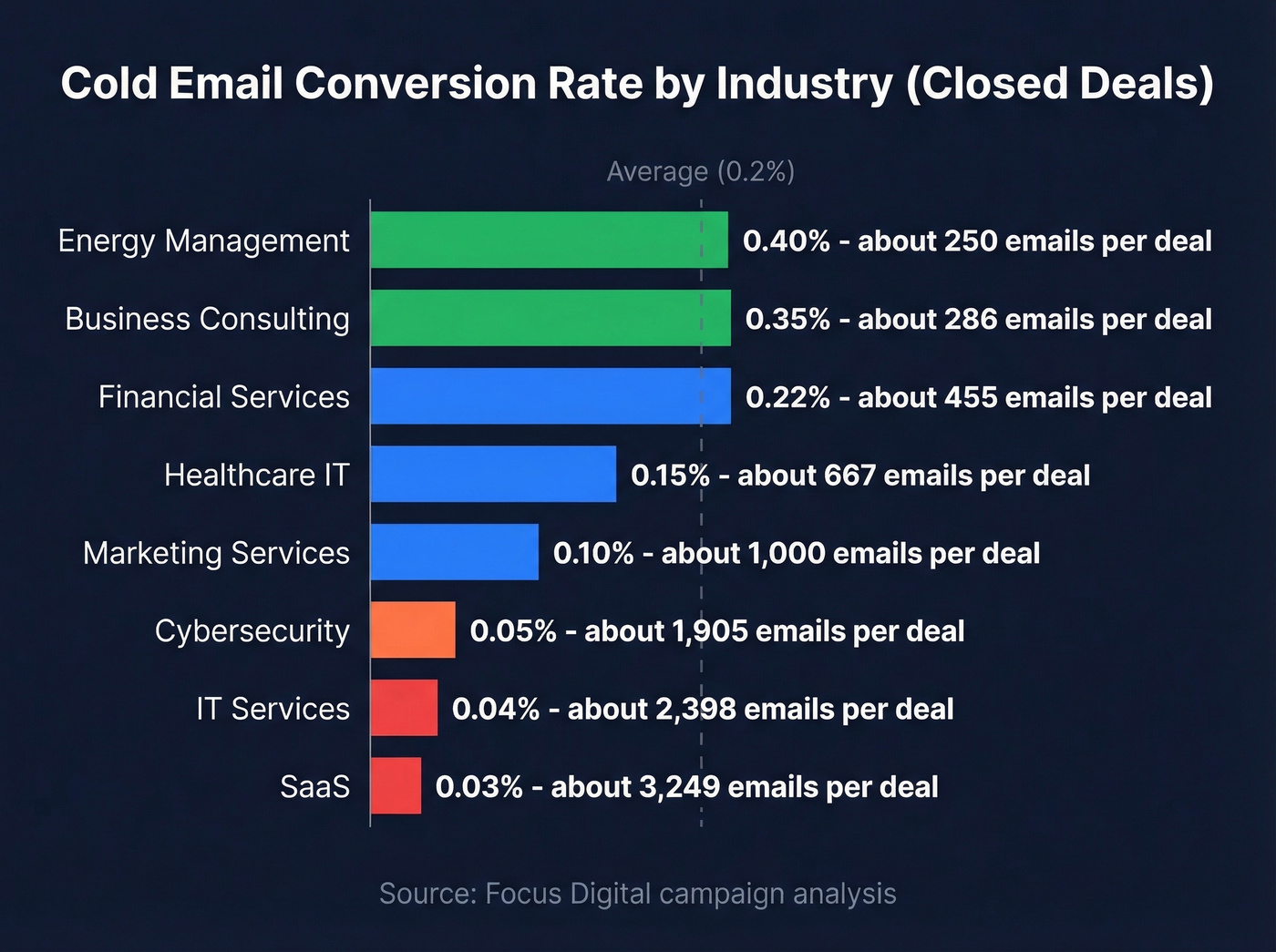
Not all verticals convert equally. Focus Digital's industry breakdown tells a stark story:
| Industry | Conversion Rate | Emails per Deal |
|---|---|---|
| Energy Management | 0.40% | ~250 |
| Business Consulting | 0.35% | ~286 |
| Financial Services | 0.22% | ~455 |
| Healthcare IT | 0.15% | ~667 |
| Marketing Services | 0.10% | ~1,000 |
| Cybersecurity | 0.05% | ~1,905 |
| IT Services | 0.04% | ~2,398 |
| SaaS | 0.03% | ~3,249 |
DemandNexus adds a role dimension worth noting: C-level prospects reply at 6.4%, while managers sit at 3.5%. Targeting seniority matters as much as targeting the right industry, and a single benchmark number is misleading without that context. If you’re building segments, use a real customer persona instead of “ICP” hand-waving.
What Drives Conversion Up or Down
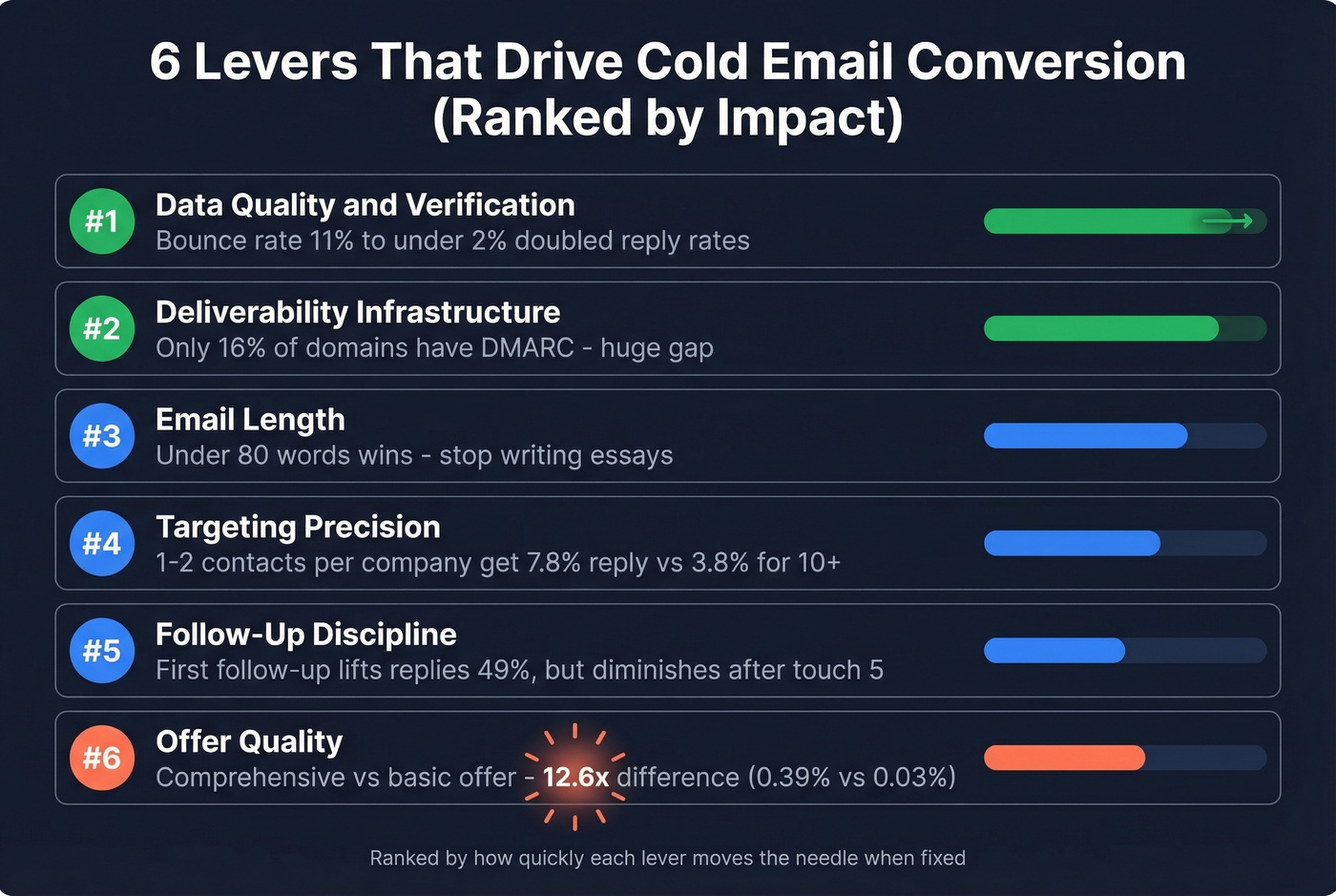
Six levers, ranked by impact.
1. Data Quality and Verification
This is the single highest-leverage fix. Bad email addresses bounce, bounces damage your sender domain reputation, and damaged reputation tanks inbox placement for every subsequent campaign. It's a death spiral, and we've watched teams fall into it repeatedly. (More on why lists decay in customer data quality.)
One practitioner on r/Entrepreneur dropped their bounce rate from 11% to under 2% and watched reply rates double. Prospeo's 5-step verification process catches invalid addresses, spam traps, and catch-all domains before they damage your sender reputation - 98% email accuracy on a 7-day data refresh cycle. Stack Optimize built to $1M ARR using Prospeo-verified lists with 94%+ deliverability, under 3% bounce, and zero domain flags across all clients.
Precision beats volume - 1-2 contacts per company get 2x the reply rate of 10+. Prospeo's 30+ search filters (intent data, job changes, headcount growth) let you build hyper-targeted lists that convert at elite rates, not averages.
Send fewer emails. Book more meetings. Start with better data.
2. Deliverability Infrastructure
Google and Yahoo started enforcing SPF/DKIM/DMARC in February 2024. Microsoft followed in May 2025. Yet only 16% of domains have implemented DMARC - a staggering gap between what's required and what teams are actually doing. Even with proper authentication, inbox placement varies: Google delivers 87.2% to inbox vs. Microsoft's 75.6%. If your list skews Outlook-heavy, expect harder deliverability. (If that’s you, start with Outlook deliverability.)
3. Email Length
Shorter emails win. The data is unanimous. Instantly's top campaigns keep first-touch emails under 80 words. Belkins found 6-8 sentences (under 200 words) optimal for their dataset. A practitioner on Reddit cut from 141 words to under 56 and saw immediate improvement. Stop writing essays. If you need structure, borrow from proven cold email examples.
4. Targeting Precision
| Contacts per company | Reply rate |
|---|---|
| 1-2 | 7.8% |
| 10+ | 3.8% |
Precision beats volume every time. Belkins also found Thursday pulled a 6.87% reply rate vs. Monday's 5.29%, so even send-day selection matters more than most teams realize. (See the latest data on the best day for email campaign.)
5. Follow-Up Discipline
The first follow-up lifts replies by up to 49%. But by follow-up #4 (the fifth email), response rates drop 55%. The sweet spot is 4-7 touchpoints. After that, returns diminish fast unless every touch adds real new value - a case study, a relevant stat, a specific insight about their business. Generic "just bumping this up" emails are dead weight.
6. Offer Quality
This is the most underrated lever, and honestly the one that frustrates us most when we see teams ignore it. Focus Digital's data: a basic offer converts at 0.03%, a comprehensive offer hits 0.39%. That's a 12.6x difference from the same list and the same deliverability setup. Your offer matters more than your subject line, your personalization, and your send time combined.
One more variable nobody talks about: your company's online presence. Businesses with excellent web presence converted at 0.38% vs. 0.03% for those with minimal presence. Prospects Google you before replying. If your site looks like it was built in 2019, that's costing you deals.
And a practitioner on r/coldemail reported iterating from 3.44% to 24.36% reply rate by switching to pain-first messaging and clearer CTAs - proof that systematic testing compounds fast when you're measuring the right things.
What Cold Email Actually Costs Per Deal
MarketOwl estimates an in-house campaign targeting 1,000 contacts runs roughly $2,200 when you factor in data, personalization, infrastructure, and follow-up labor. At a 0.2% closed-deal conversion rate, that's about 2 deals - putting your cost per customer acquired around $1,100.
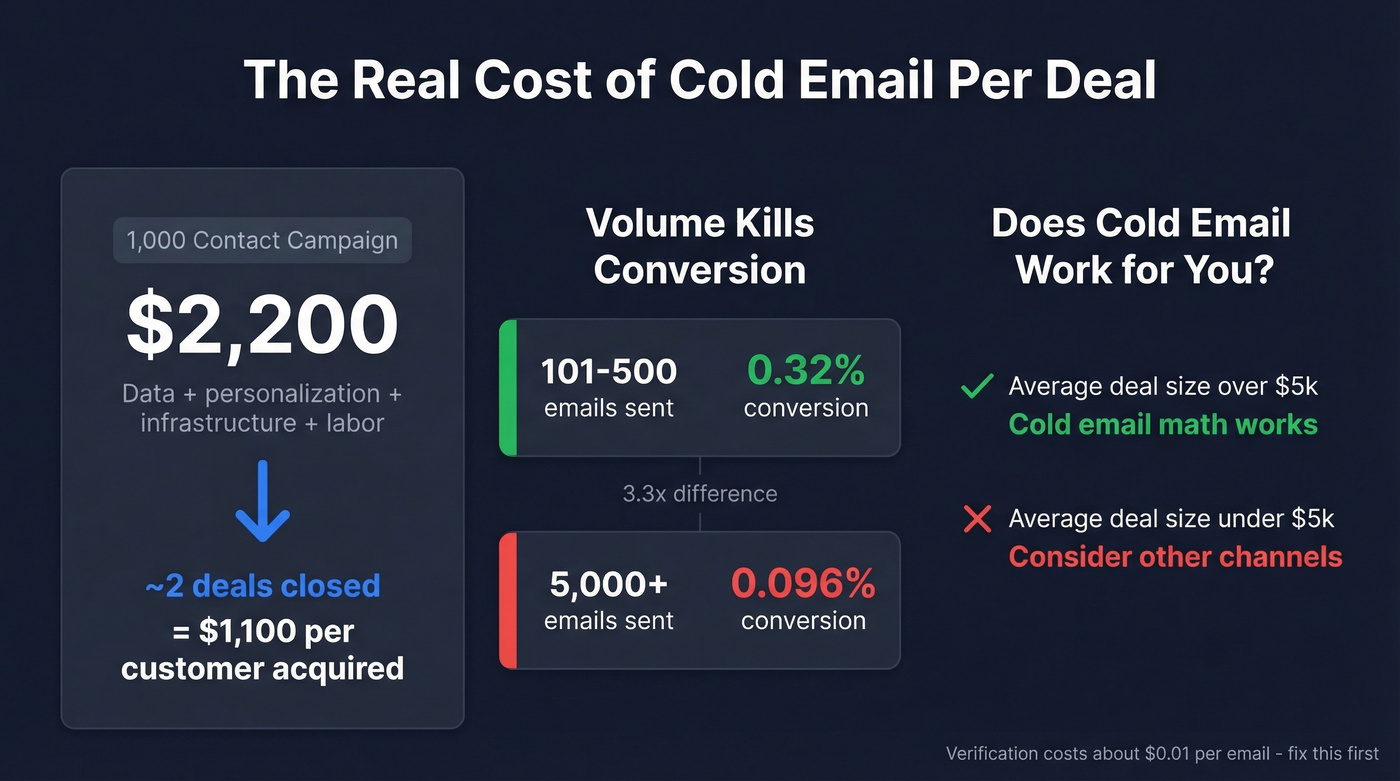
Let's be honest: if your average deal size is under $5k, cold email probably isn't your channel. At $1,100 per acquired customer, the math only works for deals large enough to absorb that cost. Stop obsessing over reply rate in isolation and calculate your cost per deal instead. That's the number that tells you whether cold email is actually working. (If you want to run the math properly, use a cold email ROI calculator.)
Verification is one of the cheapest levers in the stack - Prospeo starts free and costs roughly $0.01 per verified email, which makes it one of the first things we'd recommend fixing before touching anything else in your outbound workflow.
FAQ
What's a good cold email conversion rate?
Above 5% reply rate is solid, and 10%+ is elite. For closed deals, anything above 0.3% outperforms most campaigns. The average cold email conversion rate for closed deals sits around 0.2% - roughly 1 deal per 464 emails - so clearing that bar puts you ahead of the median.
How many cold emails to close one deal?
On average, about 464. Smaller, targeted campaigns (101-500 emails) convert at 3x the rate of mass sends over 5,000, so volume isn't the answer - precision is. SaaS teams should budget closer to 3,249 emails per deal based on current benchmarks.
How do I improve my cold email response rate fast?
Start with data quality - verify every email address before sending. High bounce rates damage your sender reputation and tank inbox placement. Then shorten emails to under 80 words, cap follow-ups at 4-7 touches, and upgrade your offer from generic to specific. Prospeo's free tier (75 credits/month) lets you validate a starter list at 98% accuracy before scaling.
Does cold email still work in 2026?
Yes, but only with clean data and proper deliverability infrastructure. Reply rates have dropped from 6.8% to 3.4-5.8% over two years as inbox providers tightened filtering. Teams running verified lists with SPF/DKIM/DMARC still book meetings consistently - the channel rewards discipline, not volume.