

B2B Appointment Setting: The Complete Playbook for 2026
You booked 40 meetings last month. Twelve were no-shows. Six turned out to be unqualified - wrong title, wrong budget, wrong stage. That leaves 22 conversations, maybe 8 real opportunities. Your team spent 200+ hours getting there, because salespeople spend roughly a third of their day actually talking to prospects. The rest is research, list-building, and chasing people who'll never buy.
That math is broken - and B2B appointment setting done right is how you fix it.
What You Need (Quick Version)
Appointment setting for B2B works when you start with clean data and a tight ICP, not when you throw bodies at a purchased list. Expect to pay $150-$500 per qualified meeting as a solid benchmark. The rest of this guide gives you the process, scripts, pricing math, and tech stack to make it work.
What Is B2B Appointment Setting?
It's the process of identifying, contacting, and qualifying prospects to schedule a meeting with a closer - an account executive, a solutions consultant, or a founder doing their own selling. It's not lead generation. Lead gen fills the top of the funnel with names and signals. Appointment setting takes those names and converts them into committed calendar slots with people who actually have budget, authority, and a problem worth solving.
In the sales funnel, this discipline sits between lead generation and the discovery call. An SDR (or an outsourced team) does the heavy lifting: researching prospects, running multi-channel outreach, handling objections, qualifying against your criteria, and booking the meeting. The closer's job starts when they show up to that call. When this handoff works, your pipeline is predictable. When it doesn't, you get the 40-meetings-that-produced-8-opportunities scenario above.
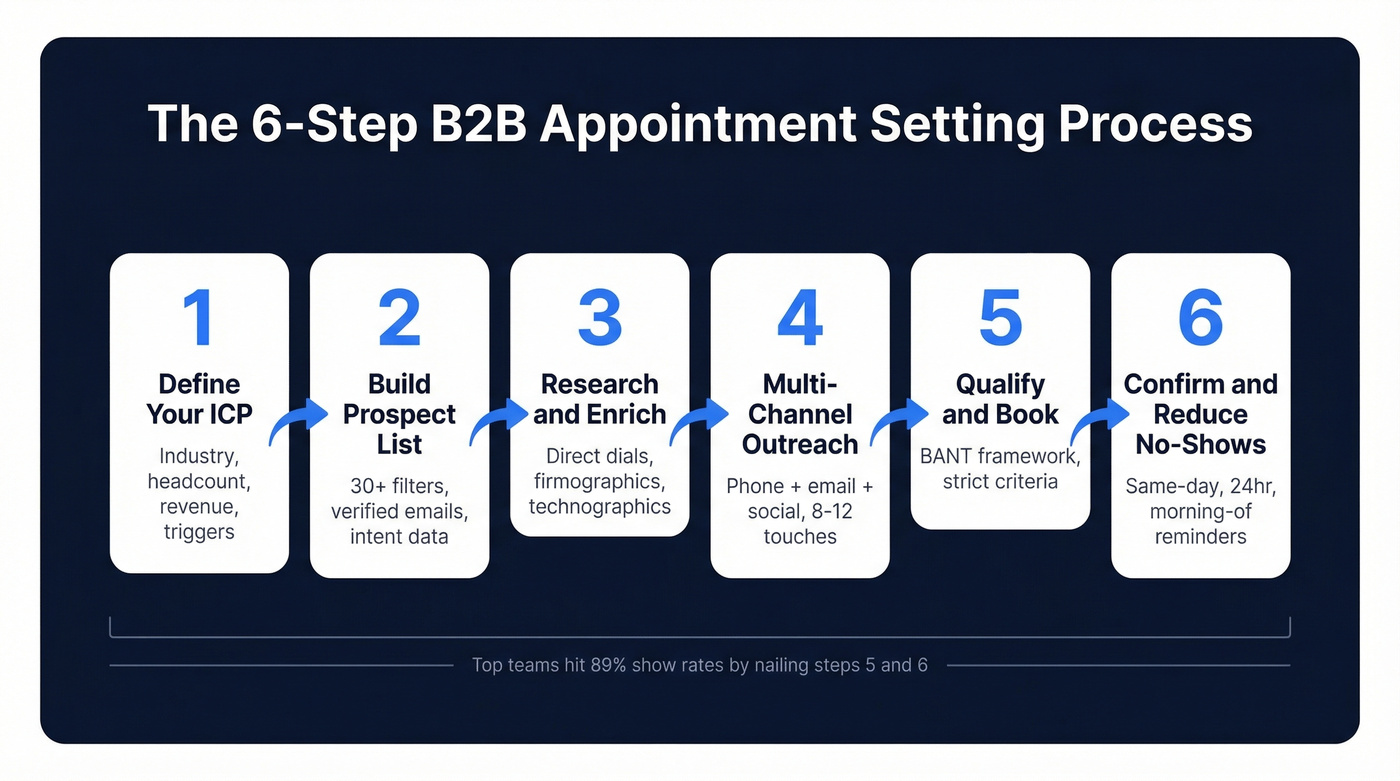
The 6-Step Process
Step 1: Define Your ICP
Everything downstream depends on this. A vague ICP - "mid-market SaaS companies" - produces vague results. Get specific: industry, headcount range, revenue band, tech stack, buying triggers like funding rounds, leadership changes, or job postings for roles your product supports. Write it down. Share it with everyone who touches outbound.
If you need a starting point, use an ICP template and scoring rubric.
Here's what a real ICP looks like: "B2B SaaS companies, 50-200 employees, $5M-$50M revenue, using HubSpot, that posted a VP Sales role in the last 90 days." That's actionable. "We sell to mid-market companies" is a wish. Any effective appointment setting strategy starts here - without a sharp ICP, every step that follows produces diluted results.
Step 2: Build Your Prospect List
Your ICP definition is useless without a list of real people who match it. This is where most teams cut corners and pay for it later - SDRs end up chasing dead leads instead of booking meetings.
Prospeo's B2B database lets you build lists using 30+ filters, including buyer intent and technographic signals, with 98% email accuracy and a 7-day data refresh cycle. Snyk cut bounce rates from 35-40% to under 5% across 50 AEs after switching, and Meritt tripled their pipeline from $100K to $300K/week. When your list is clean, everything downstream works better.

Step 3: Research and Enrich Contacts
Even a good list needs enrichment. Append direct dials, verify emails, pull in technographic and firmographic data. The goal is to give your SDRs enough context to personalize outreach without spending 20 minutes researching each prospect. Batch enrichment via API or CSV upload handles this at scale - look for tools that return 50+ data points per contact so reps can reference specific triggers in their messaging.
If you're comparing vendors, start with these data enrichment options.
Step 4: Multi-Channel Outreach
Phone, email, and social - together. Companies using 3+ channels see up to 287% higher engagement than single-channel approaches. We've tested cadences from 6 to 20 touches, and 8-12 spread across 14-21 days consistently wins. Start with a phone call or personalized email, then layer in follow-ups across channels. Most conversions happen after 5+ follow-ups, so quitting after two or three attempts leaves money on the table.
If you want more ways to structure outreach, use these sales prospecting techniques as a baseline.
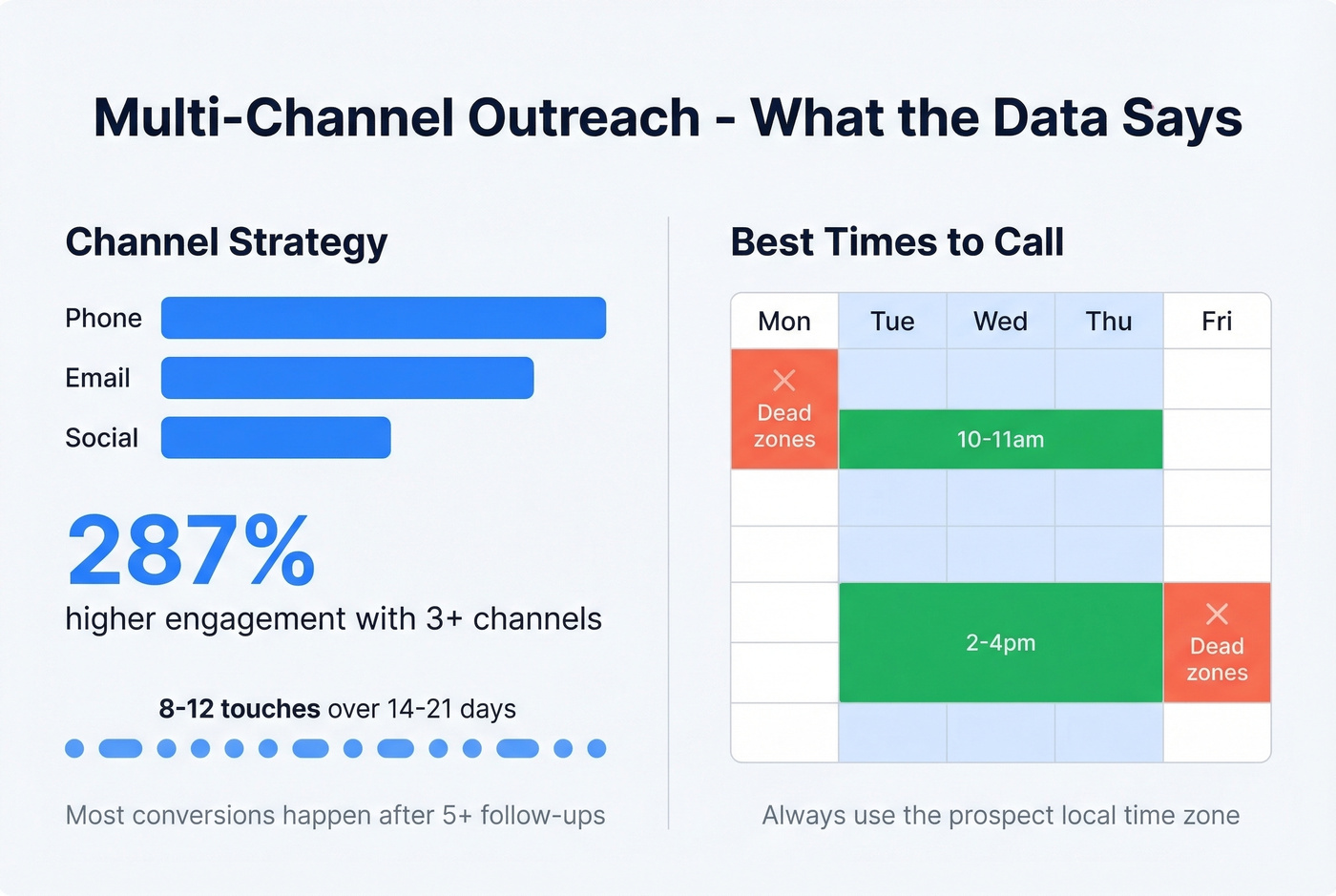
Timing matters more than most teams realize. Tuesday through Thursday between 10-11am and 2-4pm in the prospect's local time zone consistently outperforms other windows. Monday mornings and Friday afternoons are dead zones - save your best prospects for mid-week.
Step 5: Qualify and Book
Not every conversation deserves a meeting. Use a BANT framework - Budget, Authority, Need, Timeline - and define your qualification criteria before outreach starts. An SDR who books 15 unqualified meetings is less valuable than one who books 6 meetings with real decision-makers.
Here's the thing: if your SDRs can't articulate what makes a meeting "qualified" in one sentence, your pipeline will fill with tire-kickers.
If you need a stronger qualification system than BANT, consider MEDDIC.
Step 6: Confirm and Reduce No-Shows
A booked meeting isn't a held meeting. Send a confirmation email immediately, a reminder 24 hours before, and a brief "looking forward to it" note the morning of. Reinforce the value of the meeting in every touchpoint. Top programs hit 89% show rates - if yours is below 60%, your confirmation process needs work, not your outreach volume.
Cold Call and Email Scripts That Work
Cold calling averages a 2.3% success rate. Top teams push that to 5-8%. The difference isn't talent - it's structure. Here are five scenarios with scripts you can adapt today.
If you're building a repeatable calling motion, start with a cold calling system.
The Pattern-Interrupt Opener
This framework breaks the prospect out of autopilot. Instead of "Hi, this is Jake from Acme," you lead with something unexpected. Pattern-interrupt openers show a 6.6x higher success rate compared to standard intros.
"Hey [Name], we haven't met - I know that's usually a bad sign on a Tuesday afternoon. Quick reason for the call: we help [role/industry] teams solve [specific problem], and I wanted to see if that's even on your radar. Is this a terrible time?"
The self-aware humor disarms. The specificity earns 10 more seconds.
The Follow-Up After a Prior Conversation
"[Name], we spoke [timeframe] ago about [specific topic]. You mentioned [their pain point]. I've got a quick idea on how to tackle that - worth 15 minutes this week?"
Reference something specific from the last conversation. Generic "just following up" emails get deleted.
If you want plug-and-play options, use these sales follow-up templates.
The Gatekeeper Bypass
"Hi, I'm trying to reach [Name] - we're working with a few companies in [their industry] on [specific outcome]. Could you point me in the right direction?"
Don't try to sell the gatekeeper. Be polite, be brief, ask for a transfer. Treating them as an ally works better than trying to sneak past them.
The "I Don't Have Time" Handler
"Totally get it - you're busy. Here's what I can do in three minutes: I'll share one thing we're seeing work for [similar companies], and if it's not relevant, I'll never call again. Fair?"
The time-box ask works because it's low-commitment and gives the prospect an easy out. Three minutes is a small bet.
The Referral-Based Opener
"[Name], [Referral Name] suggested I reach out. They mentioned you're dealing with [problem]. We helped their team [specific result] - would it make sense to compare notes?"
Referral openers convert at multiples of cold outreach. Even a loose mutual connection changes the dynamic entirely.
How Much Does It Cost?
Pricing Models Compared
| Model | Typical Range | Risk Profile |
|---|---|---|
| Hourly | $16-$49/hr | Buyer holds all risk |
| Retainer | $2K-$15K/mo | Shared risk |
| Per appointment | $50-$1,500+ | Vendor holds output risk |
| Per qualified lead | $50-$500 | Depends on "qualified" definition |
| Project-based | $1,500-$15K/project | Fixed scope, fixed cost |
| Hybrid | $2K-$4K base + $150-$400/mtg | Best alignment |
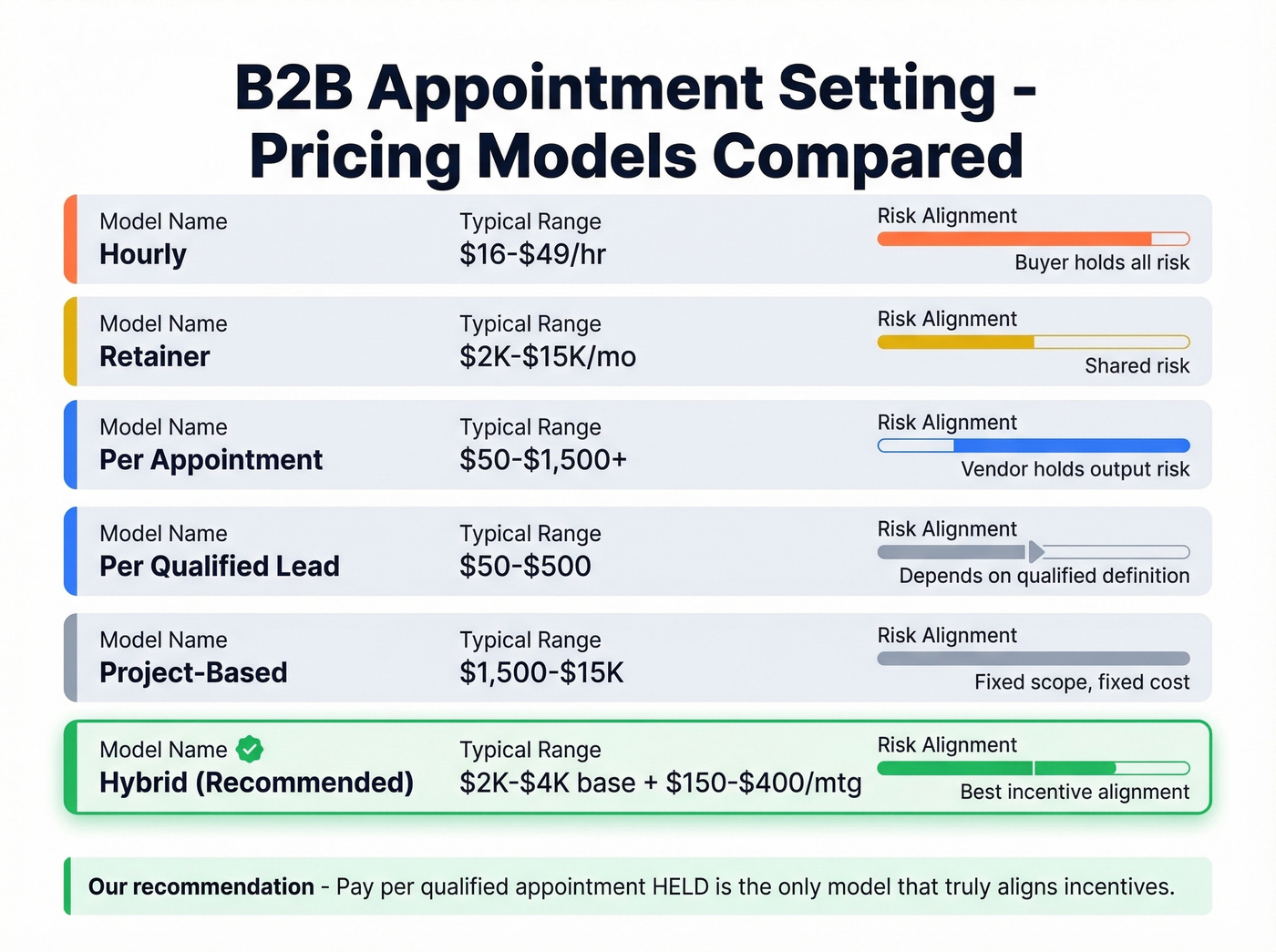
Seniority matters enormously. Booking a meeting with an SMB ops manager runs $50-$300. Enterprise VPs cost $300-$600. C-suite executives? $600-$1,500+. The pricing bands reflect the difficulty of reaching and qualifying each tier.
Our strong opinion: pay-per-qualified-appointment-held is the only model that truly aligns incentives. Hourly billing rewards time spent, not results. Pay-per-appointment without a "held" qualifier incentivizes calendar stuffing - and the skepticism on r/agency about agencies is largely driven by exactly this problem. One commenter called "qualified appointment setting agency" an oxymoron. If your agency won't agree to "qualified and held" as the billing trigger, that tells you something.
In-House vs. Outsourced - The Real Math
| Factor | In-House (4 SDRs + Mgr) | Outsourced |
|---|---|---|
| Setup cost | ~$178,770 | ~$41,000 |
| Monthly cost | $20K-$30K | $6K-$15K |
| Time to first meeting | 3-6 months | 2-4 weeks |
| Cost per lead | $250-$800+ | $150-$600 |
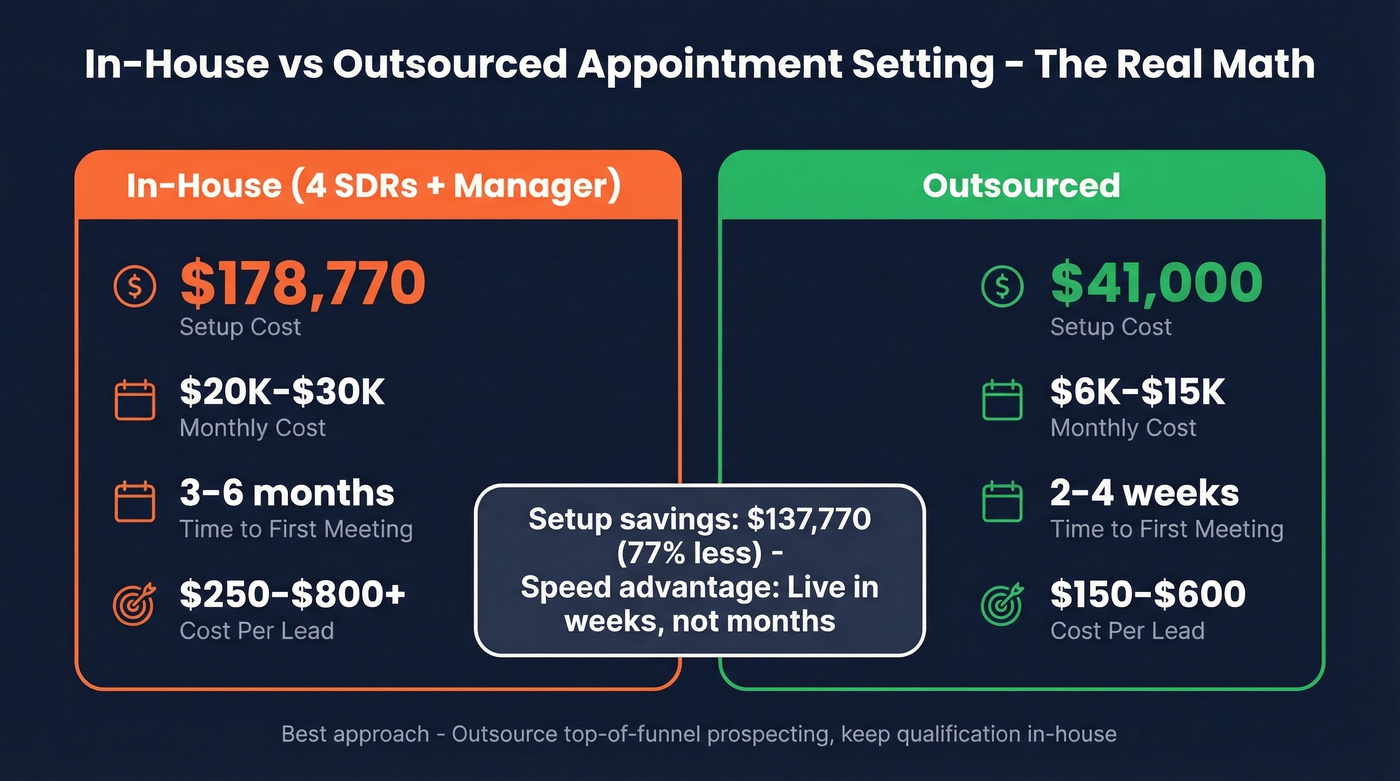
The in-house numbers add up fast. A single SDR's fully-loaded cost runs $80K-$125K/year once you factor in base salary, commission, benefits, and overhead. Onboarding costs roughly $31,000 per rep. Ramp takes 3-6 months. And with SDR turnover rates being what they are, replacement costs hit roughly 1.5x annual salary.
Outsourcing gets you to market faster and cheaper, but you sacrifice control over messaging and qualification nuance. In our experience, the best results come from a hybrid approach: outsource top-of-funnel prospecting and initial outreach, keep qualification and handoff internal. One case study showed 55 qualified appointments in 8 weeks with an 89% show rate, producing $576K in active proposals.
What to Demand From an Agency
Before you sign anything, get these in writing. Reddit threads about outsourced appointment setting are full of buyers who learned these lessons the hard way:
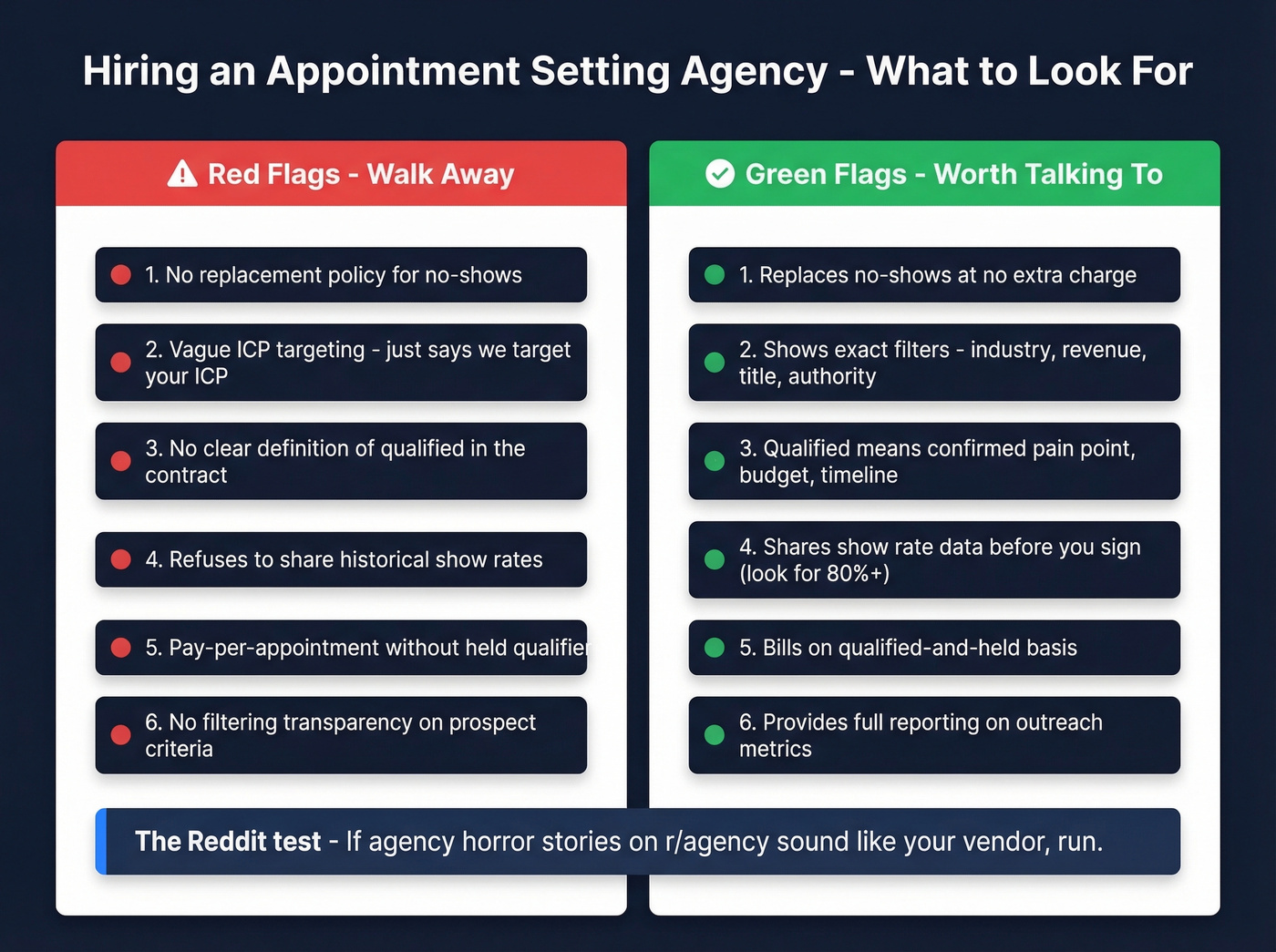
- Replacement policy for no-shows. If a booked meeting doesn't show, does the agency replace it at no charge? If not, walk away.
- Filtering transparency. You need to see exactly how they're filtering prospects - by industry, revenue range, title, and decision-making authority. "We target your ICP" without showing the filters is a red flag.
- Clear "qualified" definition in the contract. Spell out what counts: minimum title level, company size, confirmed pain point, and timeline. Vague definitions let agencies pad numbers with garbage meetings.
- Show rate reporting. If an agency won't share their historical show rate before you sign, assume it's bad.

Your SDRs spend 200+ hours a month just to book 22 real conversations. Prospeo's 30+ ICP filters, 98% email accuracy, and 7-day data refresh mean every prospect on your list is reachable and current - so appointment setters book meetings, not chase bounces.
Meritt tripled pipeline to $300K/week. Your appointment setting deserves the same data.
The Tech Stack You Need
Your data provider is the cheapest line item in your budget but has the biggest impact on ROI. Everything else - sequencing, CRM, scheduling - only works if the contacts you're reaching are real, current, and relevant.
Data and Enrichment: Prospeo sits at the foundation here. Verified emails at ~$0.01 each, 125M+ verified mobiles, intent data across 15,000 topics, and native integrations with Salesforce, HubSpot, Instantly, Smartlead, and Lemlist. The free tier gives you 75 emails and 100 Chrome extension credits per month to test before committing.
If you're evaluating your stack end-to-end, start with a shortlist of SDR tools.

Sequencing: Salesloft or Outreach for enterprise teams running complex multi-step cadences, at roughly $100-$150/user/month. Instantly or Smartlead for SMB teams that need volume at lower cost, around $30-$97/month.
CRM: Salesforce if you're mid-market or enterprise. HubSpot if you want a free starting point that scales well.
If you’re still deciding what “CRM” should look like for your org, see these examples of a CRM.
Scheduling: Calendly (free-$16/user/month) or HubSpot Meetings. Reduce friction by letting prospects pick their own slot.
Call Recording and Coaching: Gong is the standard, at roughly $100-$150/user/month. The ability to review calls, identify what's working in your scripts, and coach reps on real conversations is worth every dollar. Skip this if your team is under 3 reps - just record calls natively in your dialer and review them weekly.
AI's Impact on Meeting-Setting in 2026
AI SDRs won't replace humans this year, but they'll make a team of 2 perform like a team of 5.
| Cost Factor | Human SDR | AI SDR |
|---|---|---|
| Annual cost | ~$98K | ~$28K |
| Cost difference | - | 71% lower |
| Platform cost | N/A | $500-$2K/mo |
| ROI timeline | 3-6 months | 3-6 months (clean data) |
The numbers are compelling: a 71% cost reduction per SDR-equivalent. And 75% of sales teams already use AI for lead scoring and sequencing, with AI-assisted outreach showing 32% higher meeting acceptance rates.
But let's be realistic about what "AI SDR" means in practice. You're looking at 40-60 hours of data cleaning, enrichment, and segmentation before you can even launch. The ROI timeline stretches to 6-9 months if you're building processes from scratch. And AI outreach without human oversight produces robotic, off-brand messaging that prospects can smell from a mile away.
The winning formula right now: use AI for initial research, lead scoring, email personalization at scale, and follow-up sequencing. Keep humans on the phones for discovery, objection handling, and anything that requires reading the room. The "clean data" requirement reinforces why your upstream data quality matters so much - garbage in, garbage out, whether the sender is human or artificial.
If you want a deeper playbook on this, use AI cold email outreach to pressure-test your approach.
If your average deal size is below $15K, you probably don't need a full AI SDR platform. A solid sequencing tool with basic AI personalization and a clean contact database will get you 80% of the way there at a fraction of the cost.
Seven Mistakes That Kill Results
Vague ICP definition. "We sell to mid-market companies" isn't an ICP. Define industry, headcount, revenue, tech stack, and buying triggers before you write a single email.
Generic messaging. Personalized outreach delivers 6x higher transaction rates. "I noticed your company is growing" isn't personalization. Referencing a specific job posting, tech stack change, or funding round is.
Giving up after 2-3 touches. Most conversions happen after 5+ follow-ups. If your cadence stops at touch 3, you're quitting right before the payoff.
Starting outreach with unverified data. If 30% of your emails bounce, your domain reputation tanks and every subsequent campaign performs worse. This is the most expensive mistake on the list because it compounds. Bad data can swing your effective cost per meeting by 20-40%.
If deliverability is a recurring issue, fix it at the source with an email deliverability guide.
No qualification criteria defined upfront. If your SDRs can't explain what makes a meeting "qualified" in one sentence, your pipeline will be full of tire-kickers. Write the BANT criteria down and make every rep recite them.
Not tracking show rates. The fact that most agencies won't share their no-show rate before you sign tells you everything. If you aren't measuring held meetings, you're measuring vanity metrics.
No feedback loop between closers and setters. When AEs don't tell SDRs which meetings were good and why, the SDR team can't improve targeting. In our experience, this loop is the most underrated lever in the entire process. It's free to build and almost nobody does it.
B2B vs. B2C: Key Differences
Not all appointment setting is created equal. The gap between B2B and B2C comes down to three things: sales cycle length, decision-maker complexity, and deal value.
B2C appointments typically involve a single buyer making a quick, emotionally-driven decision - think home services or financial advising. B2B involves multiple stakeholders, longer evaluation periods, and higher contract values that justify the cost of dedicated SDR teams. The multi-channel, research-heavy process outlined in this guide is built specifically for B2B complexity; a B2C appointment setter would use a fundamentally different playbook.
KPIs to Track
Stop obsessing over meeting volume. Measure cost per qualified opportunity.
| KPI | Benchmark |
|---|---|
| Connect rate | 5-15% (phone) |
| Meeting set rate | 2-5% of contacts |
| Show rate | 70-90% |
| Meeting-to-opportunity | 30-50% |
| Cost per qualified meeting | $150-$500 |
| SDR output (avg) | 8-10 meetings/mo |
| SDR output (top) | 12-18 meetings/mo |
The show rate is your canary in the coal mine. If it drops below 70%, your qualification or confirmation process is broken - not your outreach. Top performers hit 89%+. For concrete ROI framing: one outsourced program produced 55 appointments that generated $576K in active proposals over 8 weeks. That's the kind of pipeline math that justifies the investment in B2B appointment setting infrastructure.
If you want to benchmark the rest of your funnel, track funnel metrics alongside show rate.
FAQ
What's a good cost per B2B appointment?
$150-$500 covers most targets. SMB meetings run $50-$300, enterprise $300-$600, and C-suite $600-$1,500+. Pay-per-qualified-appointment-held models offer the best value alignment because you only pay for meetings that actually happen with qualified prospects.
How many meetings should an SDR book per month?
Average SDRs book 8-10 qualified meetings monthly. Top performers hit 12-18. Quality matters more than volume - 5 meetings with decision-makers beat 15 with unqualified contacts every time.
Should I outsource or build in-house?
Outsource if you need results in weeks, not months. In-house gives more control but costs ~$178K to set up and takes 3-6 months to ramp. The best approach for most teams is hybrid: outsource top-of-funnel prospecting, keep qualification internal.
What's a good show rate?
70-90% is the benchmark with proper qualification and confirmation sequences. Top programs achieve 89%+. If yours is below 60%, fix your qualification criteria and reminder cadence - not your outreach volume.
How do I get clean data without burning my domain?
Use a verified data provider with real-time email validation. Prospeo's 5-step verification process and 7-day data refresh cycle keep bounce rates under 5%, compared to 30-40% on stale purchased lists. Clean data protects sender reputation and cuts effective cost per meeting by 20-40%.
Multi-channel cadences only work when you have verified emails AND direct dials. Prospeo gives you both - 143M+ verified emails and 125M+ mobile numbers with a 30% pickup rate - so your SDRs actually connect with decision-makers instead of voicemails.
Snyk's 50 AEs dropped bounce rates to under 5% and added 200+ opportunities per month.