

B2B Customer Engagement Is a Systems Problem, Not a Content Problem
You're publishing two blog posts a week, running a monthly webinar, and posting on social every day. The result? A handful of likes, a half-empty webinar room, and a pipeline that hasn't moved. A startup marketer on r/marketing recently described getting a "tiny amount of engagement" on B2B content - even competitors max out at one or two LinkedIn likes and empty webinar seats. The problem isn't your content volume. It's that you're treating B2B customer engagement as a publishing challenge when it's actually a systems challenge.
The north star: more conversations, not more content.
Quick version: Build an engagement score before you publish another piece of content. Prioritize SEO, email, and webinars. Fix your contact data first - every engagement play fails when half your emails bounce (see Email Bounce Rate benchmarks and fixes).
What B2B Customer Engagement Actually Means
It's the sum of deliberate, two-way interactions between your company and the people who buy from you - before, during, and after the customer lifecycle. Not impressions. Not page views. It's the depth and frequency of meaningful contact with a buying committee.
Don't confuse this with B2C. In B2C, you're nudging one person toward a $50 purchase. In B2B, you're navigating an 11.3+ month buying cycle with 11 stakeholders who consume 13 pieces of content before signing anything. The complexity isn't a bug - it's the defining feature, and it's why effective client engagement strategies must account for every role in the buying committee, not just the economic buyer (see MEDDPICC Economic Buyer).
Why Most Engagement Efforts Fail
Targeting the wrong people. Weak ICP definition means your content reaches people who'll never buy. If you haven't narrowed to specific titles, company sizes, and pain points, you're broadcasting into a void. Use an Ideal Customer Profile template to tighten targeting.
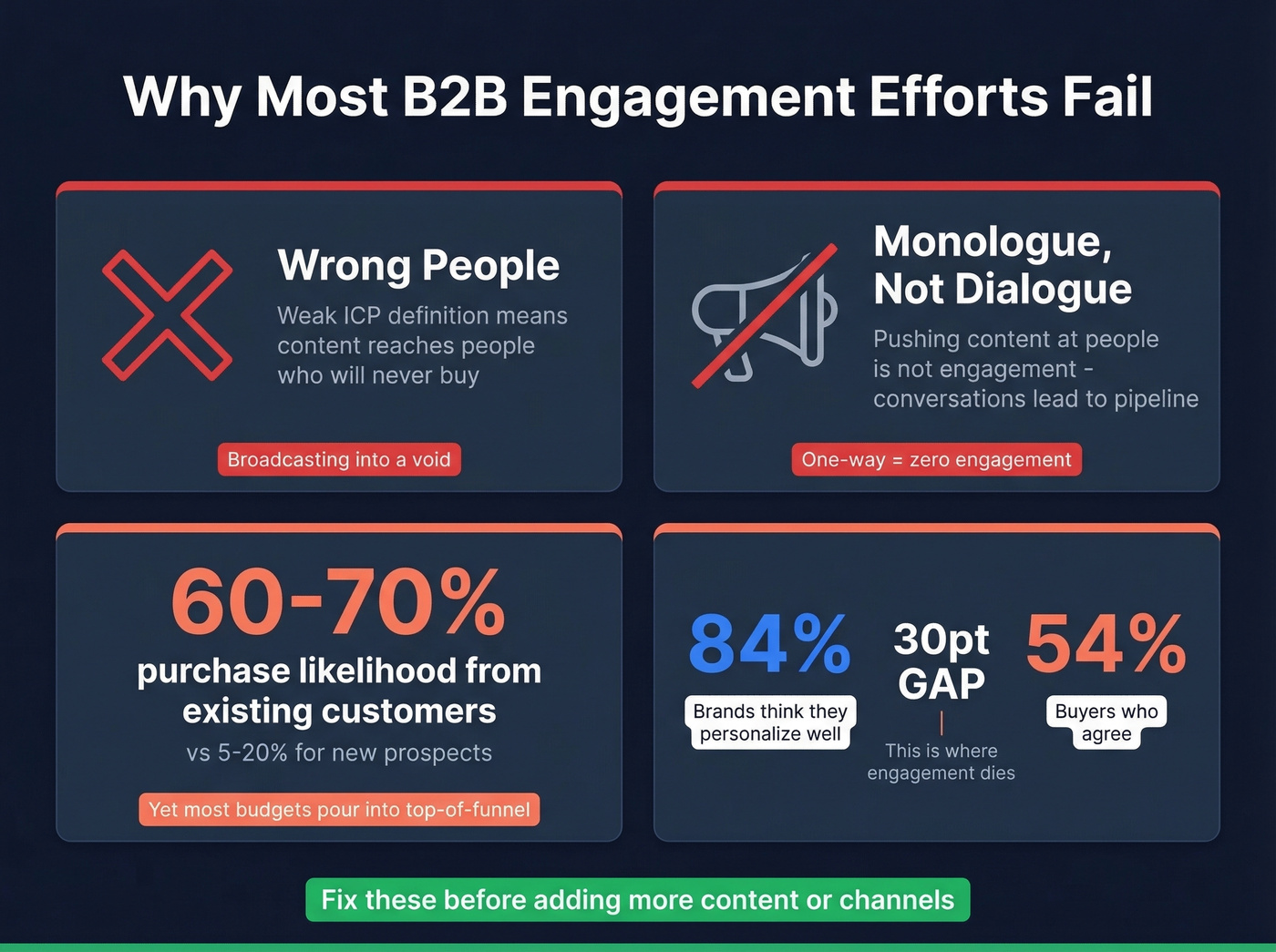
Broadcasting instead of conversing. Pushing blog posts and newsletters at people isn't engagement - it's a monologue. The r/b2bmarketing consensus is clear: conversations with real people lead to better understanding, which leads to better marketing.
Ignoring existing customers. Existing customers have a 60-70% purchase likelihood versus 5-20% for new prospects. Yet most engagement budgets pour into top-of-funnel while post-sale accounts get a quarterly check-in email. Shifting spend toward expansion campaigns, advocacy programs, and usage-based nurture is one of the highest-leverage moves a team can make (see Renewal rate).
The personalization gap. 84% of businesses believe they deliver good personalization. Only 54% of buyers agree. That 30-point gap is where engagement dies.
The Engagement Operating System
Engagement isn't a campaign. It's an operating system with five stages that loop continuously: Signals, Segments, Plays, Cadence, Measurement.
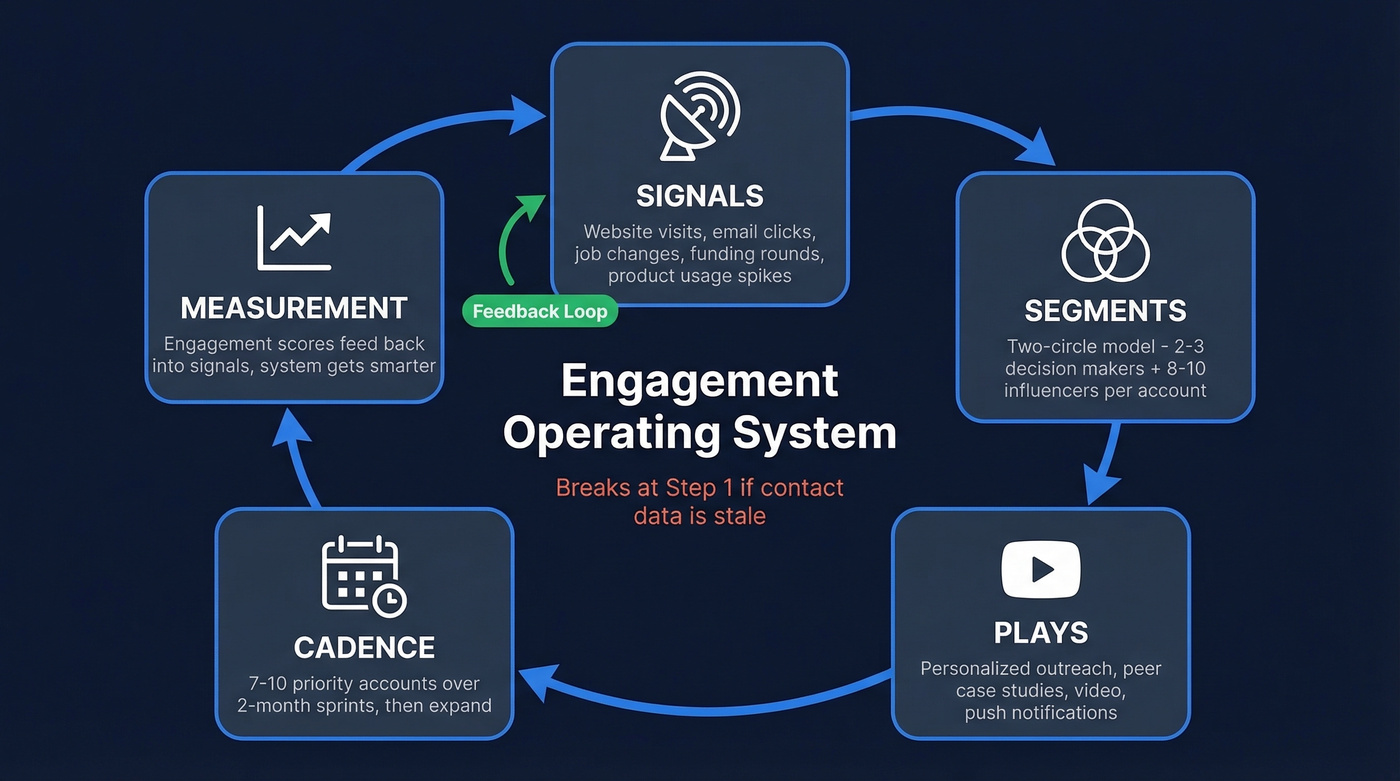
Signals are the raw inputs - website visits, email clicks, webinar registrations, product usage spikes, job changes, funding rounds. Predictive scoring tools identify high-intent accounts with up to 73% higher accuracy than manual methods. But even the best AI model is useless if the underlying contact data is wrong (see Lead scoring).
Segments turn signals into action groups. For each target account, we use the two-circles model: a wider circle of 8-10 people (influencers, users, champions) and a core circle of 2-3 key decision makers. Tailor plays by role. C-suite gets thought leadership and peer benchmarks; end users get product demos and self-serve content. 81% of customers prefer self-service tools before contacting a live agent, so designing motions around how buyers actually want to engage consistently outperforms one-size-fits-all sequences.
Plays are the specific engagement motions - personalized outreach, peer case studies, non-sales interactions. Brands combining video with industry voices are 2.2x more likely to be trusted, so make peer-led video a core play, not an afterthought. One practitioner reported higher returning visitor rates and better engagement when updates are sent automatically via push notifications - a low-effort play that keeps accounts warm between direct touches (see Personalized outreach).
Cadence means small-batch execution. Focus on 7-10 priority accounts over two-month periods, then expand once you've proven what actually moves accounts from warm to hot (see Sequence management).
Measurement closes the loop by feeding engagement data back into your signal layer so the system gets smarter over time (see Funnel metrics).
Here's the thing: the system breaks at step one if your contact data is stale. Prospeo's 7-day refresh cycle and 98% email accuracy ensure plays actually reach the buying committee - not outdated addresses that bounce.
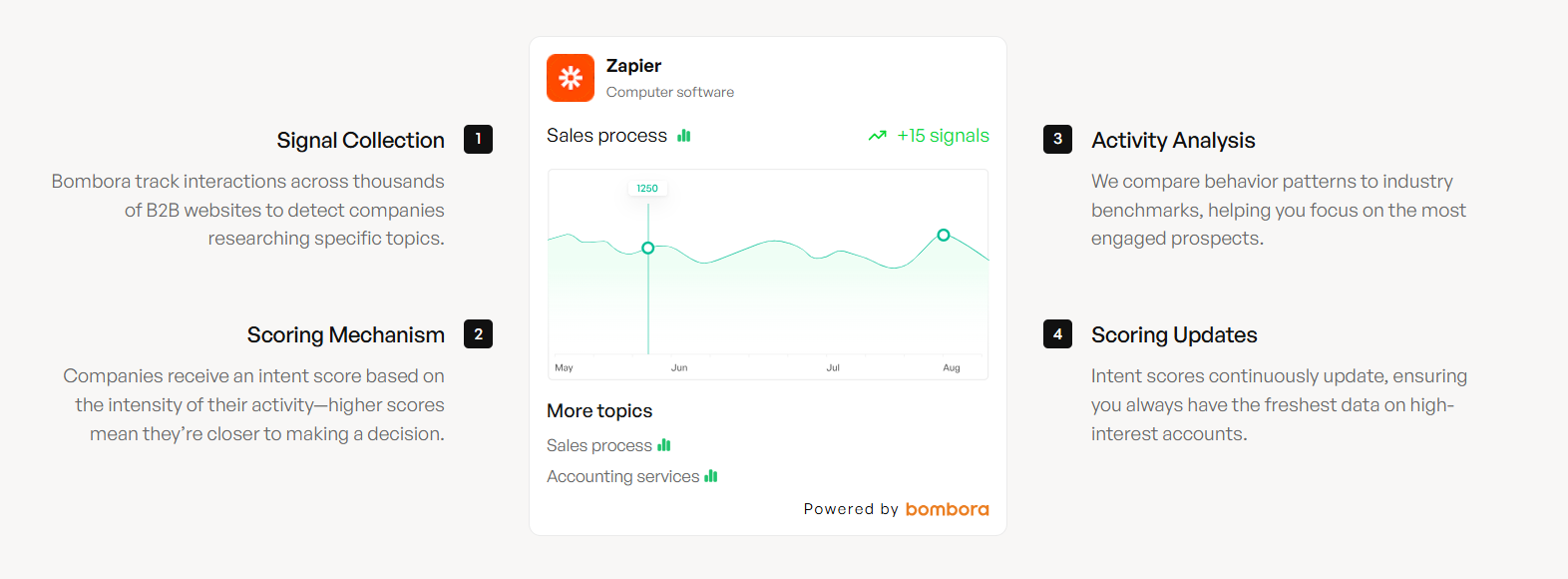

Every engagement play in your operating system depends on reaching real people at real addresses. Prospeo's 7-day data refresh and 98% email accuracy mean your signals, segments, and plays actually connect with the 11 stakeholders in the buying committee - not dead inboxes that kill your sender reputation.
Stop building engagement systems on top of broken contact data.
Channel Prioritization for 2026
Not all channels deserve equal investment. Here's how the 2026 benchmarks stack up:
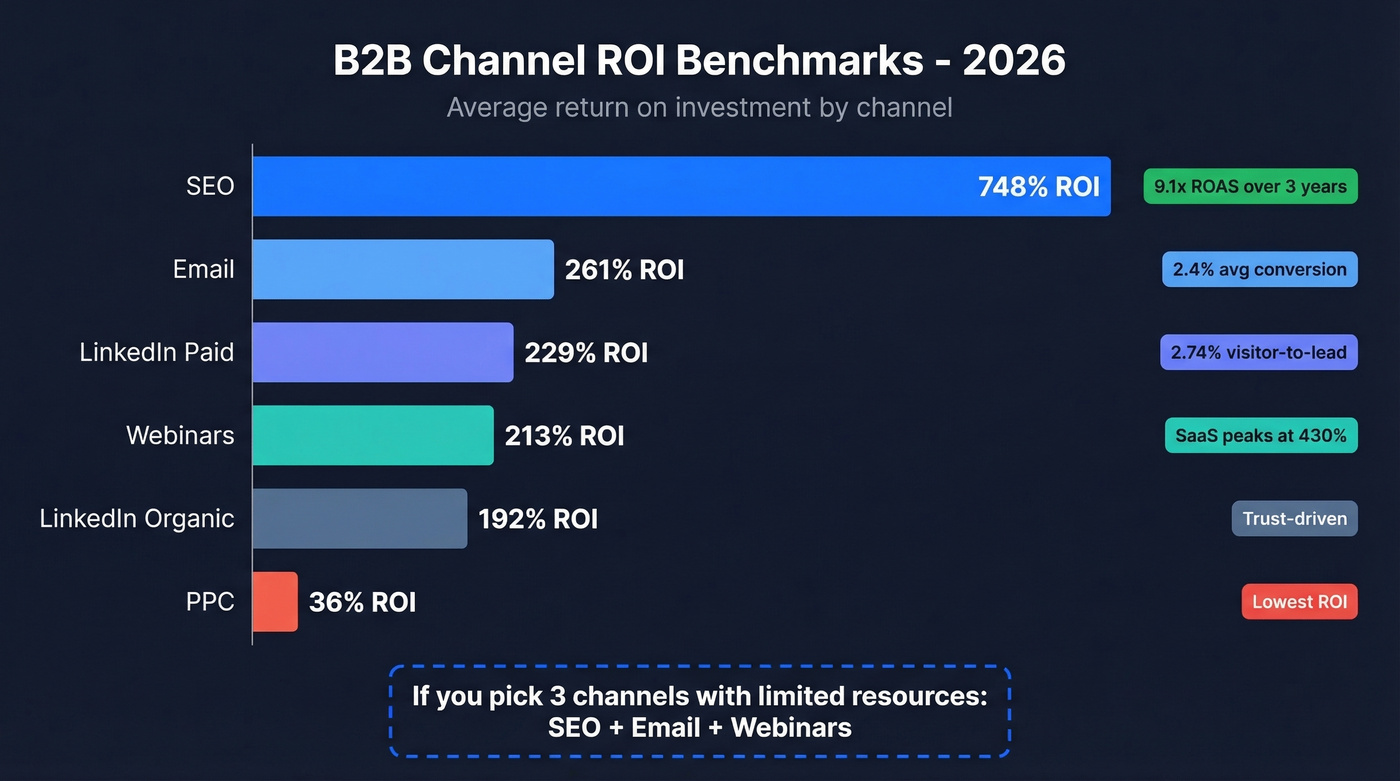
| Channel | ROI | Break-Even | Notable |
|---|---|---|---|
| SEO | 748% | ~9 months | 9.1 ROAS over 3 years |
| 261% | ~7 months | 3.5 ROAS, 2.4% avg conversion | |
| Webinars | 213% | Event-dependent | SaaS peaks at 430% |
| LinkedIn (paid) | 229% | ~3-6 months | 2.74% visitor-to-lead |
| LinkedIn (organic) | 192% | Ongoing | Trust-driven channel |
| PPC | 36% | ~4 months | Lowest ROI of the set |
If we had to pick three channels for a team with limited resources, it's SEO, email, and webinars - every time. SEO compounds, email converts, and webinars build the trust that 94% of B2B marketers say is the key to success. PPC has its place for demand capture, but the ROI gap is enormous.
Skip multi-channel orchestration platforms if your average deal size is under $15K. A tight SEO-email-webinar loop with clean data will outperform a bloated stack nine times out of ten.
Measuring Without Vanity Metrics
Engagement scores should drive action, not dashboards. Pick 5-7 signals - email clicks, webinar attendance, product logins, site visits, replies - and weight each by intent strength. Set three thresholds: hot (route to sales), warm (nurture), cold (re-engage). Review weekly.
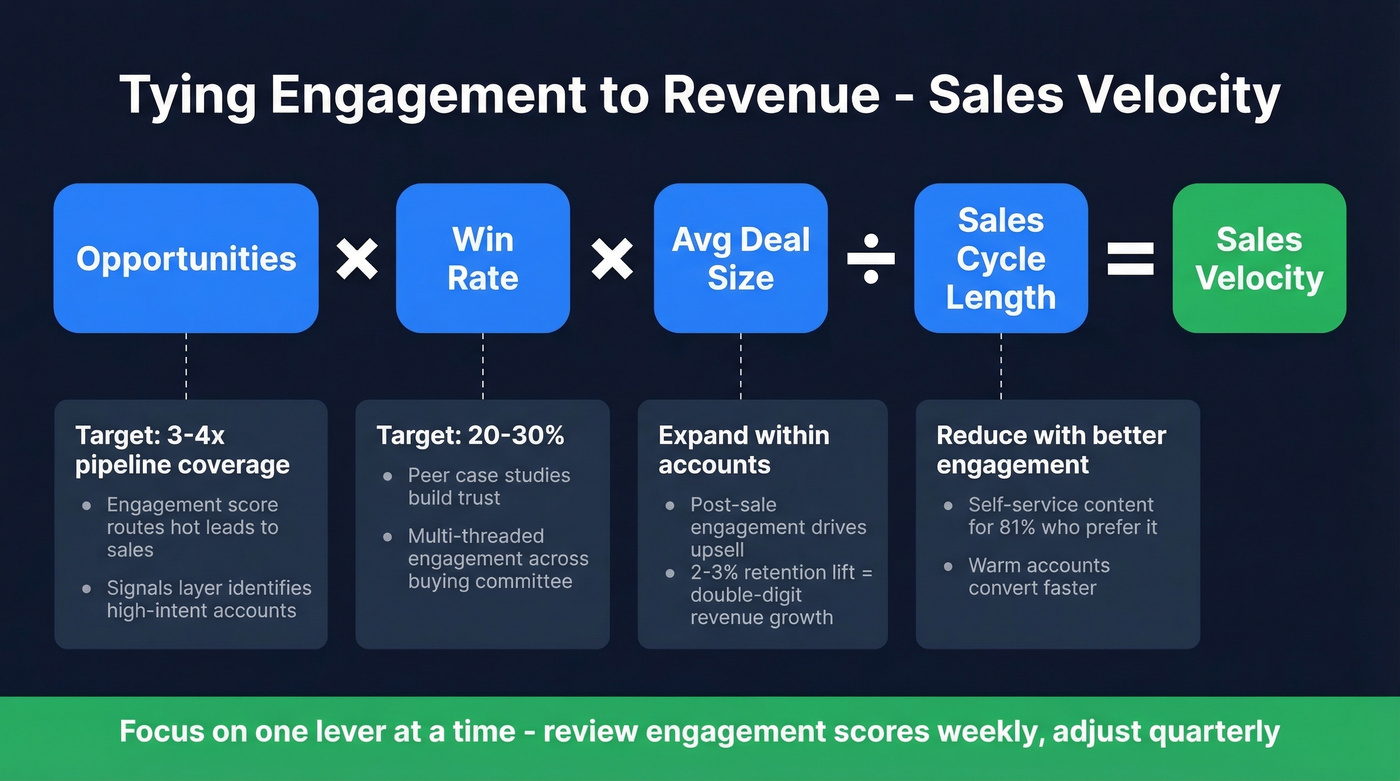
The formula that ties engagement to revenue is sales velocity:
(Opportunities x Win Rate x Avg Deal Size) / Sales Cycle Length
In our experience, the teams that move the needle focus on one lever at a time. Target pipeline coverage of 3-4x quota and win rates of 20-30%. Even a 2-3% retention lift drives double-digit revenue growth over time, which is why post-sale engagement deserves as much rigor as your acquisition motions.
The Minimum Viable Stack
92% of businesses say CRM software is integral to achieving revenue goals, and 91% of companies with 10+ employees already run one. The question isn't whether you need a CRM - it's what you layer on top (see Examples of a CRM).
| Category | Examples | Starting Price |
|---|---|---|
| CRM | Salesforce, HubSpot | Free-$25+/user/mo |
| Marketing automation | HubSpot ($800/mo Pro), ActiveCampaign ($49/mo), Pardot ($1,250/mo), Brevo (free-$18/mo) | Free-$1,250/mo |
| CS platform | Gainsight, Vitally, Pylon | ~$200-$500/mo |
| Enterprise orchestration | Salesforce MC, Adobe Journey Optimizer | $30K+/yr |
| Contact data & enrichment | Prospeo | Free (75 emails + 100 extension credits/mo) |
Don't buy an enterprise orchestration platform until you've proven the engagement model works with simpler tools. CS platforms typically take 2-8 weeks to implement and show ROI within 3-6 months. Start lean, add layers as you scale.
What Good Engagement Produces
Deloitte's "Do" campaign is the enterprise benchmark: nearly 10 million impressions, 30,000 unique external users, a 40% lower bounce rate, and a 67% lift in brand perception - reaching 1.7 million C-suite executives through the Financial Times alone.
On the SMB side, a B2B SaaS company saw a 272% increase in inbound demos and a 142% lift in organic traffic by aligning content, SEO, and outbound into a single engagement motion. The pattern is consistent across both examples: systems beat campaigns. That's the core lesson of B2B customer engagement in 2026 - orchestrate the machine, then feed it clean data.
You mapped the buying committee. You built the engagement score. Now you need direct dials and verified emails for every circle - the 2-3 decision makers and the 8-10 influencers. Prospeo gives you 300M+ profiles with 30+ filters to segment by intent, job change, and headcount growth at $0.01 per email.
Reach the full buying committee, not just the one contact you already have.
FAQ
What's the difference between engagement and customer experience?
Customer experience is the sum of every interaction a buyer has with your brand. Engagement is the proactive effort to deepen those interactions - triggering replies, attendance, and product usage - so buyers stay active across the entire lifecycle rather than passively consuming content.
How do you build a B2B engagement score?
Pick 5-7 signals like email opens, webinar attendance, product logins, site visits, and replies. Weight each by intent strength and set hot/warm/cold thresholds. Review weekly and adjust weights quarterly based on which signals actually correlate with closed-won deals.
What tools do you need for account-based engagement?
At minimum: a CRM, a marketing automation platform, and a verified contact data source to keep your lists accurate. Add a customer success platform once you're managing 50+ post-sale accounts. Most teams over-buy tooling before proving the engagement model works - don't be one of them.
How do B2B engagement strategies differ from B2C?
B2B buying committees involve 6-11 stakeholders with different priorities, sales cycles averaging 11+ months, and contract values often exceeding $25K. Effective strategies must map engagement plays to each role in the committee - champion, end user, economic buyer - rather than optimizing for a single consumer decision.