

The Numbers-Driven B2B Demand Generation Strategy for 2026
67% of B2B buyers now prefer a rep-free experience. The winning vendor is on the Day One shortlist 95% of the time. If you're not there before the buying process starts, you've already lost.
Your b2b demand generation strategy either accounts for these realities or it bleeds pipeline to competitors who do. Every guide tells you what to do - almost none tell you what it costs, how long it takes, or what conversion rates to expect at each stage. This one does.
Quick version: 95% of buyers are out-of-market at any given time - you're building memory, not capturing clicks. Start with ICP clarity, one content channel, and clean contact data. Budget 7-12% of revenue, split 50/50 between brand and activation, and give it 90 days before judging results.
Demand Gen vs Lead Gen
| Demand Generation | Lead Generation | |
|---|---|---|
| Goal | Build awareness + preference | Capture existing interest |
| Timeframe | 6-18 months to compound | Immediate pipeline |
| Tactics | Ungated content, social, events | Gated PDFs, paid ads, outbound |
| Metric | Pipeline influenced, brand recall | MQLs, CPL, form fills |
| Risk | Slow start, hard to attribute | Burns out, low quality at scale |
Here's the thing: the real question isn't "which one." It's what ratio and when to shift. Early-stage companies with zero brand recognition need lead gen to survive. But if you're still running 90% lead gen after two years, you're on a treadmill - running faster and going nowhere.
The best demand generation strategies B2B teams run both simultaneously, with demand gen gradually eating a larger share of budget as the brand compounds.
The Buyer Math That Changes Everything
Professor John Dawes at the Ehrenberg-Bass Institute quantified something most marketers feel intuitively: up to 95% of B2B buyers are out-of-market at any given time. Companies switch providers around every five years, meaning only about 20% are in-market in a given year and roughly 5% in any quarter. That's the 95/5 rule, and it's the single most important concept in demand gen.
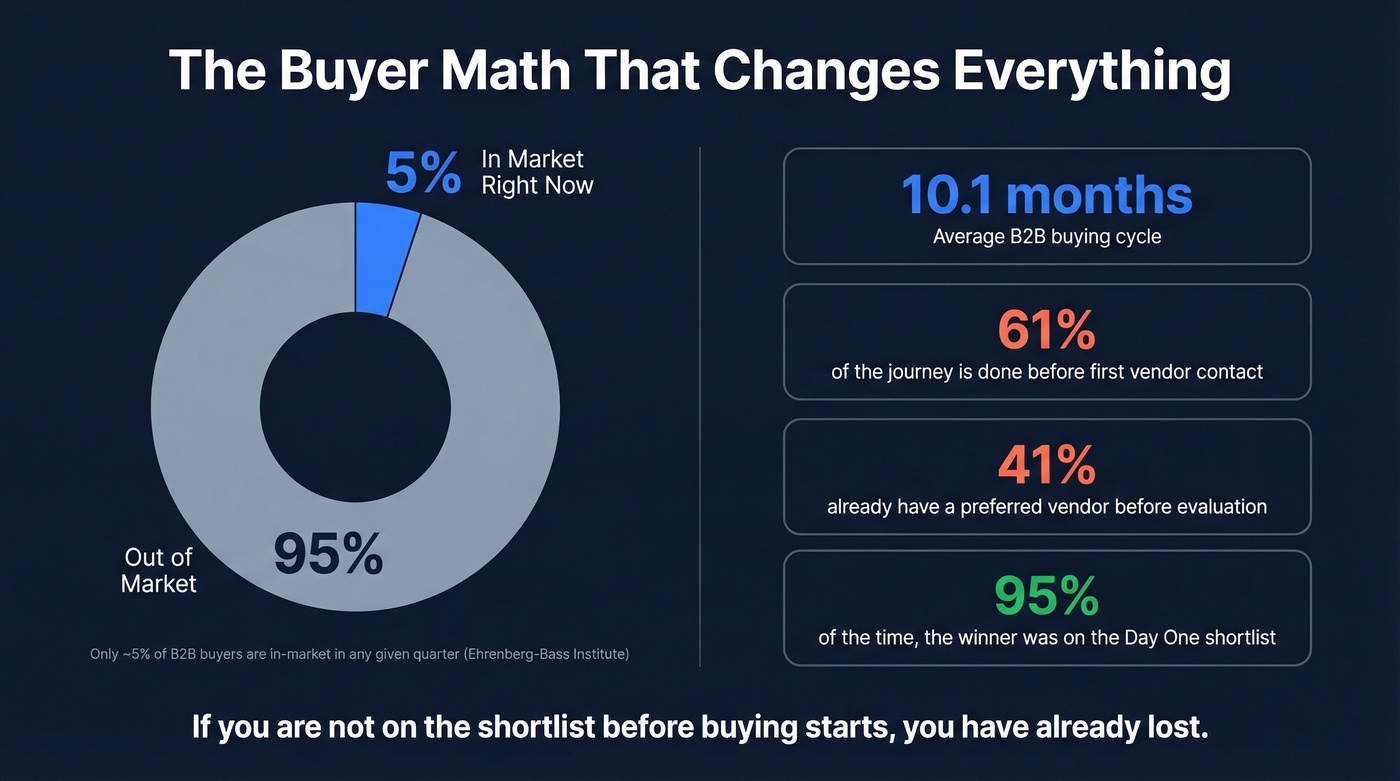
Now layer on the buying journey data. The average B2B buying cycle runs 10.1 months. First contact with a vendor doesn't happen until 61% of the journey is already complete, and 41% of buyers already have a preferred vendor before they even begin formal evaluation. The winning vendor is on the Day One shortlist 95% of the time.
Read that again. If you're not on the shortlist before the buying process starts, you've already lost.
What makes this harder: the average B2B purchase involves 6-10 stakeholders. Your demand gen doesn't just need to reach one champion - it needs to build enough brand presence that multiple people on the buying committee recognize you. Meanwhile, 73% of buyers actively avoid suppliers who send irrelevant outreach. Volume-based outbound fails on every count.
The 7-Part Framework
This is the operational backbone. Each part builds on the previous one - skip a step and the whole system underperforms. Whether you're a growth-stage startup or a CMO inheriting an existing program, the sequence stays the same.
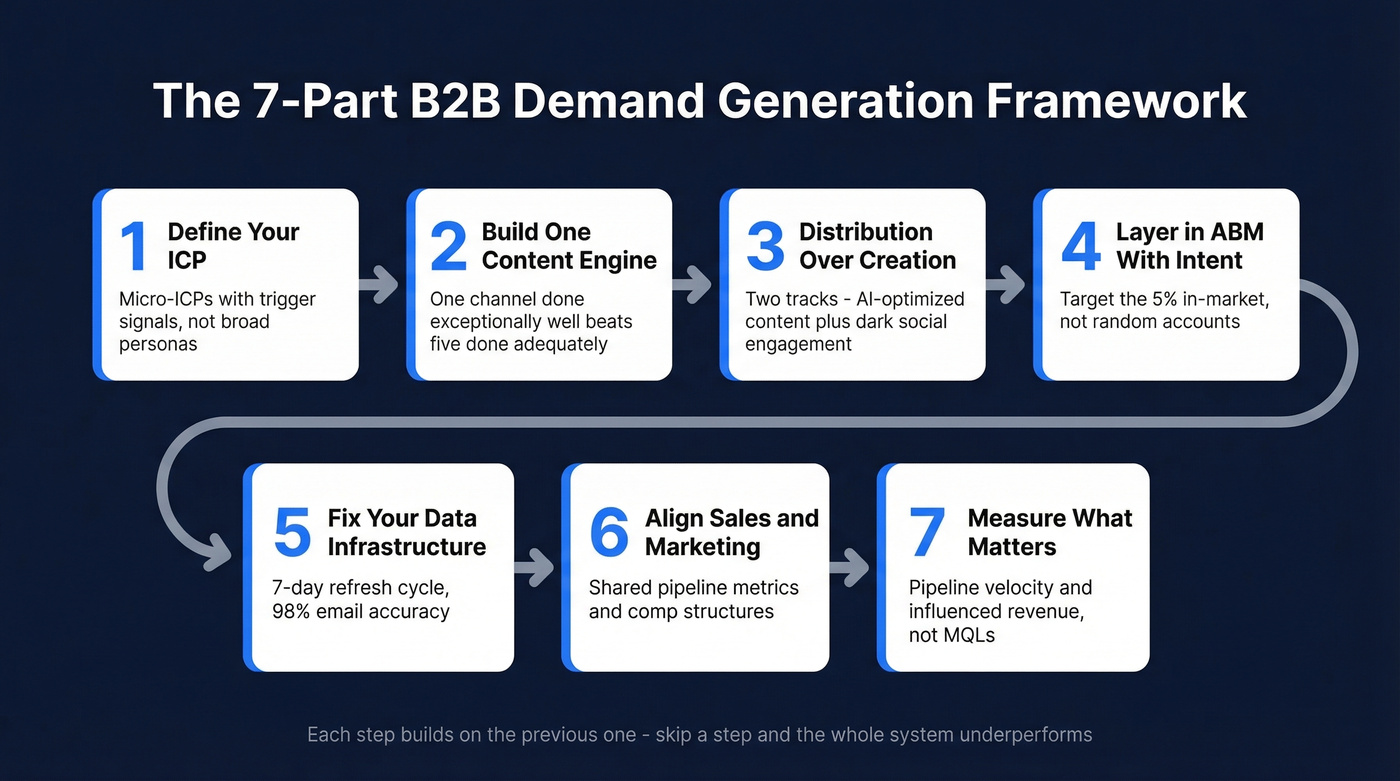
1. Define Your ICP (Tight, Not Broad)
The number one mistake in demand gen isn't bad content or wrong channels. It's targeting the wrong audience.
The lead gen trap looks like this: teams blast 10,000 contacts with unclear ICP definitions and wonder why reply rates sit at 1-2%. We've seen it dozens of times. The fix is micro-ICPs - not "VP of Marketing at mid-market SaaS" but specific tech stacks, growth signals, and org structures that create the pain your product solves. One team we worked with narrowed from a broad ICP to three micro-ICPs with trigger-based messaging and watched reply rates jump from 1-2% to 8-12%. Tighter targeting beats louder megaphones every time.
2. Build One Content Engine
FullFunnel.io generated 72 inbound opportunities and over $1M in pipeline with just 2 FTEs in year one. The key: 91% of their inbound requests mentioned LinkedIn as the channel where prospects first heard about them. Not gated whitepapers. Not webinars. Social posts that built trust over months.
The lesson isn't "do social media." One channel done exceptionally well beats five channels done adequately. Pick the channel where your ICP spends time, commit to a consistent cadence, and give it six months. Customer advocacy compounds here too - your happiest customers sharing their experience is demand gen that money can't buy.
3. Distribution Over Creation
Google AI Overviews are accelerating zero-click discovery in search. That changes how you think about content. You need two tracks.
Track one: structured, data-backed content optimized for LLM parsing - lead with direct answers, use tables and consistent terminology, build clear hierarchies that AI systems can parse.
Track two: human-engagement content on social, in communities, and in dark social channels where attribution is invisible but influence is real.
Your best-performing content will never show up in your analytics. Slack threads, group DMs, forwarded newsletters - dark social drives a significant share of B2B discovery that no attribution model captures. Build for it anyway.
4. Layer in ABM With Intent Signals
ABM without intent data is expensive account-level spam.
With a 10.1-month buying cycle and only 5% of accounts in-market per quarter, guessing which accounts to target produces terrible odds. Intent data changes the math. Job changes are one of the strongest buying signals - new leaders in a role are 3x more likely to purchase in their first 90 days. Platforms like Demandbase and 6sense offer enterprise-grade intent signals at enterprise-grade pricing, typically $30-100K+/year. For teams that can't justify that spend, Prospeo's intent data tracks 15,000 topics via Bombora and layers those signals with job change and company growth filters - at a fraction of the cost.
5. Fix Your Data Infrastructure
Your demand gen program runs on data: contact data for outbound, firmographic data for targeting, intent data for timing. When that data is stale, every downstream activity suffers. Bad emails bounce and tank your domain reputation. Wrong phone numbers waste SDR hours. Outdated firmographics send campaigns to companies that no longer fit your ICP.

The industry average data refresh cycle is about six weeks. That's six weeks of job changes and role transitions accumulating as errors in your CRM. Prospeo runs a 7-day refresh cycle across 300M+ profiles with 98% email accuracy. One customer, Meritt, tripled pipeline from $100K to $300K/week after switching - their bounce rate dropped from 35% to under 4%. That's the difference between a demand gen program that compounds and one that slowly destroys your sender reputation.
If you're seeing bounce spikes, start with email bounce rate diagnostics and then fix the root cause: data enrichment and verification.
6. Align Sales and Marketing
69% of B2B buyers report inconsistencies between what a company's website says and what sellers tell them. The fix isn't a quarterly alignment meeting. It's a shared metric - pipeline generated, revenue influenced, whatever fits your model - with comp structures built around it.
Alignment isn't a cultural aspiration. It's an operational requirement that shows up in your conversion rates.
If this keeps breaking down, treat it as a RevOps problem, not a vibes problem: RevOps Manager.
7. Measure What Matters (Not MQLs)
MQLs are a vanity metric. A form fill doesn't mean someone wants to buy - it means they wanted your PDF.
The metrics that actually predict revenue: pipeline velocity tracks how fast deals move through stages, influenced pipeline identifies marketing touches in closed-won deals, and time-to-opportunity measures speed from first touch to real sales conversation. Lead scoring helps, but only if you calibrate it against actual SQL conversion data. Most scoring models drift into irrelevance within two quarters. Multi-touch attribution is worth pursuing - just accept that no model perfectly captures dark social influence or brand recall.
If your scoring is fuzzy, rebuild it with a real rubric: lead scoring.
How Much to Spend
Budget conversations in demand gen are usually vague. Let's get specific.
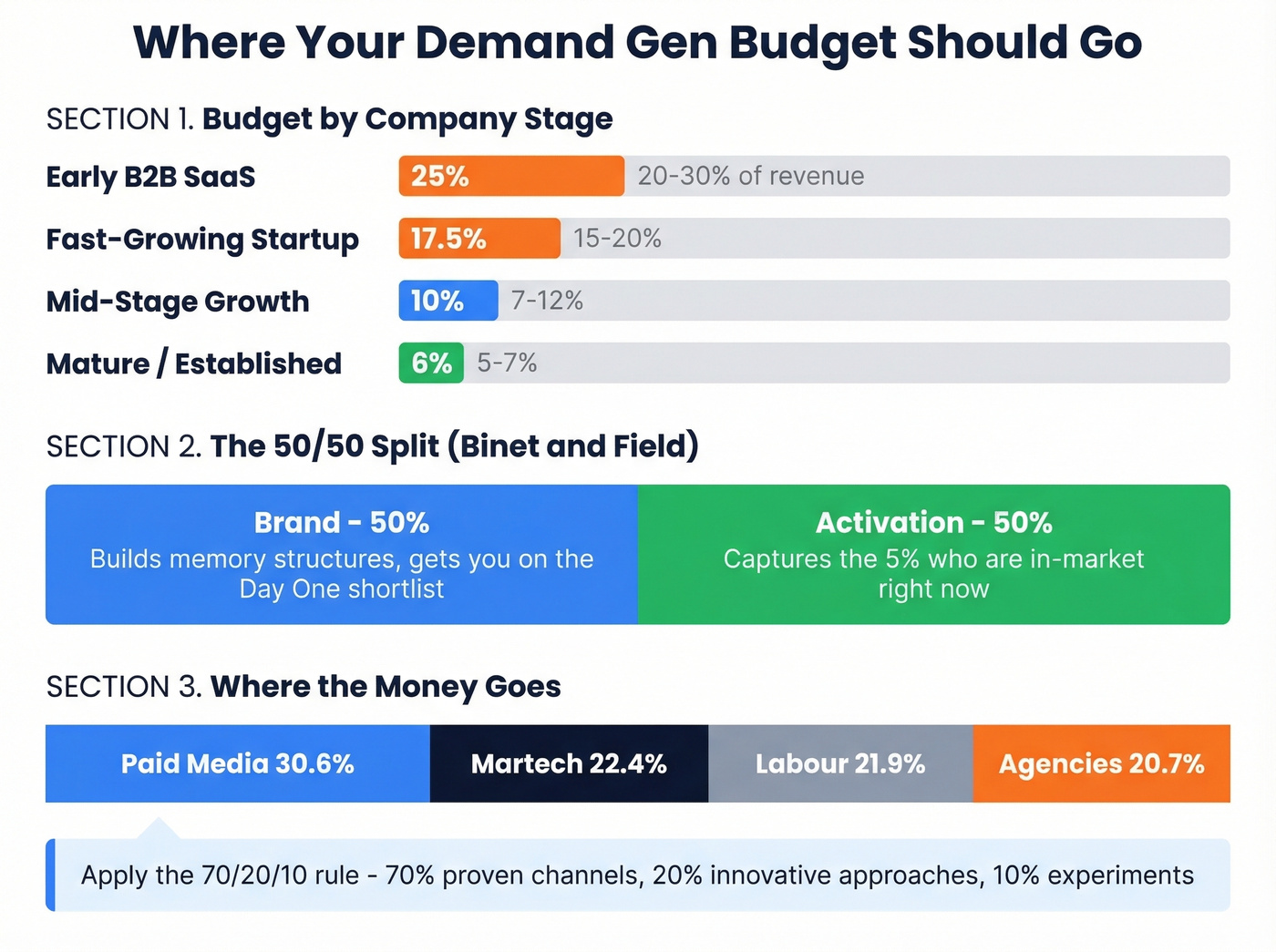
The 2026 Gartner CMO Spend Survey pegged average marketing budgets at 7.7% of revenue - flat from the prior year and well below the 9.5% benchmark from three years earlier.
| Company Stage | % of Revenue | Notes |
|---|---|---|
| Mature (established) | 5-7% | Maintenance + optimization |
| Mid-stage growth | 7-12% | Scaling proven channels |
| Fast-growing startup | 15-20%+ | Building awareness from zero |
| Early B2B SaaS | 20-30% | Land-grab phase |
Binet & Field's LinkedIn B2B Institute-commissioned research recommends a 50/50 brand-to-activation split for B2B. Brand spend builds the memory structures that get you on the Day One shortlist. Activation spend captures the 5% who are in-market right now.
Within your total marketing budget, allocate 60-80% to demand gen and direct response, 10-20% to brand awareness, and 10-20% to nurturing and retention.
Hot take: If your average deal size sits below $10K, you probably don't need a six-figure ABM platform. We've seen teams generate more pipeline with a $200/month data tool, one strong content channel, and disciplined ICP targeting than with a $100K martech stack and no strategic clarity. Spend on strategy before you spend on software.
Where does the money go? Paid media takes 30.6%, martech 22.4%, labour 21.9%, and agencies 20.7%. Apply the 70/20/10 rule: 70% on proven channels, 20% on innovative approaches showing early promise, 10% on experiments.

Your demand gen strategy is only as good as the data underneath it. Stale contacts tank deliverability, waste SDR hours, and send campaigns to people who left their role weeks ago. Prospeo refreshes every 7 days - not the 6-week industry average - so your ICP targeting, ABM plays, and outbound sequences always hit real buyers at verified emails (98% accuracy).
Stop building demand gen on a foundation of decaying data.
Benchmark Your Funnel
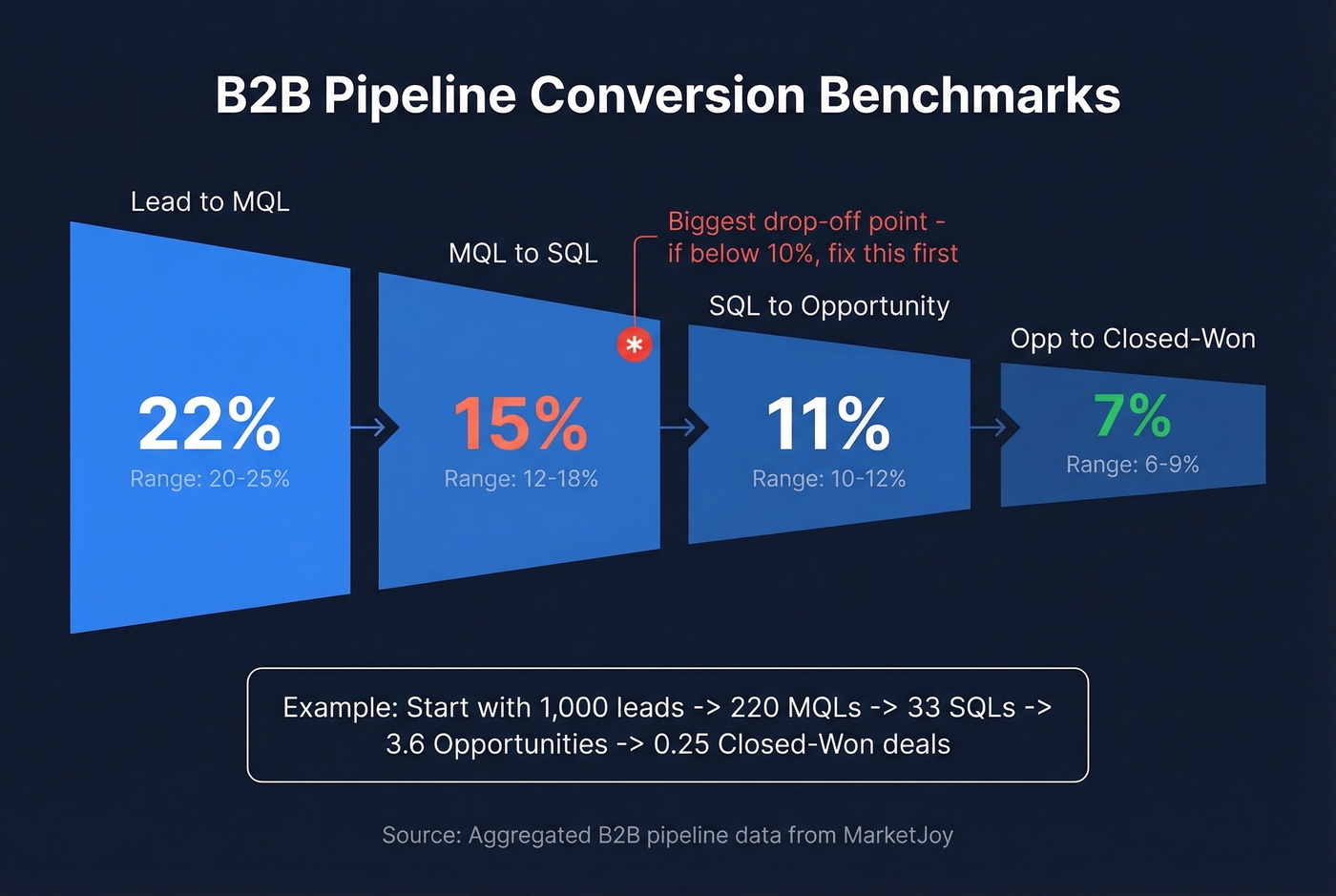
You can't optimize what you don't measure against a baseline. Here are the pipeline conversion benchmarks from aggregated B2B data:
| Stage | Benchmark Range | Midpoint |
|---|---|---|
| Lead to MQL | 20-25% | 22% |
| MQL to SQL | 12-18% | 15% |
| SQL to Opportunity | 10-12% | 11% |
| Opp to Closed-Won | 6-9% | 7% |
The biggest drop-off is consistently MQL to SQL. If yours is below 10%, either your scoring model is broken or your SDRs lack the context to qualify effectively. Both are fixable.
Speed matters too. Contacting leads within 24 hours increases conversion by 5x compared to waiting 48 hours. If your lead routing takes three days, you're losing deals before sales ever touches them. Run your own numbers against these benchmarks quarterly - the gaps tell you exactly where to invest.
To pressure-test your stages, map them to a standard model like the AIDA sales funnel and track funnel metrics consistently.
AI in Demand Gen: 2026
45% of buyers already used AI during a recent purchase. AI now accounts for 9% of total marketing budgets, and 59% of marketing leaders plan to increase AI spend this year. Here's where it actually moves the needle:
Predictive scoring and ABM - Demandbase and 6sense use AI to rank accounts by likelihood to convert, combining historical patterns with real-time intent signals. This is where AI delivers the clearest ROI: prioritizing the 5% who are in-market.
Content creation - Jasper ($39/user/mo) and ChatGPT ($20/mo) handle first drafts and variation testing. They don't replace subject-matter expertise, but they compress production timelines. Pair with Surfer SEO ($89/mo) for optimization.
Conversational marketing - Drift (now Salesloft) and similar tools use AI to qualify and route website visitors in real time, capturing intent at its peak.
Automation - Zapier ($19.99/mo) connects your stack without engineering resources. The compound effect of automating lead routing, enrichment triggers, and notification workflows is enormous.
Skip the AI hype if you haven't nailed the basics. I've watched teams buy predictive scoring platforms before they had a clean ICP definition - that's like buying a GPS before you know the destination.
The 90-Day Demand Gen Plan
Strategy without a timeline is a wish list. Here's how to operationalize everything above.
Days 1-30: Foundation
Lock your ICP definition - not a persona doc in Google Drive, but specific firmographic, technographic, and behavioral criteria your team can filter on. Set up your data infrastructure with verified contact data and intent signals, connect your CRM, and establish baseline metrics for every funnel stage. Document current conversion rates, deal velocity, and channel-level CPL. You can't measure improvement without a starting point.
Days 31-60: Engine
Publish your first content pieces on your chosen primary channel. Establish a distribution rhythm - same day, same time, every week. Build your ABM target account list using intent data to prioritize accounts showing active research signals. Draft your lead scoring model based on month-one ICP criteria, weighting behavioral signals more heavily than demographic fit alone.
Days 61-90: Optimization
Run your first pipeline attribution review. Which channels generated SQLs? Which content pieces appeared in deals that progressed? Calibrate your scoring model against actual SQL conversion data. Compare channel performance and reallocate budget toward what's working.
This isn't the finish line - it's the first data-informed iteration of a system that compounds over quarters, not weeks. The consensus on r/demandgeneration and r/sales is pretty consistent: teams that bail before the 90-day mark never see the compounding effect kick in. The most effective demand generation strategies evolve through these review cycles, not from a single planning session.
5 Mistakes That Kill Demand Gen
1. Gating everything. If every piece of content sits behind a form, you're running lead gen with a demand gen label. The ratio should skew heavily ungated - 80/20 at minimum.
2. No budget commitment. We've watched teams kill promising demand gen programs by pulling budget at the 60-day mark. Commit to 90 days minimum.
3. Stale data undermining every channel. A 35% bounce rate doesn't just waste sends - it damages your domain reputation, which tanks deliverability across everything you do. If you need a remediation plan, start with improve sender reputation and a proper email deliverability guide.
4. ABM from a spreadsheet. Without intent signals, you're guessing which accounts to prioritize. That's account-based hoping.
5. Measuring MQLs instead of pipeline. MQLs feel productive. Pipeline is productive. If your dashboard leads with form fills, your team is optimizing for the wrong thing.
Intent data shouldn't cost $50K+ a year. Prospeo tracks 15,000 Bombora topics and layers them with job change signals, headcount growth, and technographics - so you can time your demand gen to the 5% of accounts actually in-market this quarter. All starting at $0.01 per email, no annual contracts.
Target in-market accounts without the enterprise price tag.
FAQ
What's the difference between demand generation and lead generation?
Demand gen builds awareness so buyers remember you when they enter-market; lead gen captures existing interest for immediate follow-up. Most B2B companies need both - the strategic question is the ratio and when to shift budget toward demand gen as brand equity compounds.
How long does a B2B demand generation strategy take to show results?
Early signals - branded search lifts, inbound inquiries, engagement spikes - appear within 90 days. Meaningful pipeline impact takes 6-12 months. The average B2B buying cycle is 10.1 months, so patience isn't optional; ICP clarity, content consistency, and data quality compound over time.
How much should a B2B company spend on demand generation?
Most B2B companies allocate 7-12% of revenue to marketing, with Binet & Field recommending a 50/50 brand-to-activation split. Under 5% of revenue rarely generates enough momentum to build the memory structures that get you on buyer shortlists.
What tools do you need for B2B demand generation?
At minimum: a CRM (HubSpot or Salesforce), verified contact data with intent signals, a content platform, and analytics. Enterprise teams add ABM platforms like Demandbase or 6sense. Start lean and add tools as bottlenecks emerge - not before.
What's the most common demand gen mistake?
Gating all content and treating every download as a "lead." You collect an email from someone who wanted information, not someone ready to buy - resulting in bloated MQL counts and SDRs chasing unqualified contacts instead of real pipeline.