

B2B Digital Sales: What It Actually Takes to Win in 2026
$15.12 trillion in U.S. B2B sales. Growth? A sluggish 0.4%. But digital channels climbed 10% in a single year. The overall market is barely moving - the money is shifting fast underneath it. B2B digital sales isn't a channel you bolt on. It's an operating model you build from scratch, and if you haven't started, your pipeline is migrating to competitors who did.
What Digital B2B Sales Actually Means
This category covers any transaction between businesses that runs through a digital channel. Digital Commerce 360 breaks it into four buckets:
- Direct commerce - customer portals, dealer portals, your own storefront
- B2B marketplaces - owned and third-party like Amazon Business or ThomasNet
- Procurement commerce - your supplier storefront inside a buyer's procurement app
- Sales-assisted digital - call centers, live chat, Digital Sales Rooms, and reps completing orders that started online
DSRs are gaining traction fast. On Reddit, practitioners in r/sales are still debating whether DSRs are must-have or overkill - a sign the market hasn't settled on which digital layers actually move pipeline. Then there's EDI, which has quietly handled trillions in B2B transactions for decades. In 2026, ecommerce and EDI are converging into a single transaction engine, with hybrid integration models combining EDI standards and APIs for real-time inventory, pricing, and order visibility.
If you're evaluating DSRs, start with what breaks most implementations in a Digital Sales Room rollout.
A Two-Speed Economy
U.S. manufacturing and wholesale distribution sales hit $15.12 trillion in 2026, up from the post-pandemic surge years of 2021 and 2022 when growth topped 14%. Digital sales channels reached $3.36 trillion and grew 10% year-over-year. In industrial sectors alone, digital preference jumped from 20% in 2017 to roughly 67% today.
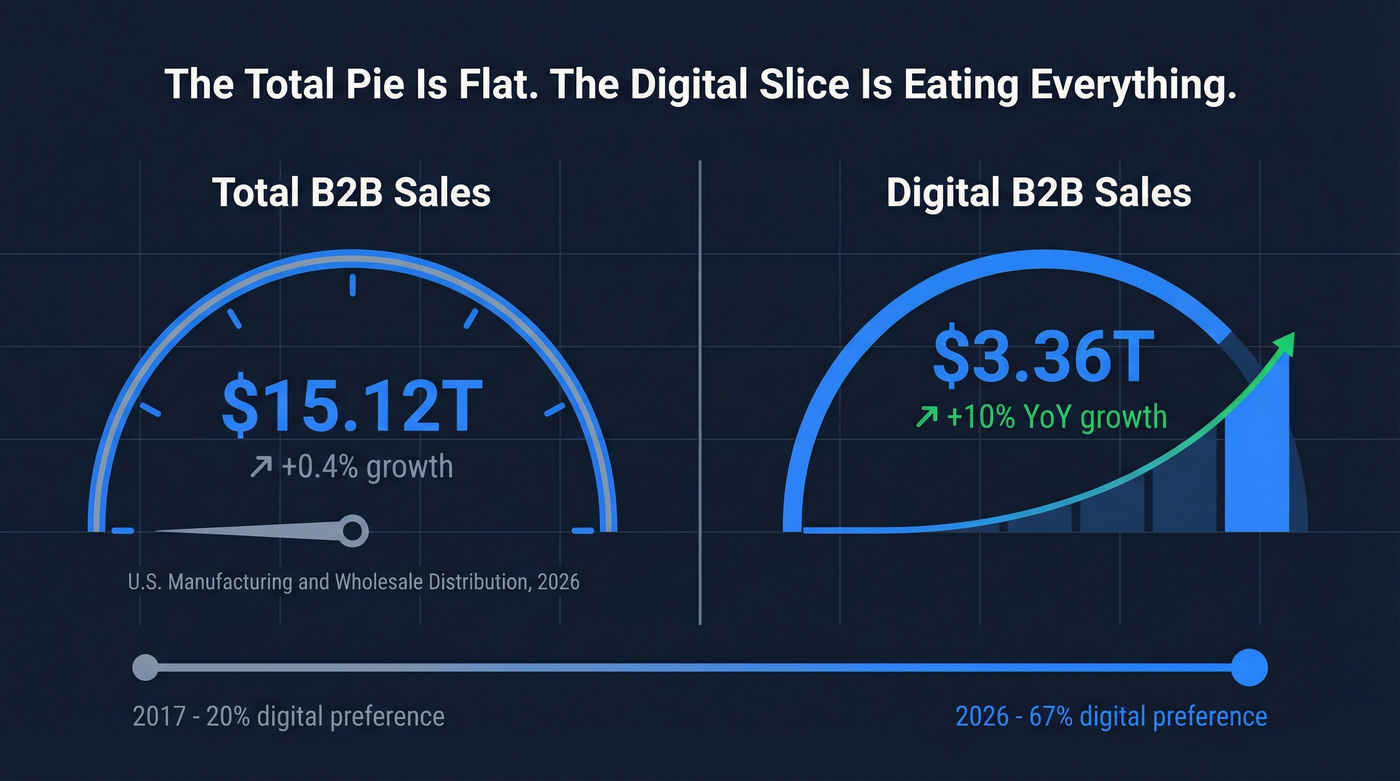
The total pie isn't growing much. The digital slice is eating everything else.
How B2B Buyers Actually Behave
A Gartner survey of 646 B2B buyers found 67% prefer a rep-free experience, and 45% reported using AI during a recent purchase - not in some theoretical future, but right now. Buyers use anywhere from 3 to 10 channels to research, evaluate, and purchase.
If you're building around rep-free journeys, map the stages like a real B2B sales funnel instead of a generic ecommerce flow.
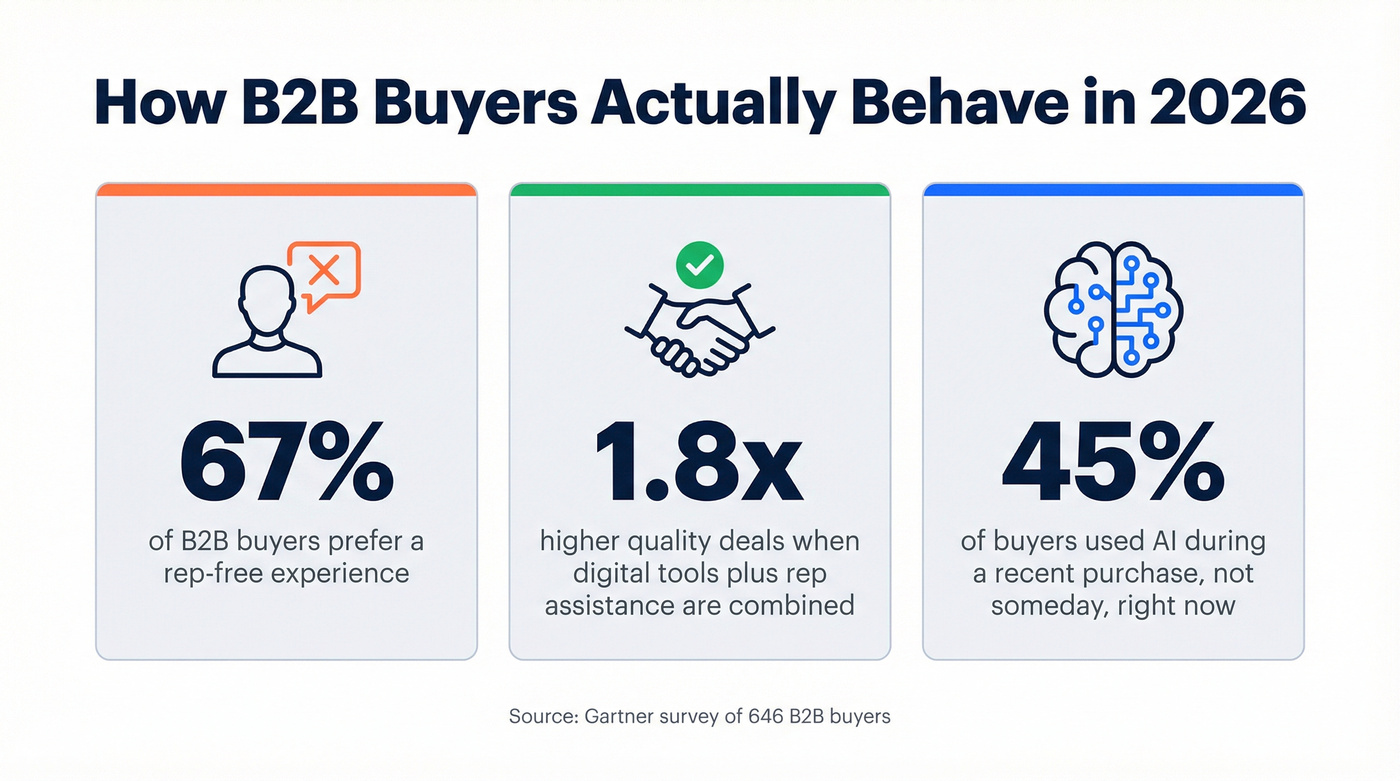
Here's the counterintuitive part: buyers who use supplier digital tools in partnership with a sales rep are 1.8x more likely to complete a high-quality deal than those going fully self-service. Gartner also warns that pure self-service purchases drive higher purchase regret. The takeaway isn't "reps are dead." It's that reps need to show up at the right moment inside a digital-first journey, not fight the journey itself.
Two Operating Models That Work
Marketing-Led (SMB / High-Volume)
Digital channels and contact centers handle most of the buyer journey, with minimal field sales involvement. This requires serious investment in content, data integration, and AI-driven decision engines - but the economics are compelling. Inside reps can cover roughly 4x the prospects at 50% of the cost of a traditional field rep, and up to 80% of accounts can be served this way. For teams building online B2B sales at scale, this model delivers the fastest time to ROI.
To keep this model from turning into content chaos, treat it like B2B content marketing with revenue ownership, not a traffic project.
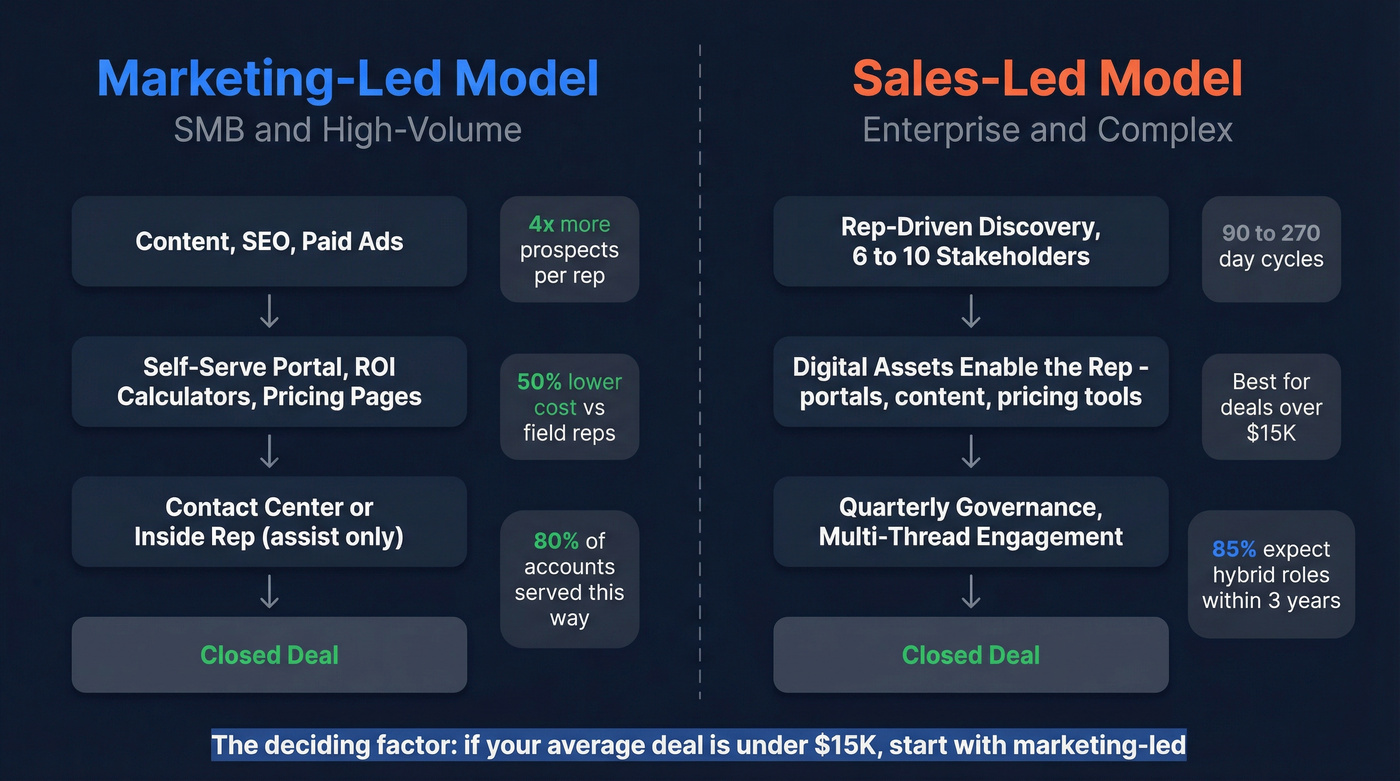
The catch? Your content has to do the heavy lifting that reps used to do. Product pages, comparison guides, ROI calculators, and self-serve pricing need to answer the questions a buyer would normally ask a rep in a discovery call. Most companies underinvest here and wonder why their portal traffic doesn't convert.
Sales-Led (Enterprise / Complex)
The rep is the quarterback. Digital assets - portals, content, pricing tools - enable the rep rather than replacing them. Enterprise cycles typically involve 6-10 stakeholders over 90-270 days, so the playbook needs quarterly governance, not annual updates. ZS Associates identifies eight go-to-market capabilities required for either model, spanning activation, analytics, orchestration, and organizational transformation. 85% of companies expect hybrid sales will be the most common role within three years.
If you're selling into complex buying committees, align the motion to enterprise B2B sales realities (stakeholders, governance, and deal risk), not SMB velocity metrics.
Here's the thing: if your average deal size is under $15K, you almost certainly don't need the sales-led model. Most teams over-invest in field reps for deals that would close faster through a well-built portal with rep assist at the proposal stage.

Digital sales models only work when reps and automation reach real buyers. With 30% annual data decay, your portal handoffs, DSRs, and outbound sequences are hitting dead ends. Prospeo's 300M+ profiles on a 7-day refresh cycle give your digital sales stack the foundation it actually needs - 98% email accuracy at $0.01 per lead.
Stop building a $3.36T channel on a rotting database.
Where Digital Initiatives Break
We've watched three failure modes kill these initiatives more often than bad strategy:
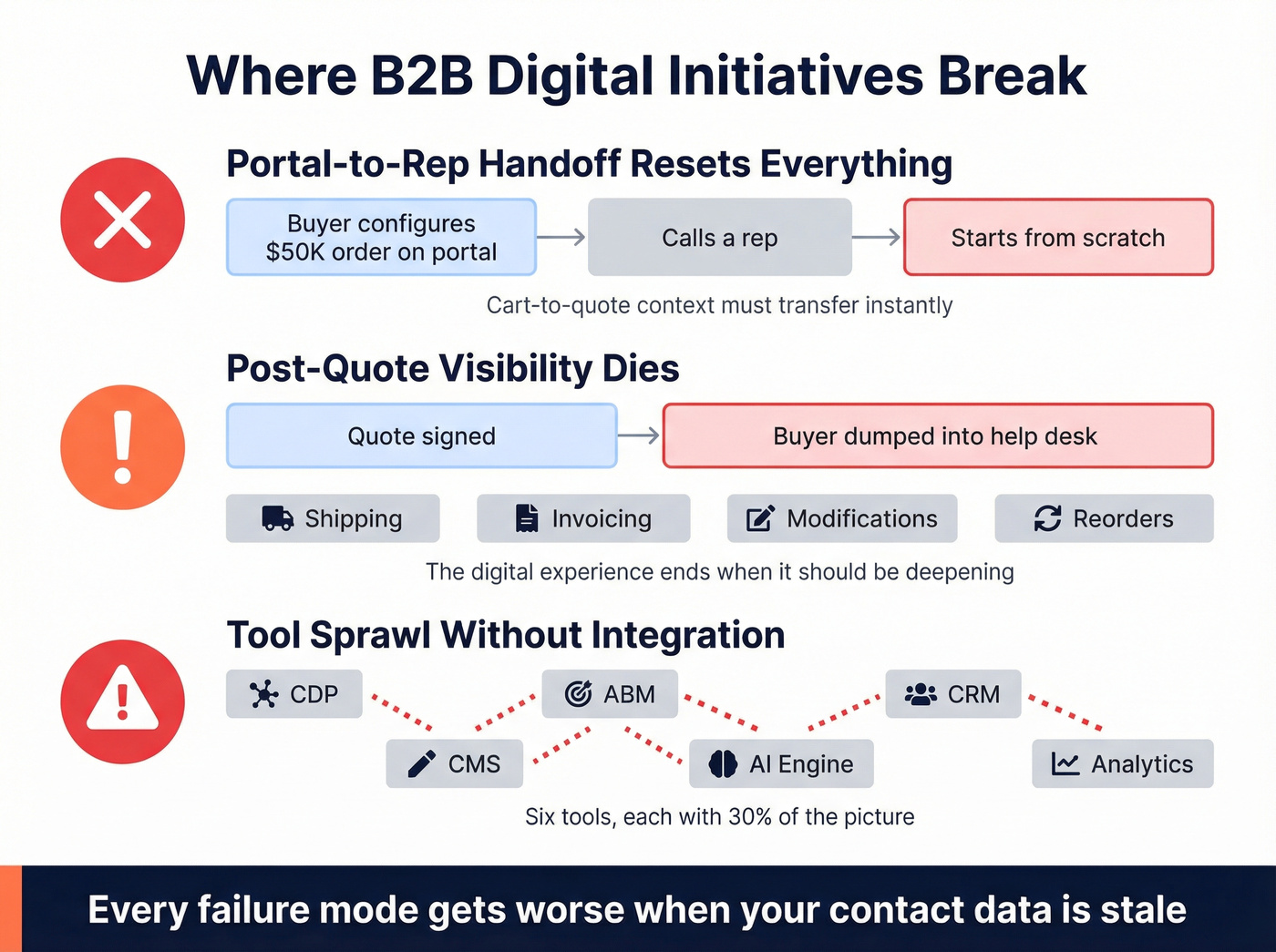
Portal-to-rep handoff resets everything. A buyer configures a $50K order on your portal, calls a rep, and starts from scratch because the quote didn't carry over. Cart-to-quote context needs to move instantly - in most implementations, it doesn't.
Post-quote visibility dies. After the quote is signed, buyers get dumped into a help desk. No single dashboard for shipping, invoicing, modifications, or reorders. The digital experience ends exactly when it should be deepening.
Tool sprawl without integration. Companies buy the CDP, the CMS, the ABM platform, the AI engine - then never stitch them together. Six tools, each with 30% of the picture. It's maddening.
If this sounds familiar, it usually shows up as classic sales pipeline challenges (stage leakage, stalled deals, and broken handoffs) more than "bad leads."
Every one of these failure modes gets worse when your contact data is stale. Bad emails, wrong titles, outdated phone numbers compound every handoff problem and make every tool in the stack less effective.
The Data Quality Foundation
B2B contact data decays at 30%+ annually. People change jobs, get promoted, switch companies. If your database hasn't been refreshed recently, a meaningful chunk of it is already wrong. Every bounced email, every wrong-number dial, every "she left six months ago" erodes your team's trust in the entire digital selling stack.
If you're seeing bounces, benchmark against a real email bounce rate baseline before you blame copy or targeting.
This is where we've seen the biggest quick wins. Snyk's 50-person sales team saw bounce rates drop from 35-40% to under 5% after switching to Prospeo, with AE-sourced pipeline up 180% and 200+ new opportunities per month. That's 300M+ professional profiles with 98% email accuracy on a 7-day refresh cycle, compared to the 6-week industry average. Before you invest in another platform, fix your data. Everything downstream depends on it.
If you're rebuilding the data layer, compare options across data enrichment services before you lock in a workflow.

Snyk's 50 AEs dropped bounce rates from 35% to under 5% and added 200+ opportunities per month. Whether you're running marketing-led or sales-led digital motions, every KPI in your pipeline - lead-to-customer, win rate, cycle length - improves when your contact data is actually current. 75 free emails per month, no contracts.
Fix the data layer and every metric downstream moves.
KPIs Worth Tracking
| Metric | Benchmark |
|---|---|
| Lead-to-customer | 2-5% |
| Median sales cycle | 84 days |
| Win rate | 20-30% |
| SEO MQL-to-SQL | 51% |
| PPC MQL-to-SQL | 26% |
| Events (trade shows/webinars) opp-to-close | 40% |
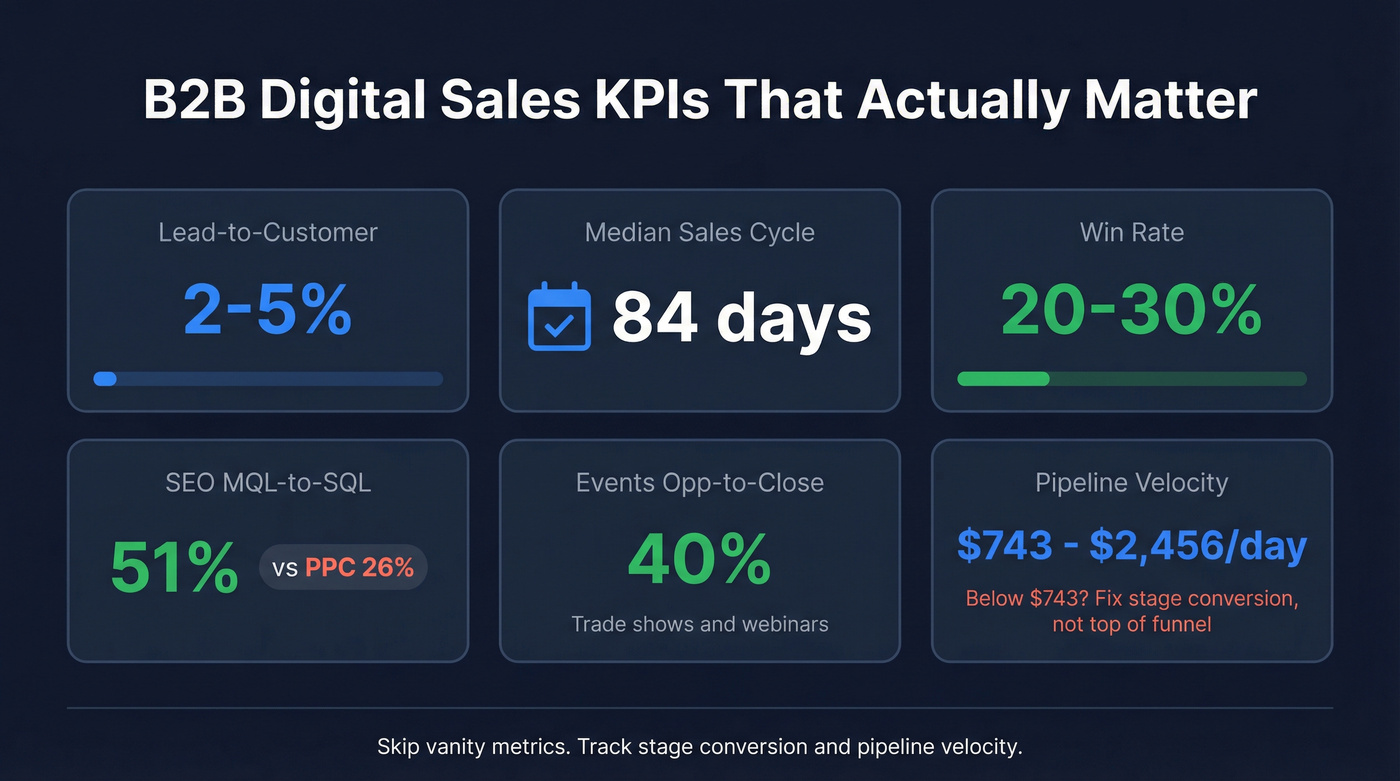
Two things jump out from recent pipeline benchmarks. SEO-sourced leads convert MQL-to-SQL at nearly double the rate of PPC - 51% vs 26% - which should inform where you put your content investment. Pipeline velocity ranges from $743 to $2,456/day depending on industry. If you're below that floor, the problem is usually stage conversion, not top-of-funnel volume.
To pressure-test your numbers, use sales pipeline benchmarks and pipeline health metrics side-by-side.
Skip the vanity metrics. Website traffic and "engagement" scores don't tell you whether your digital sales model is working. Stage conversion rates and pipeline velocity do.
What's Coming Next
Three trends are converging. EDI and ecommerce will finish merging into a single transaction engine - the separation is already breaking down for companies with modern ERP stacks. AI-driven buying will accelerate, which means your digital experience needs to be machine-readable, not just human-friendly. Expect procurement AI agents to start placing orders autonomously this year - your portals, pricing APIs, and product data need to serve machines as much as humans.
If you're planning the org changes that come with this shift, treat it as digital transformation sales, not a website redesign.
And the hybrid model - digital first with rep assistance at key moments - will become the default, not the exception. Let's be honest: most B2B companies are still running a 2019 playbook with a 2026 tech stack. The ones that align the two will win disproportionate share in a flat market.
B2B Digital Sales FAQ
What's the difference between B2B digital sales and B2B ecommerce?
B2B digital sales is the broader category encompassing ecommerce, EDI, e-procurement, marketplace transactions, and sales-assisted channels like live chat and DSRs. Ecommerce is one component, not the whole model. Most enterprises run three or more of these channels simultaneously.
Do B2B buyers still want to talk to reps?
67% prefer a rep-free experience, but hybrid deals close at 1.8x higher quality than pure self-service. Build for self-serve as the default, with rep engagement at high-stakes moments like custom pricing or multi-stakeholder sign-off.
What's the fastest way to improve digital pipeline?
Fix your contact data first. Stale emails and wrong phone numbers silently kill conversion at every stage. Teams running a weekly data refresh cycle see bounce rates drop from 35%+ to under 5%, which directly lifts pipeline velocity and rep productivity.
How does digital selling differ from traditional outbound?
Traditional outbound relies on cold calls and mass email blasts with minimal personalization. Digital selling layers intent data, verified contacts, and multi-channel sequences so reps engage buyers who are already researching solutions - resulting in shorter cycles and higher win rates.