

How to Build a B2B Go-to-Market Plan That Actually Ships
The best B2B go-to-market plan isn't a 30-page strategy document - it fits on one page with a 90-day sprint attached. 61% of B2B buyers now prefer a rep-free buying experience, which means your plan needs to support digital-first buying, not just outbound sales motions. On r/sales and r/startups, operators keep asking for GTM wireframes and one-page planning boards that cover ICP through retention - not 30-slide decks nobody reads. That's what this is.
Four Non-Negotiables
A real go-to-market plan has four parts. Skip one and the whole thing falls apart.
- ICP with named accounts - actual companies you're targeting in the first 90 days, not abstract personas.
- Motion decision - PLG, sales-led, or hybrid. Pick one before you build anything else.
- 90-day phased timeline with owners - deliverables, SLAs, and a go/no-go checklist.
- Benchmark targets - funnel conversions, CPL by channel, pipeline coverage. Numbers, not vibes.
Choose Your GTM Motion
Your average contract value dictates your motion more than anything else. A ProductLed study of 446 B2B SaaS companies found that companies with initial self-serve revenue reported 68% profitability versus 36.4% for those with zero self-serve. That's not marginal - it's a fundamentally different business model.
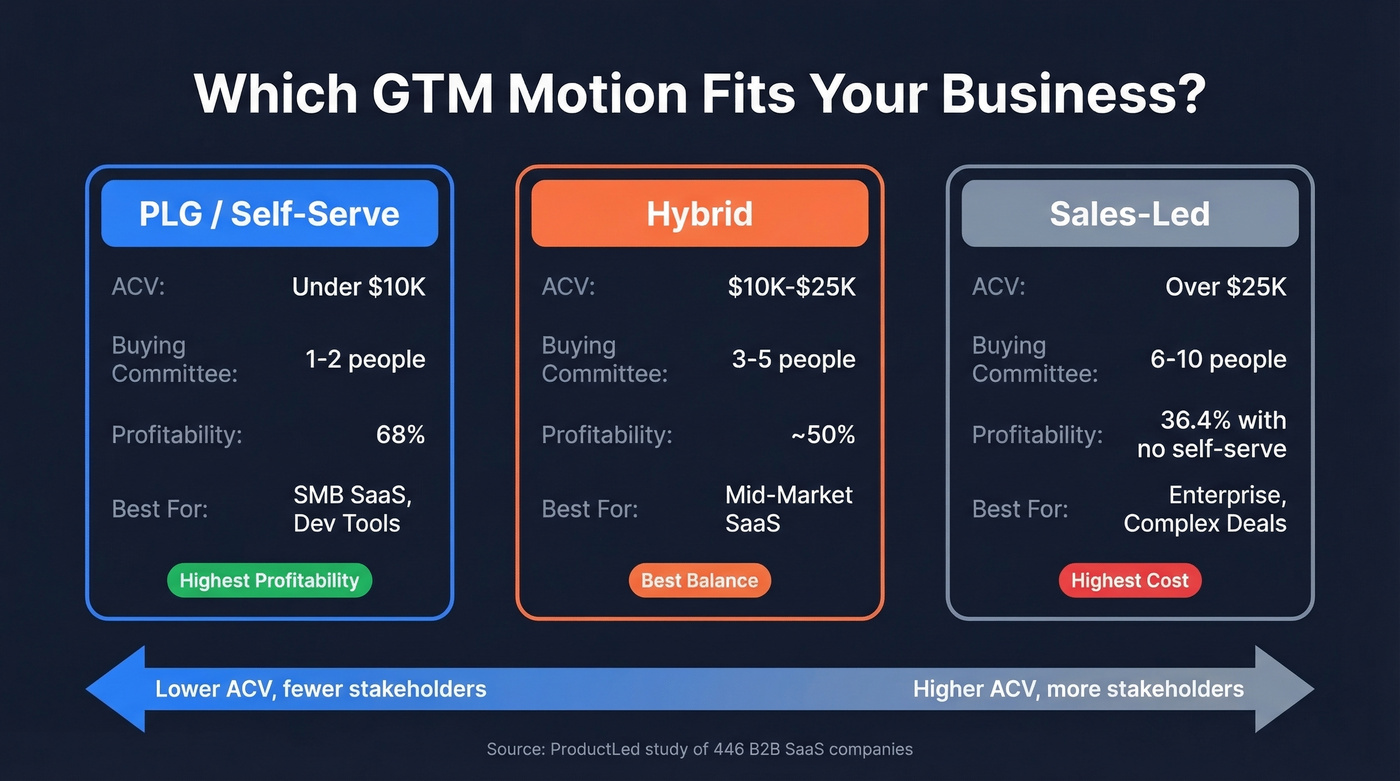
| Signal | PLG / Self-Serve | Hybrid | Sales-Led |
|---|---|---|---|
| ACV | <$10K | $10K-$25K | >$25K |
| Buying committee | 1-2 people | 3-5 people | 6-10 people |
| Profitability | 68% | ~50% | 36.4% at $0 self-serve |
| Best for | SMB SaaS, dev tools | Mid-market SaaS | Enterprise, complex |
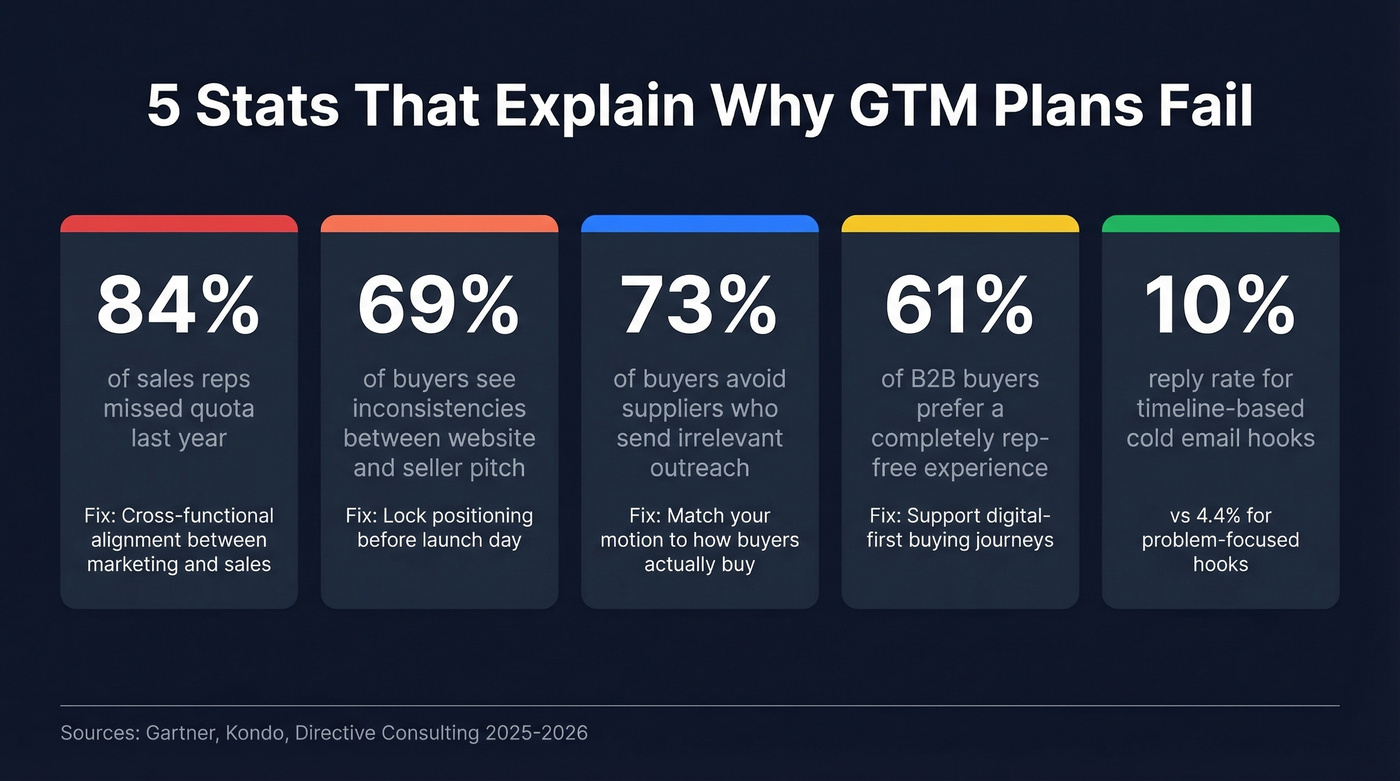
Here's the thing: 73% of B2B buyers actively avoid suppliers who send irrelevant outreach. If your motion doesn't match how your buyers actually buy, you're dead before launch. We've tested both approaches across multiple launches, and hybrid consistently outperforms pure sales-led for deals under $25K - the economics just don't support a full AE cycle at that price point.
The 90-Day B2B Go-to-Market Plan
The average B2B buying cycle runs 4.6 months. A 90-day sprint gets you through the first half of a deal cycle with real data to iterate on. We've seen teams spend three months "planning" and zero months executing. The fix is phased sprints with hard deadlines.
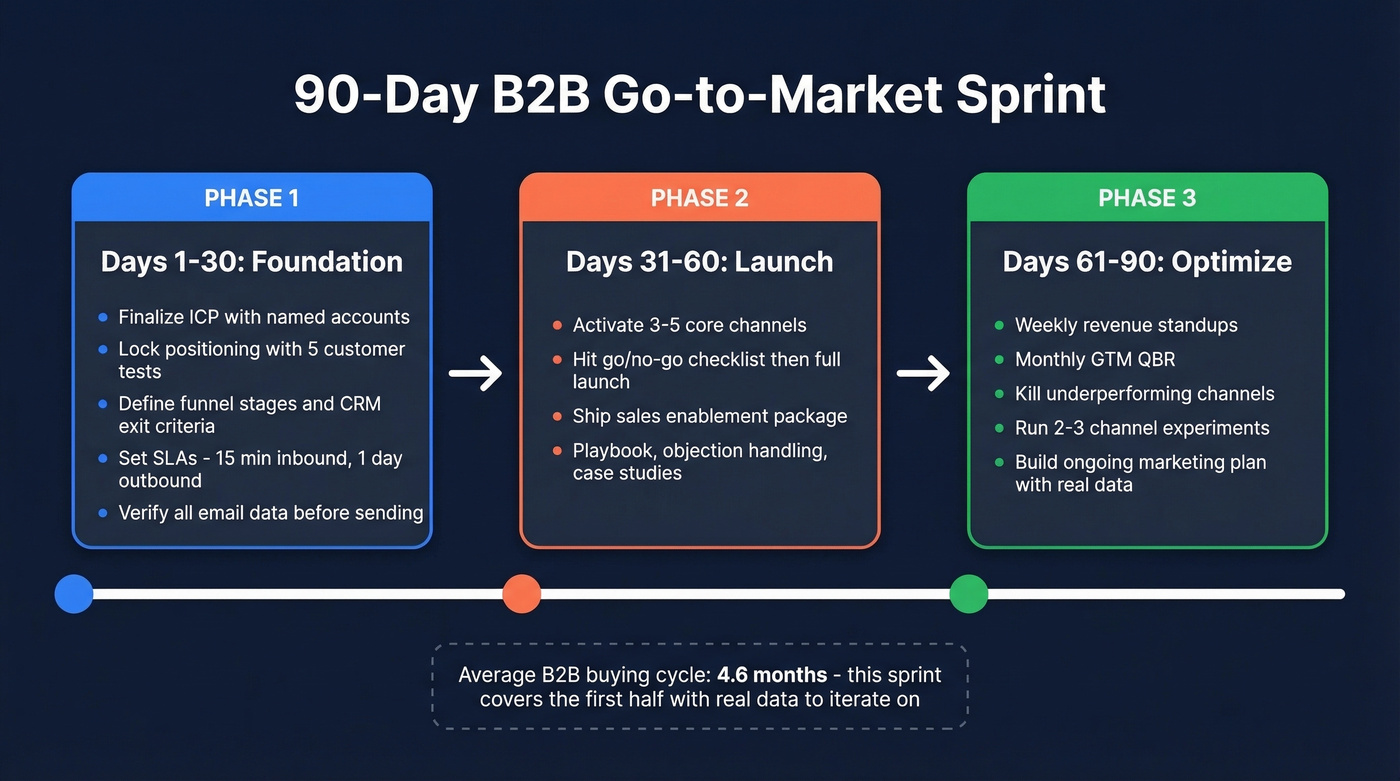
Smartsheet offers free GTM templates in common formats - but the structure below is what drives execution.
Days 1-30: Foundation
Finalize your ICP with named accounts. Lock positioning by testing it with five existing customers. Define funnel stages and exit criteria in your CRM. Set SLAs: inbound demo requests contacted within 15 minutes, outbound replies answered within one business day, and 5-7 follow-ups over 10 days.
This is also when you clean your data. I can't stress this enough - a 25% bounce rate on your first outbound campaign will tank your domain reputation before month two. Verify every email on your list before you send a single sequence. Tools like Prospeo run 5-step verification with catch-all handling and spam-trap removal, which is the kind of hygiene that keeps your sender score intact while you're still building momentum. (If you want a deeper benchmark breakdown, start with email bounce rate and email deliverability.)
Days 31-60: Launch
Activate 3-5 core channels. Run a soft launch, hit your go/no-go checklist, then push to full launch. Ship the sales enablement package - playbook, objection handling, and case studies. If your reps don't have these on day 31, they're freelancing their pitch, and your win rate will show it. Use sales follow-up templates to standardize the 5-7 touch sequence without reinventing copy.
Days 61-90: Optimize
Run weekly revenue standups and a monthly GTM QBR. Kill underperforming channels. Double down on winners. Run 2-3 channel experiments per quarter. This is also when you build the ongoing marketing plan, because now you have real channel performance data to inform budget allocation instead of guessing. If your QBRs feel fuzzy, pull a tighter agenda from QBR questions to ask.

A 25% bounce rate in month one kills your GTM before it starts. Prospeo's 5-step email verification delivers 98% accuracy with catch-all handling, spam-trap removal, and a 7-day data refresh cycle. At $0.01 per email, your Days 1-30 foundation stays clean without burning budget.
Ship your go-to-market plan on data that won't wreck your domain.
Funnel Benchmarks for 2026
Pipeline velocity ties everything together: (Opportunities x Avg Deal Size x Win Rate) / Sales Cycle in days. But you need the component benchmarks to know if your funnel is healthy.
| Stage | Target |
|---|---|
| MQL to SQL | 25-35% |
| SQL to Opportunity | 50%+ |
| Win rate | >20% |
| Pipeline coverage | 3-5x quota |
| CAC ratio | $2 per $1 new ARR |
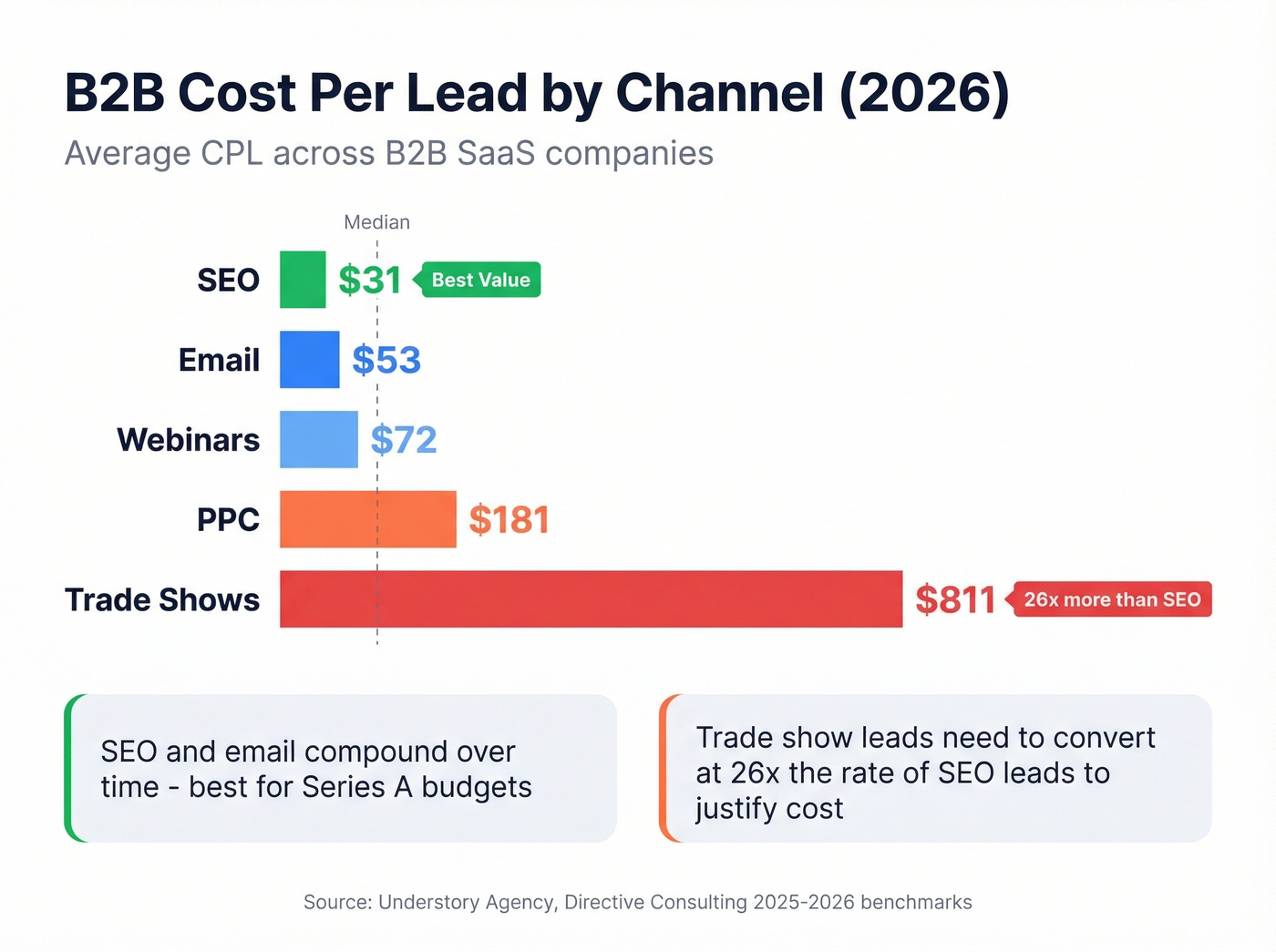
Channel costs vary dramatically:
| Channel | Avg. CPL |
|---|---|
| SEO | $31 |
| $53 | |
| Webinars | $72 |
| PPC | $181 |
| Trade shows | $811 |
SEO and email compound over time. If you're a Series A company spending $811 per lead at a booth, the math needs to be very clear on what those leads convert at. One cold email benchmark worth knowing: timeline-based hooks pull a 10% reply rate versus 4.4% for problem-focused hooks. Small copy changes, big pipeline impact. To pressure-test your funnel math, compare against average B2B lead conversion rate and sales pipeline benchmarks.
Channel Strategy That Fits
B2B buyers use seven channels before buying. High-growth orgs average 17 marketing channels versus 15 for low-growth companies. But 59% of CMOs report insufficient budget to execute their strategy, and the average company runs 10.5 simultaneous GTM efforts.
The answer isn't more channels - it's the right 3-5 core channels plus 2-3 experiments per quarter. Pick channels that match your motion, measure CPL and pipeline contribution ruthlessly, and cut what doesn't convert within 60 days.
Let's be honest: most teams don't have a channel problem. They have a data quality problem. Your outbound sequence is only as good as the list behind it, and bad data compounds fast - bounced emails damage sender reputation, wrong titles waste rep time, and stale contacts mean you're pitching people who left the company six months ago. If you're building lists manually, use a repeatable workflow like Clay list building or automate it with target account lists.
GTM Mistakes That Kill Revenue
In our experience, these five mistakes account for most go-to-market failures:
- Misaligned market understanding. Validate with 10 customer conversations before committing to a segment. Skip this and you'll build a plan for a buyer who doesn't exist.
- No cross-functional alignment. 84% of reps missed quota last year - misalignment between marketing and sales is a major reason.
- Weak positioning. 69% of buyers report inconsistencies between a supplier's website and what sellers say. If messaging isn't locked, your reps are freelancing.
- Inadequate sales enablement. Playbooks, objection handling, and case studies aren't optional - they're launch requirements.
- Neglecting iteration. Your first 30 days will be wrong. The plan accounts for that. If you're not running a GTM QBR by day 90, you're flying blind.
Your GTM Tech Stack
You don't need $50K/year in tooling. A startup can run a full outbound and inbound motion for a few hundred dollars per month.
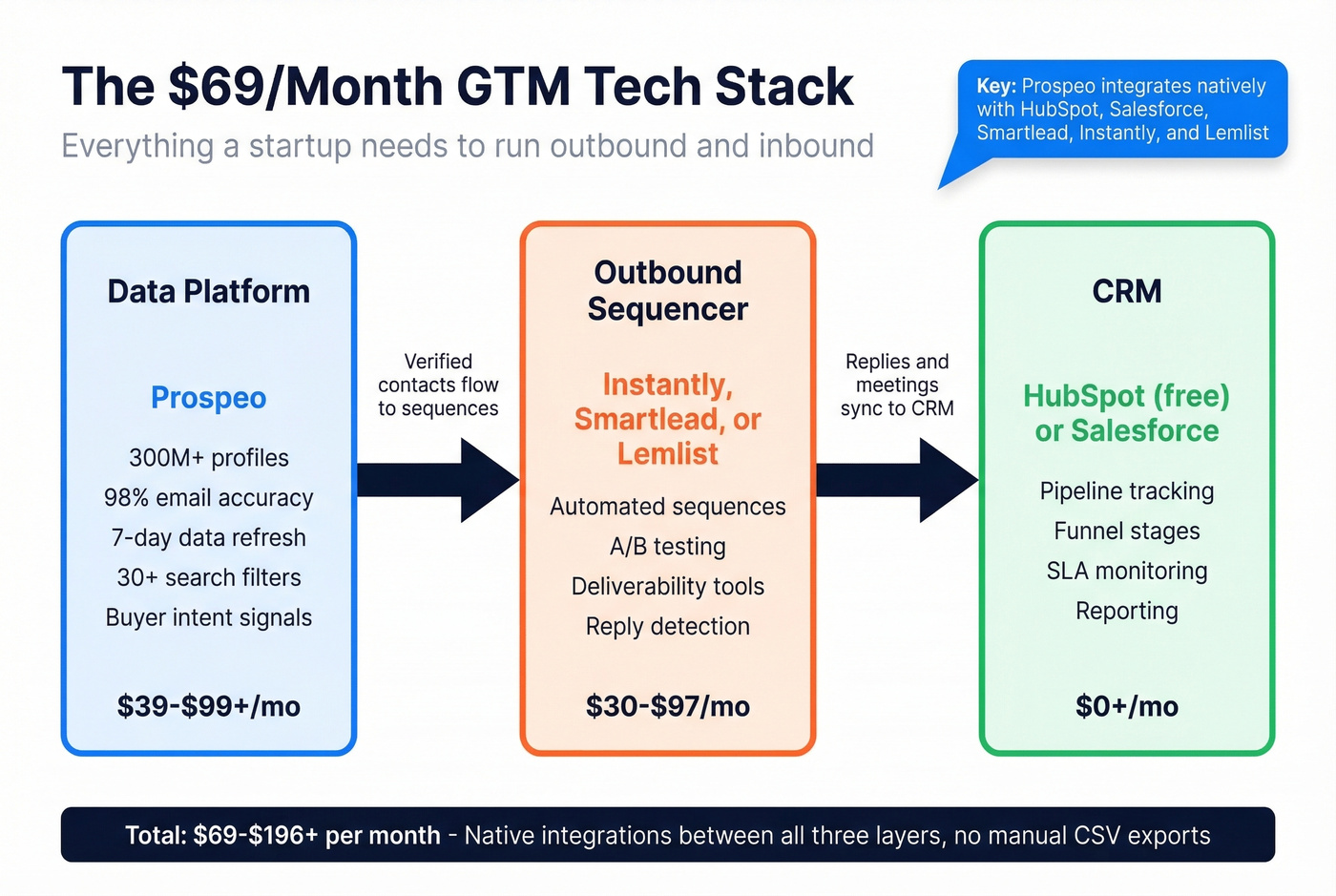
| Category | Tool | Monthly Cost |
|---|---|---|
| CRM | HubSpot (free) or Salesforce (paid) | $0+ |
| Data platform | Prospeo | $39-$99+ |
| Outbound sequencer | Instantly, Smartlead, or Lemlist | $30-$97 |
| Total | $69-$196+/mo |
Your outbound motion lives or dies on data quality. Prospeo gives you 98% email accuracy across 300M+ professional profiles, with a 7-day data refresh cycle versus the 6-week industry average. The 30+ search filters - including buyer intent powered by Bombora across 15,000 topics, technographics, and headcount growth signals - let you build ICP-matched prospect lists in minutes instead of days. It integrates natively with HubSpot, Salesforce, Smartlead, Instantly, and Lemlist, so your data flows straight into whatever sequencer you're running. If you're evaluating options, compare categories like data enrichment services and sales prospecting databases.
For teams that want to skip the data platform entirely: don't. We've watched too many launches stall because reps spent their first 30 days manually building lists instead of running sequences. The foundation phase is about speed, and verified data is what makes speed possible.

Your GTM channels are only as good as the contacts behind them. Prospeo gives you 300M+ profiles with 30+ filters - buyer intent, technographics, funding, headcount growth - so your named account list has verified emails and direct dials from day one. Teams using Prospeo book 35% more meetings than Apollo users.
Stop planning your GTM around stale data. Build your list now.
FAQ
What's the difference between a GTM strategy and a GTM plan?
A strategy defines your market, positioning, and motion. A plan adds timelines, owners, deliverables, and benchmarks. If it doesn't have dates and KPIs, it's a strategy - not a plan.
How long does it take to build a B2B go-to-market plan?
The plan itself takes one to two weeks. Execution runs in 90-day sprints. Aim for a one-page plan with a phased timeline, then iterate quarterly based on real funnel data.
Do I need a separate B2B marketing plan?
Your go-to-market plan covers launch and initial traction. A marketing plan is the ongoing engine that sustains demand generation, content, and channel optimization after the GTM sprint ends. Most teams build the marketing plan during Days 61-90 once they have real channel performance data to inform budget allocation.
What tools do I need to execute a GTM plan?
At minimum: a CRM (HubSpot's free tier works), a verified data platform for building prospect lists, and an outbound sequencer like Instantly or Lemlist. Total cost starts around $69/month for a lean startup stack.