

The 2026 B2B Go-to-Market Strategy Playbook
A RevOps lead we know launched a GTM strategy last year with a 50-page deck, 12 channels, and a "full-funnel" tech stack. Three months later, pipeline was flat, reps were blaming marketing, and the board was asking what happened. The problem wasn't effort - it was architecture. Most B2B go-to-market strategies fail because they're built on assumptions instead of math, and executed on stale data instead of verified contacts.
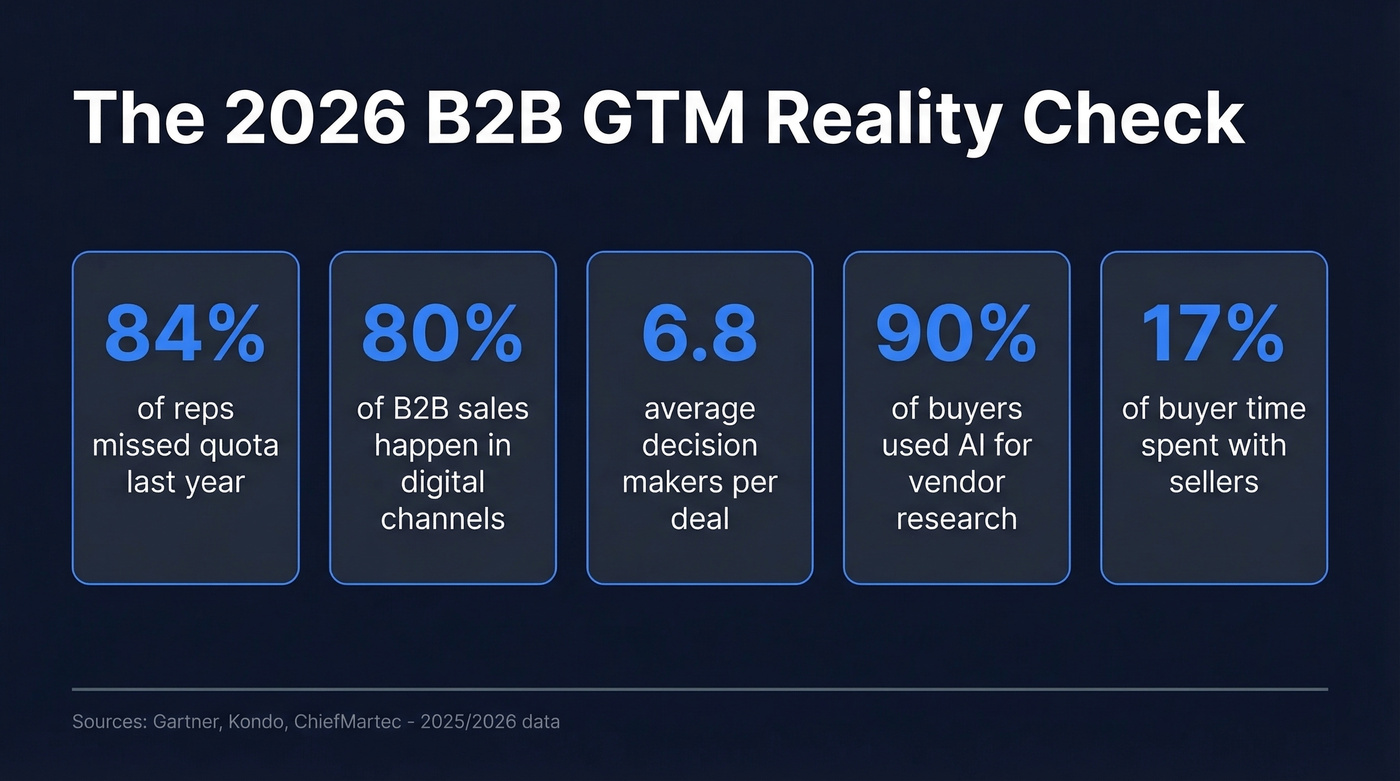
84% of reps missed quota last year. 80% of B2B sales interactions now happen in digital channels. That's not a talent problem. It's a GTM foundation problem.
Five Moves That Matter Most
If you're short on time, these cover 80% of what matters:
- Define your ICP with tiering - Tier 1 (high-fit, high-intent), Tier 2 (high-fit, low-intent), Tier 3 (low-fit, high-intent). Route and resource accordingly. Use an Ideal Customer Profile Template if you need a starting point.
- Pick your GTM motion by deal size - pure PLG under $5K ACV, hybrid product-led sales for $1K-$50K+, sales-led for $50K+.
- Start with 2-3 demand capture channels - search, review sites, and intent-based outbound. Add demand creation once capture is working.
- Set SLAs and pipeline coverage targets - 3-5x quota in pipeline coverage. Inbound leads contacted within 15 minutes. No exceptions.
- Build on verified data - your outbound dies on stale lists. A 7-day refresh cycle and 98% email accuracy should be your baseline.
What a GTM Strategy Actually Is
A B2B go-to-market strategy isn't a marketing plan. It's a time-bound, cross-functional operating plan that coordinates product, sales, marketing, and customer success around a specific market entry, expansion, or repositioning.
A marketing plan is ongoing and marketing-owned. A GTM strategy has a start date, decision gates, and an end state where you either scale what's working or kill what isn't. It answers four questions: What exact problem are we solving? Who needs it most? Why are we better than the alternatives? How will the right buyers find out?
Most teams treat GTM as a marketing exercise. It's not. It's a revenue architecture exercise.
The 2026 B2B Buyer
The buyer you're building for in 2026 looks nothing like the buyer from even three years ago. They use roughly 10 interaction channels on average, up from 5 in 2016. They spend just 17% of their buying time meeting with suppliers - the other 83% happens without you in the room.
Buying committees now average 6.8 decision makers per deal. 33% of all buyers already prefer a completely seller-free experience, and among millennial buyers that number jumps to 44%. Here's the shift that changes everything: 90% of B2B buyers used AI tools like ChatGPT for vendor research in the past year. 72% encountered Google AI Overviews during their evaluation.
Your buyers are forming opinions before they ever talk to your reps, and increasingly, AI is shaping those opinions. Your GTM plan can't rely on controlling the narrative through sales conversations alone. You need to show up in the channels where research actually happens - and the data you use to reach buyers needs to be current, not six weeks stale.
Here's the thing: if your deal size is under $15K and your product has any self-serve capability, you probably don't need a sales-led GTM motion at all. The 2026 buyer doesn't want to talk to your reps. Stop forcing them to.
How to Build Your GTM Framework
Define Your ICP with Tiering
Most ICP documents are useless - a paragraph of firmographics that nobody references after the kickoff meeting. Build a tiered model that drives actual routing and resource allocation, and validate it with real conversations. Talk to at least 10 ICP-matching people before you finalize anything.
| Tier | Fit | Intent | Action |
|---|---|---|---|
| Tier 1 | High-fit | High-intent | Dedicated AE, multi-thread |
| Tier 2 | High-fit | Low-intent | Nurture + trigger-based outbound |
| Tier 3 | Low-fit | High-intent | Self-serve or light-touch |
You can't build this from a spreadsheet. Validate the pain triggers, current tools, buying process, and disqualifiers with real conversations. In our experience, teams that skip ICP validation waste 60-90 days building channels that target the wrong people.
Map Your Competitive Landscape
Identify your top 3-5 competitors. Run win/loss analysis on the last 20 closed deals. Where are you winning? Where are you losing? The positioning gaps you find here feed directly into your messaging - and most teams skip this because it requires talking to people who chose the other vendor. Do it anyway. If you need a system, build competitive intelligence into your GTM cadence.
Nail Your Value Proposition
Stop leading with features. A cybersecurity company listing "AI-powered threat detection" and "real-time monitoring" is saying nothing the buyer can't find on three other websites. Lead with outcomes: reduced breach risk, faster compliance certification, lower insurance premiums. Map each ICP tier to the specific outcome they care about most.
Choose Your GTM Motion
Your average deal size dictates your motion. Don't fight this.
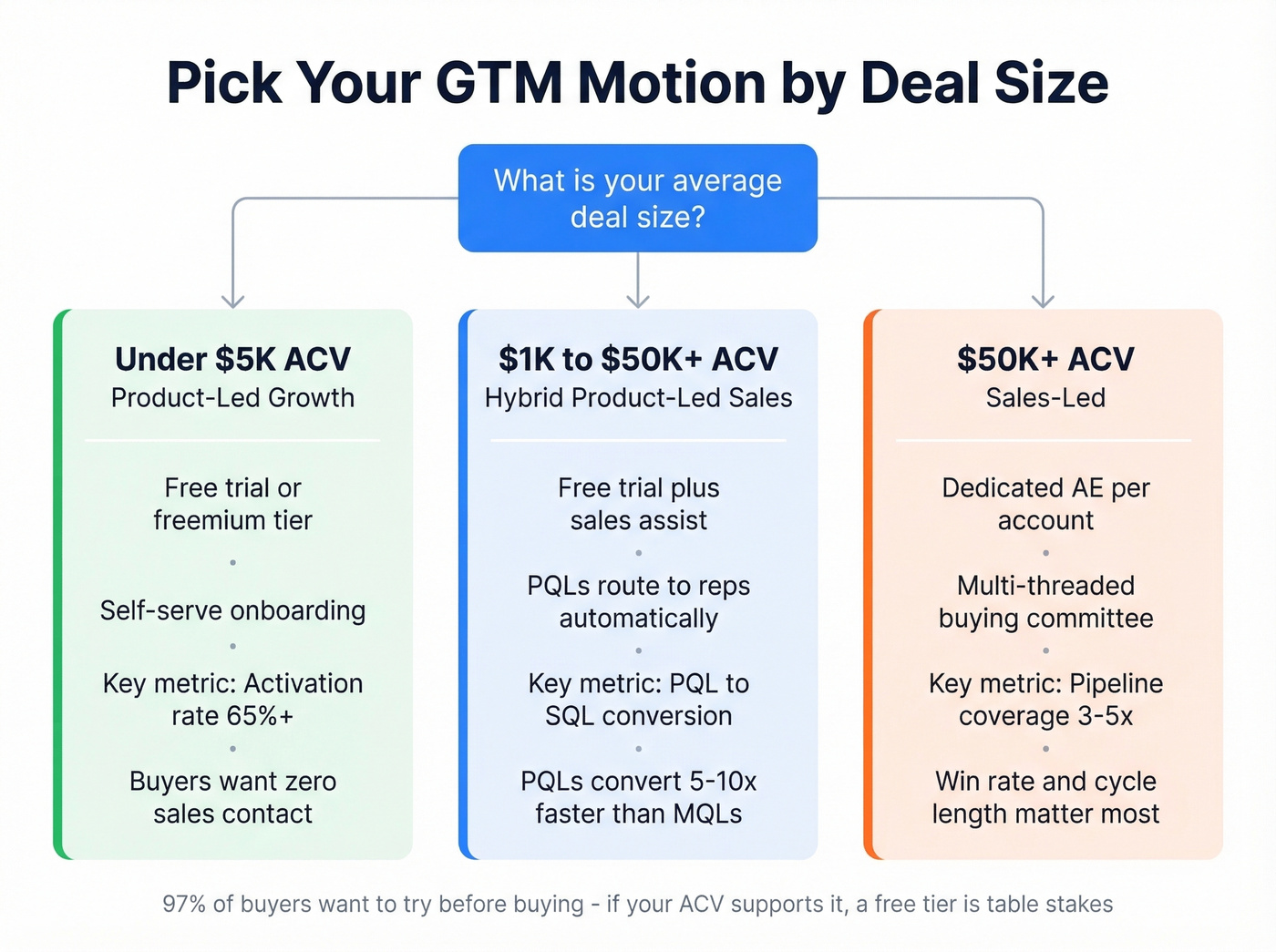
| ACV Range | Motion | Key Metric |
|---|---|---|
| Under $5K | Product-led growth | Activation rate (top performers: 65%+) |
| $1K-$50K+ | Hybrid product-led sales | PQL-to-SQL conversion |
| $50K+ | Sales-led | Pipeline coverage, win rate |
Product-qualified leads convert 5-10x faster than MQLs. And 97% of buyers want to try before buying. If your ACV supports it, a free tier or trial isn't optional - it's table stakes.
Set Pricing and Packaging
Usage-based and hybrid pricing models are now common across SaaS. Triangulate three inputs: the value your product delivers, what competitors charge, and your cost to serve. Don't overthink this at launch - you'll iterate. But don't underprice either. Race-to-bottom discounting is one of the clearest signs a GTM strategy is broken.
Pick 2-3 Channels, Not 10
The average software company runs 10.5 GTM initiatives - 5 core channels plus 5.5 experiments. That's unsustainable for any team under 50 people.
Start with demand capture: search, review sites, and intent-based outbound. These reach buyers who already know they have a problem. Demand creation - content, events, community - comes second, once capture is converting.
One tactical note worth remembering: timeline-based hooks in cold email pull a 10.01% reply rate vs 4.39% for problem hooks. That's a 2.3x difference, and it matters more now that average cold email reply rates have dropped from 6.8% to 5.8% year over year. Test your hooks before you scale your volume. (If you're rebuilding outbound, start with a B2B cold email sequence that matches your motion.)
Align Sales and Marketing with SLAs
Without SLAs, sales blames marketing for bad leads and marketing blames sales for not following up. We've seen this cycle kill more GTM launches than bad positioning ever has. Good SLAs look like this:
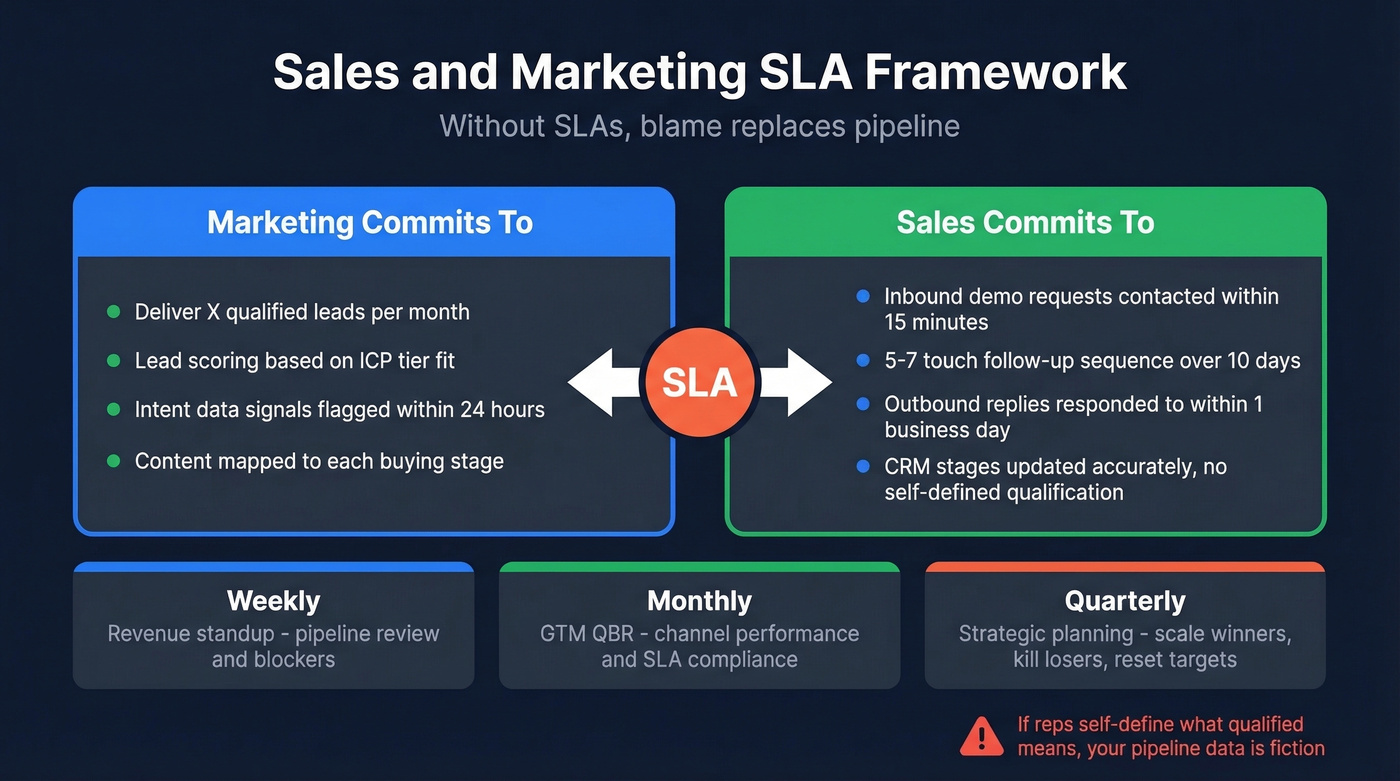
- Inbound demo requests contacted within 15 minutes during business hours
- Follow-up sequence: 5-7 touches over 10 days
- Outbound replies responded to within 1 business day
Run a weekly revenue standup, monthly GTM QBR, and quarterly planning cycle. Enforce stage definitions in your CRM - if reps can self-define what "qualified" means, your pipeline data is fiction. (If you need structure, use these QBR questions to keep reviews consistent.)
Build Your Data Infrastructure
Three things you need before you launch a single outbound sequence: a verified contact database, an enrichment layer, and a CRM with enforced funnel stages. If your bounce rate is above 5%, fix the data before rewriting the copy. Start by tightening your email bounce rate controls and your email deliverability fundamentals.
Prospeo handles the first two - 300M+ professional profiles, 143M+ verified emails, and 125M+ verified mobile numbers, with 98% email accuracy and a 7-day data refresh cycle. Layer in intent data tracking 15,000 topics via Bombora to identify which Tier 1 accounts are actively researching your category. The whole point is that your reps spend time selling, not hunting for working email addresses.

You just read that 84% of reps missed quota last year. The #1 reason GTM strategies fail is stale data - reps burning cycles on bounced emails and disconnected numbers. Prospeo refreshes every record every 7 days (not 6 weeks), delivers 98% email accuracy, and gives you 30+ filters including buyer intent and technographics to nail your ICP tiers.
Stop architecting your GTM on data that expired last month.
The 90-Day GTM Launch Plan
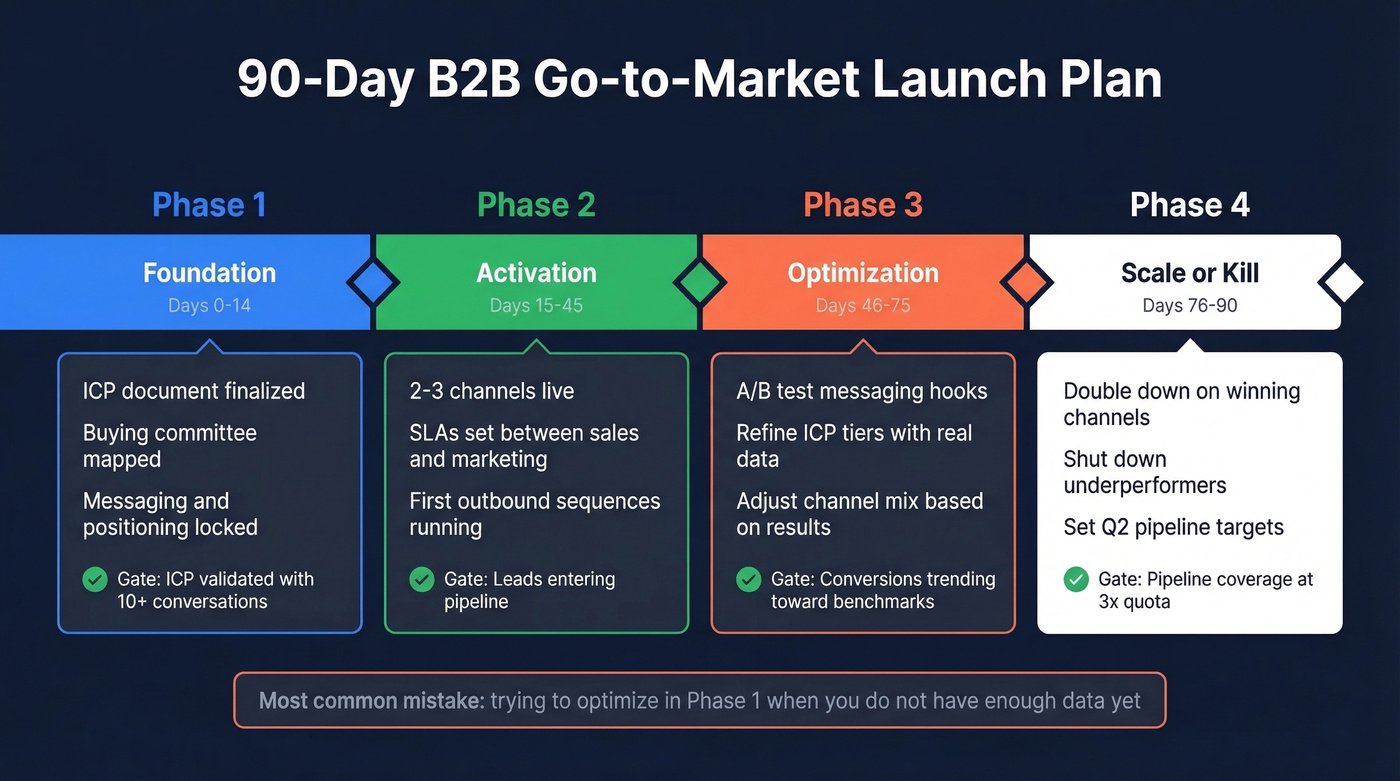
Don't try to boil the ocean. Four phases with clear decision gates consistently outperform the "do everything at once" approach - McKinsey research backs this up across industries.
| Phase | Timeline | Deliverables | Gate |
|---|---|---|---|
| Foundation | Days 0-14 | ICP doc, committee map, messaging, positioning | ICP validated (10+ conversations) |
| Activation | Days 15-45 | 2-3 channels live, SLAs set, first sequences running | Leads entering pipeline |
| Optimization | Days 46-75 | A/B test messaging, refine tiers, adjust channel mix | Conversions trending toward benchmarks |
| Scale or Kill | Days 76-90 | Double down on winners, shut down losers, set Q2 targets | Pipeline coverage at 3x quota |
The most common mistake is trying to optimize in Phase 1. You don't have enough data yet. Spend the first two weeks talking to people and building your foundation.
Benchmarks and Funnel Math
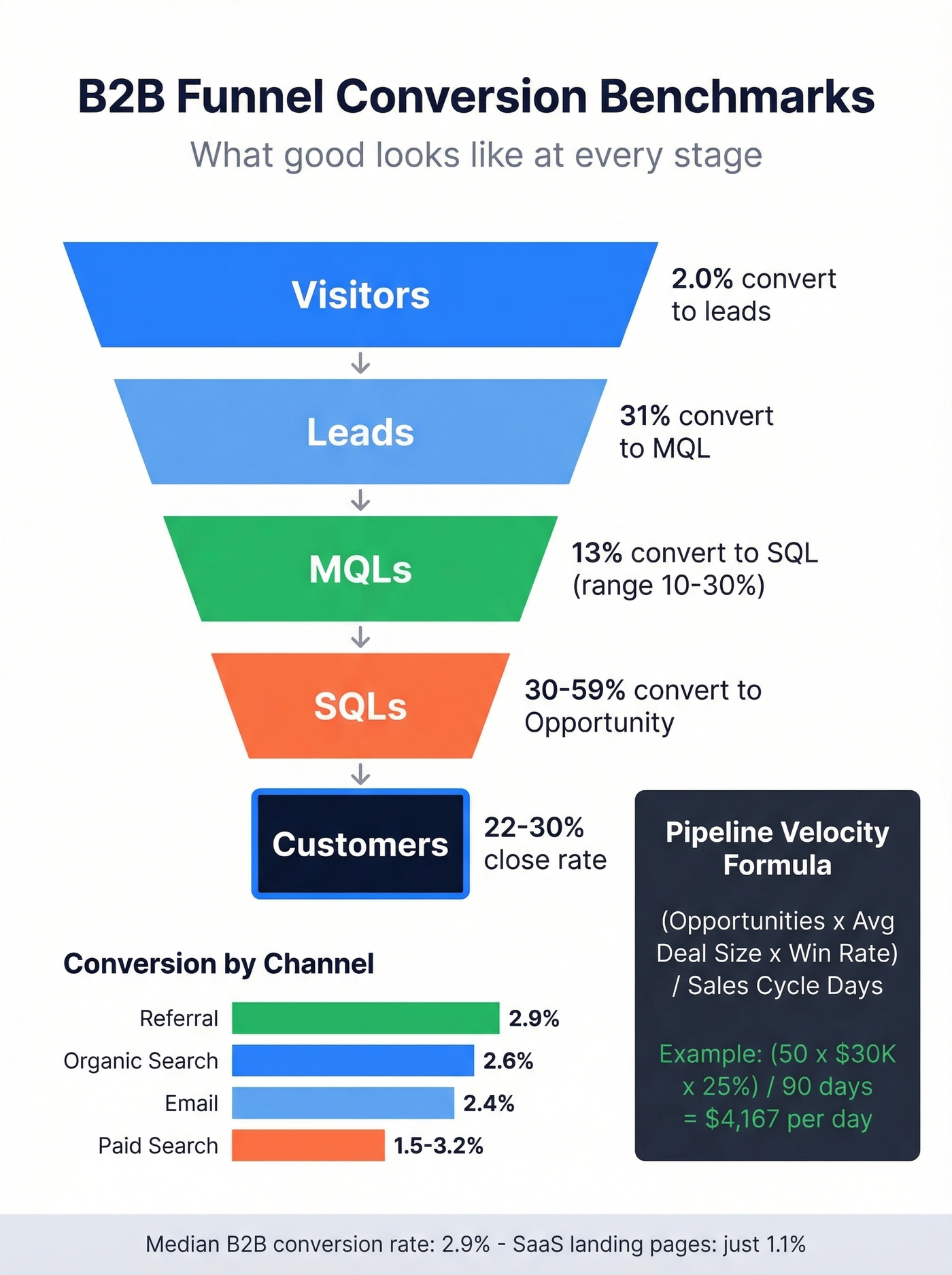
You can't manage a go-to-market motion without knowing what good looks like. Here are the stage-by-stage benchmarks you should target:
| Funnel Stage | Benchmark |
|---|---|
| Visitor to Lead | ~2.0% |
| Lead to MQL | ~31% |
| MQL to SQL | ~13% (range: 10-30%) |
| SQL to Opportunity | 30-59% |
| Opportunity to Customer | 22-30% |
And by channel:
| Channel | Avg Conversion Rate |
|---|---|
| Referral | 2.9% |
| Organic search | ~2.6% |
| 2.4% | |
| Paid search | 1.5-3.2% |
The median B2B conversion rate across industries is 2.9%. SaaS landing pages convert at just 1.1%. If you're above these numbers, you're doing something right.
Use the pipeline velocity formula to track your GTM health:
(Opportunities x Avg Deal Size x Win Rate) / Sales Cycle in Days
A team with 50 opportunities, $30K average deal size, 25% win rate, and a 90-day cycle generates roughly $4,167/day in pipeline velocity. If that number isn't growing month over month, something in your funnel is broken. Keep in mind that the typical B2B lead interacts 5 to 50 times before purchase, which is why attribution is so messy - and why only 24% of CMOs believe they have enough budget to properly measure what's working. (If you want a tighter system, track funnel metrics consistently across channels.)
Data quality is the invisible variable in all of this math. Snyk's outbound team was running a 35-40% bounce rate before switching their contact data provider. Bounce rates dropped under 5%, and AE-sourced pipeline jumped 180%. The funnel math only works if the contacts at the top are real.
Speed matters too - responding to an inbound lead within 5 minutes makes you 21x more likely to qualify them versus waiting 30 minutes.
Let's be honest about scale: SAP's "Inspire the Future" campaign generated EUR 924.4M in pipeline by aligning GTM execution tightly with ICP segmentation and multi-channel orchestration. You don't need SAP's budget, but the principle scales down. Precision targeting beats spray-and-pray at every deal size.
Intent-based outbound is one of your first demand capture channels - but it only works when you can actually reach in-market buyers. Prospeo tracks 15,000 intent topics via Bombora, layers them with job change and headcount growth signals, and returns verified emails and direct dials so your Tier 1 accounts get contacted, not just identified.
Turn your ICP tiers into booked meetings for $0.01 per email.
Five Ways Your GTM Strategy Will Fail
1. Misaligned market understanding. You built a sophisticated enterprise tool and targeted SMBs who don't have the resources to adopt it. Validate ICP before you build channels.
2. Sales and marketing misalignment. When revenue projections are consistently off by 30%+, it's not a forecasting problem - it's a GTM foundation problem. Sales and marketing are operating from different playbooks.
3. Ineffective positioning. You're listing features while your competitor is selling outcomes. The cybersecurity company talking about "AI-powered detection" loses to the one promising "SOC 2 compliance in 90 days."
4. Channel overload. Running 10+ initiatives with a 15-person team means nothing gets enough investment to work. Pick 2-3 and go deep before you go wide. Skip the "be everywhere" advice from people who've never run a GTM launch with a real budget constraint.
5. Stale data destroying outbound. If your contact database is running on the industry-average six-week refresh cycle, you're burning domain reputation with every sequence. A 34% bounce rate doesn't just waste rep time - it tanks your sender score and makes every future email harder to deliver. The consensus on r/sales is brutal about this: bad data is the number-one outbound killer, and most teams don't realize it until their domain is already flagged. (If you're fixing this, start with how to improve sender reputation.)
AI and Your 2026 GTM Strategy
AI isn't a future consideration for go-to-market planning - it's a current operating reality. 51% of GTM leaders are increasing investment in AI Engine Optimization versus just 14% for traditional SEO. 63% of marketers already publish AI-optimized content with structured FAQs and schema markup.
Jon Miller's prediction that marketers will need to market to AI agents on buying committees is already playing out. Structured content, schema markup, and clear product data are becoming as important as brand messaging.
But here's what enterprise GTM leaders are saying behind closed doors: data trust is the gatekeeper. AI recommendations are only as good as the CRM, account, and intent data feeding them. If your data layer is garbage, AI just automates bad decisions faster. Get the data infrastructure right first. The AI layer builds on top.
FAQ
What's the difference between a GTM strategy and a marketing plan?
A B2B go-to-market strategy is time-bound and cross-functional - it coordinates product, sales, marketing, and CS around a specific market entry or expansion with decision gates and an end state. A marketing plan is ongoing and marketing-owned, focused on sustained demand generation across quarters.
How long before a new GTM strategy produces results?
Most B2B GTM strategies need 90 days to generate meaningful signal. Pipeline typically lags by one full sales cycle - anywhere from 1 to 6 months depending on ACV. Set 90-day decision gates, not 30-day panic triggers.
What tools do I need to execute a GTM launch?
At minimum: a CRM with enforced funnel stages, a verified contact database with high accuracy and frequent refresh cycles, and an analytics layer for attribution. Everything else is optional until you're past $5M ARR.
How do I align departments around GTM execution?
Start with shared revenue targets, not departmental KPIs. Align sales, marketing, product, and CS around a single pipeline number, then set cross-functional SLAs that define handoff points, response times, and stage definitions. Weekly revenue standups keep everyone accountable to the same plan.