

The B2B SaaS Marketing Playbook With Real Numbers (2026)
Your CEO wants to know why CAC went up 30% last quarter. Your board deck needs a channel-level ROI breakdown. And every B2B SaaS marketing guide you find reads like a freshman textbook - "create valuable content," "know your ICP," "use social proof." Zero benchmarks. Zero budget math. Zero funnel numbers you can plug into a model.
That ends here. This is the playbook with real numbers: CAC by channel, conversion rates by funnel stage, budget frameworks by company stage, and the growth motion decision that determines everything else.
And while we're at it - stop gating your best content behind forms. Stop optimizing for MQLs that never convert. Those plays stopped working for most teams around 2023. The teams winning right now are the ones running the math below.
The Quick Version
Pick your motion first. PLG typically works best if your average deal is under ~$5K. Sales-led fits $25K+ deals. Hybrid sits in between.
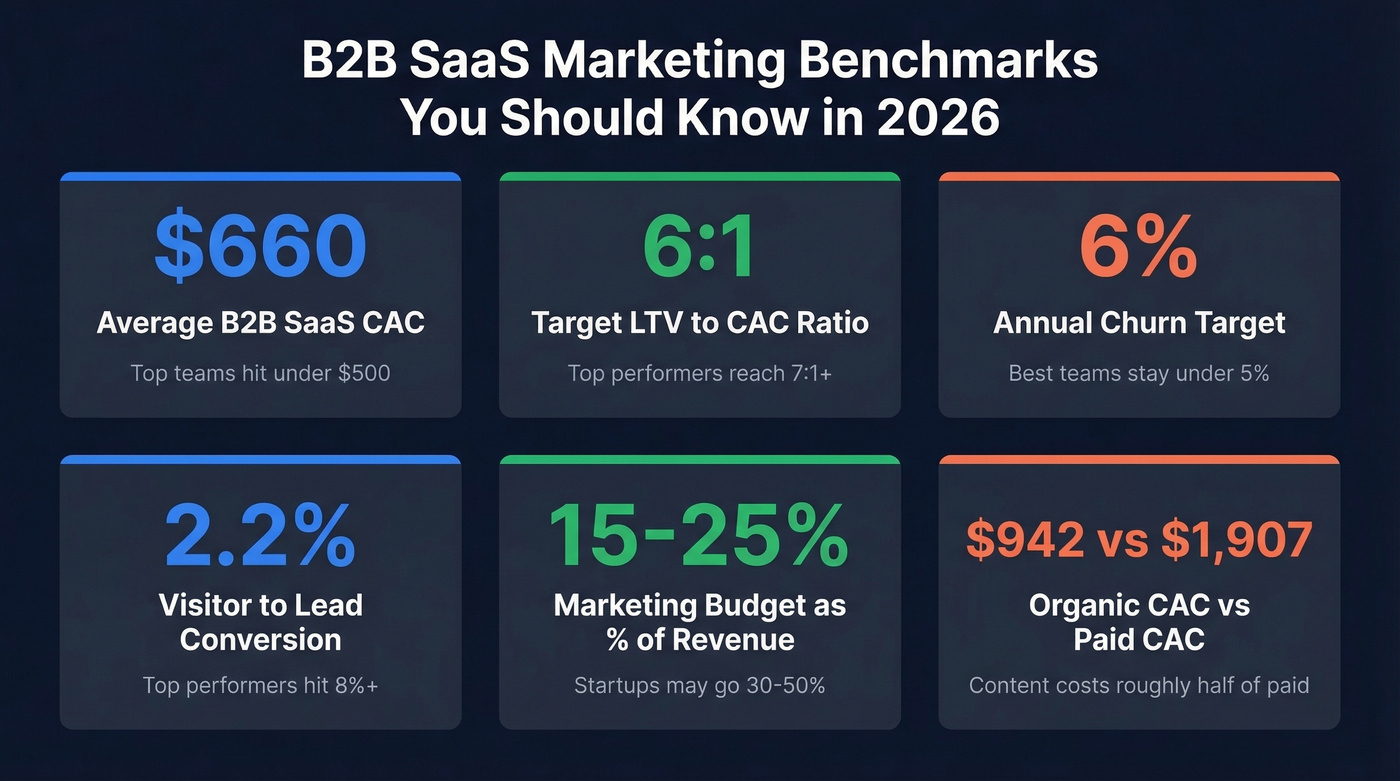
Budget reality. Spend 15-25% of revenue on marketing. Startups burning toward traction: 30-50%. Win in 3 channels, not 10.
Benchmarks to pin on your wall. B2B SaaS CAC averages $660. LTV:CAC ratio should hit 6:1. Annual churn target: 6%. Visitor-to-lead conversion: 2.2%. If you're beating these, you're performing like a top team. If not, you know where to dig.
Why SaaS Marketing Breaks Traditional Frameworks
Most marketing frameworks were built for one-time purchases. SaaS breaks that model because the sale never really ends.
Subscription economics mean your marketing team owns problems that don't exist in traditional B2B. MRR, ARR, and churn aren't finance metrics - they're marketing metrics. A 2% monthly churn rate sounds small until you realize it compounds to ~22% annual revenue loss. That's not a retention problem your CS team can fix alone; it's a positioning, onboarding, and lifecycle marketing problem that starts well before the close.
The buying cycle makes it worse. An end user discovers the product, a manager evaluates it, a VP approves it, and procurement negotiates it. Each person needs different content at different stages, which is why the acquire-onboard-retain-expand loop matters more than any single-channel tactic. You're not marketing to close a deal. You're marketing to sustain and grow recurring revenue across the entire customer lifecycle.
Choose Your Growth Motion First
Every channel decision, budget allocation, and team structure flows from one upstream choice: your growth motion. Brian Balfour's framework nails this - your growth model, channel selection, market, and product are interdependent. Pick the wrong motion and every channel underperforms.
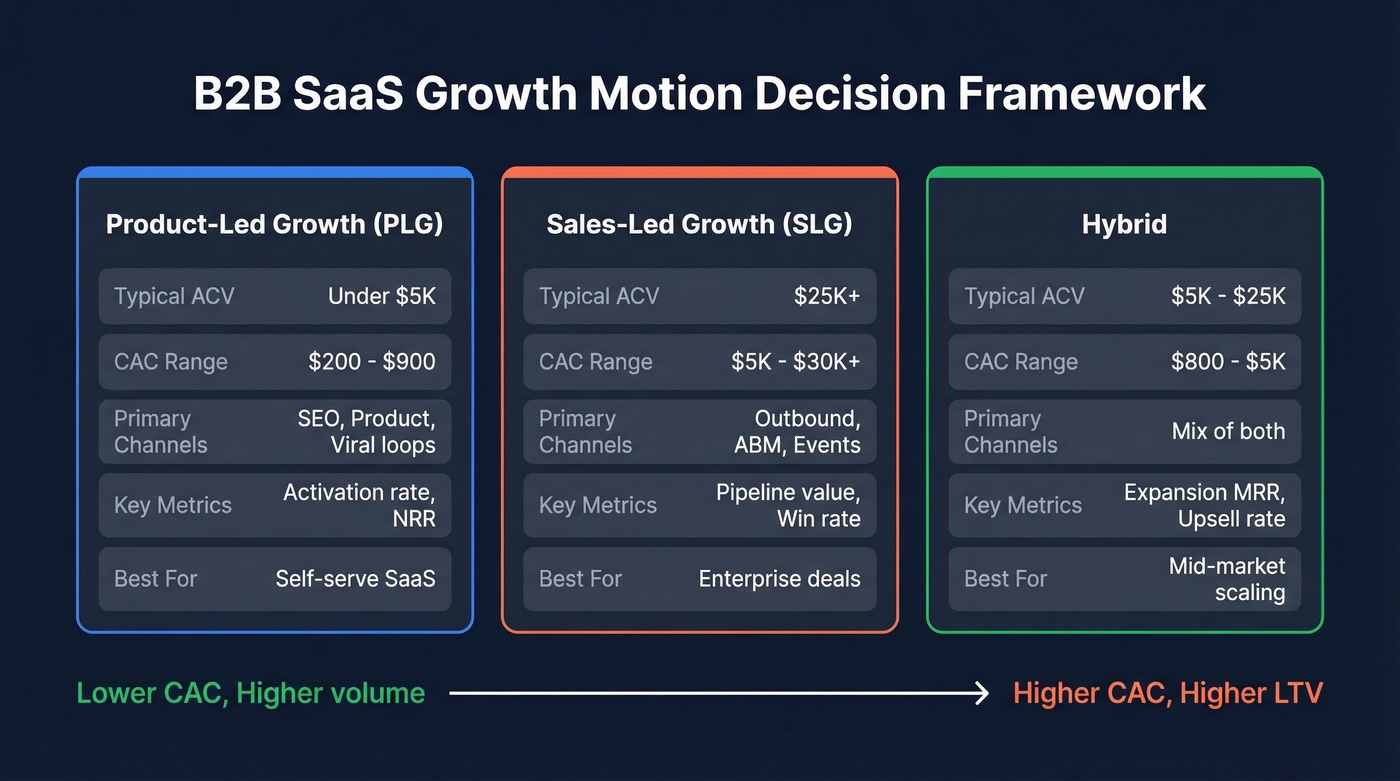
| Motion | Typical ACV | CAC Range | Primary Channels | Best For |
|---|---|---|---|---|
| PLG | < $5K | $200-$900 | SEO, product, viral | Self-serve SaaS |
| SLG | > $25K | $5K-$30K+ | Outbound, ABM, events | Enterprise |
| Hybrid | $5K-$25K | $800-$5K | Mix of both | Mid-market |
Product-Led Growth (PLG)
The product does the selling. Users discover, try, and adopt without talking to a human. Slack and Notion are the canonical examples here. PLG is built to keep CAC low - one benchmark puts average SaaS CAC around ~$702, with PLG companies often beating that number significantly. Your marketing team operates more like a media team: content, SEO, community, and product education at scale. The key metrics are activation rate and net revenue retention. The constraint isn't budget - it's whether users hit their "aha moment" fast enough.
Sales-Led Growth (SLG)
Enterprise deals with $100K+ ACV take 90-180 days to close. There's no "free trial" shortcut when procurement, legal, and a six-person buying committee are involved. Marketing's job shifts to producing sales collateral - case studies, ROI calculators, competitive battle cards, webinars - and generating qualified pipeline through outbound and ABM. Track pipeline value and win rate religiously. The CAC is higher, but so is the LTV.
Hybrid (and When to Add Sales)
Most B2B SaaS companies don't stay pure PLG forever. The pattern: start self-serve, capture the long tail, then layer a sales team to move upmarket. The data backs this up - sales and success teams drive 58% of upsells, while product-driven upsells account for just 10%. That gap is your signal. When expansion MRR flatlines on the self-serve side, it's time to add humans.
Eight Approaches That Move Pipeline
These aren't theoretical. Each one maps to a lifecycle stage and comes with a benchmark so you know if it's working.
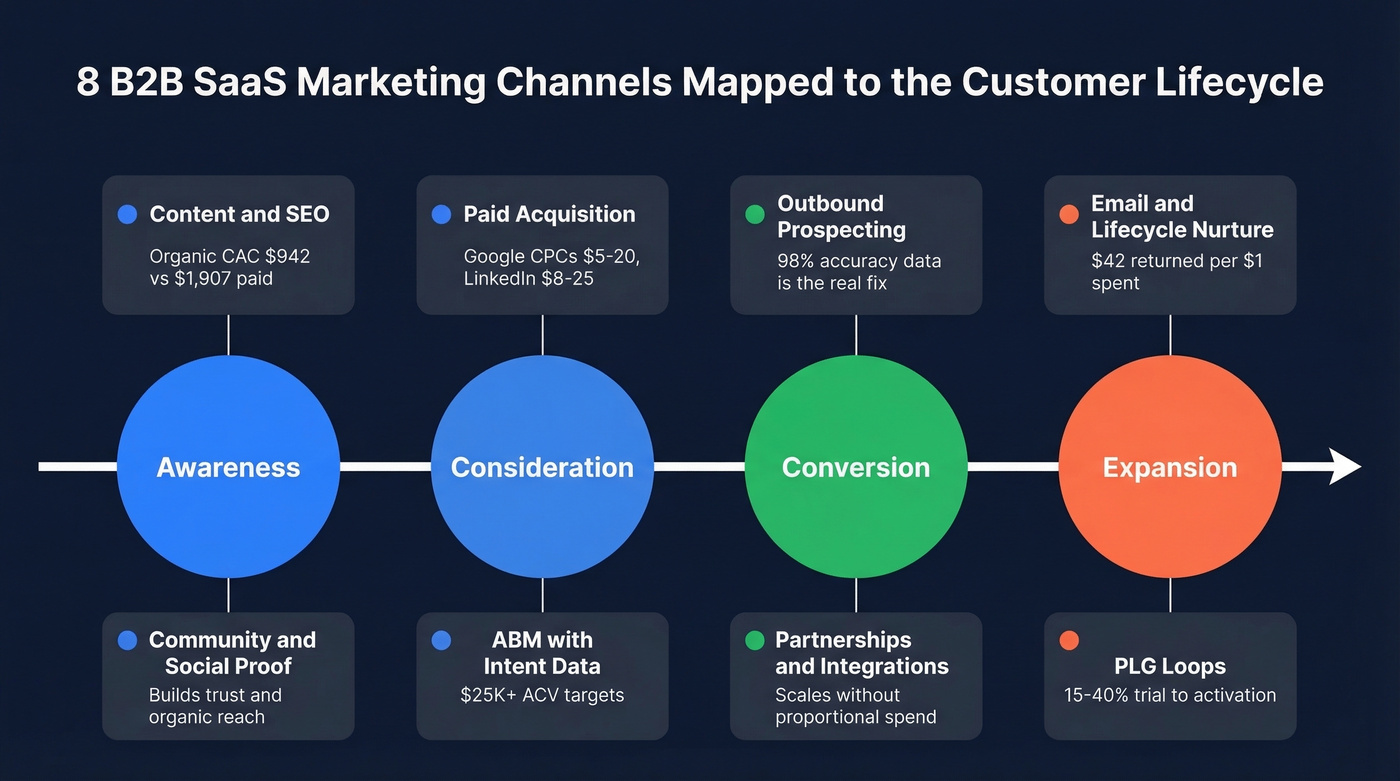
Content and SEO
Use this if: You need a compounding channel that gets cheaper over time. Organic CAC averages $942 vs $1,907 for paid - roughly half the cost.
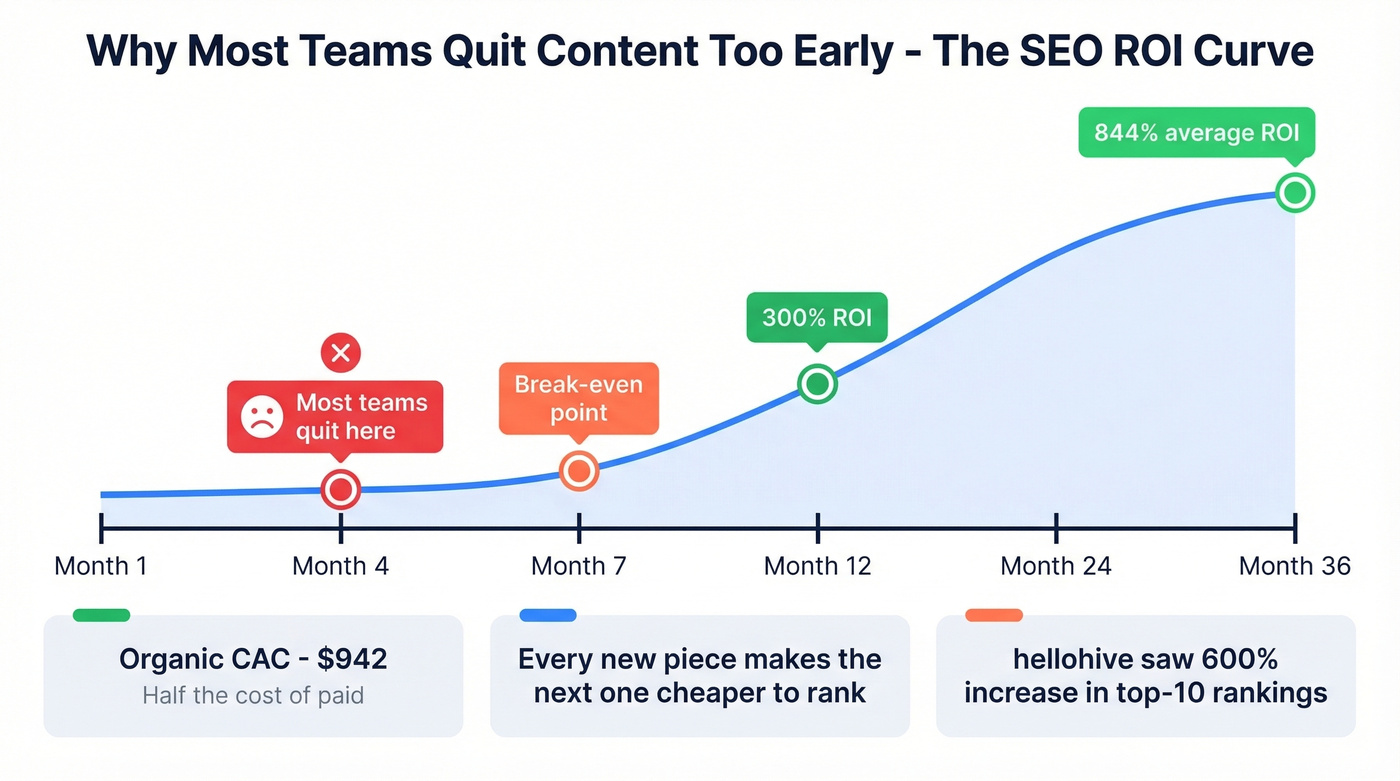
Skip this if: You need pipeline in the next 60 days. Content breaks even around month 7, hits 300% ROI by month 12, and averages 844% over three years. Most teams quit at month 4.
The proof points are hard to argue with. hellohive saw a 600% increase in top-10 keyword rankings. BOLT ON Technology hit 411% ROI on marketing-impacted revenue with a 272% increase in inbound demos. In our experience, content and SEO is the only channel where ROI compounds - every piece you publish makes the next one cheaper to rank.
Paid Acquisition (Google + LinkedIn)
Google search CPCs run $5-20+. LinkedIn CPCs hit $8-25+. Average paid CAC across B2B SaaS is $1,907. Benchmarks put paid ads ROI around $1.80 returned per $1 spent - profitable, but thin.
If your ACV is under $3K, the math doesn't work. The real play is using paid to accelerate what's already working organically, not as your primary acquisition engine. Target high-ACV segments where the unit economics justify the premium, and retarget warm audiences from your content funnel.
Outbound Prospecting
Use this if: You're running SLG or hybrid and need predictable pipeline from named accounts.
Skip this if: You don't have a clear ICP or your data quality is garbage.
Here's the scenario we see constantly: an SDR team sends 500 emails a day, gets a 2% reply rate, and 15% of those emails bounce. The instinct is to rewrite the messaging. The actual problem is the data. The fix isn't a better sequence - it's a better database.

Outbound is only as good as the contact data feeding it. Prospeo's database covers 300M+ professional profiles with 98% email accuracy and a 7-day refresh cycle, which matters because stale data is one of the fastest ways to burn a domain. At ~$0.01 per email, the economics are dramatically different from legacy platforms charging $1+ per lead. Meritt tripled their pipeline from $100K to $300K per week after switching, with bounce rates dropping from 35% to under 4%.
If you're building lists at scale, data enrichment is the fastest way to keep records usable.
ABM With Intent Data
Use this if: You're targeting named accounts with $25K+ ACV and need to time your outreach to buying signals.
Skip this if: You don't have enough target accounts to justify the setup cost.
If you're formalizing this motion, start with account-based selling best practices so marketing and sales run the same playbook.
Community and Social Proof
G2 and Capterra reviews, founder-led content on social, and community engagement in Slack groups and forums drive consideration-stage influence that's nearly impossible to attribute but clearly moves deals. Gong built an entire brand around this approach - their social presence became a demand engine.
Skip this if you don't have customers willing to advocate publicly. But if you do, niching down your community focus beats broad "thought leadership" every time.
If your message isn't landing, revisit your B2B brand positioning before you add more channels.
Email and Lifecycle Nurture
Email returns $42 per $1 spent - the highest ROI of any digital channel. But most SaaS teams treat email as a newsletter blast rather than a lifecycle engine.
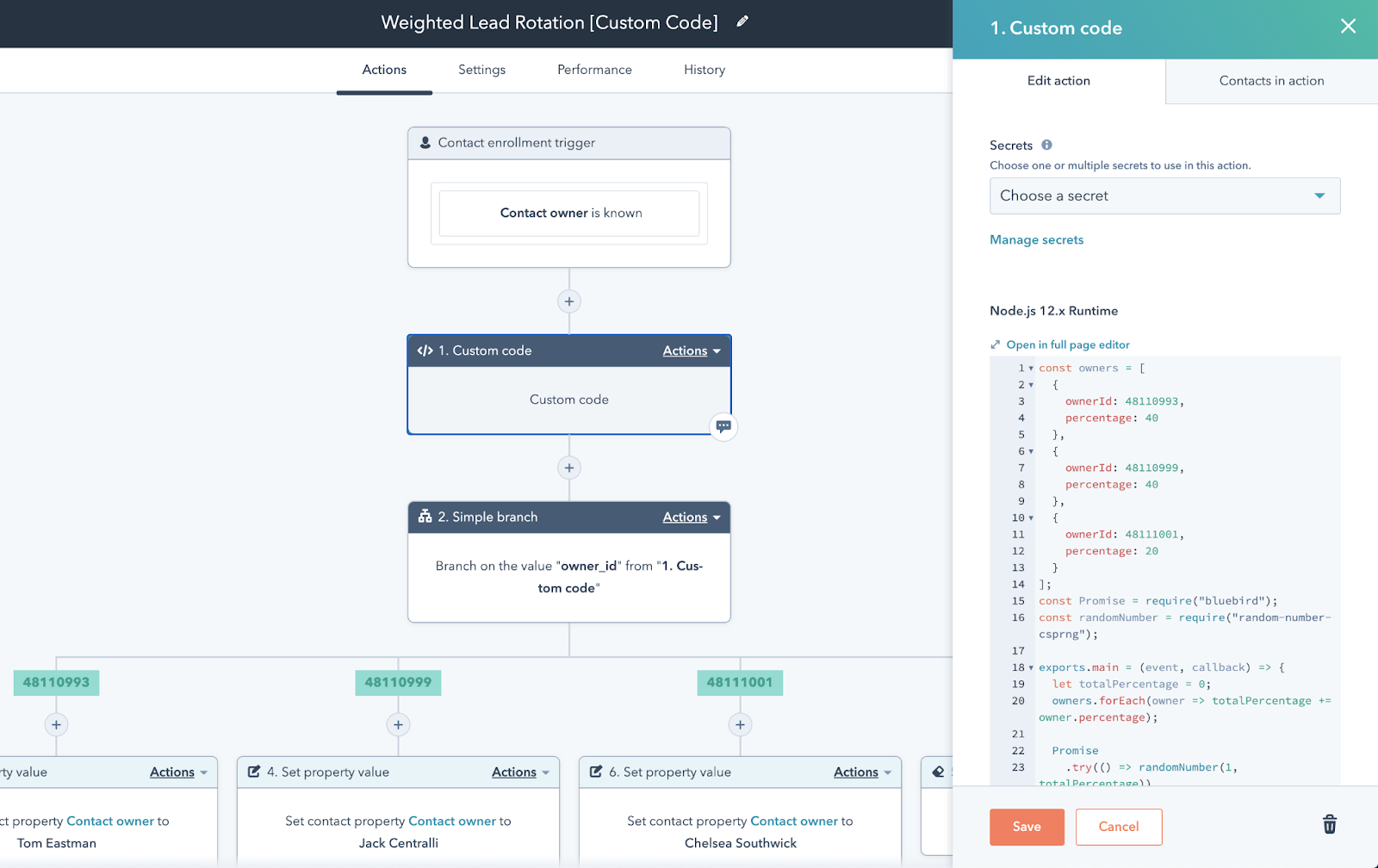
The real power is in trigger-based sequences: onboarding emails that drive activation, usage-based nudges that prevent churn, and expansion campaigns that surface upgrade opportunities at the right moment. PaySpan rebuilt their lifecycle sequences and saw a 150% increase in email click rates, with 65% of downloads coming from their top target persona. Tools like Customer.io, Braze, and HubSpot make this operationally simple. The hard part is mapping your activation milestones and building sequences around them.
If you're tightening performance, track funnel metrics and fix the biggest leak first.
Partnerships and Integrations
Co-marketing, affiliate programs, and integration marketplace listings create acquisition loops that scale without proportional spend increases. beehiiv's growth is a textbook example - their built-in viral loop became a self-reinforcing flywheel.
The key is finding partners whose customers are your ICP and building co-branded content or joint workflows. If your product is standalone with no natural integration partners, skip this and double down on content or outbound. But if you have an API or ecosystem play, this channel compounds faster than almost anything else.
Product-Led Growth Loops
In-app referrals, viral loops, and freemium-to-paid conversion paths are the highest-impact growth tactics for self-serve products. Trial-to-activation rates range from 15-40%, and the gap between those numbers is almost entirely an onboarding problem. Invest in onboarding UX before you invest in ads. Measure with Mixpanel or Amplitude - you can't optimize what you can't see.
Here's the thing: if your average contract value is under $10K, you probably don't need ZoomInfo-level data or enterprise ABM platforms. A tight ICP, verified contact data, and three well-executed channels will outperform a bloated martech stack every time. Complexity is the enemy of early-stage growth.
If you're scaling outbound, use a proven B2B cold email sequence and keep deliverability clean.

You just read that outbound CAC depends on data quality, not better sequences. Prospeo gives you 300M+ profiles with 98% email accuracy on a 7-day refresh cycle - at ~$0.01 per email. Meritt tripled pipeline to $300K/week and cut bounce rates from 35% to under 4%.
Stop burning domains on stale data. Start building real pipeline.
The playbook says B2B SaaS CAC averages $660 and organic costs half of paid. Layer intent data on top of verified contacts and that number drops further. Prospeo tracks 15,000 intent topics so you reach buyers already in-market - not cold lists.
Target accounts showing buying signals right now, not six weeks ago.
SaaS Funnel Benchmarks for 2026
These numbers come from First Page Sage's analysis of 140+ B2B campaigns and Hooklead's 2026 benchmark data. Pin them to your dashboard.
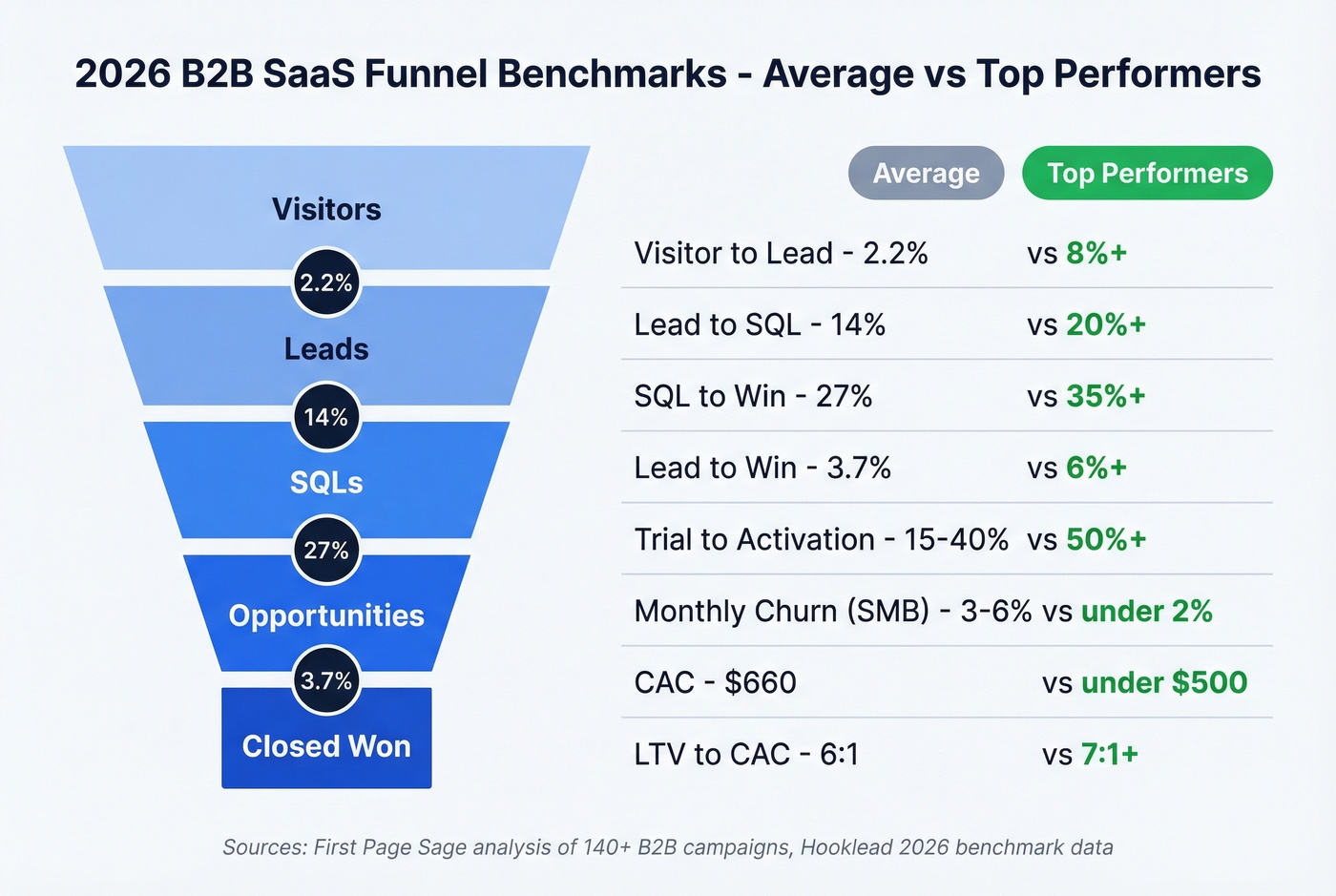
| Metric | Average | Top Performers |
|---|---|---|
| Visitor to Lead | 2.2% | 8%+ |
| Lead to SQL | 14% | 20%+ |
| SQL to Win | 27% | 35%+ |
| Lead to Win | 3.7% | 6%+ |
| Website CVR | 1-3% | 8%+ |
| Demo-to-Close | 18-32% | 35%+ |
| Trial-to-Activation | 15-40% | 50%+ |
| Monthly Churn (SMB) | 3-6% | < 2% |
| Annual Churn | 6% | < 5% |
| NRR | 95-120% | 130%+ |
| CAC | $660 | < $500 |
| LTV:CAC | 6:1 | 7:1+ |
| Organic CAC | $942 | < $500 |
| Paid CAC | $1,907 | < $1,200 |
Let's break down what this table actually tells you. If your visitor-to-lead rate is below 2.2%, your website has a conversion problem - fix the CTA, the offer, or the page speed before spending more on traffic. If your SQL-to-win rate is below 27%, your sales team has a qualification or enablement gap. And if your LTV:CAC ratio is below 3:1, you're burning cash regardless of how good your marketing looks on a slide.
The organic vs paid CAC gap is the most actionable insight here. Organic costs roughly half of paid. That doesn't mean you should go all-in on SEO - it means your paid channels need to target high-ACV segments where the unit economics justify the premium.
If you need a tighter definition of CAC (and how to model it), use this cost to acquire customer breakdown.
How Much to Spend (and Where)
| Company Stage | % of Revenue | Focus Areas |
|---|---|---|
| Early (pre-PMF) | 30-50% | Test channels, validate ICP |
| Growth | 20-30% | Scale winners, add outbound |
| Established | 10-15% | Efficiency, retention, expansion |
| Channel Category | % of Budget | Expected ROI Timeline |
|---|---|---|
| Ads (search + social) | 40-50% | 1-3 months |
| Content / SEO | 20-30% | 6-12 months |
| Events / Enablement | 15-20% | 3-6 months |
| MarTech | 10-15% | Ongoing |
The biggest budgeting mistake we see is spreading spend across 8-10 channels and being mediocre at all of them. Win in 3 channels. Dominate them. Then expand.
The second mistake is ignoring retention. Retention budgets deliver 3-5x better ROI than acquisition budgets, yet most teams allocate less than 10% of marketing spend to lifecycle and expansion. If your annual churn is above 6%, every dollar you spend acquiring new customers is partially funding a leaky bucket.
If you're diagnosing churn, run a proper churn analysis before you change acquisition spend.
The content/SEO ROI case studies are compelling enough to shift allocation. Insight Assurance saw a 142% increase in organic traffic. DeriveVQ hit a 603% increase in organic traffic with a 125% increase in leads. These aren't overnight wins, but the compounding math is hard to beat once you hit month 12.
Your First 90 Days
Stop planning. Start cutting.
Month 1: Audit and kill. Pull CAC by channel for the last two quarters. Any channel with CAC above your average and no clear trajectory toward improvement gets cut - redirect that budget to your top two performers. Audit your contact data quality while you're at it. If bounce rates are above 5%, your database is the bottleneck, not your messaging.
If you're seeing bounces, start with email bounce rate benchmarks and fixes.
Month 2: Double down. Pick your top 2-3 channels and increase investment by 30-50%. Build the measurement infrastructure you've been putting off: UTM discipline, pipeline attribution, and stage-based conversion tracking. For teams running outbound, get your data house in order before scaling volume.
If you're still defining your ICP, use an Ideal Customer Profile template and scoring rubric.
Month 3: Measure and iterate. Compare your funnel metrics against the benchmark table above. Identify your biggest drop-off point and focus the next quarter's roadmap on fixing it. One stage improvement - say, moving SQL-to-win from 20% to 27% - often matters more than adding a new channel.
AI Search Is Rewriting the Playbook
25% of B2B buyers now use generative AI over traditional search for vendor research. That number jumped 71% in just four months. 87% of B2B software buyers say AI chat is changing how they research software, and 50% now start their research in an AI chatbot rather than a search engine.
This isn't a trend. It's a structural shift.
The impact on organic is brutal. When AI Overviews appear, organic CTR drops by ~70%. Zero-click searches now account for 25-40% of queries, and only 1% of visits include a click on a link within AI summaries. Forrester estimates AI-generated traffic currently represents 2-6% of B2B organic traffic, but it's growing 40%+ month over month.
But here's the counterintuitive data point: AI-generated traffic converts 4.4x better than traditional organic visitors. The people who do click through from AI summaries are higher-intent. And 90% of higher-intent buyers click through to at least one cited source when they encounter AI Overviews.
The tactical implications are clear. Structure your content for retrieval - clear definitions, structured data, direct answers. Invest in brand authority so AI models cite you by name. Create original research and proprietary data that AI can't synthesize from competitors. The consensus on r/b2bmarketing is already framing this as "GEO" (generative engine optimization): definition-first content, structured pages, and original data are more likely to surface in AI responses.
The shift is from chasing position to securing presence. You don't need to rank #1 if the AI is quoting your benchmark data in every summary.
B2B SaaS Marketing FAQ
What is B2B SaaS marketing?
B2B SaaS marketing is the practice of acquiring, converting, and retaining business customers for subscription-based software products. It covers the full customer lifecycle - awareness through onboarding, retention, and expansion - because recurring revenue means a customer's value compounds over time rather than being captured in a single transaction.
What's a good CAC for B2B SaaS?
Average B2B SaaS CAC is $660 across all channels. Organic channels average $942, while paid runs $1,907. A healthy LTV:CAC ratio is 6:1 with CAC payback under 12 months. If you're above $1,500 CAC on a sub-$10K ACV product, your channel mix needs work.
How long does content marketing take to show ROI?
Content marketing typically breaks even around month 7, hits 300% ROI by month 12, and averages 844% over three years. The compounding effect doesn't kick in until you have enough indexed pages building topical authority. Most teams quit at month 4 - patience is the competitive advantage.
Should I start with PLG or sales-led?
Start PLG if your average deal is under ~$5K - let the product sell itself and keep CAC low. Over $25K, go sales-led with dedicated reps and longer cycles. In between, start PLG and layer sales when expansion revenue stalls. The 58%/10% upsell split between sales teams and product tells you when it's time.
What's the cheapest way to build verified prospect lists?
Prospeo offers 75 free emails per month with 98% accuracy and a 7-day data refresh cycle, making it the strongest free tier for teams running real outbound. Paid plans scale to ~$0.01 per email - roughly 90% cheaper than legacy providers. Hunter and Apollo have free tiers too, but lower verification accuracy means higher bounce rates and domain risk.